For me it is self harm. The constant pain my body is in and painful memories want me to cause the pain I can control, which releases endorphins, causing temporary easing of the mental torture I feel all the time now. But I don’t, and I won’t. Not now, not this minute, not this hour, not this day, not … as long as I can say not. I promised Randy back in 2014 I wouldn’t start doing it without telling him first. I have held to that promise. Hugs. Scottie
Isis, a Mudlark student-athlete, was taken by ICE earlier this year, and she’s now being released after much protest by fellow students, and this big local news story with national implications is being covered by … local podcaster Marty Moon, using the same iPhone camera streaming setup he uses to comment on high school golf? Honestly, I’ve never been more concerned about the health of the Milford media ecosystem.
This sunlight-powered desalination breakthrough turns seawater into fresh water while harvesting valuable minerals.
Date: May 31, 2026
Source:University of Rochester
Summary: Scientists have developed a solar desalination system that turns seawater into drinking water without creating environmentally damaging brine. Special laser-textured metal panels use sunlight to evaporate water while automatically moving salt deposits away from the working surface, preventing clogging. The process was successfully tested with water from three oceans and can recover nearly all salts as solids. Those leftover materials could even become a source of valuable lithium for batteries.
Irrefutable proof of what Spanish researchers and wildlife experts had long suspected, and long feared, finally presented itself in the form of a grainy video that was shot on a minuscule island in the Balearics in April 2024.
Ribboning its way through the turquoise waters that separate the east coast of Ibiza from the islet of Santa Eulària 450 metres away, came a pale and solitary horseshoe whip snake in search of new territory and fresh sustenance.
The arrival of the snake on Santa Eulària, recorded by a local wildlife ranger, confirmed that the insatiable invader from the Spanish mainland – which has almost wiped out Ibiza’s endemic population of dazzlingly coloured wall lizards – had opened up a new front.
“There’d beenincreasing anecdotal evidence from fishermen and tourists who’d seen the snakes swimming, so we’d thought it was happening very often,” said Oriol Lapiedra, a biologist at the Centre for Ecological Research and Forestry Applications (Creaf) in Catalonia. “But this was the first proper [evidence] we’d had of a snake swimming from Ibiza to the islet.”
The horseshoe whip snake, a non-venomous reptile found across southern and eastern Spain, has become an existential threat to the lizards since it began appearing on the island two decades ago.
Its rapid colonisation has been attributed to the fashion among wealthy property owners in Ibiza for importing ancient olive trees from mainland Spain to adorn the grounds of their homes. Unbeknown to them, however, the trees – replete with their nooks and hollows – have provided ideal travel berths for hibernating snakes and snake eggs. (snip-MORE)
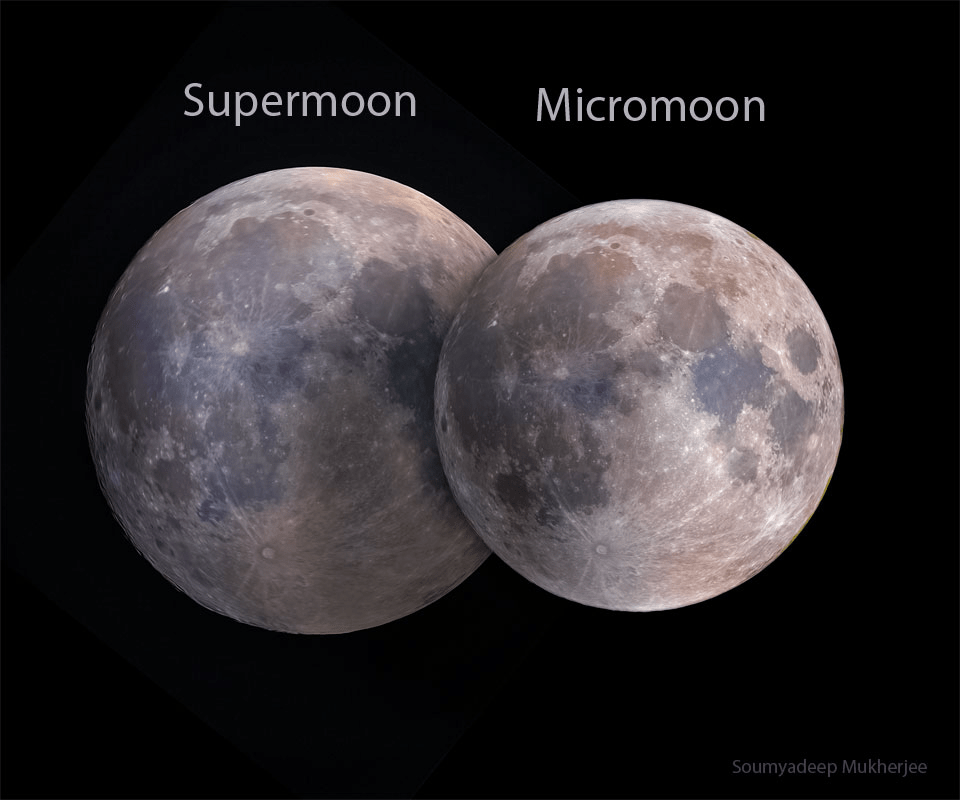
Explanation: What is so micro about tonight’s blue micromoon? Just after sunset, a full moon will appear slightly smaller and dimmer than usual. The reason is that the Moon’s fully illuminated phase occurs within a short time of apogee – when the Moon is farthest from the Earth in its elliptical orbit. In fact, tonight’s micromoon will be the farthest, smallest, and dimmest Moon this year. But tonight’s micromoon is notable for yet another reason: it is also a blue moon, meaning that it is the second full moon in the same month (moon-th). Pictured here, a supermoon — when the full moon appears near its largest — is compared to a micromoon as photographed from Kolkata, India in May and December of 2021. Although the next micromoon occurs next month, and the next blue moon at the end of 2028, the next blue micromoon will not occur until 2053.
(And in case you got an unwanted earworm from the title, maybe try this lively one, instead! – Ali)
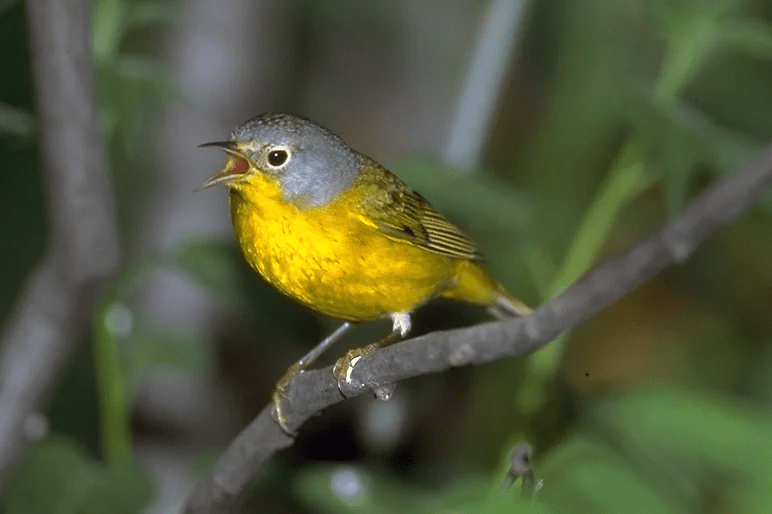
The Nashville Warbler is a lively songbird with elegant, understated plumage and a special fondness for sunny forests, brushy undergrowth, and juicy caterpillars. It is also one of several birds in the Western Hemisphere with a rather misleading name. This bird is only in the southeastern United States for a few weeks during migration on its way between the northern forests where it breeds and its wintering grounds in Mexico, Central America, and the California coast. The species was first documented in Tennessee, and the “Nashville” name stuck, although it only stops over in the area during migration.
The Latin name is also rather misleading to anyone watching this bird in the field — the species epithet ruficapilla refers to a small patch of reddish feathers on the bird’s crown, usually invisible among the gray feathers of the rest of the head. Like the Ruby-crowned Kinglet, Orange-crowned Warbler, and Yellow-rumped Warbler (scientific species name coronata, for the rarely seen yellow crown), this name may be mystifying to beginning birders, but it might also provide an avenue into the secret social life of the bird.
The ability to hide and reveal this bright, contrasting color patch allows these birds to produce a striking visual signal, which they use to communicate agitation and excitement, particularly in aggressive interactions between males at close range. The closely related Lucy’s and Virginia’s Warblers also have hidden reddish crowns, apparently used in similar contexts. In fact, colorful hidden crown patches have also evolved in distantly related species, like the Western Kingbird, suggesting they may play important roles in these birds’ lives. However, birds are rarely seen actually raising their crowns, and our understanding of their social use is only rudimentary.
Nashville Warblers are quite social. Once the young of the year are independent from their parents, these warblers begin to form large foraging flocks, numbering up to 100 birds. On their nonbreeding grounds, these birds are often at the center of equally large flocks with dozens of species, their persistent contact calls allowing other birds — and birders — to locate them in the forest canopy. In fact, Nashville Warblers may be a “nuclear species,” facilitating the formation of these large and diverse flocks with help from another energetic northern migrant, the Blue-gray Gnatcatcher. Typically, nuclear species are resident birds, not migrants. But when this warbler-gnatcatcher pair comes to town, they bring the party. (snip-MORE)
Imagine being a scientist scanning the ocean floor when suddenly a powder blue, golf ball-sized, eight-legged critter that looked like it’s been put through a kawaii filter shows up. Obviously, all professionalism goes out the proverbial window.
That is exactly what happened for the Charles Darwin Foundation when they unexpectedly discovered a brand new species of (very cute) octopus deep below the water’s surface near the Galapagos Islands.
A tiny scene-stealer enters the underwater chat
“He’s tiny!” “It’s blue!” These are the remarks that can be heard over the audio of footage captured by a remotely operated vehicle (ROV) camera as the cerulean cephalopod made its grand entrance.
Unsure which species this mysterious and adorable creature belonged to, the team sent octopus expert Janet Voight, who immediately knew “it was something really special.”
“I’d never seen anything like it,” noted Voight, who used X-Ray images from CT scans to make a 3D model of the octopus, revealing its insides, rather than cutting open the one specimen she had.
A built-in survival superpower that feels like a fashion statement
While its top side features blue, nature’s rarest hue, the new species, dubbed Microeledone galapagensis, has a “very deep purple” underside, which researchers believe is to camouflage itself while eating.
“We think this color pattern helps keep it safe. If the octopus grabs a prey item that emits light, that light may attract predators that might then eat the octopus. So the octopus puts its dark-colored web over the prey item, keeping itself safe,” explained Voight.
This little guy showed up where nobody expected it
But unusual coloring aside, what’s also remarkable about this newly discovered octopus is that no other similar species lives anywhere near it. Members of the Megaleledonidae family, distinguished by their single row of suckers, are normally much larger and inhabit cold Antarctic waters…a little ways away from the Galapagos.
The Microeledone galapagensis joins the four new species of octopus that were discovered in Costa Rica in 2024, all of which are part of a 300-ish species of octopus family living throughout all of the world’s oceans.
The ocean still has plenty of surprises left
The wild thing about ocean exploration is how much remains hidden from us. Scientists estimate that huge portions of the deep sea are still largely unexplored. Entire landscapes, unusual animals, and species no one has documented yet may still be waiting below. (snip-a bit MORE)
The seahorse cousin is named for its ‘uncanny’ resemblance to the Sesame Street character
Sheena Goodyear · CBC Radio · Posted: May 21, 2026 4:01 PM CDT | Last Updated: May 21
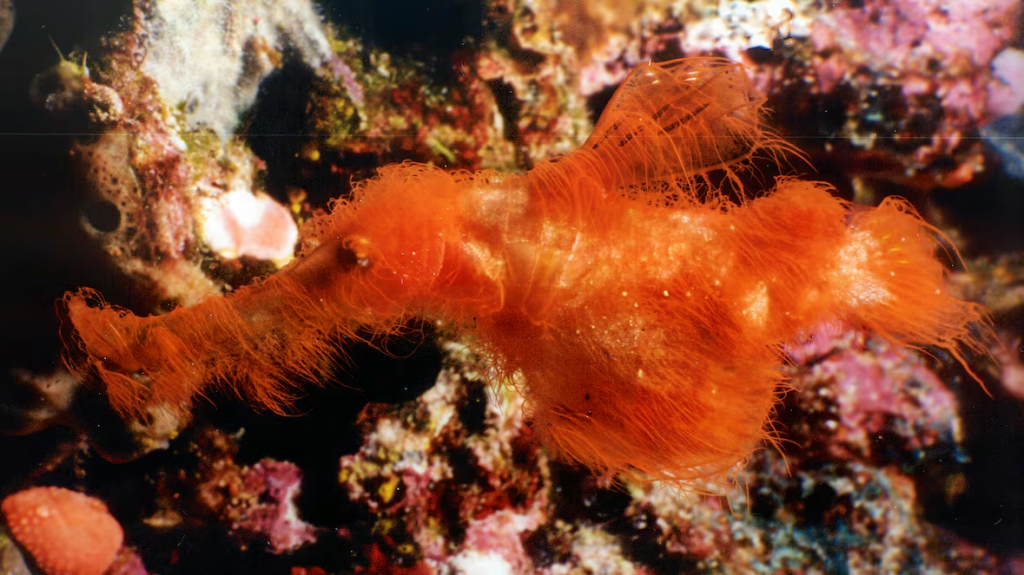
Solenostomus snuffleupagus, a newly described species of fish, is named after the beloved Sesame Street character, Mr. Snuffleupagus. (David Harasti)
Scientist David Harasti never had any doubt what he would name the tiny orange creature he first spotted on a diving expedition in Papua New Guinea in 2003.
But it would take another two decades for Harasti and his colleague Graham Short to find the elusive fish again, study it, and officially designate it a new species.
Meet Solenostomus snuffleupagus, namedafter the beloved Sesame Street character, Mr. Snuffleupagus.
“Snuffy for short,” Short, an ichthyologist at the California Academy of Sciences and the Australian Museum, told As It Happens host Nil Kӧksal. “The resemblance was quite uncanny.”
Short and Harasti have now written a new paper, published in the journal Fish Biology, describing S. snuffleupagus as a new species of ghost pipefish that makes its home along coral reefs, and disguises itself as red algae.
‘The awesome power of natural selection’
The fish has quite a few things in common with its namesake — mainly its orange-brown colouring, the long filaments that look like shaggy hair, and its elephant-like snout.
Milton Love, a marine biologist at the University of California’s Marine Science Institute in Santa Barbara, Calif., says the fish’s muppet-like appearance demonstrates “the awesome power of natural selection.”
“Clearly, all of the morphological features that we find endearing are of some value to the animal,” Love, who was not involved in the research, said in email.
“Or, and here is another hypothesis, Gaia created this fish after having one too many of those rum drinks that come with those little umbrellas.”
But its similarity to Snuffleupagus goes deeper than meets the eye.
It’s also extremely elusive, much like Mr. Snuffleupagus, who, in his early appearances on Sesame Street, was only ever seen by Big Bird, leading the other characters to mistakenly suspect he was imaginary.
Harasti and Short tried for years to spot a snuffy fish again after that first 2003 sightingto no avail.
Their luck changed in 2021 when some scuba diver buddies started seeing the little creatures on the Great Barrier Reef and got in touch. The scientists headed to Australia to see for themselves, and on their second dive, they found the fish.
“It’s an understatement to say that we screamed under water,” Short said. “We high-fived, gave each other a hug, and we were just so excited.”
An itty-bitty carnivore
In order to describe the fish and confirm it as a previously undocumented species, the scientists looked at CT scans of specimens first collected in 1993 during exhibition to far north of Queensland, Australia, in the Torres Strait.
Short says they were collected alongside several hundred other fish specimens and tucked away until he and his colleague came looking. But even back then, he says ichthyologist Helen Larson, who was part of the expedition, suspected it was a new species.
S. snuffleupagus, like other ghost pipefish, is a cousin of the seahorse.
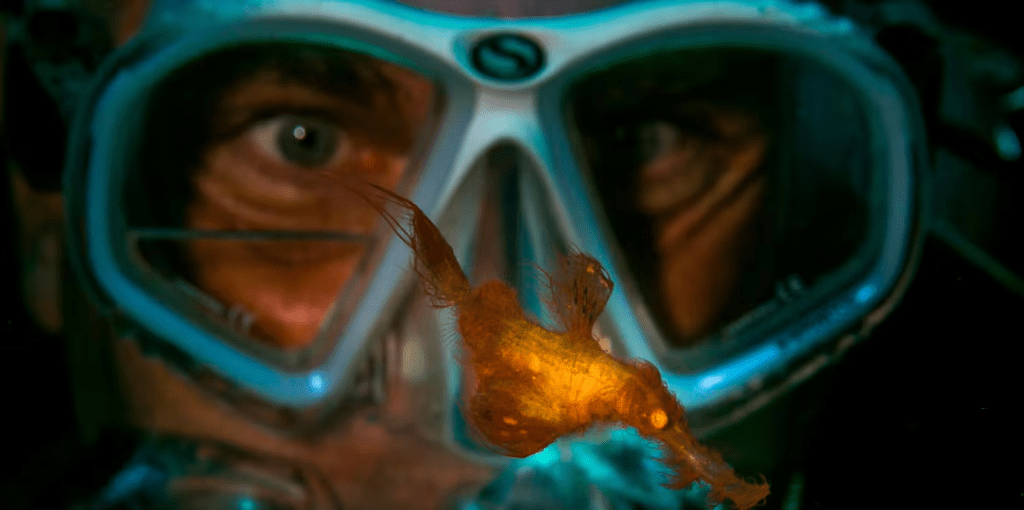
The newly described Snuffleupagus fish is smaller than a matchstick. (Darren Rice/Matafonua Lodge)
Using iNaturalist, the citizen science platform, the scientists confirmed sightings of it in Tonga, Papua New Guinea and New Caledonia, suggesting distribution across the southwestern Pacific.
And while it may look like Big Bird’s beloved bestie, there are a few significant differences between S. snuffleupagus the fish and Snuffleupagus the muppet.
While Snuffleupagus is famously big — bigger even than Big Bird — S. snuffleupagus is roughly four to five centimetres long, about the size of an airpod.
And while Snuffleupagus would never harm a fly, S. snuffleupagus is a natural-born killer.
“They look adorable, very cute. They’re very delicate and slow moving in the water. And it’s been assumed that they only eat small crustaceans like small shrimp,” Short said.
Not so, he says. The CT scans found tiny fish skeletons in the specimens’ stomachs.
“Every fish has a role, and they are either eating or being eaten. It turns out, ghost pipe fish and in particular, snuffy … they’re just like other fish,” Short said. “They’re predators.”
Short says the widespread interest in S. snuffleupagus has been a delight, and he hopes it won’t be the last fish he brings attention to.
He and his colleague already have their eyes on another species of ghost pipe fish that is known to divers around the Pacific, but hasn’t been formally described.
If it works out, they plan to name it after another muppet, but Short wouldn’t say which one.
“Not yet, because I need approval,” he said.
Interview with Graham Short produced by Leslie Amminson