Slavery Abolition, & More, In Peace & Justice History for 8/28

August 28, 1833
The Abolition of Slavery Act was passed by the British Parliament. As early as 1787, members of the Society of Friends (Quakers), particularly Thomas Clarkson and Granville Sharp, organized to end the slave trade.Since Quakers were barred from serving in the House of Commons, the cause was led by a member of the Evangelical Party, William Wilberforce, ending the international trade in slaves in 1807. By 1827 slaving was considered piracy and punishable by death. The complete ban on slavery itself through the British Empire didn’t happen until this day; Wilberforce was informed of the Act’s passage on his death-bed.

William Wilberforce
============================================
August 28, 1963

Reverend Martin Luther King, Jr. delivered his “I Have a Dream” speech from the steps of the Lincoln Memorial to a crowd of half a million gathered on the Mall in Washington, D.C.
They gathered there for jobs and freedom.


The speech 

 
organizing to build the march
Film of the March and the speech
1983: Three hundred thousand marched in Washington on the 20th anniversary of MLK’s “I Have A Dream” speech for the second “March on Washington for Jobs, Peace and Freedom.”
==============================================
August 28, 1976

60,000 joined the Community of Peace People demonstrations in Belfast and Dublin, Ireland. Peace People was founded by two women, Betty Williams and Mairead Corrigan to decry the painful violence between Catholics and Protestants, between unionists and republicans, and to move the peace process forward in Northern Ireland.

Betty Williams

Mairead Corrigan
They jointly won the Nobel Peace Prize for 1976.
More about Betty Williams and Mairead Corrigan 
From the Declaration of the Peace People:
“ . . . We want to live and love and build a just and peaceful society.
We want for our children, as we want for ourselves, our lives at home, at work and at play, to be lives of joy and peace.
We recognize that to build such a life demands of all of us, dedication, hard work and courage . . .
We dedicate ourselves to working with our neighbors, near and far, day in and day out, to building that peaceful society in which the tragedies we have known are a bad memory and a continuing warning.”

The Peace People’s website 

https://www.peacebuttons.info/E-News/peacehistoryaugust.htm#august28

Peace & Justice History for 11/7:

Getting on with it.

November 7, 1837
Abolitionist, clergyman and editor Elijah P. Lovejoy, 34, was murdered by a pro-slavery mob in Alton, Illinois, as he defended his newly delivered printing press. 
 
Elijah P. Lovejoy

He had lost two other presses to mob attacks, but refused to surrender this one, which had been contributed by the Ohio Anti-Slavery Society. For this he was shot five times in the fatal attack. Lovejoy had moved 20 miles to Alton from St. Louis where, after denouncing the lynching and burning of a black man, a mob tore down his office.
 
Warehouse with Lovejoy’s press set ablaze by mob;
“We must stand by the Constitution and laws, or all is gone.” Elijah Lovejoy, The Observer
Read more 
November 7, 1862
1700 members of the Dakota Sioux, mostly women, children and the eldersly, were force-marched 150 miles (240 km) to a concentration camp at Fort Snelling in Minnesota. The four-mile-long (6.5 km) procession was subject to physical abuse by white residents of towns along the way. Governor Alexander Ramsey had committed himself to ridding the state of all the Dakota, raising the bounty on an Indian scalp to $200.
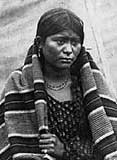
One of the prisoners at Fort Snelling
Simultaneously, 300 Dakota men were tried summarily (as many as 40 cases in a single day) and marched to another camp in Mankato.
They had surrendered to the U.S. Army at the end of the Dakota War, expecting to treated as prisoners of war.

Little War on the Prairie  (This American Life)
More on this forced march 
November 7, 1916
Jeannette Rankin, a Republican from Missoula, Montana, became the first woman elected to the U.S. Congress. American women in 19 states had no voting rights whatsoever until passage of the 19th amendment four years later. Female Montanans had full voting rights even before statehood (in 1889). 
 Read more 
November 7, 1919
Hundreds, presumed to be members of the Union of Russian Workers, were arrested in New York and other cities across the country on the second anniversary of the Russian Revolution. President Woodrow Wilson’s attorney general, A. Mitchell Palmer, and Intelligence Division chief, John Edgar Hoover, used the Sedition and Espionage Acts to thwart what they saw as a Communist plot to overthrow the government.
This was but one many assaults on radicals in what was known as the Palmer Raids. Thousands were arrested and thousands deported. It had been a year of significant labor unrest including steel, coal, and Boston police strikes, and a Seattle general strike. There was high unemployment in the wake of the demobilization after World War I. Around May Day there had been dozens of mail bombs, most of them intercepted, and a suicide bomber died outside Palmer’s Washington residence.
 
The Palmer Raids 
The first mass arrest of immigrant workers 
Attorney General Mitchell’s view 
November 7, 1973
New Jersey became the first state to allow girls to play Little League Baseball.

https://www.peacebuttons.info/E-News/peacehistorynovember.htm#november7