We’re approaching the third Trans Rights Readathon! It’s an annual call to action that coincides with Trans Day of Visibility on March 31st, and it aims to uplift, amplify, and support trans, nonbinary, gender-nonconforming, and Two-Spirit authors. It takes place from March 21st through the 31st, and this year, there are five core prompts to complete, as well as a list of bonus prompts.
The five core prompts for the 2025 Trans Rights Readathon are Transmasc and Trans Man Rep; Transfemme and Trans Woman Rep; Nonbinary, Agender, Genderqueer, and Other Gender Expansive Rep; Intersectional Trans+ Rep Outside Your Own Experience; and 2Spirit, Indigiqueer and Indigenous Gender Expansive Rep.
If you’d like some recommendations for these prompts, as well as the many bonus prompts, you can find the reading challenge on Storygraph, where users have added suggestions for each. Just be sure to vet these, since anyone can add a title.
The Storygraph description also adds more context to the reading challenge, including making sure not to out authors or interrogate authors about their gender identity: “If information isn’t available in an author’s bio, social media, or on their website, they don’t owe it to you. In an era when people’s identities are being used to target them, please be mindful that we want to CELEBRATE these stories and support authors while keeping each other safe.”
Each prompt also has more information, including that books in the 2Spirit, Indigiqueer, and Indigenous Gender Expansive Rep category may not be trans, so to be mindful about language when discussing these books: “2Spirit, Indigiqueer, and other non-Western Third Genders exist outside of Western concepts of gender and sexuality, and an author who identifies as 2S may not identify as trans.”
Another great resource for the challenge is the Trans Rights Readathon Instagram. They have posts about the readathon itself, including how to participate: by reading trans books, reviewing and discussing them online (using the tags TransRightsReadathon and #TRR2025), and monetarily supporting the trans community (including donating to mutual aid funds).
They also have posts recommending books for each of the prompts. These are vetted by the organizers, so they’re more reliable than the Storygraph suggestions.
Leading up to and during the readathon, I’ll be sharing trans book recommendations. Let me know in the comments if there’s anything in particular you’d like suggestions for!
As a bonus for All Access members, below is a list of 27 new LGBTQ books out this week.
Exclusive content for All Access members continues below. Become a member for $6 a month or $60 a year to get community features and access to exclusive content across all 20+ Book Riot newsletters.
Earlier today, the Montana Supreme Court ruled that SB 99, a 2023 Montana law that categorically bans life-saving gender-affirming care for transgender youth, is unconstitutional under the Montana state constitution’s privacy clause, which prohibits government intrusion on private medical decisions. This ruling will allow Montana communities and families to continue accessing medical treatments for transgender minors with gender dysphoria.
“I will never understand why my representatives are working to strip me of my rights and the rights of other transgender kids,” said Phoebe Cross, a 17-year-old transgender boy. “Just living as a trans teenager is difficult enough, the last thing me and my peers need is to have our rights taken away.”
“Fortunately, the Montana Supreme Court understands the danger of the state interfering with critical healthcare,” said Lambda Legal Counsel Kell Olson. “Because Montana’s constitutional protections are even stronger than their federal counterparts, transgender youth in Montana can sleep easier tonight knowing that they can continue to thrive for now, without this looming threat hanging over their heads.”
“We are so thankful for this opportunity to protect trans youth, their families, and their medical providers from this baseless and dangerous law,” said Malita Picasso, Staff Attorney for the ACLU’s LGBTQ & HIV Project. “Every day that transgender Montanans are able to access this care is a critical and life-saving victory. We will never stop fighting until every transgender person has the care and support they need to thrive.”
“Today’s ruling permits our clients to breathe a sigh of relief,” said Akilah Deernose, Executive Director of the ACLU of Montana. “But the fight for trans rights is far from over. We will continue to push for the right of all Montanans, including those who are transgender, to be themselves and live their lives free of intrusive government interference.”
The Court found that the Plaintiffs were likely to succeed on the merits of their privacy claim, holding:
“The Legislature did not make gender-affirming care unlawful. Nor did it make the treatments unlawful for all minors. Instead, it restricted a broad swath of medical treatments only when sought for a particular purpose. The record indicates that Provider Plaintiffs, or other medical professionals providing gender-affirming care, are recognized as competent in the medical community to provide that care.[T]he law puts governmental regulation in the mix of an individual’s fundamental right ‘to make medical judgments affecting her or his bodily integrity and health in partnership with a chosen health care provider.’
Two justices filed a concurrence arguing that the Court should also clarify that discrimination on the basis of transgender status is a form of sex discrimination prohibited by Montana’s Equal Protection Clause.
Plaintiffs in the case include Molly and Paul Cross and their 17-year-old transgender son Phoebe; Jane and John Doe joining on behalf of their 16-year-old transgender daughter; and two providers of gender-affirming care who bring claims on their own behalf and on behalf of their Montana patients.
On December 4, the Supreme Court of the United States heard oral arguments in a landmark case brought by the ACLU, the ACLU of Tennessee, Lambda Legal, and Akin Gump on behalf of three families and a medical provider challenging a Tennessee ban on gender-affirming hormonal therapies for transgender youth on the grounds the ban violates the Equal Protection Clause of the U.S. Constitution. Today’s decision by the Montana Supreme Court rests entirely on State Constitutional grounds, insulating transgender adolescents, their families, and health care providers from any potential negative outcome at the U.S. Supreme Court.
Incredible news! Montana’s Supreme Court just affirmed that the state’s gender affirming care ban is likely unconstitutional.This makes the state the first state Supreme Court to rule that trans medical care is protected.This applies REGARDLESS of what the US Supreme Court does.
If you find my journalism important, including breaking huge news like this, subscribe to support it at http://www.ErinInTheMorn.com/subscribe.Full decision is not yet available but I’ll release it when I get it.
I have so much to say about today’s case, legal analysis, and more.But the most powerful thing today was watching Chase Strangio argue in front of the court as the first trans attorney to do so.You could feel history, and nobody will ever take that away.
I just ran into the main plaintiff and their family in the hallway of the Supreme Court in the skrimetti case today, and we all hugged and now I’m in tears in the press room.I thanked them profusely.Trans people deserve equal protection. We deserve to live like anyone else.
Chase Strangio walks out of the court to cheers after he becomes the first trans attorney to present a case to SCOTUS.Video too big in size but will post later.
I also can't get over the conservative justices favorably citing European laws about transgender health care when they vociferously refuse to consider other nation's laws and traditions when dealing with issues on which the U.S. is an outlier, like gun violence and the death penalty.
Ran into what I assume was one of the far right people in the bathroom line who said “I thought the men’s bathroom was on the other side” at SCOTUS.Thankfully the rest of the line were people who knew me and my reporting and I didn’t even dignify it with a response.
This should be said everywhere. Allowing discrimination like this against trans people undermines bedrock principles of constitutional rights across the board.
Chris is correct. Everyone stop saying landslide or mandate now. And let’s get to work blocking their most extreme plans.[Repost: https://buff.ly/41pxuOu%5D
"Repeat after me: there was no 'landslide'. There was no 'blowout'. There was no 'sweeping' mandate given to Trump by the electorate. The numbers don’t lie."My new Guardian op-ed on the new GOP election lie – and why it's important to rebut it! I brought (lots of) receipts:
"Trump won the crucial blue wall states… by 231,000 votes? So if just 116,000 voters across those three swing states – or 0.7% of the total – had switched from Trump to Harris, it is the vice-president who would have won the electoral college … and the presidency" – me for the Guardian:
“Both Tesla and SpaceX quite likely would not exist as successful businesses if it were not for the use of public funding, either through subsidies, through the electric car industry, or through actual government contracting in the case of SpaceX,” Ramaswamy said in 2022 on a Fox News podcast.
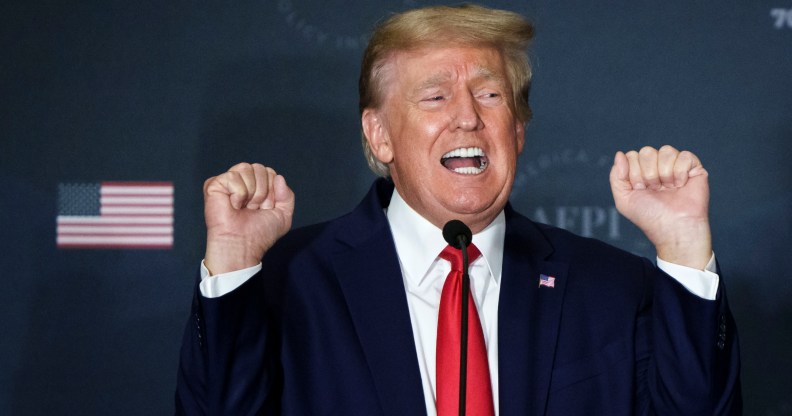
Donald Trump has been outspoken against the LGBTQ+ community. (Getty)
At the time of writing, it seems almost inevitable that Donald Trump will become the 47th President of the United States, meaning LGBTQ+ rights are under serious threat.
The election was one of the closest in history according to voting polls over the past few weeks, with polling group FiveThirtyEight reporting that Harris just barely reached a 1.2 per cent lead on Trump a day before the results were counted.
The last Trump presidency led to a roll-back of protections and anti-discrimination laws for LGBTQ+ people, and it doesn’t look as if a second term would be any different if he is re-elected, based on campaign promises and the detailed policy proposals outlined in Project 2025 – although Trump has tried to distance himself from the right-wing proposals.
In anticipation of a Trump win, the American Civil Liberties Union (ACLU) suggested a new Trump administration would “reinstate and significantly escalate the removal of anti-discrimination policies… proactively require discrimination by the federal government [and] weaponize federal law against transgender people across the country”.
So, what are Trump’s views about LGBTQ+ rights, and what exactly might he do?
Erase federal non-discrimination protections for LGBTQ+ people
Trump’s first term was extremely detrimental to the rights and protections of LGBTQ+ people, and a second term could roll back protections once again.
LGBTQ+ people might no longer be guaranteed to be free of discrimination across several federal government programs, such as Social Security, Medicare, housing and employment.
Exclude openly transgender people from the military
The first Trump administration reversed policies allowing trans people to serve in the military, and it is not difficult to foresee the president doing so again.
Another ban on trans people in the military would force out active-duty transgender service personnel as well as prevent trans people enlisting in the future.
This is despite a report in 2016 revealing that trans-inclusive policies have “little or no impact on unit cohesion, operational effectiveness, or readiness”.
In fact, trans-inclusive military policies could benefit all active service members by “creating a more inclusive and diverse force.”
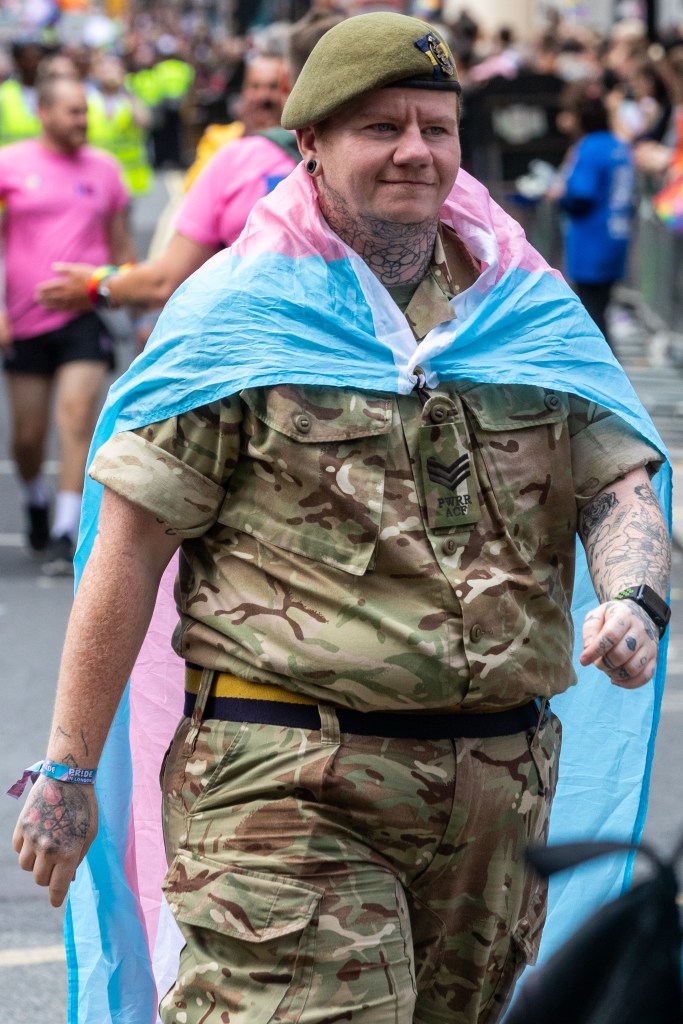
Trans people could once again be banned from serving. (Getty)
Withhold federal funding if school officials affirm transgender students
Trump has said he would act to stop any school district introducing or maintaining trans-inclusive policies and practices.
This would include withholding federal funding that allow trans students to use toilets and changing rooms that align with their gender identity, or even acknowledging that they are trans, as well as arguing that trans-inclusive policies violate the rights of cisgender pupils.
Discrimination against trans students, causing significant harm to the community as a whole, would be the likely result of such a move.
During a recent campaign rally, Trump said he was not going to “let” trans women compete in sporting events at all if he becomes president again.
He said invoking the ban would “not [be] a big deal”, citing recent sporting events in which trans women competed against cisgender women, claiming that the trans athlete had a competitive edge over their opponent.
“Physically, from a muscular standpoint… look at what’s happened in swimming. Look at the records that are being broken,” he said.
Prohibit gender-affirming care in federal healthcare programmes
His website also promises that on his first day in the Oval Office, he would issue an executive order “instructing every federal agency to cease all programs that promote the concept of sex and gender transition, at any age”.
The administration would also probably deny Medicaid funding for hospitals that provide gender-affirming care, forcing medics to deny trans people the care they require.
Access to healthcare for more than 100,000 transgender youngsters in 24 states has already been halted in the past three years.
Allow employers to discriminate against LGBTQ+ staff
A second Trump administration could bring in provisions to allow employers to discriminate against LGBTQ+ members of staff based on the boss’ stated religious beliefs, a reversal of existing non-discrimination laws.
This would not require congress or bipartisan support, and could be pushed through using an executive order from the president.
The administration could go one step further to prevent state and local governments enforcing non-discrimination laws if the defendant says the discrimination was based on religious belief.
Laws protecting LGBTQ+ people and other minorities from discrimination based on protected characteristics might also disappear.
Donald Trump has continued to target the LGBTQ+ community. (Getty)
Criminalize gender-non-conformity in public life
Project 2025 – a hard-line right-wing blueprint for a future Republican president – suggests the use of criminal laws to punish gender-non-conformity in public life, with pornography being the crux of the issue.
The authors of the plan, the Heritage Foundation, inexplicably link pornography with “transgender ideology” and argue that neither has a “claim to First Amendment protection” and therefore should be outlawed.
“The people who produce and distribute it should be imprisoned,” they demand. “Educators and public librarians who purvey it should be classed as registered sex offenders, and telecommunications and technology firms that facilitate its spread should be [closed down].”
That means any discussion of transgender people in schools and libraries could be criminalized, and trans people might face jail time for being themselves.
Trump would only be able to put this into practice with congress’ approval and there is unlikely to be bipartisan support for such a law, but even the slim possibility is terrifying.
Finally – could gay marriage be reversed?
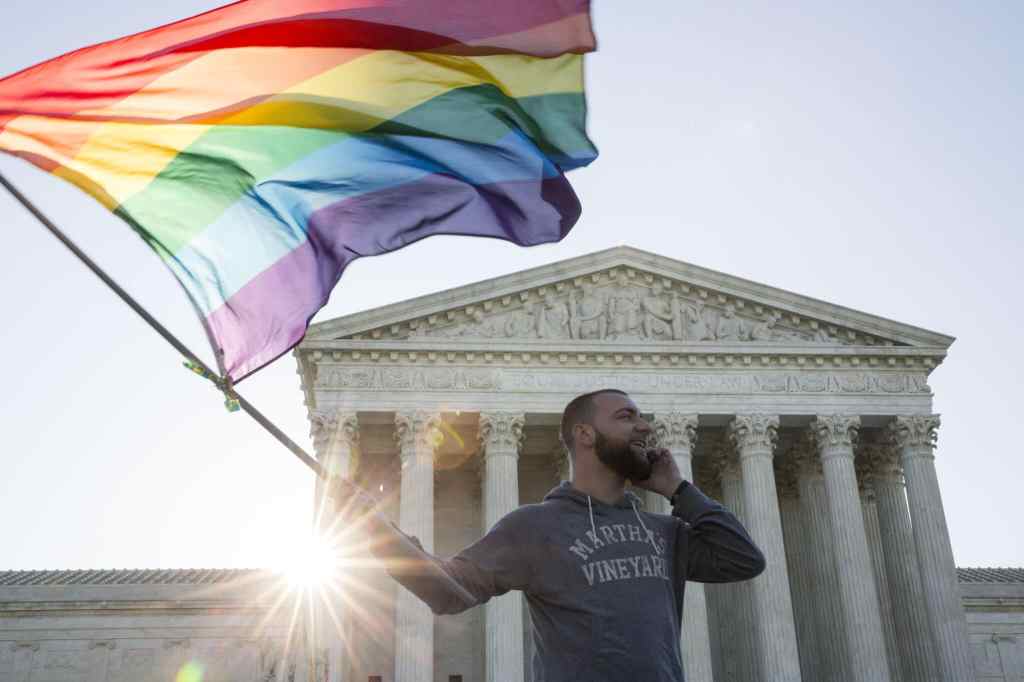
Same-sex marriage supporter Vin Testa, of Washington DC, waves a rainbow pride flag near the Supreme Court. (Drew Angerer/Getty Images)
Unfortunately, yes, it could.
After crucial abortion legislation Roe v. Wade was overturned by the Supreme Court, many people said that next, they would be coming for Windsor and Obergefell and Lawrence – three rulings that unlocked a national right to same-sex marriage.
Whether a same-sex couple could marry varied by state before 2015. With its 5-4 decision in Obergefell v. Hodges, the Supreme Court extended the full federal right to marry to all same-sex couples.
So would – or could it be taken away? Many people think that the Supreme Court wouldn’t dare. Same-sex marriage is now too accepted in American society, they argue. It would cause “legal chaos.”
However, it remains the case that some justices, particularly Samuel Alito and Clarence Thomas, appear to be itching to overturn Obergefell. In 2022, Justice Thomas said the Supreme Court “should reconsider” its past rulings codifying rights to contraception access, same-sex relationships and same-sex marriage.
It’s important to remember in all of this Pride is a protest, and it continues to be. We can fight any and all of these attacks by standing up, speaking out and refusing to stay silent.
The NSW equality bill brings the state into line with others. Photograph: Dean Lewins/AAP
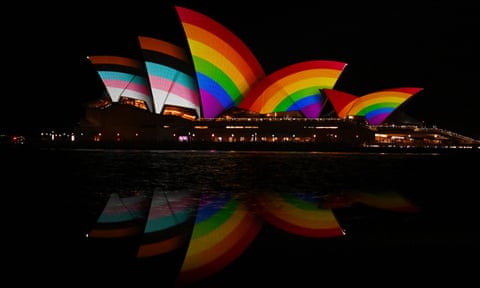
Rights and protections for LGBTQ+ people in New South Wales have been strengthened with the passing of a bill in the state parliament late on Thursday, after the legislation was watered down to gain Labor support.
The equality bill will give transgender people the ability to have their sex changed on their birth certificates without undergoing invasive surgery, bringing the state in line with others, and non-binary will become a gender option for birth certificates.
There were cheers in the chamber when the bill passed about 8.40pm. The independent MP Alex Greenwich, who introduced the package a year ago, embraced the leader of the government in the upper house, Penny Sharpe after the vote that succeeded without the opposition’s support.
Greenwich said the changes would “improve LGBTIQA+ dignity, safety and equality” and thanked Sharpe for her work getting the legislation through the upper house.
“We’ve got more work to do and we start that work now with new confidence from these significant wins for our community,” he said on Thursday night.
After months of stagnation, Greenwich convinced the premier, Chris Minns, to support the bill by making a number of major concessions, including dropping changes to the anti-discrimination act.
While advocates welcomed the remaining elements of the bill, many also raised concerns that protections for LGBTQ+ teachers and students at private schools had been dumped.
The Equality Australia chief executive, Anna Brown, thanked community members who shared their stories and all those who campaigned to garner support for the changes.
“These new laws will have no impact on the lives of most people in our state, but for a small number of people it will make their lives immeasurably better,” she said after the bill passed.
“It’s a journey that continues as we turn our attention to the state’s anti-discrimination laws and our ongoing efforts to protect vulnerable teachers and students in religious and private schools across the state.”
Greenwich had hoped the Coalition would allow MPs a conscience vote on the bill but earlier in the week the opposition leader, Mark Speakman, confirmed his party would stand against the reforms.
Despite that, the Liberal MP for the North Shore, Felicity Wilson, crossed the floor.
“Just because your party doesn’t have a conscience vote doesn’t mean you don’t have a conscience,” she told ABC Radio Sydney earlier in the week.
Greenwich said on Wednesday that the Coalition was moving further to the right and “using my community as a political football, as a political punching bag”.
“I am concerned that we are seeing a rightwing trend developing within the Coalition,” he said. “No other leader has denied their members a conscience vote on LBGT issues.”
The opposition attorney general, Alister Henskens, held a news conference with religious figures and community members opposed to the reforms earlier in the week.
Among the concerns he raised was about the “impact upon the privacy of women’s spaces”.
“It’s moving too far and it’s moving too quickly,” he said.
But the attorney general, Michael Daley, said the opposition was misrepresenting the package.
The bill also repealed offences for living off the earnings of a sex worker and made threatening to “out” a person’s LGBTIQA+ status an offence.
I hope this short video means as much to others as it meant to me. Growing up gay meant I was different. Coming from an abusive family meant I had no support and it hurt my sexual identity even more as those abusing me used homophobic slurs against me, but they were the ones forcing me to submit to them. I have watched several videos of reverse gender stereotypes and sadly the ones that need to see it won’t and I doubt they would absorb the message if they were forced to view them. but it is important to understand the stereotypes are created to give the majority a feeling of security and normalcy as they try to force every child into the mold preset by their thinking that the child should be. Making mini me copies of the parents. That is not normal or how it should be. Each child is a new being and should be allowed to have the feelings and express themselves are they really know themselves to be. Openly and freely without repercussions and targeted harm. Please watch the short video, it is eye opening at the end. Hugs. Scottie
Hi, welcome to Essence of Thought with me, Ethel Thurston, as your host.
Today’s video explores the Cold War’s impact on the West, namely how the Red Scare laid down the groundwork for the modern anti-trans panic in sports. From the media’s open misogyny to literally cartoonish fearmongering, there’s a lot to unpack.
@EssenceOfThought7 hours ago Today’s video explores the Cold War’s impact on the West, namely how the Red Scare laid down the groundwork for the modern anti-trans panic in sports. From the media’s open misogyny to literally cartoonish fearmongering, there’s a lot to unpack.


 Scottie's Playtime