Putin doesn’t see Ukraine as a sociergn nation but as a puppet state of Russia’s that he can control. He doesn’t see them as having the right to determine their own future. Here is a quote from the article.
Putin signalled no movement in Russia’s long-held demands, which also include a veto on Kyiv’s desired membership in the NATO alliance.
————————————————————————————————————————
Source says Putin demands control of entire Donetsk region
Trump says Zelenskiy has ‘gotta make a deal’
Zelenskiy reported to have rejected demand
Zelenskiy to visit Trump on Monday with European back-up
Europeans say they will maintain or increase pressure on Russia
WASHINGTON/MOSCOW/KYIV, Aug 16 (Reuters) – U.S. President Donald Trump said on Saturday that Ukraine should make a deal to end the war with Russia because “Russia is a very big power, and they’re not”, after a summit where Vladimir Putin was reported to have demanded more Ukrainian land.
After the two leaders met in Alaska on Friday, Trump told Ukrainian President Volodymyr Zelenskiy that Putin had offered to freeze most front lines if Kyiv ceded all of Donetsk, the industrial region that is one of Moscow’s main targets, a source familiar with the matter said.
Zelenskiy rejected the demand, the source said. Russia already controls a fifth of Ukraine, including about three-quarters of Donetsk province, which it first entered in 2014.
Trump also said he agreed with Putin that a peace deal should be sought without the prior ceasefire that Ukraine and its European allies had demanded. That was a change from his position before the summit, when he said he would not be happy unless a ceasefire was agreed on.
“It was determined by all that the best way to end the horrific war between Russia and Ukraine is to go directly to a Peace Agreement, which would end the war, and not a mere Ceasefire Agreement, which often times do not hold up,” Trump posted on Truth Social.
Zelenskiy said Russia’s unwillingness to pause the fighting would complicate efforts to forge a lasting peace. “Stopping the killing is a key element of stopping the war,” he said on X.
Nevertheless, Zelenskiy said he would meet Trump in Washington on Monday.
That will evoke memories of a meeting in the White House Oval Office in February, where Trump and Vice President JD Vance gave Zelenskiy a brutal public dressing-down. Trump said a three-way meeting with Putin and Zelenskiy could follow.
Kyiv’s European allies welcomed Trump‘s efforts but vowed to back Ukraine and tighten sanctions on Russia. European leaders might join Monday’s White House meeting as well, German Foreign Minister Johann Wadephul said.
Russia launched a full-scale invasion of Ukraine in February 2022 and has been gradually advancing for months. The war – the deadliest in Europe for 80 years – has killed or wounded well over a million people from both sides, including thousands of mostly Ukrainian civilians, according to analysts.
RUSSIA LIKELY TO WELCOME TRUMP’S COMMENTS
Trump’s various comments on the three-hour meeting with Putin mostly aligned with the public positions of Moscow, which says a full settlement will be complex because positions are “diametrically opposed”.
Putin signalled no movement in Russia’s long-held demands, which also include a veto on Kyiv’s desired membership in the NATO alliance. He made no mention in public of meeting Zelenskiy. Kremlin aide Yuri Ushakov said a three-way summit had not been discussed.
In an interview with Fox News’ Sean Hannity, Trump signalled that he and Putin had discussed land transfers and security guarantees for Ukraine, and had “largely agreed”.
“I think we’re pretty close to a deal,” he said, adding: “Ukraine has to agree to it. Maybe they’ll say ‘no’.”
Asked what he would advise Zelenskiy to do, Trump said: “Gotta make a deal.”
“Look, Russia is a very big power, and they’re not,” he added.
Item 1 of 10 U.S. President Donald Trump looks on next to Russian President Vladimir Putin during a press conference following their meeting to negotiate an end to the war in Ukraine, at Joint Base Elmendorf-Richardson, in Anchorage, Alaska, U.S., August 15, 2025. REUTERS/Kevin Lamarque
[1/10]U.S. President Donald Trump looks on next to Russian President Vladimir Putin during a press conference following their meeting to negotiate an end to the war in Ukraine, at Joint Base Elmendorf-Richardson, in Anchorage, Alaska, U.S., August 15, 2025. REUTERS/Kevin Lamarque Purchase Licensing Rights, opens new tab
Graphic: Map of Ukraine shows the eastern oblasts and the areas under Russian control
NEED FOR SECURITY GUARANTEES FOR UKRAINE
Zelenskiy has consistently said he cannot concede territory without changes to Ukraine’s constitution, and Kyiv sees Donetsk’s “fortress cities” such as Sloviansk and Kramatorsk as a bulwark against further Russian advances.
Zelenskiy has also insisted on security guarantees to deter Russia from invading again. He said he and Trump had discussed “positive signals” on the U.S. taking part, and that Ukraine needed a lasting peace, not “just another pause” between Russian invasions.
Canadian Prime Minister Mark Carney welcomed what he described as Trump’s openness to providing security guarantees to Ukraine under a peace deal. He said security guarantees were “essential to any just and lasting peace.”
Putin, who has opposed involving foreign ground forces, said he agreed with Trump that Ukraine’s security must be “ensured”.
For Putin, just sitting down with Trump represented a victory. He had been ostracised by Western leaders since the start of the war, and just a week earlier had faced a threat of new sanctions from Trump.
‘1-0 FOR PUTIN’
Trump spoke to European leaders after returning to Washington. Several stressed the need to keep pressure on Russia.
British Prime Minister Keir Starmer said an end to the war was closer than ever, thanks to Trump, but said he would impose more sanctions on Russia if the war continues.
European leaders said in a statement that Ukraine must have “ironclad” security guarantees and no limits should be placed on its armed forces or right to seek NATO membership, as Russia has sought.
Some European commentators were scathing about the summit.
“Putin got his red carpet treatment with Trump, while Trump got nothing,” Wolfgang Ischinger, former German ambassador to Washington, posted on X.
Both Russia and Ukraine carried out overnight air attacks, a daily occurrence, while fighting raged on the front.
Trump told Fox he would postpone imposing tariffs on China for buying Russian oil, but he might have to “think about it” in two or three weeks.
He ended his remarks after the summit by telling Putin: “We’ll speak to you very soon and probably see you again very soon.”
“Next time in Moscow,” a smiling Putin responded in English.
Additional reporting by Kanishka Singh, Trevor Hunnicutt, Jeff Mason, Lidia Kelly, Jasper Ward, Costas Pitas, Ismail Shakil, Bhargav Acharya, Alan Charlish, Yuliia Dysa, Pavel Polityuk, Gwladys Fouche, Dave Graham, Paul Sandle, Joshua McElwee, Andreas Rinke, Felix Light and Moscow bureau; Writing by Andy Sullivan, Kevin Liffey, Mark Trevelyan, Joseph Ax and James Oliphant; Editing by Raju Gopalakrishnan, Gareth Jones and Cynthia Osterman
The markets were rattled after Trump’s plans were confirmed, with U.S. stock futures plummeting in after-hours trading. CNN reported that gold, “considered a safe having amid economic and political uncertainty,” went the opposite direction, and “the most actively traded gold futures contract in New York briefly rose above $3,200 a troy ounce, a record high.”
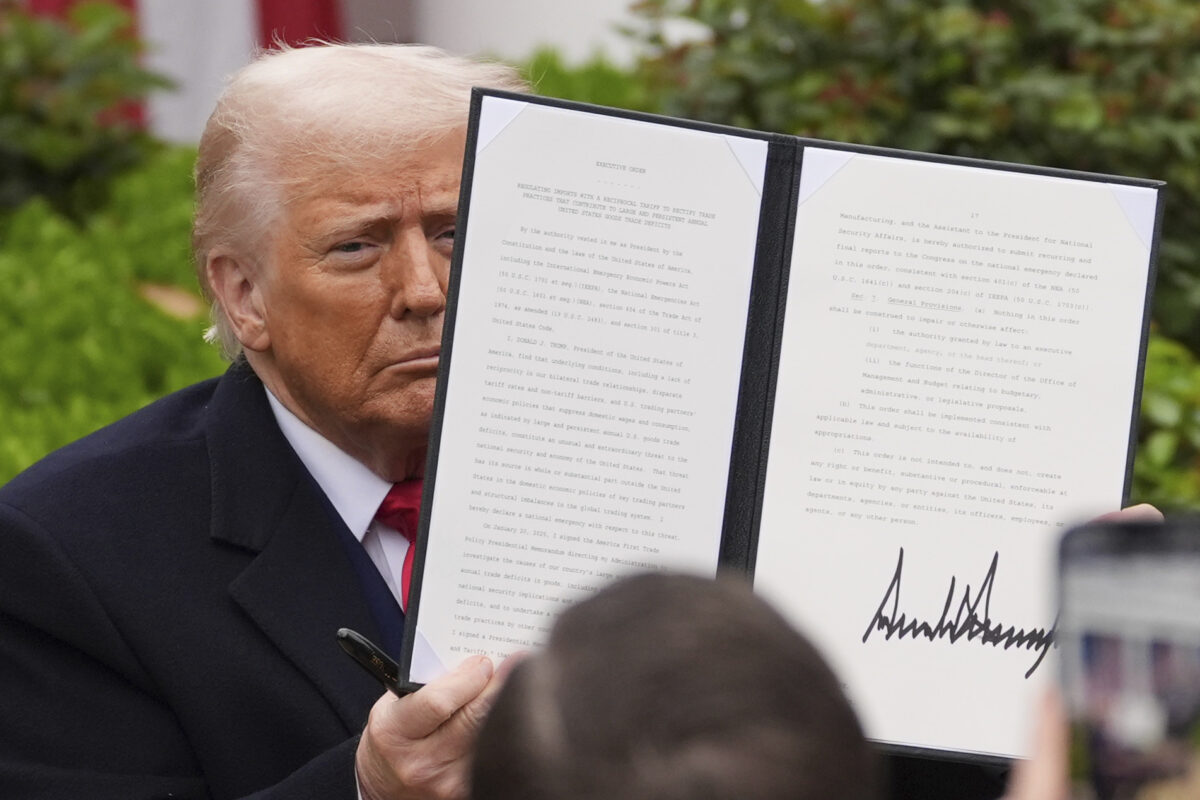
Numerous commentators have criticized the new tariffs for not just the economic havoc they were poised to spark, but for falsely categorizing value-added taxes and other sales or corporate taxes as tariffs.
The White House tweeted a series of tweets with the countries included in the “reciprocal tariffs.”
Not on the list? Russia. Also absent: Belarus, which has been actively allied with Russia in its ongoing invasion of Ukraine.
Ukraine is on the list, as are many other former Soviet satellites and republics. Multiple social media accounts posted about Russia’s absence from Trump’s list of the new tariffs.
NOTUS reporter Jasmine Wright reported that a White House official claimed that the reason for Russia’s omission was that sanctions imposed after the war with Ukraine began had “already rendered trade between the two countries as zero.”
That does not seem to be accurate.
Trade between Russia and the U.S. did in fact drop significantly after the invasion of Ukraine, but not to zero. A Forbes article from Jan. 2024 described it as “plummeting to lowest levels since [the] demise of Soviet Union,” but still reported that the November YTD total at that time was $4.81 billion.
The website for the Office of the United States Trade Representative provides an even lower number for 2024, but the total was still several billion dollars and showed a trade deficit:
U.S. total goods trade with Russia were an estimated $3.5 billion in 2024. U.S. goods exports to Russia in 2024 were $526.1 million, down 12.3 percent ($73.5 million) from 2023. U.S. goods imports from Russia totaled $3.0 billion in 2024, down 34.2 percent ($1.6 billion) from 2023. The U.S. goods trade deficit with Russia was $2.5 billion in 2024, a 37.5 percent decrease ($1.5 billion) over 2023.
Ron has followed this young man for a while. This morning he was telling me how smart and well grounded he was. I decided to check him out. I found out I really like his content. Here are a few clips. Hugs
Adam Mockler with MeidasTouch Network breaks down Donald Trump’s botched Ukraine meeting.
Adam Mockler with MeidasTouch Network breaks down Donald Trump and JD Vance throwing a fit while meeting with President Zelenskyy.
Donald Trump had been the president-elect for just two days when he reportedly spoke by phone with Russian President Vladimir Putin on Nov. 7.
On the call, Trump advised the Russian president not to escalate the war with Ukraine and reminded him of the U.S.’s military presence in Europe, according to an account first published by The Washington Post, which cited multiple sources familiar with the conversation.
The Kremlin, however, denied that meeting had ever taken place. “Pure fiction,” Kremlin spokesperson Dmitry Peskov insisted.
Normally, the U.S. would be able to document that the call had happened. But not this time.
That’s because the State Department, which traditionally helps coordinate phone calls between incoming presidents and world leaders, has been shut out of Trump’s calls with foreign dignitaries.
That means the conversations were not held over secure phone lines, no State Department staff were available to offer guidance on the nuances on foreign policy and no official interpreters were on hand to overcome language barriers that can sometimes lead to confusion or misunderstandings about exactly what was said.
For U.S. foreign policy analysts, Trump’s calls with Putin and other world leaders after his victory over Vice President Kamala Harris in the Nov. 5 election are cause for alarm.
“We’re entering a dangerous territory of telephone games, where Trump is going to have private chats with foreign leaders, and they’re going to tell their teams one thing, and Trump is going to tell our national security team another,” said Brett Bruen, a former diplomat who worked in the White House under President Barack Obama.
Different interpretations of private conversations stemming from translation difficulties or misunderstandings could not only sow confusion, Bruen said, but also could trigger an international crisis.
Trump’s transition team did not respond to questions about why he has not involved the State Department in his calls with foreign leaders.
After he won another term as president, Trump waited three weeks to sign some of the legal documents needed to formally begin the transition of power from President Joe Biden’s administration. The delay in submitting the documents – which typically are filed at least a month before presidential elections – meant the government couldn’t provide security clearances, briefings and resources to Trump’s incoming team.
Trump’s transition team announced Tuesday that it had finally signed one of the documents so that it could access nonpublic government information, receive government briefings and deploy personnel inside the federal agencies and departments it will soon take over. It was not immediately clear whether Trump would tap into the State Department’s resources on his future calls with foreign leaders.
Historically, the State Department has helped coordinate phone calls between incoming presidents and foreign leaders because it’s important to ensure during the transition that the government is always speaking with one voice, particularly on matters of national security and foreign policy, according to the nonpartisan Center for Presidential Transition.
But since his first term as president, Trump has openly expressed suspicion and resentment of what he derisively calls “the Deep State,” the government bureaucrats who he argues worked secretly behind the scenes to sabotage his agenda.
A phone call with Ukrainian President Volodymyr Zelenskyy in 2019 deepened Trump’s distrust of government employees. During the call, Trump threatened to withhold U.S. aid to Ukraine unless Zelenskyy investigated then-former Vice President Biden and his son, Hunter Biden. A summary of the conversation, made public by Trump’s Justice Department and prepared by a government aide who had been permitted to listen to the call, helped lead to Trump’s first impeachment.
Trump has pledged to fire bureaucrats who would impede his agenda during his second term.
All presidents field phone calls from world leaders after winning office – and not all of those calls have been handled in coordination with the State Department. Some of Biden’s phone conversations with foreign dignitaries after the 2020 election were done without State Department officials because Trump refused to concede he had lost, said Daniel Fried, a former diplomat who played a key role in carrying out U.S. policy in Europe after the fall of the Soviet Union.
Trump started receiving phone calls from foreign leaders within hours of his victory over Harris. The callers included Zelenskyy, British Prime Minister Keir Starmer, French President Emmanuel Macron and Indian Prime Minister Narendra Modi, all of whom publicly acknowledged reaching out to the president-elect. Two days after the election, Trump said he had already spoken to more than 70 world leaders.
In most cases, calls between the president-elect and a foreign head of state usually involve just congratulatory remarks and pledges of cooperation with the incoming administration. But some of Trump’s calls with world leaders appear to have gone beyond the routine and delved into policy discussions.
Israeli Prime Minister Benjamin Netanyahu wrote in a pair of messages on the social media platform X on Nov. 10 that he had spoken three times with Trump since the election. “We see eye-to-eye on the Iranian threat in all its aspects, and on the dangers they reflect,” Netanyahu said. “We also see the great opportunities facing Israel, in the area of peace and its expansion, and in other areas.”
Trump’s remarks to Putin that he should not escalate the war with Ukraine raised eyebrows because federal law makes it a crime for an unauthorized American citizen to negotiate a dispute between the United States and a foreign government.
“There can only be one foreign policy at a time,” Bruen said. “What Trump is doing is saying you need to do X or Y, even though he hasn’t been sworn in, even though he doesn’t control U.S. foreign policy right now.”
Russia’s denial that the call ever took place also shows why it’s problematic for Trump to hold private conversations with foreign leaders without the involvement of the State Department, its official interpreters or other support staff, said Fried, who worked under Democratic and Republican administrations and is now a fellow at the Atlantic Council.
“Somebody’s not telling the truth,” he said. “If the Trump people had used the State Department, the Kremlin wouldn’t be able to get away with denying that the call took place, or at least there’d be no doubt.”
Fried said private calls with foreign dignitaries are not always held over secure phone lines because some leaders may not have such lines at their disposal. Still, phone conversations over unsecured lines are risky.
“Most of our adversaries are able to tap into these calls, which in and of itself is concerning because it means that the Russians are spying on the calls he’s having with Europe and the Middle East, and the Chinese are accessing the same ones,” Bruen said. “These are sensitive discussions. They allow countries’ leaders to understand where there may be potential compromises or vulnerabilities.”
When Zelenskyy called Trump at his Mar-a-Lago estate in Florida to congratulate him on his victory, Trump handed the phone over to Elon Musk, the billionaire business titan who has become one his advisers and a ubiquitous presence at his side. Musk, a government contractor, has provided communications services to Ukraine through his Starlink satellite network during its war with Russia.
Musk also met on Nov. 11 with Iran’s ambassador to the United States in an effort to help defuse tensions between the two countries, according to multiple reports. Iran later denied that the meeting had taken place.
Allowing Musk to participate in a private call with Zelenskyy is alarming, Bruen said, because “Musk does not have a government role. He doesn’t have a security clearance. He does have a whole of lot of interest in the outcome of what is happening in Ukraine” because of his business interests there.
Worries about Trump’s calls with foreign leaders are compounded by questions of how he has handled classified documents in the past, Bruen said.
Trump suggested his Democratic opponent in the 2016 election, Hillary Clinton, should be jailed and disqualified from holding office amid questions about how she handled classified information. Seven years later, after he left office, a federal grand jury in Florida indicted Trump on 40 counts of mishandling classified documents, some of which were stored in a bathroom in Mar-a-Lago. The special prosecutor, Jack Smith, effectively killed the case Monday when he dropped his appeal of a judge’s ruling that had dismissed the charges.
Given Trump’s past, his unsupervised phone calls with foreign leaders should set off alarms, Bruen said.
“It’s a hot mess,” he said.
Contributing: Joey Garrison
Michael Collins covers the White House. Follow him on X @mcollinsNEWS.


 AP Photo/Evan Vucci
 Michael Collins
 Scottie's Playtime