A hydrogel has learned to play the 1970s video game “Pong” and improved its ability to hit the ball by 10% with some practice.
Dr Hayashi, a biomedical engineer at the University of Reading in the UK, says: “Our research shows that even very simple materials can exhibit complex, adaptive behaviours typically associated with living systems or sophisticated AI.
“This opens up exciting possibilities for developing new types of ‘smart’ materials that can learn and adapt to their environment.”
The research is described in a paper published in Cell Reports Physical Science.
Video link, an example run of a hydrogel playing Pong.
Credit: Cell Reports Physical Science/Strong et al.
What is a hydrogel?
A hydrogel, like gelatine or agar, is made of a 3D network of polymers that become jelly-like when water is added.
The hydrogel in this study is an “ionic electro-active polymer”, where the media surrounding the polymer matrix contains charged particles, in this case hydrogen ions.
As a result, it can deform when an electric current is applied to it.
Stimulation by an electric field causes the hydrogen ions migrate and, as they move, drag water molecules with them, causing areas to swell.
“The rate at which the hydrogel de-swells takes much longer than the time it takes for it to swell in the first place, meaning that the ions’ next motion is influenced by its previous motion, which is sort of like memory occurring,” says first author and University of Reading robotics engineer, Dr Vincent Strong.
“The continued rearrangement of ions within the hydrogel is based on previous rearrangements within the hydrogel, continuing back to when it was first made and had a homogeneous distribution of ions.”
It’s this property the researchers exploited to teach the hydrogel to play Pong.
How does a hydrogel play Pong? (snip-More on the page)
NASA is about to launch a helium balloon carrying a telescope, to test its ability to see exoplanet atmospheres.
The Exoplanet Climate Infrared Telescope (EXCITE) is eventually destined to fly around the poles, collecting data above much of the Earth’s atmosphere, but its first test flight is due to happen from the USA in the next few months.
It will be launched for the first time from the Columbia Scientific Ballooning Facility in New Mexico.
EXCITE (EXoplanet Climate Infrared TElescope) hangs from a ceiling at the Columbia Scientific Balloon Facility’s location in Fort Sumner, New Mexico. The mission team practiced taking observations ahead of flight by looking out the hanger doors at night. Credit: NASA/Jeanette Kazmierczak
“EXCITE can give us a three-dimensional picture of a planet’s atmosphere and temperature by collecting data the whole time the world orbits its star,” says principal investigator Peter Nagler, from NASA’s Goddard Space Flight Center. (snip-More on the page)
Sorry to interrupt your Sunday but I think it useful in these final weeks before the election to give you the truth on important matters of public policy.
Today, Republican vice-presidential nominee JD Vance told NBC News that the tariffs Trump imposed during his term in office had not raised prices for Americans but had brought a significant number of jobs back to the United States.
Wrong on both counts.
In a careful analysis, researchers found the cost of Trump’s tariffs were “almost entirely borne by U.S. firms and consumers.”
That’s not surprising; tariffs function like taxes by raising the costs of imported goods. Trump’s proposal to raise tariffs on all imports as a means of raising revenue to offset a tax cut is obviously absurd.
Vance is also wrong about employment. Research clearly shows that the Trump tariffs did not bring jobs back to the United States.
Tariffs may be necessary for national security to protect critical industries such as semiconductors. But no one should be fooled into thinking they’re costless for consumers, or good for workers. The 1930 Smoot-Hawley tariff made the Great Depression far worse than it already was.
That Vance would make these claims — which have been so convincingly debunked — should cause all of us some concern. He seems as unreliable as the person who named him his running-mate.
August 26, otherwise known as Women’s Equality Day, marks the anniversary of the certification of the 19th Amendment, which granted some women the right to vote.
Yet today, women have fewer rights than they’d had in decades. To recognize this, we acknowledge Women’s Inequality Day.
Inequality impacts our health: although women pay $15 million more each year for health care than men, we spend more of our lives in poor health. Those who may experience pregnancy no longer have reproductive freedom; and when we do give birth, we (particularly women of color) face high rates of maternal mortality.
It impacts our work: we’re paid less than our male counterparts and are underrepresented in leadership roles. We also deal with workplace harassment, insufficient maternal leave, and disproportionate caretaking responsibilities that affect our ability to work.
It impacts our representation: women are severely underrepresented in politics, making up only 25% of the Senate, 29% of the House, and 31.9% of statewide elective executives.
How can we make policies that protect and serve women without more women in office? And in an age where our basic freedoms and bodily autonomy are under fire, how can we ensure our rights aren’t degraded further?
The 2024 federal election is a critical moment in the fight for our equality.
The people we elect in November will be in charge of our rights – including the right to reproductive freedom – for the next four years.
So when you cast your vote in 2024, will you vote for someone who defends those rights? Or someone who wants to take them away?
Our 2024 campaign centers around empowering women to make their voices heard at the ballot box by equipping them with essential voter information. We’re highlighting our free, bilingual one-stop-shop for nonpartisan election information, VOTE411.org.
This year’s Women’s Inequality “Day” campaign will take place from August 26-30, with unique calls to action engaging voters every day! Get involved by sharing content via our social toolkit.
“Bad Romance: Women’s Suffrage is a parody music video paying homage to Alice Paul and the generations of brave women who joined together in the fight to pass the 19th Amendment, giving women the right to vote in 1920.” Watch here.
=====
WOMEN’S PROGRESS THROUGH THE YEARS…
Prior to 1918 Doctor’s weren’t allowed to advise married patients about birth control. Prior to 1920 Women couldn’t vote in all elections until 19th Amendment was ratified. Prior to WWII Female teachers couldn’t be married. During 1950’s Domestic abuse was not considered a crime but a’family matter’. Prior to 1963 Equitable wages for the same work, regardless of race, color, religion, national origin, or sex of the workers were not promised until passage of Equal Pay Act. Prior to 1964 Discrimination on the basis of race, color, religion, national origin, or sex was not prohibited until passage ofthe Civil Rights Act. Prior to 1965 State laws could prohibit the prescription or use of contraceptives by married couples. In some states, the woman needed her husband’s permission to purchase contraceptives. Prior to 1969 Yale and Princeton didn’t accept female students. Prior to 1969 Women couldn’t work at jobs that had been for men only. Prior to 1971 Women with a law degree could be denied the right to plead a client’s case in court. Prior to 1971 Private employers could refuse to hire women with pre-school children. Prior to 1972 The Boston Marathon was an all-male event. There was no Women’s Division. Prior to 1972 The right to privacy didn’t encompass an unmarried person’s right to use contraceptives. Prior to 1972 Title IX of the Education Amendment didn’t exist. Schools that received Federal support didn’t need to provide the same programs to women as they did men.
Prior to 1973 Abortions weren’t legal in the entire U.S. until Roe v. Wade decision by Supreme Court declared the U.S. Constitution protected a woman’s right to terminate an early pregnancy. Prior to 1974 Housing discrimination on the basis of sex and credit discrimination against women existed. Prior to 1974 It was legal to force pregnant women to take maternity leave on the assumption they were incapable of working in their physical condition. Prior to 1974 Single, widowed, or divorced women had to bring a man along to open a bank account or to cosign any credit application. Married women couldn’t open a bank account without their husband’s permission. Prior to 1975 Women were excluded from serving on juries. Prior to 1976 West Point Academy didn’t admit female students. Prior to 1977 Harvard didn’t admit female students. Prior to 1978 There was no ban on discrimination against women on the basis of pregnancy, childbirth, or related medical issues. Prior to 1984 Women were not allowed to join all-male organizations (Jaycees, Kiwanis, Rotary, Lions) Prior to 1994 There were no funded services for victims of rape or domestic violence. Prior to 2013 Women in the military were banned from combat positions. Prior to 2022 Since the 1973 Supreme Court decision (Roe v. Wade), a woman’s right to terminate a pregnancy was protected by the U.S. Constitution. This decision was reverse by the current U.S. Supreme Court in 2022. Information provided by Soroptimist site. Learn more about Soroptimist’s by visiting their site here.
LEARN MORE ABOUT THE HISTORY OF WOMEN’S EQUALITY DAY
The state is one of the epicenters of the moral panic and anti-trans rhetoric that have dominated campaigns and media cycles during the presidential election. Under the guise of fighting the “indoctrination of our children”, Republicans have made restricting trans rights a focus of their platforms. Donald Trump has vowed to stop “the leftwing gender insanity” while a leading Missouri Republican has celebrated residents leaving the state due to anti-trans policies, saying: “We are better if they are gone.”
The toxic discourse has fomented fear and anger among conservatives about trans people’s increasing visibility in society and created deep anxiety and distress for queer and trans people and their families.
Parents of trans youth across the St Louis region interviewed for this article said they were desperately trying to protect their kids’ health and wellbeing as politicians have zeroed in on their children. They are rationing medications and traveling hours out of state for care. Some are counting the days until their kids turn 18 and the laws don’t apply; “We are truly doing what we can to keep our children alive,” said one mother of a trans boy.
“Kids are being told by their government that they have to be eradicated from public life,” said Chelsea Freels, a recent high school graduate from St Louis, who has become a vocal advocate for trans youth like herself. “I’m 18 now. I can handle it – ish. But I have to help the kids who are younger. It’s like Sisyphus pushing a boulder up a hill. You can help them get better, but then it’s gonna go back down.”
In Missouri, less than 1% of young people identify as trans, but lawmakers have made control over their lives an increasing priority.
“It’s stressful and physically and mentally exhausting,” said Corey Hyman, an 18-year-old trans man who has been testifying against anti-trans bills for roughly five years. “These legislators really didn’t take me seriously as a young kid, and they don’t see me as human. I just wish they’d give up.”
Republicans have long sought prohibitions on puberty blockers and hormone therapy, treatments that allow children to medically transition, which families can consider when trans youth are persistent and consistent about their gender identities. The treatments are part of the gender-affirming care model, which is endorsed by the American Academy of Pediatrics, American Medical Association and othermajor US medicalgroups. There has been growing global scrutiny of the medications, including in the UK, which recently adopted restrictions, but they remain part of the recommendedstandards of care in America.
In Missouri, Republicans’ efforts were boosted last year by a media firestorm at a St Louis clinic for trans youth. Jamie Reed, a former caseworker at the Washington University (WashU) transgender center at St Louis Children’s Hospital, publicly denounced the clinic in February 2023, alleging youth who might not actually be trans were being rushed into treatments. A group of patients publicly rebutted the claims, sayingthe care was methodical and vital. Families argued lawmakers should stay out of their private medical decisions, but the GOP governor last June adopted a law banning gender-affirming treatments for minors.
The law said youth already receiving treatments could continue. WashU, however, ceased prescribing medications to all trans youth, meaning families could no longer continue treatment at a top children’s hospital.
Christine Hyman, Corey’s mom, recalled listening to the Senate hearing in her car when the ban passed: “I’ll never forget that feeling. First I was screaming, then I was crying. I sat in my car for half an hour when I got home, thinking, ‘How do I tell my son?’”
Living under the anti-trans laws
In the backyard of their St Louis house, Danielle Meert and James Thurow have a luscious garden of herbs and fruit trees that has become their oasis – a respite from the anxiety of trying to raise a trans boy in Missouri. “To be in the garden, not distracted by the bullshit that has consumed us for the past four years has been wonderful,” Thurow said, sitting in his living room one recent afternoon.
“Then there’s the guilt.”
That guilt, the couple said, comes from feeling they could always be doing more to stop anti-trans bills and protect their son Miles, who was turning 18 the following day.
WashU prescribed Miles hormones at age 15, and the treatment had obvious benefits, he said: “I feel comfortable in public. I don’t feel out of place with my friends who are dudes. It just feels good for people to view you as you are.”
Meert said the family was prepared for the healthcare ban. “We’ve been stockpiling medication and hiding it around town with friends and families in case child services shows up and raids our house. People say we’re overreacting or being hysterical, but these Republicans think I belong in jail, that my child is the downfall of America … He’s just a happy kid living his best life.”
They had rationed Miles’s medications so he had enough for his final year underage, but during that time, he lost access to his doctor; the law threatens revoked licenses for practitioners.
Miles said he had become adept at managing stress from anti-trans bills, joking of the sports bans: “It’s not like trans and gay people are known for their athleticism.” He knows how to calm his mother when she suffers panic attacks. He extends grace to those who oppose his rights, saying he understands people have questions about something unfamiliar.
He felt “very relieved” to turn 18, making his care lawful again. But he worries about younger kids.
Republican lawmakers in Missouri have made it one of the most hostile states in the nation for trans youths. Photograph: Hudson Heidger/Missourian
One St Louis mother of a 12-year-old trans boy has spent months talking to clinics in Illinois, Maryland, Minnesota and Michigan to try to find care for her son, who had been seen by WashU.
At a young age, the boy had repeatedly spoken of dying. “He didn’t want to grow up because he knew what that would look like,” said the mother, who requested anonymity to protect her son’s privacy. Once he started living as a boy and received gender-affirming treatment, his anger issues dissipated and he excelled at school, she added.
She scoffed at the media narrative that parents were trying to turn their kids trans. “You wouldn’t wish this upon anyone – for your child to feel uncomfortable in their body. But you do have to give freedom to children to tell you if something is wrong. You have to be loving and affirming and open to your child’s journey.”
In November, WashU sent her a letter expressing “deep regret” that a former staffer had publicly discussed her family’s treatment – an apparent reference to Reed, the former caseworker, who seemed to suggest in the media that this mother was rushing treatments.
“I was working with world-class doctors and the brightest minds in this science – how can that be wrong, how can that be illegal, how can that be bad parenting? I’m not denying my child medical care. I’m making sure I comply with the best practices,” said the mother, who provided records indicating there were roughly three years of appointments before her son got puberty blockers, which doctors recommended.
Her boy will soon need additional treatment. She has scheduled an initial appointment in Chicago, but she is anxious about travel costs and worried she will have to take medical leave. “This has robbed us of joy,” she said. “I hate counting the years until my son is 18 and he can move where he wants and go get care. I hate that I’m rushing his young, beautiful life to beat the legislative actions mandating what he can do.”
Reed declined to comment on the mother’s story and criticisms of her efforts, but has previously stood by her claims and continued to argue that the “clinic was harming kids” with medical interventions.
A ‘nightmare’ at schools
Missouri Republicans’ efforts have not stopped at healthcare. Earlier this year, lawmakers proposed bills to end legal recognition of trans people, prevent trans people from using facilities that match their gender identity in schools and workplaces and criminalize teachers who use trans students’ pronouns.
The bills did not pass, but LGBTQ+ families say the demeaning debates and news cycles have taken a toll. Some said they encountered bullying at school, hateful comments from neighbors and casual transphobia at social gatherings. Others said they were forced to cut off relatives who had absorbed misinformation or refused to use correct names and pronouns. Some outspoken advocates said they feared for their safety. Several parents said the stress had made them physically ill.
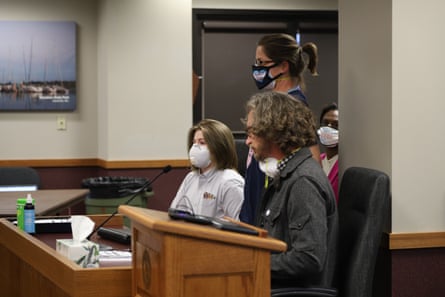
At one school board meeting last month in St Charles county, a more conservative county neighboring St Louis, queer and trans youth and their supporters sat through a lengthy discussion surrounding a proposal to make it easier for civilians to challenge potentially “obscene” materials – a move seen as an effort to increase censorship of LGBTQ+ content. Some attendees held “trust our teachers and librarians” signs and a trans pride flag, applauding when a student criticized the removal of queer characters from shelves; another speaker said kids shouldn’t be exposed to “sexual scenes”.
Toward the end of the meeting, a board member gave a speech about her disdain for trans youth using locker rooms, an item not on the agenda.
Youth protesters and parents of trans kids gathered at the end of the meeting to commiserate.
“The trans community is burning to the ground here. It’s a nightmare. Where are the national LGBTQ+ organizations?” said Kim Hutton, who has a trans son.
“They frame these policies as ‘protecting the children’, but they’re really just hurting specific marginalized groups. It’s not fun to see when you’re part of those marginalized groups,” said Hannah Yurkovich, a 17-year-old St Louis high schooler at the meeting. “I grew up here, I love St Louis, but I can’t be part of it, if it’s going to keep being against who I am.”
Her friend, Rohan Webb, 18, attended a neighboring high school that adopted gender-neutral bathrooms to better support LGBTQ+ students and had queer support groups. “To see this school district move in the exact opposite direction is saddening,” they said. “To see them getting to make students’ lives so much worse is infuriating.”
‘Will Democrats throw us to the fire?’
Trans Missourians and their families say they have endured by leaning on each other. Families carpool to government hearings. A regional summer camp provides a safe haven for LGBTQ+ youth. Rene and Kyle Freels, the parents of Chelsea, the recent high school graduate, run a support group for trans kids and parents, and they have organized “Transgiving” potlucks for Thanksgiving.
Chelsea has dedicated significant time to supporting trans youth who don’t have the resources she has had. Over breakfast at a queer-friendly cafe with her parents, she described how she assists others in legally changing their name, saying she had just received a court alert about a case she was managing.
“It’s all in the bucket of preventing suicidality,” Chelsea said matter-of-factly. “That is what worries me the most about going to college, because sometimes I have to talk them down … What happens if I’m not in St Louis?” She said she has been fighting to stop friends’ suicides since she was 15 and learned to always gets friends’ addresses in cases of emergencies.
“The public only hears from trans people in the positions of the highest of privileges. I have supportive parents, I’m white, I’m 18, I got healthcare – later than I needed it, but I got it. But my story is one aspect of the trans story, and it’s one of the better ones, and even it is filled with sadness.”
Chelsea, who is leaving the state for college and is interested in coding and liberal arts, said she felt disillusioned with politics. On the Republican side, people were using “genocidal rhetoric” to talk about trans people, she said, referencing calls for the “eradication of transgenderism” at last year’s Conservative Political Action Conference and demonization of trans people in the Trump-aligned Project 2025.
On the Democratic side, candidates defend trans rights, but it feels fragile, she said.
“The Democrats in Missouri are our allies, they’re the best support we have in the chamber, but there’s an anxiety they won’t always be that way. When shit hits the fan, they’ll say, is it worse to be out of office and standing on your morals, or is better to just throw a little bit to the fire? But the thing they’re throwing to the fire are my friends and family.”
The Freels considered relocating to Illinois last year, but couldn’t afford it.
“There will always be trans kids and they will be out and asserting themselves,” Rene Freels said. “We’re part of this leftover crew that is super mad and stubborn and wants to see this resolved and want our kids to have full civil rights.”
(From L-R) Rene, Chelsea and Kyle Freels pose for a photo. ‘There will always be trans kids and they will be out and asserting themselves,’ says Rene Freels. Photograph: Sam Levin/The Guardian
Miles, who hopes to become a teacher or work with youth, said leaving is not an option: “I’ve always wanted to stay here. It sounds weird, but I really love Missouri. I have so many memories here and I could see myself raising my kids here.”
Missouri is where he spent his whole life, where his favorite restaurants and hiking trails are, where his girlfriend and her family live, where he had his first date, he said.
He can’t imagine moving away from his elderly grandparents, who he stays with on a weekly basis. “I have a plan for my life,” he said, “and I couldn’t imagine doing it somewhere else.”
Throughout Meert and Thurow’s home are objects they have repurposed from friends who left the state due to anti-trans laws.
In the garden, the couple recently put up a sign saying they had planted beans “in remembrance of the 50+ families we know that have left Missouri”. But the number of departures is greater, she said. They’ve lost count.
I read these whenever I get ’em. I think everyone should, so give it a try when you get a few minutes. Well, unless you already did; I’m a few days late reading this one! 🌞
Company A of the 3rd Battalion, the 196th Light Brigade, refused to advance further into the Songchang Valley of Vietnam after five days of heavy casualties; their number had been reduced from 150 to 60. This was one of hundreds of mutinies among troops during the war.
“He [President Nixon] is also carrying on the battle in the belief, or pretense, that the South Vietnamese will really be able to defend their country and our democratic objectives [sic] when we withdraw, and even his own generals don’t believe the South Vietnamese will do it.” –James Reston in the New York Times
(Note from A: Sometimes, people recall things that don’t make it into these newsletters. I referred someone one time to the page, where you can contact the owner/writers, and let them know. They appreciate that, and you’ll see the item next time! Just in case.)
(I had a Substack from Jose’ Andres with a ceviche recipe, but after setting the post up, it turns out it’s a paid article, and I’m a free subscriber. Still, it sounded so perfect, especially for a day when someone might not have much appetite, so here’s a recipe from another place online I like to read. You may do the same thing I do: if I want something today, and don’t have an ingredient or two, or some ingredient doesn’t agree with me, I improvise with what I have/will eat. If I do that, I may not call it, say, ceviche, but just a thing I made. No worries! -A)
When the heat of summer sets in I just want to eat meals that will cool me down. My relationship with soups, stews, and basically anything that comes out of the oven is on hold for these next few months. I prefer easy summer dinners that come together quickly when I don’t feel like cooking.
Needless to say, this shrimp ceviche is on heavy rotation. The shrimp are gently poached first, then marinated in freshly squeezed lime and lemon juice with ripe summer tomatoes, red onion, jalapeño, and fresh cilantro. Add creamy, diced avocado right before serving. It’s tangy and refreshing, perfect for those hot summer days.
The shrimp are perfectly cooked. Instead of relying on citrus juice to “cook” the shrimp, we’re poaching the shrimp quickly in hot water. Poaching the shrimp gently cooks them for the best texture, then they’re marinated in fresh lime and lemon juice.
It’s bright and fresh; full of zesty lime, buttery avocado, juicy tomatoes, with a kick of jalapeño. Serve it as a snack, lunch, or light dinner. Whichever way you choose, be sure to have crunchy tostadas or tortilla chips nearby for scooping.
Key Ingredients in Easy Shrimp Ceviche
Peeled and deveined raw medium shrimp: Unless you’re buying shrimp fresh off the boat, it’s most likely been frozen at some point. Frozen shrimp is the best choice because you can find them already peeled and deveined in the frozen aisle at most grocery stores.
Citrus juice: Marinate the cooked shrimp in freshly squeezed lemon juice and lime juice.
Red onion: Finely chopped red onion gives the shrimp ceviche some bite.
Jalapeño pepper: Add finely chopped jalapeño for a bit of heat.
Cilantro: Chop both the leaves and tender stems, which are edible.
Avocado: Add the diced avocado right before serving.
How to Make Easy Shrimp Ceviche
Cook the shrimp. Bring a large pot of salted water to a boil over high heat. Turn off the heat, add the shrimp, poach until the shrimp are opaque and just cooked through, drain, and set aside until cool enough to handle.
Combine the ingredients. Chop the cooked shrimp into 1/2-inch pieces and place in a large bowl. Add the lemon juice, lime juice, tomatoes, red onion, jalapeño, cilantro, and salt, and toss to combine. Cover and refrigerate for at least 1 hour.
Add the avocado right before serving. Just before serving, dice the avocado, add to the ceviche, and gently toss to combine. Serve with tostadas or tortilla chips.
Helpful Swaps
Use frozen cooked shrimp. To save time, you can use frozen cooked shrimp instead of frozen raw shrimp. Thaw the frozen cooked shrimp completely and drain well before using.
Use serrano peppers. Use serrano peppers instead of jalapeño if you like a spicier ceviche.
Is Ceviche Safe to Eat?
We cook the shrimp for this ceviche, which means you don’t have to worry as much about obtaining the freshest raw shrimp possible, which can be a challenge depending on where you live and what’s easily accessible.
Storage Tips
Leftovers can be stored in an airtight container in the refrigerator for up to 1 day.
Easy Shrimp Ceviche Recipe
Prep time 15 minutes to 20 minutes, Cook time 2 minutes to 3 minutes
Serves 4 to 6
Ingredients
1 pound peeled and deveined raw medium shrimp, thawed if frozen
1/4 cup freshly squeezed lemon juice (from 2 lemons)
1/4 cup freshly squeezed lime juice (from 2 to 3 limes)
2 medium tomatoes, seeded and chopped
1/2 small red onion, finely chopped
1 medium jalapeño, seeded and finely chopped (about 3 tablespoons)
1/2 cup chopped fresh cilantro leaves and tender stems
1/2 teaspoon kosher salt
1 medium avocado
Tostadas or tortilla chips, for serving (optional)
Instructions
Bring a large pot of salted water to a boil over high heat. Turn off the heat, add 1 pound peeled and deveined raw medium shrimp, and poach until the shrimp are opaque and just cooked through, 2 to 3 minutes. Drain the shrimp and set aside until cool enough to handle, about 10 minutes.
Chop the shrimp into 1/2-inch pieces and place in a large bowl. Add 1/4 cup freshly squeezed lemon juice, 1/4 cup freshly squeezed lime juice, 2 chopped tomatoes, finely chopped red onion, 1 finely chopped medium jalapeño, 1/2 cup chopped cilantro, and 1/2 teaspoon kosher salt, and toss to combine. Cover and refrigerate for at least 1 hour or up to 4 hours.
Just before serving, dice 1 medium avocado, add to the ceviche, and gently toss to combine. Serve with tostadas or tortilla chips, if desired.
Recipe Notes
Storage: Leftovers can be stored in an airtight container in the refrigerator for up to 1 day.
(It’s very interesting. Well-written, but there are still little gold nuggets or Easter Eggs scattered throughout. It’s worth the click. Read it on my phone last night.)
At the very beginning I goofed and misspoke the name of the blog, referring to my old blog and old YouTube channel instead of Scotties Playtime blog and channel. Unfortunately I do not have editing software yet, and so I left it in as I would have to dump the entire video and make a new one. Remember I do not use scripts so I don’t know I could do a new one without a mistake either. Also remember it normally takes YouTube a day or more to do the CC for videos. Hugs. Scottie







 Scottie's Playtime