
Month: January 2025
Right Wing Weirdos Defend Disturbing Trans Hate Crime
“Infinite Hope”: Angela Davis Speaks at 2025 Peace Ball Ahead of Trump Inauguration
January 20, 2025 Watch The Show
With the U.S. political establishment gathered in Washington for the second inauguration of Donald Trump, the iconic venue Busboys and Poets on Sunday hosted the Peace Ball, an event held around presidential inaugurations since 2009 and featuring voices of resistance to war, racism, poverty and more. This year’s Peace Ball featured author Angela Davis, who spoke of the power of “infinite hope” to fight against injustice. “I want us all to generate the kind of collective hope that will usher us into a better future,” said Davis. We air highlights from the event.’
Transcript
This is a rush transcript. Copy may not be in its final form.
AMY GOODMAN: This is Democracy Now!, democracynow.org. I’m Amy Goodman.
On Saturday night in Washington, D.C., Busboys and Poets hosted the 2025 Inaugural Peace Ball, which first started in 2009 with the inauguration of President Obama. The theme was “A Gathering for Positive Change.” While the event had once been held at the Smithsonian’s National Museum of African American History and Culture, this year Busboys and Poets founder Andy Shallal was quoted in The New York Times saying that the museum had complaints about, quote, “the tone of the event,” even though some of the featured speakers are also featured in the museum, including the abolitionist, the author, the professor and longtime activist Angela Davis. The event did proceed, however, at the Arena Stage at the Mead Center for American Theater. This is Angela Davis.
ANGELA DAVIS: A lot more is happening in the world than the inauguration of someone who represents fascism in this country and the world. And if we look back at struggles for justice and equality, we find that there aren’t often propitious moments for those struggles. We’ve always confronted waves of conservatism. And while we cannot create the conditions for the struggles in which we engage, we can bring our determination. We can bring our vision for a better future. And even as we express the deep disappointment — and I’m not going to try to enumerate all of the things about which we are collectively disappointed, but we can’t find ourselves so ensconced in that disappointment that we don’t create the kind of hope that will allow us to move forward and pass legacies to the next generation of people who are struggling. And we do — we do — we do want to join that celebration that Linda Sarsour talked about on the sands of Gaza. We want to be able to look forward to that moment.
Now, I guess I should at least mention the fact that the conditions of struggle today are horrendous. And when I try to imagine what it might mean to confront, you know, all of those who are the billionaires, who once were opposed to Trump, who are now offering themselves up to him, but when I think about the move toward fascism, I also celebrate the fact that we have never seen as many people stand up for the freedom of Palestine. People who were dissuaded in the past by Zionist propaganda are standing up and powerfully demanding a free Palestine. Free, free Palestine. And that is what we are celebrating this evening. That is what we are celebrating.
Now, I think it might be propitious — I’ll use that word again — that the inauguration is happening on the same day as we celebrate the birthday of Dr. Martin Luther King. And in that context, I want to remind us that it was Dr. King who said that we cannot capitulate to finite disappointments, and what we do is we confront those finite disappointments with infinite hope. And that is what we are in the process of doing.
AMY GOODMAN: That was Angela Davis, the abolitionist, the author, the professor, the longtime activist, speaking at the 2025 Inaugural Peace Ball at the Arena Stage on Saturday night. Special thanks to the whole Democracy Now! team and to Guy Warner.
The original content of this program is licensed under a Creative Commons Attribution-Noncommercial-No Derivative Works 3.0 United States License. Please attribute legal copies of this work to democracynow.org. Some of the work(s) that this program incorporates, however, may be separately licensed. For further information or additional permissions, contact us.
https://www.democracynow.org/2025/1/20/infinite_hope_angela_davis_speaks_at
NH man accused of civil rights violation in LGBTQ sign thefts
Maga cult members and the fundamentalist Christians (maybe they are the same) are feeling very emboldened. They feel they have the right to erase those they don’t like or agree with. Remember their refrain is to make America great again and take back their country back. Their country, only theirs. No one else matters, no one else should be here if they disagree with them or live differently from the maga Christians. They want a country for only them by only them. We really have to fight this hard. Hugs.
=================================================================
Frank Hobbs Jr. is accused of stealing signs supporting gay rights from an intersection in Goffstown, New Hampshire, during Pride Month
By Michael Rosenfield
A New Hampshire man is under investigation for possible civil rights violations.
Frank Hobbs Jr. is accused of swiping someone else’s signs supporting gay rights.
New Hampshire authorities say Hobbs was caught on camera stealing signs from a Goffstown intersection.
A woman had lawfully placed signs in support of the LGBTQ community, and when one of them disappeared, she decided to do some detective work.
“She set up a trail camera to monitor the intersection and make sure her signs weren’t taken down,” said Senior Assistant New Hampshire Attorney General Sean Locke.
Sure enough, that camera recorded another theft taking place.
“She was able to capture someone on video coming to the intersection removing the signs and driving away,” said Locke.
It happened last June during Pride Month, and the New Hampshire Department of Justice has now filed a complaint against Hobbs accusing him of civil rights violations.
Local law enforcement said he was easily recognizable because he’s well known in the community.
According to court documents, Hobbs denied knowing anything about the incident, but when informed there were photos, he said he’d been told by people at Town Hall he could remove signs that displayed “pedophile symbols” and that he found the signs offensive.
“These identity-based or bias-based behaviors and unlawful acts create a perception in the community that this may not be a safe place if you’re a person who identifies as LGBTQ+ if these signs are getting torn down,” said Locke.
Hobbs has not returned multiple requests for comment.
He will have a hearing and is facing thousands of dollars in fines depending on what a judge decides.


Peace & Justice History for 1/21
January 21, 1661 King Charles II The Quaker (Society of Friends) Peace Testimony was presented to King Charles II of England. The testimony begins: “We utterly deny all outward wars and strife and fightings with outward weapons, for any end or under any pretence whatsoever. And this is our testimony to the whole world….” Why are Quakers pacifists |
| January 21, 1954 The first atomic-powered submarine, the USS Nautilus, built by Electric Boat Company, was launched at Groton, Connecticut. All previous submarines were powered by batteries which had to be periodically recharged by diesel-powered generators which could only run if the sub surfaced.The nuclear power plant, developed under the leadership of Captain Hyman Rickover, and its ability to produce its own fresh water, allowed Nautilus and its successors to remain underwater and undetectable for weeks rather than hours. It carried only conventional torpedoes. It has been completely restored and can be seen at the Submarine Force Museum in Groton.  nautilus submarine launch |
| January 21, 1977 The day after his inauguration President Jimmy Carter declared an unconditional amnesty for draft resisters, both the accused and those who might have faced possible prosecution. Carter’s pardon |
| January 21, 1984 A Women’s Peace Camp was set up near Volkel Airbase in The Netherlands to protest siting of U.S. nuclear weapons there. |
https://www.peacebuttons.info/E-News/peacehistoryjanuary.htm#january21
How I post using the classic editor
Step 1. Click the + symbol of the block editor
Step 2. Type CL in the search box for widgets displaying the classic one.

Step 3. Click the classic.

Step 4. Click the gray bar.

Step 5. Using some of the features. If you want to change the color or font size or bold, italicize, and more, use the bar. If you want to change the color or what you wrote just highlight the words and pick a new color. The classic editor bar makes it so easy. So as most know I like to write my own stuff in blue. Just click the large A with the line under it and chose the color you want to write in. Then type.



Step 6. To add pictures you can copy and paste or you can use the camera / music note symbol. Notice the things you can do in the media library. This is the place every picture, meme, cartoon is stored. From every post. You can click on one or more and insert them. You can upload from your computer or a website.



You can double click the picture if you want to adjust the size or if you want writing to one side or the other of the picture. I find it so easy to add stuff like this. There is only one issue to remember. If you want to post a link you must get out the classic editor first or it will wipe out everything you have done. If that does happen just use the undo button to restore what you wrote in classic. You might have to do it twice but it does work. So if you are writing in classic and need to post a link like a YouTube video just click below the current box to get a new block, post the link, click below that and get a new block, do the steps above to go back to classic. I wrote this entire thing in classic and it is so easy including adjusting the screen captures I did. I hope this makes blogging easier for you. If you have any questions please ask me. Hugs.
Good Advice From Jenny Lawson
Not giving up by Jenny Lawson (thebloggess)
Read on Substack
It’s a hard time to be an empath out here, y’all.
I suspect many of you are also feeling too much of the darkness of the world, which can be especially dangerous for those who already stand too close to the edge of the abyss. It can be easy to burn with anger at hypocrisy and hate and chaos, but here is what I have learned…and what I keep telling myself:
You can use that heat as fuel to create change, to promote kindness, to protect yourself and those who are most vulnerable…to keep you warm when the world seems too cold. But, that burning anger can also be dangerous. It can exhaust you. It can pull the oxygen from the room. It can cause you to lash out in fear at those who want to help. The smoke obscures how much good and joy is out there. And those who thrive on turmoil and hate are so happy to see you lost in it…to see your precious energy drained putting out the fires they scatter about just to keep you too busy to live.
Don’t let the world burn you to ashes.
Protecting your fragile heart can be an act of rebellion. Don’t be afraid to love and laugh and find joy and silliness even in the hard times.
Especially in the hard times.
Don’t underestimate the beautiful works of love and kindness and help that you put out into the world. You may do them loudly or you may do them quietly, but they are invaluable in ways you may never see.
Today’s doodle is inspired by one of my favorite Czech artists, Alphonse Mucha, who came from the same land that my father’s family immigrated from.
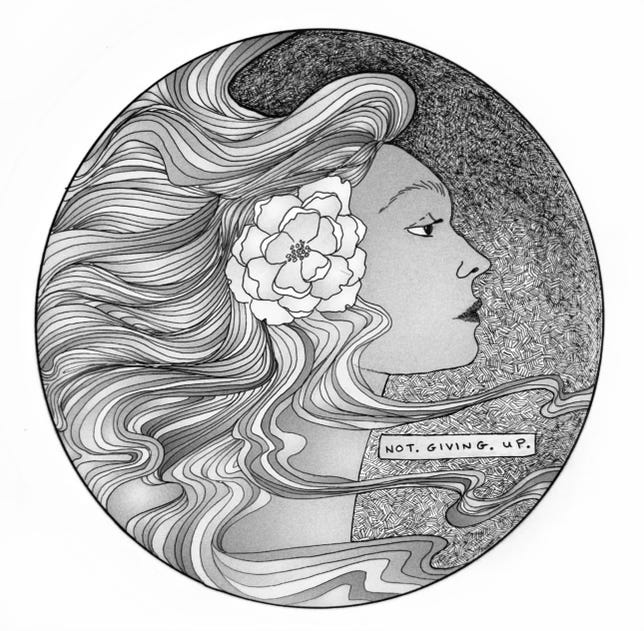
“NOT. GIVING. UP.”
Most people know Mucha from his flowy art-nouveau posters and cigarette ads but my favorites of his came at the end of his life, when he used his art to explore both the pain and the beauty of life. This one, Woman With a Burning Candle, stays with me:
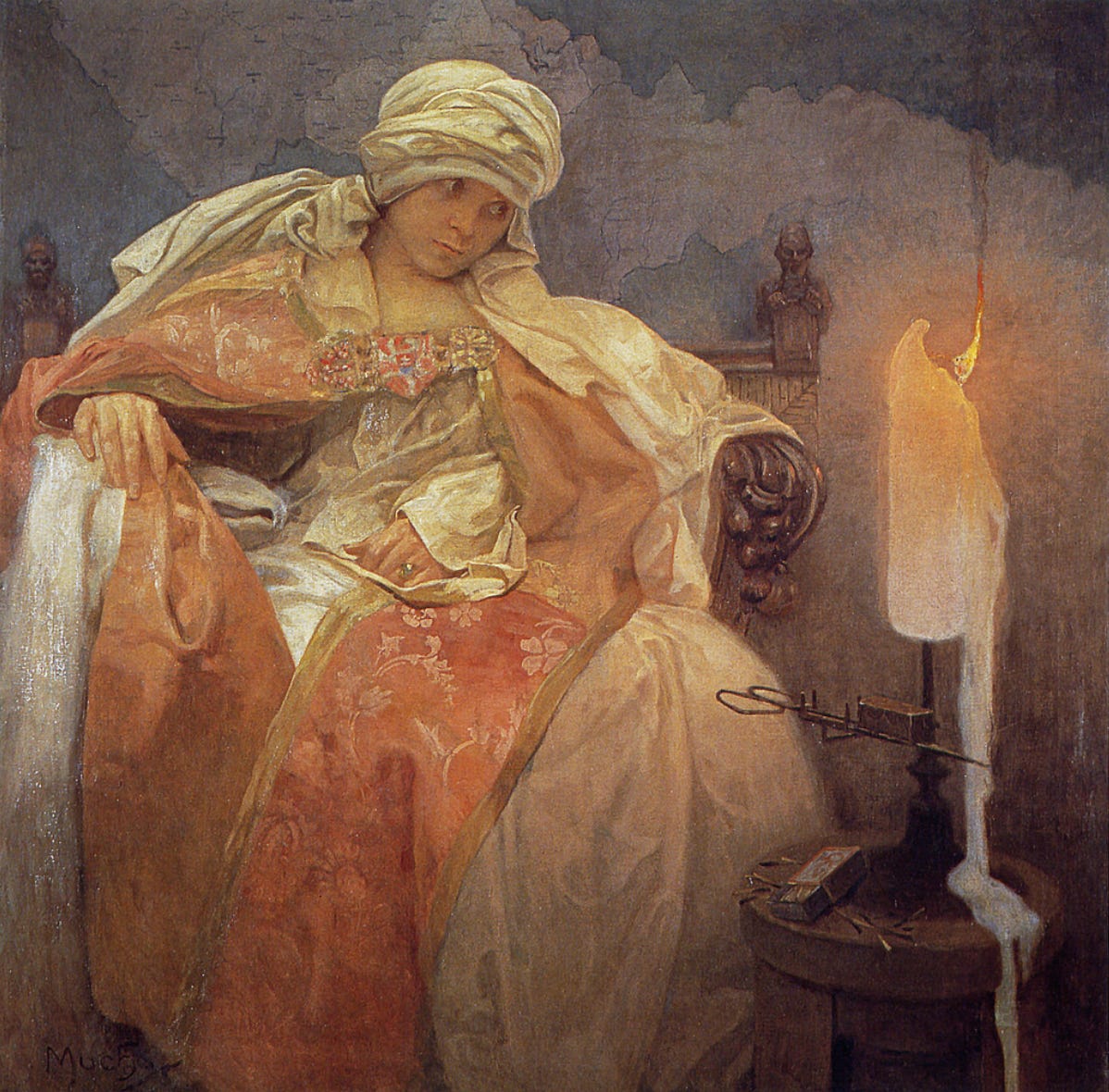
It was painted during the rise of Nazism…a slavic woman tending to a candle…keeping the light in the dark going, but watching as it slowly burns down…unsure as to what would come next but still focused on the glowing illumination. He painted about enlightenment, love and knowledge in a time when all that seemed to be threatened and was an act of revolution. The day after Prague was stormed by Nazi’s, Mucha was arrested and while in custody he contracted the pneumonia that would kill him. He never lived to see the victory over the darkness, but even in that darkness and uncertainty he created light that we can still see today. He still found beauty and joy. He found a way to celebrate life and enlightenment and humanity in his own way.
He didn’t give up.
I’m not going to either.
I super-crazy love you.
~ Jenny
PS. If you ever want to feel bad about your doodles you should follow one up with a painting by an actual master because…wow. Lesson learned. (snip)
Jon Stewart DISMANTLES Right Wing Grifter On His Show | Hasanabi reacts
OK, So There Is Bad News Within,
but the reason I’m posting it is so we can be aware, and be better able to help our own neighbors locally. It may not be ours to start writing letters and calling on ACLU or any of those things, but maybe simply keeping our eyes open for the regular people we know or interact with. So here is this, which came to me from Death Penalty Action. It’s the first 10 EO’s issued today, plus some policy info.
All of the Day 1 executive actions Trump has announced so far
Updated January 20, 20251:50 PM ET By Lexie Schapitl Franco Ordoñez
For updates, context and analysis of Donald Trump’s 2025 inauguration, check out NPR’s live blog throughout the day Monday.
President Trump is expected to sign a flurry of executive orders, memorandums and proclamations after his inauguration on Monday, reversing many of his predecessors’ policies and reinstating actions from his first term in office.
The actions are expected to address a range of issues, including campaign priorities like border security and culture war issues like DEI policies.
Here’s what we know so far:
Immigration
Trump is expected to declare a national emergency at the U.S. southern border, designate criminal cartels as terror groups and end birthright citizenship for children born to immigrant parents without legal status, according to incoming White House officials who spoke to reporters on a call on condition of background.
Trump will also reinstate the “Remain in Mexico” policy, which would require some asylum seekers at the southern border to wait in Mexico for their hearings in U.S. immigration court, the officials said.
The moves are some of 10 sweeping executive actions on border security that incoming officials say Trump plans to sign on Monday:
- Declare a national emergency at the border: The officials on the call said this action will allow U.S. armed forces to finish the border wall and allow the secretary of defense to deploy members of the armed forces and National Guard to the border.
- “Clarify” the military’s role in border security: This action “directs the military to prioritize our borders” and protect territorial integrity “by repelling forms of invasion, including unlawful mass migration, narcotics trafficking, human smuggling and trafficking and other criminal activities,” the officials said.
- End “catch and release,” continue building the wall, and end “Remain in Mexico”
- Designate criminal cartels as terrorists: This will allow the U.S. to more easily remove members of groups like Tren de Aragua, a transnational criminal organization from Venezuela, and MS-13.
- Suspend refugee resettlement: The official said the U.S. would suspend refugee resettlement for at least four months.
- End asylum and close the border to those without legal status via proclamation: Officials said they are planning to end asylum entirely and close the border to those without legal status via proclamation, “which creates an immediate removal process without possibility of asylum.”
- End birthright citizenship: The officials said the White House plans to end birthright citizenship, which is enshrined in the 14th Amendment. They argued the amendment does not recognize automatic birthright citizenship for children born in the United States to parents without legal status. This action is likely to see immediate legal challenges.
- Enhance vetting and screening: The officials said they are going to “enhance vetting and screening of illegal aliens.”
- “Protect American citizens against invasion”: Officials said this “equips agents and officers of ICE and CBP with the authorities” they need to deport people from the U.S.
- Restore the death penalty: “This action in particular, directs the Attorney General to seek capital punishment for the murder of law enforcement officers and capital crimes committed by illegal aliens. It encourages state agencies and district attorneys to bring capital state charges for these crimes,” the officials said.
Read more from NPR’s Ximena Bustillo.
Defining ‘sex’ and ending DEI programs
Trump will sign an executive action on Monday that says it’s the policy of the United States to recognize two biologically distinct sexes — male and female — an incoming White House official speaking on background told reporters Monday.
“These are sexes that are not changeable, and they are grounded in fundamental and incontrovertible reality,” the official said.
The change will require government agencies to use the definitions on documents like passports, visas and employee records the official said. Taxpayer funds will not be allowed to be used for “transition services,” the official said.
A second action will end diversity, equity and inclusion programs in the federal government, the official said, giving as examples environmental justice programs in the U.S. Department of Agriculture, as well as diversity training.
National energy emergency and “electric vehicle mandate”
Trump intends to declare a national energy emergency on Monday, aiming to cut red tape and regulations for the energy industry, and a second one specific to Alaskan resources, an incoming White House official told reporters on a background conference call.
“That national energy emergency will unlock a variety of different authorities that will enable our nation to quickly build again, to produce coal and natural resources, to create jobs, to create prosperity and to strengthen our nation’s national security,” the official said. The official said energy prices are too high, but declined on the call to name a lower target price.
The action will end what incoming Trump officials call the “electric vehicle mandate” and will end “efforts to curtail consumer choice on the things that consumers use every single day, whether it be showerheads, whether it be gas stoves, whether it be dishwashers and the like,” the official said.
Trump has long railed against energy efficiency standards on the campaign trail, and specifically taken aim at “electric vehicle mandates,” a term he uses to encompass all policies designed to encourage a transition to battery-powered cars. Rules actually requiring 100% of vehicles to be electric do not exist on the federal level.
Inflation
Trump will sign a presidential memorandum on inflation Monday, an official from the incoming administration said. The official did not provide additional details.
NPR correspondents Tamara Keith, Ximena Bustillo and Camila Domonoske contributed to this report.
Useful Info for We Who Care
DEI in the Age of Trump: A Roadmap on How to Build More Just Communities in the Next Four Years
PUBLISHED 1/18/2025 by Nilanjana Dasgupta
With Trump’s second presidential administration looming before us, Americans who care deeply about equality and social justice are asking ourselves: What now? How do we move forward in this dramatically changed political and legislative climate? What actions will have a fighting chance of getting traction? What is the most effective sphere of influence for individuals?
A high priority of Trump’s agenda for his second presidential term is to eliminate diversity equity and inclusion (DEI) programs in federal agencies and to also take away federal funding from agencies, contractors and organizations that have DEI programs. This, together with the repeal of affirmative action in college admissions by the U.S Supreme Court, makes many initiatives related to diversity and civil rights a target for the second Trump administration.
The truth is some diversity, equity and inclusion programs, like training, haven’t worked. Research shows that while DEI trainings increase attendees’ awareness and knowledge about bias, there’s little evidence of changes in attendees’ behavior, nor increased diversity in the types of people hired, promoted, retained or more inclusive climate in the organizations where such training is implemented. Sometimes DEI training backfires, creating resentment and resistance when people feel coerced.


In my new book, Change the Wallpaper: Transforming Cultural Patterns to Build More Just Communities, I explain why.
DEI training tries to change individuals’ beliefs, hoping it will change their future behavior. But individuals’ beliefs often don’t shift behavior because human behavior is buffeted by multiple situational forces. These include the social roles individuals occupy and their accompanying behavioral etiquette, what others around them are saying or doing, and norms and rules that constrain their actions, all of which guide people’s behavior no matter what their personal beliefs.
Another situational force is the physical design of places where people live and work, which influences whether casual interactions with others of diverse backgrounds are easy or not. Such interactions, when pleasant and repeated, morph into familiarity and friendliness that are an essential building block for trust.
Like wallpaper, these situational forces are in the background, barely noticed. Yet they subtly nudge people’s thoughts and actions in small ways, accumulating over time in one of two directions. They either pull us apart based on initial differences, increasing unfamiliarity, mistrust and polarization, or they push us together, increasing familiarity, trust and inclusion.
We need to notice the wallpaper that silently pulls and pushes our own behavior. To do that, we must step out of our bubble and mix with people different from ourselves.
Even if individuals’ behavior were to be changed by DEI training, they would be quickly overwhelmed by the wallpaper when they returned to their workplace, stepped into their old roles, surrounded by unchanged norms, rules and colleagues, and in buildings with limited physical arrangements for cross-group mixing and relationship building.
Here is an alternative roadmap to social justice backed by scientific research simplified in the form of five steps.
First, we need to notice the wallpaper that silently pulls and pushes our own behavior. To do that, we must step out of our bubble and mix with people different from ourselves. Have real conversations, be curious and learn about the material conditions of others’ lives that may not be visible from the outside. Repeated interactions start a virtuous cycle of growing familiarity, understanding, trust, cross-group relationships and a sense of belonging in a shared community. These interactions reveal stories about people’s material conditions, highlighting inequality or vulnerability in a personal way, and grow solidarity and momentum for change.
Know that inequalities often hide in the “3 Rs” where we live and work: rules, resources and recognition. Do the rules in the place where you live or organization where you work exclude some people’s voices from decision-making, especially people with less power? Are there transparent and reasonable processes to change these rules? Are resources distributed to individuals based on need, merit, effort, seniority, or a combination? Are the criteria and processes for resource distribution open and transparent? Are people recognized for their contribution fairly?
If you see inequalities in the 3 Rs where you live or work, don’t be silent. Talk to others, see what they think, and explore ways to act collectively for change.
Second, actions make more of a difference if they attempt to change the material conditions of people’s lives—access to high quality education, healthcare, housing and employment—than if they are mostly symbolic—mission statements, lawn signs or imagery of diverse people on websites and marketing materials.
Third, acting collectively with other people will get more traction rather than acting alone because individuals quickly get swept away by situational forces. In acting together, the goal is not to limit ourselves to gather with people who are all the same. Rather, when we are not afraid to mix with people different from ourselves, we are able to discover and develop new allies across the spectrum instead of being caught in old identity traps that haven’t served us well.
Because the wallpaper is old and sticky, collective action is needed over and over again in different ways. It’s not one and done. That’s the fourth step.
Finally, actions get more traction if they are local. That’s the Goldilocks space. That’s our call for action in the next four years and the hope for change.
==============================================================
Ms. Classroom wants to hear from educators and students being impacted by legislation attacking public education, higher education, gender, race and sexuality studies, activism and social justice in education, and diversity, equity and inclusion programs for our series, ‘Banned! Voices from the Classroom.’ Submit pitches and/or op-eds and reflections (between 500-800 words) to Ms. contributing editor Aviva Dove-Viebahn at adove-viebahn@msmagazine.com. Posts will be accepted on a rolling basis.
 Scottie's Playtime