I post this to again affirm that not all Christian denominations / churches are bigoted racist jerks using their holy book to bash others they don’t like. There are many good supportive Christians in the world as there are members of other faiths along with people of no faith. We should call out the bigots who use their religion to control others rather than as a guide for how they live their lives. But remember we must not blame all religious people / people of faith for the actions of those who are abusive of others. I am a live and let live person. I don’t want to control the lives of other people. I can barely handle being an adult in my own life, I don’t need the job of telling everyone else how to live. The caveat I will add to the live and let live way of life, it assumes others do not want to cause harm to others. Society has a responsibility to protect and care for each other and protect those who need such from those who do not respect the personhood of others. Hugs
Beth Bloom (L) and Pat Uleskey (R), among the couples getting married Saturday in downtown Rochester.
Love and resilience were on full display this past weekend at the inaugural Big Gay Wedding Day, held at Rochester’s First Universalist Church.
Organized by local Unitarian Universalist congregations, including First Unitarian Church of Rochester, First Universalist Church of Rochester and the Unitarian Universalist Church of Canandaigua, the free event offered LGBTQ+ couples the opportunity to marry in a safe and affirming environment.
The event came at a time of growing concern over potential shifts in federal policies that some worry could threaten marriage equality and other LGBTQ+ protections under the incoming administration. Advocacy groups have voiced fears that hard-won rights for queer and trans individuals may be at risk.
Stephanie Ballard-Foster
/
WXXI News
Caliana (L) and Angelas Rolon Torres (R) who were among the couples getting married Saturday in downtown Rochester.
Rev. Lane-Mairead Campbell, Minister of the First Universalist Church of Rochester and one of the event’s organizers, said the importance of providing certainty and support for LGBTQ+ couples in the face of these challenges cannot be overstated.
“We’re seeing anti-transgender legislation being upheld and passed like across our country, and so this is a way that we could provide some certainty for our community and be able to provide some space to be able to get married legally, safely, quickly, inexpensively,” said Campbell.
Local vendors were on hand to donate flowers, cakes and professional photography services to create a celebratory atmosphere. After the ceremonies, couples and their supporters gathered for a reception.
Rev. Shari Halliday-Quan, Lead Minister at the First Unitarian Church and an event organizer, said her own experience demonstrates why events like this are important. In 2012, same-sex marriage was illegal in New York, so she and her now-wife planned to marry in Massachusetts, where their Unitarian Universalist congregation welcomed same-sex weddings. By the time they wed, New York had legalized same-sex marriage, allowing them to marry at home.
Stephanie Ballard-Foster
/
WXXI News
A wedding cake at an event in downtown Rochester on Saturday, titled, ‘Big Gay Wedding.’ Local vendors donated flowers, cakes, and professional photography for the event which was organized by LGBTQ+ advocates.
Even though more than a decade has passed, Halliday-Quan said the need to create safe and affirming spaces for queer couples remains pressing.
“It matters deeply,” she said. “I think today, that right now, we’re helping couples secure rights that they’re worried will be taken away. We all hope that that won’t be the case. But what I want folks to know, and what I think today really celebrates and uplifts, is that queer and trans people have a place in our community, that you are loved and worthy.”
Among the couples married during the event were Caliana and Angeles Rolon Torres, who first discovered the opportunity while scrolling through Instagram. The couple, grateful for the chance to marry without financial barriers, said the event was especially meaningful after facing financial struggles.
“It means the world in that regard,” said Caliana. “The fact that we can do something like this, and there’s any organization doing something like this that enables people to get married, not only for free, but also before people are worried about it and things like that, is incredible. Like, outside of the marriage itself, the fact that this is happening is an amazing concept.”
Since the legalization of same-sex marriage in New York in 2011, more than 25,000 same-sex couples in the state have tied the knot. Nationally, there are an estimated 711,000 married same-sex couples in the United States.
This is more than the general republican wish to hurt poor people to help the wealthy. This is about the tRump tax cut give aways to the very wealthy in the US costing the add of 8 trillion to the national debt. The republicans wrote the bill so the minor cuts to the lower income’s taxes sunset with in a couple years, but the wealthy people got to keep theirs for ten years. Now they are due to sunset and the government will receive a huge influx of revenue again to pay the bills of running a country, paying for the world’s largest bloated military, and to help the poorest people in the country survive with some dignity. But tRump and the republicans are determined to make those cuts permanent and never ending while constantly pushing for more cuts to their taxes. Their goal is to push the entire cost of running the government on to those least able to pay for it, the lower incomes while the upper incomes pay little to nothing. Then using the complaints of the people that their taxes are too high they will cut social services and the social safety nets for the poorest among us including the elderly and disabled. Plus they will stop funding road repairs and other infrastructure projects and when people complain will privatize the roads, selling sections to companies who will be able to charge tolls of any amount they wish to make profit off the public needing to get somewhere. How we stop them I don’t know. Idiots worried about the price of eggs bought every lie tRump made about how he was going to magically bring all the prices down to 2020 levels … when the stores were empty and we had no toilet paper. Now he admits that he can not and will not be lowering prices, and the cult is not getting upset about being lied to by the leader of their cult. Hugs
lawmakers estimating Trump’s domestic policy agenda — including tax cuts and border security proposals — costing as much as $10 trillion over the coming decade.
House Republicans are passing around a “menu” of more than $5 trillion in cuts they could use to bankroll President-elect Donald Trump’s top priorities this year, including tax cuts and border security.
The early list of potential spending offsets obtained by POLITICO includes changes to Medicare and ending Biden administration climate programs, along with slashing welfare and “reimagining” the Affordable Care Act.
Five people familiar with the document said those provisions are options to finance Republicans’ massive party-line reconciliation bill or other spending reform efforts, including those being spearheaded by the so-called Department of Government Efficiency.
The people, granted anonymity to discuss closed-door negotiations, said that the list originated from the House Budget Committee, chaired by Rep. Jodey Arrington (R-Texas). Republicans involved in the reconciliation plans have been generally targeting the listed programs for several months, but internal GOP fights over trillions of dollars in potential cuts are just beginning.
The overall savings add up to as much as $5.7 trillion over 10 years, though the list is highly ambitious and unlikely to all become law given narrow margins for Republicans in the House and Senate.
Cuts to Medicaid, the Affordable Care Act and the country’s largest anti-hunger program would spark massive opposition from Democrats and would also face some GOP resistance. House Speaker Mike Johnson can’t afford any Republican defections if he wants to pass a package on party lines.
Even proposed cuts to green energy tax credits, worth as much as $500 billion, could be tricky — as the document notes, they depend “on political viability.” Already 18 House Republicans — 14 of whom won reelection in November — warned Johnson against prematurely repealing some of the IRA’s energy tax credits, which are funding multiple manufacturing projects in GOP districts.
A House GOP source said that the “document is not intended to serve as a proposal, but instead as a menu of potential spending reductions for members to consider.”
Johnson and GOP leaders are hunting for trillions of dollars in cuts, with lawmakers estimating Trump’s domestic policy agenda — including tax cuts and border security proposals — costing as much as $10 trillion over the coming decade.
Johnson, with scores of House Republicans this week to chart the way forward, and groups of GOP members are set to meet with Trump in Florida this weekend.
In addition to Medicaid and ACA cuts, the document floats clawing back bipartisan infrastructure and Inflation Reduction Act funding.
One senior GOP lawmaker, asked if there were any particularly controversial spending offsets dividing Republicans, replied: “They all feel pretty controversial.”
Johnson agreed to make $2.5 trillion in spending cuts through the budget reconciliation process as part of last year’s government funding negotiations. Asked in a brief interview Wednesday evening if he was targeting $5 trillion in spending offsets, he replied, “Not sure yet.”
The policy menu suggests Republicans could capture major savings from Medicaid — up to an estimated $2.3 trillion. The list includes so-called per-capita caps on Medicaid for states, meaning the program would be paid for based on population instead of being an open-ended entitlement, and would institute work requirements in the program.
The list also includes a policy to equalize payments in Medicaid for able-bodied adults with those of traditional Medicaid enrollment — those with disabilities or low-income children, which would save up to $690 billion.
It would “recapture” $46 billion in savings from Affordable Care Act health insurance plan subsidies, which are set to expire at the end of the year, setting up a major policy battle. It would also limit eligibility for plans based on citizenship status.
Also on the chopping block are President Joe Biden’s climate policies, which are estimated to yield as much as $468 billion. That includes Trump’s repeated promise to repeal Biden’s “EV mandate,” as well as discontinuing “Green New Deal” provisions from the bipartisan infrastructure law and green energy grants from the IRA.
The green energy cuts could be particularly tricky from a political perspective. GOP lawmakers have long backed some technologies supported under the climate law, including supporting hydrogen, biofuels and carbon capture.
After Greenland, Canada. Then we liberate Great Britain, like Elon Cunt suggested. We may as well annex Phony Stark’s homeland, as well. Then why don’t we add Central and South America? That’ll stop immigration. We should also stop the Woke Mind Virus in English speaking Australia, too.
After handing Europe to Putin the final step is renaming our country Oceania.
January 12, 1954 Secretary of State John Foster Dulles announced U.S. would go beyond of President Harry Truman’s doctrine of “containing Communism” for a new policy: “. . . there is no local defense which alone will contain the mighty landpower of the Communist world. Local defenses must be reinforced by the further deterrent of massive [nuclear] retaliatory power.” More on Massive Retaliatory Action(We might check in on this in light of recent Republican rhetoric; some history need not be made nor repeated -A.)
January 12, 1957 The Southern Christian Leadership Conference (SCLC) was founded by Dr. Martin Luther King, Jr. and other African-American clergymen who wanted to press for civil rights long denied members of their community. Sixty black ministers from ten states went to Atlanta, Georgia, to set up the coordinating group. They elected King as its first president, with the Reverend Ralph David Abernathy as treasurer. SCLC history
January 12, 1962 Federal workers were guaranteed the the right to join unions and bargain collectively after President John F. Kennedy signed Executive Order 10988.“Employees of the Federal Government shall have, and shall be protected in the exercise of, the right, freely and without feel of penalty or reprisal, to form, join and assist any employee organization or to refrain from any such activity.” Eventually, regulation of labor-management relations in the federal government was codified under the Civil Service Reform Act of 1978. President Kennedy signing executive order
January 12, 1971 Reverend Philip F. Berrigan, founder of the Catholic Peace Fellowship anti-Vietnam War organization, was indicted along with five others on charges of conspiring to kidnap National Security Advisor Henry Kissinger, and to bomb the tunnels of federal buildings in Washington, D.C. They became known as the Harrisburg Seven. At the time, Berrigan was serving a six-year sentence at a federal prison in Connecticut with his brother, Daniel, for their destruction of military draft records in Maryland during 1967-68. The Berrigans’ ethic of nonviolence towards others made the charges questionable, and eventually all six were acquitted of the conspiracy charges. Phil Berrigan and Elisabeth McAllister, later his wife, were ultimately convicted and sentenced on just one count of smuggling mail out of a federal penitentiary, the only person in history to be prosecuted on such a charge. More about Philip Berrigan The Harrisburg Seven
January 12, 1971 “All in the Family” premiered on CBS-TV. The sitcom focused on the major social and political issues of the day such as racism, war, homosexuality and the role of women. In-depth background on the show
January 12, 1987 Twenty West German judges were arrested for blockading the U.S. Air Force base at Mutlangen, West Germany where Pershing II nuclear-armed cruise missiles were deployed. Judge Ulf Panzer stated: “Fifty years ago, during the time of Nazi fascism, we judges and prosecutors allegedly’did not know anything.’ By closing our eyes and ears, our hearts and minds, we became a docile instrument of suppression, and many judges committed cruel crimes under the cloak of the law. We have been guilty of complicity. Today we are on the way to becoming guilty again, to being abused again. By our passivity, but also by applying laws, we legitimize terror: nuclear terror.Today we do know…” More on “Judges and Prosecutors for Peace”
January 12, 2002 The “Refusenik” movement began when 53 Israeli soldiers signed an ad refusing to serve in the West Bank or Gaza Strip. Their letter concluded: • We shall not continue to fight beyond the 1967 borders in order to dominate, expel, starve and humiliate an entire people. • We hereby declare that we shall continue serving in the Israel Defense Forces in any mission that serves Israel’s defense. • The missions of occupation and oppression do not serve this purpose – and we shall take no part in them. [The term originally referred to Jews in the Soviet Union who had applied to emigrate but were delayed or refused by the Communist government, in one case for more than 22 years.] Video interview with Yonatan Shapira, refusenik and former captain in the Israeli Air Force
The year 2025 is off to an extremely rocky start. Between the devastating Los Angeles fires and Donald Trump’s upcoming inauguration, times are tough. But if you’re on the hunt for a small kernel of joy, may we recommend tuning into season three of The Traitors for some respite? Hosted by none other than Emmy-winning diva Alan Cumming, the hilarious and messy game takes place in a stunning Scottish castle — and features some of our favorite reality TV icons and villains as they basically play an amped-up version of the party game Mafia with twists, turns, and delicious challenges. Prepare yourself to watch some Real Housewives stir the pot while big-game players — think: Survivor, Big Brother, The Challenge — inflict maximum pain on the competition. It really is as fun as it sounds.
This season, specifically, features a cast seemingly pulled directly out of our very gay fever dreams. Bob the Drag Queen! Gabby Windey! Chrishell Stause! Carolyn Wiger! A gay royal! Thank you, Alan. We are forever indebted to you for your efforts to ramp up the LGBTQ+ factor this year. After Peppermint was the first to be voted out last season… it’s nice to have multiple icons to root for, especially ones so vehemently opposed to Vanderpump Rules villain Tom Sandoval.
The longtime Traitors fans here at Them have been counting down the days until the return of this beloved show, so in honor of the first three episodes being released on Peacock, we sat down to discuss our fave players, judge the choices they’ve made so far, and share our hopes for the rest of the season. Below, site director Samantha Allen joins me to break it all down. — Ana Osorno (snip-More at the link)
‘Concerns About A Stronger-Than-Expected Economy’ Is A Real CNN Thing We Just Read by Rebecca Schoenkopf
Oh no everybody’s got jobs. This is terrible news for stonks! Read on Substack
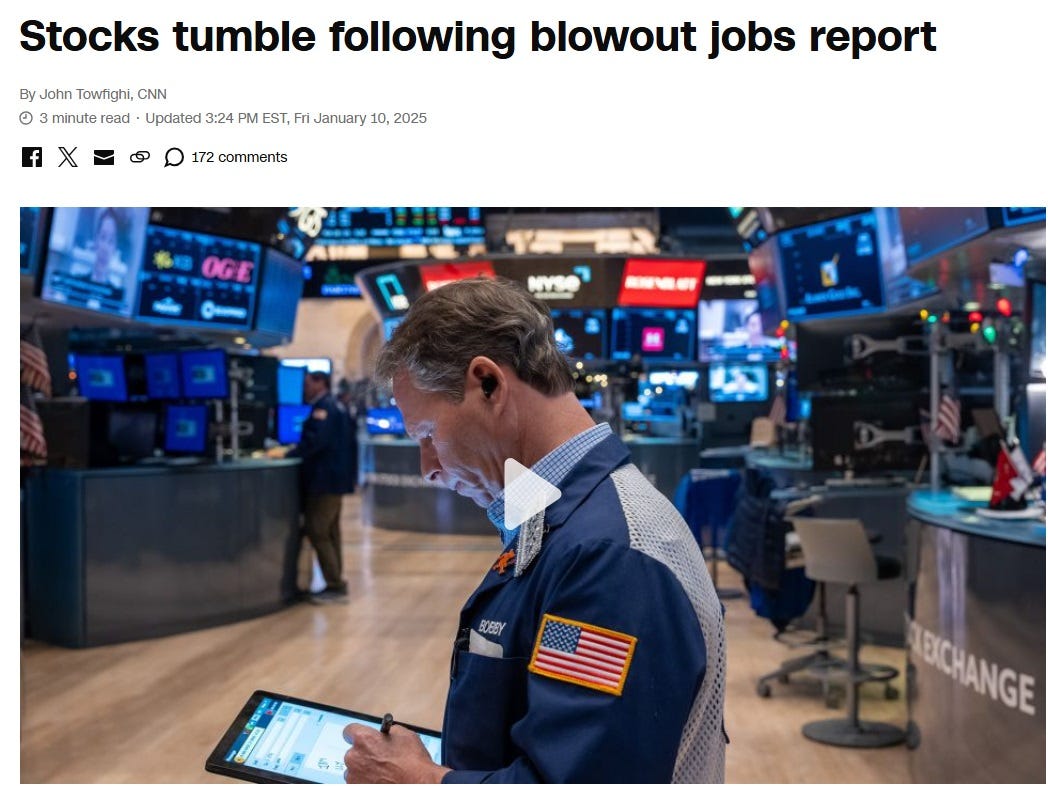
Now that Yr Wonkette is doing thinky pieces instead of trying to keep up with every last bit of news, we won’t feel obligated to bring you every monthly jobs report, but golly, this story from CNN sure is a ride. Looka this headline: “Stocks tumble following blowout jobs report.”
Hey, Bobby.
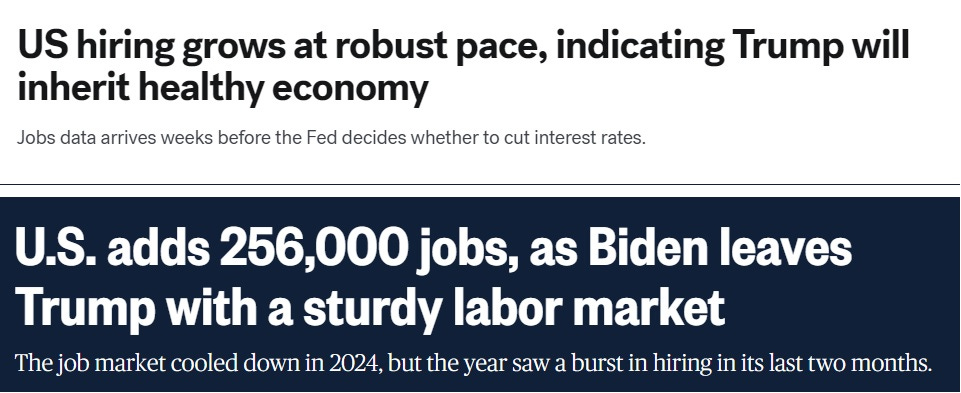
We are informed that US stocks “plunged” Friday in response to a much better-than-expected jobs report for December, showing that the economy added 256,000 jobs, way more than the 153,000 jobs that Wall Street economists predicted. Investors were reportedly worried that meant that the Federal Reserve will be too nervous about possible inflation to make more interest rate cuts anytime soon:
The Dow dropped by 697 points, closing at 41,938, while the S&P 500 fell by 1.5% and the tech-heavy Nasdaq index was lower by 1.6%.
The three indices all finished the week in the red as Friday’s selloff erased the week’s previous gains.
That’s one way to report the strong job growth, which was accompanied by a drop in the unemployment rate to 4.1 percent.
Or the numbers could also be reported with headlines like these, from ABC News and NBC News, respectively:
You know, just in case you needed a reminder that the stock market is not the economy, the stock market is not the economy, and did we also mention that the stock market is not the economy?
Traders now expect just a 2.7% chance the Fed will cut rates at its policy meeting later this month, according to the CME FedWatch Tool.
The Russell 2000 index, which tracks smaller companies, fell 2.2%, highlighting concerns about the impact of “higher for longer” interest rates.
And yes, it’s quite true that higher interest rates can be a drag on the economy, which is how the Fed deploys them, sometimes too aggressively, to keep inflation in check.
The story also noted that returns on 10-year Treasury notes,
spiked to 4.76% and the yield on the 30-year US treasury rose to 4.95%.
Rising yields signal concern about a stronger-than-expected economy, resurgent inflation and potentially fewer rate cuts in 2025 than anticipated.
Let’s just repeat that: “concern about a stronger-than-expected economy.” In other words, the strong economy that Joe Biden is handing off to Donald Trump as he leaves office is primarily a concern for big investors, not necessarily the rest of us proles out there.
The contrast in perceptions was evident even in the video attached to the CNN stocks story, which focuses more on the jobs numbers than on stocks. Reporter Matt Eagan was almost giddy, saying, “This is really good news for Main Street, right? It shows that workers are still very much in demand.” Eventually he did get to the response on Wall Street, but before that, Egan pointed out that yet again, workers’ buying power increased because wage growth outpaced inflation, yay.
Unemployment rate at 4.1%, widely considered to be “full employment.” Wages have risen 3.9% over the past 12 months, outpacing the inflation rate 2.8% during this period.
Rosenberg also helpfully reminds us that net job creation under Biden — 16.6 million jobs — is far greater than under the last three Republican presidents (Trump and both Bushes) combined, a piddling 1.9 million. Yes, yes, that includes the pandemic shock for Trump and the recovery of those jobs under both Trump and Biden — some nine million of ‘em lost and regained all told; roughly half of the bounceback occurred under Trump in the second half of 2020. But the pandemic job losses were all restored by June 2022, far earlier than most economists predicted, meaning that Biden’s economy has added around 6.8 million jobs since regaining the pandemic losses.
On the whole, the economy in 2024 added 2.2 million jobs, returning to something like the pre-pandemic job growth rate, and — we’re gonna say it again — reaching a “soft landing” from the high inflation that hit every industrialized country in the world following the pandemic and its disruption of supply chains. Joe Biden also pulled off something rarely seen in US history: Job gains in every single month of his presidency.
So congratulations, Mr. Trump. After cleaning up the mess made by the 2008 economic crash, Barack Obama handed you an economy that kept growing until the pandemic hit. Now Joe Biden, after getting things on track in the wake of the pandemic, will leave behind what just might be the best economy any incoming president has inherited.
Hello All. I don’t know how this will come across, so forgive me for doing a bit of navel gazing. I thought giving a bit of voice to something I really really don’t want to talk about may help. Or, at least it may help someone else. Who knows.
What people don’t always understand is that I find it very difficult to talk about this, and forced to, I feel even worse and find myself with even darker thoughts. Nonetheless, it seems right to try.
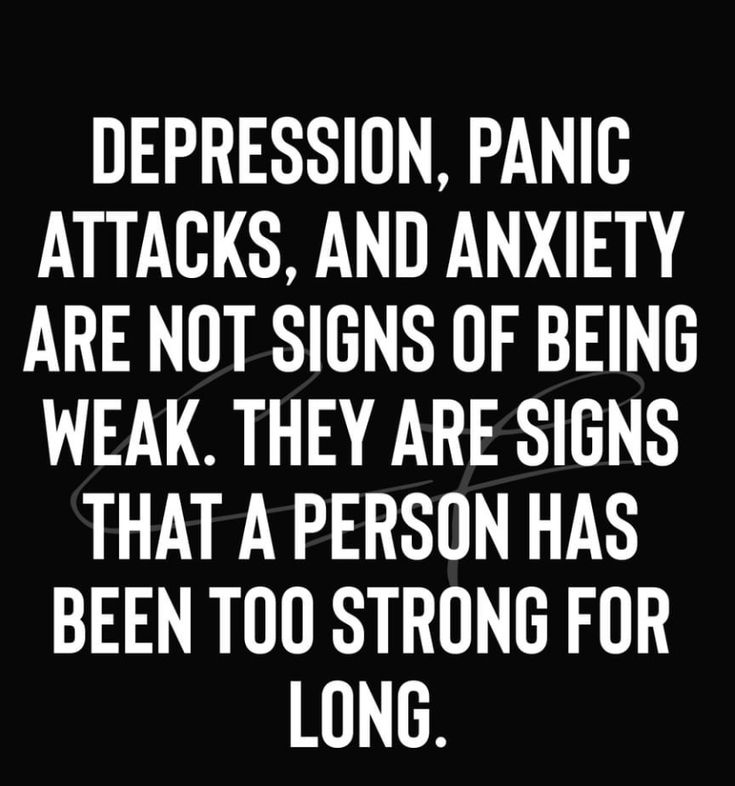
See, when you tell people you are dealing with depression, they try to give you advice, tell you to snap out of it, some begin to smother you – or at least it feels that way. Frankly, it’s a psychophysiological issue, and there are no easy answers, no easy solutions.
Most doctors don’t understand depression any better than their patients. They either want to overmedicate or ignore.
Most people dealing with depression try to self medicate. Alcohol, drugs, impotent rage at the smallest things. Me – it’s eating my feelings and hiding away in the house away from my overwhelming problems that others likely see as immaterial issues.
I’m still working every day, but I don’t want to go in. I want to stay home. I don’t want to deal with the problems at work because they are seemingly insurmountable. Heat not working. Machines not working. Employees not working. My truck isn’t working. And my dryer is shrinking my clothes… ok, that might be the Little Debbies. Messed up thing is, if I stay home I’m alone with things that aren’t working here at home and someone needs to clean the kitchen! So, going in to work is actually relieving after a while.
One of the things that surprises people is just how many of us live with depression. Just how many go to work, feed the kids, fill the gas tank and go through their normal day dying inside. I had to tell my boss on Thursday that I was not doing well with his – what feels like – pummeling me with criticism and ‘why didn’t you’s’. No one is perfect, and even though I tried to make the right decisions – well, I could only handle so many things even though I knew I was letting him down even while I was killing myself trying to be everywhere and handle everything.
Does he know that I am forced to handle imperative things that others are assigned but fail to do or that no matter what I do there are so many things yet to do? Does he know that I am working late just to get things done when no one is in the way? Does he know that I’m tired but can’t sleep no matter how exhausted I am? Does he know that I’m whining to you rather than cleaning my kitchen?
The odd thing is that I don’t know whether to feel better that I’m not alone or feel worse that so many of us have to deal with this shit. And, that’s the point, isn’t it. So many of us deal with this it’s just called “being an adult in America”. I wanted unicorns and rainbows, and like everyone else I more often just get bull-shit and rained on. (sigh!) Adulthood sucks. So, be kind to those you meet, for they are likely going through their own battles.
And, for those of you out there that are, well – just another adult in America, hang on. Keep going. I’ve heard the sun comes out, tomorrow.
We live in a world where right-wing nationalism is on the rise and many governments, including the incoming Trump administration, are promising mass deportations. Trump in particular has discussed building camps as part of mass deportations. This question used to feel more hypothetical than it does today.
Faced with this reality, it’s worth asking: who would stand by you if this kind of authoritarianism took hold in your life?
You can break allyship down into several key areas of life:
Who in your personal life is an ally? (Your friends, acquaintances, and extended family.)
Who in your professional life is an ally? (People you work with, people in partner organizations, and your industry.)
Who in civic life is an ally? (Your representatives, government workers, individual members of law enforcement, healthcare workers, and so on.)
Which service providers are allies? (The people you depend on for goods and services — including stores, delivery services, and internet services.)
And in turn, can be broken down further:
Who will actively help you evade an authoritarian regime?
Who will refuse to collaborate with a regime’s demands?
These two things are different. There’s also a third option — non-collaboration but non-refusal — which I would argue does not constitute allyship at all. This might look like passively complying with authoritarian demands when legally compelled, without taking steps to resist or protect the vulnerable. While this might not seem overtly harmful, it leaves those at risk exposed. As Naomi Shulman points out, the most dangerous complicity often comes from those who quietly comply. Nice people made the best Nazis.
For the remainder of this post, I will focus on the roles of internet service vendors and protocol authors in shaping allyship and resisting authoritarianism.
For these groups, refusing to collaborate means that you’re not capitulating to active demands by an authoritarian regime, but you might not be actively considering how to help people who are vulnerable. The people who are actively helping, on the other hand, are actively considering how to prevent someone from being tracked, identified, and rounded up by a regime, and are putting preventative measures in place. (These might include implementing encryption at rest, minimizing data collection, and ensuring anonymity in user interactions.)
If we consider an employer, refusing to collaborate means that you won’t actively hand over someone’s details on request. Actively helping might mean aiding someone in hiding or escaping to another jurisdiction.
These questions of allyship apply not just to individuals and organizations, but also to the systems we design and the technologies we champion. Those of us who are involved in movements to liberate social software from centralized corporations need to consider our roles. Is decentralization enough? Should we be allies? What kind of allies?
This responsibility extends beyond individual actions to the frameworks we build and the partnerships we form within open ecosystems. While building an open protocol that makes all content public and allows indefinite tracking of user activity without consent may not amount to collusion, it is also far from allyship. Partnering with companies that collaborate with an authoritarian regime, for example by removing support for specific vulnerable communities and enabling the spread of hate speech, may also not constitute allyship. Even if it furthers your immediate stated technical and business goals to have that partner on board, it may undermine your stated social goals. Short-term compromises for technical or business gains may seem pragmatic but risk undermining the ethics that underpin open and decentralized systems.
Obviously, the point of an open protocol is that anyone can use it. But we should avoid enabling entities that collude with authoritarian regimes to become significant contributors to or influencers of open protocols and platforms. While open protocols can be used by anyone, we must distinguish between passive use and active collaboration. Enabling authoritarian-aligned entities to shape the direction or governance of these protocols undermines their potential for liberation.
In light of Mark Zuckerberg’s clear acquiescence to the incoming Trump administration (for example by rolling back DEI, allowing hate speech, and making a series of bizarre statements designed to placate Trump himself), I now believe Threads should not be allowed to be an active collaborator to open protocols unless it can attest that it will not collude, and that it will protect vulnerable groups using its platforms from harm. I also think Bluesky’s AT Protocol decision to make content and user blocks completely open and discoverable should be revisited. I also believe there should be an ethical bill of rights for users on open social media protocols that authors should sign, which includes the right to privacy, freedom from surveillance, safeguards against hate speech, and strong protections for vulnerable communities.
As builders, users, and advocates of open systems, we must demand transparency, accountability, and ethical commitments from all contributors to open protocols. Without these safeguards, we risk creating tools that enable oppression rather than resisting it. Allyship demands more than neutrality — it demands action.

 Beth Bloom (L) and Pat Uleskey (R), among the couples getting married Saturday in downtown Rochester.Stephanie Ballard-Foster/WXXI News
 Stephanie Ballard-Foster/WXXI News
 Stephanie Ballard-Foster/WXXI News




































 Scottie's Playtime