A Good One From Sojo

Queerness Is a Calling Every Person Should Aspire To
By Brandan Robertson

“Queer” is not about who you’re having sex with (that can be a dimension of it), but “queer” as being about the self that is at odds with everything around it and has to invent and create and find a place to speak and to thrive and to live.”
—bell hooks

I’ve always been queer, but it took me a while to realize it. Even after coming out as gay, I still struggled with the language of “queer” because I grew up hearing it used as a slur. In many places, it still is. I remember the shocked look on the faces of a lecture audience in rural England when I said “queer” — as if I had uttered a curse word.

This is how the word sits with many people — even within the LGBTQIA+ community. But over the years, as I’ve wrestled with my identity, learned the history of LGBTQIA+ liberation, and developed my beliefs, I’ve come to resonate deeply with being queer, just as much as with being Christian.

In fact, for me, to be an authentic Christian — one who seeks to follow the life and teachings of Jesus — is to be queer. Let me explain.

To be queer generally means one of two things. First, it’s a catch-all phrase for the LGBTQIA+ community — those who embrace a non-heterosexual orientation and/or non-cisgender identity. Second, queer also means to disrupt arbitrary norms, making space for diverse, often marginalized, expressions to flourish.

To be queer means resisting the repression of our true selves and the forces that demand we conform to others’ ideas of who we should be. It’s a declaration of our commitment to live authentically — who God created us to be — not who society or religion says we must become.

In this sense, queerness is holy. It affirms that God doesn’t make mistakes — that our unique expression reflects God’s creativity — and refuses to blaspheme the Creator by suppressing that divine image. When seen this way, queerness is a calling every person should aspire to.

To follow Jesus is to refuse conformity, as Paul wrote: “[to] be transformed by the renewing of your mind” (Romans 12:2). This means shifting how we see ourselves and others — removing the masks we were taught to wear, the roles we were conditioned to play. In this way, queerness is deeply aligned with the way of Jesus.

bell hooks defines queerness as “being at odds with everything around it.” That feels exactly right. We live in a world shaped by systems built to benefit particular people. What’s considered “normal” is often an invention — crafted to maintain control and marginalize difference. Nothing has always been the way it is, and it shouldn’t remain the same.

Today, there’s a rising awareness of the value of diversity and pluralism by many in society (while diversity is also demonized by many). More people are becoming suspicious of those who demonize difference and cling to the status quo. The past century has shown us that the status quo is often built on lies that lead to oppression.

Our society was set up by people who established norms to benefit themselves. But as the world grows more connected and aware of diverse ways of being, movements of resistance have chipped away at this conformity and demanded a new, inclusive path. These movements are “queering” society — questioning and resisting what’s been called normal — and they’ve made the world more just and diverse.

One of the most resistant institutions to queering has been Christianity. This isn’t surprising. Religion resists change, and Christian institutions have fought nearly every cultural shift from desegregation to women’s voting rights to rock music. Those willing to reform are often labeled heretics and excluded from church power. But every so often, resistance sparks reform in the church. The Protestant Reformation, the abolitionist movement, and the fight for women’s rights have all queered Christianity by disrupting norms and pushing forward new expressions of faith.

The inclusion of queer people in Christianity is another such movement. Today, nearly every mainline Protestant denomination in the U.S. officially affirms queer people. We can serve as clergy, marry, and be fully embraced. While there are many local congregations in each denomination that resist these changes, the movement for inclusion is well underway. This is a remarkable shift.

Just last year, Pope Francis announced that Catholic priests may bless same-sex couples. A few months before, he said transgender people could be baptized and serve as godparents. Though these don’t change Catholic doctrine, they marked major steps forward that made many lay queer Catholics feel more included in their churches.

Still, there is much work to do. The truth remains that most Christians worldwide still uphold anti-queer theology. Many still preach that homosexuality is an abomination. Many still teach that women must submit to men and cannot lead.

Progressive Christians sometimes believe the church is rapidly changing, but that’s often just the view from our bubble. Most Christians still cling to rigid, patriarchal theology. And I’ve come to believe that the only way to challenge that resistance is through queering.

Not every LGBTQIA+ Christian agrees with this strategy. There are many queer Christians who would prefer to simply shift the church’s understanding of the six clobber passages and be accepted into the traditional Christian institution with its traditional sexual ethics, understanding of relationships, and devotion to conservative theology otherwise. I understand that desire; I once had it too. But I’ve come to believe it’s actually counterproductive to our flourishing as queer people.

The more I’ve studied Scripture and listened to queer stories, the more convinced I’ve become: The issue isn’t a few misinterpreted Bible verses — it’s that Christianity was institutionalized. A few hundred years after Jesus, his radical movement was merged with the Roman Empire and transformed into rules, dogma, and rigid orthodoxy.

Other perspectives were labeled heresy, punished, and driven underground. What remained became dominant: a version of Christianity that, frankly, looks nothing like Jesus.

When I became a Christian, it was because I wanted to follow Jesus — not an institution. But I was quickly taught that faithfulness to Jesus meant faithfulness to the church. I learned the doctrines and ethics of my church and saw that the more I conformed, the more I was accepted — and even celebrated.

From adopting the politics of my pastors to unquestioningly espousing conservative theology, to even dressing in ways that mirrored the evangelical subculture, I learned that through conforming and contorting myself to look, believe, vote, and act like what was seen as normative for evangelical Christians, my inclusion would be solidified.

I gained status and privilege. I was affirmed by my church and I believed that this meant I was close to God. But I felt uneasy, even early on. As I read Scripture, I struggled to see our theology or ethics reflected in Jesus’ life. Jesus lived on the margins of religious and political power. He constantly challenged the status quo and resisted exclusionary doctrine.

I came to see that neither I nor my church looked like Jesus. That realization was unsettling. Eventually, it led me to believe that queering Christianity wasn’t just permissible — it was necessary. Not only for LGBTQIA+ inclusion, but for everything and everyone.

Rather than blindly accepting church authority, I began to pursue truth wherever it led and invited others to do the same. My ministry became about queering Christianity, not just including queer people in the traditional frameworks of the church.

That meant challenging every theology and ethic that doesn’t reflect Jesus’ ethic of love. It meant reimagining how we follow Jesus — beyond traditional Christianity.

This is, I believe, the most faithful path. But it’s also the hardest. It requires us to stop seeking the affirmation of and inclusion in the old structures and instead focus on building subversive, queerly spiritual communities that reflect the Spirit of Christ.

It means being open to truth from everywhere and everyone — because all truth is God’s truth — and letting it shape our spiritual journeys.

It means getting used to being called heretics. Excluded even from some so-called affirming churches that find our vision too radical. But our goal isn’t to be welcomed because we conform — it’s to create a community that welcomes all expressions and beliefs, grounded in the love and example of Jesus in whatever form that takes.

Our goal isn’t even to be “Christians,” really. Jesus never used that word. Never spoke a Christian doctrine. Never stepped inside a Christian church. So inclusion in the traditional institutions of Christianity isn’t the point.

The point is a truly queer revolution of faith that liberates us all to show up authentically, that remains open to the voice of our still-speaking God in the most unlikely people and places, and that understands that the Kingdom of God that Jesus preached and embodied can never be contained in the rigid boundaries of any institution, but is found among the diversity, complexity, and beauty of all of our human experiences.

Editor’s note: This essay is an adaptation from Queer & Christian: Reclaiming the Bible, Our Faith, and Our Place at the Table. It has been adapted with the permission of St. Martin’s Essentials.

Peace & Justice History for 6/5

June 5, 1851
Uncle Tom’s Cabin or, Life Among the Lowly began to appear in serial form in the Washington National Era, an abolitionist weekly.
The novel by Harriet Beecher Stowe, a tear-jerking tale of the hardships of slavery, became a central reference point in the national debate over the issue.

 
Read more 
June 5, [since 1972]

World Environment Day was established by the U.N. General Assembly to commemorate the opening of the Stockholm Conference on the Human Environment in Sweden.
The United Nations Environment Program (UNEP) was established as a result of the conference.
The 1972 Stockholm conference 
UNEP’s mission: To provide leadership and encourage partnership in caring for the environment by inspiring, informing, and enabling nations and peoples to improve their quality of life without compromising that of future generations.
Each year World Environment Day adopts a different theme.
June 5, 1989
Just a few days before the first fission reaction was to be allowed at New Hampshire’s Seabrook Station nuclear power plant, hundreds breached the security fence, leading to 627 arrests. They carried signs reading, “In Mourning for the Late, Great State of New Hampshire,” and “Remember Chernobyl.”
Led by the Clamshell Alliance, their concern was for the safety of local residents in the event of a nuclear accident, as well as environmental pollution and the unsolved problem of safe disposal of nuclear waste generated by the reactor. There were also concerns for increased electricity rates to cover the costs of the project. Repeated significant protests occurred as early as 1976 at the beginning of construction when sometimes more than a thousand would be arrested.
Ron Sher, a Seabrook spokesman, termed the demonstrators “very vocal but a small minority . . . They don’t represent the millions of people in New England that recognize that nuclear energy is a viable energy option.” The plant was projected to produce up to 1.15 gigawatts, enough for one million homes.
June 5, 1993
Thousands marched to protest neo-Nazi violence against foreigners, particularly ethnic Turks, living in Germany.

https://www.peacebuttons.info/E-News/peacehistoryjune.htm#june5

In Honor and Memory

Edmund White remembered: ‘He was the patron saint of queer literature’

Colm Tóibín, Alan Hollinghurst, Adam Mars-Jones and more recall the high style and libidinous freedom of a writer who ‘was not a gateway to gay literature but a main destination’

‘He showed me gay fiction could also be high art’

Alan Hollinghurst

Alan Hollinghurst

British novelist

Edmund White’s luminous career was in part a matter of often dark history: he lived through it all.  He was a gay teenager in an age of repression, self-hatred and anxious longing for a “cure”; he was a young man in the heyday of gay liberation, and the libidinous free-for-all of 1970s New York; he was a witness to the terrifying destruction of the gay world in the Aids epidemic in the 1980s and 90s.  All these things he wrote about, in a long-term commitment to autofiction – a narrative adventure he embarked on with no knowledge of where or when the story would end. He is often called a chronicler of these extraordinary epochs, but he was something much more than that, an artist with an utterly distinctive sensibility, humorous, elegant, avidly international.  You read him not just for the unsparing account of sexual life but for the thrill of his richly cultured mind and his astonishingly observant eye.  

A young Edmund White

What amazed me about A Boy’s Own Story, when it came out in 1982, was that a stark new candour about sexual experience should be conveyed with such gorgeous luxuriance of style, such richness of metaphor and allusion. This new genre, gay fiction, could also be high art, and almost at once a worldwide bestseller!  It was an amazing moment, which would be liberating for generations of queer writers who followed.  These younger writers Edmund himself followed and fostered with unusual generosity – I feel my whole career as a novelist has been sustained by his example and encouragement. In novels and peerless memoirs right up to the last year of his life he kept telling the truth about what he had done and thought and felt – he was a matchless explorer of the painful comedy of ageing and failing physically while the libido stayed insatiably strong.  It’s hard to take in that this magnificent experiment has now come to a close.  (snip-MORE)

=======

Jonathan Joss: Three roles the late US actor was known for

Ian Casey BBC News

US actor Jonathan Joss, known for his roles in King of the Hill and Parks and Recreation, has died aged 59.

Joss was shot dead, in what his husband called a homophobic hate crime, although police in Texas say there is no evidence of this.

Joss’s broad career spanned different genres and platforms, appearing in films, sitcoms, animations, stage productions and more.

He has been credited with increasing representation of Native Americans on screen. Here are three of the notable performances he will be remembered for.

John Redcorn in King of the Hill

In the animated sitcom King of the Hill, Joss voiced the character of John Redcorn, a Native American “licensed New Age healer” from season two onwards.

The sitcom centres around the Hill family and is set in the fictional town of Arlen, in suburban Texas.

For the first four seasons, Redcorn is having an affair with Hank Hill’s neighbour, Nancy Gribble. Nancy’s husband Dale is oblivious.

While a flawed character, Redcorn is known for his kindness and calm persona, and for championing his Native American heritage.

In season four, during perhaps his most notable storyline, Redcorn reveals an ongoing battle between his tribe and the Bureau of Indian Affairs, saying he hoped to regain Native American land from the government.

Considering Redcorn a “true friend”, Dale decides to help him with the lawsuit filed against the government, by introducing him to the Freedom of Information Act.

Redcorn then permanently ends his14-year affair with Nancy, out of respect for Dale. The affair is not revealed to Dale and he happily heads home with Nancy.

Author Dustin Tahmahkera once described Redcorn as “arguably the most developed and complex indigenous character in US sitcom history, thanks in critical part… to the on-and-offscreen work of Joss”. (snip-MORE)

Wednesday Political cartoons / memes / and other news. Sorry it is late spent all morning shopping with Ron

“Pay no attention to us redistributing wealth upwards, while we cut healthcare and food support, Be Afraid Of Scary Trans People!”

Harley Schwadron CagleCartoons.com

Malcolm McGookin CagleCartoons.com


political cartoon

Town Square Cartoons

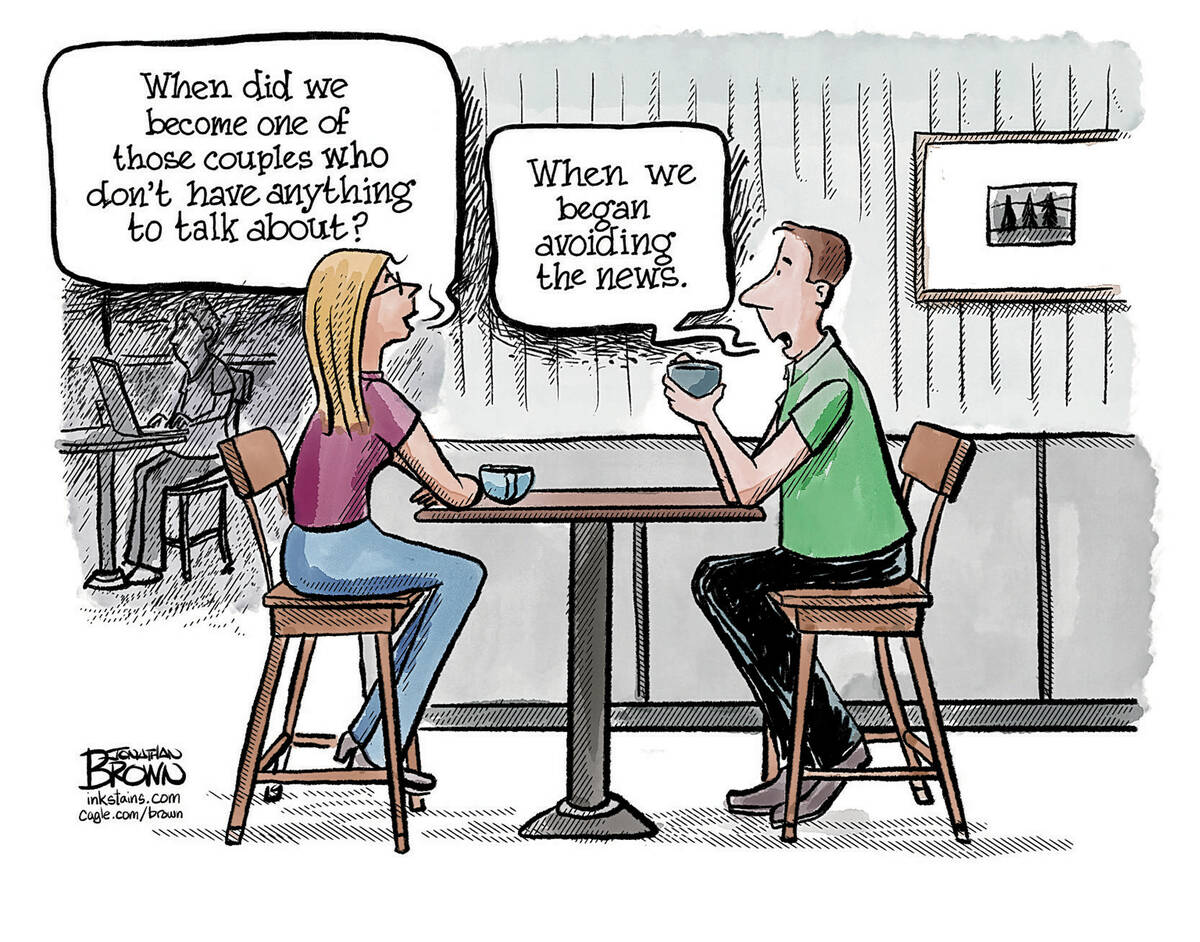
Jonathan Brown PoliticalCartoons.com

Alexandra Bowman CagleCartoons.com


Vladimir Kazanevsky Ukraine


Gary Varvel Creators Syndicate

Harley Schwadron CagleCartoons.com

John Cole Philadelphia Inquirer


We Know What To Do-

Some Clay Jones Work

Black Eye Clones by Clay Jones

There are a lot of weird things going on Read on Substack

There are other issues I should be drawing about, but how can I resist a second Biden Clone cartoon? This shit is cray-cray, yo? Do the kids still say “cray-cray?” Anywhosies, I drew a second Biden clone cartoon. The bad thing is, I have at least two more ideas on Biden Clones that I should at least sketch out for the Blog O’ Roughs, which is long overdue.

Since we talked about Biden Clones yesterday, we’re going to talk about the other shit in this cartoon.

Elon says he’s leaving Washington, and he’s taking Stephen Miller’s wife with him. Whaaaaat?

Katie Miller, the wife of Baby Goebbels, has left her position as adviser and spokesperson for the Department of Government Efficiency (DOGE) to work full-time for Musk and his companies. I don’t know what position she’ll be assuming for Elon, but I heard she bought some knee pads. Wow, I’m a horrible person. But, Baby Goebbels doesn’t want to talk about it. (snip-MORE, and oh, do go read it!)

Biden Clone by Clay Jones

It’s extremely difficult to out-crazy the shit that comes out of the Trump White House Read on Substack

Late last night, around the time a person would tweet while on a bender or call up an ex-girlfriend for a booty call, Donald Trump posted to Truth Social that Joe Biden was executed in 2020 and replaced with clones and robots. (snip-MORE, and it’s also very good)

The Soylent Green Party by Clay Jones

Not to give the GOP any ideas Read on Substack

Republicans suck. They suck with compassion. They suck with empathy. Lord knows they suck with humor. And yet, voters believe the GOP connects more with average Americans than Democrats do, never mind that their leader craps in a golden toilet.

Iowa Senator Joni Ernst is a great example. She ignored Republican advice against holding town halls and learned the hard way that her constituents don’t like the current MAGA agenda. Probably because it sucks. You don’t need a think tank to run a bunch of surveys to know that the majority of voters don’t want to lose their Medicaid coverage or health insurance. And, they don’t want it to be more difficult with loops to jump through to keep their coverage.

During Joni’s town hall last Friday, she was grilled by her voters about the “One Big Beautiful Bill,” which the House barely passed 215-214, and will cut Medicaid along with a lot of government health programs, along with SNAP, and make Medicaid tougher to keep, all so billionaires retain their huge 2017 MAGA tax cuts while adding trillions to the debt.

Grams might have to eat generic cat food, not even the good cat food, while your boss will get to purchase his fourth yacht, which Republicans are trying to make tax-deductible, along with private jets and trophy wives, like Melania. (snip-yes, MORE that’s good to read!)

Peace & Justice History for 6/4

June 4, 1939
During what became known as the “Voyage of the Damned,” the SS St. Louis, carrying more than 900 Jewish refugees from Germany to the U.S., was turned away from the Florida coast. The ship, also denied permission to dock in Cuba, eventually returned to Europe; many of the refugees later died in Nazi concentration camps.

The reality of what happened 
The movie based on the history 
June 4, 1972
Angela Y. Davis, a former philosophy professor at the University of California, outspoken black leader and self-proclaimed communist, was acquitted on charges of conspiracy, murder, and kidnapping by an all-white jury in San Jose, California.

More on Angela Davis
 
Angela Davis wearing a peace button from peacebuttons.info, speaking at The Grays Harbor Institute, Hoquiam, Washington April, 2007
  
June 4, 1987

New Zealand passed legislation declaring itself nuclear-free. In 1986, New Zealand had banned the entry of U.S. Navy ships from their ports in the belief that they were carrying nuclear weapons or were nuclear-powered. U.S. government protests of the policy led to breakup of the ANZUS (Australia-New Zealand-United States) defense alliance.The New Zealand Nuclear Free Zone, Disarmament and Arms Control Act of 1987 (which ratified the Nuclear Non-Proliferation Treaty) prohibits the:
•   manufacture, acquisition, possession, control of any nuclear explosive device
•   aiding, abetting or procuring any person to manufacture, acquire, possess, or have control over any nuclear explosive device
•   transport, stockpiling, storage, installation, or deployment of any nuclear explosive device.
June 4, 1989
Hundreds of civilians were shot dead by China’s People’s Liberation Army during a bloody military operation in Beijing’s Tiananmen Square. Students and workers had become part of a growing pro-democracy movement, gathering there continuously for weeks. The Chinese government still officially denies any deaths occurred; thousands who were arrested “disappeared” and remain unaccounted for.
“… deaths from the military assault on Tiananmen Square range from 180 to 500; thousands more have been injured . . . thousands of civilians stood their ground or swarmed around military vehicles. APCs [armored personnel carriers] were set on fire, and demonstrators besieged troops with rocks, bottles, and Molotov cocktails.”* 

*From a comprehensive overview prepared by the National Security Archive
based on formerly classified U.S. Government documents

https://www.peacebuttons.info/E-News/peacehistoryjune.htm#june4

Sometimes Things Just Happen Out Of The Clear Blue Sky, or Maybe It’s Magic!

I’m not advocating violence, of course, but I got a great giggle from this when I saw it. I thought others might, too. There is no direct violence, it’s more a karmic-type of happening.

More PRIDE

(https://www.peacebuttons.info/)

It’s been stormy/flooding/messy all day long, Ollie is not happy with the weather so I’ve been busy keeping him busy, we’ve still got about an hour to go with the weather, and now I can’t recall where, this morning over breakfast, I read this about Compass Group promoting PRIDE. But, the tab is still up there, so here it is at not quite suppertime!

https://www.compass-usa.com/happy-pride-month-2025

Happy Pride Month 2025!

June 02, 2025

2025 Happy Pride Month from Compass Group USA

June is here, and with it comes Pride Month – a powerful celebration of love and authenticity. It’s a time to recognize the rich history of the LGBTQ+ community while embracing the voices that make our workplace stronger, more inclusive, and deeply connected.

Meet three inspiring associates from across Compass Group’s family of businesses – Elise, Greg, and Chef Michelle – whose journeys of inclusion and belonging enrich our organization in meaningful ways. Through their work, passion, and personal experiences, they continue to cultivate spaces where everyone can thrive.

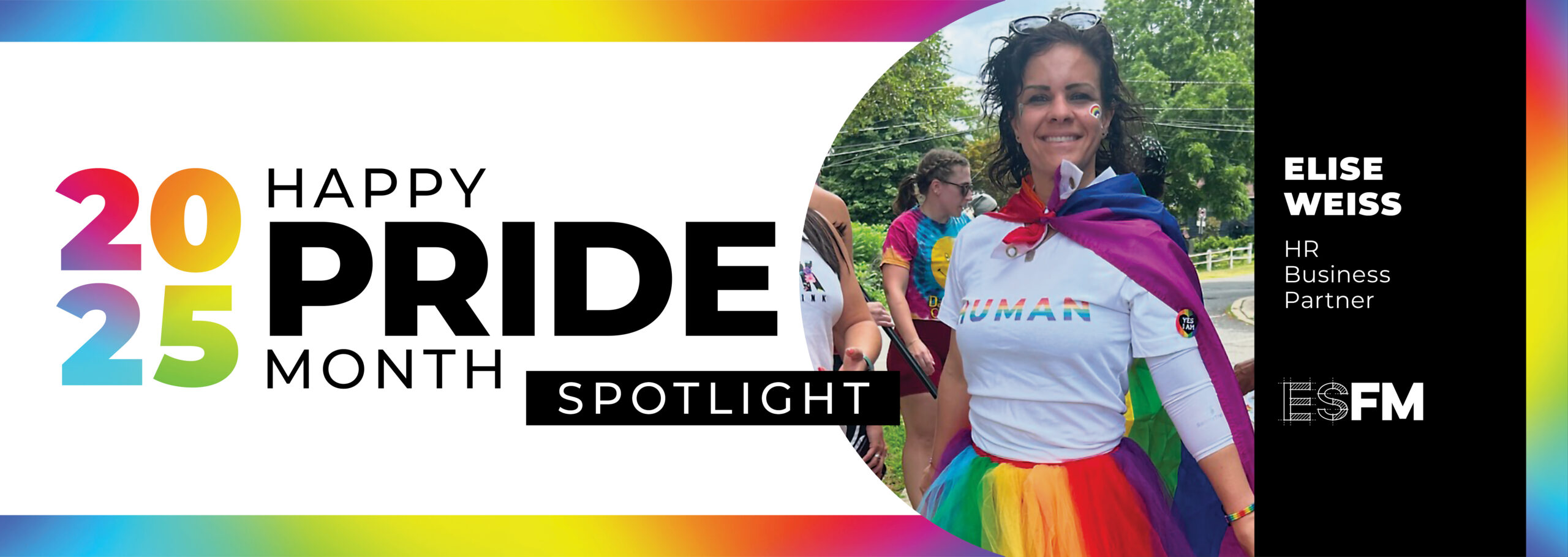
An Image of Elise Weiss, HR Business Partner from ESFM for Pride Month 2025

Elise Weiss has been with ESFM for seven years. The best part of her job as an HR business partner is building relationships, fostering strong team dynamics, and simplifying tough situations. Education and empowerment drive her. Leading ESFM’s Global University of Lifelong Learning (GULL) program as well as serving as co-chair of its Diversity & Inclusion Action Council (DIAC) make her work deeply fulfilling.

“Pride Month means LOVE is LOVE! Accepting everyone as they are so that no one fears loving who they truly love,” Elise says.

An Image of Greg Yeager, HR Business Partner from Unidine for Pride Month 2025
Greg Yeager has been with Unidine for eight years and currently serves in strategic dining services and national accounts as the HR business partner. Making a difference in people’s lives – with the support of his incredible team – is what he loves most about his position

“Pride is a reminder of both the progress made and the work still needed to ensure equal rights and respect for everyone,” Greg adds. “It’s also a deeply personal time when I acknowledge and celebrate my own growth, embracing who I am unapologetically.”

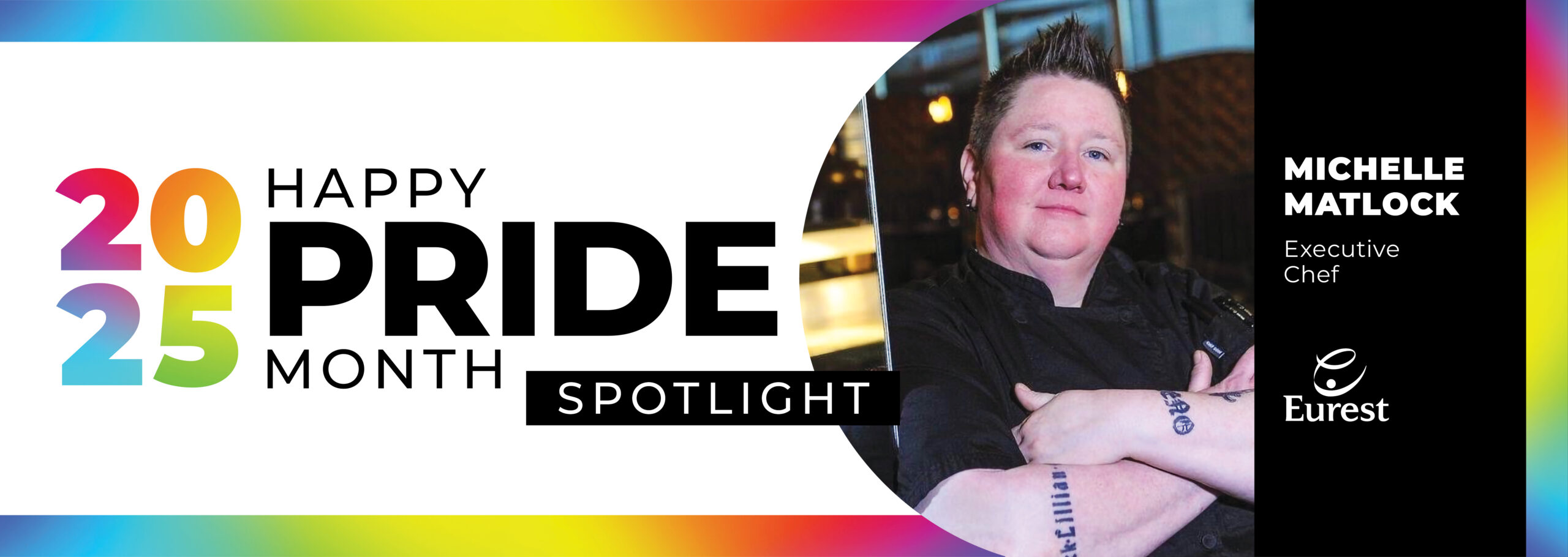
An Image of Chef Michelle Matlock, Executive Chef from Eurest for Pride Month 2025
Chef Michelle M. Matlock CEC has been with Compass for three years, and for the past year has been an Executive Chef in Atlanta with Eurest.

“What I love most about my job is spending my life’s energy within a group that supports diversity, equality and inclusion,” Chef Michelle declares. “I love being able to mentor our young chefs and leaders. I adore my leadership and believe in their life’s work so much, find our corporate goals so similar, it keeps me going.”

Greg, Chef Michelle, and Elise’s respective journeys have been shaped by many people, and their experiences within the LGBTQ+ community have influenced their careers.

“I often wonder if I’ve done enough, because just living openly doesn’t always feel like enough,” Greg notes. “Getting into HR grounded me, showing me that I could be the person I had always needed – a representative living openly.” Greg hopes to be that person for future generations entering the hospitality industry.

A pivotal figure in Chef Michelle’s life was Charlene Schneider, who opened the first LGBTQ+ tavern in New Orleans in the 1950s. She was a “Den Mother” to many LGBTQ+ youth, offering acceptance, guidance, and life skills. She once told Michelle, “People walk through this world every day, just hoping someone will smile their way. BE THAT PERSON.” She taught Michelle honor, ethics, never to hide, and to BE SEEN.

Elise’s path has also been influenced by people who embody authenticity, strength, acceptance, empathy and love – qualities she strives for. Her most life-changing discovery, however, is yoga. “The inward journey transformed me, replacing fear with acceptance and love,” she says.

Each has precious advice to share with colleagues striving to be more inclusive.
Chef Michelle considers herself an “Elder” in the LGBTQ+ community and shares this impassioned message: “TO OUR BEAUTIFUL LGBTQ+ YOUTH – TO ‘B’ – Sometimes the world swings ugly and sometimes it swings back to beauty. In all these times, you are loved, you are important, you are beautiful EXACTLY as you are, and you MATTER. Know your history, get involved, define our community for US so that others can’t define it for YOU.”

Elise advises her teams to lead with vulnerability and humility. “Show up, listen, and be present. People feel that, and it matters,” she says. “In the photo, my shirt says ‘HUMAN,’ because kindness is what matters, not labels. Live in the energy of love, and never forget our shared humanity – we are all equal.”

And Greg encourages open and honest conversations. “Understanding comes from curiosity and the willingness to learn; I always tell friends and family to ask me anything,” he adds. “If it helps bridge the gap in understanding that our lives aren’t so different, then that’s one more educated mind shaping a better future.”

As Pride Month unfolds, let’s celebrate the progress made while recommitting to the work still ahead. Elise, Greg, and Chef Michelle remind us that inclusion is about people, actions, and creating spaces where everyone feels seen, valued, and empowered to be their authentic selves. Their stories illuminate the power of representation, resilience, and genuine connection. As we honor Pride, let’s continue building a workplace – and a world – where acceptance isn’t just a celebration for one month, but a commitment we carry every day.

Happy Pride from your Compass colleagues!

THE HILL: Democrats outraged with DHS after Nadler staffer handcuffed

Democrats outraged with DHS after Nadler staffer handcuffed
The simmering tensions between the Trump administration and House Democrats are threatening to boil over after agents of the Department of Homeland Security (DHS) forced their way into the office of Rep. Jerry Nadler (D-N.Y.).

Read in The Hill: https://apple.news/Aadd3iAaATDqY0hBLgmnniQ

Shared from Apple News

Best Wishes and Hugs,Scottie