







| July 19, 1848 The first Women’s Rights Convention in the U.S. was held at Seneca Falls, New York. Its “Declaration of Sentiments” launched the movement of women to be included in the constitution.The Declaration used as a model the U.S. Declaration of Independence, demanding that the rights of women as individuals be acknowledged and respected by society. It was signed by sixty-eight women and thirty-two men. The impetus came from Elizabeth Cady Stanton and Lucretia Mott, both of whom had been excluded, along with all the other female American delegates, from the World Anti-Slavery Convention (London, 1840) because of their sex.  Frederick Douglass, the former slave and abolitionist leader attended the convention and supported the resolution for women’s suffrage. When suffrage finally became a reality in 1920, seventy-two years after this first organized demand in 1848, only one signer of the Seneca Falls Declaration, Charlotte Woodward, then a young worker in a glove manufactory, had lived long enough to cast her first ballot. The Seneca Falls Convention and the Early Suffrage Movement The Declaration of Sentiments |
| July 19, 1958 Several black teenagers, members of the local NAACP chapter (National Association for the Advancement of Colored People), entered downtown Wichita’s Dockum Drug Store (then the largest drugstore chain in Kansas) and sat down at the lunch counter.  Wichita sit-in sculpture The store refused to serve them because of their race. They returned at least twice a week for the next several weeks. They sat quietly all afternoon, creating no disturbance, but refused to leave without being served. Though the police once chased them away, they were breaking no law, only asking to make a purchase, a violation of store policy. This was the first instance of a sit-in to protest segregationist policies. Less than a month later, a white man around 40 walked in and looked at those sitting in for several minutes. Then he looked at the store manager, and said, “Serve them. I’m losing too much money.” That man was the owner of the Dockum drug store chain. That day the lawyer for the local NAACP branch called the store’s state offices, and was told by the chain’s vice president that “he had instructed all of his managers, clerks, etc. (statewide), to serve all people without regard to race, creed or color.” |
| July 19, 1974 Martha Tranquill of Sacramento, California, was sentenced to nine months’ prison time for refusing to pay her federal taxes as a protest against the Vietnam War. |
| July 19, 1993 President Bill Clinton announced regulations to implement his “Don’t Ask, Don’t Tell” policy regarding gays in the military, saying that the armed services should put an end to “witch hunts.” The policy was developed by General Colin Powell, then Chair of the Joint Chiefs of Staff, and eventually summarized as “don’t ask, don’t tell, don’t pursue, don’t harass.” |
| July 19, 2000 A federal administrative law judge ordered white supremacist Ryan Wilson to pay $1.1 million in damages to fair housing advocate Bonnie Jouhari and her daughter, Dani. The decision stemmed from threats made against Jouhari by Wilson and his Philadelphia neo-Nazi group, ALPA HQ.  Bonnie and Dani Jouhari |
https://www.peacebuttons.info/E-News/peacehistoryjuly.htm#july19
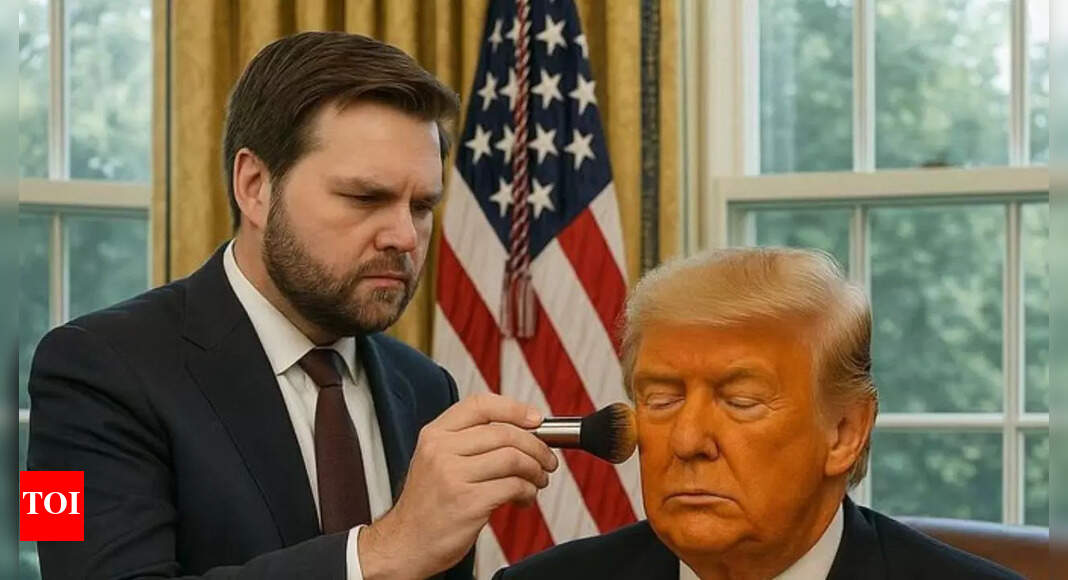
Happy Birthday, Pedo by Clay Jones
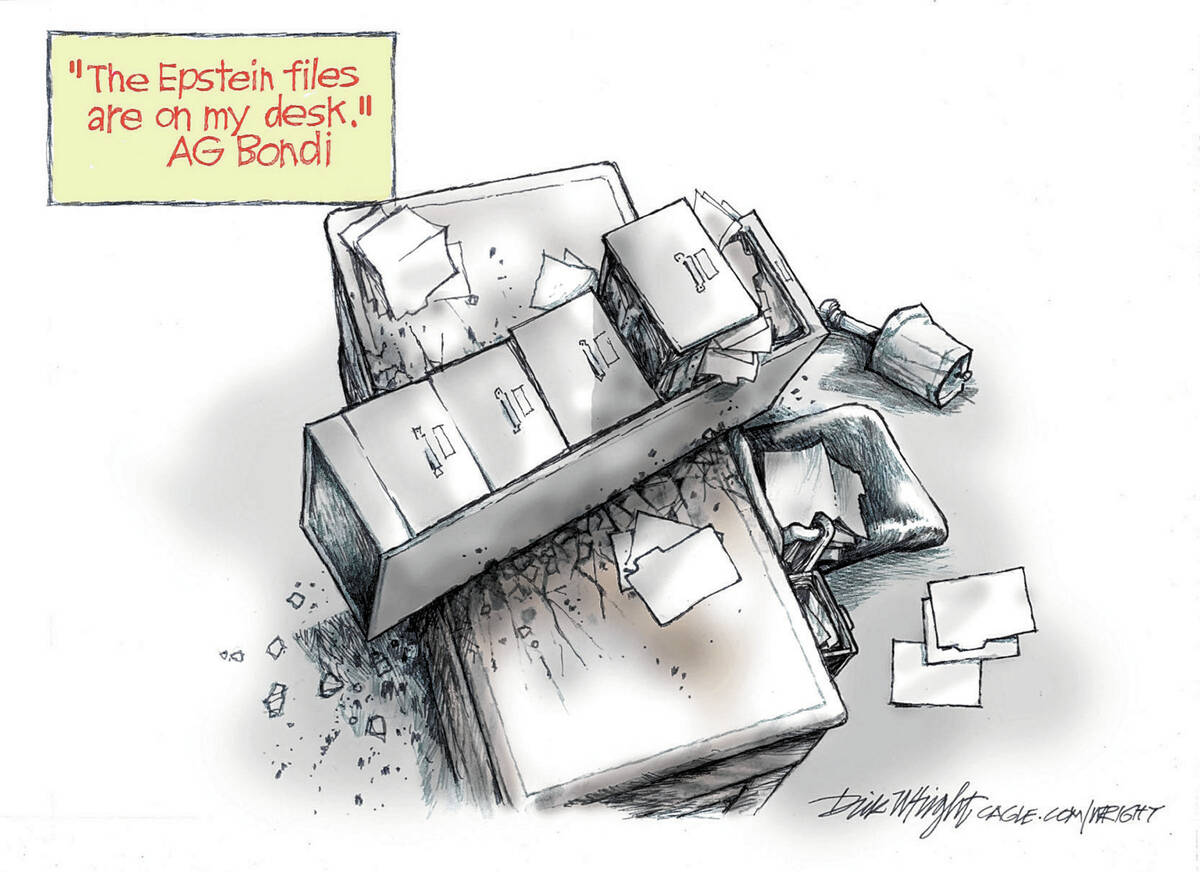
Donald Trump’s birthday card to Jeffrey Epstein Read on Substack
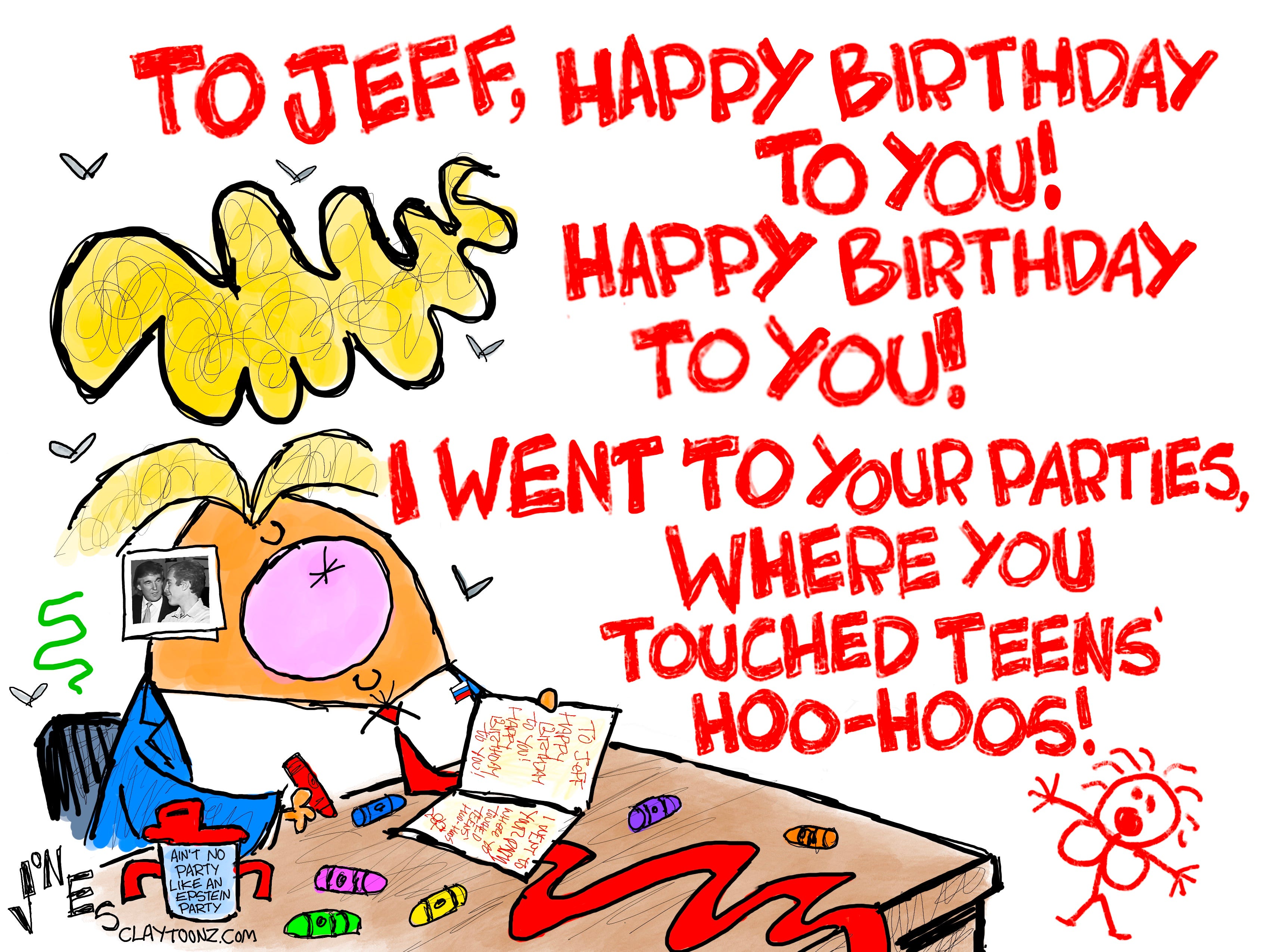
The Wall Street Journal is reporting that Donald Trump wrote a “racy” birthday letter to Jeffrey Epstein way back in 2003. I’m shocked too. Who knew he could write?
This letter is part of the Epstein Files from the investigation by the Department of Justice. One of the MAGA talking points is that if there were anything in those files with Trump’s name on it, then the Biden administration would have released it to help the Democrats with the 2024 election. Take note that the Biden administration did NOT release it.
The question, “Why didn’t Biden release it?” is based on the presumption that Joe Biden is as corrupt as Donald Trump and would politicize the DOJ. Despite the MAGA narrative, Biden never politicized or weaponized the DOJ.
And there is something to this, because Trump is upset, and threatening to sue the WSJ, its owner, News Corp, and Rupert Murdoch. WSJ reported that the letter was part of a book of messages organized by Ghislaine Maxwell for Epstein’s 50th birthday. Maxwell was convicted 16 years later in 2019 for aiding Epstein’s sexual abuse of minors.
The letter, signed by Trump, wishes Epstein a happy birthday and tells him, “may every day be another wonderful secret.” The letter featured lines of typewritten text framed by a drawing of a naked woman, with Trump’s name signed below the woman’s waist.
Hmmmm. Whatever could that secret be, and has anyone checked the age of the woman in the naked drawing?
Trump issued a denial, saying, “I never wrote a picture in my life. I don’t draw pictures of women. It’s not my language. It’s not my words.” It’s true, you don’t write a picture. Unfortunately for Trump, the letter was written in crayon. (snip-MORE. Also, the card was written in 2003, when POTUS had a few more words in his vocab.)
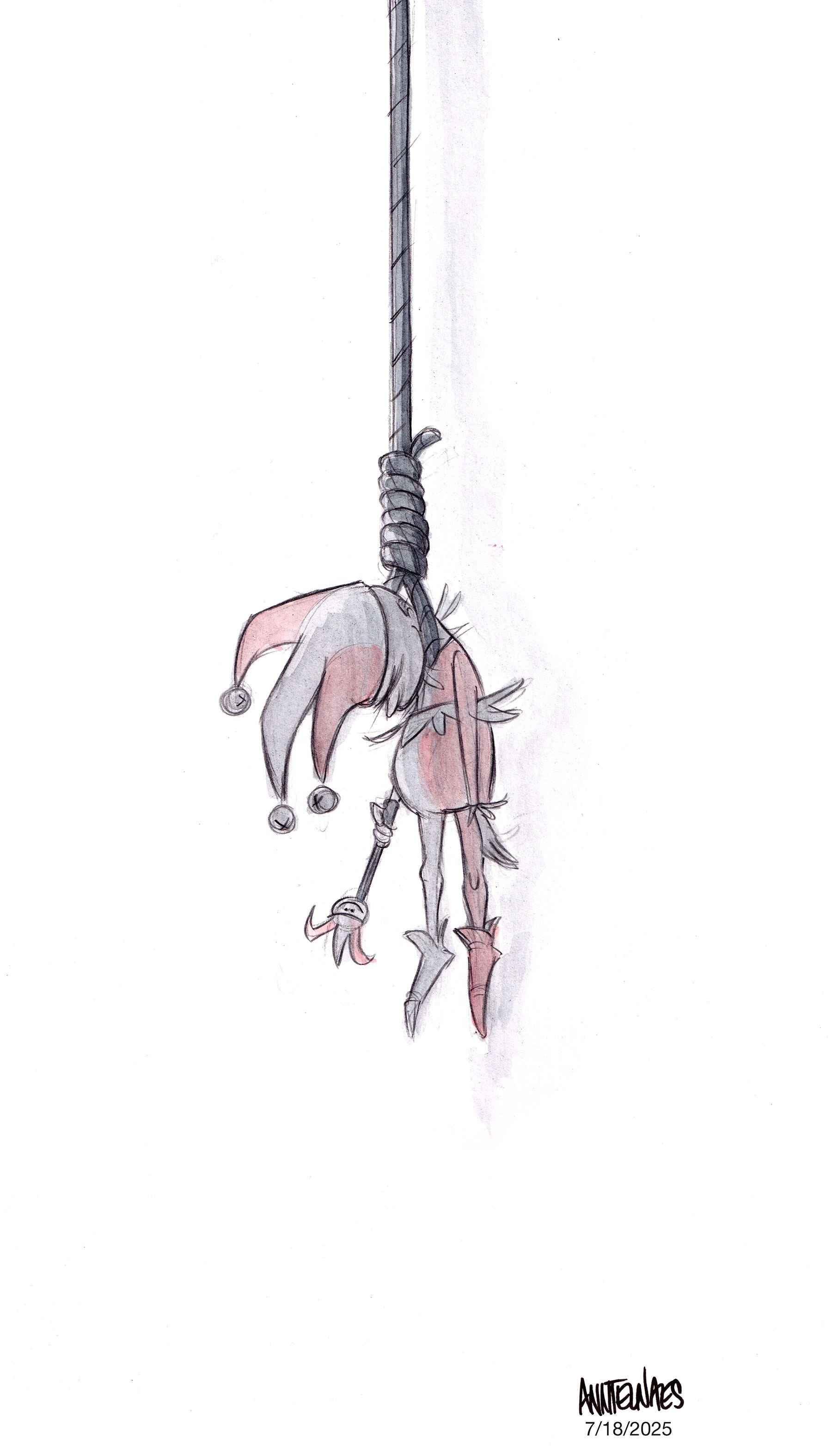
Killing satire by Ann Telnaes
CBS cancels The Late Show with Stephen Colbert, claiming it was “purely a financial decision” Read on Substack
The timing of the cancellation is suspect since Colbert publicly criticized the network’s parent company, Paramount, just a few days ago for settling a $16 million lawsuit with Trump while also looking to get approval from the FCC for a merger worth $8.4 billion. As Colbert described during his monologue, a “big, fat bribe”.
Paramount is just another media company looking to keep on Trump’s good side in order to benefit their bottom line. As any other autocrat, Trump has a very thin skin and doesn’t like getting ridiculed so expect more of this. Not a good sign for satirists or editorial cartoonists…or free speech in general.
A few months ago I was interviewed by Jeffrey Brown of the PBS Newshour and talked about how important it is for a democracy to protect the rights of editorial cartoonists and satirists (at end of the segment). (snip)
Margolis & Cox, Take Two by Clay Jones
A long song for MargoCox Read on Substack
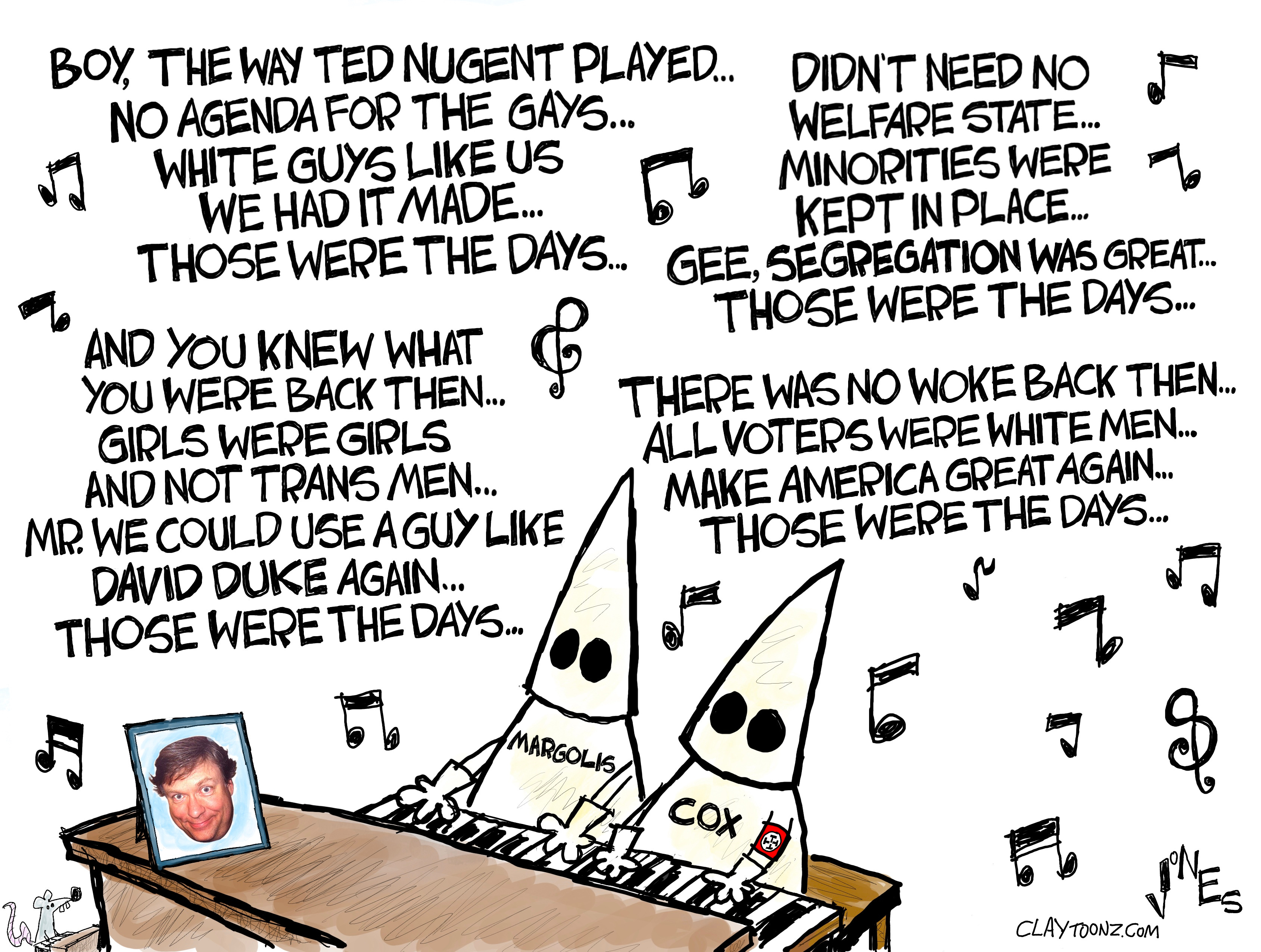
Ya’ll already knew I was a stinker. This cartoon is from December 2023, on the death of Norman Lear. I’m repurposing it with a few changes for Margolis & Cox, the racist cartooning duo I had a little spat with a couple of days ago, which I wrote about.
I sent this to my clients, but it’s not a regular syndication cartoon. They will get another cartoon today.
Nothing new with those racists, I just want to ask them a question. Cox is the artist and Margolis is the writer, right? So why does Cox need Margolis if he’s only going to write tropes that have already been done a million times? Look at this cartoon and remember, they said I can’t draw. Again, it doesn’t matter how well you draw (and they don’t draw well) if your ideas are shit.
Creative note: I had a few qualms about doing this, not about pissing off Margolis, Cox, or Cagle. I couldn’t care less about what mood this puts them in. I was concerned about repurposing an old cartoon. I’m no Dave Granlund. I don’t care about his mood either. But I decided this is special, and what better way to call them out than with a cartoon?
I have discovered over the years that many people who criticize others for a living can’t take criticism, especially if they’re MAGAts.
Music note: I listened to Verbena.
Drawn in 30 seconds: (snip-go see it-)
The powerful Ohio Republican coached wrestlers who say he knew team doctor Richard Strauss molested them but did nothing to protect them.
Rep. Jim Jordan of Ohio, one of the Republican Party’s top inquisitors in Congress, is expected to be deposed Friday about allegations that he failed to protect the wrestlers he once coached at Ohio State University from a sexual predator, four plaintiffs in lawsuits against the university told NBC News.
Jordan, who was the assistant wrestling coach at the university from 1986 to 1994 before he got into politics, has repeatedly and publicly denied any knowledge that the team’s doctor, Richard Strauss, was preying on the athletes.
It will be the first time Jordan has be questioned under oath by lawyers representing hundreds of former OSU students, both athletes and nonathletes, who are suing the school for damages in federal court in the Southern District of Ohio. Jordan is not a defendant, but he is referred to in some of the lawsuits alleging he was aware of the abuse.
Jordan, the powerful chairman of the House Judiciary Committee and a staunch ally of President Donald Trump, is known for his combative questioning of witnesses and for avoiding suit jackets during it.
Reached for comment, Jordan spokesperson Russell Dye released a variation of the statement Jordan’s team has been using since July 2018, when three former OSU wrestlers told NBC News that Jordan was lying when he claimed he did not know that Strauss molested them under the guise of giving physical examinations. (snip-a bit MORE)
(One’s a meme.) It’s likely been obvious since I’ve been posting here, that aside from some comments I make which are my own and don’t represent the blog, I’m careful about what sort of energy I put into the Playtime universe. I’ve just finished reading Evan Hurst’s Moral High Ground for today, and while it’s wildly, hilariously entertaining as well as pertinent, it’s not the energy I want to put out, so instead, here is a meme from me, with a bit from the piece, which is linked, and if you like really snarky humor, please do go enjoy it! It’s just a little rougher than I want to post here, even though I restacked it on substack. To be totally clear, the meme applies to myself and what Chip Gaines said. And now, we carry on- A.
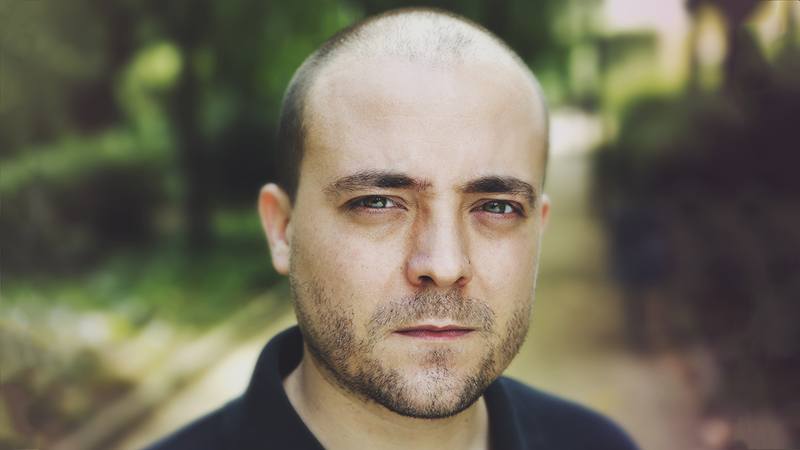
Snippet from The Moral High Ground:
I don’t know what Chip Gaines’s walk with the Lord on these issues has consisted of, bu his response to the manufactured controversy from God’s most wasted creations confirms that he’s indeed been on some version of such a walk, unlike anybody else in this post.
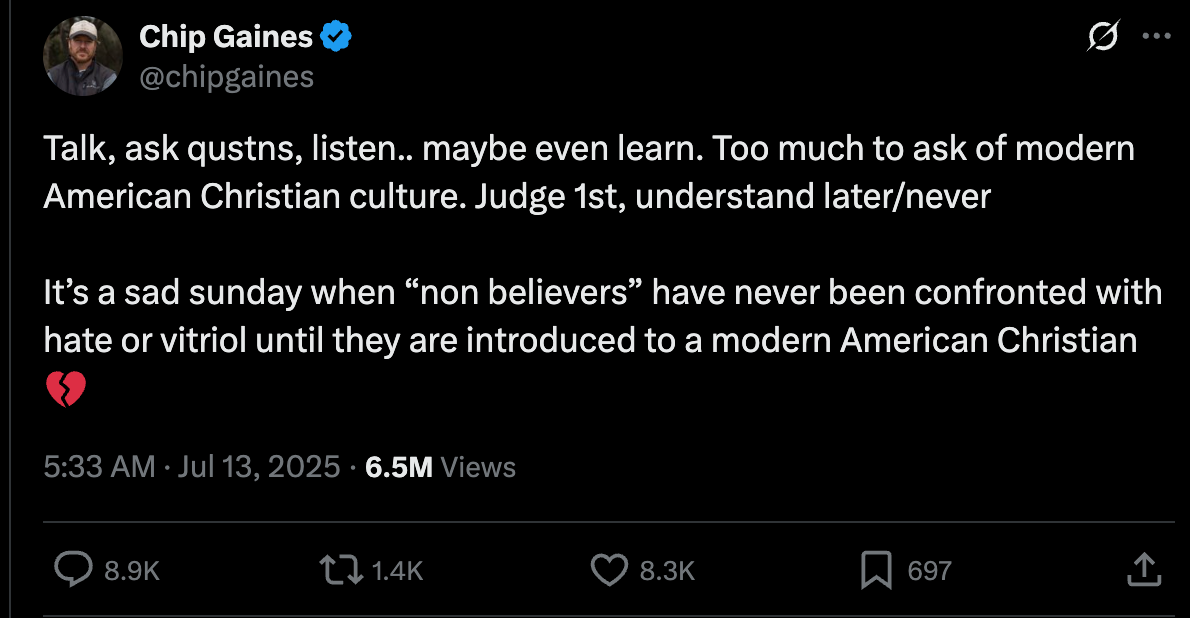
One line in there tells me that Chip, wherever he is exactly on this issue, his heart is at least aiming in the direction of Jesus:
Talk, ask qustns, listen.. maybe even learn. Too much to ask of modern American Christian culture. Judge 1st, understand later/never It’s a sad sunday when “non believers” have never been confronted with hate or vitriol until they are introduced to a modern American Christian
“Maybe even learn. Too much to ask of modern American Christian culture.” That’s biting, but that’s not the line. “Judge 1st, understand later/never.” He’s not fucking around, but that’s still not the line.
“It’s a sad sunday when ‘non believers’ have never been confronted with hate or vitriol until they are introduced to a modern American Christian.”
There it is. That’s the one that says he gets it. (snip-do go read it all, if you like; link below!)
Chip And Joanna Done Pissed Off The Bigots, Oh Lord by Evan Hurst
Joanna better not give a gay couple any shiplap! Read on Substack
Image Credit & Copyright: A.J. Smadi
2025 July 18

https://apod.nasa.gov/apod/astropix.html
Explanation: This month, bright planet Saturn rises in evening skies, its rings oriented nearly edge-on when viewed from planet Earth. And in the early morning hours on July 6, it posed very briefly with the International Space Station when viewed from a location in Federal Way, Washington, USA. This well-planned image, a stack of video frames, captures their momentary conjunction in the same telescopic field of view. With the ISS in low Earth orbit, space station and gas giant planet were separated by almost 1.4 billion kilometers. Their apparent sizes are comparable but the ISS was much brighter than Saturn and the ringed planet’s brightness has been increased for visibility in the stacked image. Precise timing and an exact location were needed to capture the ISS/Saturn conjunction.
Tomorrow’s picture: light-weekend
Please read thoughtfully and sign if you’re in the UK, and share it with people you know who are in the UK. And thank you!
Note from A: Something about which to write or call your US Rep and push:
‘Representatives and advocates are fighting for more LGBTQ+ mental health services. Kansas Rep. Sharice Davids reintroduced a bill last month dedicated to LGBTQ+ mental health resources. “By increasing access to mental health support for our children and teens, we can save lives,” Davids said in a press release. And last weekend, hundreds of people protested in front of Trump Tower in an effort to save the hotline.‘
———————————————————–
Jul 17, 2025 Sam Donndelinger, Uncloseted
If you or a loved one are in crisis, please call the National Suicide Prevention Lifeline at 1-800-273-TALK (8255), or contact the Crisis Text Line by texting TALK to 74174.
This story was originally published in Uncloseted Media, an LGBTQ-focused investigative news outlet.
When Arden was 16, they called a suicide crisis hotline “thinking their life was over.”
They were in an abusive relationship, regularly self-harming, and felt that nothing was helping. “It was terrifying,” they told Uncloseted Media.
“If it weren’t for the hotline, I would have killed myself.”
Since that day, Arden, now 24 years old and living in Brooklyn, has used various crisis helplines. When the 988 national suicide prevention hotline launched a “Press 3” option in 2022 for LGBTQ+ youth, they immediately started using the resource.
Arden, who identifies as nonbinary, says the LGBTQ+ hotline workers “respected their identity” and were understanding that they are not a woman. “It was really affirming for a very troubling time in my life.”
Since then, Arden has “Pressed 3” more times than they can remember, seeking help for everything from dealing with the loss of their friend, who died by suicide, to “stupid cliquey gay people stuff.”
“I remember when my friend had killed himself and I was dealing with a lot. I called them and they talked to me for over an hour because I was really upset,” they say. “When I called the hotline, it was a last resort. I was really at my wits’ end.”
Arden — whose last call to the lifeline was two weeks ago — is one of 1.3 million callers and chatters the LGBTQ+ youth hotline has served since it launched, according to federal data. The legislation that greenlit the national program, signed by Trump in 2020 during his first term, explicitly recognized that LGBTQ+ youth are more than “4 times more likely to contemplate suicide than their peers, with 1 in 5 LGBTQ+ youth and more than 1 in 3 transgender youth reporting attempting suicide.”
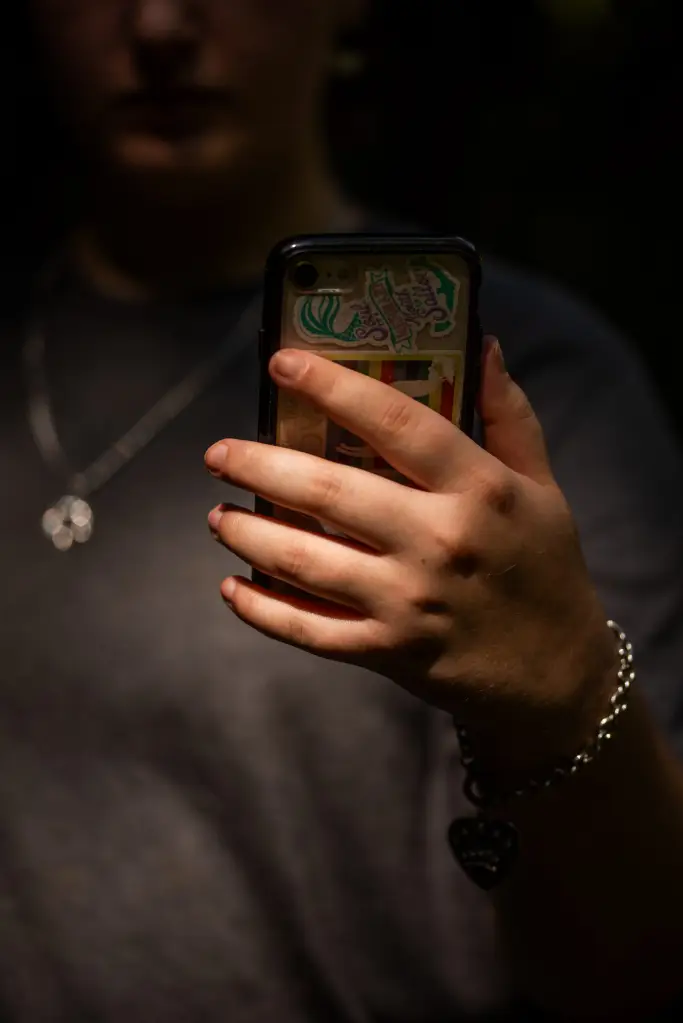
This new option to “Press 3” allowed queer youth in crisis the ability to directly connect with counselors from a set of specialized LGBTQ+ crisis centers. These counselors are trained in cultural competency and often bring lived experience, providing identity‑affirming, empathetic support for challenges like coming out, discrimination or mental health crises.
Despite the hotline’s success, the Trump administration announced last month that they would be shutting it down on July 17, claiming that the service had run out of congressionally directed funding. The Substance Abuse and Mental Health Services Administration said in an email to Uncloseted Media that “continued funding of the Press 3 option threatened to put the entire 988 Suicide & Crisis Lifeline in danger of massive reductions in service.”
There are no plans, however, to shut down the other hotline options, including the Veterans Crisis Line, the Spanish Language Line and the Native and Strong Lifeline. And while Congress spent $33 million on the LGBTQ+ service last year, the cost of continuing it represents merely 0.006 percent of the $510 billion that suicide and self-harm costs the U.S. yearly.
“This is absolutely a mistake,” a suicide prevention call center director told Uncloseted Media. “We are concerned that this will result in increased suicide rates for LGBTQ+ youth.”
The director’s concern is supported by a 2022 research brief that found that queer college students with access to LGBTQ-specific services were 44% less likely to attempt suicide than those without it. Research also shows that a hotline specific to LGBTQ+ services increases the likelihood of queer youth calling.
“It’s true for any direct service,” Harmony Rhoades, associate research professor of sociology at Washington University, told Uncloseted Media. “People who are in substance use recovery want to work with people who’ve gone through recovery themselves because they understand what that experience is. Culturally, there is not a lot of understanding of the specific experiences of someone who is LGBTQ+ and without specific training, a crisis counselor isn’t going to be able to know the language that’s going to feel affirming.”
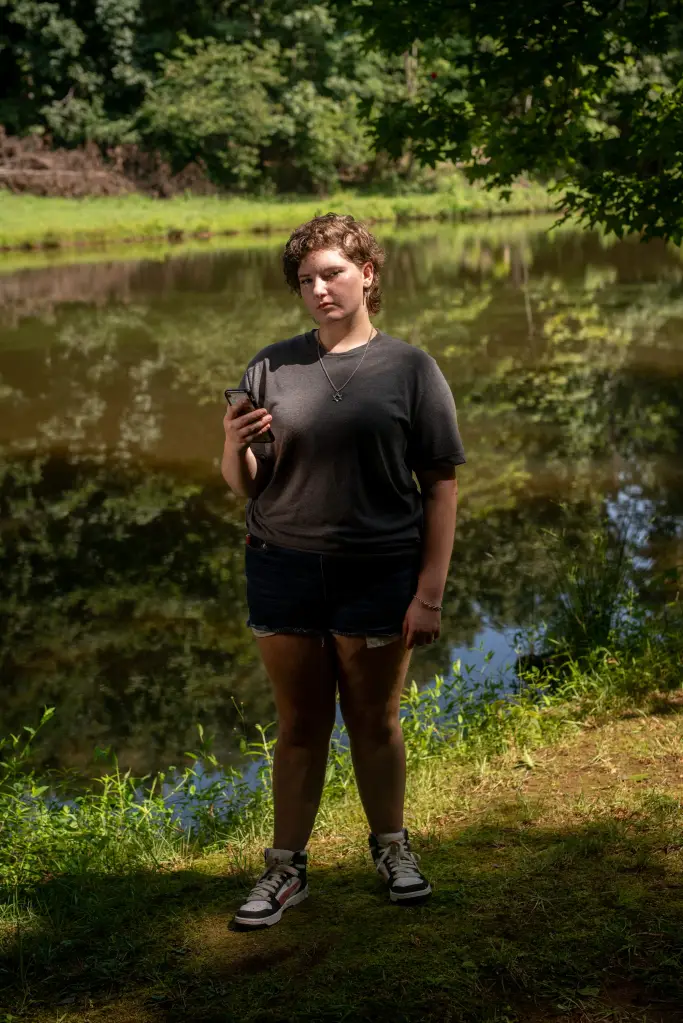
“Connecting with someone who gets it was really helpful. … Because at home, I was so isolated and I didn’t really interact with other queer people,” says Genna Brown, who used the Trevor Project’s chat function at 10 years old.
“I was an extremely self-loathing, suicidal kid who was under the impression that God hated me and I was gonna burn in hell for eternity,” Brown, now 15 and living in High Point, North Carolina, told Uncloseted Media.
“I only used the chat feature because I was scared my parents would hear me. We shared a wall,” she says. “I was spiraling really bad. I’d just realized I was crushing on girls, and I thought I was going to burn in hell for all eternity because that is what we are taught.”
Raised in a Southern Baptist church, Brown never felt safe at home, where her father would regularly spit slurs like “faggots” and “queers.” At church, every sermon was about Sodom and Gomorrah or about how “real love” only existed between a man and a woman.
“I grew up knowing the number one thing not to be was one of the ‘dirty queers,’” she says. “I kept thinking, I can kill myself now and go to hell, or live longer and still go to hell. I used to have panic attacks at 9, 10 years old, just thinking about burning in hell perpetually.”
Brown remembers Caitlin, the chat counselor who helped her, being the first ever to tell her that queer love was valid.
“She told me she’d been with her girlfriend for seven years. I didn’t even believe queer people could be happy. … It broke my brain in the best possible way,” says Brown, who is now out and proud to her parents, who have come around, and to most of her friends on social media.
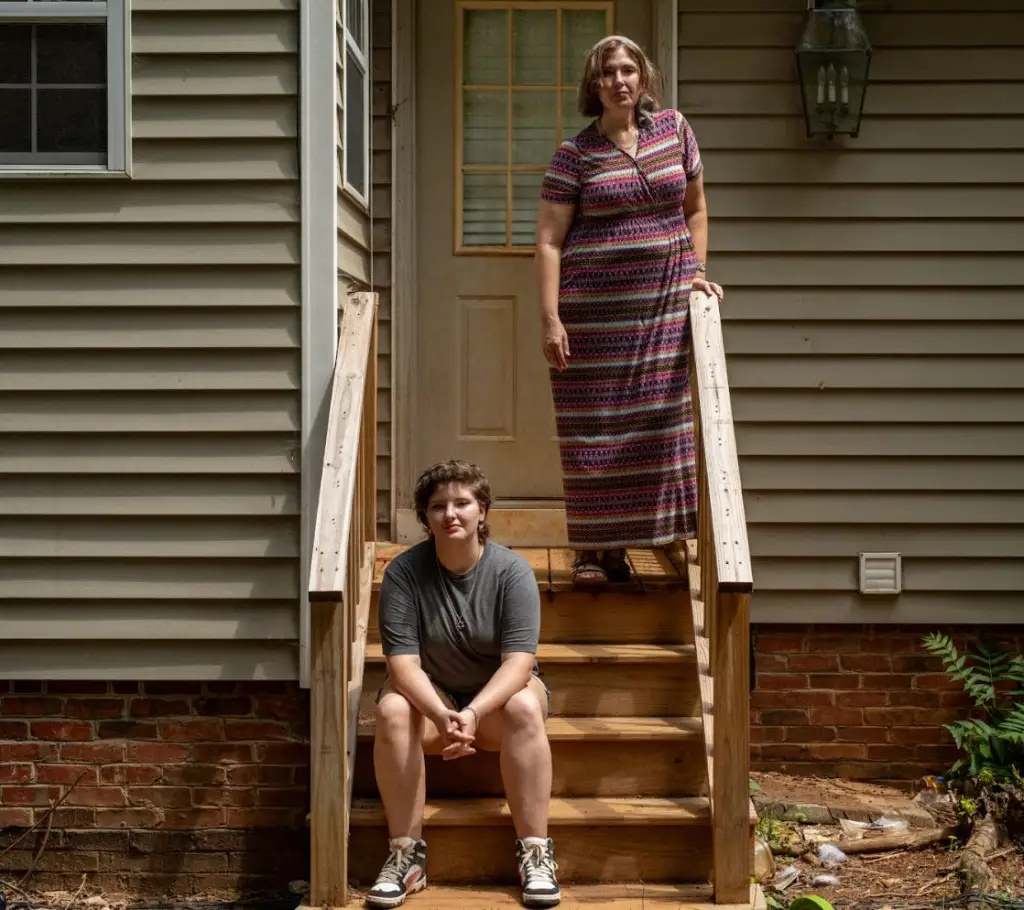
Genna and her Mom, Melanie. Kaoly Gutierrez/Uncloseted Media
Arden had a similar experience. “The queer line is better than the regular line,” they say. “I feel like it’s less like going through a checklist on the queer line.”
As a survivor of sexual assault, Arden says knowing that the counselors on the other line were trained in LGBTQ-specific trauma made it easier to reach out for help. “My voice doesn’t pass per se but they still respected my identity,” they say.
LGBTQ-specific resources for youth are critical, with 41 percent seriously considering suicide in 2024. In addition, queer youth are disproportionately affected by a litany of mental health issues and trauma, including physical and sexual assault, anxiety, depression, eating disorders, bullying and addiction.
“It’s not like we’re cherry-picking some random group,” says Rhoades. “If we are going to fund [suicide prevention], there is no reason we should do it inefficiently by not effectively targeting the people who need it most. So yes, they need specific suicide prevention services.”
While the hotline focuses on LGBTQ+ youth, they don’t turn away adults who need help. Joshua Dial, 36, says that when he called 988, he was often connected to the LGBTQ+ youth hotline after mentioning that he’s gay.
“I always walked away feeling better after I called,” he says. “There have been times when I spoke to the regular 988 crisis people, and they helped too. But they didn’t understand quite as much.”
Dial, a Lutheran who lives in Stillwater, Oklahoma, says he wasn’t always comfortable being open about his sexual orientation to his religious community and that the only way to meet other gay people was on hook-up and dating apps, which he notes are “not for emotional support.”
“I wouldn’t be talking to my pastor about getting on Grindr. I can’t go to my pastor and tell them what I did last weekend,” he says.
Dial, who was raised to believe that homosexuality is a sin, has experienced depression since the age of 16 and has also struggled with bipolar disorder, addiction and PTSD. “My addiction was getting worse, and the only constant was that the line was always available,” he says. “I didn’t have any other options, but I knew that if I called the hotline, I would get help.”
Dial says the emotional support he received through these phone calls kept him from self-harm and suicide. “There are times when I called that number and was this close to taking a handful of pills, this close to slitting my wrist, this close to buying a gun to shoot myself. And I talked to those people, and they not only understood, but they gave me the empowerment of knowing that someone had my back.”
While the cuts are only meant to affect the hotline’s support for LGBTQ+ youth, crisis center employees say they’ll impact the entire 988 network.
“This being rifted does very much mean less capacity for 988 as a whole,” says the suicide prevention call center director. “Everyone will be affected.”
“When the LGBTQ+ hotline opened up, it really lowered the volume on the mainstream counselors,” a 988 hotline counselor in Washington state told Uncloseted Media. “It seemed really helpful, and I didn’t get a lot of LGBTQ+ chats after that point.”
The counselor at the Washington state center says they are about to lay off 42 counselors from their LGBTQ+ hotline. They say these roles won’t be replaced on the main 988 line due to a hiring freeze. Because of this, counselors expect the number of calls they receive to double, which could dramatically increase wait times. The Washington state center did not respond to a request for comment.
Even without the cuts, wait times are an issue. A 17-year-old caller from Virginia says that even the 10 minutes they had to wait for their call to be answered were painful. “I was worried that nobody would want to talk to me. I was just feeling hopeless,” they say. “There’s this one resource that I’m supposed to be able to have access to 24/7, but it just isn’t as accessible as it should be. For some people, those 10 minutes are crucial.”
In a 2009 study of 82 patients referred to a psychiatric university hospital after a suicide attempt, nearly half reported that the period between their first thought of suicide and their actual attempt had lasted 10 minutes or less, underscoring how shorter wait times can be a matter of life and death.
“If we are not able to catch someone during the time that suicidal thoughts have appeared and intervene as quickly as possible, they could start figuring out how they’re going to kill themselves and make it happen,” says the suicide prevention call center director. “And a lot of folks have access to means that can result in instant death like firearms.”
With the “Press 3” option gone, Rhoades worries that the current spate of anti-LGBTQ+ legislation and hateful rhetoric toward the community will affect how counselors without queer-specific training will provide care.
“We’re living in an unprecedented time where anti-LGBTQ+ hatred is being normalized,” she says. “It absolutely affects how young people are treated. And it filters down to crisis counselors.”
As Congress and the Trump administration prepare to shut down “Press 3” on July 17 in an effort to save money, many believe that it will have the reverse effect.
“They just want these people to die. … That’s the message I got,” says a hotline operator in Washington state, adding that the administration is “not looking at the bigger picture.”
Representatives and advocates are fighting for more LGBTQ+ mental health services. Kansas Rep. Sharice Davids reintroduced a bill last month dedicated to LGBTQ+ mental health resources. “By increasing access to mental health support for our children and teens, we can save lives,” Davids said in a press release. And last weekend, hundreds of people protested in front of Trump Tower in an effort to save the hotline.
Arden says they wouldn’t be here today without the line’s support. “I’ve been struggling for a long time in my life [with] self-harm and I’ve been clean almost two years now,” they say. “I would definitely not be clean if it weren’t for the hotline and I would probably hurt myself again.”
 Scottie's Playtime