
Teaching new Americans culinary skills…and beyond by José Andrés
At Emma’s Torch, refugees get the skills to work in kitchens and make a life for themselves Read on Substack
Hello friends, today I want to tell you about a really special organization here in Washington, DC as well as in Brooklyn, New York. It’s called Emma’s Torch, a non-profit organization that provides culinary training for refugees. Kerry Brodie, the founder of Emma’s Torch, named it after the famous poem written on the Statue of Liberty (“Give me your tired, your poor…”) by Emma Lazarus. The organization runs culinary programs for small groups of students to learn kitchen skills as well as life skills—and they have a network of partners to support students and graduates find housing, seek employment, connect with local communities, and find mental health support.
Soon, the DC program will be expanding to a much larger facility in Silver Spring, opening the door for even more students to be supported. My Longer Tables Fund has given a grant to Emma’s Torch to support this growth as a lead partner as they grow across the DC region, starting with the flagship Silver Spring hub in 2026…building a stronger future where more students can train for meaningful careers, more employers can connect with incredible talent, and more neighbors come together around the table. I’m excited to see the development of the new space and hopefully one day to attend a future graduation!
The Emma’s Torch culinary training program is 11 weeks total, and includes time in a classroom, in a teaching kitchen, in professional kitchens, and in a café that the organization runs. The Emma’s Torch team teaches culinary skills like knife skills, food safety, and recipe execution, as well as training outside the kitchen, like how to write a resume, how to interview, conflict resolution skills, coping methods, and language—mostly focused on culinary vocabulary and kitchen-specific language. Just imagine how important it is to be able to understand the difference between “you did cook that” and “you will cook that”…!
Emma’s Torch also has a relationship with José Andrés Group restaurants in Washington and New York—a program coordinated by our director of people, Eduardo Maia—and some of the program’s students work in our kitchens for a few days…as we say in kitchens, a “stage.” Students have worked at Zaytinya, Oyamel, Jaleo, China Chilcano, as well as minibar in DC, and Mercado Little Spain and Zaytinya in New York…and our teams have been so proud to work with them.
The organization partners with local nonprofits in DC and New York, organizations that support refugees like the International Rescue Committee, the Ethiopian Community Development Council, and other resettlement organizations…many of which have seen a decline in funding, so now more than ever, we need to be thinking about how to support people coming to our country. Today of all days, this week of all weeks, this year of all years, I think we should all be thinking about what longer tables means to us—and how the work of organizations like Emma’s Torch can make our communities, and our country, stronger.
My team had the opportunity to visit the DC cafe and meet some of the team members and students from Emma’s Torch (and had an amazing lunch at the café, of course!). Here are some thoughts from Kerry Brodie, the organization’s founder, Justin Edwards, the lead culinary trainer, and two recent graduates, Clara and Mamaissata.
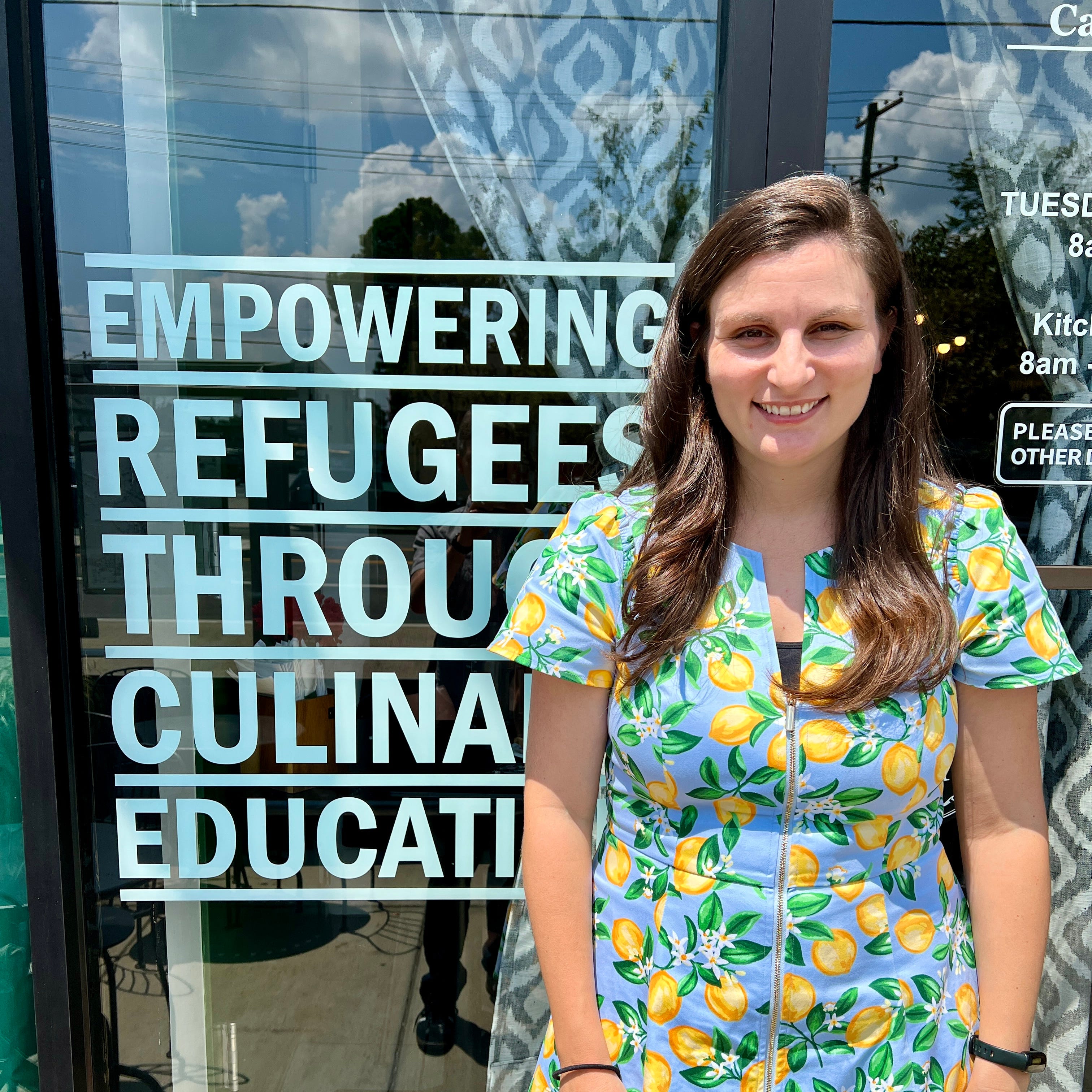
Kerry Brodie is the founder of Emma’s Torch. She created the organization in 2016 after seeing the challenges of the day—a growing refugee crisis and increasingly hostile attitudes to new Americans, as well as restaurants struggling to find good workers. She’d had difficulty understanding how major change could happen through public policy—so instead, she decided to take matters into her own hands, and start a program training refugees to cook and to enter the workforce. Here’s more in Kerry’s own words.
Refugee resettlement is a long process because there’s the immediate trauma that a person might be escaping, but there’s also the trauma of building something entirely new—something that you didn’t plan for, that might not be plan B for you, but plan Z. Like, this is not where you thought you would be. And so many of our students have a shared experience of coming to terms with that, processing the loss as well as seeing the future with optimism, and working to build something.
And now, that trauma is paired with the constant harassment of headlines telling you that you’re not welcome here, and that you’re a drain on society, or that you are an other.
I think the loss of agency is something that becomes a huge problem because fundamentally, many people who leave their homes as refugees are taken from place to place and no longer given choices…Like, start here, go there, do this class. Instead, we like to frame everything as terms of a choice. We have our program and we’re clear with potential students about the parameters of it: this is what might be possible for you if you want to do it, but it is your choice to show up here, it is your choice to participate. It’s also your choice to accept or not to accept a job on the other end, at one of our employment partners.
We’ve seen more and more situations where families are separated, which leads to a lot of social isolation. It means we need to help people build a whole new social network for themselves, to establish a whole new social capital structure. So of course we’re teaching culinary skills, but we’re also teaching about employment. I like the phrase “knife skills and life skills”—but it’s not just language skills and how to write a resume, but also about equity and empowerment, how to speak up for yourself, to have agency over your life, despite the huge headwinds. (snip-There Is More-Please go read it!)

 Scottie's Playtime