A far-right influencer posted a video in late December alleging fraud at daycare centres run by Somali-Americans. Citing the video, the Trump administration suspended $185 million in funding to Minnesota pending a review of the childcare centres in question. The administration followed up in January by suspending another $10 billion in federal funding for childcare subsidies to hundreds of thousands of households in five Democratic states, including Minnesota.
The decision to target the Somali community echoed Trump’s own rhetoric. In December, he said Somalis should not be welcome in the United States, comparing them to “garbage”. DHS reinforced the message in a post on X announcing the end of a temporary protected status: “Our message is clear. Go back to your own country, or we’ll send you back ourselves.”
What followed bore little resemblance to a targeted investigation. Residents reported agents sweeping through residential neighbourhoods and the parking lots of big-box stores, stopping people seemingly at random to demand their immigration status. “Masked men” broke into a north Minneapolis home without a judicial warrant, arresting a 38-year-old Liberian man as his wife and 9-year-old stepdaughter were inside, local public radio outlet MPR News reported.
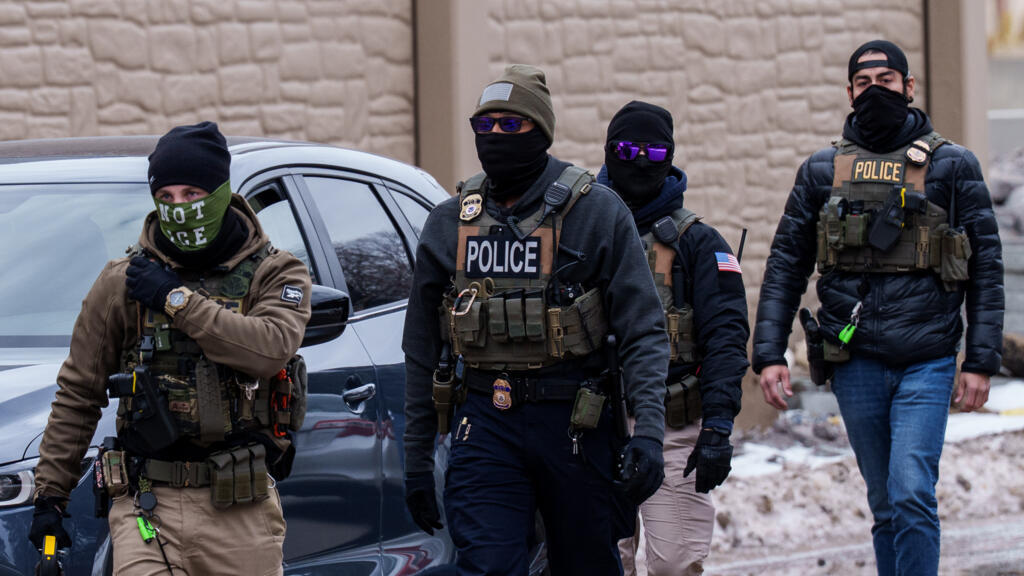
Operation “Metro Surge” has brought together a rarely seen patchwork of agencies far from the border: three-quarters are from ICE Enforcement and Removal Operations, AP reported, working alongside agents from Homeland Security Investigations (HSI) and Customs and Border Patrol (CBP).
This blending of uniforms, mandates and chains of command made it nearly impossible for civilians to know who was stopping them, under what authority, and what rights they retained.
A symbolically progressive city
The scale of coordination reflects a strategy first developed at the southern border. Shortly after returning to office in January 2025, Trump declared a national emergency at the border, triggering a significant mobilisation involving DHS, ICE, CBP, the National Guard and US Northern Command.
With the events in Minnesota, the same emergency logic and the same mix of civilian and quasi-military forces are now being applied hundreds of miles from the border.
Minneapolis is the most dramatic example so far, but not the only one. Federal immigration surges have already taken place or are planned in cities including Chicago, Phoenix, Denver, New York and Los Angeles.
Trump has shown little interest in calming tensions, using florid and almost biblical language to describe the continuing operation.
“FEAR NOT, GREAT PEOPLE OF MINNESOTA,” he wrote on Truth Social. “THE DAY OF RECKONING & RETRIBUTION IS COMING!”
Immigration attorney Scott Shuchart says Minnesota offered a perfect opportunity for the Trump administration, which was looking for an excuse to invoke the Insurrection Act as Trump has threatened to do.
“The administration has been trying to pick this fight, trying to find a place [resisting] enough to have an excuse to declare an insurrection and use more force,” Shuchart said. “Minneapolis was the next target. It’s ideal for them – it has a large Somali immigrant population, and there is [Minnesota Representative] Ilhan Omar, whom Trump hates. His people are very angry and, frankly, racist.”
Unlike law enforcement agents like police, who are trained in de-escalation tactics, ICE officers appear to relish doing the opposite.
“They are escalating rather than de-escalating,” Shuchart added. “They need this. They don’t want unity: disunity is good for them. Trump has never tried to be more popular or to appeal to the other side. By continuing to feel victimised, he empowers himself politically.”
Minneapolis represents both a symbolic and strategic target: it’s a Democratic stronghold, a “sanctuary city” where local authorities limit cooperation with federal immigration enforcement, and a place still nationally associated with protests against police violence over the killing of George Floyd in 2020. Minnesota is also governed by Tim Walz, the Democrats’ 2024 vice-presidential nominee.
According to DHS, the surge is part of a nationwide push to fulfil Trump’s promise to carry out the “largest deportation operation” in American history. ICE has more than doubled its manpower in less than a year, from roughly 10,000 officers to more than 22,000, driven by an aggressive recruitment campaign.
To staff that expansion, barriers to entry have been lowered. Deportation officers must be US citizens, pass a background check and drug screening, and meet basic physical requirements. The job requires carrying a firearm and explicitly authorises the use of deadly force “when necessary”.
Training has been significantly shortened, with NBC reporting that it was cut from 13 weeks to six – a move one former ICE agent described to Time magazine as “a recipe for disaster”.
“New recruits often have minimal education and abbreviated preparation. The danger is that it attracts people who are more loyal to Trump than to professional law enforcement,” said Shuchart, citing far-right, pro-Trump militias such as the Oath Keepers and Proud Boys.
That broader lack of professionalism has fed into another flashpoint in the operation: the use of masks by immigration agents. Acting ICE director Todd Lyons said the practice is intended to prevent officers from being doxxed. But it actually “spurs dangerous impersonations, impedes accountability for officers who are engaged in misconduct, and undermines trust in law enforcement”, the Center for American Progress argued in a report released on August 2025, when hundreds of officers from nearly 20 federal agencies were deployed to the streets of Washington.
In a confidential bulletin circulated to law enforcement agencies last month, the FBI even warned that criminals across several states have been posing as ICE officers to commit robberies, kidnappings and sexual assaults.
A deliberate media blur
The confusion has been amplified online. High-profile right-wing influencers were granted privileged access to operations, blurring the line between the administration, law enforcement agents and partisan media.
Figures with large followings, including “Dr Phil” McGraw and Libs of TikTok creator Chaya Raichik, were repeatedly invited on ride-alongs and allowed to interview senior officials, producing content that framed enforcement actions as necessary and heroic. ICE’s own social media accounts actively promoted the operation, which the Washington Post has described as a broader “media machine” designed to project strength and deter resistance.
Pro-Trump influencer Benny Johnson went even further, wearing a Border Patrol tactical vest to observe a raid at a Walmart in the Chicago area alongside Homeland Security Secretary Kristi L. Noem. In a video posted on X, he praised the operation as “amazing”, highlighting what he called “wild scenes”.


 Scottie's Playtime