
I first read about Bayard Rustin in “The Nation” in the late 1990s. His story was both sad and inspirational. Here is some background on an unrecognized star (not that article I read years ago, I’m sorry. I have no access.)
Bayard Rustin
(1912–1987)
Bayard Rustin (1912–1987) was a human rights activist known for his work during the Civil Rights Movement
Rustin was a key organizer of the 1963 March on Washington for Jobs and Freedom and was one of Martin Luther King Jr.’s closest advisors, especially on techniques of nonviolent resistance. Rustin was extremely active in the Congress of Racial Equality (CORE) and helped to create the Southern Christian Leadership Conference (SCLC).
Early in his career, he was arrested for “moral cause” which led to his outing to the public. However, once outed, Rustin was completely open about his sexuality and was never ashamed. Criticism and discrimination over his sexuality led Rustin to have a more background role in the Civil Rights Movement. He never wanted his sexuality to have a negative effect on the Movement, which is often the reason that Rustin’s efforts are not widely known. (snip-MORE)
Bayard Rustin: A Gay Man in the Civil Rights Movement.
Bayard Rustin was an American leader in social movements for civil rights, socialism, pacifism and non-violence, and gay rights.
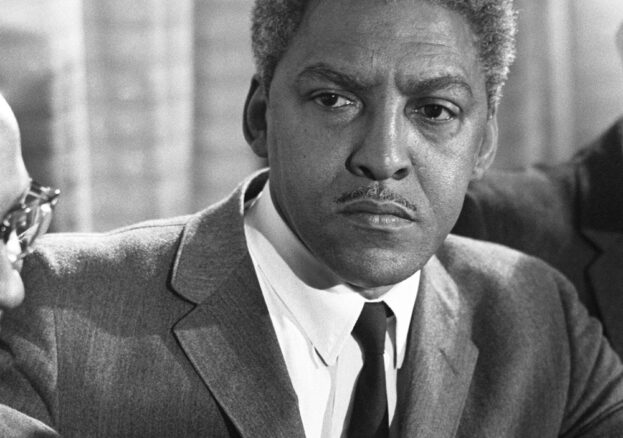
2HKJNR6 Bayard Rustin (1912-1987), American civil rights activist, attending Walter Reuther Press Conference, Warren K. Leffler, US News & World Report Magazine Collection, March 17, 1965
Bayard Rustin was an unsung hero whose indomitable spirit and relentless dedication carved a pivotal path in the American civil rights movement. Despite the shadows cast by prejudice and political adversity, Rustin’s life radiated with a fervent commitment to justice, equality, and nonviolence. His story is one of courage, resilience, and unwavering passion for the principles he held dear.
A Foundation of Activism
Born on March 17, 1912, in West Chester, Pennsylvania, Rustin was nurtured in a household steeped in activism and moral conviction. Raised by his Quaker grandparents, particularly his grandmother, Julia Rustin, a dedicated member of the NAACP, he absorbed the values of equality and social justice from an early age. This upbringing ignited a spark within him that would blaze throughout his lifetime.
Rustin’s early education at Wilberforce University and Cheyney State Teachers College further fueled his activist spirit. Though he did not complete his degree, these institutions were fertile ground for his burgeoning political consciousness. His move to Harlem in 1936 immersed him in the heart of African-American culture and political activism, setting the stage for his life’s work.
The Power of Nonviolence
Rustin’s commitment to nonviolence was both a strategic choice and a deeply held belief. His association with the Fellowship of Reconciliation (FOR), a pacifist organisation, was pivotal. Under the mentorship of A. J. Muste, Rustin honed his skills in civil disobedience and nonviolent resistance, becoming a leading voice in the fight against racial injustice.
In 1947, Rustin co-organised the Journey of Reconciliation, a courageous precursor to the Freedom Rides of the 1960s. This daring initiative aimed to dismantle segregation on interstate buses through direct action. Facing arrests and brutality, Rustin’s unwavering resolve demonstrated the transformative power of nonviolent protest and set a powerful precedent for future civil rights campaigns.
A Strategic Visionary
Rustin’s encounter with Martin Luther King Jr. during the Montgomery Bus Boycott marked a turning point in the civil rights movement. Recognising King’s potential, Rustin became a crucial advisor, infusing the movement with his vast experience and strategic acumen. His efforts were instrumental in the formation of the Southern Christian Leadership Conference (SCLC) in 1957, strengthening the infrastructure of the civil rights struggle.
Rustin’s strategic brilliance shone through his emphasis on Gandhian principles of nonviolence. He played a key role in guiding King towards these philosophies, ensuring that nonviolent resistance remained at the heart of the movement. Rustin’s behind-the-scenes influence was a driving force that propelled the civil rights movement forward, even amidst escalating tensions and opposition.
The March on Washington (snip-MORE)
And from Quakers In Action,
Bayard Rustin
1912-1987
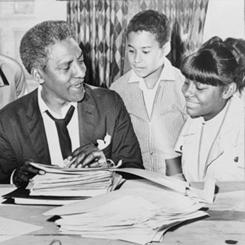
Bayard Rustin was a black Civil Rights activist, a close associate of Martin Luther King, and an advocate of gay and lesbian rights, and a Quaker.
Rustin was born in West Chester, Pennsylvania and was brought up by his grandmother, who had been raised as a Quaker. He himself became a Quaker in 1936, shortly before moving to New York where he lived most of his adult life. He was a pacifist and a primary influence in bringing non-violent resistance into the American Civil Rights Movement, much inspired by Gandhi’s approach in India.
In 1941, he joined the pacifist Fellowship of Reconciliation. He protested against segregation within the armed forces, and worked with the American Friends Service Committee to protect the property of interned Japanese Americans.
Despite his membership of the Society of Friends (one of the so-called ‘Historic Peace Churches’), Rustin was jailed in 1944 for his conscientious objection to cooperating with the draft. While in jail, he organised protests against segregated seating in the dining hall. In a letter to the prison warden, he wrote:
Both morally and practically, segregation is to me a basic injustice. Since I believe it to be so, I must attempt to remove it. There are three ways in which one can deal with an injustice. (a) One can accept it without protest. (b) On can seek to avoid it. (c) One can resist the injustice non-violently. To accept it is to perpetuate it.
After the War, he took part in the Journey of Reconciliation across four southern States, to protest against illegal segregation in inter-state travel. He was arrested, along with his fellow protestors, several times in the course of the journey and in North Carolina was sentenced to thirty days on a chain gang. The protest became a model for future ‘Freedom Rides’.
In 1956, he was asked to advise Martin Luther King on the application of non-violent resistance to the boycott of public transport in Montgomery, Alabama. In August 1963, Rustin had the mammoth task of organising the March on Washington for Jobs and Freedom – a rally attended by twenty thousand people that culminated in King’s ‘I have a dream’ speech. In 1968, shortly before King’s assassination, he drafted the ‘Economic Bill of Rights’ which called for – among other things – a meaningful job and a living wage for people of all colours.
Rustin’s concern for Human Rights was never confined to black Americans. In the 1940s and 50s, He supported independence movements in India, Ghana and Nigeria. In the 1970s and 1980s, Rustin became an election and human rights observer in countries like Chile, El Salvador, Grenada, Haiti, Poland, and Zimbabwe. As Vice Chairman of the International Rescue Committee he participated in the international March for Survival on the Thai-Cambodian border and helped raise awareness of the plight of the Vietnamese boat people. He was Co-Chairman of the Citizens Commission on Indochinese Refugees and helped found the National Emergency Coalition for Haitian Refugees.
Rustin was an openly gay man who had once been arrested for public indecency at a time when homosexuality was illegal in all US states. This fact was used against him more than once and contributed to his relatively low profile in the Civil Rights movement. However, in the 1970s and 80s he wrote a number of essays which drew parallels between the black civil rights movement and the gay liberation movement. In 1986, Rustin wrote:
Today, blacks are no longer the litmus paper or the barometer of social change. Blacks are in every segment of society and there are laws that help to protect them from racial discrimination… It is in this sense that gay people are the new barometer for social change… The question of social change should be framed with the most vulnerable group in mind: gay people.
Rustin fell ill during a human rights expedition to Haiti in 1987 and died shortly after from a perforated appendix.
His life was documented in the film Brother Outsider.
His collected writings were published in A Time On Two Crosses.


