Target, Cracker Barrel, and the Race to Lose $100 Million Dollars
Fresh for the week. Enjoy!

Target, Cracker Barrel, and the Race to Lose $100 Million Dollars
Fresh for the week. Enjoy!
Kinda thinkin’ of moving to Chicago. I still have some relatives around there; not to live with, but that I know people who know me.
Video is embedded on the page, for those who prefer to watch/listen.
By CBS Chicago Team Updated on: August 26, 2025 / 9:16 AM CDT / CBS Chicago
Illinois Governor JB Pritzker spoke at a news conference Monday afternoon, addressing reports President Trump is planning to send the military to Chicago. Here is the full text of his remarks.
I want to speak plainly about the moment that we are in and the actual crisis, not the manufactured one, that we are facing in this city, and as a state, and as a country. If it sounds to you like I am alarmist, that is because I am ringing an alarm, one that I hope every person listening will heed, both here in Illinois and across the country.
Over the weekend, we learned from the media that Donald Trump has been planning, for quite a while now, to deploy armed military personnel to the streets of Chicago. This is exactly the type of overreach that our country’s founders warned against, and it’s the reason that they established a federal system with a separation of powers built on checks and balances.
What President Trump is doing is unprecedented and unwarranted. It is illegal. It is unconstitutional. It is un-American.
No one from the White House or the executive branch has reached out to me or to the mayor. No one has reached out to our staffs. No effort has been made to coordinate or to ask for our assistance in identifying any actions that might be helpful to us. Local law enforcement has not been contacted. We have made no requests for federal intervention. None.
We found out what Donald Trump was planning the same way that all of you did: We read a story in The Washington Post.
If this was really about fighting crime and making the streets safe, what possible justification could the White House have for planning such an exceptional action without any conversations or consultations with the governor, the mayor, or the police?
Let me answer that question: This is not about fighting crime. This is about Donald Trump searching for any justification to deploy the military in a blue city, in a blue state, to try and intimidate his political rivals.
This is about the president of the United States and his complicit lackey, Stephen Miller, searching for ways to lay the groundwork to circumvent our democracy, militarize our cities and end elections.
There is no emergency in Chicago that calls for armed military intervention. There is no inter- insurrection. There is no insurrection. Like every major American city in both blue and red states, we deal with crime in Chicago. Indeed, the violent crime rate is worse in red states and red cities.
Here in Chicago, our civilian police force and elected leaders work every day to combat crime and to improve public safety, and it’s working.
Not one person here today will claim we have solved all crime in Chicago, nor can that be said of any major American metro area. But calling the military into a U.S. city to invade our streets and neighborhoods and disrupt the lives of everyday people is an extraordinary action, and it should require extraordinary justification.
Look around you right now. Does this look like an emergency? Look at this. Go talk to the people of Chicago who are enjoying a gorgeous afternoon in this city. Ask the families buying ice cream on the Riverwalk. Go see the students who are at the beach after school. Talk to the workers that I just met taking the water taxi to get here. Find a family who’s enjoying today sitting on their front porch and ask if they want their neighborhoods turned into a war zone by a wannabe dictator. Ask if they’d like to pass through a checkpoint with unidentified officers in masks while taking their kids to school.
Crime is a reality we all face in this country. Public safety has been among our highest priorities since taking office. We have hired more police and given them more funding.
We banned assault weapons, ghost guns, bump stocks, and high-capacity magazines. We invested historic amounts into community violence intervention programs. We listened to our local communities, to the people who live and work in the places that are most affected by crime and asked them what they needed to help make their neighborhoods safer.
Those strategies have been working. Crime is dropping in Chicago. Murders are down 32% compared to last year and nearly cut in half since 2021.
Shootings are down 37% since last year, and 57% from four years ago. Robberies are down 34% year over year. Burglaries down 21%. Motor vehicle thefts down 26%.
So in case there was any doubt as to the motivation behind Trump’s military occupations, take note: 13 of the top 20 cities in homicide rate have Republican governors. None of these cities is Chicago.
Eight of the top 10 states with the highest homicide rates are led by Republicans. None of those states is Illinois.
Memphis, Tennessee; Hattiesburg, Mississippi have higher crime rates than Chicago, and yet Donald Trump is sending troops here and not there? Ask yourself why.
If Donald Trump was actually serious about fighting crime in cities like Chicago, he, along with his congressional Republicans, would not be cutting over $800 million in public safety and crime prevention grants nationally, including cutting $158 million in funding to Illinois for violence prevention programs that deploy trained outreach workers to deescalate conflict on our streets. Cutting $71 million in law enforcement grants to Illinois, direct money for police departments through programs like Project Safe Neighborhoods, the state and local Antiterrorism Training Program, and the Rural Violent Crime Reduction Initiative, cutting $137 million in child protection measures in Illinois that protect our kids against abuse and neglect.
Trump is defunding the police.
To the members of the press who are assembled here today, and listening across the country, I am asking for your courage to tell it like it is.
This is not a time to pretend here that there are two sides to this story. This is not a time to fall back into the reflexive crouch that I so often see, where the authoritarian creep by this administration is ignored in favor of some horse race piece on who will be helped politically by the president’s actions.
Donald Trump wants to use the military to occupy a U.S. city, punish his dissidence, and score political points. If this were happening in any other country, we would have no trouble calling it what it is: a dangerous power grab.
Look at the people assembled before you today, behind me. This is a full cross-section of Chicago’s leaders from the business world, the faith community, law enforcement, education, community organizations, and more. We sometimes disagree on how to effectively solve the many challenges that our state and our city face on a daily basis. But today, we are standing here united, in public, in front of the cameras, unafraid to tell the president that his proposed actions will make our jobs harder and the lives of our residents worse.
Earlier today in the Oval Office, Donald Trump looked at the assembled cameras and asked for me personally to say, “Mr. President, can you do us the honor of protecting our city?” Instead, I say, “Mr. President, do not come to Chicago.”
You are neither wanted here nor needed here. Your remarks about this effort over the last several weeks have betrayed a continuing slip in your mental faculties and are not fit for the auspicious office that you occupy.
Most alarming, you seem to lack any appropriate concern as our commander-in-chief for the members of the military that you would so callously deploy as pawns in your ever-more-alarming grabs for power.
As a governor, I’ve had to make the decision in the past to call up members of the National Guard into active service, and I think it’s worth taking a moment to reflect on how seriously I take that responsibility, and on the many things that I consider before asking these brave men and women to leave their homes and their communities to serve in any capacity for us.
As I’ve said many times in the past, members of the National Guard are not trained to serve as law enforcement. They are trained for the battlefield, and they’re good at it. They’re not trained to arrest people and read them their Miranda rights. They did not sign up for the National Guard to fight crime. And when we call them into service, we are reaching into local communities and taking people who have jobs and families away from their neighborhoods and the people who rely upon them.
It is insulting to their integrity and to the extraordinary sacrifices that they make to serve in the Guard to use them as a political prop, where they could be put in situations where they will be at odds with their local communities, the ones that they seek to serve.
I know Donald Trump doesn’t care about the well-being of the members of our military, but I do and so do all the people standing here.
So let me speak to all Illinoisans and to all Chicagoans right now. Hopefully the president will reconsider this dangerous and misguided encroachment upon our state and our city’s sovereignty. Hopefully rational voices, if there are any left inside the White House or the Pentagon, will prevail in the coming days. If not, we are going to face an unprecedented and difficult time ahead.
But I know you Chicago, and I know you are up to it. When you protest, do it peacefully. Be sure to continue Chicago’s long tradition of nonviolent resistance. Remember that the members of the military and the National Guard who will be asked to walk these streets are, for the most part, here unwillingly. And remember that they can be court martialed and their lives ruined if they resist deployment. Look to the members of the faith community standing behind me today for guidance on how to mobilize.
To my fellow governors across the nation who would consider pulling your National Guards from their duties at home to come into my state against the wishes of its elected representatives and its people, you would be failing your constituents and your country. Cooperation and coordination between our states is vital to the fabric of our nation and it benefits us all. Any action undercutting that and violating the sacred sovereignty of our state to cater to the ego of a dictator will be responded to.
The State of Illinois is ready to stand against this military deployment with every peaceful tool we have. We will see the Trump administration in court. We will use every lever at our disposal to protect the people of Illinois and their rights.
Finally, to the Trump administration officials who are complicit in this scheme, to the public servants who have forsaken their oath to the Constitution to serve the petty whims of an arrogant little man, to any federal official who would come to Chicago and try to incite my people into violence as a pretext for something darker and more dangerous: we are watching and we are taking names.
This country has survived darker periods than the one that we are going through right now, and eventually the pendulum will swing back, maybe even next year. Donald Trump has already shown himself to have little regard for the many acolytes that he has encouraged to commit crimes on his behalf.
You can delay justice for a time, but history shows you cannot prevent it from finding you eventually. If you hurt my people, nothing will stop me, not time or political circumstance, from making sure that you face justice under our constitutional rule of law.
As Dr. King once said, “The arc of the moral universe is long, but it bends toward justice.” Humbly I would add, it doesn’t bend on its own. History tells us we often have to apply force needed to make sure that the arc gets where it needs to go. This is one of those times.
| August 26, 1789 The French National Assembly agreed to document known as the “Declaration of the Rights of Man.” It was a set of principles for gauging the legitimacy of any governing system, and included (in summary): • “Men are born and remain free and equal in rights” “ Those rights are liberty, property, security, and resistance to oppression” “ Liberty consists in the freedom to do everything which injures no one else” • “The free communication of ideas and opinions is one of the most precious of the rights of man”  Declaration des Droits de L’Homme et du Citoyen (Declaration of the Rights of Man and the Citizen) • Law can only prohibit such actions as are hurtful to society and law is the expression of the general will. “ Every citizen has a right to participate personally, or through his representative, in its foundation.” • No person shall be accused, arrested, or imprisoned except when in violation of a public law, all persons are held “innocent until they shall have been declared guilty,” and receive punishments “only as are strictly and obviously necessary” • The security of the rights of man and of the citizen requires public military forces, and a “common contribution” is essential for the maintenance of the public forces and for the cost of administration, and that public servants are obliged to account for use of those funds • Property is an “inviolable and sacred right,” and no one shall be deprived thereof The complete text: |
| August 26, 1839 The Amistad (“Friendship”), a Spanish slave ship seized by the 54 Africans who had been carried as cargo on board, landed on Long Island, New York. The leader of the mutiny was Joseph Cinque, a Mende, from the part of Africa that is now Sierra Leone.  Cinque-one of the revolt leaders   The Amistad More on the story of the Amistad |
August 26, 1920 The 19th Amendment, guaranteeing women the right to vote, officially became part of the U.S. Constitution: “The right of citizens of the United States to vote shall not be denied or abridged by the United States or by any State on account of sex.” This day has been known since 1971 as Women’s Equality Day. More on Women’s Equality Day The document itself, from the National Archives (And it is still there.) |
| August 26-29, 1968 Police and anti-war demonstrators clashed in the streets of Chicago as the Democratic National Convention nominated Vice President Hubert Humphrey for president inside the Amphitheater. Club-swinging Chicago police indiscriminately tear-gassed, kicked and beat anti-war demonstrators, delegates, reporters and innocent bystanders outside, arresting 500. 11,900 Chicago police, 7500 Army troops, 7500 Illinois National Guardsmen and 1000 Secret Service agents were ultimately involved. Protesting what was later officially designated a police riot, members of the Democrats’ Wisconsin delegation attempted to march to the convention hall, but police turned them back. When Senator Abraham Ribicoff (D-Connecticut) delivered his nominating speech, he infuriated Mayor Richard Daley by saying, “with George McGovern as President of the United States, we wouldn’t have Gestapo tactics in the streets of Chicago.”   Julian Bond, the first black member of the previously all-white Georgia state legislature, seconded the nomination of anti-war presidential candidate Minnesota Senator Eugene McCarthy. Bond added that he had seen such police behavior before, but only in segregationist Mississippi, Alabama, and Georgia. a narrative account Arthur Miller on the Convention |
| August 26, 1970 Betty Friedan leads a nationwide protest called the Women’s Strike for Equality in New York City on the fiftieth anniversary of women’s suffrage. |
| August 26, 1971 Six thousand turned out for a National Organization for Women-organized Women March for Equality in New York City. They were calling for equal rights, including the demand “51 percent of everything,” reflecting women’s proportion of the U.S. population. This first “Women’s Equality Day,” instituted by Bella Abzug, was established by Presidential Proclamation and reaffirmed annually. |
| August 26, 1985 Samantha Smith, a 10-year-old from Manchester, Maine, was invited to visit the Soviet Union by its Premier, Yuri Andropov.  Statue of Samantha Smith at the Maine State Library, Augusta, Maine She had written him a letter asking if the Soviet Union intended to attack the United States. She visited him in the U.S.S.R. and became a young ambassador for peace. She died in an airplane crash at age 13 on this day returning home with her father from a peace mission.  Grade school student, peace activist 1972-1985 |
https://www.peacebuttons.info/E-News/peacehistoryaugust.htm#august26
Cracker Cancel Culture by Clay Jones
What will MAGA World be upset about next? Read on Substack
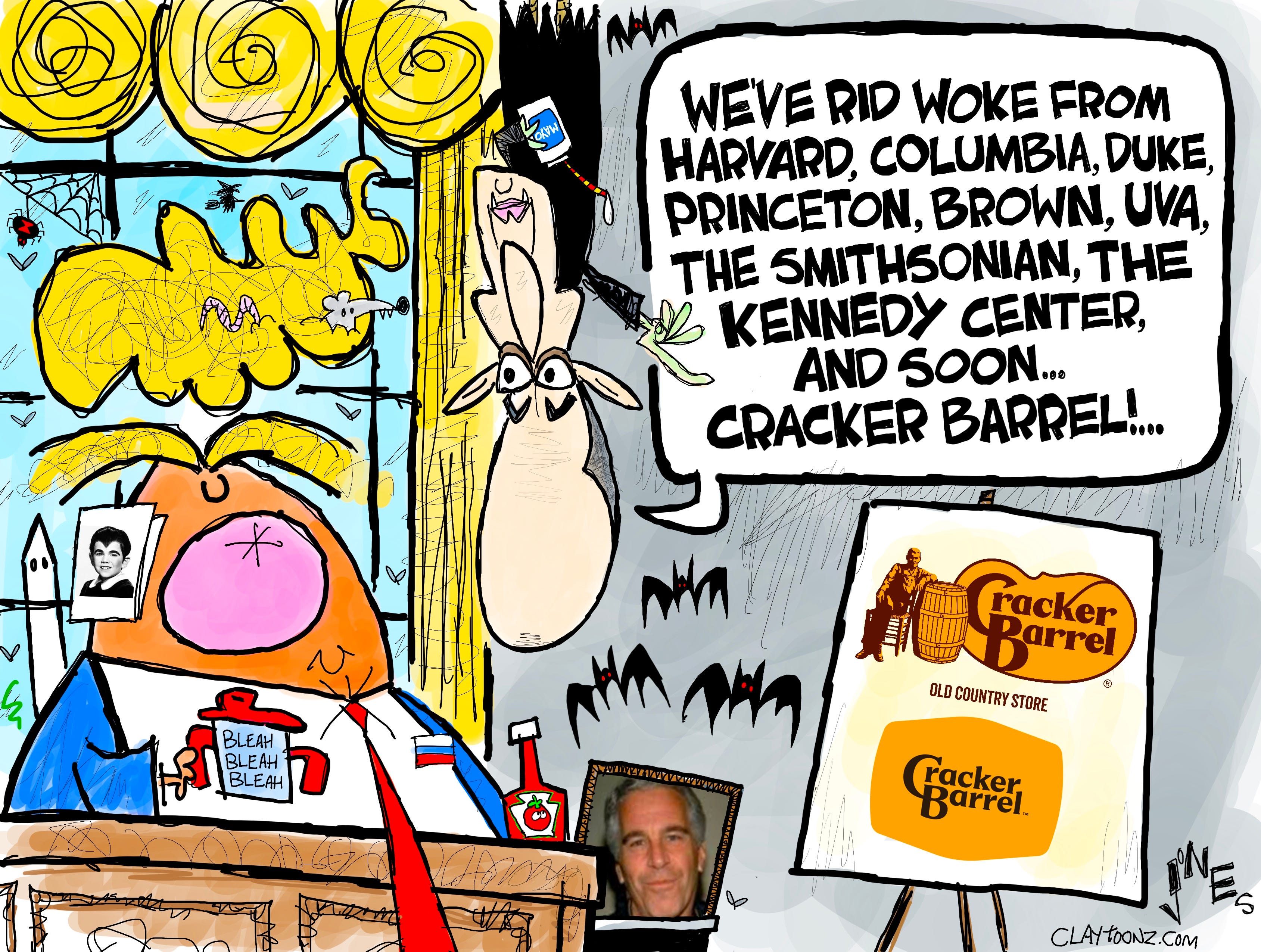
Cracker Barrel, the restaurant that does to down-home southern cooking what Olive Garden does to Italian food, has changed its logo from one boring image to a new boring image…and White people are upset. Seriously, they’re upset.
It’s like that time Sexy M&M ditched her Go-Go boots and Tucker Carlson had to find something new to envision while spending “quality time” with himself. Or, it’s like that time Aunt Jemima was removed from syrup bottles and old White conservatives had to find something else to get sticky with. That reminds me, do you put syrup in the fridge after you open it? I saw that on the TV show Mom (Alison Janney is the shit) last night, and I was like, “whaaaaaaa?” I always thought putting syrup in the fridge made it all stiffy. OK, I’ll get off this gross roll here and continue writing about these wankers. (snip-MORE and it is good)
Cheat To Win by Clay Jones
Republicans cheat Read on Substack
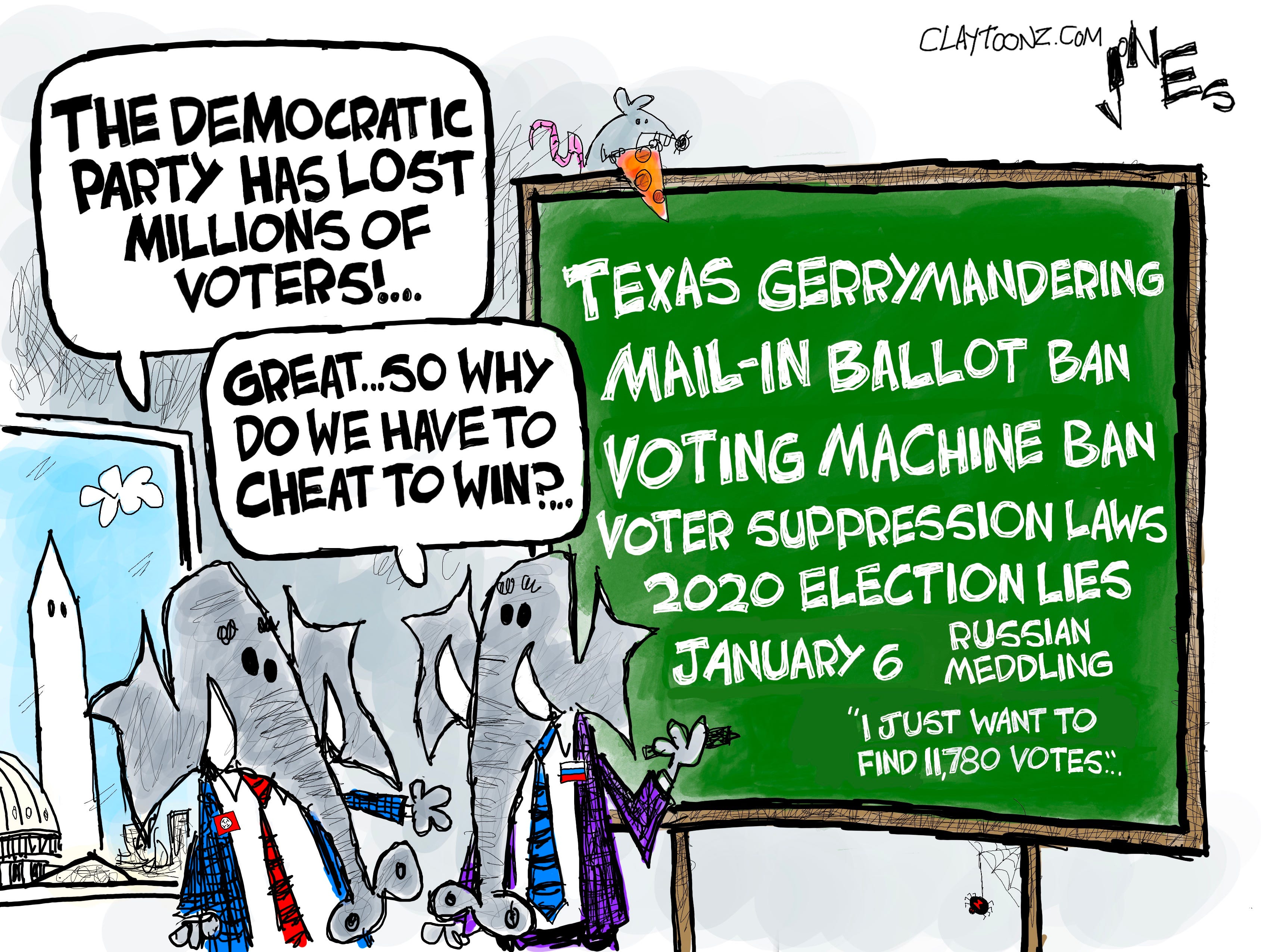
The New York Times reported that the Democratic Party is losing voters, and lost over 2.1 million between the 2020 and 2024 elections in the 30 states and Washington, DC that allow voters to register by party. Republicans, on the other han,d picked up over 2.4 million. There are still more Democrats registered nationwide, but the gap between the two parties is shrinking.
This is a fact. Don’t say it’s a fake poll like a MAGA would, because denying it isn’t how you fix it. And yeah, I get it. It’s as confusing as why anyone would choose Trump over Kamala Harris.
The truth is, too many people in this nation don’t care. (snip-MORE)
New Schools and Bathroom Rules by Clay Jones
Linda McMahon wants to see your bathroom Read on Substack
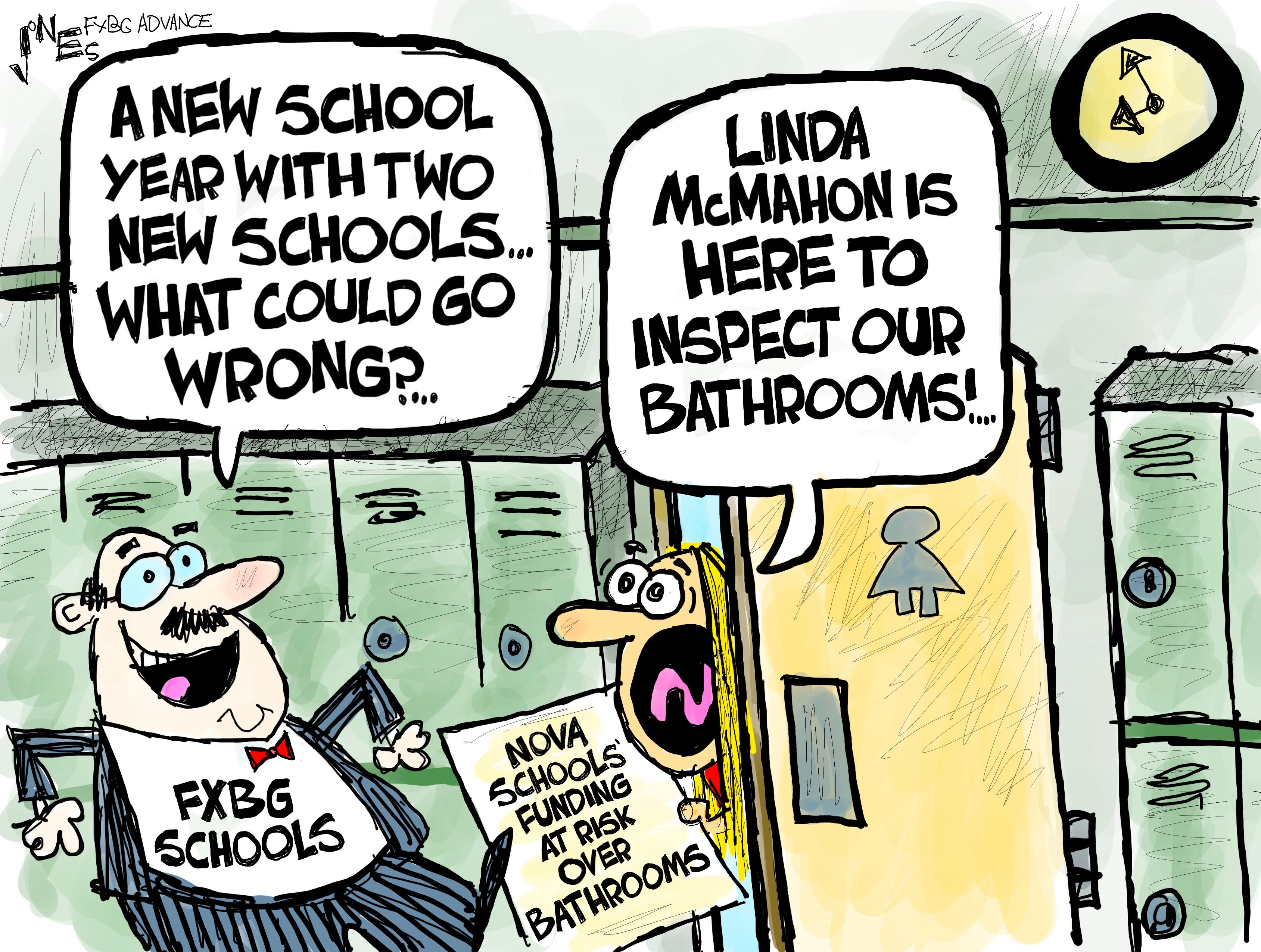
This cartoon was drawn for the FXBG Advance.
The Advance wrote this to go with today’s cartoon: Fredericksburg City Schools had a tough summer (well, the School Board did, anyway), but there were some good things this year, like the opening of two new schools. What could possibly go wrong? Well, when the new U.S. Education Secretary’s experience for the job is being able to distinguish a Camel Clutch from a Cobra Clutch, and her idea of a towering academic intellectual is Hulk Hogan, a lot. Yes, the Trump Administration specializes in hiring — how should I put this kindly — less-than-smart people to lead federal agencies. So rather than ‘rassling’ with serious education issues, we spend our time banning every book with a black face on it and having freak-outs about bathrooms. Yeah, that’s gonna make America great. Just ask Clay Jones.
Linda McMahon and the Education Department are going after five schools in Northern Virginia over bathrooms. (snip-MORE)
Newsom Nuisance by Clay Jones
Gavin Newsom is trolling Trump Read on Substack
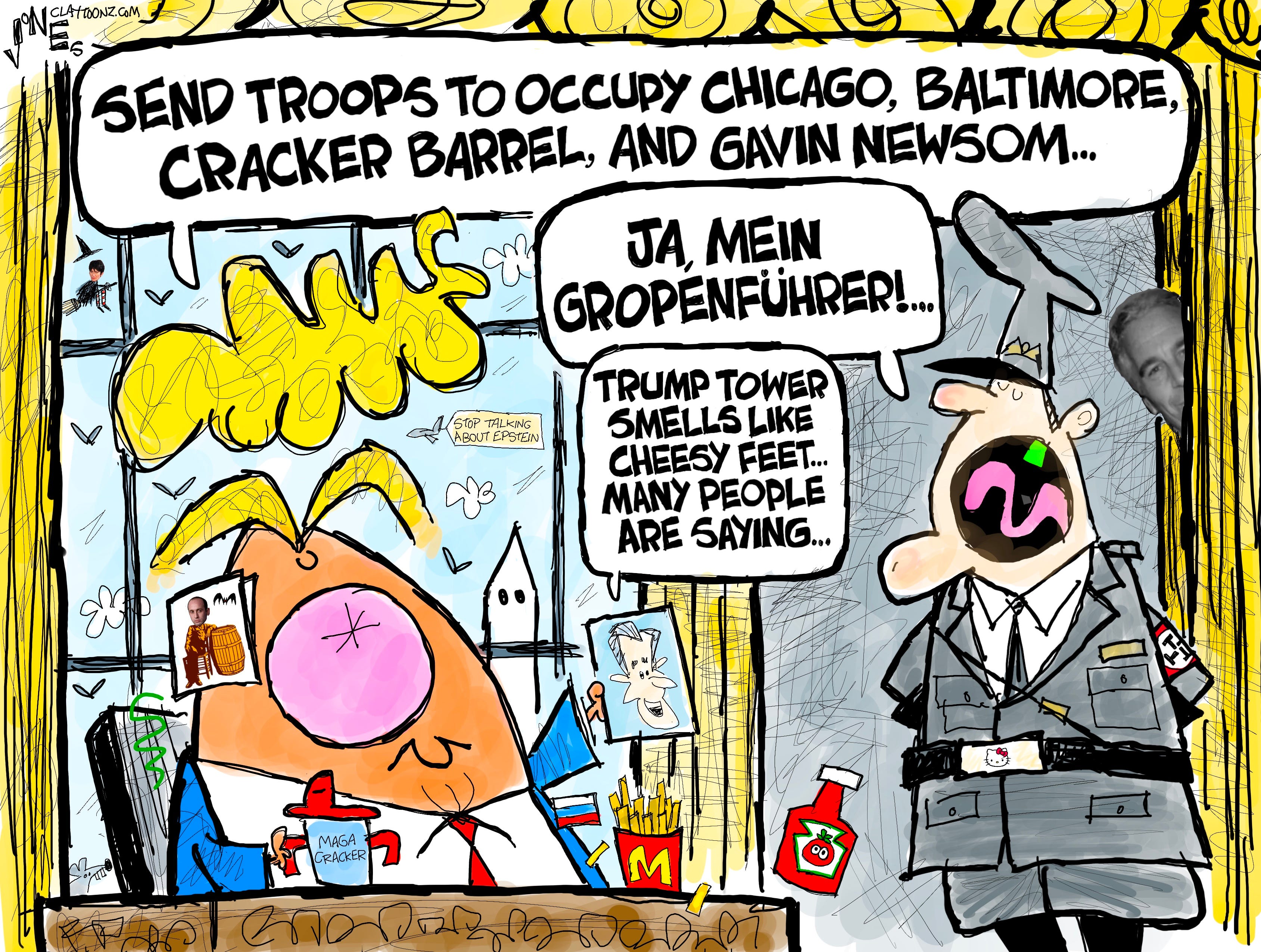
California Governor Gavin Newsom has been trolling Donald Trump, or at least his press office has. It’s being done in the style of Trump. The tweets coming from Newsom’s account are mimicking Trump’s style, as in stupid, praising himself, belittling in a juvenile way, full of narcissism, and often in all caps.
Here’s one tweeted out after Trump’s press conference with Putin:
TRUMP JUST FLED THE PODIUM WITH PUTIN — NO QUESTIONS, NOTHING! TOTAL LOW ENERGY. THE MAN LOOKED LIKE HE’D JUST EATEN 3 BUCKETS OF KFC WITH VLAD. IS HE AFRAID THE PRESS WILL ASK ABOUT ME??? (AMERICA’S FAVORITE GOVERNOR) AND THE FACT I “STOLE THE CAMERAS” THIS WEEK WITH “THE MAPS”? MANY PEOPLE ARE SAYING HE BEGGED PUTIN TO HOLD HIS HANDS (TINY) ON THE WAY OUT. ADMIT IT, DONNIE J… YOU’RE TERRIFIED BECAUSE THIS WAS THE WORST WEEK OF YOUR LIFE BECAUSE OF ME, GAVIN C. NEWSOM. “THE MAPS” WILL END YOUR PRESIDENCY, RETAKE CONGRESS FOR THE PEOPLE, AND EXPOSE YOUR RIGGED “LITTLE GAME.”
Now that’s funny, and it’s very effective. Proof of that is Fox News host Dana Perino’s reaction, saying, “Stop it with the Twitter thing! I don’t know where his wife is. (snip-MORE)
A key point: Josh Marshall has been writing about how to leverage the separate sovereignty of the states against Trump. “Strategic depth,” he calls it, from military studies:
Understanding the critical role of the sovereign powers of the states as a redoubt beyond the reach of Trump’s increasingly autocratic power is really the entire game right now, at least for the next 18 months and, in various measures, almost certainly through the beginning of 2029. People can march, advocate, campaign, donate to candidates, all the stuff. But in many ways the most important thing right now is both communicating to and demanding of state officials that they act on this latent power.
There are key areas where Democrats in Congress may have moments of power, the ability to slow a few things down. But to a great degree, the battle is already lost within the federal government until the next election. It’s only in the states where opponents of Donald Trump hold executive power outside the reach of and the hierarchies of the federal government. That’s where the whole game is. It is strategic depth not in extent or remoteness of territory but in the structure of government and the state. And states have vast amounts of power, far more than we tend to realize because we’ve never been in a position where the mundane daily activities of state and local government have become so critical — its taxing powers, its policing powers, the ways in which the federal government actually struggles to effectively extend its powers to the local level at scale without the active participation of local government.
======================================
Published by Tom Sullivan on August 25, 2025
Something Jason Sattler wrote yesterday needs repeating this morning:
Everything we do makes it easier for our neighbors to stand up or sit down for this regime. We all know there’s a crisis coming that will force all who pay attention to make a choice that could define the rest of their lives.
Will people do it? In most cases, it depends on what they see us doing next.
SEE us doing. That’s the key.
How the less-engaged make up their minds about political matters, Anand Giridharadas observed (based on Anat’s work), is more akin to how they decide to buy pants: What’s everyone else wearing this year? What are normal people like me doing? Not in one-and-done big rallies but every day. Your resistance must be visible and persistent for that to work and give the less engaged permission to join the resistance movement. Calling your senator five days a week is fine, but which of your neighbors sees that?
Plus, if you want people to join your party, throw a better party. We’re out in the streets multiple times a week now. I bring dance music.
A friend pointed to this TikTok by someone going by @logicnliberty. She advocates a unified front by blue-state governors with trifectas. It’s not that they are not already unified, coordinating, and suing. They are. Govs. Gavin Newsom, JB Pritzker, Kathy Hochul are speaking out and holding press conferences. (State AGs too.) But not necessarily as a team. Are they leveraging their trifectas proactively to erect firewalls in their states against Trump’s gutting of the Constitution? They should.
(snip-TikTok video embedded on the page)
Would the press cover it if they did? We are already in the slow civil war Jeff Sharlet described. The blue and the gray meets the blue and the red. Run with it. The press loves controversy. Generate more, blue state governors.
Josh Marshall has been writing about how to leverage the separate sovereignty of the states against Trump. “Strategic depth,” he calls it, from military studies:
There are key areas where Democrats in Congress may have moments of power, the ability to slow a few things down. But to a great degree, the battle is already lost within the federal government until the next election. It’s only in the states where opponents of Donald Trump hold executive power outside the reach of and the hierarchies of the federal government. That’s where the whole game is. It is strategic depth not in extent or remoteness of territory but in the structure of government and the state. And states have vast amounts of power, far more than we tend to realize because we’ve never been in a position where the mundane daily activities of state and local government have become so critical — its taxing powers, its policing powers, the ways in which the federal government actually struggles to effectively extend its powers to the local level at scale without the active participation of local government.
Understanding the critical role of the sovereign powers of the states as a redoubt beyond the reach of Trump’s increasingly autocratic power is really the entire game right now, at least for the next 18 months and, in various measures, almost certainly through the beginning of 2029. People can march, advocate, campaign, donate to candidates, all the stuff. But in many ways the most important thing right now is both communicating to and demanding of state officials that they act on this latent power.
And those actions must be not only public, but in-your-face public. Their actions and yours.
Update: Read it. It’s where your neighbors are.
The human heart hangs on to hope until there’s no other choice. People will not fight back in the ways that will work, until they realize there is no other choice, until the only other choice is their own imprisonment or death, or that of someone they love. For many of us, that moment is already here. But for most of us, it’s not.
* * * * *
Have you fought dicktatorship today?
50501 – Labor Day events
May Day Strong Labor Day Events
No King’s One Million Rising movement
The Resistance Lab
Choose Democracy
Indivisible: A Guide to Democracy on the Brink – Search on Labor Day events near you
You Have Power
Chop Wood, Carry Water
Thirty lonely but beautiful actions
Attending a Protest Surveillance Self-Defense
(If you click through, you can read Dr. Hogans own story on his page.)
When the Parade Stops, the Silence Speaks Louder by Richard Hogan, MD, PhD(2), DBA
null Read on Substack

Narrative Word Count: 289
Bio: Richard Francis Hogan is a Canadian writer, Poet and advocate on several levels based in Ottawa. His work explores hope, resilience, identity, faith, and the quiet power of public spaces.
(snip-personal contact info)
https://richardhogan1.substack.com
Cover Letter for Submission
Subject: Op-Ed Submission: When the Parade Stops, the Silence Speaks Louder
Dear Editor,
I am submitting the attached op-ed for consideration in the Ottawa Citizen. It reflects on the recent cancellation of the Ottawa Gay Pride Parade and the deeper cultural and spiritual implications of that absence. As a longtime resident and advocate for inclusive public spaces, I believe this piece speaks to a moment of reflection for our city and its commitment to visibility, dignity, and belonging. Thank you for your time and consideration.
Sincerely,
Richard Hogan
(snip-personal contact info)
Full Narrative
When the Parade Stops, the Silence Speaks Louder
By Richard Francis Hogan
The cancellation of the Ottawa Gay Pride Parade due to protests is more than a logistical decision. It is a cultural silence, a civic absence, a spiritual pause that demands reflection.
For decades, Pride has been more than a celebration. It has been a procession of courage, a public hymn of identity, a communal act of love. It has been where the marginalized found visibility, where joy became resistance, and where the city itself remembered its promise to all its people.
To cancel such a gathering is not merely to postpone an event. It is to interrupt a ritual of belonging.
As a Christian, I believe in the sacredness of every human soul. As a Buddhist, I recognize the impermanence of all things—but also the importance of showing up, again and again, with compassion. And as someone with Irish blood, I know that humor and heartache often walk hand in hand. We laugh because we’ve cried. We march because we’ve been still for too long.
This year, there will be no rainbow flags waving down Bank Street. No music echoing through Centretown. No cheers from sidewalks lined with families, allies, and elders who remember when Pride was a protest, not a party.
But let us not confuse absence with apathy.
Let us write, speak, gather, and remember. Let us honor those who came before, and those who still wait to be seen. Let us make sure that when the parade returns, it does so not just with glitter—but with grit.
Because Pride is not a date on the calendar. It is a declaration of dignity.
And dignity, like love, does not disappear. It waits. It endures. It marches on.

(I don’t know what this formatting is about; it’s a copy/paste, as they all are. If it’s annoying, read it as it usually posts, on the page. Thanks. -A.)
| August 25, 1969 |
| Company A of the 3rd Battalion, the 196th Light Brigade, refused to advance further into the Songchang Valley of Vietnam after five days of heavy casualties; their number had been reduced from 150 to 60. This was one of hundreds of mutinies among troops during the war. |  |
 | “He [President Nixon] is also carrying on the battle in the belief, or pretense, that the South Vietnamese will really be able to defend their country and our democratic objectives [sic] when we withdraw, and even his own generals don’t believe the South Vietnamese will do it.” –James Reston in the New York Times | |
| Vietnam: The Soldier’s Revolt | ||
| GI resistance in the Vietnam War | ||
https://www.peacebuttons.info/E-News/peacehistoryaugust.htm#august25
To me, it seems damned important. We the people have all become owners/stockholders of Intel. What I get for avoiding the Friday evening news dump; it is in today’s newsletter.
Trump turns $11.1B in US government funds into a 10% stake in downtrodden Intel
By MICHELLE L. PRICE and MICHAEL LIEDTKE Updated 5:55 PM CDT, August 22, 2025
WASHINGTON (AP) — President Donald Trump on Friday announced the U.S. government has secured a 10% stake in struggling Silicon Valley pioneer Intel in a deal that was completed just a couple weeks after he was depicting the company’s CEO as a conflicted leader unfit for the job.
“The United States of America now fully owns and controls 10% of INTEL, a Great American Company that has an even more incredible future,” Trump wrote in a post.
The U.S. government is getting the stake through the conversion of $11.1 billion in previously issued funds and pledges. All told, the government is getting 433.3 million shares of non-voting stock priced at $20.47 apiece — a discount from Friday’s closing price at $24.80. That spread means the U.S. government already has a gain of $1.9 billion, on paper.
The remarkable turn of events makes the U.S. government one of Intel’s largest shareholders at a time that the Santa Clara, California, company is in the process of jettisoning more than 20,000 workers as part of its latest attempt to bounce back from years of missteps taken under a variety of CEOs.
Intel’s current CEO, Lip-Bu Tan, has only been on the job for slightly more than five months, an d earlier this month, it looked like he might be on shaky ground already after some lawmakers raised national security concerns about his past investments in Chinese companies while he was a venture capitalist. Trump latched on to those concerns in an August 7 post demanding that Tan resign.

