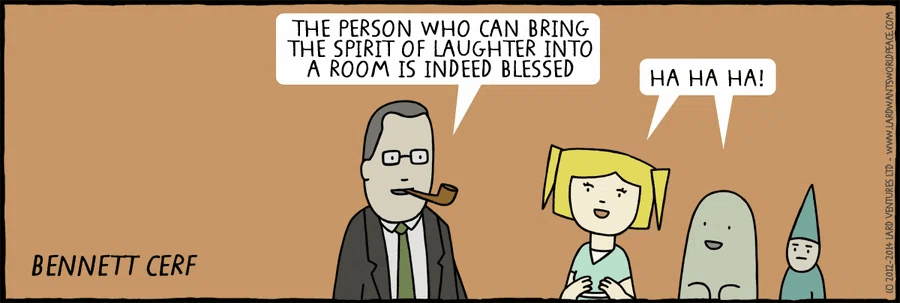
https://www.gocomics.com/lards-world-peace-tips
All these creators are indeed blessed!
(I did not verify this one; I simply enjoyed the jam.)

https://www.gocomics.com/lards-world-peace-tips
All these creators are indeed blessed!
(I did not verify this one; I simply enjoyed the jam.)
May 12, 2026, 8:30am
Cesar Chavez, Eric Swalwell, Justin Fairfax, and the gender politics of keeping their dirty secrets.
News about powerful men committing violence against women has bombarded the United States in recent months.
On April 16, 2026, Virginia’s former Lieutenant Gov. Justin Fairfax killed his wife, Dr. Cerina Fairfax, and then himself inside their family home. The shocking news came days after Rep. Eric Swalwell, a Democrat from California, resigned from Congress following multiple sexual misconduct allegations.
A few weeks prior, in March 2026, an investigation about labor movement leader Cesar Chavez revealed a decades-long pattern of sexual abuse, including against another farmworker icon, Dolores Huerta.
All three of these powerful men had known patterns of alleged predatory sexual behavior. But their secret was protected—in some cases for decades—not only by other men, but also by some of the same women they’d hurt.
Somehow, no matter how much progress we think we’ve made, women keep being sacrificed—or sacrificing ourselves—for men’s accomplishments and legacy. Our lives and futures and mental health are even sacrificed on the altar of their potential political accomplishments and legacy.
I’m a legal historian and commentator on sexism and gender-based violence. I’ve studied violence against women and the criminal trials that let male perpetrators off the hook. I’m also a woman who experiences sexual harassment so often that it has become a dull hum following me throughout my day.
This self-sacrifice seemingly stems from what seems to me to be a societal belief that the men who commit harm are more needed than the women who are harmed. Our ideas, organizing, and logistical labor—often dismissed as “secretarial” work—can’t compete with the fear of losing a single powerful man.
When the allegations against Swalwell first broke, some on the left rushed to defend him. Some on social media claimed it was a Republican smear job because he’s been opposed to Trump’s policies and was running to be the next governor of California.
Eventually, as more women came forward and D.C. insiders said that they’d heard rumors about Swalwell’s behavior for years, Democratic leadership called for Swalwell to drop out of the governor’s race.
Women often come forward with their stories when a man is running for political office because they feel that information is relevant to voters. Or, they may speak out because it’s difficult to see one’s abuser portrayed so incompletely in the news.
Yet some people cast doubt on the timing of the Swalwell accusations, suggesting people were out to get attention or take a “good man” down before he can further ascend in his career. On social media, posts compared the situation to Al Franken resigning from Congress in 2017 over sexual misconduct allegations.
Franken’s resignation is often treated as an example of #MeToo going “too far,” because some reporting suggests that the initial accusation against Franken may have been trumped up. But he was sexually inappropriate with women both before and after taking office. His resignation was important to live up to progressive values, and the left didn’t actually lose any political clout over it: Franken’s replacement, Tina Smith, has been a fantastic senator.
It’s relatively rare for members of Congress to resign after being accused of sexual misconduct. According to the National Women’s Defense League, 23 lawmakers with public accusations are running for reelection in 2026 in 16 states, including nine people running for Congress.
The group held a press conference on April 21, 2026, to discuss two new reports on sexual misconduct in Congress and state government. According to its research, 80 percent of candidates publicly accused get reelected.
The calculus for marginalized women to come forward about sexual assault is even tougher.
The first line of Dolores Huerta’s public statement about her abuse says she kept quiet for nearly 60 years because she “believed that exposing the truth would hurt the farmworker movement I have spent my entire life fighting for.”
I believe many women stay quiet when they think coming forward could hurt a movement—in this case, one Huerta helped to build. But they may tell their story if they’re worried not doing so could cause even more harm.
Her story details two incidents of sexual assault that resulted in two hidden pregnancies. She gave both children up for adoption.
Soon after the investigation broke, Chavez’s name was erased from monuments across the country. That’s not necessarily an indication of local leaders taking sexual violence seriously. In some places, it may just as well reflect a desire to erase Mexican American achievements and the progress of the United Farmworkers Union in securing rights for migrant laborers, some of the most marginalized workers in the country.
I say that because we have the perfect replacement for Chavez’s legacy in Huerta herself. It would be so easy to simply rename every street and monument after her, rather than simply erase commemorations of the movement.
Huerta was already forced to sacrifice so much by Chavez, must she now watch as her life’s work goes down with him, too?ire News Group is a reader-supported, independent nonprofit newsroom.
In my own Jewish community, there is a long history of pressuring victims of domestic violence and sexual assault to stay quiet—and not air their suffering outside the community.
Doing so would be an example of “lashon hara,” or evil speech or gossip. If we report our abuse to police, we are contributing to negative ideas about the Jewish men in our community. Some men in the Jewish community even claim that because of Jewish teachings and customs, Jewish men can’t ever actually abuse their wives, because domestic violence is a Christian affliction of gentile culture—that is, a non-Jewish problem.
This myth persists outside the Jewish community, and it can impact how Jewish women are treated in secular American courts.
My doctoral dissertation research covered a case of a Jewish woman in New York City murdered in 1875. Both suspects in her killing were Jewish men protected by the community. During the trial, the victim was used as a cudgel against her own people to prove that Jews were dangerous.
If she had survived and was given the choice to report the violence she faced would she have feared exposing a man from her community to the criminal justice system?
This concern is even more heightened for Black women. If their abusers are Black, they know that reporting them means increasing exposure to a racist criminal justice system.
Research also suggests Black women are less likely to be seen as victims by the dominant society and more likely to be blamed for harming men of their own community, or accused of trying to “take down a good man.” (Think back to how accusations against R. Kelly, Mike Tyson, Bill Cosby, and Clarence Thomas were greeted.)
As Aishah Simmons, Black feminist and activist, explains, many people “think that exposing and addressing intra-racial sexual violence against Black women divides the community … and we should only focus … on racism since that is the ‘real problem.’”
This community protection can feel even more important when the abuse comes from a so-called “good Black man,” as author Kaitlyn Greenidge wrote on April 19, 2026, of Cerina Fairfax’s killing. The promise of a Black middle class life with a politician husband like Justin Fairfax is supposed to guarantee a safe and protected life.
Cerina Fairfax stood by her husband even after two women accused him of sexually assaulting them; one alleged incident occurred back when he and his accuser were undergraduates at Duke University.
The accusations against Fairfax came to light during a crisis in Virginia politics when he was poised to possibly take over the governorship from the scandal-plagued Ralph Northam. Fairfax denied any misconduct and refused to resign. No criminal charges were filed. He ran for governor in 2021, and lost.
Fairfax later sued CBS for defamation (the suit was thrown out) and claimed he was experiencing a form of lynching (taking a page out of Justice Clarence Thomas’ book after Anita Hill’s accusations).
In this case, Democrats did lose leadership of the state. Before the sexual assault allegations, Fairfax was seen as a rising star in the Democratic Party. Had his accusers not gone public, he might have become the state’s next governor.
But it’s equally true that had he resigned in 2019, after they did, a new Lt. governor could have stepped in and potentially run successfully in 2021.
It irks me that Fairfax ran for governor after being accused of sexual misconduct. It irks me that Swalwell did, too.
Swalwell’s name remains on the primary ballots in the California governor race, and that will hurt the Democrats’ chances to hold onto that post. It was Swalwell’s hubris and entitlement hurt his party—not the women who came forward to prevent him from accruing more power.
I wonder: How many young staffers left politics because Swalwell was allowed to prey on his subordinates? What progress could have been made in the labor movement if the women abused by Chavez had instead been in leadership roles? Would Cerina Fairfax still be alive if her husband had been prosecuted in 2019?
We’ll never know how the world would look if the well-being of the women in these cases had been prioritized over the careers of their abusers. What I know is that the harm done to us as women is more important than the potential of the men who hurt us. And I know that the goals of movements or political gains can no longer rest on our silence and our labor.
Three weeks ago, on April 29, lawyers for Rhode Island Hospital responded to an email from a Justice Department lawyer in Washington, D.C., sent the day before, asking for a conference on next steps in addressing an outstanding administrative subpoena issued by DOJ to the hospital nearly a year earlier about its provision of gender-affirming care for transgender minors.
The next day, DOJ shifted tactics without even initially telling the hospital — going to court across the country to try and get an order enforcing the subpoena.
At least seven challenges to the invasive subpoenas had previously resulted in federal court rulings quashing the subpoenas or, at least, the parts of the subpoenas seeking identifiable patient information. In the wake of those losses — and as Acting Attorney General Todd Blanche took over the Justice Department — the strategy, as Law Dork has covered, began to shift to more aggressive tactics on multiple fronts.
The change has had at least one tangible effect already with regards to Rhode Island Hospital.
Beginning Tuesday night, at least some records responsive to the administrative subpoena were sent to a far-right federal judge in Texas who on Monday ordered the hospital to provide the records to him — although, for now, not to DOJ — while the hospital appeals his earlier ruling that the records need to be turned over to DOJ.
Any action on that earlier ruling, however, would appear to conflict with a later ruling from a federal judge in Rhode Island quashing the subpoena in full and barring DOJ from receiving any such records from the hospital — although the U.S. Court of Appeals for the First Circuit late Tuesday denied a request to take further action immediately to enforce that order.
This latest dispute, which has now involved four courts across the country, as well as related discussions in court filings and before a federal judge in Rhode Island, serve as a warning for transgender people, their allies, and the parents of trans kids about how aggressively the Trump administration is acting to advance President Donald Trump’s anti-trans policies and then-Attorney General Pam Bondi’s implementation of them — and where the administration could be going next in this attack.
That April 28 DOJ email to Rhode Island Hospital’s lawyers — in which David Gunn, a DOJ lawyer, referenced having been out of office for the past few weeks before asking for a conference to discuss the subpoena production — was a DOJ response to a February 4 email from lawyers from the hospital.
The hospital’s lawyer responded simply the next day: “We are happy to connect. Would Monday of next week work?”
The conference never happened because, on April 30, DOJ went to a friendly forum for them in the Northern District of Texas seeking to enforce the administrative subpoena, which, to be clear, was issued in D.C. to a Rhode Island entity. Going there meant the case had a good chance of and was, in fact, assigned to U.S. District Judge Reed O’Connor, a far-right judge with a history of anti-LGBTQ rulings.
Within hours, and before the hospital even had a chance to file any response, O’Connor granted the request — ordering the hospital to turn over the records within two weeks.
Over the past three weeks, there have been daily developments — and often multiple developments — shining an alarming light on what is happening.
In addition to the order to enforce the subpoena in the Northern District of Texas, one of the two other most significant other development was the news — acknowledged by NYU Langone Health in accordance with New York law on May 11 — that it had received a grand jury subpoena for similar records that was issued in the Northern District of Texas.
Ethan Womble is listed as the person who sought the grand jury subpoena. He is, as of last month, an Assistant U.S. Attorney in the Northern District of Texas. (He was previously listed — as recently as February — as a trial attorney in the DOJ Criminal Division’s Fraud Section, although that health care fraud work does appear to have been based out of Texas.)
Womble and Ryan Raybould, the U.S. Attorney for the Northern District of Texas, were the only two lawyers on the DOJ petition to enforce the Rhode Island Hospital subpoena. They are both former O’Connor clerks.
The grand jury subpoena — which does not require judicial approval — was received by NYU Langone on May 7 (although dated May 6), and the date for compliance is June 10.
There is also evidence that other grand jury subpoenas were issued. In addition to NYU Langone stating that it was “one of several institutions that received a grand jury subpoena,” Law Dork previously reported that DOJ’s decision to withdraw its appeal of one of its administrative subpoena losses — as to Children’s Hospital of Philadelphia (CHOP) — came the same date that the NYU Langone grand jury subpoena was issued.
In a filing later on May 6 before the district court that had heard and granted the Philadelphia hospital’s initial request, the lawyers for CHOP were direct:
Just this morning, DOJ attorneys reached out to counsel for CHOP indicating that DOJ intended to dismiss its appeal, which has been proceeding in the Third Circuit since January and in which DOJ’s brief was due today. That development, along with DOJ’s unexplained effort to compel compliance by a Rhode Island hospital in the Northern District of Texas, suggest that DOJ may seek to end-run this Court’s jurisdiction over additional issues that arise involving the Subpoena.
Unlike the administrative subpoenas, which were challenged in the locations where the hospitals were located, challenges to the grand jury subpoena(s) would generally be in the Northern District of Texas — although lawyers will be looking for other paths.
It also should be noted that it is not yet clear what, if any, action beyond the issuance of the grand jury subpoenas has actually happened in the Northern District of Texas.
The grand jury subpoenas aren’t the only new development.
On May 15, DOJ announced it had reached a “resolution” with Texas Children’s Hospital in conjunction with a long-running investigation against the hospital by the Texas Attorney General’s Office.
Although DOJ presented the development as “the first resolution secured under the Department’s ongoing national investigation into violations of federal law in connection with” provision of gender-affirming medical care for transgender minors, Texas Attorney General Paxton only mentioned DOJ in one sentence and instead stated, “After a years-long investigation by the Healthcare Program Enforcement Division, Attorney General Paxton has negotiated a historic settlement that will help protect Texans.“ DOJ does cite agreements reached by the hospital with both federal and Texas governments.
In addition to ending the provision of such care, Paxton’s news release stated that Texas Children’s Hospital has agreed to “the creation of the country’s first-ever Detransition Clinic” and “pay $10 million for billing Texas Medicaid for unallowable and illegal ‘gender-transition’ interventions, including by using false diagnosis codes.“
In the DOJ news release, which only quotes Main Justice senior officials from D.C., it noted, “These matters and the investigations into sex-rejecting procedures (sic) on minors are being led by the Justice Department’s Civil Division Enforcement and Affirmative Litigation Branch and Commercial Litigation Branch, Fraud Section.”
There was no mention of the U.S. Attorney’s Office for the Northern District of Texas — or any district in Texas, for that matter — but the fact that the news releases are about a Texas hospital, DOJ’s release referenced what appears to be the same investigation at issue in both the administrative and grand jury subpoenas, and Texas’s release referenced one of the topics raised by DOJ in defending its subpoenas as allegedly supporting its investigation (improper billing codes) should not be glossed over.
For its part, Texas Children’s Hospital, in a statement to Law Dork, sounded a significantly different note than DOJ and Paxton’s office:
Over the last three years, we have cooperated fully with the Texas Attorney General and Department of Justice, navigating an unconscionable campaign of mistruths and mischaracterizations related to gender affirming care. We produced over 5 million documents and conducted multiple internal and external investigations. These efforts have required significant staff time and financial resources to defend ourselves. All reviews and investigations continue to support the facts – we have been compliant with all laws.
Today, we made the difficult decision to settle with the Texas Attorney General and the Department of Justice, closing a chapter that has been wrought with falsehoods and distractions. To be clear – we are settling to protect our resources from endless and costly litigation. This settlement will allow us to redirect those precious resources to focus on the life-saving care and groundbreaking discoveries of our exceptional clinicians and scientists.
Nonetheless, if DOJ proceeds with a grand jury investigation in the Northern District of Texas, these settlements could quickly become very relevant to DOJ’s claims.
All of which brings us back to Rhode Island Hospital.
After O’Connor issued his initial order three weeks ago Thursday, the Rhode Island Child Advocate — responsible for oversight of children under the care of Rhode Island’s youth services — sought to quash the subpoena in Rhode Island.
U.S. District Judge Mary McElroy, a Trump appointee who had initially been nominated during the Obama administration, was assigned the matter. She denied DOJ’s initial request to move the matter to O’Connor and set a quick timeline for consideration of the request.
The hospital, meanwhile, sought to stay O’Connor’s order — first before O’Connor and then at the U.S. Court of Appeals for the Fifth Circuit. (Both were denied.) The hospital also joined the Rhode Island Child Advocate’s request, intervening and filing its own motion to quash the subpoena.
On May 12, McElroy held an explosive hearing — accusing DOJ of having misled the hospital; the court in Texas; as well as, potentially, the court in Rhode Island.
Highlighting the incredibly invasive plans potentially involved in DOJ’s effort, McElroy told the relatively new DOJ lawyer before her, Brantley Mayers, counsel to the Assistant Attorney General, “[I]t is ridiculous to say that you’re going to find 14- and 15-year-olds who are undergoing gender reassignment or gender treatment and question them about what was told to them by their doctor. How invasive is that?”
An amicus brief submitted by Lambda Legal Defense and Education Fund addressed the improper ways DOJ is employing the Federal Food, Drug, and Cosmetic Act and other “healthcare offenses” to attempt to justify this investigation, but every judge has, again, found the effort to be an “improper purpose” under the laws at issue — or, at the least, the patient-specific documents requested not to have been appropriately sought.
Regarding the timing of the filing in Texas to enforce the Rhode Island Hospital administrative subpoena in conjunction with the emails earlier that week, McElroy told Mayers:
I take a very negative view to playing fast and loose by telling people one thing and filing other things with the court, and then taking the position like, oh, well, we didn’t tell you, but we did tell you afterwards. That is dirty pool, in my opinion, and the Department of Justice have willfully done that in this case.
Mayers had joined DOJ in November 2025 after three clerkships and with virtually no prior practice experience, a fact highlighted by McElroy, who repeatedly suggested that she believed the new lawyer was set up to defend the actions without having hardly any actual knowledge of the underlying investigation.
Sitting at his side, however, was Deputy Assistant Attorney General Jordan Campbell, a more senior Texas lawyer who joined DOJ in June 2025 after having co-founded a law firm that states it is “proudly seeking justice for the detransitioner community nationwide.“
Specifically as to the grand jury subpoena, which was discussed because NYU Langone’s statement had come out the day before, McElroy warned:
[T]he problem I’m having here is that it’s pretty clear to me that this was shopped to Texas, that’s fine, you have the right to investigate wherever you want, but these indictments that come out of Texas, if they ever come, because every person has signed an affidavit in this court and is going to be before me to explain it if they don’t.
Mayers insisted there were reasons for the investigation being in the Northern District of Texas — and acknowledged part of the content of a secret declaration that was filed ex parte (meaning just with the judge) in DOJ’s opposition to Rhode Island Hospital’s request that O’Connor stay his order enforcing the subpoena.
This secret declaration from Lisa Hsiao, the acting director of the Enforcement & Affirmative Litigation Branch — who has filed declarations in most if not all of DOJ’s efforts defending the administrative subpoenas and which have drawn questions previously — was later provided to McElroy as well. Of that, Mayers acknowledged:
[H]ere were many reasons why the investigation is being carried on in the Northern District of Texas. As the affidavit that you received yesterday ex parte indicates, there are potential targets, potential witnesses there.
The reference to “potential targets” of the investigation being in the Northern District of Texas appears to be a significant piece of information as that proceeds.
In any event, the next evening, on May 13, McElroy issued her ruling, quashing the administrative subpoena in full and blocking DOJ from receiving the requested documents. She also repeatedly questioned DOJ’s actions in the opinion, writing at one point that “the discrepancy between the honorable conduct expected of federal prosecutors and DOJ’s tactics in this case is unsettling.”
DOJ, however, did not let it go — appealing the order the next day and informing O’Connor of the ruling. O’Connor, on May 15, ordered an in-person hearing in Texas on May 18.
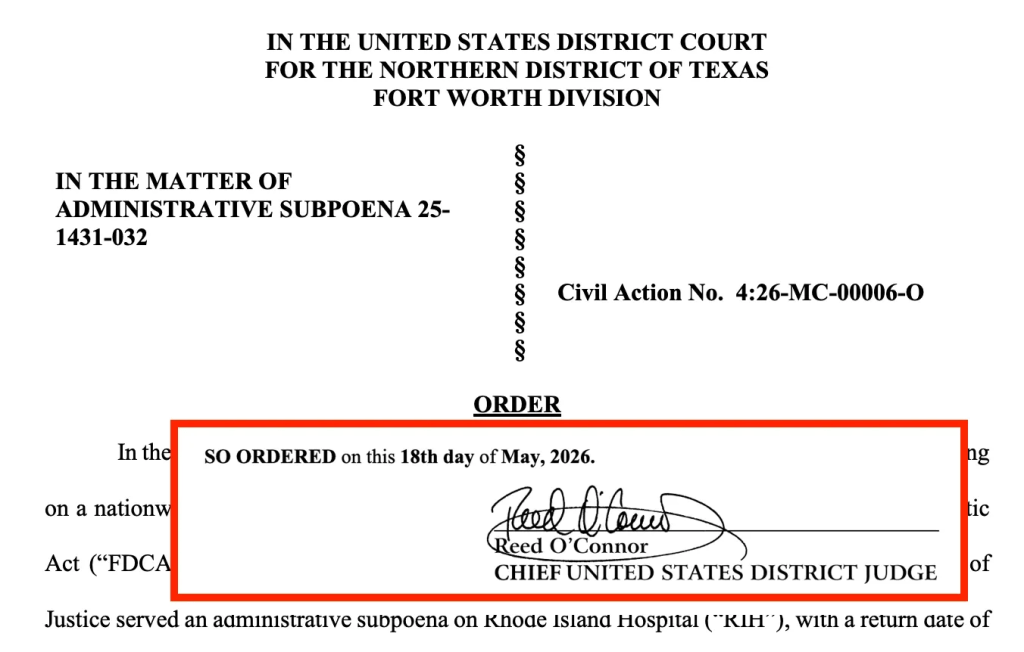
Following that hearing came the May 18 order from O’Connor, concluding that “RIH has also sought to circumvent the authority of this Court and the Fifth Circuit and attempted to collaterally attack the Enforcement Order“ and ordering the hospital to turn over to the court “all materials that it would have turned over to the Government in compliance with this Court’s Enforcement Order“ on the condition that the materials would be “secured and held in camera, inaccessible to the Government for the pendency of the appeals.“
Additionally, O’Connor — responding to his conclusion about the alleged circumvention — purported to bar Rhode Island Hospital from seeking relief from his order in any court aside from his court, the Fifth Circuit, or the U.S. Supreme Court and from “cooperat[ing] with others in seeking relief“ from his order.
That led to one last effort to hold things off, with the Rhode Island Child Advocate filing a motion in the First Circuit — where DOJ had appealed McElroy’s order — on May 19 seeking an injunction ordering Rhode Island Hospital “not to produce patient-identifying information or protected health information” in response to the administrative subpoena “to any person or entity pending resolution of this appeal or until further order of this Court.”
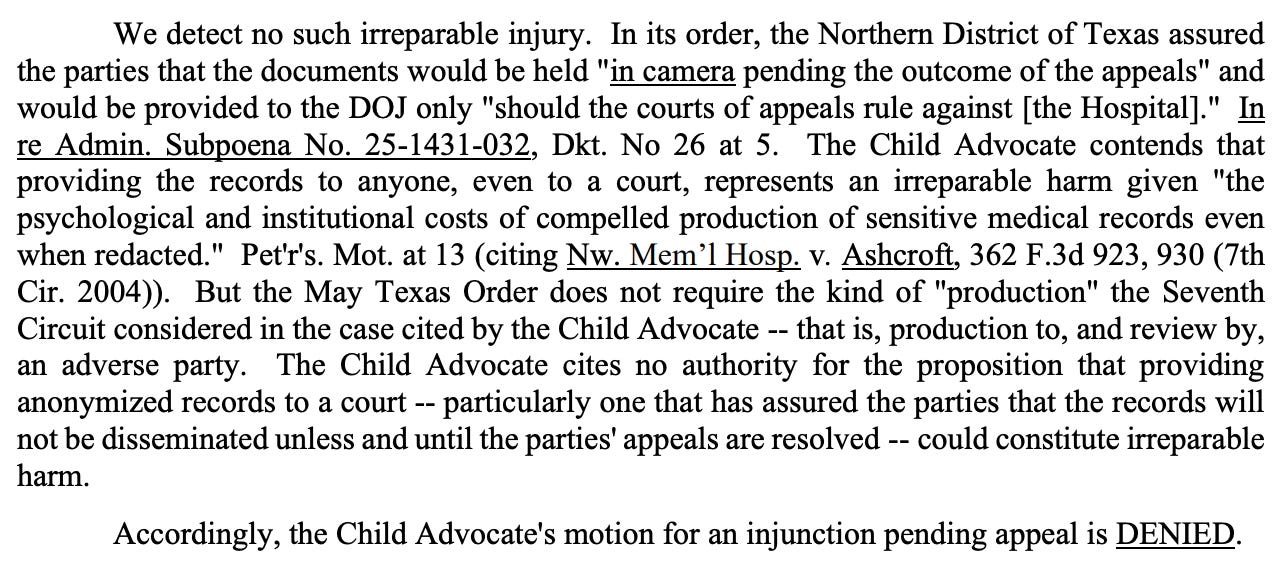
DOJ opposed the request, and later highlighted the fact that, in Rhode Island Hospital’s notice about its production, “RIH represents that, ‘[t]o the extent that records RIH intends to produce contain any patient information, RIH will anonymize and de-identify this information.’“ DOJ stated that “RIH’s stated plan to anonymize any documents filed in the Northern District of Texas today further undercuts the Child Advocate’s claim of imminent irreparable harm.“
In a short order issued a few hours later, the First Circuit essentially agreed, denying Rhode Island Child Advocate’s request because, the court stated, “We detect no such irreparable injury.“
The panel consisted of Judges Gustavo Gelpí and Lara Montecalvo, both Biden appointees, and Judge Joshua Dunlap, a Trump appointee who took the bench in 2025.
Notably, Dunlap issued a concurring opinion, highlighting “additional concerns regarding the request for an injunction pending appeal“ — including, he wrote, “serious questions about the merits of the district court’s decision.” This is contrary to the seven other federal judges to have ruled on the question and was an aside, but it is nonetheless notable coming from the one Republican appointee on the First Circuit.
The bigger problem, however, with the First Circuit’s ruling is what was missing.
The paragraph highlighted above seems to run counter to and with an almost blind ignorance to all that McElroy got on the record in her May 12 hearing.
This is a situation where DOJ has questionably, and without providing public evidence, claimed that it has moved an investigation to the Northern District of Texas, justifying invoking the court’s jurisdiction there to enforce an administrative subpoena issued many months before the investigation had a connection to the district and against an entity across the nation that had been in discussion with DOJ the day before the enforcement action was filed. Then, a far-right judge there granted the request sought by his former clerks and now has ordered the hospital to provide him with the information that every other judge has decided medical providers should not need to provide.
No awareness of that reality comes through in the First Circuit’s order. Although the caveats in the order do mean that renewed requests could follow and it certainly means nothing as to the hospital or Rhode Island Child Advocate’s chances on appeal in quashing the subpoena (Dunlap’s concurrence aside), the First Circuit’s presumption of regularity is particularly ill-suited here.
As McElroy wrote specifically in her order, quoting an Oregon colleague:
The Court cannot help but share the sentiment that “[t]he presumption of regularity that has previously been extended to [DOJ] that it could be taken at its word—with little doubt about its intentions and stated purposes—no longer holds.” United States v. Oregon, No. 6:25-CV-01666-MTK, 2026 WL 318402, at *11 (D. Or. Feb. 5, 2026). It is regrettable that this is now the case.
As DOJ continues with these escalations of its attacks on trans people — and the provision of medical care specifically — courts need to keep their eyes opened to the reality as McElroy saw and detailed it, not to the image of courts as they would wish things to be.
Law Dork covers LGBTQ legal developments in depth. Consider becoming a free or paid subscriber.
By Peter Karleby
One good thing about trolling comedians, they always know exactly how to respond.
New York City Pride recently announced the Grand Marshals for its annual Pride parade, scheduled for June 28.
It’s quite a roster, featuring trans actress Dominique Jackson, drag star Peppermint, trans journalist and radio personality Bernie Wagenblast, activist group Gays Against Guns and SNL alum Bowen Yang.
Of course someone was gonna have an opinion on this lineup, and one of them tried to come for Yang in the comments of the announcement on Instagram.
And Yang, ever the seasoned comedian, had the perfect response. The troll demanded to know “why bowen,” and Yang didn’t miss a beat, quipping:
“showed hole to the board.”
(snip-embedded social post)
Perfect.
It’s a strange question in the first place: Yang made history when he joined the SNL cast in 2019.
In a statement, NYC Pride wrote:
“Bowen Yang became a household name as the first Chinese-American cast member on Saturday Night Live in 2019.”
“With that platform, he helped usher in an era of authentic queer humor in mainstream media, earning an Emmy® for writing and becoming the most-nominated Asian male performer in Emmy® history in the process.”
The better question is “why not Bowen?”
(🤣 🤣 🤣 snip-MORE ; lots of embedded social media posts; enjoy!)
Marisa Kabas
For the last seven months, Kat Abughazaleh wasn’t allowed to go to Alaska. It’s not that she had any particular reason to, but being under felony indictment meant that she was only allowed to travel throughout the lower 48 United States. And forget leaving the country. But on Thursday, those restrictions were suddenly lifted when all charges against her were dropped.
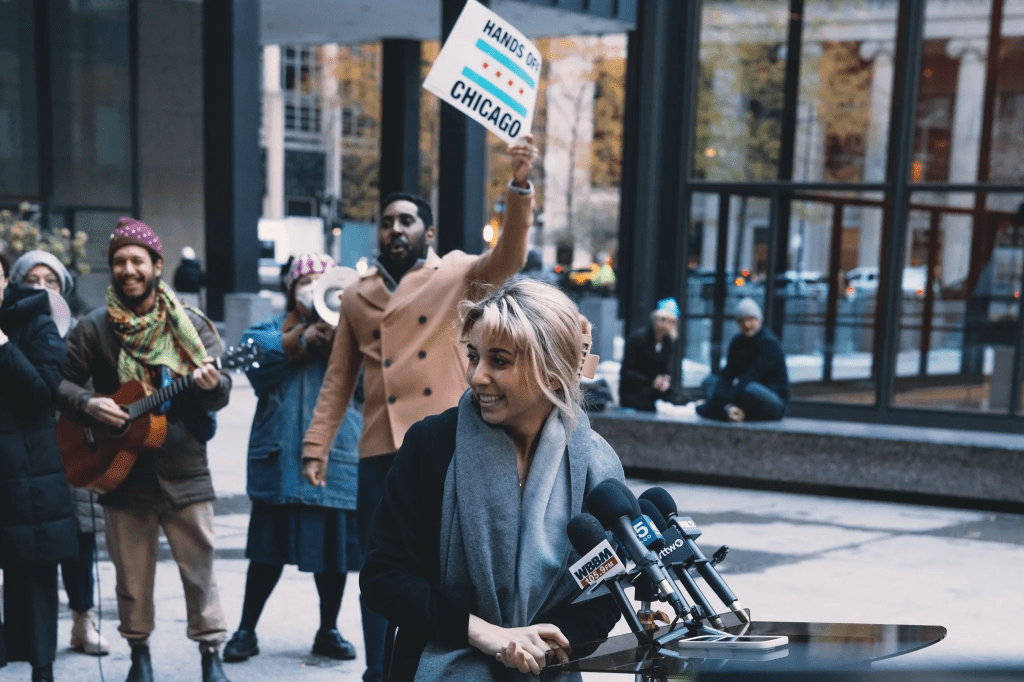
Abughazaleh, 27, woke up Friday a free woman. The former Illinois congressional candidate was charged in October along with five others for conspiring to impede an officer near the Broadview ICE facility just outside of Chicago. In reality, Abughazaleh and her co-defendants were there to protest the federal government’s increasingly public cruelty and the human rights abuses happening inside Broadview specifically, and broadly by ICE. The Trump administration, not surprisingly, did not appreciate their very public pushback and responded with brutality and violence. But with all charges against them now dropped, the only thing they’re an example of is why fighting fascists is good.
With the trial scheduled to begin just after Memorial Day, US district judge April Perry called an emergency hearing Thursday to discuss missing pieces of the trasncript from the grand jury proceedings where DOJ lawyers convinced jurors to indict Abughazaleh, her campaign field director Andre Martin, Michael Rabbitt, Brian Straw and two others who had the charges against them dropped earlier.
The case was already on the decline, with prosecutors dropping the felony charges against the remaining four in April as questions about the grand jury transcripts popped up. They still faced a full trial on misdemeanor charges and up to one year in jail. But Judge Perry ruled the DOJ’s handling of the grand jury and subsequent redactions constituted grave misconduct, making it impossible to move forward.
I spoke with Abughazaleh by phone Friday morning about right wing fuckery, ridiculous rumors, and how she plans to reclaim her life after the federal government tried to destroy it. Our conversation has been edited and condensed for clarity.
MARISA KABAS, THE HANDBASKET: How did it feel waking up this morning?
KAT ABUGHAZALEH: I had to get up at like 5am to go on Morning Joe, but I woke up and I was like, oh yeah, I don’t have to go to trial this week—which is not a statement I thought I’d have to say ever in my life.
KABAS: Walk us through what you thought the next week or so was supposed to be like before yesterday’s hearing.
ABUGHAZALEH: I was supposed to have not just trial prep with my lawyers, but having to get my clothes dry cleaned. Going to get a manicure because my nails always always look awful. I spent way too long at a Nordstrom Rack picking out shoes that I thought looked fashionable but also modest and wouldn’t make jurors think I was a bitch. On Tuesday we were supposed to have jury selection. On Wednesday we were supposed to have opening arguments, which is a shame that we don’t get to hear our lawyers spit absolute fire. But yeah, it’s nice not to do it in the first place.
KABAS: Absolutely. So what do you think you’re gonna do instead?
ABUGHAZALEH: I have a 12-hour live stream tomorrow to raise money for our legal funds because, despite not having to go to trial, we’re still picking up the pieces of our lives both emotionally and financially. Every single one of us as co-defendants, we have very real fears of bankruptcy and being in debt for the rest of our lives because of this. And then, I don’t know, sleep a bunch. Get my passport renewed, something that I couldn’t do for the last seven months. I couldn’t even go to Alaska.
KABAS: Are you serious? Could you go to Hawaii?
ABUGHAZALEH: No, just the lower 48. Couldn’t even go to Puerto Rico.
KABAS: So this has really restricted your movement as a human being for the last seven months.
ABUGHAZALEH: Yeah, and it’s something that’s really scary, especially as the government gets more and more aggressive, just being like, oh, you’re stuck here no matter what happens.
KABAS: So when did you get a sense that things might be changing this week?
ABUGHAZALEH: So we’ve been requesting to see the grand jury transcripts or just have the judge look at them for months. And ahead of trial Chris Parente—Brian Straw’s lawyer—just asked the judge, “Can you just look at the unredacted version?” And her understanding was that the redactions were referring to some IT issues, and the prosecution had never corrected her. So she looked at the unredacted transcript and then called a hearing the next morning. And it was sealed. Now the transcript is public.
She was saying “I’m not sure that the charge will get dismissed without prejudice because there’s not a lot of precedent for that, especially for a misdemeanor.” And then we broke for an hour for the government to talk it over, and then they came in. I remember one of my lawyers looking at me as one of the government’s lawyers [Andrew Boutros] started talking, and she just turns to me and says, “Congratulations.” And I went, “What?” And then Boutros said, “dismissed with prejudice.” [Meaning the case was permanently closed.] And it was just surreal. Absolutely surreal.
KABAS: Did you have a sense of where things were heading or were you totally shocked by the outcome?
ABUGHAZALEH: I truly did not think it would get dismissed yesterday. I did not want to get my hopes up. I thought that we were going to trial for sure, just because it’s very unusual to try a federal misdemeanor. I knew we would win in that case, but I was completely shocked.
KABAS: How do you think this will change or impact anti-ICE protests and prosecutions in the future?
ABUGHAZALEH: I hope that it does have impact. It was meant to intimidate us into silence, and none of us took a deal. None of us sold each other out (not that there was anything to sell each other out on.) But, you know, we were charged with conspiracy. We were facing like 10 years in prison.
(snip-there is MORE, but this is already a long post, and I’m a free subscriber to Handbasket, and don’t want to just lift their work. Click on through!)
It’s 1984 again.
We have read George Orwell since the beginning of Trump’s first administration. Studied him through the eyes of experts like Ruth Ben-Ghiat, whose scholarship is in the field of authoritarianism. But nothing makes his relevance as plain as living through history in 2026.
“Every record has been destroyed or falsified, every book rewritten, every picture has been repainted, every statue and street building has been renamed, every date has been altered. And the process is continuing day by day and minute by minute. History has stopped. Nothing exists except an endless present in which the Party is always right.”
― George Orwell, 1984
On Friday, NBC’s Ryan J. Reilly and Kyla Guilfoil reported that “The Justice Department has removed press releases detailing the charges against hundreds of individuals who participated in the Jan. 6, 2021 Capitol riot from its website.”
DOJ was not ashamed of the reporting on this development; instead, they responded to a tweet claiming they were “quietly” deleting the information by bragging:
Nothing “quiet” about it.
We are proud to reverse the DOJ’s weaponization under the Biden administration. We will do everything in our power to make whole those who were persecuted for political purposes. This includes stripping DOJ’s website of partisan propaganda.
As acting Attorney General Todd Blanche continues his long, slow audition to get the nomination for the permanent job, there is apparently no service the Justice Department he leads will refuse Donald Trump. That includes the effort Trump launched on day one of his second term in office to erase the insurrection. It began with the pardons of Rudy Giuliani and the fake slates of electors. As Ed Martin put it, “No MAGA left behind.” It went on to include virtually everyone who was present at or involved with the January 6 attack on the U.S. Capitol, including those charged with insurrection, some of whom received clemency because even Trump, apparently, didn’t believe he could get away with outright pardons.

Blanche was in place at DOJ as Pam Bondi’s number two, overseeing the firing of prosecutors and agents assigned to work cases and leads in the January 6 investigation. Then, as we discussed last week, he signed off on Trump’s $1.776 billion “anti-weaponization fund,” the repurposing of taxpayer dollars Congress allocated to DOJ’s judgment fund as reward payments to Trump friends and allies who “suffered weaponization and lawfare.”
Blanche declined to exclude even defendants convicted of violent offenses in connection with January 6 from eligibility for payment out of Trump’s slush fund. The crescendo of outrage that began with Democrats swelled to include a handful of Republicans. But not all of them. In a mark up meeting before they left town for Memorial Day, every Republican member voted against a measure proposed by California Democrat Mike Levin that would have excluded members of Congress from filing to receive a payout from the fund.
Lawsuits have been filed, and we will be watching to see how quickly the federal judiciary might move to block the payouts from going into effect. Among the lawsuits so far:
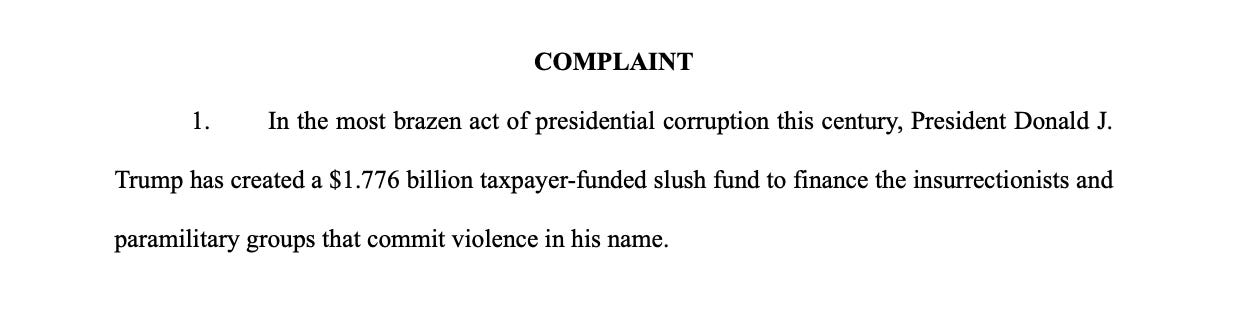
The success of Trump’s effort to rewrite history is not a foregone conclusion. But pushback will require our focus. In January of 2025, the Brennan Center’s Michael Waldman, author of The Briefing with Michael Waldman wrote, “It was an insurrection. Pardoning the perpetrators won’t change that.”
On Friday, former Attorney General Pam Bondi will testify before the House Oversight and Government Reform Committee. Although the topic at hand is her mishandling of the release of the Epstein Files, Bondi could easily face questioning about the origins of the slush fund plan and will undoubtedly be asked about Trump’s single-minded effort to rewrite history to repaint his own efforts to take down democracy.
It’s up to us to make sure Trump doesn’t get away with rewriting our true history. This is an important awareness to carry with us into the weeks and months ahead, especially as we approach the 250th Anniversary of the day the Declaration of Independence was signed, this July 4. In the words of Orwell, “Who controls the past controls the future. Who controls the present controls the past.”
As I wrote to you last week on the day we first learned about Trump’s creation of a slush fund he could use to divert taxpayer funds into rewards for his friends, we are at a crisis point. It’s a crisis for many reasons, among them the president’s comfort with outright abuse of public funds and his party’s unwillingness to step in and outlaw their use in the absence of a congressional designation of them for this purpose. Trump, the would-be autocrat, is again trying to enlarge the circle of presidential power he can exercise and it will be up to the judicial branch to tell him no, for now, and the voters to do it resoundingly in November. It’s time to pay close attention to developments this week.
We’re in this together,
Joyce
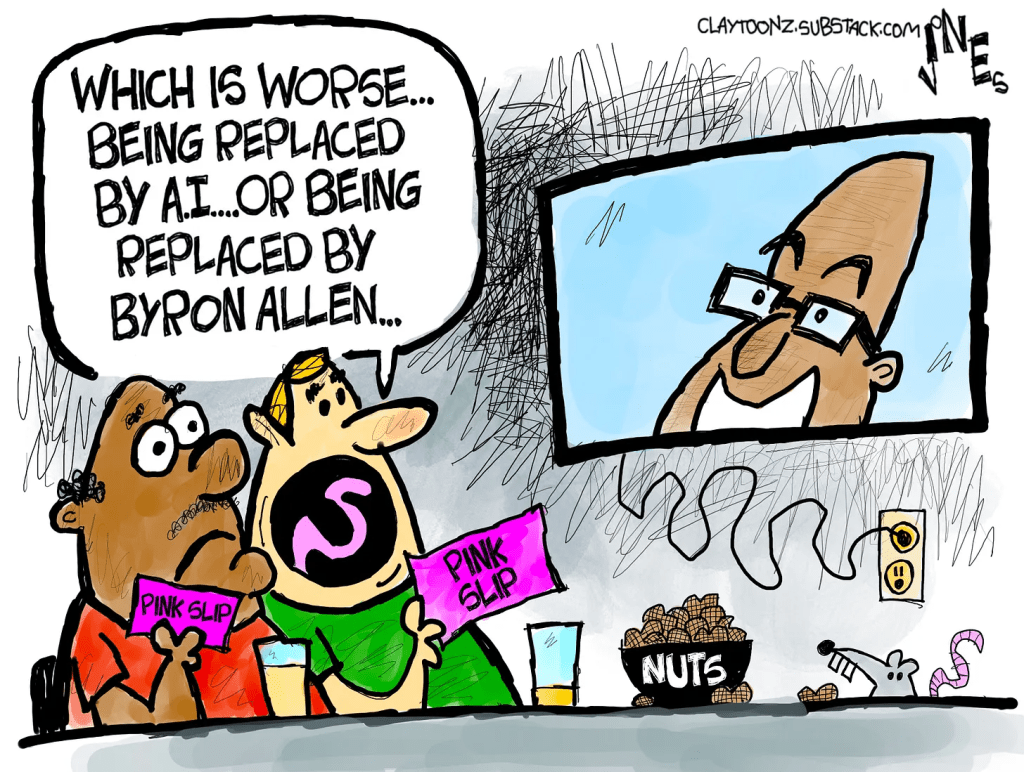
(Note Please that this is not a dig on Byron Allen per se. It’s about the vast difference in material. I’ve watched “Comics Unleashed”, and “Funny You Should Ask,” both are fine, but are not what people are used to at night; I’ve watched them while doing my 10AM jog on the trampoline, instead of a game show that may be on. Of course, well, viewership’s been dropping in that nighttime time slot, so. Clay explains how Byron Allen makes it work.)
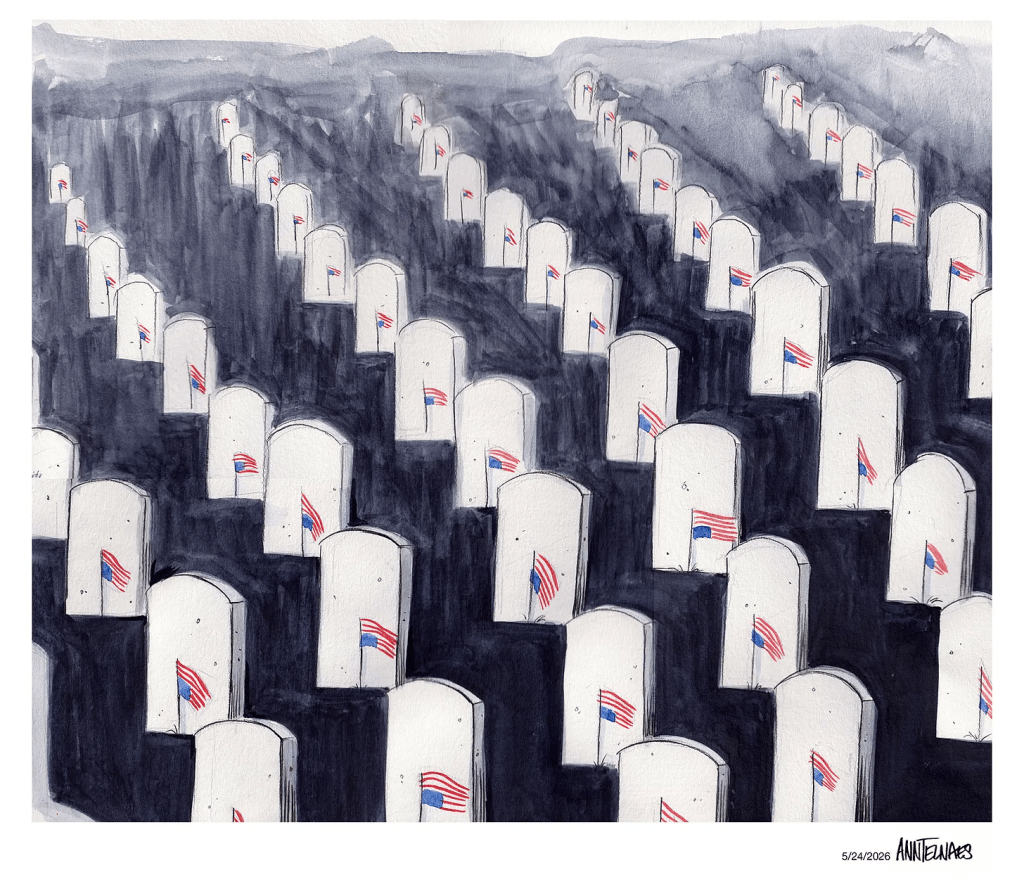
Daryl Cagle distributes more political cartoons than any other syndicate in the business, and each week he publishes the top ten cartoons from his service that are being published by his newspaper clients. I normally don’t look at it because it makes me sick.
This is not meant as a criticism of Cagle, even though I believe he’s doing everything in his power to destroy our industry just to make a nickel, nor is it a criticism of the cartoons that make his top ten list. A lot of cartoonists who draw hard-hitting cartoons often draw something nice, or even bland, on occasion. It doesn’t mean that they’re not good cartoonists. Although there are cartoonists who do nothing but draw boring, bland, generic, copy-and-paste cartoons, like Dave Granlund. (snip-MORE, and he gets to the point)

The only weaponization of the Justice Department that comes to mind is that which has been committed by Donald Trump and his goons. Going after goons who attacked the capital is not weaponization. Going after Donald Trump for sending those goons or for stealing classified documents is not weaponization. Going after people who try to overturn the election is not weaponization.
The $1.8 billion slush fund that Donald Trump is going to give to the so-called victims of the so-called weaponization of the Justice Department under Joe Biden is bogus. It’s not for victims as much as for political allies who would do Donald Trump’s bidding. Trump isn’t trying to reward people who work for him; he’s recruiting them. When he pardoned the J6 terrorist, it was to recruit them.
Polls on the slush fund have not come out yet, but I expect them to next week. And I also expect that they are going to be very negative about the Donald Trump slush fund. I expect public opinion to be very much against the slush fund. The slush fund is so unpopular that even some Republicans are speaking out against it, and not anonymously either. (snip-MORE)
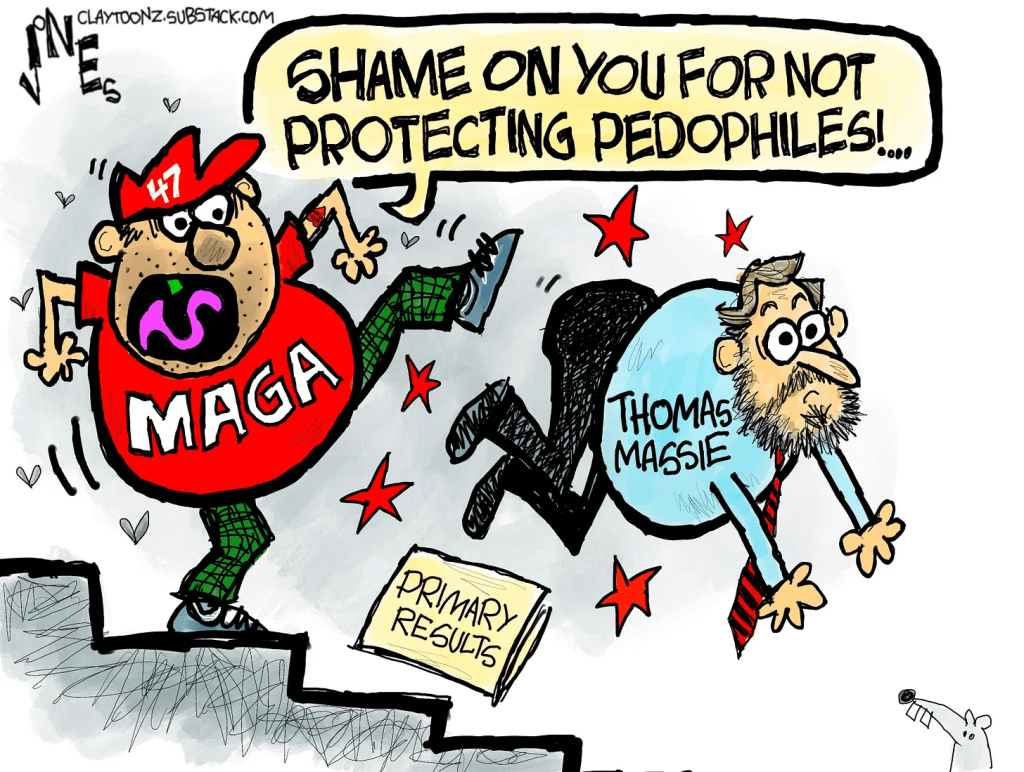
And this is why I do not want to live in a red state or a red congressional district. I don’t want to live in a place where the majority of people are so loyal to Trump that they will punish a man for not protecting pedophiles. It’s bad enough that the blue city I live in now borders what we affectionately call Spotsyltucky.
Even while he has the lowest approval ratings of any president in the history of approval ratings, Trump’s MAGA base will go to any lengths to serve him, even if it means ousting a guy because he would not protect pedophiles.
Congressman Thomas Massie of Kentucky had been a thorn in Trump’s side for a while, even though he was a staunch conservative. It’s not like Massie wanted equal rights for black Americans, for women to be free to make health decisions regarding their own bodies, or that he wanted free lunches for children in poverty.
Massie voted against Trump’s signature tax-and-spending package and moved to rein in his war powers over Iran, but the final straw was his leadership of the bipartisan effort to release the Epstein files, in which Trump is mentioned thousands of times. Republicans spent $33 million to defeat Massie in a primary. This was $33 million to defeat one of their own. This was $33 million spent on a safe red seat. And they invested all of it in a failed state Senate candidate, whom many believe is dumber than a doorbell. (snip-MORE)
for their constituents (or are supposed to!), and not posted as a dig on the National Weather Service, which is doing what it can with what it has, and has very little leeway to talk about why they don’t get everything done as they used to in the Before Times.
U.S. Rep. Sharice Davids urges NWS to be transparent about data collection shortcomings
TOPEKA — U.S. Rep. Sharice Davids expressed frustration Friday with the National Weather Service’s failure in the last month to launch three-fourths of the balloons typically sent aloft in Kansas to assess atmospheric conditions and assist with weather forecasting.
Davids, a Democrat representing the 3rd District in eastern Kansas, said publicly available records indicated NWS didn’t conduct on 25 of the past 30 days the standard 7 a.m. weather balloon flight dedicated to collecting atmospheric data in Kansas.
“That’s unacceptable,” she said. “Kansans deserve transparency about what’s happening, why it’s happening and what’s being done to fix it. Kansans deserve confidence that the systems meant to keep them safe are fully operational during tornado season and meteorologists deserve the reliable data they need to do their jobs.”
In the past year, Davids and U.S. Sen. Jerry Moran, R-Kansas, have raised questions about staff shortages and other issues at NWS bureaus in Kansas.
Moran recently said staffing problems persisted despite Congress appropriating sufficient funding for 24/7 operation of Kansas weather offices in Topeka, Wichita, Dodge City and Goodland.
Davids said she requested explanations one month ago from NWS about disruptions in gathering data after an outbreak of severe weather. NWS didn’t respond to the inquiry, the congresswoman said, despite seven more tornadoes touching down in Kansas last week.
NWS has an obligation to be transparent with the public about data collection failures, Davids said.
“These are not abstract bureaucratic problems,” Davids said. “You don’t get to quietly scale back something this important without transparency, especially in a state where severe weather can turn deadly fast. The administration owes the public answers and immediate action to address these reported failures before tragedy strikes.”
Davids said weather balloons provided forecasters real-time measurements, including temperature, humidity, pressure and wind conditions useful in anticipating storm intensity. Missed launches limited information available to meteorologists, she said.
She previously asked NWS to share details about reasons for missed balloon launches and how missing data contributed to delayed tornado advisories.
“For decades, 7 a.m. weather balloon launches have been a standard part of how we track severe weather and protect communities. If that standard has changed, the National Weather Service owes Kansans clear answers about why and the science and data behind that decision,” she said.
It was actually some Canadian-made little-kids’s science TV show on The Learning Channel (when it actually was!) that first got me acquainted with Dr. Suzuki, then I read more in a “The Nation” interview. I’m glad he’s still out here kickin’.
David Suzuki Turns 90, Says We’re All Screwed!
Dr. David Takayoshi Suzuki — an author, environmental A-lister and original host of CBC’s long-running documentary series The Nature of Things — marked his 90th spin around the sun at a star-studded gala Friday night in Vancouver. Jane Fonda and Al Gore were among the VIPs who flew in to show the old tree-hugger some love and enjoy performances from Sarah McLachlan, Bruce Cockburn, Snotty Nose Rez Kids, and even a surprise set from Neil Young.
Dr. Suzuki may not be a household name outside of Canada and maybe Japan but he came in a solid fifth place in a big CBC contest back in the early aughts to name the best Canadian ever, ahead of the more problematic Don Cherry and Wayne Gretzky, the only other living finalists to make the top 10.
Imagine if Bill Nye the Science Guy and Sir David Attenborough had a baby and you’re on the right track. The hot ticket event was livestreamed for free but hasn’t yet been uploaded anywhere, presumably to cut down on the footprint from permanent data storage, so we may never know if he had anything interesting to say about attending a lavish celebration of his life’s work when it has widely fallen on deaf ears.
He was pretty blunt when asked about his hopes for the future in a recent interview with Piya Chattopadhyay where he said hunkering down in communities is our best shot at survival now that we’ve reached the point of no return:
For years I was told on The Nature of Things, “you can’t say that, that’s too depressing.” So I’ve been held back from telling the truth. And now, when the science has said “we have passed a tipping point, we cannot go back,” people are going “oh well, what the hell, it’s too late.” It’s true we are now headed for a catastrophic way and it’s unavoidable. The science is telling you that. So do you just throw up your hands? If you have children or grandchildren, you can’t do that. So you have to hunker down and say “it’s coming.” Because when the emergency comes, we don’t know what it will be. Government won’t be able to respond with the speed and the scale that you’re going to need so get your act together. The reality is the science says we’ve come to that point, and so I believe that the unit of survival is going to be your local community.
This is coming from a father of five who watched Justin Trudeau sign the Paris Climate Accords to limit the rise of global temperatures and then turn around to buy a new frickin pipeline two years later. And now the new prime minister has essentially declared war on the environment by tossing regulations aside to fast-track new projects because Donald J. Trump poses a more immediate threat to the country than Mother Nature does.
Mark Carney recently announced plans for a potential new bitumen pipeline from Alberta to somewhere in the Pacific, with construction expected to begin as early as September 2027 if they can find anyone to put build it. “This is Canada working, this is co-operative federalism, this is Canada building,” he told reporters at a press conference with Alberta preem Danielle Smith. “In effect, it creates an energy transition — all aspects of energy — but really sets the stage for an industrial transformation.”

