I love dogs and people. I want living creatures to thrive. I love to cook, and share the food, but ya gotta get in line in front of the dog, and greatest good luck with that!
July 8, 1917 The Women’s Peace Crusade organized a protest against the first world war in Glasgow, Scotland. Processions from two sides of the city, accompanied by bands and banners, wound their way toward the Glasgow Green where they merged into one demonstration of some 14,000 people. Read about the Women’s Peace Crusade
July 8, 1958 “Omaha Action” protestors march from Lincoln, Nebraska to the Mead ICBM construction site in 1959. Source — NSHS. In an effort called “Omaha Action,” by the Committee for Nonviolent Action (CNVA), anti-nuclear activist Don Fortenberry was arrested after climbing a fence to protest against the building of ICBM sites in Nebraska. Also arrested during this series of actions was internationally known peace activist A. J. Muste. More about Omaha Action
July 8, 1959 Vietnamese guerillas ambushed two U.S. advisors, Major Dale Buis and Sgt. Chester Ovnand, are killed by Viet Minh guerrillas at Bien Hoa, South Vietnam, making them the first U.S. casualties in Vietnam since 1946.
July 8, 1965 Roy Wilkins became the executive director of NAACP, the National Association for the Advancement of Colored People. He had edited the organization’s magazine, Crisis, for fifteen years, and was one of the most articulate of civil rights leaders. Roy Wilkins the Roy Wilkins Memorial in Minneapolis
July 8, 1996 The International Court Of Justice declared that, in almost all circumstances, use of nuclear weapons is illegal.
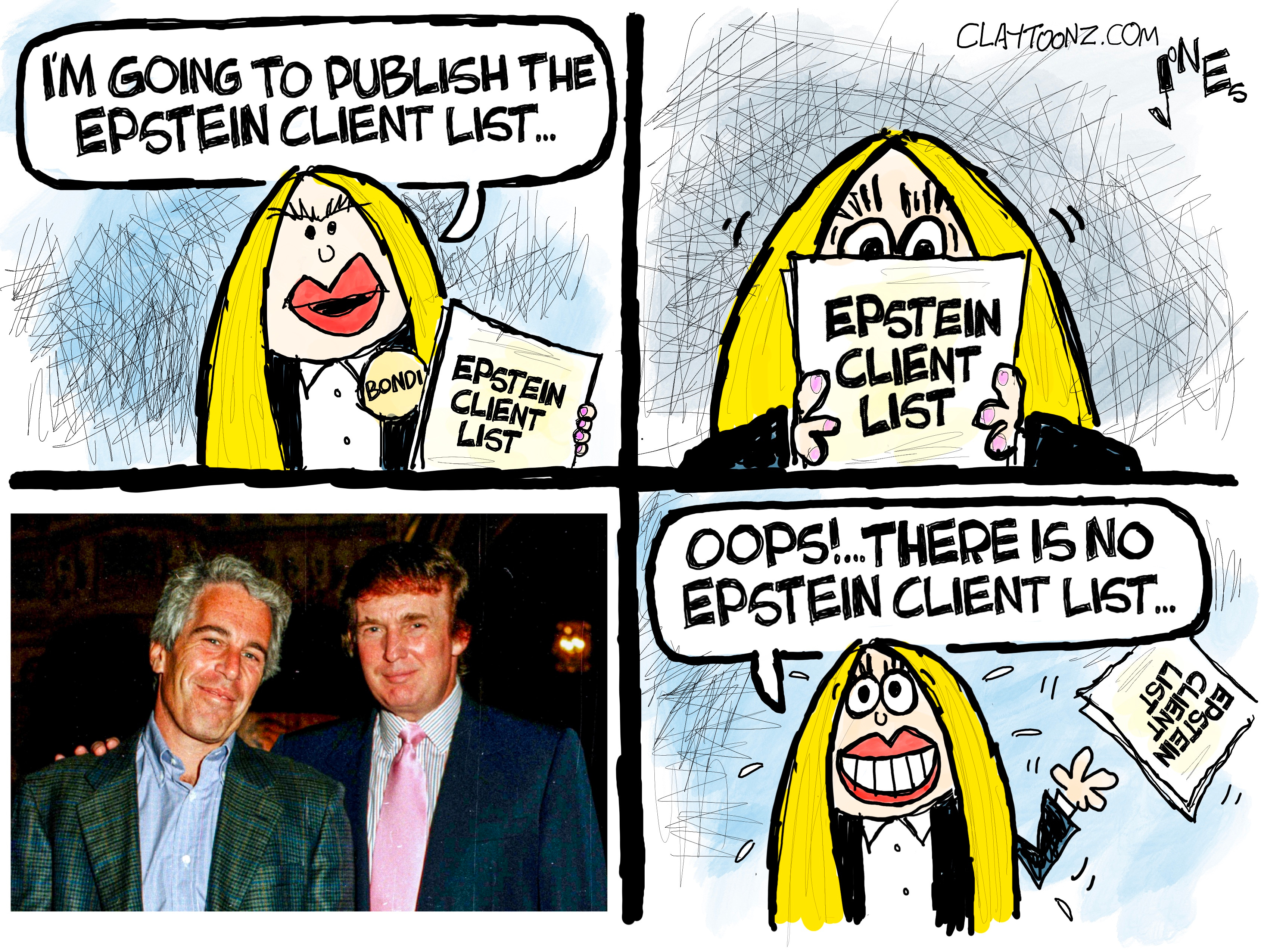
Today, the Justice Department posted a memo saying there is no evidence that the late pedophile and Trump party buddy Jeffrey Epstein was murdered or that he kept anything amounting to a much-anticipated “client list.” A DOJ spokesgoon told CNN that the department does not plan to release any new documents on the matter.
If you’re not surprised that there’s not a list of Epstein’s clients, that’s probably because you know New York City’s medical examiner had ruled Epstein’s death (hanging himself in jail) a suicide. The attorney general in Trump’s first term, Bill Barr, said the same thing, despite his suspicions of something more sinister. A Justice Department Inspector General report also pushed back on the idea that the death was anything but a suicide, while criticizing staff failures for allowing it to happen.
The Miami Herald’s Julie K. Brown, one of the best-sourced reporters on the Epstein case, reported earlier this year, “Those who have worked with the FBI on the case for decades say there is no evidence Epstein kept a ledger or a list of clients who were involved with his sex trafficking operation.”
But the problem for Trump 2.0 is that the regime promised to expose everything upon taking power, even promising to produce Epstein’s “client list.” Even an insider in Trump’s DOJ said there was a “client list.” Now, who in the Justice Department would jump the gun so badly when there’s not a client list? Who, who I ask? Who? Who? Who? Oh, it was the Attorney General, Pam Barbie Bondi. That’s who.
Remember, Bondi was Florida’s Attorney General who was going to investigate Trump University’s fraud in that state, but pulled the investigation after being paid off by Trump, who funneled it through his fake charity, the Trump Foundation. Later, she defended Trump in his impeachment trials, and was his second choice to be his AG after Matt Gaetz.
Imagine being the second choice after Matt Gaetz. If I were the second choice to Matt Giggity Gaetz, I’d probably hang myself. (snip-MORE, and it’s really good)
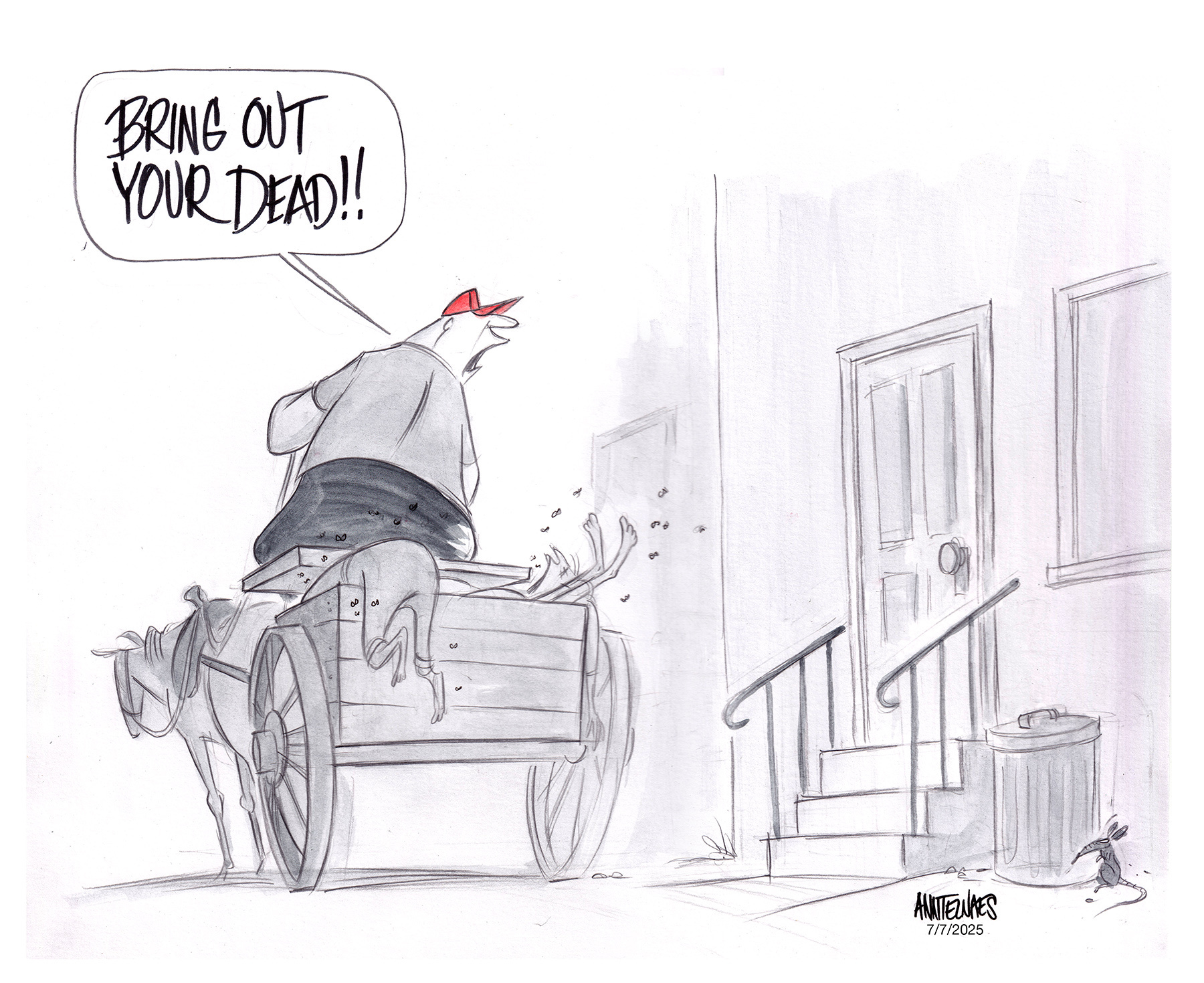
The Republican idea of a healthcare system by Ann Telnaes
Between their medicaid cuts and an anti-vaccine HHS secretary, this is the Republicans’ idea of a healthcare system. And as I’ve said before, Americans don’t have a healthcare system, they have a healthcare insurance system. Contrary to what politicians say, it is not the best in the world- far from it. There are many, many other countries which provide superior preventive care to all (which is the foundation of a healthy society).
FEMA Fiend by Clay Jones
Trump is once again doing something he accused Biden of Read on Substack
I told you that you were getting two blogs today. This is the second.
I’ve heard more than one liberal say that because they support Trump and other horrible Republicans, Texas parents deserve to have their children die in these floods. Folks, no. Hell no. Cut that crap out. Let the GOP and MAGAts be the heartless ones. Do NOT emulate them. We must always be better than them. It’s not hard.
Last September, Hurricane Helene hit the southeast Atlantic coast, being one of the strongest storms on record. It brought devastation to Florida, Georgia, the Carolinas, and even landlocked Tennessee. Naturally, Republicans politicized it.
First, they claimed the Biden administration wasn’t providing any recovery aid to areas that voted Republican. Of course, this was a lie.
Marjorie Taylor Greene showed a map of Republican congressional districts hit by the hurricane, and claimed Democrats manipulated the weather and sent the hurricane to those districts. These idiots don’t believe in science but believe a hurricane can be shot at a target.
Then, Donald Trump, who was running for president, claimed that Joe Biden spent all the FEMA funds on “illegal immigrants. He said the Biden administration “stole the FEMA money just like they stole it from a bank.” If anyone knows anything about stealing from a bank, or taxpayers, grifting his own supporters, or being a felon, it’s Donald Trump.
Of course, what Trump said was a lie…at least about Biden, because there has been a president (sic) stealing from FEMA.
As we’ve all come to learn, unless you’re a MAGAt living in denial, any accusation Trump makes is projection. (snip-MORE, and it’s sizzling hot!)
July 7, 1863 The first military draft was instituted in the U.S. to provide troops for the Union army in the American Civil War. Once called, a draftee had the opportunity to either pay a commutation fee of $300 to be exempt from a particular battle, or to hire a replacement that would exempt him from the entire war.
July 7, 1903 The March of the Mill Children watch a video – highly recommended Labor organizer Mary Harris “Mother” Jones led the “March of the Mill Children” over 100 miles from Philadelphia to President Theodore Roosevelt’s Long Island summer home in Oyster Bay, New York, to publicize the harsh conditions of child labor and to demand a 55-hour work week. It is during this march, on about the 24th, she delivered her famed “The Wail of the Children” speech. Roosevelt refused to see them. “Fifty years ago there was a cry against slavery and men gave up their lives to stop the selling of black children on the block. Today the white child is sold for two dollars a week to the manufacturers.” –from Mother Jones’s autobiography Read more about Mother Jones
July 7, 1957 Convened at the onset of the Cold War, a group of scientists held their first peace conference in the village of Pugwash, Nova Scotia, Canada. The mission of the Pugwash Conference was to “. . . bring scientific insight and reason to bear on threats to human security arising from science and technology in general, and above all from the catastrophic threat posed to humanity by nuclear and other weapons of mass destruction . . . .” Bertrand Russell Wealthy industrialist and Pugwash son Cyrus Eaton had invited the world’s greatest minds to his family home in Nova Scotia and address the emerging threat of nuclear war. The Conference became the basis for an ongoing organization that deals with issues of weapons of mass destruction. The 1995 Nobel Peace Prize was awarded to Joseph Rotblat (one of the original signatories of the Pugwash Manifesto) and to the Pugwash Conferences on Science and World Affairs. Albert Einstein Pugwash home
Fifty years later . . . 25 scientists, diplomats and former military officers from 15 countries gathered for a “Revitalizing Nuclear Disarmament” strategy workshop. The meeting was held near the Thinkers’ Lodge, the site of the first meeting in 1957. “Fifty years ago from Pugwash, Nova Scotia, nuclear scientists helped alert the world to the dangers of nuclear weapons, and especially the newly developed hydrogen bomb,” said Paolo Cotta-Ramusino, Secretary General, Pugwash Conferences on Science and World Affairs. “Today, we are working with experts from around the world for global action to revitalize nuclear disarmament and the final elimination of nuclear weapons.” Senator Roméo Dallaire, Honorary Patron of the Pugwash Peace Exchange, said “It is appalling to observe the increasing potential for many regional nuclear arms races, shameless plans to modernize nuclear arsenals and bald-faced threats of pre-emptive nuclear use,” said Senator Dallaire. “Only by revitalizing discussion and implementation of disarmament leading to abolition can we ensure that these genocidal devices will never again be used.”
July 7, 1977 The United States conducted its first test of the neutron bomb. The neutron bomb was a tactical thermonuclear weapon designed to cause very little physical damage through limited blast and heat but was designed to kill troops through localized but intense levels of lethal radiation. A neutron bomb explosion at a test site
July 7, 1979 2,000 American Indian activists and anti-nuclear demonstrators marched through the Black Hills of western South Dakota to protest the development of uranium mines on sacred native lands.
In the late 20th century, a gay social club became a major political force in the California tech industry, eventually influencing corporate policies as well as state and federal laws across the country.
In the 1980s, at a time when the federal government turned its back on the LGBTQ community, gay men and lesbians found an unlikely partner in their fight for equality: corporations.
In the face of the AIDS crisis, hostility toward LGBTQ employees forced the community to “turn from the state to business for protection, according to Margot Canaday’s Queer Career: Sexuality and Work Modern America.” Corporate America did more than federal or state governments in this regard, outpacing both the labor movement and the non-profit sector.
And it started in Silicon Valley.
While Silicon Valley was dominated by the kind of straight white men mocked in the HBO series of the same name, it also wasn’t the establishment. In these early days, for example, women made up a larger proportion of those working in computer programming. Nonconformity was seen as valuable rather than problematic. In 1987, Lotus became the “first highly visible, for-profit company” to provide same sex couples with partner benefits, according to Canaday.
Today, Silicon Valley dominates the public narrative and the economy. Granted, in our current moment, it seems paradoxical that the same industry that gave us social media platforms that often perpetuate misogyny and homophobia also served as an important battleground for the assertion of employment rights for LGBTQ workers. Yet it did, and it happened internally through employee resource groups and externally through advocacy groups.
One of the most prominent of these external advocacy organizations was the High Tech Gays (HTG). Formed in the living rooms of Silicon Valley’s San Jose in 1983, it began largely as a social group for the region’s LGTBQ tech workforce, but over time it served as an incubator for other organizations dedicated to LGBTQ political rights, inspiring members to start their own employee resource groups at their places of employment and organizing against anti-gay state referendums.
The 1980s and Silicon Valley
While San Francisco, has long been identified with LGBTQ activism, suburban Silicon Valley proved more conservative. “Even though I was ‘out’ with friends and family who knew me…I found myself being very reserved in expressing affection, talking in any depth about gay culture with them,” says Bob Correa, a California native, San Jose resident (1971-1986), and an early HTG member. “Even in the early ’80s there was a lot of prejudice back then, a heck of lot more than today,” adds his husband and one of HTG’s founders, Denny Carroll, in their 2018 interview.
Denny Carroll and Bob Correa after donating the HTG collection to the San Jose State Martin Luther King Library (Photo courtesy of HTG, Martin Luther King, Jr. Library, San Jose State University)
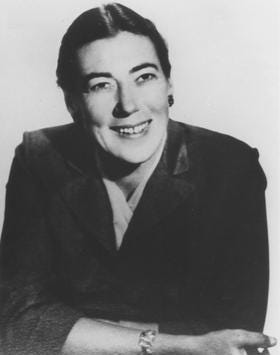
In 1956, when the entire psychiatric establishment was convinced that homosexuality was a form of mental illness requiring treatment, cure, or containment, one woman looked at the scientific evidence and said, “This is complete bullshit.” Evelyn Hooker didn’t just challenge conventional wisdom—she demolished it with the kind of methodological precision that left her opponents scrambling for excuses and the LGBTQIA+ community with something they’d never had before: scientific proof that there was absolutely nothing wrong with them.
But this wasn’t some abstract academic exercise conducted by a dispassionate researcher in an ivory tower. Hooker’s work was personal, political, and profoundly revolutionary in ways that extended far beyond the confines of psychological journals. She was a straight woman who risked her career to defend people she cared about, a scientist who refused to let prejudice masquerade as objective research, and a human being who understood that the difference between pathology and normalcy could literally be a matter of life and death for millions of people.
Her story is one of scientific courage in the face of institutional pressure, intellectual honesty in an era of willful ignorance, and the transformative power of rigorous methodology applied to questions that society would rather not examine too closely. It’s also the story of how one woman’s determination to follow the evidence wherever it led helped liberate an entire community from the tyranny of psychiatric pathologization, proving that sometimes the most radical act is simply insisting on the truth.
The Making of a Scientific Revolutionary (snip-MORE)
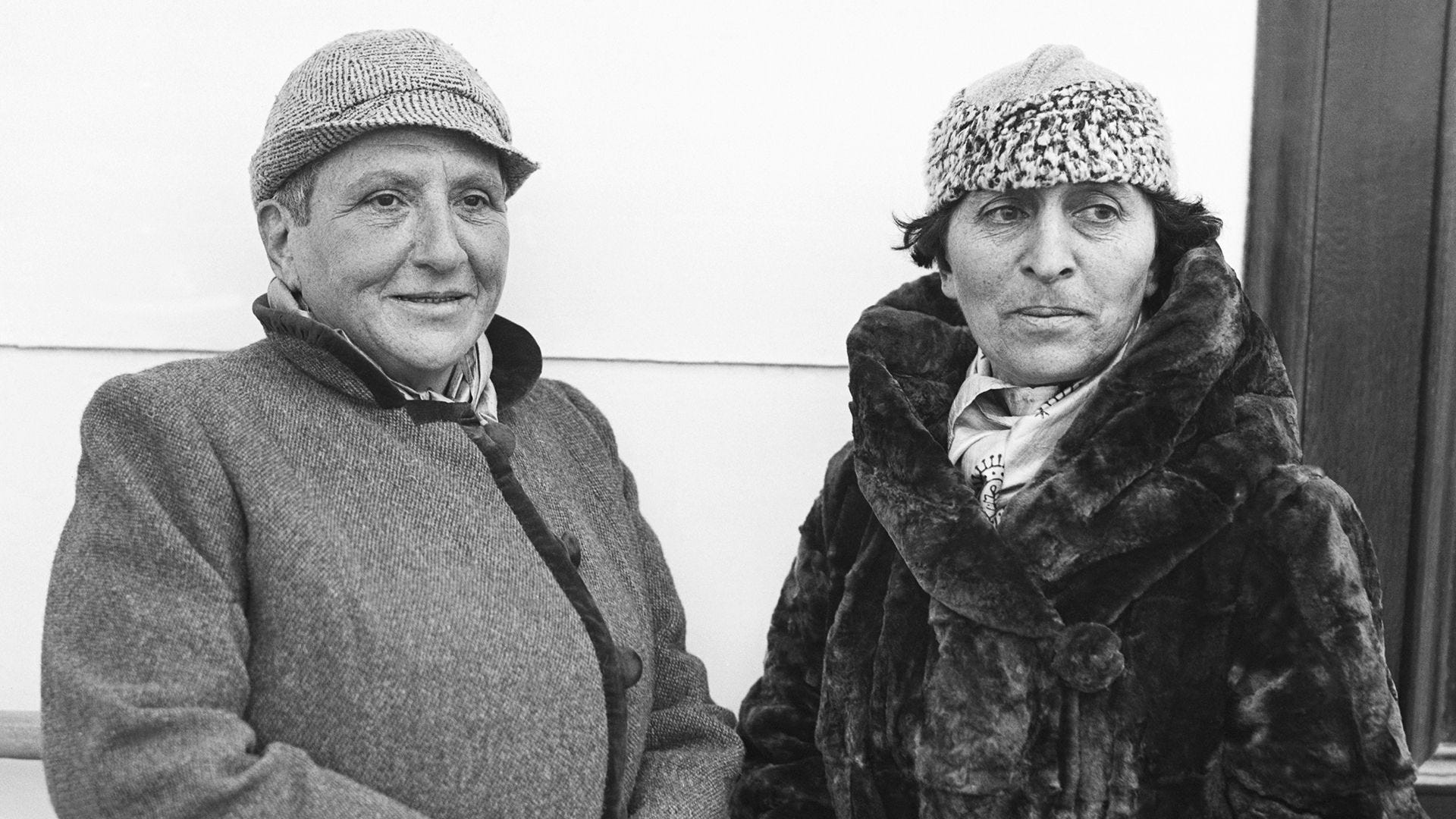
Queer History 573: Gertrude Stein and Alice Toklas by Wendy🏳️⚧️🏳️🌈🌈
The Badass Bitches Who Told Paris to Go Fuck Itself and Made Art History Anyway Read on Substack
Listen up, you beautiful fucking souls, because today we’re diving headfirst into the absolutely goddamn legendary love story that rewrote the rules of art, literature, and what it meant to be authentically, unapologetically queer in the early 20th century. We’re talking about Alice B. Toklas and Gertrude Stein – two women who said “fuck your heteronormative bullshit” and proceeded to create one of the most influential artistic partnerships in modern history.
These weren’t just two women living together because society expected spinsters to share expenses. Hell no. This was a love affair that burned so bright it illuminated the entire fucking modernist movement, and their relationship became the beating heart of Parisian avant-garde culture for nearly four decades.
The Fierce Fucking Beginning
Picture this shit: It’s 1907, and Alice Babette Toklas, a sharp-as-hell California Jewish woman with an eye for detail that could cut glass, walks into Gertrude Stein’s salon at 27 rue de Fleurus in Paris. The moment their eyes met, the world shifted on its goddamn axis. Alice later described hearing church bells ringing – not metaphorically, but literally – because apparently when your soulmate walks into the room, even the universe knows it’s time to celebrate.
Gertrude Stein wasn’t just any woman. This brilliant bitch had already established herself as a radical writer whose experimental prose was making traditional literature scholars shit their conservative pants. Born in 1874 in Pennsylvania to a German-Jewish immigrant family, Gertrude had studied psychology under William James at Harvard’s sister school, Radcliffe College. She understood the human mind in ways that would make Freud jealous as fuck.
Alice, born in 1877 in San Francisco, came from a middle-class Jewish family and had been living what society deemed an “appropriate” life for a single woman. But the moment she encountered Gertrude’s magnetic presence, all that conventional bullshit went straight out the window. Here was a woman who wrote things like “A rose is a rose is a rose” and made it sound like the most profound shit you’d ever heard.
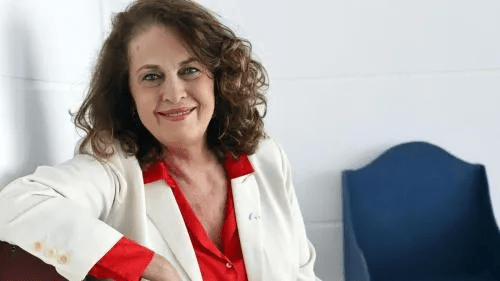
In the sun-scorched landscape of Spanish politics, where machismo runs deeper than olive oil and Catholic conservatism clings like barnacles to a ship’s hull, Carla Antonelli emerged like a fucking phoenix from the ashes of Franco’s repressive regime. Born Carlos Álvarez-Malvar in 1959, she didn’t just transition from male to female—she transformed from a society that wanted her dead into a political force that would reshape Spain’s understanding of transgender existence. This wasn’t some gentle evolution; this was a goddamn revolution with lipstick and legislative power.
Carla Antonelli represents more than just political firsts and broken barriers. She embodies the visceral struggle of transgender people in post-Franco Spain, where the ghost of fascist oppression still haunted every street corner and the Catholic Church’s influence seeped into every crack of social life. Her journey from underground actress to regional parliamentarian reads like a masterclass in survival, authenticity, and the raw power of refusing to be erased.
Let’s be brutally fucking honest about what Carla faced: a Spain that had spent decades under a dictator who considered LGBTQIA+ people degenerates worthy of imprisonment or worse. Franco’s regime didn’t just criminalize homosexuality and gender nonconformity—it tried to erase these identities from existence entirely. When Franco finally had the decency to die in 1975, his ideological progeny didn’t magically disappear. They lurked in institutions, in families, in the collective psyche of a nation that was slowly, painfully learning to breathe freely again.
The Making of a Revolutionary in Franco’s Shadow (snip-MORE)
Queer History 892: Ben Barres – The Badass Brain Scientist Who Fucked Up Gender Bias Forever by Wendy🏳️⚧️🏳️🌈🌈
In the testosterone-soaked world of academic neuroscience, where brilliant minds wrapped in fragile egos compete to unlock the secrets of the human brain, Ben Barres stood as a goddamn force of nature who revolutionized not just our understanding of neural circuits but the entire fucking structure of scientific academia itself. Born Barbara in 1954, Ben didn’t just transition from female to male—he transformed from a marginalized outsider fighting for recognition to one of the most respected neuroscientists on the planet, all while wielding his unique perspective like a scalpel to dissect the sexist bullshit that infected his field.
Ben Barres wasn’t just another transgender scientist who happened to make discoveries. He was a revolutionary who used his lived experience of gender bias to expose the systemic discrimination that had been hiding in plain sight for decades. His story reads like a masterclass in how authenticity and scientific rigor can combine to create change that extends far beyond laboratory walls. When he died in 2017, he left behind not just groundbreaking research on glial cells and neural development, but a legacy of advocacy that continues to reshape how academia treats women, minorities, and anyone who doesn’t fit the traditional mold of what a scientist should look like.
This is the story of a brilliant mind who refused to be diminished by a world that couldn’t understand him, who channeled the fury of marginalization into scientific excellence and social change. Ben Barres proved that the best revenge against discrimination isn’t just success—it’s using that success to burn down the systems that tried to stop you in the first place.
The Early Years: A Brilliant Mind in the Wrong Package (snip-MORE)
News outlets are supposed to expose corruption, not engage in it Read on Substack
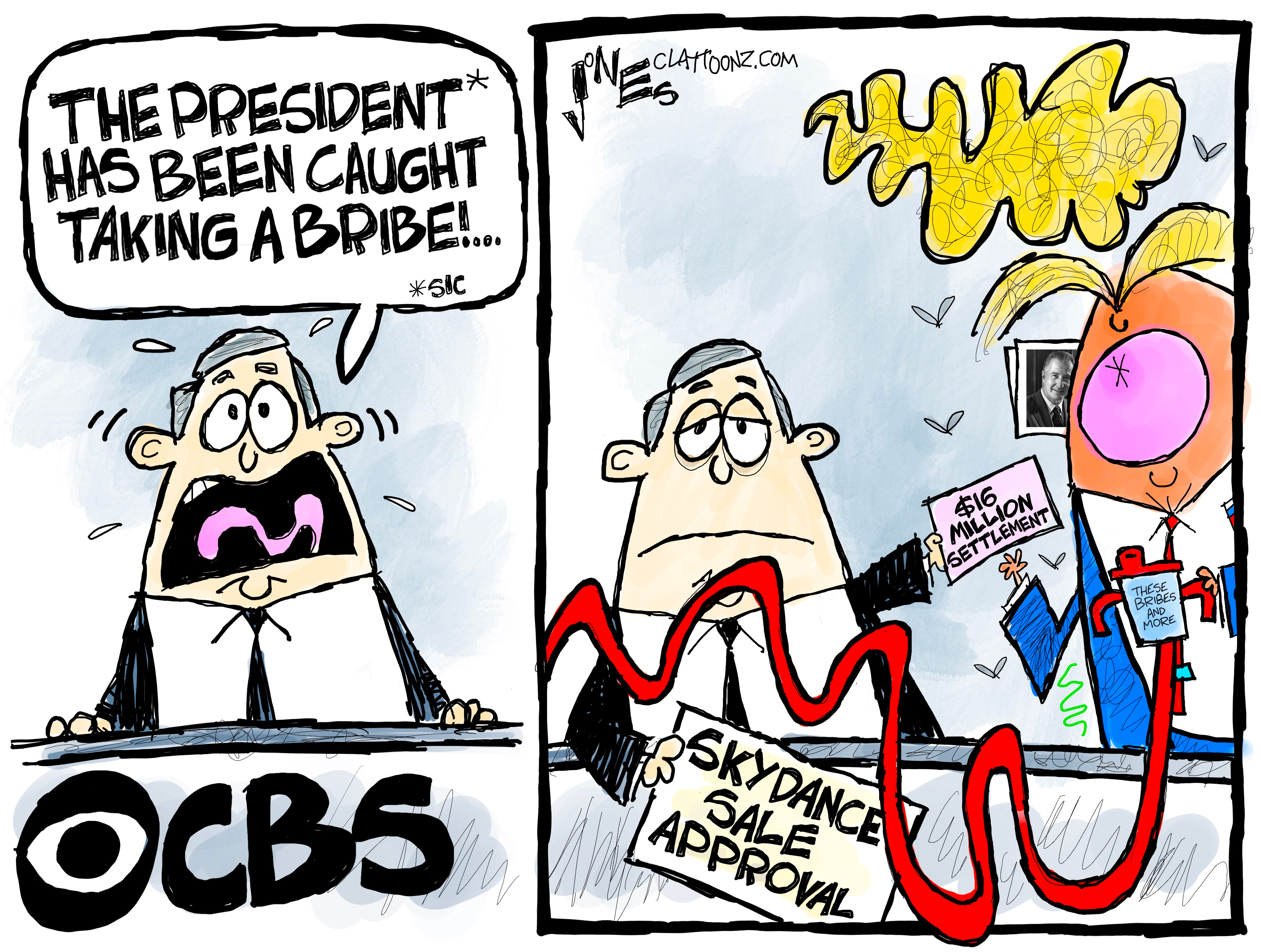
The headline at Fox News blasted, “Paramount, CBS forced to pay eight figures, change editorial policy in settlement with President Trump.” Forced? Would Fox News use the word “forced” when they settled a lawsuit with Dominion for over $787 million? You may feel forced, but a settlement is a choice. It’s a choice not to go any further into a trial and shut that shit down, for whatever reasons. And yes, CBS has changed its editorial policy, which is that anytime Trump comes for a bribe, you pay it.
Usually, when someone settles a lawsuit, they’re trying to get off cheaper as they fear the result of the trial will cost them more. In Fox News’ case with Dominion, they were afraid the verdict in a trial would bankrupt them. They were guilty of spreading misinformation that they knew were lies. It’s why Tucker’s no longer on their payroll.
When CNN and the Washington Post settled with teenage Trumper Nicholas Sandmann, one of those smirky, obnoxious, entitled white privileged Catholic Covington kids who was in the center of a viral video controversy with an elderly Native American, they didn’t settle because they were guilty. They settled for what legal experts estimate to be a small portion of the $275 million they were sued for, in order to save on lawyer fees. They weren’t afraid of losing the trial because it had already been dismissed once, but felt they’d pay more to their lawyers than to the little asshole whose feelings got hurt. I hope the ugly little entitled priviliged fuck isn’t feeling too litigious today.
When Disney settled a lawsuit with Trump earlier last December, who sued because ABC news anchor George Stephanopoulos said Trump was “liable for rape,” it wasn’t because they were guilty of anything other than hurting TACO’s feelings because Stephanopoulos was technically correct. Disney, ABC’s parent company, settled because the judge was scary and said in her denial to dismiss that “a reasonable jury could interpret Stephanopoulos’s statements as defamatory,” despite the fact that Donald Trump is a rapist who also liked to pal around with rapists while also endorsing pedophiles for the United States Senate. Also, Trump put Alexander Acosta in his first cabinet. He was the prosecutor who saved Epstein from a criminal trial.
When Meta settled a lawsuit with Trump in January, it was to bribe Trump. Trump sued Meta for banning him from its platforms, Facebook and Instagram, in 2020 after his election denial and white nationalist terrorist insurrection attempt. Trump told Mark Zuckerberg that he would have to settle the lawsuit before he could be “brought into the tent.” I don’t think he’s talking the kind of tent migrants will be forced to sleep in at Alligator Alcatraz, but the MAGA tent. The settlement was for $25 million, and it was a bribe.
Even Elon settled a lawsuit with Trump, and was also to bribe Trump. As if the $275 million Elon paid to elect him wasn’t enough. Like with Meta, Trump sued Twitter for banning him, citing that his First Amendment rights were violated. A federal court in California tossed the case, saying only the government can deny First Amendment rights, not corporations. But Trump’s team took it to an appeals court, which was skeptical. Elon settled with Trump for $10 million. Why would you settle when you already won? Because it’s a bribe.
Also, do you like the irony of Trump claiming his First Amendment rights were violated, and now he’s trying to deport people for protesting? (snip-MORE)
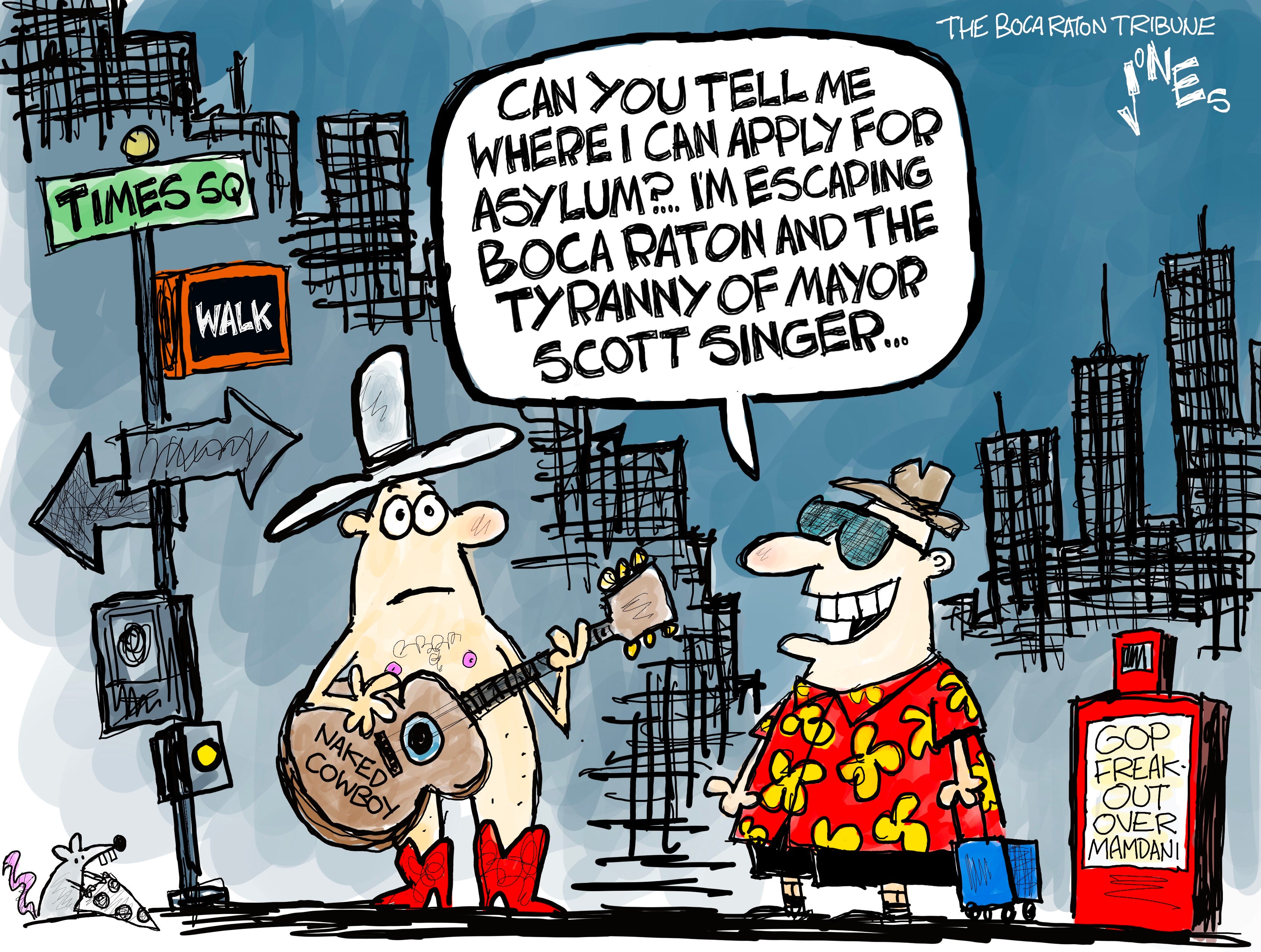
This cartoon was drawn for The Boca Raton Tribune, whose mayor went on Fox News and offered New Yorkers an escape from “socialist” New York City if Zohran Mamdani wins the mayoral race in November.
The mayor, Scott Singer, has aspirations for higher office, and to do that as a Republican, you have to be a vile piece of shit. This is the kind of stuff MAGAts find amusing, like throwing migrants to alligators.
Being the mayor of a city in Florida, Singer should focus on being the mayor of his city in Florida. That’s the job he was elected to do, and not worry about who’s the mayor of New York City. Right now, Republicans are using Mamdani as red meat for their base, without even understanding what they’re talking about.
Sometimes, I think I should move to Florida just for the issues, and syndicate cartoons about them to Florida newspapers. But then, I’d be living in Florida. (snip-MORE)
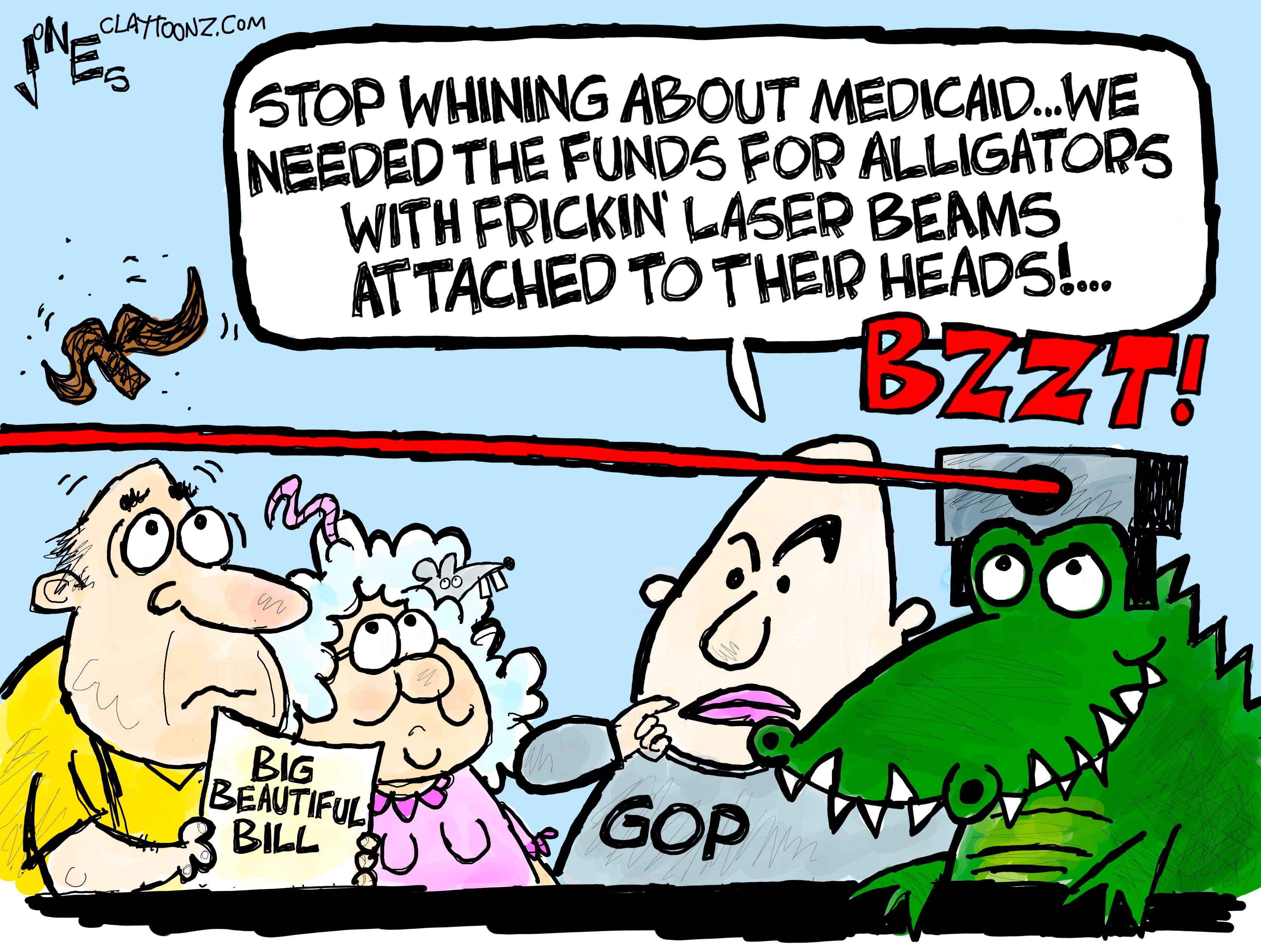
Trump’s $4 trillion (at least) “big beautiful bill” is giving seniors a tax credit of $6,000, which is great because they’re gonna need it.
The bill makes deep cuts to Medicaid, the government health insurer for the poor, which covers more than 60 percent of the nation’s nursing home residents.
The nonpartisan Congressional Budget Office (CBO) estimated that the BBB will cut federal spending on Medicaid and Children’s Health Insurance Program (CHIP) benefits by $1.02 trillion, due in part to eliminating at least 10.5 million people from the programs by 2034.
This will lead to benefit losses, increased paperwork requirements, and rural hospital closures that will hurt Americans, especially those with disabilities. It will also make nursing homes scramble to find resources for services they’re currently providing, or simply eliminate services.
Republicans like to say, or lie, that people who receive Medicaid aren’t going to notice any changes. But you can’t find one of the shitweasels who can explain how you don’t lose any services after cutting out over a trillion dollars. Find me one Republican, just one, who can explain that shit.
This will hit rural communities harder. Do you know which party rural communities mostly vote for? The one that just cut their Medicaid. Republican voters are stupid. Red states need the most federal support. Red states need the most welfare, which they also cut. (snip-MORE)
July 6, 1892 In one of the worst cases of violent union-busting, a fierce battle broke out between the striking employees (members of the Amalgamated Association of Iron and Steel Workers) of Andrew Carnegie’s Homestead Steel Company and a Pinkerton Detective Agency private army brought on barges down the Monongahela River in the dead of night. Twelve were killed. Henry C. Frick, general manager of the plant in Homestead, near Pittsburgh, Pennsylvania, had been given free rein by Carnegie to quash the strike. At Frick’s request, Pennsylvania Governor Robert E. Pattison then sent 8,500 troops to intervene on behalf of the company. Read more (2 links)
July 6, 1942 In Nazi-occupied Holland, thirteen-year-old Jewish diarist Anne Frank and her family were forced to take refuge in a secret sealed-off area of an Amsterdam warehouse under threat of arrest and deportation to a concentration camp by the Einsatzgruppen (Task Force), a part of the German Gestapo. The Anne Frank Center for Mutual Respect
July 6, 1944 Irene Morgan, a 28-year-old black woman, was arrested for refusing to move to the back of the bus eleven years before Rosa Parks did so. Her legal appeal, after her conviction for breaking a Virginia law (known as a Jim Crow law) forbidding integrated seating, resulted in a 7-1 Supreme Court decision barring segregation in interstate commerce. Irene Morgan More about Irene Morgan June 3, 1946: Morgan v. Commonwealth of Virginia Zinn Ed Project
July 6, 1965 As many as 500 students in Berkeley, California, attempted to block trains carrying troops destined for Vietnam along the Santa Fe Railroad tracks; there were no casualties. Organized by the Vietnam Day Committee, this was the first civil disobedience at UC-Berkeley against the Vietnam War.