Useful Material, Here

Of course, we’re all looking to save what we can, every day. This can be applied to small households larger than single resident. Give it a look! I remember doing some of this in the 80s, and I still do all I can. A penny’s a penny! Also, if you click through to read, here on the headline, | you can see funny graphics to go with many of the suggestions.

People who live alone share their 45 best money-saving hacks

“I fill empty glass jars with water and store them in my fridge. It costs more to cool an empty fridge than a full one.”

Emily Shiffer

Whether you’re single or choose to live alone, it can be expensive. Finding ways to save money living alone can take some creative thinking, but there are easy ways to put some extra cash back in your wallet.

In an online forum, member Just_Throw_Away_67 posed the question to fellow people who live alone: “What random cost-saving measures have you found that work well for those living alone?”

And single people and people living solo happily shared their money-saving hacks. These are 45 of the best ways to save money if you live alone.

“I’ll start, to save money on energy I fill empty glass jars with water and store them in my fridge. It costs more to cool an empty fridge than a full one, and since I don’t eat very much my fridge is often nearly empty. Not sure how much this has saved me, but now I have water if I ever were to need it!” Just_Throw_Away_67 (Note from A.: This holds true for the freezer, too. Keep some containers of water up/out there. They help use less energy, and frankly, the ice is useful during power outages.)

“Blackout curtains because I live in the South so it’s always hot. I also have privacy film that blocks some UV rays when I do want some light. Using a floor fan in my room (where I spend the majority of my time) with the door closed to keep it cooler. Close the air vents in my guest room since it’s primarily unused to cut down on AC costs. Cook large batches of food at one time so I’m not constantly using my stove/oven.” eternally_feral

“It’s a pain to heat the whole oven for a little food. I recommend an air fryer over a toaster oven though. They’re a bit faster (and you can still make toast).” MissDisplaced

“I keep my heating and cooling low. I can wear extra layers or less to get to a comfortable temp.” Reasonable-Cold2161

“I read a tip to not bother doing a full ‘grocery shop’ trip if it doesn’t work for you/doesn’t make sense for you. Rather, if you find you’re throwing food away you couldn’t eat in time, try to do the method of going to the store of getting, say, just what you need for tonight and tomorrow’s meals, or whatever.” citynomad1

“Grocery delivery. I end up spending 50% less compared to shopping in the store.” Everydaylookwithin

“This is why I do curbside pickup. I order through the app, see what deals and coupons they have, stick to my list and don’t end up impulse buying. An added bonus is I can pick up on my way home from work and not spend time waiting in the checkout line.” zoebadwolf

“It took a little bit of up front investment, but I dumped my gigantic and ancient energy-hungry fridge a long time ago for a brand new one that is much smaller and also has a variable speed compressor for extra efficiency. The energy savings from that move alone probably paid for the fridge several times over by now.” BrewCityChaserV2

“I have a countertop dishwasher that I intentionally use only during off-peak hours. Luckily, this rental has a new refrigerator, and I run my air purifier on its 2 hour timer during those off hours (cat hair lol). Oh- I bought a Tushy bidet on sale- it pays for itself in the first year!” sk8rcruz

“I always bring my own lunch to work. I also cut up fresh veggies, put them in ziploc bags, freeze them, and then steam them later in the microwave. You can also just put a whole bag of spinach in the freezer and then steam it in the microwave. Clean with a plastic spray bottle of vinegar and dish soap. Sprinkle baking soda on carpets and rugs before vacuuming.” Unhappy-Jaguar-9362

“I have milk jugs with water in them in the fridge and freezer. I also buy in bulk. Usually the more you buy the cheaper per unit it is. I have a year supply of everything (joking) not quite but almost. I keep my air conditioner at a warmer temperature and use a fan to cool me all the way. I close blinds and curtains during the day. This cuts down on the heat in the room. Unfortunately it is dark in my apartment during the day , but this can make a difference of up to 10 degrees. This saves on cooling costs. Instead of buying single servings of food. I make a family size amount and put the leftovers in round dinner containers all ready to go for the next meal. These can also be frozen if you don’t want the same thing a couple days in a row and put in the microwave for 6 or 7 minutes.” Delightful_Helper

“I buy the family size packs of meats, divide and freeze. I also still cook big meals like when my kids were teenagers and divide them into portions and freeze. Its simply too hard to cook for one person. I make a weekly menu of the dishes I want to cook and then place my order for the grocery delivery. It does save money and since I cook a lot of casseroles, big pots of soups and stews, etc., and freeze in portions. I use my air fryer to warm the frozen dishes instead of the oven. It has almost become my hobby to have a variety of different meals through out the week without having to cook every day. Life is good 😊.” No_Guava_90

(snip-MORE, plus funny graphics)

Hmmm.

(I think we’ve seen the long cut of this riff, before. This short popped up last night. Enjoy! -A.)

Emancipation, Pullman Strike & Boycott, & More, in Peace & Justice History for 7/5

July 5, 1827
The newly freed African-American population of New York, led by men on horseback, marched in an Emancipation Day Parade from the Battery at the foot of Manhattan to City Hall.
Follow the route of the parade 
July 5, 1894
Buildings erected for the 1892 Columbian Exposition in Chicago’s Jackson Park were set ablaze, seven reduced to ashes. The fire was part of the chaos in reaction to President Grover Cleveland’s calling out federal troops to end the Pullman Strike.
The Pullman Palace Car Company produced the sleeping cars used by most of the railroads. The contingent of federal, state and local forces equalled the number of striking workers.The Pullman employees, who lived in company-owned housing in Pullman, Illinois, had suffered massive layoffs and pay cuts averaging 25%. The company refused to cut the rent on the housing its employees were required to occupy, nor would it bargain with workers’ representatives.

Federal troops guarding the Arcade Building in Pullman, Illinois.
The Pullman workers’ cause had been taken up by Eugene V. Debs, the leader of the American Railway Union, who helped organize a nationwide boycott of any train that included a Pullman car.
The Pullman Strikers’ Statement 
More on the Great Pullman Strike 
July 5, 1934

Bloody Thursday, July 5, 1934, near Rincon Hill.
On “Bloody Thursday,” police armed with machine guns opened fire against striking longshoremen and their supporters, killing two, wounding 32 more by gunfire, and injuring 75 others at Rincon Hill in San Francisco.
July 5, 1935
The National Labor Relations or Wagner Act (named for New York’s Senator Robert Wagner) became law, recognizing workers’ rights to organize and bargain collectively. It was signed into law by President Franklin D. Roosevelt.
Read more about the act 
July 5, 1989
   
Former National Security Council aide Oliver North received a $150,000 fine and a suspended prison term for his part in the Iran-Contra scandal. The scandal was a secret arrangement directed from the Reagan White House that provided funds to the Nicaraguan Contra rebels (despite specific congressional prohibition) from profits gained by selling arms to Iran (at war with Iraq at the time) in hopes of their releasing hostages, despite President Reagan’s claim that he would never negotiate with hostage-takers.
North’s conviction was later overturned because evidence revealed in the congressional Iran-Contra hearings had compromised his right to a fair trial.
The real details on Ollie North’s activities   (It’s still up! -A.)

“High-Flying Filter-Feeder”

A Nice Little Video

I just ran across this in my SBTB email. It belongs here. Doesn’t look like it embedded (it didn’t on SBTB, either,) so click through on “View this post…” and make sure the sound is on. A very worthy click.

View this post on Instagram

A post shared by Jacob Witzling (@jacobwitzling)

Baby Strikers, Barbara Gittings, & More in Peace & Justice History, 7/3, 7/4

July 3, 1835
Children employed in the silk mills at Paterson, New Jersey, went on strike for an eleven-hour workday and a six-day workweek rather than 12-14 hour days. With the help of adults, they won a compromise settlement of a 69-hour week.
More on the Baby Strikers 
July 3, 1966
4000 Britons chanting, “Hands off Vietnam,” demonstrated in London against escalation of the Vietnam War. U.S. warplanes had recently bombed the North Vietnamese capital of Hanoi as well as the port city of Haiphong. Police moved in after scuffles broke out at the demonstration outside the U.S. Embassy in Grosvenor Square; 31 were arrested.

Actress Vanessa Redgrave joins 25,000 two years later at Anti-Vietnam war protest, Grosvenor Square.
Read more 
July 3, 1974
At the Moscow Summit talks between President Richard Nixon and President Leonid Brezhnev, the United States and the Soviet Union agreed to hold bilateral talks on the prohibition of chemical weapons.
July 4, 1776

The United States declared its independence from King George III and Great Britain, thus beginning the first successful anti-imperial revolution in world history. Signed in Philadelphia by 56 British subjects who lived and owned property in thirteen of the American colonies, the document asserted the right of a people to create its own form of government. The signers of the Declaration of Independence were members of the 2nd Continental Congress which had voted two days earlier to separate from the British crown.
Read the Declaration
see some quotes on nationalism and patriotism
July 4, 1827
Slavery was outlawed in New York State as the result of the Gradual Emancipation law passed ten years earlier. This freedom applied only to those who had been 18 at the time of its passage. Enslaved children born during the subsequent ten-year period were not be freed until they reached the age of 21.
At the urging of Reverend William Hamilton, a freedman and carpenter, and others, the end of slavery was celebrated in churches. The Fourth of July had in the past been marred by young white men attacking black Americans.
More on William Hamilton  and others
July 4, 1829
Speaking at Boston’s Park Street Church, newspaper editor and abolitionist William Lloyd Garrison gave a seminal speech on “Dangers to the Nation.” Though Massachusetts had banned slavery in 1781 and there was strong anti-slavery sentiment, most understood that a national ban of slavery would threaten the union of the states. Compensation to slaveholders and return of the enslaved to Africa was considered the best solution.
Garrison, on the other hand, called attention to the hypocrisy of celebrating the the day the document was signed declaring, “All men are created equal” while two million were in bondage. He proposed four propositions that day to guide the abolitionist movement:
1. Above all others, slaves in America deserve “the prayers, and sympathies, and charities of the American people.”
2. Non-slave-holding states are “constitutionally involved in the guilt of slavery,” and are obligated “to assist in its overthrow.”    
3. There is no valid legal or religious justification for the preservation of slavery.
4. The “colored population” of America should be freed, given an education, and accepted as equal citizens with whites.


William Lloyd Garrison
July 4, 1894
The Republic of Hawaii was proclaimed with Sanford B. Dole as president. It was recognized immediately by the United States government under President Grover Cleveland. This was the result of the successful overthrow of the Hawaiian monarchy, then held by Queen Lydia Liliuokalani, and the support by white Americans involved in the sugar trade on the islands for annexation by the United States. Shortly after she had come to office, she had promulgated a new constitution which increased the power of the monarchy and that of native Hawaiians.
July 4, 1965

Barbara Gittings at the Philadelphia picket
The first of an annual picket in front of Philadelphia’s Independence Hall was held by gay and Lesbian Americans. Jack Nichols and Frank Kameny and members of the New York and Washington Mattachine Society and the Daughters of Bilitis had earlier demonstrated in Washington, and wished to change the general perception that homosexuals were perverted or sick.

“By those protesters coming out publicly, and placing themselves very strategically in front of the building that evoked the Declaration of Independence and the idea that all men are created equal, it suggested it [gay rights] was no longer a moral or national security or psychiatric issue … it was a civil-rights issues,” 
David K. Johnson wrote in The Lavender Scare: The Cold War Persecution of Gays and Lesbians in the Federal Government.
July 4, 1966
The Freedom of Information Act, P.L. 89-487, became law. It established the right of Americans to know what their government is doing by outlining procedures for getting access to internal documents.
July 4, 1969

“Give Peace a Chance” by the Plastic Ono Band was released in the United Kingdom.
The song was recorded May 31, 1969, during the “Bed-In” John Lennon and Yoko Ono staged at the Queen Elizabeth Hotel in Montreal as part of their honeymoon. John and Yoko stayed in bed for 8 days, beginning May 26, in an effort to promote world peace.
Some of the people in the hotel room who sang on this were Tommy Smothers, Timothy Leary, Allen Ginsberg, and Petula Clark. Smothers also played guitar. This event promoting peace received a great deal of media attention.
“All we are saying . . .”  
watch & listen – give it a chance
July 4, 1969
A national anti-war conference in Cleveland, Ohio, mapped out activities against the Vietnam War and resulted in the founding of New Mobe (mobilization).
More about the Mobes
July 4, 1983
The Women’s Encampment for a Future of Peace and Justice began an eight week stay on a farm just outside the Seneca Army Depot near Romulus, New York. The purpose of the gathering was for the women to learn about and together protest the escalation of militarism and the weapons build-up being led at the time by the Reagan administration.
visit PeaCe eNCaMPeNT HeRSToRy PRoJeCT 
July 4, 2007
The first of several Peace Caravans (Caravanes de Paix) set out from South Kivu and traveled across Africa’s Great Lakes region, including the Democratic Republic of the Congo, Burundi and Rwanda. The Scout Associations of the countries in the violence-ridden area trained hundreds of young people in conflict resolution through their focus on education for peace.

Members of the Caravan for Peace in Burundi
The classes and the caravans included hundreds of young people in Scouts and Girl Guides from many ethnic groups (often with a history of mutual hostility) who act as community mediators.
https://www.peacebuttons.info/E-News/peacehistoryjuly.htm#july3

Republican Crimes Against The U.S.

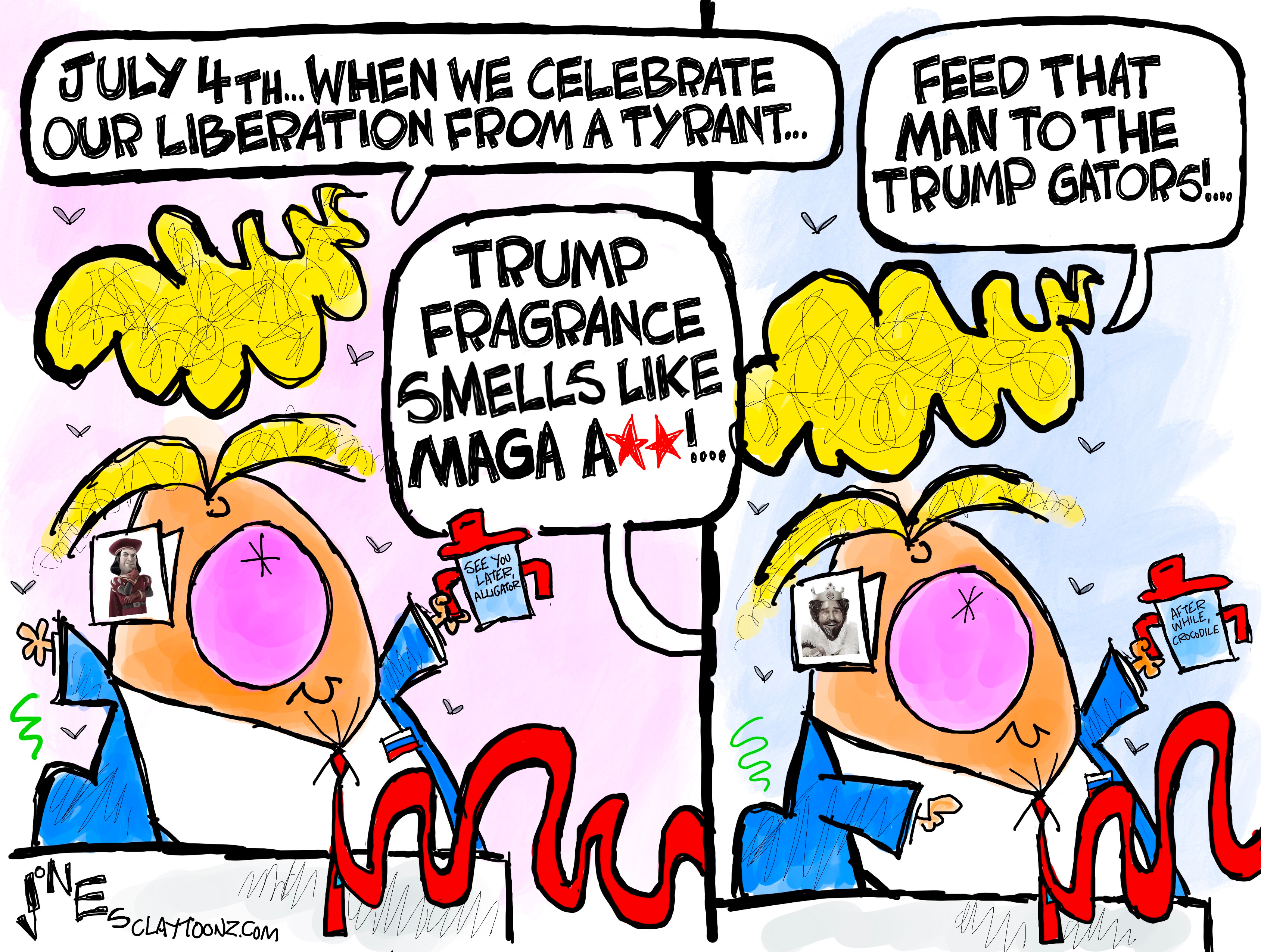
King Stinks-A-Lot by Clay Jones

No room for tyrants Read on Substack

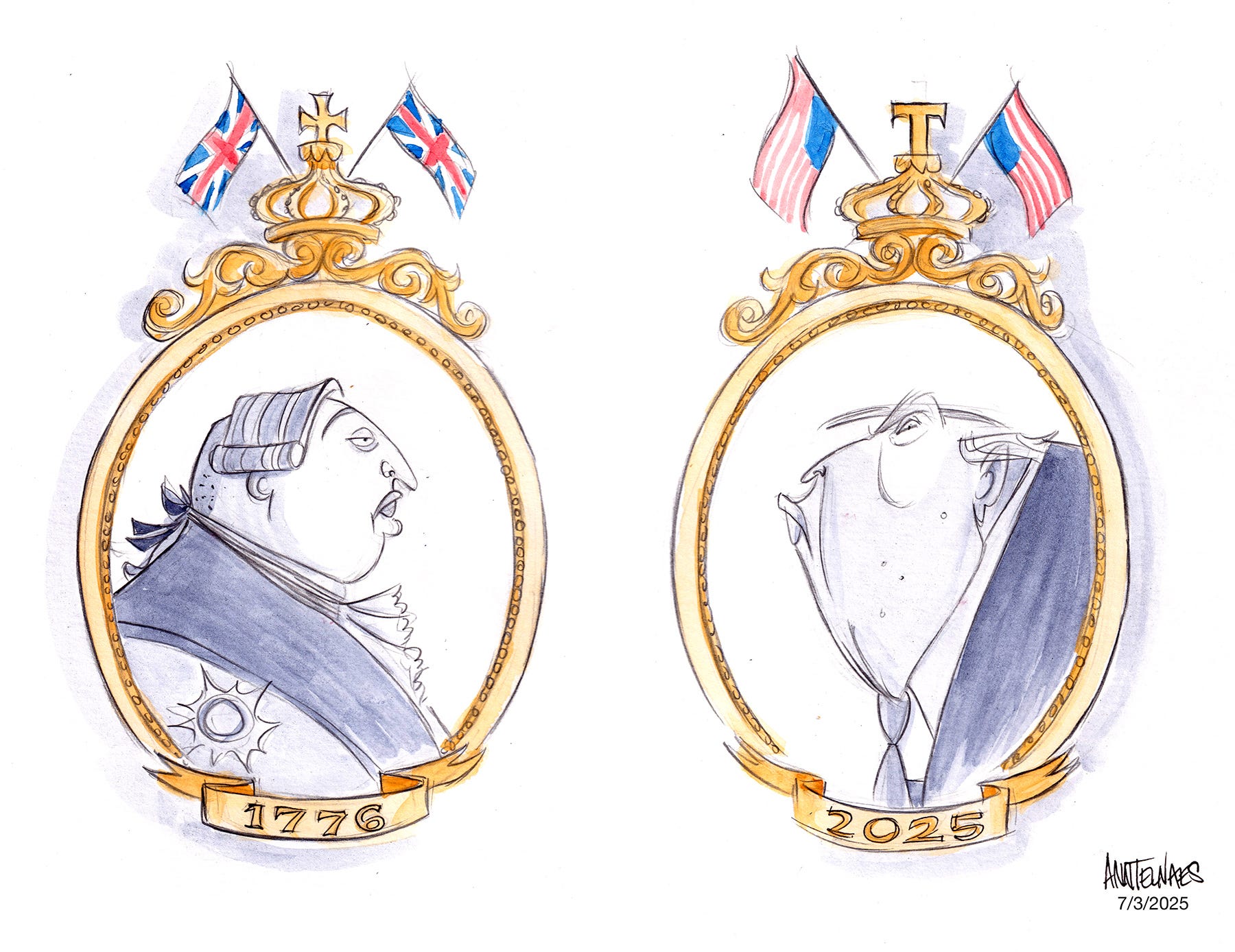
Tomorrow, we’re celebrating the anniversary of our independence from a monarchy. Yet, the guy in the White House envisions himself as a monarch.

He wants to ban protests, which is a First Amendment right. He didn’t send the military to California to stop riots. He sent them to stop the protests. Ice has arrested legal residents, without charges, but citing their protests. The regime is bullying colleges to stop protests against the war in Gaza. This is not freedom. This is not independence.

Trump asked the courts for immunity from criminal charges. Every court said no until it got to the Supreme Court. One man has been ruled to be above the rest of us, and he has immunity.

The Supreme Court allowed Trump to stay on the ballots despite his waging war against this nation.

Trump waged war against this nation to remain in office. He led a white nationalist coup attempt against our country. He attacked Congress to prevent it from doing its constitutional duty of certifying the 2020 election.

Now, Congress is in Trump’s pocket and failing to work as one of the three branches.

The Supreme Court has now ruled that lower courts shouldn’t make rulings against Trump that apply nationally.

The Supreme Court failed to address Birthright Citizenship, allowing Trump to violate a Constitutional amendment. Until SCOTUS acts on this, Trump will go unchallenged.

He is building concentration camps.

He’s ordering the Department of Defense to go after his enemies.

He’s violating the Emoluments Clause, using the White House to enrich himself.

He’s talking about running for a third term, but this would just be another violation of the Constitution. If he’s talking about running for a third term, then he will be running for a third term.

Trump will not allow another election to be fair.

He’s attacking the media, and soon, the only media that will be allowed to continue to exist will be Trump media.

I left a lot out, so go ahead and fill in the blanks in the comments.

(snip-MORE)

In 1776 we rejected a monarchy by Ann Telnaes

You can thank the oath breaking Republicans for where we are Read on Substack

“He has refused his Assent to Laws, the most wholesome and necessary for the public good.”

Hi, All!

I didn’t get any posts set up last night for today. Ollie got a little overheated yesterday during our walk, and I wanted to watch over and care for him to make sure he’s all right. I just didn’t get to setting up posts. (I feel as if that will be a relief for eyes on the blog! But anyway.) He is fine; he’s not taking the fireworks real well, and for some reason doesn’t want his morning walk today, either, which is different, but I’m letting him lead on that. Fireworks don’t begin until 10AM here, so so far, so good on that. Anyway, that’s what’s up here. I hope all are managing to stay healthily cool enough, and taking good care to hydrate well, and screen the UV rays. And that the fireworks aren’t irritating! 🎆

NJ, VT Get With The Program Again, & More, in Peace & Justice History for 7/2

July 2, 1776
New Jersey became the first British colony in America to grant partial women’s suffrage. The new constitution (temporary if there were a reconciliation with Great Britain) granted the vote to all those “of full age, who are worth fifty pounds proclamation money,” including non-whites and widows; married women were not able to own property under common law.
July 2, 1777
Vermont became the first of the United States to abolish slavery.
July 2, 1809
Alarmed by the growing encroachment of whites squatting on Native American lands, the Shawnee Chief Tecumseh called on all Indians to unite and resist. By 1810, he had organized the Ohio Valley Confederacy, which united Indians from the Shawnee, Potawatomi, Kickapoo, Winnebago, Menominee, Ottawa, and Wyandotte nations.
For several years, Tecumseh’s Indian Confederacy successfully delayed further white settlement in the region.


Chief Tecumseh
Tecumseh’s efforts 
July 2, 1839

Slave ship
Early in the morning, captive Africans on the Cuban slave ship Amistad, led by Joseph Cinquè (a Mende from what is now Sierra Leone), mutinied against their captors, killing the captain and the cook, and seized control of the schooner. Jose Ruiz, a Spaniard and planter from Puerto Principe, Cuba, had bought the 49 adult males on the ship, paying $450 each, as slaves for his sugar plantation.
 More about Amistad
  
Joseph Cinquè
July 2, 1964

Jobs and Freedom march April 28, 1963, Washington DC
U.S. President Lyndon B. Johnson signed the Civil Rights Act of 1964 into law, thus barring discrimination in public accommodations (restaurants, stores, theatres, etc.), employment, and voting.
The law had survived an 83-day filibuster in the U.S. Senate by 21 members from southern states.


“I think we just delivered the South to the Republican party for a long time to come,” said President Johnson to his press secretary,
Bill Moyers later that day.
He anticipated a shift in white southern voting from the Democratic to the Republican party in response to the law.

Massive demonstrations a year earlier ensured passage of the Act.
July 2, 1992
President George H.W. Bush (the elder) announced that the United States had completed the worldwide withdrawals of all its ground- and sea-launched tactical nuclear weapons [see September 27, 1991].

https://www.peacebuttons.info/E-News/peacehistoryjuly.htm#july2

A Necessary Read-