I love dogs and people. I want living creatures to thrive. I love to cook, and share the food, but ya gotta get in line in front of the dog, and greatest good luck with that!
Picking on Minority Leader Jeffries who truly ought to be able to say a little more is fine, but it’s actually Republicans who need to step up, as they have the power and ability to put things on the floor for action.
Think I’ll go outside for a while, and just smile! And pick up the branches, put the bird feeders back out, etc., etc. I am so very thankful our storms were not nearly so bad as was forecast as possible-to-likely! I hope all of us are able to find beauty today!
Donald Trump went to China, and all he got were some seeds.
Donald Trump did not receive any help from China on ending the war in Iran or reopening the Strait of Hormuz, but Chinese President Xi Jinping did give him some rose seeds. The Chinese leader gave Trump a tour of the Zhongnanhai Garden, where he admired the roses. I guess he admired them so much that Xi decided to give him seeds so that he could grow his own roses. He didn’t even give him roses, just the seeds. You know that Donald Trump does not care about growing some damn flowers.
Trump’s trip to China was a total and abject failure and failed to secure any agreements or promises. Trump came home empty-handed. (snip-MORE)
In 2023, a government contractor pleaded guilty to stealing the tax information of Donald Trump and other wealthy Americans and leaking it to media outlets in 2019 and 2020. After he was restored to the presidency in 2025, Trump filed a $10 billion lawsuit against the Internal Revenue Service for “allowing” this leak, along with a $230 million lawsuit against the Department of Justice for the Russia collusion investigation he faced during his first term in office and the 2022 search of his Mar-a-Lago.
Since he is the president of the United States and head of the executive branch, and the DOJ and the IRS are agencies under the executive branch, Donald Trump was the plaintiff and defendant. Basically, he was trying to hand himself $10 billion of our money. Even Richard Nixon didn’t try to get away with this kind of corruption. The only kink to Donald Trump’s plan of grifting us out of $10 billion is that it had to be approved by a judge. (snip-MORE)
Well, a few weeks ago when his health was improving, I’d written in a comment to Scottie that I needed some time because I want to help out our Humane Society director with some tasks she cannot get done. Things went South with Scottie’s health, and I let it go until Scottie improves. Well, it is unfortunate to have worked out that I need to go in to the shelter to help out; our director is in danger of burning out. She’s always had many offers from shelters around the country, many of which no doubt can not only provide her with office support but also with more money and benefits than my city and county is able to provide. I was asked again if there’s anything I can do, so I’m trying to configure things.As a board member, I’m somewhat obliged to pitch in (which is what I was afraid of, but I do need to get out of the house now and then.)
I’m thinking maybe I’m not going to post every day, or at least not as many posts. Josh Day Next Day will be posted weekly! I don’t want Scottie to worry about the blog, so I’ll be writing to him tomorrow about all this after I see how it hits with readers; also, he may, of course, see this post and chime in. I’m wondering, though: if the posts are fewer during some days, will you readers drift away from the blog? Please be at liberty to say yes, don’t cut back on posts. Or, nah-some days everyone’s busy, so no worries. Or, whatever your words and opinion may be.
Last week I flagged that oral argument was set in the D.C. Circuit for this past Thursday in the combined challenges filed by four law firms against Trump’s executive orders seeking to keep them from conducting much of their business. All four firms won in the lower courts. Based on the panel’s reception, they seem on track to do it again.
These cases are highly significant because they go to the heart of a major abuse of executive power: Trump’s insistence that he has the ability to put entities that oppose him out of business. Former Solicitor General for George W. Bush, Paul Clement, representing the firms, argued that Trump’s executive orders “run afoul of the better part of the Bill of Rights.” Not just one or two provisions, mind you, but “the better part.” He argued that they threaten the right to counsel, the separation of powers, and the rule of law.
Clement explained, “The executive orders here strike at the heart of the First Amendment and the ability of lawyers to zealously represent their clients. Lawyers cannot zealously represent their clients while walking on eggshells for fear of reprisals; thus, the executive orders strike at the heart of the rule of law and the zealous representation on which the judiciary and the adversary process depend.” That seems entirely clear. It could even be possible that firms might avoid representing certain clients—one of Trump’s early attacks was on Covington and Burling, a D.C. firm that gave advice to Jack Smith, the special counsel during the Biden administration who oversaw the two prosecutions of Donald Trump.
Clement also explained the headlock Trump had put firms in: “I either keep my security clearance, or I can sue the Trump administration, not both.” For many defense firms, the ability to obtain a security clearance is essential to doing certain types of work. Trump’s orders purported to remove those clearances for lawyers at firms that ran afoul of him. He also tried to suspend active government contracts and prevent attorneys who worked at the interdicted firms from entering government buildings, including federal courthouses. As we discussed here, it was always going to be a nonstarter because the orders, if permitted to go into effect, would allow a president to pick and choose which attorneys could continue to make a living and put ones he didn’t like out of business.
During argument, the panel seemed unpersuaded that the executive orders were discretionary national security decisions made by a president that aren’t subject to review by the courts. If the case makes its way to the Supreme Court, Trump will undoubtedly argue that the district judges who first considered the case were biased. Assuming Trump loses at the Court of Appeals, the Supreme Court could take the case on appeal, but is not obligated to. For instance, Judge Richard Leon, one of first district judges to consider a law firm executive order case, is also the judge who issued a preliminary injunction halting construction of Trump’s ballroom, finding that the president is the “steward” of the White House and not the “owner,” and that Trump had no statutory authority to proceed, absent authorization from Congress. So prepare yourself for meritless arguments about judicial bias if Trump suffers a loss here. There is no way of predicting how long it will take the court to rule, and the administration is enjoined from putting the orders into effect while the cases are being litigated.
Closing the loop on mifepristone
With only two justices, predictably, Thomas and Alito, writing in dissent, the Supreme Court has prevented Louisiana’s law, which would make mifepristone unavailable via telehealth, from going into effect while the litigation moves forward.
It’s not skeptical to question whether this happened because the Court is well aware of the risk of agitating voters in advance of the midterm elections.
Trump is hyperfocused on trying to salvage the November election despite his sinking performance in the polls.
We always knew that, backed into a corner, Trump would become ever more willing to damage democracy to save himself. It’s on.
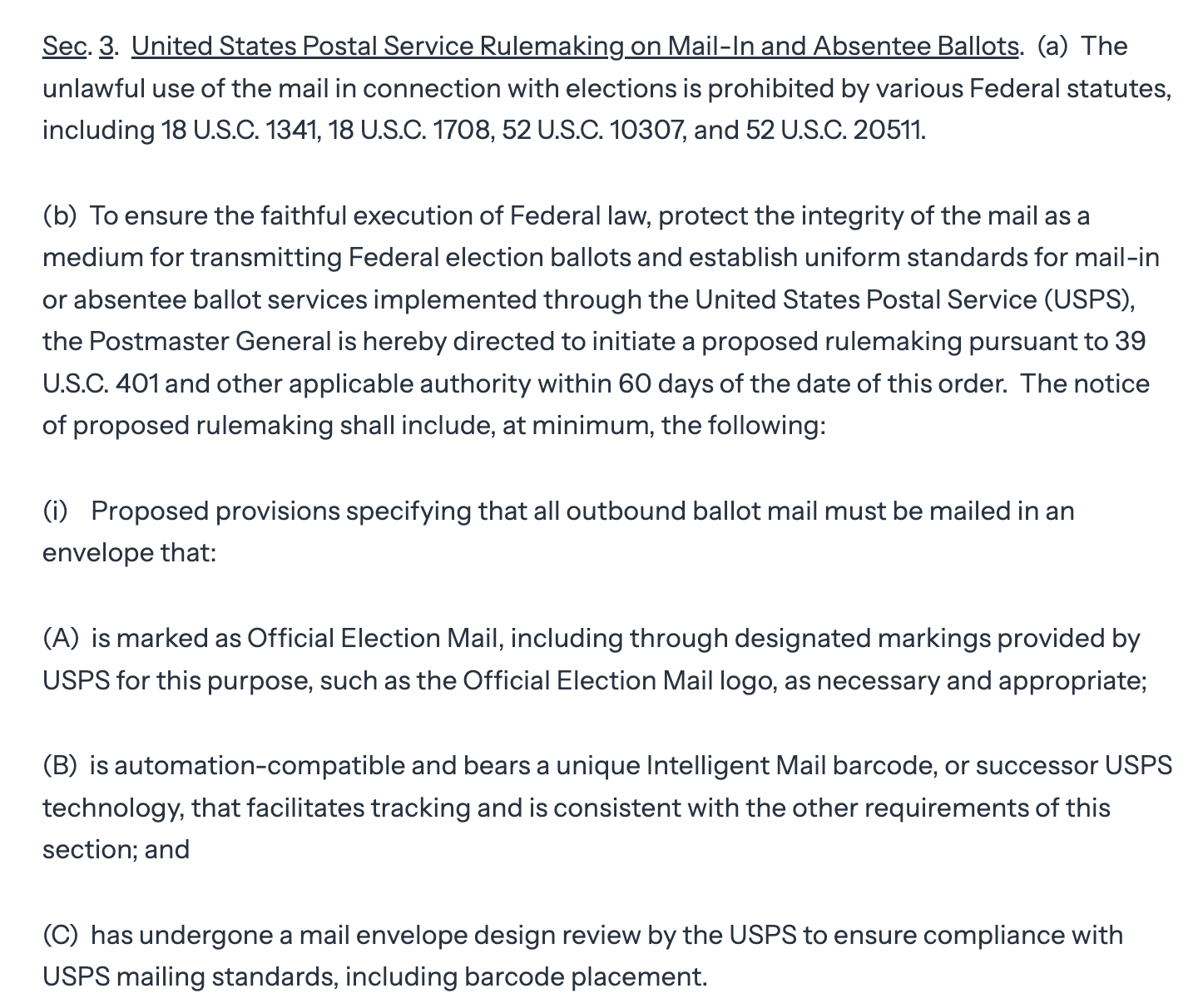
NOTUS is reporting that meetings are being held, out of the public eye, between the White House, DOJ, DHS, and the Postal Service to try and interfere with the election. The goal seems to be building a national voter database that can then be used to determine who can and can’t vote—which is up to the individual states—and implement Trump’s order that the Post Office should interfere with mailing ballots.
The report in NOTUS included comments from an unidentified White House staffer speaking on background, who declined to acknowledge that the conversations were taking place, but did say that “it is standard process for administration officials to coordinate on implementing President Trump’s executive orders. We do not comment on private meetings that may or may not have happened.” That’s as good as a yes.
Trump’s executive order directing USPS to interfere in state-run elections is under challenge in court. At a hearing last week, DOJ argued that the court can’t act because the issue being raised is an “abstract legal question unless and until the Postal Service actually issues a rule that injures the plaintiffs and it does so only because it was directed to by the president — rather than, for example, as an exercise of the agency’s own independent judgment.” Judge Carl Nichols seemed inclined to buy that argument at one point in the hearing, asking how there could be irreparable injury, which he must find before he can enjoin the executive order, when no action has been taken as of yet. But at other points in the hearing, he pushed the government on the constitutionality of the president’s executive order.
We’ll watch carefully for a forthcoming ruling in this case, which will tell us a lot about whether the courts will entertain presidential interference in each state’s administration of its own election. But the White House is making its position clear.
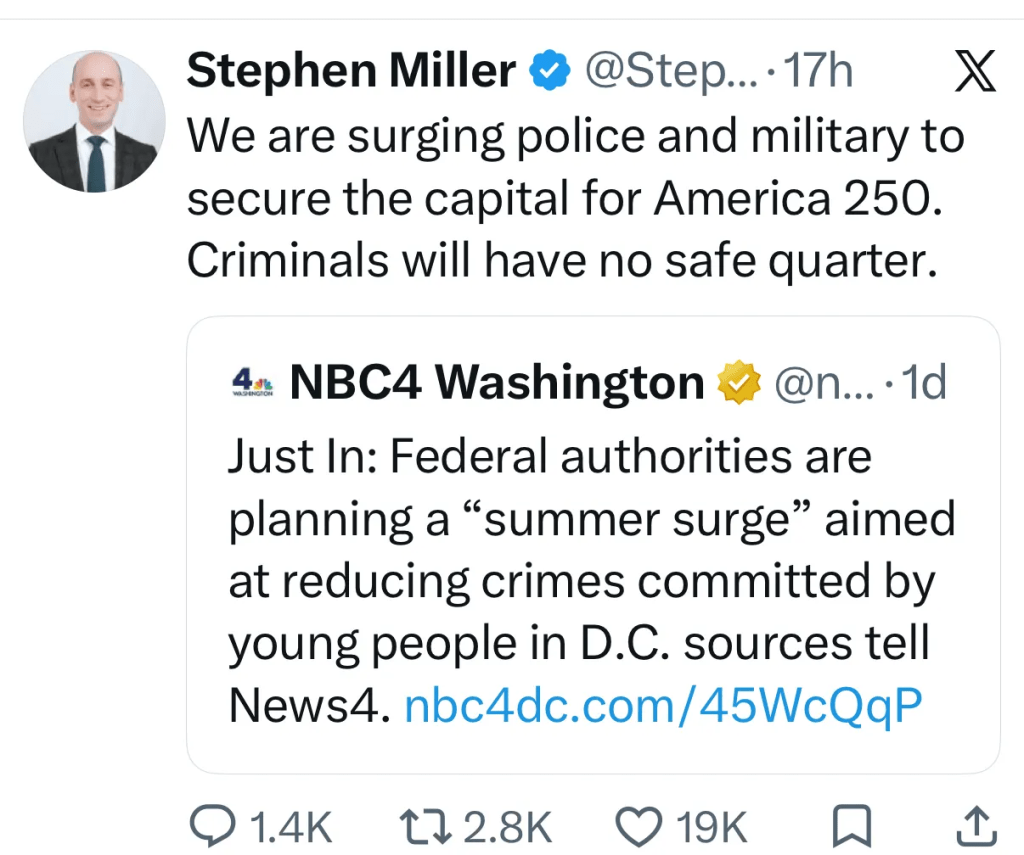
Stephen Miller, who it’s always worth noting is not a lawyer and doesn’t seem to appreciate what the Constitution says, seems to be continuing to look for a new way to militarize the country for reasons that don’t hold water in advance of the election. We’ll take up the issue of the illegality of sending federal troops or federal agents to the polls first breather we get.
Also …
On Wednesday, the state of Tennessee has a court date to defend itself against the NAACP’s allegations that it cannot, without violating state law, redraw its voting maps this late in the decade.
On Thursday, SCOTUS will be issuing more opinions.
By Friday, the Government has to produce discovery to the defendants in the Minnesota church protest case against Don Lemon and individual protestors who were indicted for violating the FACE Act. A judge ruled that heavily redacted discovery that prevents the defendants from identifying witnesses, including members of law enforcement, so they can prepare their cases violates the law. He has given the government until Friday to rectify its errors and “produce discovery consistent with its Rule 16(a) obligations, unredacted as to all victim and witness names, addresses, and telephone numbers; as well as fully unredacted as to law enforcement PII [personally identifiable information]” to every defendant who has agreed to abide by a protective order preventing its public dissemination. The government’s case has been widely viewed as likely violating the First Amendment from the outset.
Next up on the list of bad cabinet secretaries
Agriculture Secretary Brooke Rollins is being sued for violating employees’ right to be free from establishment of religion by the government. She’s been proselytizing in emails to the captive audience that is her workforce.
I recall once handling a case where a public employee was being subject to far less overt religious commentary, and the government agency immediately conceded error and fired the offender. This case is even more clear. Government employees are not disciples of Christ.
In new federal lawsuit, employees accuse Agriculture Secretary Brooke Rollins of "sending increasingly proselytizing communications to the entire USDA workforce, promoting her own preferred brand of Christian beliefs and theology to the captive audience of employees"
But don’t hold your breath for the president to fire her. This was a weekend characterized by a full-scale display of support for Christianity being promoted by the White House. The administration held a “Rededicate 250,” which many observers, both approvingly and disapprovingly, referred to as a Christian religious service featuring high-ranking government officials on the National Mall.
Rededicate 250 was “a White House-backed prayer festival dedicated to America’s Christian roots.” Trump gave a video speech. Speaker Mike Johnson, Secretary of Defense Pete Hegseth, and Secretary of State Marco Rubio were present, standing with evangelical leaders on the stage. Johnson told the crowd, “Our founders boldly proclaim that our rights do not derive from the government. They come from you, our Creator and Heavenly Father.”
Podcaster Brian Allen posted this snippet from MAGA radio host Eric Metaxas’ speech at the federally funded prayer event on the National Mall today: “It’s hard to believe that it would take two centuries for the Lord to raise up a great man to bring that ballroom finally to stand where it needs to stand. It’s extraordinary. We only had to wait two hundred years.”
As Allen put it, Metazas “told a crowd of thousands of Christians that God spent two centuries waiting to raise up Donald Trump — to build a ballroom.” The crowd responded by cheering.
The only way to overcome this sort of thing, a clear violation of the Constitution, is with a relentless commitment to telling the truth and sharing it widely. We know from Trump’s poll numbers that some of it is breaking through. The utter lunacy of the Christian God wanting a ballroom is something to ask people to stop, and instead of just following like sheep, spend a moment thinking about.
More Kleptocracy
Bloomberg is reporting that Trump’s disclosure forms for the first quarter of 2026 show that he made 3,600 Stock trades, and that they are worth as much as $750 Million (the reporting is done in bands, so it’s impossible to determine the exact amount from the forms). Former Undersecretary of State Rick Stengel pointed out that Bush and Clinton kept their assets in a blind trust and neither Obama nor Biden traded stocks or bonds while in office.
“3,700 trades,” Stengel tweeted, “is probably more than all the trades of all the presidents until now. And he is trading stocks that are affected by his decisions. A walking conflict of interest, at the least, and perhaps insider trading. Just as members of Congress should not be able to trade stocks, so too the president.” Stock trades aren’t official acts; they’re clearly personal ones. Stengel has certainly identified reasons that merit a closer look at these trades.
So, lots happening this week. We’ll be here through everything as we head into the Memorial Day weekend, trying to make it make sense. I’m grateful to all of you who spend part of your week here with me, thinking carefully about the law, democracy, and where we go from here. Thank you for being a part of Civil Discourse.
The mid-decade fight to redraw congressional lines ahead of the November midterm elections has surged beyond statehouses and into ballot boxes and courtrooms – with millions of dollars pouring in to shape those outcomes, much of it from nonprofits that never have to say who is funding their activities.
Voters in California and, most recently, Virginia have weighed in on new House maps. A Colorado group wants to put its own proposal before voters. Missouri petitioners are trying to stop a new map from taking effect. And lawsuits are stacking up from Florida to Utah.
One through-line: dark money from 501(c)(4) nonprofits. Free from donor-disclosure rules, these groups move large sums with little transparency and have helped turn state-by-state redistricting battles into nationalized, big-dollar fights bankrolled by tight networks of high spenders.
“It’s a perfect example of where money is trying to influence policy outcomes, and redistricting is so high-stakes that now it’s just part of the process,” said Alex Keena, an associate professor of political science at Virginia Commonwealth University who has co-authored two books about redistricting.
What began last year with President Donald Trump urging Texas to redraw its map has now gone national, fueled by a surge in dark money that “perfectly encapsulates what’s happening here,” said Doug Spencer, a law professor at the University of Colorado.
“Every single story really feels like a domino in a long chain of events that goes back to President Trump’s cajoling of Texas to start this,” Spencer told OpenSecrets.
‘A tsunami of money’
The latest epicenter of the redistricting fight was Virginia, where voters in April approved a mid-decade redistricting plan that could have helped Democrats win four additional House seats in November. The measure would have bypassed a bipartisan redistricting commission and allowed the state to use new districts drawn by the Democratic-led General Assembly. The state Supreme Courtblocked it on May 8, declaring it unconstitutional because of a procedural timing dispute. Democrats filed an emergency appeal to the U.S. Supreme Court on May 11.
Virginia, which has no limit on campaign donations, is “basically the wild, wild west in terms of campaign finance,” said Kyle Kondik, managing editor of Sabato’s Crystal Ball, a political newsletter run out of the University of Virginia. The three key players in this ballot measure fight combined to raise nearly $100 million since February in large cash contributions alone. The Virginia Public Access Project found it to be the most expensive referendum in state history.
“This was the confluence of all of these variables that resulted in just a tsunami of money in a state with lax regulation, high stakes, a single vote involving redistricting that could lead to four or even five new members of Congress,” Keena told OpenSecrets. “And we just had a ton of money flow into the state in a relatively short amount of time, and the result of all that money was just a blitz coming from every medium.”
And on both sides of the debate, the vast majority of that money came from a handful of dark money groups. window.addEventListener(“message”,function(a){if(void 0!==a.data[“datawrapper-height”]){var e=document.querySelectorAll(“iframe”);for(var t in a.data[“datawrapper-height”])for(var r,i=0;r=e[i];i++)if(r.contentWindow===a.source){var d=a.data[“datawrapper-height”][t]+”px”;r.style.height=d}}});
Virginians for Fair Elections, the main organization backing the redistricting effort, reported $63.2 million in large cash contributions, defined as any single contribution or loan of at least $10,000, between Feb. 6 and April 24. Nearly 97% of that total came from five 501(c)(4)s:
House Majority Forward, which is aligned with Democratic leaders in the U.S. House of Representatives, contributed $39.3 million across 10 installments from Feb. 6 to April 10, the largest of which was $9.3 million on March 30.
The Fairness Project, founded by a California-based healthcare workers union, contributed $11.7 million across five payments from Feb. 18 to April 9, including a $5 million contribution Feb. 18, in addition to $22,950 in in-kind contributions.
The Global Impact Social Welfare Fund, the 501(c)(4) arm of philanthropic organization Global Impact Ventures, donated $1.5 million across two contributions.
The same structure appeared on the opposition side. window.addEventListener(“message”,function(a){if(void 0!==a.data[“datawrapper-height”]){var e=document.querySelectorAll(“iframe”);for(var t in a.data[“datawrapper-height”])for(var r,i=0;r=e[i];i++)if(r.contentWindow===a.source){var d=a.data[“datawrapper-height”][t]+”px”;r.style.height=d}}});
The Virginians for Fair Maps Referendum Committee, which formed Feb. 9, reported $24.1 million in large contributions between March 2 and May 1. One organization – Virginians for Fair Maps, which shares a post office box in Alexandria with the committee – accounted for 98% of it. State records identify the group as a tax-exempt organization, but there is no corresponding listing for it or its classification in the IRS online database. Co-chaired by former House Majority Leader Eric Cantor (R-Va.), it donated $23.5 million across nine contributions from March 6 to May 1, a sum that includes $5 million contributions on both March 31 and April 7 along with $4 million on April 6.
“There’s a real question. … Who’s actually trying to influence our election, and to what end?” Keena said. “What are they hoping to get out of it and whose interests are hanging in the balance?”
Donor networks in multiple states
Some of those groups also spent big on similar efforts in other states.
Coloradans For a Level Playing Field wants a new House map for the 2028 and 2030 elections before allowing the state’s independent congressional redistricting commission to draw another one for 2032 based on the 2030 census. Under the plan, Democrats would be favored to win seven of the state’s eight House seats.
According to its May 4 report, the organization raised $246,747 between Feb. 18 and April 29. Two of the key donors in Virginia also supplied more than 97% of the Colorado group’s total: House Majority Forward contributed $150,000 on Feb. 25, and the Fairness Project provided $90,000 on April 29. Of the 149 other cash donations made during that time, 148 averaged just $32.
That breakdown reflects the uneven appetite for redistricting in the state, Spencer said. Sometimes, it draws attention; other times, he said, “it really feels like it’s gone by the wayside – or, at least when you dig underneath, you don’t see a big push or a lot of local money.”
And in Missouri, the Democratic-supported group People Not Politicians, which opposes the state’s new GOP-drawn map, in December submitted more than 300,000 signatures for a petition seeking to block the map from being used. In its April 14 campaign finance report, it reported raising $6.1 million during the cycle. Of that total, $1.7 million came from American Opportunity Action, a Democratic-aligned dark money group supporting ballot measures. Additionally, the Fairness Project donated $250,000 on Nov. 17, 2025, along with four $1,000 payments in late 2025 and early 2026 for “strategic guidance.”
“I think, to the layperson, this all just looks like gerrymandering,” Spencer said. “But up close, every state’s doing this slightly differently.”
Massive spending around California’s Prop 50 fight
The biggest spending took place in California – where more than a quarter of a billion dollars was poured into its redistricting measure.
Voters in a November 2025 special election passed Proposition 50, which responded to the Texas redistricting push by redrawing the map used in the 2026 midterms and in 2028 and 2030. It generated more than $256 million in fundraising from both sides combined. Roughly two-thirds came from groups supporting the measure, and 87% of that $171 million came from two organizations, both of which have received noteworthy contributions from dark money groups:
Democratic Gov. Gavin Newsom’s Ballot Measure Committee raised more than $102 million through Nov. 3, 2025. The Fund For Policy Reform provided its largest single contribution, $10 million on Sept. 18, 2025..
HMP for Prop 50, the House Majority PAC, raised $46 million. That group’s largest single contribution in 2024 ($34 million) came from House Majority Forward, which also contributed $11.2 million in late 2025, according to Federal Election Commission filings.
On the opposition side, two organizations combined for an even higher share of the spending – 92% of the $84 million that flowed into the race.
The No on Prop 50 Congressional Leadership Fund raised $44.3 million. That group received four separate $10 million donations in 2024, from hedge fund founder Ken Griffin, Aon founder Patrick Ryan, Mellon banking heir Timothy Mellon and Blackstone CEO Stephen Schwartzman. Billionaire megadonor Miriam Adelson donated $10 million on March 11, according to the FEC.
Protect Voters First reported $32.8 million, with Charles Munger Jr. – a physicist and the son of a late billionaire – loaning the organization nearly the full amount.
“It does not seem like the states themselves have been going out of their way to clamor for this,” Spencer said. “California responded to Texas. Texas was responding to Trump.”
How dark money fuels the legal fights
While some states decided redistricting questions in the voting booth, others are fighting the same battles in courthouses – and some groups funding those fights are just as nationalized, donor-driven and opaque.
The National Redistricting Foundation has partnered with the left-leaning Elias Law Group in suing to challenge Florida’s new map. It filed a legal brief urging the Supreme Court to reject Alabama’s request to fast-track its redistricting case and filed a motion to intervene in Utah’s.
The foundation is the 501(c)(3) nonprofit arm of the National Democratic Redistricting Committee. As a 527 organization, it is tax‑exempt and may spend unlimited amounts on issue advocacy. It is chaired by former Attorney General Eric Holder, and in 2018 it received $2.6 million from Soros. Its largest contribution in the 2024 election cycle, the most recent available to OpenSecrets, was $500,000 from PAC to the Future, former House Speaker Nancy Pelosi’s leadership PAC. The committee also provided nearly $20,000 in in-kind contributions to the pro-redistricting group in Virginia.
The foundation makes up one part of an apparatus that also includes the National Democratic Redistricting PAC and a 501(c)(4), the National Redistricting Action Fund. The PAC raised $423,000 in the first quarter of 2026, has raised $2 million during the current election cycle and had $250,000 in cash on hand, according to FEC documents. The 501(c)(3) foundation reported $9.7 million in contributions and grants in 2023, according to its most recent IRS filings, but does not identify those donors. Neither does the action fund, whose latest IRS filing shows $5.2 million in total revenue in 2023 – and the same Washington address as the foundation.
A similar structure is in place at the nonpartisan Campaign Legal Center, a 501(c)(3) nonprofit that on May 4 joined the UCLA Voting Rights Project in suing Florida over its redistricting plan. It has also moved to intervene in the Utah case. It shares a Washington address with Campaign Legal Center Action, a 501(c)(4) dark money nonprofit.
Campaign Legal Center’s most recent IRS documents show $13.9 million in total revenue in 2024, with most coming from contributions and grants, and $36.7 million in net assets. But its donors are not identified. Campaign Legal Center Action also does not disclose donor names on its IRS filings.
On the Republican side, the American Redistricting Project – a 501(c)(3) also known as Fair Lines America Foundation Inc. – has been active in redistricting debates in recent years. Its most recent IRS filing shows roughly $1.9 million in both revenue and expenses in 2024. It maintains an online repository tracking redistricting legislation, but it is unclear whether the organization is providing financial support or filing motions in the current legal fights. OpenSecrets reached out to the group but did not immediately receive a response.
This article was originally published by OpenSecrets, a nonpartisan, nonprofit organization that tracks money in politics. View the original article.
Last summer, journalist turned comedian Charlie Berens started getting social media messages from concerned Wisconsin residents about plans for a massive datacenter campus in their state.
The developer, Vantage Data Centers, claimed the $8 bn project would largely run on zero-emission energy resources like solar, wind and battery storage. The company said the campus would bring thousands of temporary construction jobs and potentially more than 1,000 permanent jobs to Port Washington, a city of 13,000 people about a half-hour north of Milwaukee. Residents opposed the project for what they said was lack of transparency and criticized the lucrative tax incentives offered to Vantage. They worried about the strain on local water and energy sources from an enormous 1.3-gigawatt project that could ultimately span 1,900 acres.
Berens, who shot to internet fame with his “Manitowoc Minute” videos that play on midwestern quirks and stereotypes, had his own reservations about the artificial intelligence datacenter boom. A Milwaukee-area native who still lives in the city, he’d heard about the potential environmental hazards, the steep rise in energy costs for neighbors and noise pollution, among other risks.
When he Googled, he found that lawmakers in his state had paved the way to make the Port Washington project a reality. The deal between Port Washington and Vantage gave an estimated $458m in tax breaks to the developer over 20 years to fund infrastructure for the project,with the city not seeing any of that tax revenue during that period.
“It was shocking,” Berens said.
That’s when he decided to do something he had rarely done before: discuss politics in his videos. He used his platform to address one of the more polarizing issues in contemporary life: what AI portends for Americans.
In August 2025,Berens published his first “Manitowoc Minute” video on AI datacenters.The two-minute skit matched the typical style of Berens’s videos, where he intersperses facts with humor in the style of a TV news report. But he was remarkably direct in his critique of big tech. Sporting a Green Bay Packers tie, he lambasted Silicon Valley CEOs, accusing them of using Wisconsin as a “dumping ground” for datacenters at the expense of the state’s cherished natural resources while evading any type of public scrutiny.
“It is our civic duty to make sure the billionaires become trillionaires,” said Berens in a satiric bit.
He channelled his outrage at lawmakers in Port Washington, a historic city on the banks of Lake Michigan and once home to thriving fishing and shipping industries. In a contentious vote last August, officials there approved the initial $8bn datacenter campus despite strong resistance from residents. (The project later expanded to a $15bn joint venture with OpenAI and Oracle, one of the Trump administration’s showcase “Stargate” megaprojects.)
“I was shocked at how many people I saw speak against this [at public meetings he watched online] and then to see a unanimous vote for it,” Berens said. “It just felt like an imbalance of democracy.”
The video went viral, garnering more than 2.5m views on YouTube alone. Berens’s inbox was soon flooded with messages of support from Wisconsinites of all political stripes – self-declared Maga supporters, avowed socialists and everyone in between – sounding the alarm on datacenters.
“It was 99% positive comments, which doesn’t happen on anything these days,” said Berens. “From that point, I decided that I should do more because nobody’s negotiating for the people here.”
Berens has since thrown himself into the cause, routinely publishing videos and headlining well-attended events with field experts and anti-datacenter activists. He has quickly become the most famous face of a burgeoning movement in Wisconsin, where resistance to these projects – Port Washington is just one of seven hyperscale datacenter projects across the state– has risen dramatically in the last year. A March survey from Marquette University Law School found that nearly 70% of registered voters in Wisconsin say the costs of large datacenters outweigh the benefits they provide, a remarkable shift from last October when that figure stood at 55%.
The attention has placed the comedian in the crosshairs of most of the state’s labor unions, pro-business groups and much of its political establishment, who argue the badger state cannot afford to be left behind in the AI arms race.
In a series of interviews, Berens laid out why he decided to jump head-first into the movement; his case for how big tech destroyed public trust through hard-armed, often secretive tactics to push forward datacenters; and what he has learned as he has crisscrossed the state and toured the country.
“Every step of the way, the more people look, they’re seeing that this is not really a fair fight here,” said Berens.
‘Protecting the people’
On a late winter evening in March, hundreds of people packed a community center in Juneau, a tiny rural town about 45 miles north-east of the state capital, Madison.
The crowd had assembled for a “people’s town hall” to address a $1bn Meta datacenter that has pitted residents of nearby Beaver Dam against their elected officials. The featured speakers ranged from community activists to a former Meta employee. The main act was Berens, who squeezed in the appearance between stops in Iowa and Vermont on his standup comedy tour.
“This is the most bipartisan issue since beer,” he said in opening remarks.
Construction is ongoing at the Beaver Dam Commerce Park where a new Meta datacenter is being built on 2 February 2026 in Beaver Dam, Wisconsin. Photograph: Wisconsin Watch/Getty Images
In his roughly 15-minute speech, he called for more regulation of AI, pointing out that a beloved Wisconsin staple, bratwurst, was more heavily regulated than the trillion-dollar industry. Berens warned the audience of the risks of AI technology, running through a slideshow of news headlines that highlighted the potential, and very real, harm to children. He also addressed his critics.
“I will stick to comedy when our politicians stick to policy and stop protecting big tech and start protecting the people that put them into office,” said Berens, to applause.
As he turned his attention to the project in Beaver Dam, he attacked Meta’s use of a shell company and nondisclosure disagreements (NDAs) that required secrecy from some public officials in the process of getting to an approval. In April 2025, a report found Meta was the mystery tech company behind Degas LLC, the listed corporation on the development. By November, the company acknowledged they were behind the project.
Meta’s practices in Beaver Dam are part of a larger pattern across the state, where datacenter projects have often been developed in secrecy despite their huge price tags and massive footprint on communities. A recent investigation from Wisconsin Watch, a non-profit news site, found that NDAs have been signed in at least five cities in Wisconsin where AI datacenters are proposed or under construction.
Another panel speaker that night was Maily Kocinski, a lifelong Beaver Dam resident whose farm lies less than 2 miles from the 700,000 sq ft datacenter campus construction site. Last June, she posted a TikTok video after a creek that runs on her property had gone dry one morning. The water came back, but occasionally appeared milky white and gave off a toxic smell. Kocinski said she contacted the state’s department of natural resources on several occasions and was told the agency collected water samples but were not always able to reach her property in time before the water cleared up again.
She personally commissioned a water analysisin February from a lab at the University of Wisconsin-Stevens Point, which found metal levels in her well water above what was considered safe to drink, per recommendations from the Wisconsin department of health services. She questions whether the daily controlled blasts on the construction site led to disruptions in her water supply. Meta commissioned its own study in response, denying any link.
A spokesperson for the Wisconsin department of natural resources confirmed that the department collected a water sample at Kocinski’s creek last November. The results, shared with the Guardian, show elevated metal levels but the department did not speculate as to the potential cause.
“Without a site specific review, the DNR cannot speculate on the role of the blasting on the aquifer and Ms. Kocinski’s private water supply,” the spokesperson said in a statement.
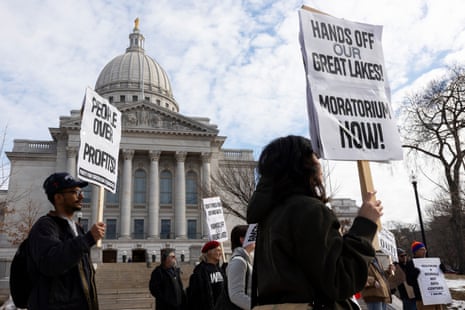
Protesters gather for a statewide datacenter day of action at the Wisconsin state capitol on 12 February 2026 in Madison, Wisconsin. Photograph: Wisconsin Watch/Getty Images
Kocinski, an elementary school teacher, saidsince last fall, she has spent up to 15 hours a week researching the large-scale construction of datacenters and the potential environmental harms they can wreak in a community. In March, she testified in the Wisconsin senate in favor of a datacenter oversight bill that ultimately failed to reach a vote.
She said she had never met Berens before the event in Juneau but the two had been in regular contact for months after she cold-emailed him her story.
“Charlie has really put in the work to understand this issue,” said Kocinski. “Most people came to Juneau probably because he was there, but they stayed and maybe learned a bit about these things [datacenters] … That kind of education leads to action.”
The risks of speaking out
As Berens’s critiques of datacenter projects in Wisconsin have gained traction with the public, he has faced pushback from the state’s trade unions, who welcome the thousands of temporary construction jobs that typically come with a project.
A major Wisconsin labor leader called out Berens in a December op-ed in the Milwaukee Journal Sentinel. “For us in the building trades, data centers aren’t some big, scary mystery,” wrote Emily Pritzkow, head of the Wisconsin Building Trades Council that represents nearly 50,000 workers in the state. “They’re high-skill, long-term work. The kind of work that feeds families, pays mortgages, and sends kids to college.”
Local governments have weighed in too. In Port Washington, city officials posted a “fact sheet” online to “clarify some lingering misconceptions” after Berens posted a second video urging residents to question officials about the datacenter project at an October council meeting.
Ted Neitzke, Port Washington’s mayor, expressed frustration with the attention that Berens’s videos had brought his city. He noted that more than 100 people began showing up at council meetings after the comedian published his first video last August, forcing the city to move them to a hotel conference center with an added police presence.
“After Charlie Berens’s video, things escalated very rapidly, very contentiously, and our city was besieged with people from outside of our town,” said Neitzke. “Charlie Berens created chaos for us.”
Neitzke also challenged some claims Berens has made in his videos, including those about the amount of jobs the project would create, its environmental impact and whether residents’ power bills would increase.
“I don’t know where the line gets drawn between factual and embellishment for him,” said Neitzke. “There’s a very gray area between the entertainment and the facts.”
Berens defended his videos and the people who showed up to council meetings in response, noting that a hyperscale datacenter affects not just one city but the surrounding communities and “they deserve a say too”. He maintained that his videos were well-researched and cited news articles to back up his claims.
“I informed people about a massive AI datacenter going up by adding some punchlines,” said Berens. “If the truth brings chaos, that seems like something the mayor would want to take accountability for.”
Neitzke met with Berens last fall in an attempt to find common ground. The mayor described the two-hour meeting as cordial but both left in disagreement. He has been the project’s greatest champion, referring to it as a “transformative” development for the Rust Belt city, one that has the potential to once again make Port Washington a hub in the midwest.
That stance has drawn some fierce public opposition, even leading to an attempted recall effort over the $458m tax incremental finance, or TIF, district with Vantage. Under the deal, Vantage will pay upfront costs for the development and the city will reimburse the company with new property tax revenues over a period up to 20 years. Neitzke said he was no fan of TIFs but called them a “necessary evil” in negotiations to win the contract over other cities chasing major developments to boost revenue.
“This is a save our city strategy,” said Neitzke. “[Berens is] doing what he does, and we’re going to do what we’re doing.”
Berens has also faced criticism online from those who say the comedianhas built his career on tech platforms, while looking to close the door to their projects in Wisconsin. He said he “understands the irony” but wants to use his sizable platform to educate his audience on these types of developments that could remake their communities.
Berens engaging with his audience on stage. Photograph: Todd Rosenberg
Advertisers, too, have noticed his shift to politics. Berens acknowledged that he lost a major brand deal with a company that did not want to appear alongside his anti-datacenter content, though he declined to name the business.
“I’m asking for transparency. I’m asking for honesty. I’m asking for people to get informed,” said Berens. “I’m trying to facilitate that and if that at the end of the day means I lose everything, then so be it.”
A personal evolution on AI
Berens was not always an AI pessimist.
A few years ago, he believed the utopian vision laid out by AI luminaries like OpenAI’s Sam Altman, who spoke of how the technology could be used to cure social ills, even to treat intractable diseases. Berens thought maybe it could also help Wisconsin deal with its Pfas contamination issue. “My interest in AI started with a lot of hope and optimism actually,” he said.
That sentiment eventually turned to cynicism as, he claims, the industry’s billionaire CEOs dispelled any virtuous use of the technology for the social good in favor of enriching themselves and their investors. He cited Altman’s recent efforts to create an Erotica feature in OpenAI’s ChatGPT chatbot, despite concerns even from the company’s advisers that such a tool could create a “sexy suicide coach”, according to a Wall Street Journal report.
“I thought this thing was supposed to cure cancer,” Berens said, referencing Altman’s past statements. “Is this what we’re giving our land for? Is that what we’re giving our water for? Is this what you’re asking to change our communities for?”
For him, the “tip of the iceberg” was the gold rush to build hyperscale datacenters in his state through secretive tactics and potentially exploitative agreements in post-industrial cities longing for an economic revival.
“Wisconsin created an environment that would please the billionaire tech companies,” said Berens of the tax incentives. “Billionaire tech companies took full advantage of that.”
Prescott Balch knows a bit about those types of corporate tactics. A former technology executive at US Bank turned anti-datacenter activist in retirement, Balch was on the frontlines of the successful effort to stop a major Microsoft AI datacenter project last fall in the picturesque eastern Wisconsin village of Caledonia, where he lives. In April, he won a seat on the town’s village board, beating an incumbent who supported the datacenter. He views the AI datacenter boom as akin to the dot-com bubble crash of the early 2000s, another chapter in the boom-and-bust cycles of the volatile tech industry.
“We got irrationally exuberant and built too much stuff,” Balch said of the dot-com period. “Maybe the company running your datacenter will go bankrupt. This big dollar amount that you’re chasing comes with significant risk.”
Balch’s insider expertise in the wonky world of municipal subsidies has been fundamental for Berens. Balch factchecked many of Berens’ videos on the issue, even appearing in one where he methodically crunched the numbers on thesedevelopments, referring to the Port Washington project as “up and down a horrible deal”.
The 62-year-old is, in many ways, the polar opposite of Berens. He is professorial in demeanor and careful to point out that he is not an AI alarmist. Where the two agree is a belief that there’s been an information vacuum around these projects, leaving the public largely uninformed abouttheir size and scope. That’s part of the message they have taken on the road, appearing together at events in Wisconsin and Illinois. Berens’s celebrity has been the draw for people to turn out.
“[He] gets people interested in the topic and warms them up,” Balch said. “And I get to do the dry delivery of the financial perspective.”
Port Washington vote
On 7 April, Port Washington residents passed the nation’s first anti-datacenter referendum. By a roughly 2-1 margin, voters approved a measure that would require city officials to get approval from voters before approving tax incremental districts of more than $10m.
An aerial view of Port Washington, Wisconsin. Photograph: Lena Platonova/Shutterstock
The effort came together after a group of residents called Great Lakes Neighbors United gathered more than 1,000 signatures in less than two weeks to get it on the ballot. The referendum does not stop the $15bn datacenter campus under construction, but would apply to all future projects above that $10m threshold. Industry advocates have warned the vote could set a dangerous precedent for municipalities across the country, potentially paralyzing AI datacenter developments.
Mayor Neitzke said the referendum makes the city less competitive and puts it at a disadvantage to vie for future projects. For Berens, the vote reflected the energy he has seen on the ground in Port Washington and in every corner of the state.
“The people who are the heartbeat of this movement are like people in Great Lakes Neighbors United,” said Berens. “These are people from all different walks and all different political stripes, but they all care about the same thing: [that] their community should have a voice.”
I can’t get the entire article here; I think I used up all my NYFT freebies for life back in 2004. However, I got a blurb, and because it’s pertinent to our interests, I’m still posting the link for anyone who’d like to see the story. It’s surprising, as is the story after this one.
TOPEKA — A few spaces are exempt from Kansas’ new bathroom law that requires people to use the facilities in government buildings that match their sex assigned at birth, Attorney General Kris Kobach said in an opinion he released Wednesday.
Kobach’s opinion, which carries no legal authority, exempted some government spaces — such as skilled nursing rooms at the Kansas Office of Veterans’ Services — from complying with the bathroom law that went into effect in February.
He issued the opinion in response to an April letter from Justin Whitten, Gov. Laura Kelly’s chief counsel, who asked for clarification on defining “multiple-occupancy private spaces” and “facilities” as written in Senate Bill 244.
“This was a poorly written and ambiguous law, which is why the governor’s office sought an attorney general opinion,” said Olivia Taylor-Puckett, spokeswoman for Kelly. “The AG’s opinion provides new clarity on the more limited scope of SB 244 as inapplicable to places that are more ‘residential in character’ like a cabin or hospital room.”
The bill became law in February after passing through contentious legislative debate, including a veto from Kelly that was overturned. At the time, Kelly questioned vague language in the bill and how it would apply to some state facilities.
The law sets high fines for agencies that fail to comply and smaller fines escalating to class B misdemeanors for those who violate the law. Critics said the law doesn’t specifically address implementation, leaving agencies statewide struggling to determine what to do to comply.
In an April letter, Whitten asked Kobach to render an opinion on whether spaces like hospital rooms, prison cells and bedrooms in public buildings are considered “multiple-occupancy private spaces” under the law.
The letter asked for definition of “facilities,” and whether Kansas Department of Wildlife and Parks cabins throughout the state and Kansas Office of Veterans’ Services nursing facility rooms must adhere to the law.
“SB 244 makes no distinction based on a ‘facility’s’ purpose and instead focuses on the existence of a mere possibility of whether an individual may be in a state of undress in front of another individual,” Whitten’s letter said.
Arguments that the hospital is the “facility” rather than the patient room are “untenable,” he said. The hospital building would fit under the law’s definition of a public building, while the room would be the private space, Whitten said.
“If your answer relies on finding an ambiguity in Senate Bill 244 with the term ‘facilities,’ we ask that you work with the Legislature in the 2027 session to clarify this ambiguity,” he said.
Kobach’s opinion
Citing a dictionary definition of “facility” and saying that “in the absence of a contrary definition, words in a statute should be given their ‘ordinary, contemporary, common meaning,’ ” Kobach said neither the skilled nursing rooms or the Kansas Department of Wildlife and Parks rental cabins meet the definition of “facility,” which exempts them from the law.
Kobach said SB 244 listed examples of rooms the bill applies to.
“The debate surrounding SB 244 focused on the types of rooms listed in the statute — restrooms, locker rooms, changing rooms, and shower rooms — and the risks to safety and privacy when individuals of one biological sex use facilities designated for individuals of the opposite biological sex,” his opinion said.
Kobach said the Legislature’s intent didn’t include stopping a married couple from sharing a nursing home or assisted living facility room or to prevent people in those facilities from receiving guests of the opposite sex.
Prison cells, however, more closely match the type of facilities addressed in the law, Kobach said, which means multiple-occupancy cells must only be shared by prisoners of the same sex.
Taylor-Puckett said attorney general opinions are generally given “persuasive but not binding weight in a courtroom.” She recommended that individuals and entities should consult with their attorney with regard to any decisions about complying with SB 244.
‘Poorly drafted’
Harper Seldin, senior staff attorney for the American Civil Liberties Union, said he was glad to see some spaces exempted from the law but that the opinion reinforced what civil rights activists contended from the beginning: The vagueness of the law makes it difficult to enforce and understand.
“This uncertainty about whether people just living their lives are going to run afoul of this law, I think demonstrates both that the law was meant to terrorize and also that it’s poorly drafted,” he said.
Some Kansans and legislators objected to SB 244 being termed an “anti-trans” bill. But Seldin said the interpretation reinforces that it is a bill targeted at transgender and intersex people.
“These interpretations really continue to try to find ways to push transgender and intersex people out of public life, while making sure that people who aren’t transgender don’t feel any disruption whatsoever,” he said. “It does seem to very strongly suggest that this law was really targeted at transgender people and is not actually responsive to any concerns about safety or privacy.”
Seldin said any concerns about safety and privacy aren’t related to reality in Kansas.
Seldin is representing two Lawrence transgender men who are challenging the bathroom law in court, with the next hearing scheduled for Sept. 29 through Oct. 2. That will be an evidentiary hearing regarding the ACLU’s request for a temporary injunction of the law, Seldin said.