I love dogs and people. I want living creatures to thrive. I love to cook, and share the food, but ya gotta get in line in front of the dog, and greatest good luck with that!
April 21, 1856 Stonemasons and other construction workers on building sites around Melbourne, Australia, stopped work and marched from the University of Melbourne to Parliament House. They advocated eight hours for work, eight hours for recreation, and eight hours for rest. Their direct action protest was a success, becoming the first organized workers in the world to achieve an eight-hour workday, inspiring the celebration of Labor Day and May Day.
April 21, 1989 Six days after the death of Hu Yaobang, the deposed reform-minded leader of the Chinese Communist Party, some 100,000 students from more than 40 universities gathered at Beijing’s Tiananmen Square to commemorate Hu prior to his funeral.They voiced their discontent with China’s authoritarian communist government, and called for greater democracy. Ignoring government warnings of violent suppression of any mass demonstration, the students were joined by workers, academics, and civil servants. Pro-democracy student protesters face-to-face with policemen outside the Great Hall of the People in Tiananmen Square the day of Hu Yaobang’s funeral.
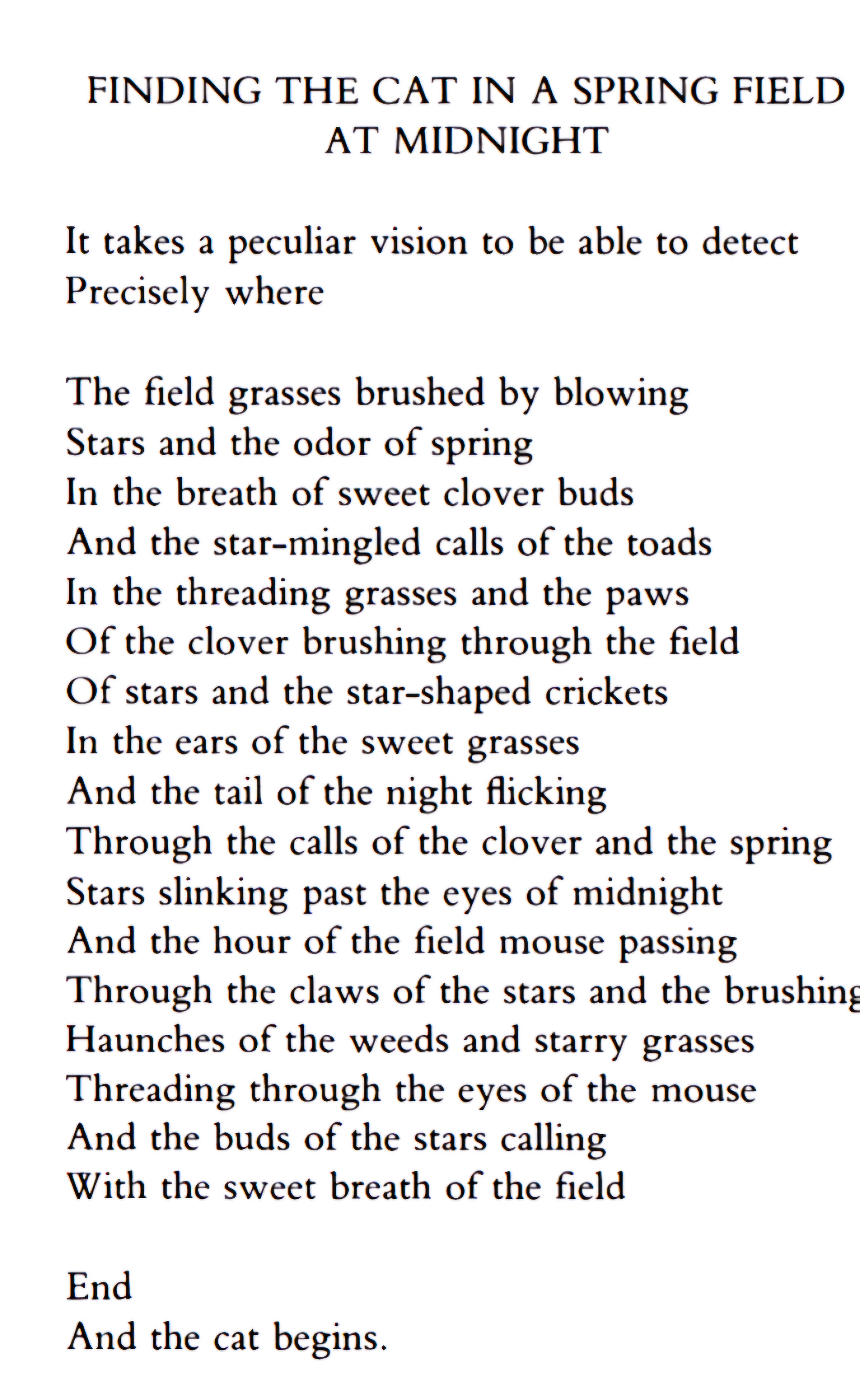
I love when the whole poem fits in the title box. I had a different poem I was trying to use but I couldn’t figure out an excerpt that made sense. Go read the whole poem, you’ll see what I mean. Plus, it’s a terrific poem!
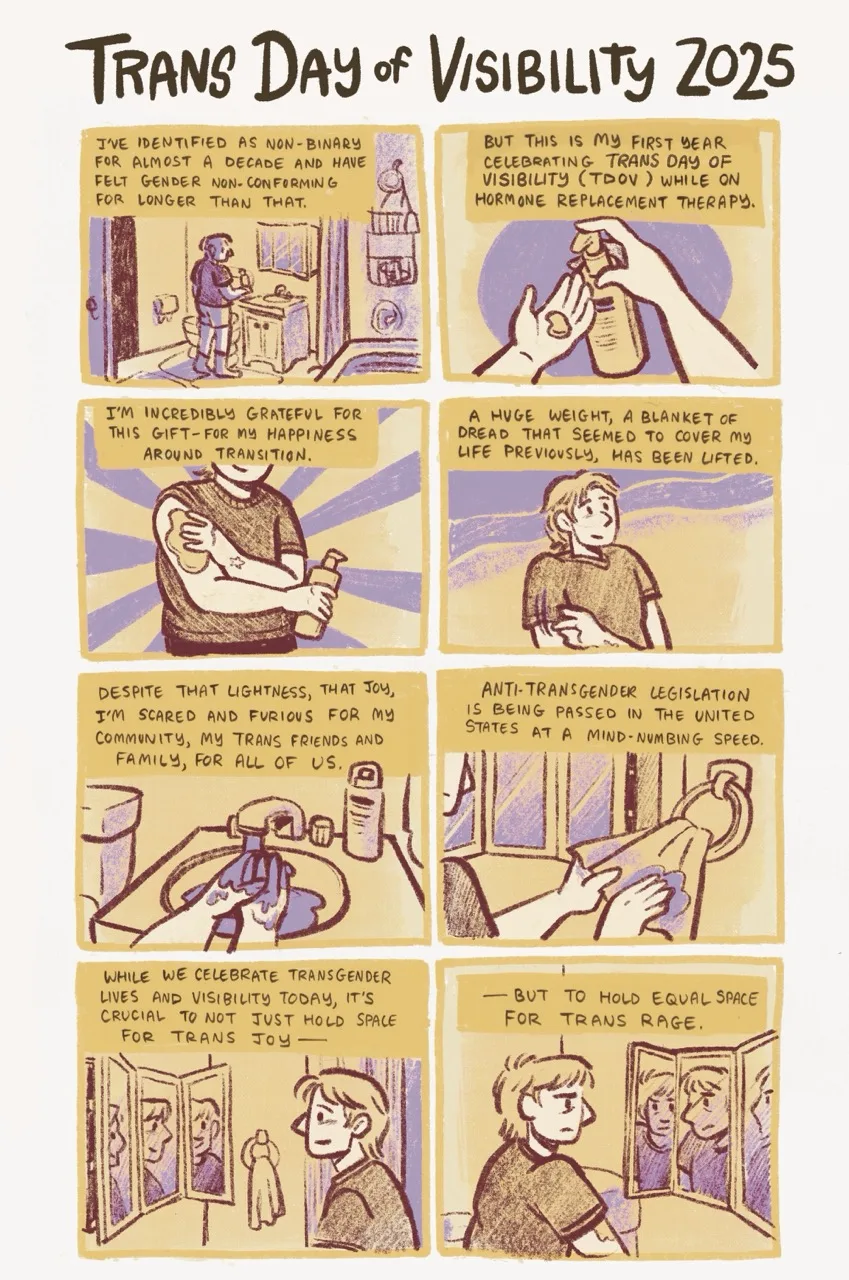
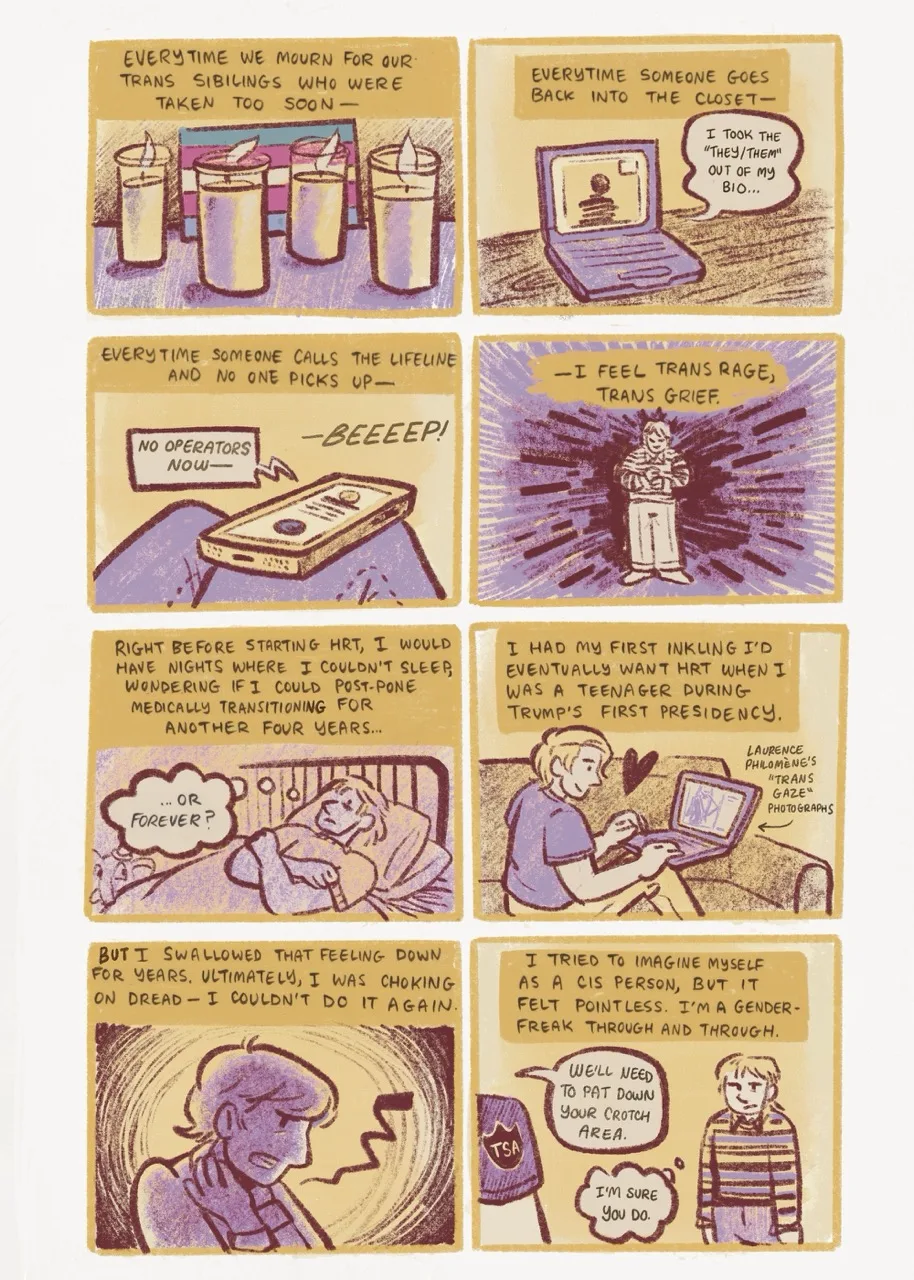
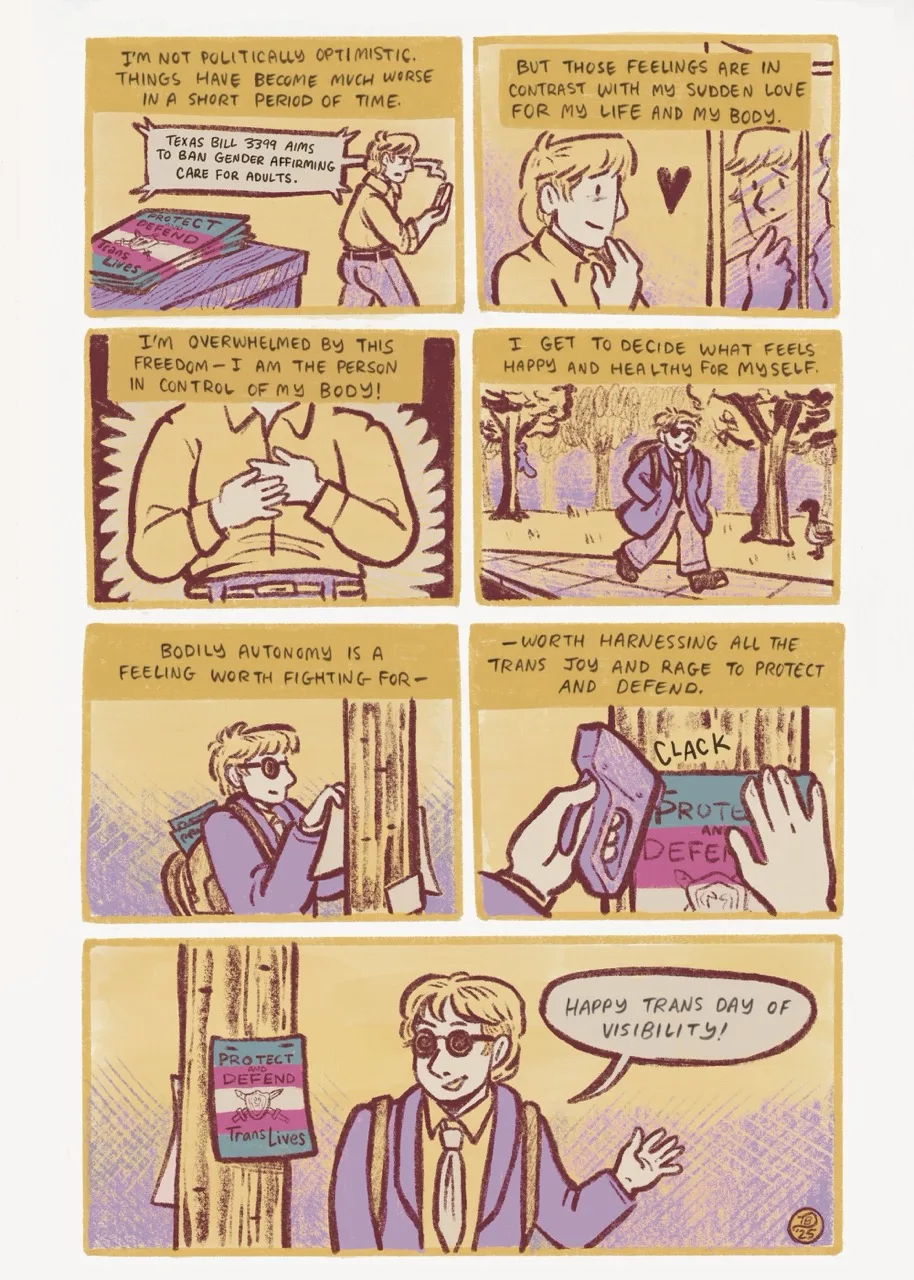
(Having only just now (10 PM Sunday) opened the email with this comic, I’m quite late; I’d saved it for a possible post, and it got buried. No matter, though; the message is good for more than one day, IMO. Everyone should be welcome everywhere every day, as they are welcome here. So, enjoy a comic. -A)
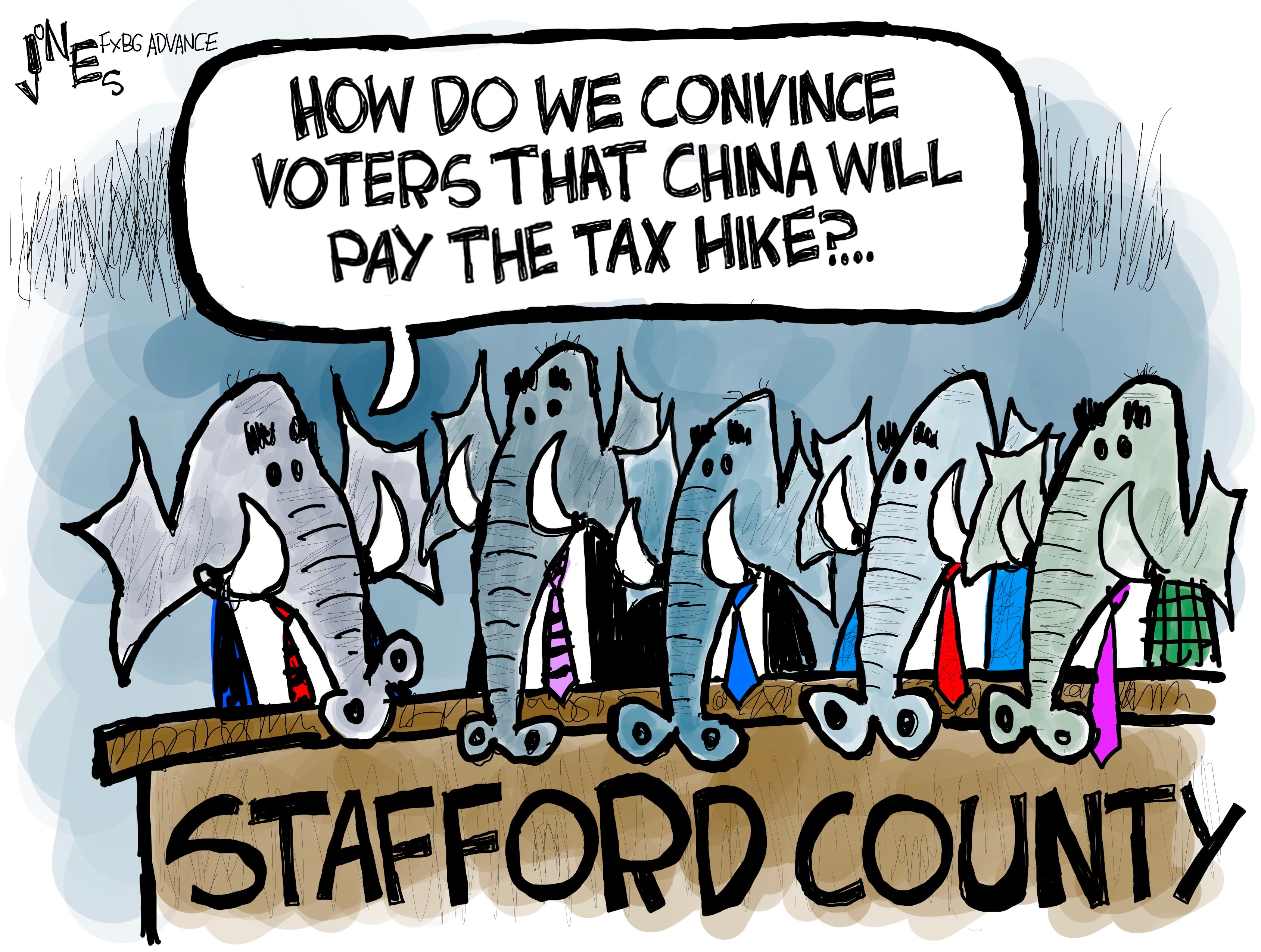
It seems Stafford County has always been staunchly conservative, but Joe Biden won the county in 2020 and 2024, barely…but he won. Blue Northern Virginia stopped at Stafford, but maybe that’s changing.
Yet, the Board of Supervisors is majority Republican, but it wasn’t that long ago when they held all the seats. But despite the board being majority GOP, taxes are still going up.
Hell, taxes aren’t just going up in Stafford. Donald Trump is raising our taxes while trying to cute them for billionaire assholes, such as himself. Trump is raising taxes while denying they’re taxes. They’re called tariffs, and Trump claims other nations pay them, not US taxpayers. If you’re not an idiot, you know that’s true.
The Board of Supervisors voted to advertise a one percent increase to the meals tax and a two percent increase to the transient occupancy tax. The three percent tax increase isn’t a bad thing, though, as it’s going to public schools. At least Republicans in Stafford are trying to help public schools, while Trump is trying to destroy them. Well, most of them. Not every member voted for the tax increase.
This three percent increase is a lower hike than the recent hikes to my Cox WiFi service, Netflix, Disney Plus, Peacock, Prime, and the giant increase in YouTube TV.
The County Administrator requested a five percent increase, but he only got three. To keep the increase low, the Board is cutting other things like new cars for the sheriffs department, delaying raises, and cutting $5,000 from the Christmas lights budget. Governments shouldn’t have Christmas budgets. We need more separation of church and state.
Creative note: I usually draw my cartoons for the Advance on Friday evenings or Saturday afternoons. I drew this one Thursday night.
Drawn in 30 seconds (turn up your volume): (Go see and listen!)
===============
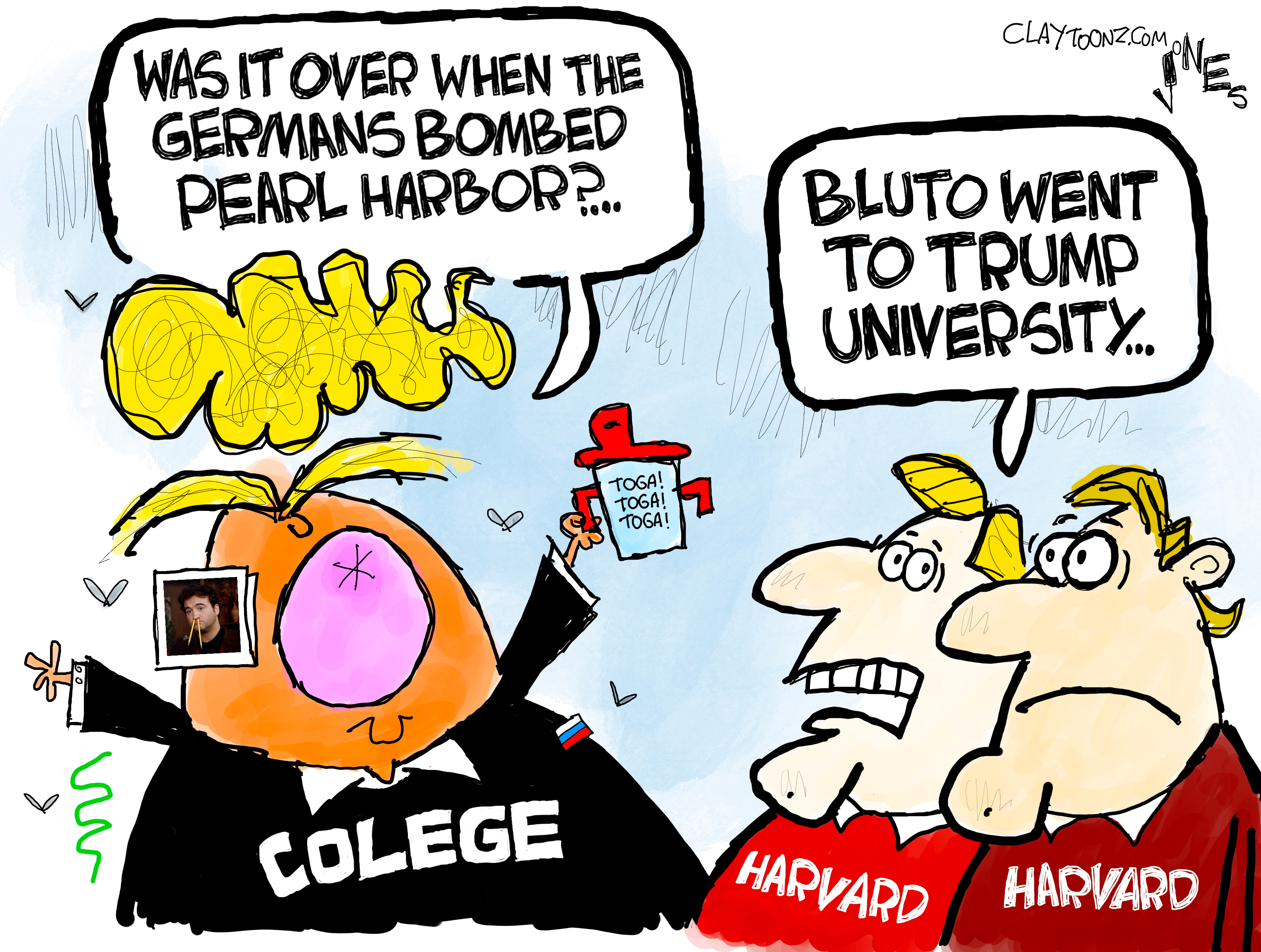
Bluto by Clay Jones
The regime wants to make Harvard more like Trump University Read on Substack
Trump has been pushing everyone around, from the courts to law offices to corporations to governors to media outlets to fellow Republicans to world leaders to universities. Many of those, like The Washington Post, CBS, and Facebook, obeyed before he even started pushing. But two that pushed back are Janet Mills, the Governor of Maine, and Harvard.
During a meeting with governors in the White House, Trump asked, “Is Maine here?” He probably forgot her name.
Trump’s memory for grievances was calling back to a moment during the pandemic in 2020 when he referred to Mills as a “dictator,” and she replied, “I have spent the better part of my career listening to loud men talk tough to disguise their weakness.” She’s got his number.
Back to the White House (sic) meeting, Trump bullied Mills to ignore an anti-discrimination law in her state that allows transgender athletes to participate in girls’ and women’s sports. Trump threatened to cut off funding for Maine at the White House event with governors if the law persisted. Mills replied, “See you in court.”
When you listen to Republicans, you would believe that men are intentionally cutting their nuts off to play women’s volleyball.
Later, Trump claimed her talking back to him was…wait for it…”illegal.” This is probably the “nastiest” a woman has talked to him since that time a woman wouldn’t sell him Greenland, or that other time a woman in Puerto Rico told him, “No, you’re doing a shitty job with hurricane recovery, you bloviating fartknocker,” or that time a female Speaker out-negotiated him, or that time a woman said his penis looked like a cartoon mushroom, or that time a woman dared to run against him, or that other time a woman dared to run against him.
Since then, the federal government has barraged the state with investigations, declared its education system to be in violation of federal law, and frozen some of its funding. Maine sued the Trump administration on April 7, doubling down on its defiance as it began the legal fight that Governor Mills promised at the White House.
Governor Janet Mills has bigger balls than every male governor in this nation combined, and she cracked Trump’s little nuts like it was a Maine Lobster.
Trump is also waging war with universities, especially Ivy League schools. He’s demanding that schools ban “woke,” and the regime is revoking student visas and has sent goons to kidnap foreign students without pressing criminal charges, and holding them in detention facilities in the Deep South.
The Trump regime is accusing Harvard of violating students’ civil rights (which is ironic, coming from the regime that violates students’ civil and constitutional rights). The regime is also accusing its leaders of breaching Title VI, the federal law that bars federal funding to any school found to violate civil rights.
The regime claims that Harvard was failing to keep Jewish and pro-Israel students safe by allowing antisemitism on campus.
Most of the claims of antisemitism during the protests from last year are not true. I’m sure hatred and harassment happened here and there, and from both sides, but it wasn’t widespread or condoned by any university. I don’t believe Muslim students were beating up Jewish students outside a dean’s window at any university, and he said, “Eh, kids will be kids.”
The Armed Conflict Location and Event Data Project, an independent non-profit that tracks political violence and political protests around the world, found that 97 percent of campus demonstrations over the war in Gaza have been peaceful. It analyzed 553 US campus demonstrations nationwide and found that fewer than 20 resulted in any serious interpersonal violence or property damage.
Republicans lie about the Gaza protests like they lie about Black Lives Matter protests (who was that who brought a gun to a BLM protest and shot people? Oh, yeah. Kyle Fucking Rittenhouse).
The non-profit also documented at least 70 instances of forceful police intervention against students, including the arrest of demonstrators and the use of physical dispersal tactics, including the deployment of chemical agents, batons, and other kinds of physical force.
Last Monday, Harvard refused to submit to extensive government oversight while overhauling its governance, admissions, and hiring practices, calling the orders illegal and unconstitutional.
According to Harvard’s President, Alan Garber, those demands include requirements to ‘audit’ the viewpoints of the student body, faculty, staff, and to “reduce the power” of certain students, faculty, and administrators targeted because of their ideological views.”
The Trump regime retaliated by freezing $2.2 billion in federal funding to the university and threatened to revoke its tax-exempt status.
This is bullshit. The Trump regime doesn’t care about antisemitism on college campuses any more than they care about it coming from within the Trump regime. When Trump was elected in 2016 (sic), hate crimes increased substantially. We never heard Trump express outrage about that. Instead, he defended it. When tiki-torch Nazis chanted “Jews will not replace us” and “Blood and soil” shortly before they murdered Heather Heyer, an anti-racism protester in Charlottesville, Trump defended the Nazis (they had a permit!) Maybe he got a free tiki torch out of it. Who knows?
Trump doesn’t hate antisemites. Instead of condemning them, he invites them to lunch at MAGA-Lardo. Trump dined with racists and antisemites Ye and Nick Fuentas at one of his shitty golf resorts. That kinda sets a bad example for Harvard to follow, doesn’t it?
Republicans have always pushed the narrative that education is bad somehow, and people who went to college should be spited, condemned, spit on, and treated like polo-loving foie gras eaters. They push the narrative that people with higher education look down on the rest of America. They often talk about the “East Coast Elite,” or “elitists.”
Some people do act like that.
I was recently kinda seeing a woman who is as liberal as I am, and during a conversation about how members of both of our families are Trumpers, she mentioned that some of her family members, who live in the Midwest, considered her to be among the “East Coast Elite.” You know, a snob who looks down on people. When I told her I kinda get the same thing, she became quickly annoyed, and said I couldn’t be considered a member of the “East Coast Elite” because I didn’t have a PhD, which she has. I was just some bum who dropped out of college to go surfing and draw cartoons, and it wasn’t even a snooty college I dropped out of. She started off criticizing the notion that there is an “East Coast Elite,” and then started acting as if she were a bona fide member of it. Later, she took me to a party and was “called out,” as she put it, that it was only for “serious people,” and I haven’t seen her since. As you can tell, I still have a little attitude about that.
Maybe it is all my fault. Someone at the party told me they had season tickets to the orchestra, and I told them that was awesome and to let me know if they make the playoffs. See? I’m not a serious person.
While I don’t like stuck-up obnoxious boring assholes who look down on people as if they’re better than them, I also don’t like hypocrites. Who am I talking about?
The vice president (sic), JD CouchFucker Vance, is all in on this attack on Ivy League schools, but it should be noted that he’s a graduate of Yale, an Ivy League school. Another Yale man is Treasury Secretary Scott Bessent. Defense Secretary Pete Hegseth went to Princeton and Harvard. Secretary of the Interior Doug Burgum didn’t go to an Ivy League school, but he did go to Stanford, which is private and snooty enough. Howard Lutnick, Commerce Secretary, also went to a private school, Haverford College. RFK Jr, secretary of health and weird conspiracy theories, also went to Harvard and three other universities. The Secretary of Energy, Chris Wright, went to MIT and Berkeley, which is a hippy school. Right? John Ratcliffe, head of the CIA, went to Notre Dame. Jamieson Greer, Trump’s trade rep, went to Brigham Young, which is another private school (and founded by a guy with 56 wives and 52 more kids than Donald Trump has).
Where did Donald Trump matriculate? Trump went to the Wharton School, which is not a daycare but the business school of the University of Pennsylvania, and the last time I checked, it is an Ivy League school.
Trump is like one of those people who travels the world and somehow fails to take any of it in, and returns home still a knuckle-dragging moron with an inability to comprehend simple thoughts. Donald Trump went to an Ivy League school and came out still behaving like Donald Trump. That gives me the impression he only “went” there. It’s like that guy who visits France and complains that the croissants aren’t croissandwiches.
Turning a croissant into a croissandwich would be like turning Harvard into Trump University.
Creative note: This cartoon is dedicated to John Belushi. I believe his work is an influence on my cartoons.
This was interesting: Last night, I ran into an ex (of sorts) who is involved in the local theater scene. She invited me to audition for a part in an upcoming play, saying she thinks I would be a good fit for it. I haven’t acted since the sixth grade, but I was the lead (there hasn’t been a better Pecos Bill since). I was intrigued and wanted to audition this morning, but not to get the part, but just to see if I could do it. I didn’t go because I had to draw this cartoon.
I just want you readers to know that I gave up being the next Brad Pitt for you.
April 20, 1853 Harriet Tubman began her Underground Railroad, a network of people and places that aided in the escape of slaves to the north. Story of a liberator of her people from bondage Harriet Tubman
April 20, 1914 Troops from the Colorado state militia attacked strikers, killing 25 (half women and children), at Ludlow. Having struck the Rockefeller-owned Colorado Fuel and Iron Company the previous September for improved conditions, better wages, and union recognition, the workers established a tent camp which was fired upon and ultimately torched during a 14-hour siege. The Ludlow Massacre
April 20, 1964 In his closing statement at the Rivonia Trial, African National Congress leader Nelson Mandela addressed the court: “We want a just share in the whole of South Africa . . . We want security and a stake in society. Above all, my lord, we want equal political rights, because without them our disabilities will be permanent.” He was in Pretoria Supreme Court in South Africa where he and eight co-defendants were charged with 221 acts of sabotage designed to “ferment violent revolution,” and were facing the death penalty. At the time, black South Africans had no civil or political rights whatsoever, though they composed over 80% of the population. He concluded: “During my lifetime I have dedicated my life to this struggle of the African people. I have fought against white domination and I have fought against black domination. “ I have cherished the ideal of a democratic and free society in which all persons will live together in harmony and with equal opportunities. It is an ideal for which I hope to live and to see realised. But, my lord, if it needs be, it is an ideal for which I am prepared to die.” Mandela in 1958 The trial that changed South Africa
April 20, 1969 On the site of a parking lot owned by the University of California, Berkeley, a diverse group of people came together, each freely contributing their skills and resources to create People’s Park. People’s Park history
April 20, 1982 Seven women were arrested in an anti-nuclear protest outside Mather Air Force Base, near Sacramento, California, in what had become a weekly vigil. Speaking after her arrest, Barbara Weidner, 72, said, “As a mother and grandmother, I could no longer remain silent as our world rushes on its collision course with disaster which threatens the lives and futures of all children, everywhere, and the future of this beautiful planet itself.” She later said, “I hope people will not think we are encouraging people to break the law,” she said. “But our actions should teach people, and children, to scrutinize laws against human life, and they should be broken to prove a point.”
April 20, 2002 More than 75,000 marched in Washington, D.C. to protest U.S. policies in the Middle East, specifically regarding Palestine and the threatened war in Iraq. The demonstration was organized by the A.N.S.W.E.R. Coalition (Act Now to Stop War & End Racism) and included members of the Arab-American, Muslim and South Asian communities.
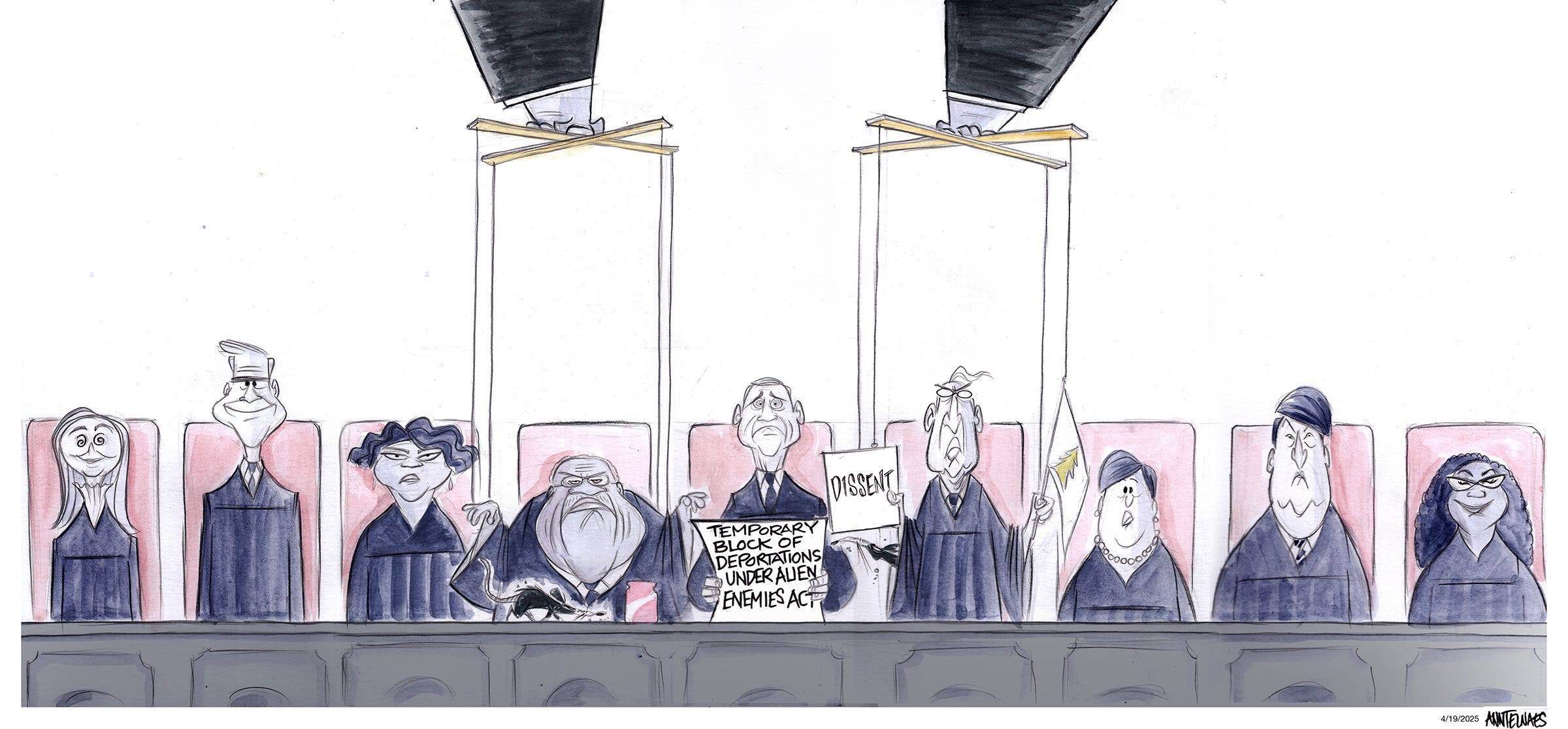
At 1 a.m. today, the Supreme Court paused the deportation of immigrants who are subject Donald Trump’s abuse of the Alien Enemies Act (a measure that’s only supposed to be used during an invasion or times of war), just as the Trump regime was on the verge of flying a group of Venezuelans from Texas to El Salvador to rot in that nation’s hellhole of a prison.
Breaking news at 1 a.m. is usually about an explosion, an invasion, a tsunami, a tweet from Trump containing an incomprehensible new word, but rarely a Supreme Court ruling.
SCOTUS had previously told the regime that it’d be OK if they used the illegal Alien Enemies Act, just so long as each immigrant (and maybe US citizen) received due process first. The regime apparently ignored that last part about due process and was about to go all-skippy with deporting more Venezuelans.
The court ordered the Trump administration to respond to the emergency appeal once a federal appeals court in Louisiana takes action in the case. The court said, “The government is directed not to remove any member of the putative class of detainees from the United States until further order of this court.” That means the regime will probably go ahead and do it.
SCOTUS did not explain the ruling, maybe because it was 1 a.m. and a rumor started that Denny’s was about to close, and Sotomayor is a real grouch if she doesn’t get her Moons Over My Hammy.
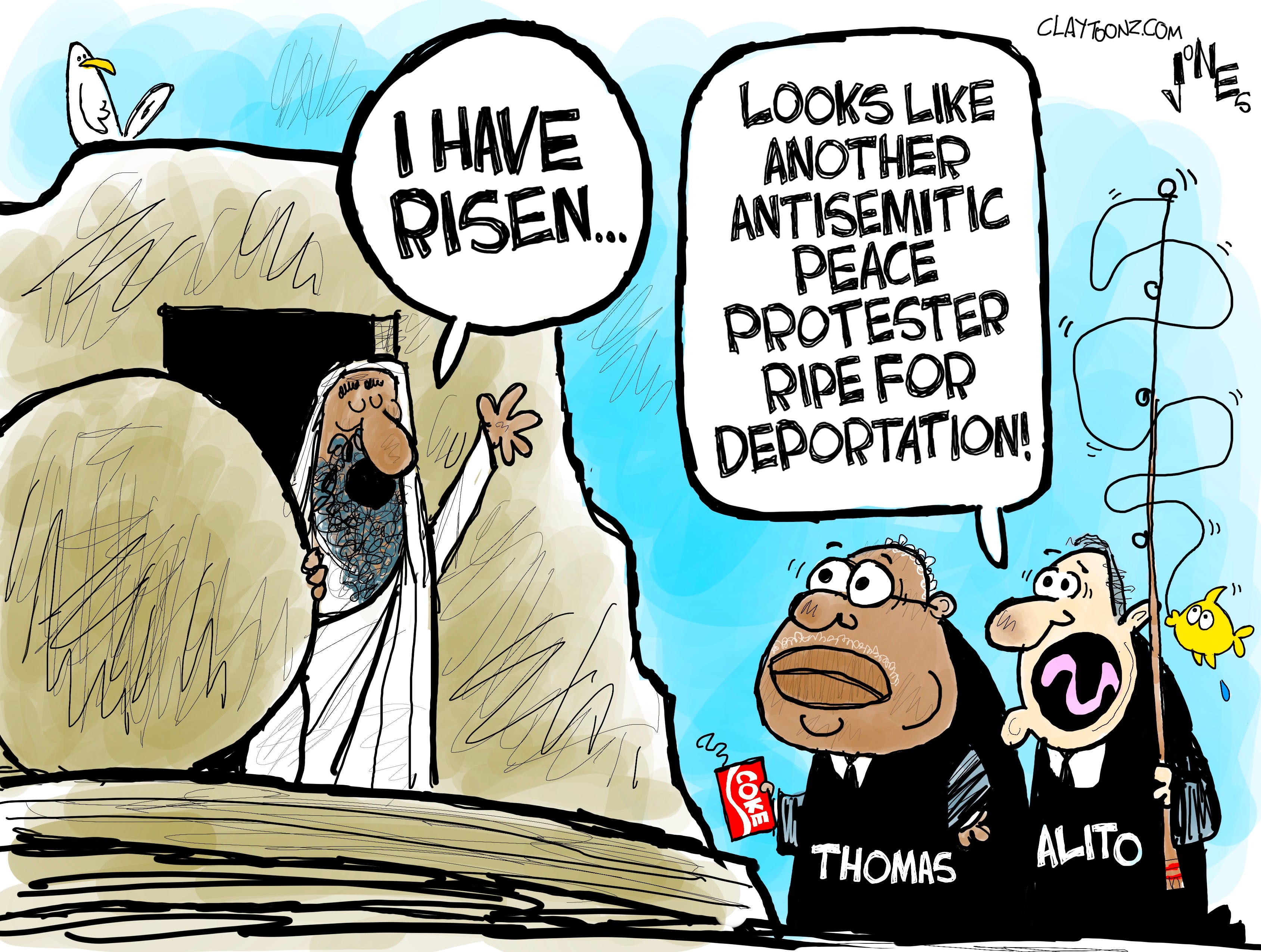
But we probably don’t need an explanation for why the only two dissenters were (be ready to be surprised) Clarence Thomas and Samuel Alito (OK, that wasn’t surprising).
Why would those two oppose delaying the deportation of immigrants without due process and support the regime violating the last order from SCOTUS? There are several possible reasons, and I’m sure none of them are good.
The first reason could, they’re fascist goons.
The second one could be that they just don’t give a shit about the Constitution and know this is the side they’re supposed to be on.
The third reason could be that they don’t care what the issue is and all they need is to be pointed in the direction Trump’s going, and they will follow.
The fourth reason could be that it’s booty night, Clarence doesn’t want to upset Ginny Thomas, and Samuel is hoping Mrs. Alito will help raise his flag.
The fifth reason could be that they’re both corrupt and were bought off to vote this way.
Even Trump’s justices, Neil Gorsuch, Brett Kavanaugh, and Amy Coney Barrett, voted for this delay.
These guys would deport Jesus, especially since he’s not a blue-eyed blonde like White Christians make him out to be.
This part of the blog is short because I want to clean my apartment before I fly to Chicago on Monday. I like coming home to a clean apartment.
I have a beef, and it’s not the Italian beef sandwich I’m planning to try in Chicago: I may be starting a fight I don’t want to fight, but dammit. Somebody has to.
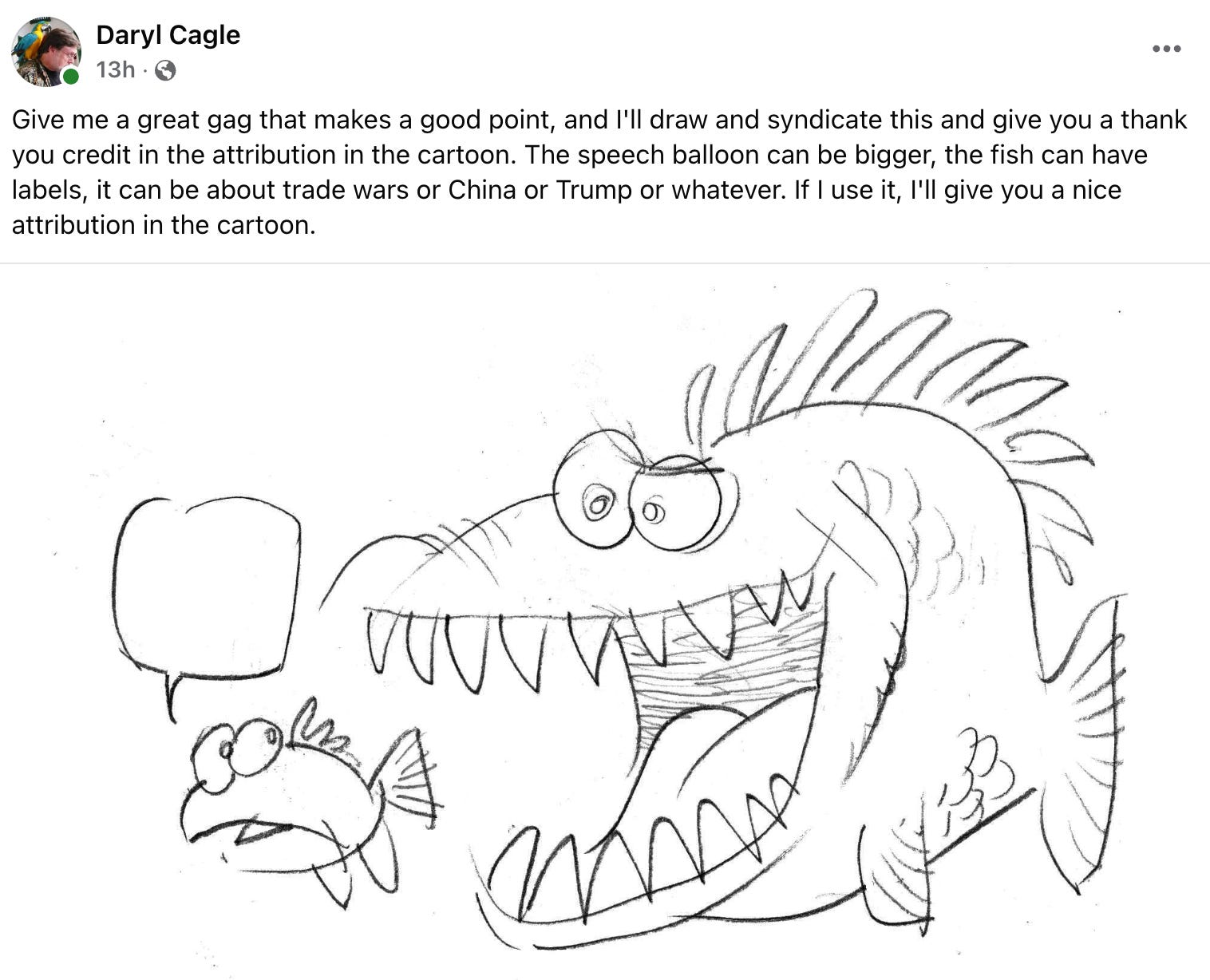
A caption contest is where a cartoonist draws a cartoon, but doesn’t finish writing it. He creates an image and leaves a blank speech bubble/balloon. He then invites the readers to fill in the bubble and makes a contest out of it. It’s fun for the readers, gets them to engage with the cartoonist and the publication, and brings more hits and views to the publication’s website. I always felt it was a cheap way to make readers come back to look at other same page, and I openly admitted that when I did a caption contest for The Free Lance-Star. I hated the caption contest, but knew my readers loved it and my editors liked the views. I don’t see anything wrong ethically with the caption contest because I don’t see it as political cartooning. I saw it as a newspaper feature similar to the crossword puzzle, the jumble, or today’s Wordle. I’ll occasionally bump into a reader who’ll bring up the caption contest…that I hated.
My friend Walt Handelsman is doing a caption contest, and he does it well.
I saw something similar last night that’s kinda similar to the caption contest, but it’s entirely unethical, diminishes political cartooning, lazy, and is screwing readers over.
This is what I saw, and it’s by Daryl Cagle, who operates the largest syndication company for political cartoons.
If this were just a game for his website, I’d think nothing of it, but it’s not a game.
Daryl is shopping for his reader to write his ideas, and then he plans to sell them. If he does manage to sell them, they won’t be next to a crossword puzzle, but on the opinion page. It’s not like editors will care if they suck, and they will. And if he sells them, he’s not sharing the money with the person who wrote the idea. They’ll just get an “attribution.”
Remember my blog about why I don’t use cartoon ideas I didn’t write? The reason boils down to ethics, which Daryl doesn’t have. Even though I might be the goofiest guy in this industry, I take this industry seriously. I care about my work. Obviously, Daryl doesn’t care about his. He once drew two versions of a cartoon, one version from the Right and the other from the Left. It was a total hack job. He doesn’t care.
I commented on Daryl’s Facebook page, telling him to write his own cartoons. He replied, “According to the Pulitzer people, we’re all just illustrators now, Clay.” That’s pretty much true as the Pulitzers have taken away the contest category for political cartoons and combined it with “illustrated reporting” or some shit like that, but I wasn’t going to let Daryl use it as an excuse.
I replied to Dayl’s reply, saying, “Then why are you helping the Pulitzers diminish us? You already used the anonymous cartoonist to tell editors and publishers that we’re not journalists. Most political cartoonists have too much integrity to take ideas submitted by readers, and here you are shopping for them. Do you not care about your work? If you don’t want to be a political cartoonist, then get out of the political cartoon business. And then on top of all that, you’re not going to pay the person who writes the cartoon you’re going to sell.”
Daryl previously syndicated an anonymous cartoonist who signed his work as Rivers. Rivers is a lying racist idiot MAGAt in Canada (that was a secret too). By syndicating Rivers, Daryl was telling editors and publishers that political cartoons didn’t have to abide by their ethics policies, thus cartoonists aren’t journalists anymore. That’s a weird position for a cartoonist to take. Even letters to the editor must be signed. When asked to justify this a couple of years ago, Daryl replied to me, “I don’t see a problem with this,” which wasn’t answering the question.
I first met Daryl in 1997 when I was in Hawaii. He flew out and bought me a burrito. I liked him. He’s a nice guy personally, and I thought at the time with his website, that he was a huge advocate for our entire industry, but over the years, he started doing shit like this, shit I can’t remain silent about. Other cartoonists have told me to shut up and not make noise, but you know I’m not good at that. I’m a noisy motherfucker. I rock a Gibson. And then others send me private messages encouraging me on, but won’t add their voices to my one-man protest. Those cartoonists are smarter than I am.
I would rather support other cartoonists than criticize them. I try to make any criticism about the message in it, like if it’s lying or racist, never just because I think it sucks. I don’t want to go after Daryl, but here I am.
Daryl could come after all my clients and try to chase me out of the business, but there’s no sign he’s ever tried that, though I have lost newspapers to his syndicate, which sells dozens of cartoons in one package for a flat fee. It’s hard to compete against that. Once, every cartoonist could submit to USA Today, but then Daryl made a deal with Gannett that shut out every cartoonist from their entire chain except for his cartoonists. Now, Gannett doesn’t publish political cartoons at all.
But he can’t come after my Substack. To all you paid subscribers, this is one of the things you’re helping me fight, and you’re giving me more freedom to speak out. So I thank you again.
I’m going to open the comments today to be fair, to give Daryl a chance to respond to this. I don’t think he will, but I’m trying to be fair.
I’m not going to fight a war or carry a torch for this. I’m going to move on and focus on my work, but somebody had to say something. I’ll end this with one more message to Daryl: Write your own fucking cartoons.
Creative note: I already did one Easter cartoon, which has a higher chance of being published than this one. I wanted to do something like this cartoon just to rouse up the conservatives on Easter Sunday. It’s so much better than the he-has-risen bullshit from the fake Christians like Gary Varvel.
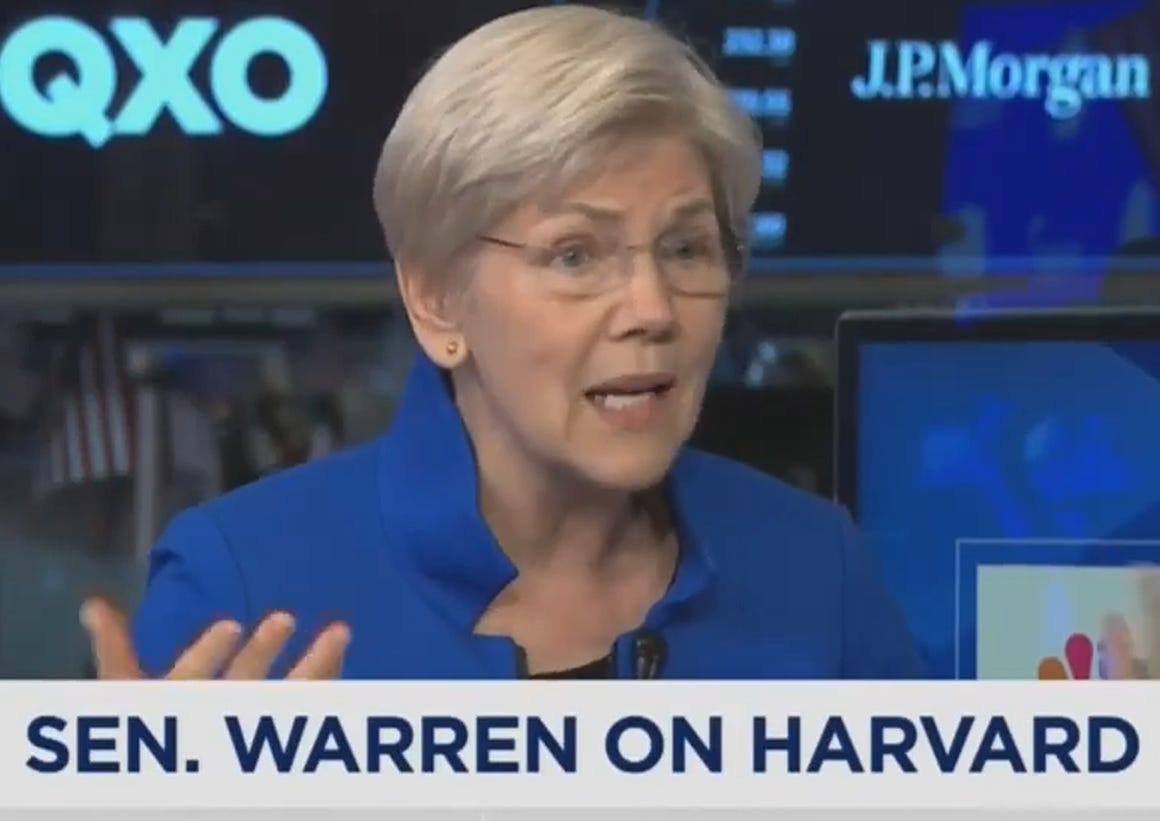
Snippet-go read this, the videos are delightful- Sen. Prof. Warren remains outstanding!
Oh yeah, baby, talk dirty to us.
Professor Senator Elizabeth Warren stopped by CNBC’s “Squawk on the Street”on Friday for some chattin’ and some rantin’ and some tarriffsplainin’ for the benefit of the show’s blow-dried hosts. We don’t normally watch financial news shows, because what are we, the Vanderbilts? But put Warren on anytime, and we’ll consider tuning in more. She can be entertaining!
Especially if your anchor isn’t following her argument, which sends her into her professorial did-you-not-do-the-reading voice. Which is what happened to Sara Eisen, who must have thought for one moment that she was back at the Medill School and had skipped that week’s assignment. (snip)
Black Mirror, eat your heart out. Researchers have apparently just figured out how to make people see a color completely new to humanity.
Scientists at the University of California, Berkeley conducted the research, published Friday in Science Advances. Using a technique called Oz, the research team induced human volunteers into seeing a color beyond the “natural human gamut.” Oz could allow scientists to conduct experiments previously not possible before, the authors say, and the lessons we learn from it might even someday help color-blind people regain their missing color vision.
Our retinas contain certain photoreceptive cells, known as cones, that allow us to see color. There are three cone types that correspond to different wavelengths of light: short-wavelength (S) cones, medium-wavelength (M) cones, and long-wavelength (L) cones.
Typically, when we try to reproduce color in front of someone’s eyes, we do so by manipulating the spectrum of light seen by the retina’s cones. But since some of our cones, particularly M cones, share overlap in how they respond to certain wavelengths, there are theoretically colors out there that our eyes can never truly see. The UC Berkeley researchers, based on their earlier work studying cone cells, say they’ve found a way around this limitation. (snip)
What is the South African Renewable Energy Masterplan?
It is an industrial strategy that sets out how South Africa can set up a new manufacturing industry in renewable energy and battery storage value chains.
The masterplan was developed by the government, some sections of organised labour, a non-profit organisation advocating for renewable energy, and representatives of the renewable energy industries. It sets out a framework to produce renewable technologies locally. These include solar photovoltaic panels, wind turbines and batteries.
The masterplan has been drawn up so that it aligns with South Africa’s existing national target of adding 3–5 gigawatts of renewable energy capacity each year to 2030. This is a scale that can support the development of local manufacturing hubs. (One gigawatt can supply electricity to about 700,000 average homes.) This steady supply will be enough to give businesses and investors the confidence to commit to long-term investments in local manufacturing hubs. These are zones where renewable systems and components are produced or assembled for domestic and export markets.
The state-owned electricity company, Eskom, has not directly guaranteed that it will buy 3-5 gigawatts of renewable energy each year. But the government’s national electricity plan (the Integrated Resource Plan) provides a strong indication of future demand. (snip)