I love dogs and people. I want living creatures to thrive. I love to cook, and share the food, but ya gotta get in line in front of the dog, and greatest good luck with that!
March 13, 1830 The term “rat,” referring to a worker who betrays the interests of fellow workers, first appeared in print. The New York Daily Sentinel reported on replacement workers who had agreed to work for two-thirds of the going rate. “ . . . [many printers are out of work, others are being paid about 2/3 the regular pay; they should join in cooperative associations, ‘as we have done’] “ [While] the master printers [fill] their offices with boys and two-thirds men, alias ‘rats,’ it will be difficult to find a remedy.”
March 13, 1864 The first contingent of 14,030 Navajo reached Fort Sumner, New Mexico. Men, women and children had been forced to march almost 400 miles from northeastern Arizona and northwestern New Mexico to Bosque Redondo, a desolate tract on the Pecos River in eastern New Mexico. Traveling in harsh winter conditions for almost two months, about 200 Navajo died of cold and starvation along the way. More died after they arrived at the barren reservation. The forced march, led by Kit Carson, an Indian agent and military leader in both the Mexican and Civil Wars, became known by the Navajos as the “Long Walk.” A grueling 400-mile march to imprisonment in a sterile land. More on The Long Walk
March 13, 1945 Pax Christi, an international Catholic peace organization, was founded in France. From their website: “Pax Christi is a ground up organization – it began with a few committed people who spoke out, prayed and worked for reconciliation at the end of the second world war, and is now active in more than 60 countries and five continents, with more than 60,000 members worldwide.” Pax Christi history
March 13, 1968 Clouds of nerve gas drifted outside the Army’s Dugway Proving Grounds in Utah, poisoning 6,400 sheep in nearby Skull Valley. Sign near Dugway: Warning Hazardous Area: This area may contain Chemical, Biological and Radiological contaminated material and explosives . . . Read more about Dugway – the home of Amerian WMD
A second SpaceX rocket has blown up this year. And remember, the year is less than three months old. Debris from the explosion shut down air traffic in the state of Florida, or it was because they found a trans flight attendant in Orlando.
MSNBC’s Rachel Maddow had some snark about the explosion, using a metaphor for Elon Musk’s and DOGE’s dismantling of federal government agencies, Maddow said, “Rapid unscheduled disassembly is kind of Elon Musk’s specialty these days, especially in a way that really messes with other people through no fault of their own.”
Just think of all those inconvenienced by Elon’s rocket explosion delaying flights. Florida alligators are waiting to eat those people, Elon!
MSNBC’s Michael Steele said, “For Elon, his response to all of this was, ‘Rockets are hard.’ And Mr. Musk, if they’re so hard, why don’t you go back to your day job and work that out and leave those of us who do government to do government because you can’t do both. Clearly, you’re failing right now at both. Your rockets are blowing up, and the government is blowing up.”
Poor Kayleigh Menaney flipped her blonde wig over at Fox News, saying to the liberal media, “Don’t you dare root against SpaceX.” You would think they had put a shit-covered flag into a blender to serve as smoothies to World War II veterans, but then again…Elon’s making cuts at the Veteran’s Administration. It’s getting harder and harder to use analogies with these bastards.
There was a lot of wig flipping over on Trump TV. (snip-MORE)
=====
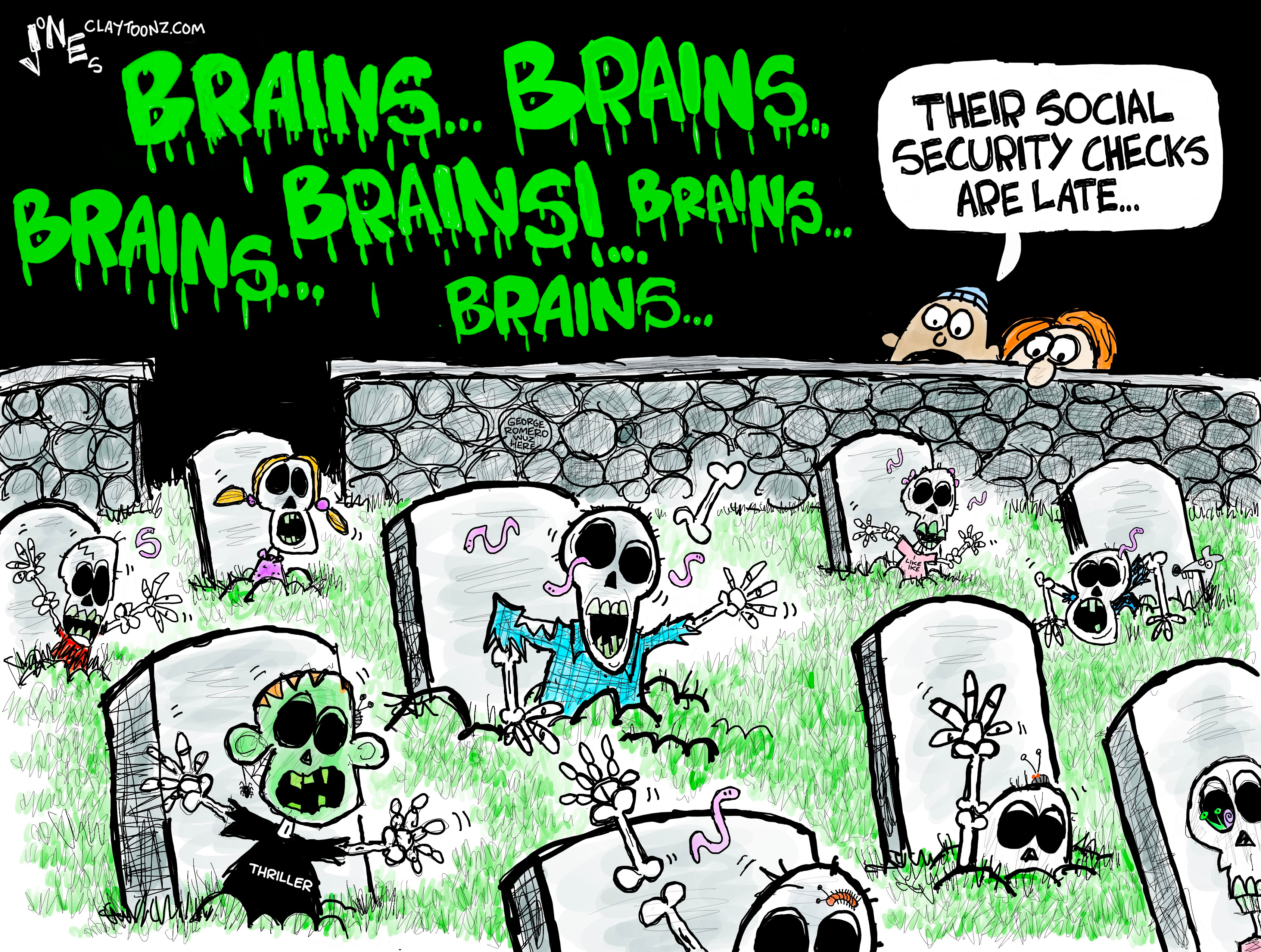
BRAAAAAAINS by Clay Jones
Where are the brains in the Trump/Elon Administration? Read on Substack
During Trump’s address to Congress last week, he repeated Elon Musk’s lie that 150-year-olds are collecting Social Security. The lie is even more malicious than originally thought because Trump repeated and enhanced it after it’s been debunked.
It’s a lie.
Elon previously posted on X in February, when it was working, that DOGE found beneficiaries in their 100s, 200s, and even 300s who were still receiving Social Security payments.
Nobody’s actually against the government rooting out waste and fraud. What we’re against is the lack of transparency by a Trump-appointed, corrupt, lying unelected bureaucrat with huge conflicts of interest and a lack of any qualifications to make decisions on government spending without any input from the three branches of government. Why is this so hard to understand?
We know there’s waste and fraud in government, but you don’t elect lying swamp creatures to drain the swamp.
In his address, Trump said, “We are also identifying shocking levels of incompetence and probable fraud in the Social Security program for our seniors and that our seniors and people that we love rely on. He then went on to list the number of people who are past the age of 100. “Money is being paid to many of them, and we are searching right now,” King Grifter said.
At one point during the speech, he criticized “unelected bureaucrats,” which made the Democrats laugh. (snip-MORE)
The very first execution of a Conscientious Objector, and more in today’s items.
March 12, 295 Maximilian of Thebeste (near Carthage in North Africa) was beheaded by Romans after refusing military service because he said his Christian beliefs did not permit him to become a soldier.
March 12, 1912 Workers led by the Industrial Workers of the World (IWW) won the Lawrence, Massachusetts, “Bread & Roses” textile strike after 32,000 workers (mostly young female immigrants who spoke 25 different languages, half between the ages of 14 and 18) stayed out for nine weeks. They were striking for a wage increase, double time for overtime and safer working conditions: the equipment was dangerous and the air quality caused lung disease in about one-third of the workers before the age of twenty-five. IWW organizer Elizabeth Gurley Flynn addresses a strike rally Background “Bread and Roses” became the strikers slogan and inspired a poem by by the same name. Bread & Roses victory parade
March 12, 1930 Gandhi’s Salt March began from Ahmadabad, India, with 76 followers to protest the salt tax. Great Britain’s Salt Acts prohibited Indians from collecting or selling salt, a staple of the Indian diet. Gandhi leading the Salt March Citizens were forced to buy it from the British, who, in addition to exercising a monopoly over the manufacture and sale of salt, also exerted a heavy salt tax. Defying the Salt Acts, Gandhi reasoned, would be a simple way for many Indians to break an unjust law nonviolently (civil disobedience), increasing the pressure for independence from the British Empire. By the time Gandhi had covered the 241 miles to the coastal city of Dandi on the Arabian Sea, the number of marchers had grown into the thousands. More on the Salt March
March 12, 1978 150,000 demonstrated against construction of a nuclear power plant in Lemoniz, Spain, part of the Basque region. No fewer than a dozen plants were planned in a relatively small, densely populated area, Lemoniz being only 12 km (5 miles) from Bilbao, a city of a million. The opposition was concerned about the possibility of accidents. Lemoniz protest
March 12, 1990 Sixteen disability-rights activists from ADAPT (American Disabled for Accessible Public Transit)were arrested at the U.S. Capitol demanding passage of what would become the Americans With Disabilities Act. The Capitol Crawl
Simply very bad news. Precisely what Project 2025/Agenda 47/Republican National Platform said they want to do. I’m sorry; I don’t like to bring bad news. But people need to prepare. This is written in editorial/opinion style, but facts are within and there are citations. For people like us who need time to prepare for austerity, it’s news we ought to read.
Also, there are Senator names included for who we should write to regarding this bill. That’s our last chance. Shutdown is on Republicans, not Democrats, no matter how they try to deflect. We need to tell the Dem senators to speak what’s in this bill, every chance they get, and to refuse to vote in favor, pointing at Republicans the entire time.
There are parts in the article complaining about Democrats and their choices, etc., et. m. Read it if you want (you’ll have to click through for it,) but it won’t help anyone to read more complaining about Democrats. We the people need to energize Dem. Senators to speak out, and to vote no. Especially the speak out portion; Sen. Mark Kelly does that especially well, and is among those the author of this piece feels is wavering. I intend to start first thing in the morning, and I hope all of us will devote some time to this. It’s vital.
Without the luxury of Republicans falling apart, Democrats in the Senate need to decide whether to prevent a dangerous and harmful budget that shrinks the power of Congress in the government. Since operating on principle goes against their “adults in the room” mindset, they are wavering on what to do. But it should be an open-and-shut case.
A normal continuing resolution funds the government at the same level as the previous budget. This bill does not. It cuts non-defense discretionary spending by $13 billion below last year’s level, while increasing military spending by $6 billion. It zeroes out funding for programs that fund homeless shelters and prevent child abuse. It cuts health care funding for clinics and hospitals, emergency preparedness for communities, clean water projects and tribal assistance. Meanwhile, it adds money for mass deportations, just as Immigrations and Customs Enforcement has illegally detained a green card holder for his political beliefs.
Most of the budget cuts are achieved by removing earmarks, which members of Congress put in to direct projects. But usually when earmarks are removed, the money goes back to the agency to decide how to distribute it. This maneuver cuts the earmarks and the money.
The House Republican bill also fails to fix a carryover of a $20 billion rescission to IRS money from the Inflation Reduction Act, effectively doubling that cut. This was kind of pre-ordained when Democrats punted on this in a prior continuing resolution last December, but it still means that practically all of the IRA’s funding for greater enforcement of tax collection is now gone.
The bill not only adds $6 billion to the Department of Defense’s enormous budget, but adds $8 billion in “transfer authority” that allows the agency to shift spending where they deem important, a flexibility no other agency gets.
While Republicans tout a $6 billion increase in veterans health care in the bill, they neglect to mention the removal of a $23 billion appropriation to the Toxic Exposure Fund to implement the PACT Act, which cares for veterans exposed to burn pits and other cancer-causing chemicals. While there’s an extra $2.2 billion for the Federal Emergency Management Agency’s disaster relief fund, there’s no additional money to support the rebuilding in southern California after the January wildfires.
But most important, the bill grants an open invitation to Trump and Elon Musk to continue to ignore Congress and toss out disfavored spending. Vice President JD Vance, while selling the deal to House Republicans, stated outright that “Trump would continue cutting federal funding with his Department of Government Efficiency initiative and pursue impoundment — that is, holding back money appropriated by Congress.” This has been reiterated by others in the Trump administration.
In fact, the House Republican bill gives the president more leeway to move money around. It appropriates money for things that Musk has eliminated, meaning that money can operate as a floating slush fund for Trump’s priorities, as long as the courts don’t roll back the illegal impoundments.
… The Trump administration is saying that they will sign a bill appropriating specific funding, and then go about cutting funding anyway. If you’re a member of Congress, you’re being told that your work product doesn’t matter, that the constitutional power of the purse doesn’t matter, and that there’s no guarantee that anything you pass will actually reach the people you serve.
I can see why Republicans would take this deal: they want budget cuts but know they don’t have the votes for them, so they’re plenty happy to outsource that to the president, even if it turns Congress into a separate and unequal branch of government. But why would Democrats willingly submit to a fake budget on paper that can be so easily circumvented? As Rep. Greg Casar (D-TX), chair of the Congressional Progressive Caucus, said on X, “The Republican spending plan will supercharge Musk’s theft from working people to pay for billionaire tax cuts. Senate Democrats must stop it.”
…
So far, only Sen. John Fetterman (D-PA) has committed to voting yes. But as Josh Marshall has documented at Talking Points Memo, a number of Senate Democrats have stated no position on the bill, leaving their options open. In general, senators have been hedging their bets until forced to make a decision. That time has come.
Credible sources indicate that the most likely Democrats to offer up the remaining seven votes to avoid a shutdown are Mark Kelly (D-AZ), Ruben Gallego (D-AZ), Michael Bennet (D-CO), John Hickenlooper (D-CO), Jon Ossoff (D-GA), Gary Peters (D-MI), Elissa Slotkin (D-MI), Maggie Hassan (D-NH), and Mark Warner (D-VA).
about Gov. Newsom tossing trans people away like disposables. Here’s a thing, and it’s exciting! At least, to me; I’ve been a big Katie Porter fan for several years now. Her campaign website is very general in regard to civil rights, stating more than once that she has and wants to continue to protect everyone’s civil rights. So I went hunting, and found this, and this, both from her congressional days. I’m pretty sure someone will pin her down on this a little more, after what Gov. Newsom did. The bit below is from the announcement email I received a few minutes ago.
======= Will you join our movement?
It’s official: I’m running to to be California’s next Governor.
I didn’t make this decision lightly. But with an emboldened Trump in the White House and MAGA loyalists doing his bidding day in and day out, California—and our country—need a leader who is ready to go toe to toe with extremists.
I’m asking you to join our movement to stand up to Trump and his cronies. Can you add your name to be one of my first endorsers?
March 11, 1988 Ten days of protest and direct action ensued demanding an end to nuclear testing at the Nevada Test Site. The site, larger than the state of Rhode Island, is an outdoor laboratory and national experimental center for testing nuclear weapons. The actions resulted in over 2,200 arrests, the largest number of arrests in U.S. history for a political protest outside Washington, D.C.
March 11, 2011 More than 85,000 Wisconsin citizens rallied outside the Capitol in Madison to welcome the return to the state of fourteen Democratic state senators. Known as the Wisconsin 14, they had left the state to deny the senate a quorum, thus delaying passage of legislation which took away public employees right to collectively bargain and restricting other rights of union members. State Senate Minority Leader Mark Miller remarked about the gathering, “This is what democracy looks like!” The Wisconsin 14
Hope you’re enjoying your weekend. To give you a bit more enjoyment, here’s all the good news I could find from the week that just ended. I’m certain there was more, but the below is a good sampling. As awful as things are right now—and they are awful—there’s much good happening as well.
Enjoy this list, read it a few times, and share it with friends. It is not by staring relentlessly at what’s wrong that we will prevail, but in lifting up what’s working and celebrating it. Really!
Let’s do that. Then tomorrow we’ll get back to work making new victories.
The Trump administration has rescinded its decision to cut off legal aid for unaccompanied immigrant children. You sent letters about that! Bravo!
After a public outcry, the Alabama Department of Economic and Community Affairs has resumed the Low-Income Home Energy Assistance Program, lowering energy bills for thousands of Alabamans.
The Supreme Court lifted its hold on a lower court order compelling the Trump administration to resume nearly $2 billion in foreign aid funding from USAID. HUGE!
Over the weekend after Trump and Vance’s meeting with Zelensky in the Oval Office supporters like you donated $2,597,908 to UNITED24, the Ukrainian government’s official fundraising website. Wonderful!
In Minnesota, House Republicans brought House File 12 to the Floor, legislation that would prohibit trans and non-gender conforming youth from participating in girls’ sports in Minnesota schools and subject all women and girls to inappropriate scrutiny about their bodies. Democrats defeated it!
Rep. Al Green, was ushered out of Trump’s address to Congress by security guards after raising his voice about Medicaid. THAT is resistance!
Campaign Legal Centerfiled a new lawsuit challenging the creation of the Department of Government Efficiency (DOGE). They claimed Elon Musk’s and DOGE’s actions are unconstitutional.
The African Development Foundation is putting up a fight and denying DOGE and Pete Marocco — the State Dept official dismantling USAID — access to their building.
More than 34,000 Vermonters attended Rep Rebecca Balint’s town hall the night of the SOTU —she was joined by Sen Bernie Sanders and Peter Welch. Wow! (You can view a recording on Facebook.)
A federal judge extended a nationwide preliminary injunction on Trump’s executive order to end federal funding for gender-affirming healthcare for trans youth.
The White House pulled the expected signing of the executive order to dismantle the Department of Education
A federal judge ruled that the head of the Office of the Special Counsel, who is responsible for protecting whistleblowers, must be able to continue in his role through the duration of his term.
Alabama’s parole rate more than doubled in 2024. The board released 20 percent of prisoners last year compared to just eight percent in 2023. One lawmaker credited the boost to increased scrutiny from journalists.
A crowd hundreds strong gathered near the National Oceanic and Atmospheric Association campus in Boulder on Monday to protest cuts made to the agency last week as part of the Trump administration’s effort to downsize the federal government.
The U.S. Merit Systems Protection Board (MSPB) reinstated about 5,600 probationary USDA employees that had been terminated by the Trump administration.
“Hamilton” is canceling plans to perform next year at the Kennedy Center, citing President Trump’s moves to impose his values on the venue. “We’re not going to be a part of it while it is the Trump Kennedy Center,” said its creator, Lin-Manuel Miranda. Couldn’t love him more.
Virginia lawmakers unanimously passed a bill to educate the public about common menstrual disorders like endometriosis and PCOS.
Educators in New York City are embracing rather than restricting discussions of race in schools. Leaders have said they’ll do so whether the Trump administration approves or not.
Black churches across the country were awarded more than $8 million in grants by The National Trust for Historic Preservation, part of an effort to preserve buildings that played significant roles in Black history.
Stanford University chemists have developed a practical, low-cost way to permanently remove atmospheric carbon dioxide, the main driver of global warming and climate change, using rocks.
A federal judge ordered the reinstatement of Democratic NLRB member Gwynne Wilcox, whom Trump fired to eliminate the board’s quorum.
CBS has filed a motion to dismiss Trump’s $20 billion lawsuit over former Vice President Kamala Harris’ 60 Minutes interview last year, calling the suit an “affront to the First Amendment without basis in law or fact.”
Ontario will charge 25% more for electricity shipped to 1.5 million Americans starting Monday in response to Trump’s tariffs, Premier Doug Ford said Thursday.
A Federal judge in Rhode Island entered a preliminary injunction that indefinitely blocks Trump’s freeze on federal grants and loans, saying the Trump Administration “put itself above Congress.” This lawsuit was brought by Democratic state Attorneys General, led by New York AG Letitia James.
Watch This! 👀
Warning, this is slightly risque. But if you saw the weird AI-generated video about “Trump Gaza” that Trump reposted last week, you have to see this. (Full disclosure; I have not watched it. No time for videos today unless it’s one of you people here. Also, the scene shown has ruined my lunch. -A)
Story March 07, 2025 (Watch and/or listen on the page, linked just above.)
Republicans in Congress are pushing forward budget plans that would cut trillions in federal spending and give trillions more in tax cuts that disproportionately benefit corporations and the ultra-rich. This week, hundreds of faith leaders gathered on the Christian holy day of Ash Wednesday on Capitol Hill to voice their opposition. “There’s no way you can do the kinds of cuts they’re talking about — it’s mathematically impossible — without touching Social Security, Medicare and Medicaid,” says Bishop William Barber, one of the participants. Barber also reflects on the 60th anniversary of Bloody Sunday, when civil rights marchers were brutalized in Selma, Alabama, and stresses that economic justice was always at the heart of the movement alongside ending segregation and winning voting rights.
Transcript
This is a rush transcript. Copy may not be in its final form.
AMY GOODMAN: This is Democracy Now!, democracynow.org, The War and Peace Report. I’m Amy Goodman.
House Republicans narrowly adopted a budget proposal last week to cut as much as $2 trillion in spending over a 10-year period, in part to fund Trump’s tax cuts. A new analysis by the Congressional Budget Office shows the proposed budget would require massive cuts to Medicaid spending. Meanwhile, Elon Musk, the richest man in the world, has warned the U.S. government will go bankrupt without his Department of Government Efficiency, DOGE, which is working to slash a trillion dollars from the deficit.
This week, hundreds of faith leaders gathered to mark the Christian holy day of Ash Wednesday on Capitol Hill and to protest the impact the proposed cuts could have on the poor and the vulnerable. This is Bishop William Barber speaking at the protest Wednesday.
BISHOP WILLIAM BARBER II: If an unelected technocrat can delete the financial commitments of a government established for the people and by the people, and we don’t say anything, we betray our moral commitments to liberty.
AMY GOODMAN: Faith leaders also shared findings of a new report Wednesday called “The High Moral Stake: Our Budget, Our Future,” which details how President Trump and the Republican Party are taking more essential services and money away from working people while cutting taxes for the wealthiest. It was authored by Institute for Policy Studies, the Economic Policy Institute and Repairers of the Breach.
For more, we’re joined from North Carolina by Bishop William Barber, president and senior lecturer at Repairers of the Breach, national co-chair of the Poor People’s Campaign, founding director of the Center for Public Theology and Public Policy at Yale Divinity School. He’s co-author of the new book White Poverty: How Exposing Myths About Race and Class Can Reconstruct American Democracy.
Bishop Barber, welcome back to Democracy Now! on this 60th anniversary of Bloody Sunday, when voting rights activists marched — tried to march over the Edmund Pettus Bridge, led by John Lewis, and were beaten down by Alabama state troopers. Five months later, the Voting Rights Act would be signed by President Johnson. Your thoughts on putting history and this moment together, and what you were demanding on Wednesday?
BISHOP WILLIAM BARBER II: Well, thank you so much, Amy.
As I was listening to that song, “We Shall Overcome,” there’s another line that says, “We are not afraid.” And I want to thank Representative Green for his courage and showing the way of courage. He’s a dear friend of mine. He’s exactly right: You cannot wait until a dictator is in charge. You must challenge the way toward that dictatorship.
And we must remember, on this day 60 years ago, we did see that Bloody Sunday, but for nearly 40 years, Amelia Boynton, who was also beaten that day, a woman that John Lewis held in his arms, they have been working against voter suppression in that particular city. They also connected the issues of voter suppression and voter denial to economic injustice. Remember, the voting piece was supposed to be a part of the Civil Rights Act of ’64 along with raising the minimum wage to a living wage, and those things were gutted out of the ’64 Civil Rights Act, which made the ’65 march and the ’65 Voting Rights Act necessary.
At the end of that march, when they finally did reach Montgomery, Dr. King gave an amazing sermon. And he chose not to just talk about voting rights, but he chose to connect voting rights to economic injustice. And in that sermon, he said that the greatest fear of the greedy oligarchs in this country was for the masses of Black people and poor white people to join together and form a voting bloc that could fundamentally shift the economic architecture of the nation, and that every time this possibility becomes possible, the forces of extremism and the forces of division sow that division to keep it from happening.
I think we see that here today, what’s going on with this Congress. And it’s amazing to me, for instance, that they would censure Representative Green. They didn’t censure our sister out of Georgia. They didn’t censure the man who called Obama a liar on the floor. It’s a strange time that — the cheering, the applauding. But I think we are in a crisis of civilization, really, not just a crisis of democracy. It’s going to call people to have to stand, regardless of where they are.
So, what we’re dealing with right now, Amy, before I even talk about the specific policy, is this immoral philosophy that’s at work. Number one, they are operating off of the deliberate attempt to use executive orders as a way of intentionally violating the Constitution, thereby creating enough confusion to distract people from what’s going on in the Congress, because what happens in the Congress has the weight of the law, and EO doesn’t have the weight of law.
Number two, we are seeing the tyranny of technology and the dehumanization of people.
Number three, we’re seeing the attempt to make people justify their existence, which has its roots in racism, apartheid and Nazism.
Number four, we’re seeing the denial of equality on every front.
Five, we’re seeing the outright violation of freedom of speech, due to the process — due process and equal protection under the law for all persons, and an attempt to end birthright citizenship.
Number six, we are seeing the outright betrayal of liberty.
Number seven, we are seeing the idolatry of the certainty of white supremacy, that some people can decide who’s in, who’s out, who’s right, who’s wrong.
And number eight, we’re seeing the misuse of religious Christian nationalism in an attempt to falsely claim that their immoral actions are moral.
This is what is underneath, if you will, what we see going on. It is dangerous. It leads us to dictatorships and worse. And we must be courageous in this moment. I think that what you saw happen with Representative Green is just the tip of the kind of pushback we’re going to see as the weather gets warmer and as people see more and more the kind of damage that’s being suggested by this current budget and this current Congress. (snip-MORE; watch/listen on the page)
Bill Nye the Science Guy speaks to people protesting the Trump administration’s federal funding cuts during the Stand-Up for Science Rally in Washington DC, Friday, March 7, 2025. Photo by Dominic Gwinn.
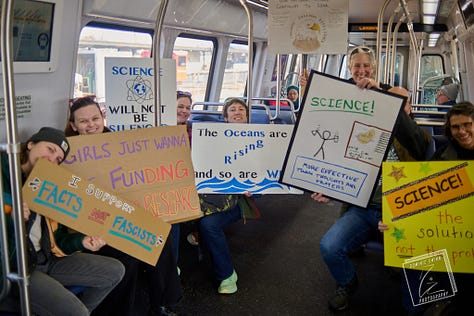
On Friday, nerds all over the US staged rallies to protest the Trump administration’s cuts to federal funding research. Thousands rallied on the steps of the Lincoln Memorial in Washington DC to plead about the benefits of funding science and research in the knowns, known-unknowns, and unknown-unknowns.
Like so many DC rallies before it, the steps of the Lincoln Memorial were transformed into a temporary stage. There wasn’t a big, black riser with rows of cameras and media crews. There weren’t throngs of journalists roaming around and shoving microphones in the faces of flag waving attendees. The crowd didn’t have any kind of uniform apparel, like colored hats and/or armbands.
With a few exceptions, like Bill Nye the Science Guy, and patients who owe their lives to federally funded medical research, a number of speakers were fairly boring. They stood awkwardly at podium and told corny jokes that fell flat. At one point, some of the older folks sang out-of-tune folk songs.
These were scientists. They proudly identify as nerds. They’ve dedicated their careers to saving lives and the planet we’ve all been mucking up for generations. And now many of them were facing unemployment because a merry band of bigots, buffoons, and bros decided science is, like, queer, or whatever.
People in the crowd cheered on speakers — their colleagues and fellow researchers — who lamented the loss of funding that didn’t just help find cures for cancers and disease, create new technologies, or reveal secrets of the universe; they were pissed there was no money for things like coolant used in specialized freezers that preserve decades of biological specimens.
Dr. Allison Agawu speaks to people protesting the Trump administration’s federal funding cuts during the Stand-Up for Science Rally in Washington DC, Friday, March 7, 2025. Photo by Dominic Gwinn.
“This will lead to more deaths,” summarized Dr. Allison Agawu, Professor of Adult and Pediatric Infectious Diseases at Johns Hopkins University School of Medicine. “Science is a beautiful art built on a canvas of ideas. The best science comes from diverse ideas, from diverse people with diverse perspectives, spurring innovation and progress … We collectively reject that inclusion, diversity, equity and access are bad words. In fact, programs championing these ideals should be celebrated and expanded, as that is how we get the best science and the best outcomes.”
A retired mathematician from the National Security Agency explained that it could be difficult for people to understand why research jobs were important. Not everything can be easily described in an elevator pitch. “Are there places we could cut,” they said, “Sure, but people just don’t understand what we do. We can’t talk about it. I know my work saved lives.”
Lloyd Franklin, 64, stood at the front of the stage wearing a blue NASA jacket. He is a retired aerospace engineer who, like many kids, grew up wanting to be an astronaut. He held a sign with a photo of Apollo astronaut Gene Cernan from 1972. Cernan is taking a selfie while holding the American flag as the Earth, a pale blue dot, floats in over his shoulder. It was the last time humans walked on the Moon.
Above the photo on Franklin’s sign were the words: “Science gave us this.”
“I know this is important,” Franklin said. “I know we have to make a stand.”
Lloyd Franklin, 64, protests the Trump administration’s federal funding cuts during the Stand-Up for Science Rally in Washington DC, Friday, March 7, 2025. Photo by Dominic Gwinn.
These types of protests have been happening almost daily over the last few weeks. Much of this is being carried out by federal workers themselves through private, encrypted chats and public message boards. Mustering a sizable crowd on short notice in the middle of the week in DC can be a Herculean task, but they have been showing up to protest regularly since congressional Republicans turned a blind-eye to Donald Trump’s sweeping cuts to federal agencies.
If they get any media attention, it’s from struggling freelancers or niche bloggers. National broadcasters or their local affiliates are not really showing up to show hundreds of federal workers protesting on the evening news. There’s a massacre being carried out in broad daylight and the pathetic reality is that much of the DC press corps is either too scared to do their jobs, or they just don’t care.


 Pax Christi, an international Catholic peace organization, was founded in France. From their website: “Pax Christi is a ground up organization – it began with a few committed people who spoke out, prayed and worked for reconciliation at the end of the second world war, and is now active in more than 60 countries and five continents, with more than 60,000 members worldwide.”