I love dogs and people. I want living creatures to thrive. I love to cook, and share the food, but ya gotta get in line in front of the dog, and greatest good luck with that!
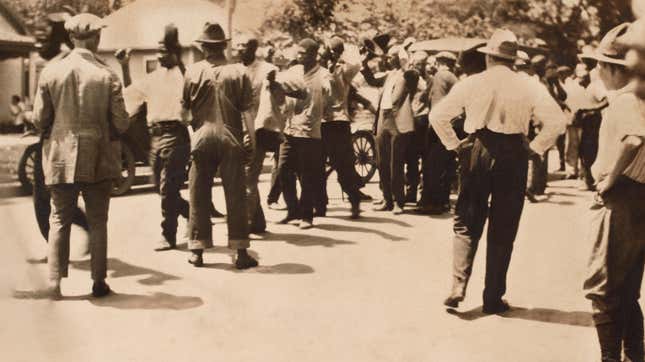
(However, it’s not well-known, it’s chilling, and it could be upsetting, so take only what you can take. It’s like Rosewood+Greenwood, plus yet more. -A)
Photo: Unidentified Photographer, June 1921 (Getty Images)
Most Black Americans have never heard of the Red Summer of 1919…but it is an element of Black history that we need to pay attention to. This country specializes in committing monstrous atrocities and then ignoring the consequences of their actions. It happened with Native Americans and the Trail of Tears. And, of course, it happened with Black folks. This truth is best captured when we consider what happened in the year 1919.
When Austrian Archduke Franz was assassinated on 28 June 1914, it set off a chain of events that led to what we now call World War 1. Working age white men were drafted and sent to fight, so that left many job vacancies in northern cities that Black men were happy to fill. See, Black folks were feeing the racist South hoping to find less racism in northern cites. The population of Black Chicagoans increased by more than 100% while the number of Black folks in Philadelphia grew by 500%.
While that was happening, 367,000 Black Americans either enlisted or were drafted into service to fight in the war that had just popped off. Black men were eager to prove to white America that Black people deserved dignity. They hoped they would see that by fighting in what white folks were calling ‘The Great War.’ But once the war ended, Black soldiers returned to an ungrateful nation. Thinking about these men, W.E.B. Du Bois wrote on May of 1919 in the NAACP’s Crisis newsletter, “We return. We return from fighting. We return fighting.”
Du Bois had no idea how prophetic his words would be. From May of that year to December, over 25 race massacres took place on American soil. More than 250 Black men, women and children’s lives were violently cut short. Black folks discovered that the racial violence they thought they escaped when they left places like Alabama and Mississippi was not a feature of Southern living. Instead, it was part of being Black in America.
Those white soldiers who came home and discovered that scores of Black people had moved to the north. They also found Black soldiers who felt that they had earned their place in American life by serving their country. An official put it like this: “one of the principle elements causing concern is the returned negro soldier who is not readily fitting back into his prior status of pre-war times.” Therefore, white soldiers became white terrorists to put these soldiers and anyone who looked like them back in their place. There were race massacres in Washington D.C., Omaha, Knoxville, and a massive race riot in Chicago where 38 people were killed and 537 injured. Few white people were arrested for these crimes, fewer were prosecuted. Two years later was the Tulsa race riot where the Greenwood district, what we now call Black Wallstreet, was burned to the ground.
As we celebrate Black History Month, we need to tell the entire truth of our history. Not just the accomplishments of men and women who embody Black excellence, but also the way that America has wronged us. The Red Summer of 1919 is one of those stories that we would like to forget. Yet don’t our accomplishments shine even more brightly considering the darkness we had to endure? No doubt we have endured days when hope unborn had died. But, somehow, against all odds, we came to the place for which our fathers sighed.
You can scroll down 3 grafs to get to the tools if you don’t care to read the words. I don’t want to lose the purpose within my words, like trees in a forest.
I consider myself a superlative networker. I can find people/things/articles/whatever and bring to them others who can use them. Scottie needed some help a few months back and gave me some space on his platform, and mostly, instead of writing my opinions about things which so many of us share already and read in lots of places, I’ve tried to go in the direction of supporting mental health, and things we can do to keep (or, these days, try to keep) our democracy (healthy) and fix things for people’s greater good. So, it’s true, other than a few comments and some original post titles, I don’t write much here; I network information. This post is from me, though.
We all know that I’m big on civic duties, having been practically brought up to do them, and believing in the rule of law and being loyal opposition when opposition supports the most people. So, when I do write things, typically it is with hopes of motivating or reminding others that we still have these duties and the rights to perform them; that letting these duties slide has helped bring us where we are; and, especially now, if we don’t use our rights and perform our duties, we lose the rights and can no longer perform the duties.
Which brings me to some tools. I’ve read EPI for years and years, and use their tools to help me lobby my legislators about issues that matter to most people. EPI has created a new set of tools, so I’m sharing them here in this post. I hope you managed to read through the previous grafs to get here, because this is important, and will be helpful to all of us as we do our work preserving democracy.
EPI Action is the home page. From here, you can scroll and click around to see what you want to see, and gain the tools to make your work easier. Yes, “EPI” stands for Economic Policy Institute (I think; they’ve been EPI now for so long, I may have messed that up.) And, yes, maybe someone thinks, “Hey, I only want to work on this, that, or the other, but not on economics.” Well, you can do that from here. EPI has information and tools to work with:
Learning About Wages, Jobs, and Inequality listing numerous items of data to peruse, including “Union membership rates and the union wage premium, Annual wages for select groups, including the top 1% and bottom 90% of wage earners, Racial and gender wage gaps, Unemployment rates, including by state, Poverty rates, Inflation rates”.
EPI has fact sheets you can use when you go to legislator town halls/forums, if that’s your thing, or to give away at a booth or a table if that’s your thing, or just to consult while you’re writing up a letter or email, or a script for calling, your legislators. Whatever your thing. If your thing is filing to run for office, EPI is a great information resource for use while campaigning and forming policy.
The Trump’s administration’s unprecedented war on LGBTQ+ health research—erasing data, censoring science and threatening lives—demands urgent resistance from the medical and research communities.
For the first time in a long time, I was scared. Two weeks after the election, I gave a lecture I’ve delivered countless times, on the critical need to measure sexual orientation and gender identity in health research. Such measures are necessary to identify the unique health needs of lesbian, gay, bisexual and transgender (LGBT) people. In my 25 years of doing research in and withLGBT communities, this is a topic that has shaped my career.
Yet this time, I began my lecture with a caveat: I was uncertain—and afraid—of what the new administration might mean for the hard-won progress we’ve made in LGBT health research, to say nothing of the civil rights gained for my community in the past 30 years.
Not only was my fear justified. It was understated.
The administration’s actions have been swift and ruthless. (snip)
The American Public Health Association filed a lawsuit to challenge federal funding freezes. The American College of Obstetricians and Gynecologists has publicly condemned censorship and used their website to post some of the purged data. Organizations that rely on federal data should publicly take a stand, much like the American Association for Public Opinion Research just did. These aren’t just commendable actions; they’re blueprints for what every medical and scientific organization should do immediately.
Academic publishers and journal editors can no longer remain neutral. They have an ethical imperative to actively resist censorship and protect academic freedom. Their platforms, influence and resources need to be deployed in this fight—now, not after more damage is done.
A commentary by editors of the British Medical Journal is an excellent example. In it, they forcefully decry the Trump administration’s ludicrous order for CDC scientists to withdraw or retract scientific articles containing the aforementioned forbidden words, plainly explaining, “This is not how it works.” Article retractions, they note, do not happen on demand. They happen when there is evidence of data fabrication or manipulation, not because of political pressure.
Some may imagine that silence in the face of injustice will shield them from harm, particularly if their work is seemingly unrelated to issues of sexual orientation, gender or gender identity. But when healthcare data and related research about LGBT groups are suppressed, it is not just scientific integrity that is undermined. We’re actively worsening health outcomes and costing lives. And this is a cost we allwill bear.
Strengthening our cross-issue collaborations and advocacy efforts is imperative. This crisis demands unprecedented coalition-building across scientific disciplines, civil rights organizations and public health institutions. The administration’s assault on LGBT people and health research, as well as science writ large, may seem overwhelming. They are counting on our paralysis and division. We should not—must not—fall prey to this tactic.
It the midst of this deliberately wrought chaos, we must also take care of each other and ourselves. We cannot let these actions crush our spirit and obliterate our hope. I have found comfort in the work of Rebecca Solnit, author of Hope in the Dark, who reminds us that hope is itself an act of resistance. “They want you to feel powerless and surrender and let them trample everything, and you are not going to let them,” she posted on her site, “Meditations in an Emergency,” recently. “The fact that we cannot save everything does not mean we cannot save anything, and everything we can save is worth saving.”
Science is worth saving. Speak up. Push back. Build coalitions. File lawsuits. Protect data. Continue research. The future of science and countless lives hang in the balance. We cannot wait another day. We will not surrender.
I don’t know about you, but I’m ready for the weekend. Living through an attempted coup is exhausting. And yet here so many of you are—more every day! Our movement, or whatever we’re calling it now, is growing by leaps and bounds. This newsletter has gained well over 50,000 new subscribers in the last thirty days. That’s NUTS, and also shows that Americans continue to be fired up and determined to fight back. I am so glad.
I know it feels like Trump and Musk are “getting away with everything” right now, but I want to remind you that, as they say in twelve step programs, sometimes we have to just “let time take time.” We’re not even a month into this thing yet. Already the country has seen large demonstrations, swamped Congressional phone lines, mass Senate office visits, the first Stop-Shopping day scheduled (for February 28), and the rise of the 50501 movement. Indivisible groups are exploding, new coalitions are being built, and new connections being formed.
This is a moment when old heroes to many—Adam Schiff, the New York Times, Snoop Dogg?—are proving disappointments, but also when new ones—Chris Murphy, the AP, Kendrick Lamar— are rising with brilliant fierceness. Entire media empires are crumbling, yes, but out of those ashes are emerging a whole new crop of great publications and tough, fearless journalists. Political content creators are taking their rising visibility seriously and forming new groups to coordinate their messaging. State Attorneys General and Governors are stepping up in a big way. Career Prosecutors at the DOJ are, as we speak, exhibiting stunning courage in standing up to Trump.
Progress, in short, is being made, and the work being done. Not always by whom we want, and not always as fast as we want. But that stands to reason: There is a massive and necessary reorganization taking place in response to Trump’s attacks. It can’t be instant—that simply defies the laws of physics. We’ve never been here before, so it stands to reason that none of the old rules apply.
So we’re all going to have to keep building the plane while flying it, remembering that new mechanics and pilots are joining us all the time.
Now a word about the many protests and strikes being planned. I have received a LOT of emails asking me for more information on the ones I’ve mentioned here. I have very little. These events are happening organically in a decentralized way. They are being organized on discords and in signal messages. I am not organizing them. What I put in the newsletter is the extent of what I know.
I did glean some helpful resources from a fellow activist today, though: This site is encouraging groups (not just of these events, but all groups doing on the ground actions) to list their events to create a centralized hub for movement work. You can search by state and see if there’s an action listed. You may also find some events on this website (although it is not organized in a way that is as user friendly). The 50501 Bluesky account is also sharing flyers for events as they learn about them. 50501 also has a Reddit page and a website. They seem to be emerging as a major force in this effort; I intend to follow them. And before you ask—no, I don’t know who “they” are. But last week’s 50501 protests went off without a hitch. I’m not going to keep avoiding them just because they have diffuse leadership. This just may be how resistance to an autocracy has to look. I’m grateful for the work they’re doing.
OK, all. I’m running way behind today, so I’m going to leave you with my favorite Vaclav Havel quote; I resort to it often in moments of duress:
Either we have hope within us or we do not.
It is a dimension of the soul and is not essentially dependent on some particular observation of the world.
HOPE is an orientation of the spirit, an orientation of the heart. It transcends the world that is immediately experienced and is anchored somewhere beyond its horizons.
HOPE in this deep and powerful sense is not the same as joy that things are going well or willingness to invest in enterprises that are obviously headed for early success, but rather an ability to work for something because it is good, not because it stands a chance to succeed.
HOPE is definitely not the same thing as optimism. It is not the conviction that something will turn out well, but certainty that something makes sense regardless of how it turns out.
It is HOPE, above all which gives the strength to live and continually try new things.
Hi, I’m a constituent calling from [zip]. My name is ______.
(snip)
I know Congress is going on recess soon and I’d like to know when the Senator is holding his/her Town Hall. We constituents have a lot to say about the coup attempt that’s happening and we expect an opportunity to have our voices heard. Thanks.
Hi, I’m a constituent calling from [zip]. My name is _______.
I am upset about House Republicans’ proposed cuts to SNAP and Medicaid. Grocery prices and hunger are increasing in the country. Cutting the program that helps over 42 million people put food on the table is unacceptable. Same with Medicaid. 72 million Americans rely on it for healthcare—mostly children, seniors, and veterans. Republicans’ desire to cut these programs in order to pay for tax cuts for rich people is disgusting. What is the Congressmember doing to protect SNAP and Medicaid? Thanks.
Extra Credit ✅
VERY IMPORTANT! A group of 17 states (all Republican) have sued the United States government in a case called Texas v Becerra. These states are asking the court to get rid of Section 504—a critically important law that says you can’t discriminate against disabled people if you get money from the US government. Section 504 does everything from requiring schools to include students with disabilities and help them learn to requiring doctors and schools to have sign language interpreters for people who are deaf and hard of hearing. There’s so much more. The fact that they’re suing to kill this rule is really shocking. I guess Texas started the lawsuit when they found out that gender dysphoria can get you 504 protections. But they’re not trying to get rid of just that provision. They’re trying to kill the whole thing.
One of my subscribers sent me a document that explains the situation in super clear language. It also gives us ways to reach out to the Attorneys General involved and ask them to drop the lawsuit. I’m asking all of us who live in one of the 17 states involved to take the time to do this, please.
The document is here. Please read it, share it, and, if you live in one of the 17 red states that are part of the lawsuit, use the sample letter as a template and write to (or call) your Attorney General. This MUST be stopped!
Extra Extra Credit for NY State Residents
You can do this if you’re not a NY resident but obviously it will pack more punch if you live there. There’s also an email form here.
Call Governor Kathy Hochul at 1-518-474-8390 and say:
My name is ____ and I live in [NY zip]. The Trump administration and NYC Mayor Eric Adams seem to have engaged in an overt quid pro quo – dropping the criminal case against Adams in exchange for the Mayor facilitating the Trump administration’s indiscriminate immigration crackdown. The Governor has the power to remove Mayor Adams. She needs to do so. He’s a criminal and a disgrace. Thanks.
Get Smart! 📚
As many of us engage on urgent threats to democracy, it is also vital to prepare and plan for the 2025 elections that will need a robust voter protection effort. Early planning and coordination will be key to protecting voters.
To help kick start that work, I’m pleased to announce a short Zoom presentation on February 25, convened by Voter Protection Corps and featuring voter protection experts analyzing the 2024 elections and providing insight into what to expect in 2025.
Please join them for this interactive virtual event.
Speakers: Caroline Hutton (Voter Protection Director, WisDems), Cecelia Ugarte Baldwin (Voter Protection Director, Democratic Party of Georgia), Jenny Guzman (Common Cause Arizona), Jesse Littlewood (Voter Protection Corps), moderated by Quentin Palfrey (Voter Protection Corps)
Date: Tuesday, February 25, 2025 Time: 5:30 PM – 6:30 PM ET
With RFK Jr. now the HHS Secretary access to abortions is more threatened than ever. I truly believe we’re going to see the FDA ban (or severely restrict) abortion pills soon. Fortunately the amazing org Plan C is not backing down.
From them:
At this time of uncertainty we know several things: evidence-based information is critical in healthcare and beyond. People will continue to have abortions. And the evidence shows that abortion pills are safe, effective, life-saving medications, whether obtained through a clinic visit, via telehealth, or as a self-managed option. Abortion pills are accessible in all states and territories, including states with heavy restrictions, and can be kept on hand for two years.
Here are a few specific actions people can take to protect this access. PLEASE share this information:
Learn about pills in advance. People can access highly affordable (as low as $70) abortion pills now before they need them, so they have access to this vital form of health care. Visit plancpills.org/pills-in-advance to learn more and find pill options.
Order Plan C stickers. To date, we’ve distributed more than 4M stickers that direct people to our website with accurate, up-to-date information about how people are accessing abortion pills. We plan to continue to share this information under a Trump administration. plancpills.org/stickers
Spread the word about resources. We encourage people to know about and bookmark the following resources which will have information on how to access abortion:
For pills by mail sources and info on using them, visit plancpills.org
For clinics, travel and pills by mail visit ineedana.com
And for a one-stop URL for reproductive access information, youhaveoptions.com.
Give 💰!
Movement Voter Project has just launched The Comeback Campaign: a plan for the first 100 days which is an all-hands-on-deck push to fund the most effective frontline groups around the country working to protect communities, block MAGA, and plant the seeds to win back power in 2026 and beyond.
Y’all, I’m doing a bit of work with Gay Valimont’s team to help publicize her upcoming special Congressional election in Florida. This race is a super long shot but in this climate I actually think a victory is possible. Watch the video for more info, then sign up to volunteer here or make a donation here.
Hey Missouri!
I’ve launched yet another state newsletter! This time it’s Missouri (here’s the link). My co-author is Anna Eggemeyer, a St. Louis-based activist, and we’ll be sending out legislative updates, actions, events etc. once every two weeks or so starting today. If you’re from MO, go check it out! Or if you know someone who is, send them the link. Thanks!
No Resistbot letter today, sorry!
OK, you did it again! You’re helping to save democracy! You’re amazing.
February 15, 1898 The man-of-war (battleship) USS Maine was sunk in Cuba’s Havana Harbor as the result of an explosion, 260 American naval personnel dying as a result, another 58 wounded. An insurrection against Spanish colonial rule in Cuba had persisted for years, and brutal Spanish tactics had engendered strong American reaction. That is why Consul General Fitzhugh Lee had asked President William McKinley to send the Maine “for the moral effect it might have.” Spain’s Governor-General Weyler had forced 300,000 Cubans into towns and cities to insulate them from the insurgents but had made no preparations for their food, housing or health care. Half of the reconcentrados, as they were called, died as a result. Pres. McKinley had tried since coming into office to reach a settlement through negotiation but Spain rejected his efforts. Following the sinking of the Maine, popular opinion in the U.S. moved toward war with Spain, partially in response to inflammatory press coverage. Congress then voted McKinley $50,000,000 to be used for the national defense at his discretion, and provided for a contingent increase of the army to 100,000 men. The cause of the explosion ???
February 15, 1998 About 2,000 people – including a tractor convoy consisting of over 100 farmers – staged a demonstration in the north German town of Ahaus in protest against the planned shipment of nuclear waste to a storage facility in the town. A consignment of full CASTOR (Casks for Storage and Transport of Radioactive Material) containers was expected at the Ahaus interim nuclear storage site within the next two weeks.
February 15, 2002 President George W. Bush approved Nevada’s Yucca Mountain as the site for long-term disposal of 70,000 metric tons (77,000 tons) of highly radioactive nuclear power plant waste. 12 years and $6.8 billion worth of study and construction had gone into the site 90 miles from Las Vegas. It is officially estimated that, by the time it is completed in 2017, the total construction cost will be $23 billion. 2000 additional metric tons of such waste are generated by U.S. nuclear power plants each year, leading to concerns that the facility would be full shortly after its opening. All such waste is currently stored onsite at individual nuclear power plants. Problems with the Yucca Mountain site What are the alternatives FAQs on Yucca Mountain
February 15, 2003 The world said NO to war… In the single largest day of protest in world history, millions on 6 continents demonstrated against the U.S./U.K. plans to invade Iraq. Reported totals included 1 to 2 million in London and Rome; 1.3 million in Barcelona, Spain (a city of 1.5 million); 500,000 each in Berlin, Paris, Madrid, and New York. Smaller demonstrations were held in over 600 cities and towns across the U.S., including tens of thousands in several cities, and 150,000 the following day in San Francisco. Total participation is estimated at 25 million in more than 100 countries.
This is your TPM evening briefing. By Nicole Lafond | February 13, 2025 6:27 p.m.
A federal district court judge issued a temporary restraining order Thursday afternoon blocking the enforcement of Donald Trump’s sweeping Jan. 28 executive order that sought to shut down medical care for trans youth under the age of 19 nationwide.
Judge Brendan Hurson of the U.S. District Court for the District of Maryland, a Biden nominee, issued the decision from the bench earlier this afternoon and a written order is due out soon.
The ruling puts Trump’s executive order on hold while the case moves forward.
During Trump’s second week in office, he signed an executive order that declared the U.S. will not “fund, sponsor, promote, assist, or support” gender transition for people under the age of 19. The executive order specifically sought to block trans youth from accessing gender-affirming medical care, such as blocking medical professionals from prescribing hormones or puberty blockers to patients under the age of 19. This executive order was separate from the one Trump signed on his first day back in the White House, which sought to enable discrimination against trans people across multiple agencies and departments within the federal government through a very specific and somewhat bizarre assertion that there are only two genders “at conception.”
Quickly after Trump signed the executive order seeking to ban gender affirming care for trans youth on Jan. 28, hospitals in Massachusetts, Maryland, Washington, Illinois, Colorado, Virginia, Pennsylvania, New York City, Los Angeles and Washington, D.C., among other places, announced their intentions to either suspend or review their care; many “abruptly halted medical care for transgender people under age 19, canceling appointments and turning away patients, including some who had been receiving this care for most of their life,” according to the ACLU, a plaintiff in the case that Hurson’s court is presiding over.
The ACLU, along with Lambda Legal and the ACLU of Maryland filed a federal lawsuit on Feb. 4, on behalf of trans youth and their families whose health care had been blocked in the immediate aftermath of Trump’s order.
In Thursday’s hearing, Hurson heard arguments from plaintiffs, who requested a temporary restraining order. Plaintiffs argued the EO was “unlawful and unconstitutional” because it violates anti-discrimination laws and attempts to block funds that have already been allocated by Congress.
The government argued that the executive order was not a ban on gender affirming care, but a “general policy directive,” claiming that the plaintiffs did not yet have grounds to sue, NBC News reported.
“In this situation, it is clear that these plaintiffs have received phone calls stopping their care, stopping their appointments, stopping their everything,” Hurson said during the hearing Thursday, adding that hospitals stopped care because of the order, which also seeks to prohibit federal funding of transition-related care for minors.
“I don’t know how you can credibly argue that this is not demanding the cessation of funding for gender affirming care,” he said.
Additionally, the executive order “seems to deny that this population even exists, or deserves to exist,” Hurson continued, according to the AP.
Lambda Legal told NBC News that they intend to request a preliminary injunction before the 14 days are up.
The foundation wants the court to cut their access to the Office of Personnel Management systems.
mariella moon Contributing Reporter Tue, Feb 11, 2025, 10:22 PM CST·2 min read
The Electronic Frontier Foundation, along with multiple federal employee unions, have filed a lawsuit against Elon Musk and his Department of Government Efficiency (DOGE) team to block their access to sensitive and identifying information on millions of Americans. Specifically, the plaintiffs are looking to block them from being able to access data stored by the Office of Personnel Management (OPM) and to delete any information they’ve collected so far. The lawsuit also names OPM and Acting Director Charles Ezell as defendants.
In early February, Reuters reported that Musk’s aides locked OPM employees out of the agency’s systems. “We have no visibility into what they are doing with the computer and data systems,” one of its sources said back then. The OPM has the largest collection of employee data in the US and contains sensitive information on both past and current federal employees, as well as on job applicants for federal positions who applied through USAJobs.gov. As the EFF notes, the agency’s records contain federal employees’ names, birthdates, home addresses, social security numbers, work experience, union activities, salaries, performance reviews, demotions, life insurance, death benefits as well as classified information NDAs. The list even includes the first names and last name initials of CIA employees in highly sensitive roles.
In its announcement, the EFF explained that the mishandling of information in OPM’s systems could lead to “significant and varied abuses,” and that DOGE’s “unchecked access” on its own puts federal employees at risk of privacy violations and even political pressure and blackmail. The foundation also emphasized the risk federal employees are facing with DOGE’s access to unrestricted information and Musk’s ownership of X. It cited Musk’s old tweets naming specific government personnels whose jobs he would cut even before he had access to OPM’s database. (snip-MORE)