I love dogs and people. I want living creatures to thrive. I love to cook, and share the food, but ya gotta get in line in front of the dog, and greatest good luck with that!
February 14, 1957 The organization that would shortly be called the Southern Christian Leadership Conference (SCLC) chose its leadership at a meeting in New Orleans. Reverend Martin Luther King, Jr. and Reverend Ralph David Abernathy led the group which sought to coordinate civil rights protests throughout the South. Organizers of bus boycotts, inspired by the one in Montgomery, Alabama, had met in Atlanta a month earlier. During that meeting, Dr. Abernathy’s home and church were bombed. Reverend Ralph David Abernathy and Rev. Martin Luther King, Jr. Southern Christian Leadership Conference history
February 14, 1971 President Richard Nixon ordered a secret taping system to be installed for his offices in the White House. Listen in on the presidents
February 14, 1989 At a meeting of the presidents of Nicaragua, Honduras, Guatemala, Costa Rica, and El Salvador, the Sandinista government of Nicaragua agreed to release a number of political prisoners and hold free elections within a year. In return, Honduras promised to close bases established by the U.S. for and used by the anti-Sandinista Contra rebels. Just over one year later, elections were held (with international observers including former President Jimmy Carter) though the nation was threatened with a continuing U.S. economic boycott, and was experiencing ongoing Contra violence. The Sandanista Front candidate was defeated 55% to 41%.
In Major Win For Trans Students, New Jersey Court Rules Against Forced Outing Policies by Erin Reed
The pair of rulings came in an environment where Trump and red states are pushing anti-trans policy across the United States.Read on Substack
Yesterday, the New Jersey Superior Court’s Appellate Division issued two unanimous rulings blocking forced outing policies in school districts across Morris and Monmouth counties. In mid-2023, Hanover Township Public Schools in Morris County, Marlboro Township Public Schools in Monmouth County, Middletown Public Schools in Monmouth County, and Manalapan-Englishtown Regional School District in Monmouth County implemented policies mandating the disclosure of a student’s transgender status to their parents. The policies varied in scope—some required notification only if a student formally changed their gender identity at school, while others mandated disclosure if a student merely mentioned being transgender in counseling sessions. Shortly after the policies were enacted, they were challenged in court and met with preliminary injunctions, preventing their enforcement. The appellate court upheld these injunctions yesterday.
The plaintiffs in both cases are New Jersey Attorney General Matthew Platkin and Sundeep Iyer, Director of the New Jersey Division on Civil Rights. The Attorney General’s office represented them in both cases. However, in Platkin et al. v. Middletown Township Board of Education et al., the American Civil Liberties Union and LGBTQ+ rights organization Garden State Equality filed amicus briefs in support of the plaintiffs. In Platkin et al. v. Hanover Township Board of Education et al., no amicus briefs were submitted. The cases were overseen by Judges Robert J. Gilson, Avis Bishop-Thompson, and Lorraine M. Augostini. Gilson was appointed by Democratic Governor Jon Corzine, while Bishop-Thompson and Augostini were appointed by Republican Governor Chris Christie. (snip-MORE)
Corewell, Largest Michigan Provider, Resumes Trans Youth Care Despite Illegal Trump EO by Erin Reed
On Wednesday, the hospital system announced that it was resuming gender affirming care after a brief pause due to Trump’s executive order attempting to ban it for those under 19.Read on Substack
In an announcement on Wednesday, Corewell Health, the largest healthcare provider in Michigan, stated that it would resume gender-affirming care for transgender youth under the age of 19. The decision follows a temporary halt in services to new patients after President Trump issued an executive order unlawfully claiming the authority to withhold federal funding from hospitals providing such care. Corewell Health is the first—and the largest—hospital system to reverse course after initially pausing treatment, a move that sparked nationwide protests against other healthcare providers that have yet to reinstate care.
The hospital, in a statement released Wednesday, said that its decision was always meant to be temporary, and that decisions around transgender healthcare best belong to patients and their doctors.
“We are lifting our pause on new hormone therapies for pediatric patients seeking gender affirming care. Care decisions are best made between physicians and their patients and families.
We briefly paused beginning these therapies to allow us time to assess the potential impact that recent policy changes might have on our patients and their health. Contrary to some inaccurate reports, we never suspended any gender affirming care for any of our patients.”
The decision to reinstate care is huge for Michigan transgender patients. The hospital system is the largest in the state, employing over 60,000 people. The LGBTQIA+ adolescent page for one of the member hospitals states, and stated through the closure, “The adolescent and young adult medicine team at Helen DeVos Children’s Hospital takes a holistic, individualized approach to patient care. We guide Michigan patients and their families through comprehensive education and an evidence-based approach. We know this is a challenging time for many of our patients and their families. No matter what is happening around us, we will always remain committed to providing high-quality care for all of our patients.” (snip-MORE)
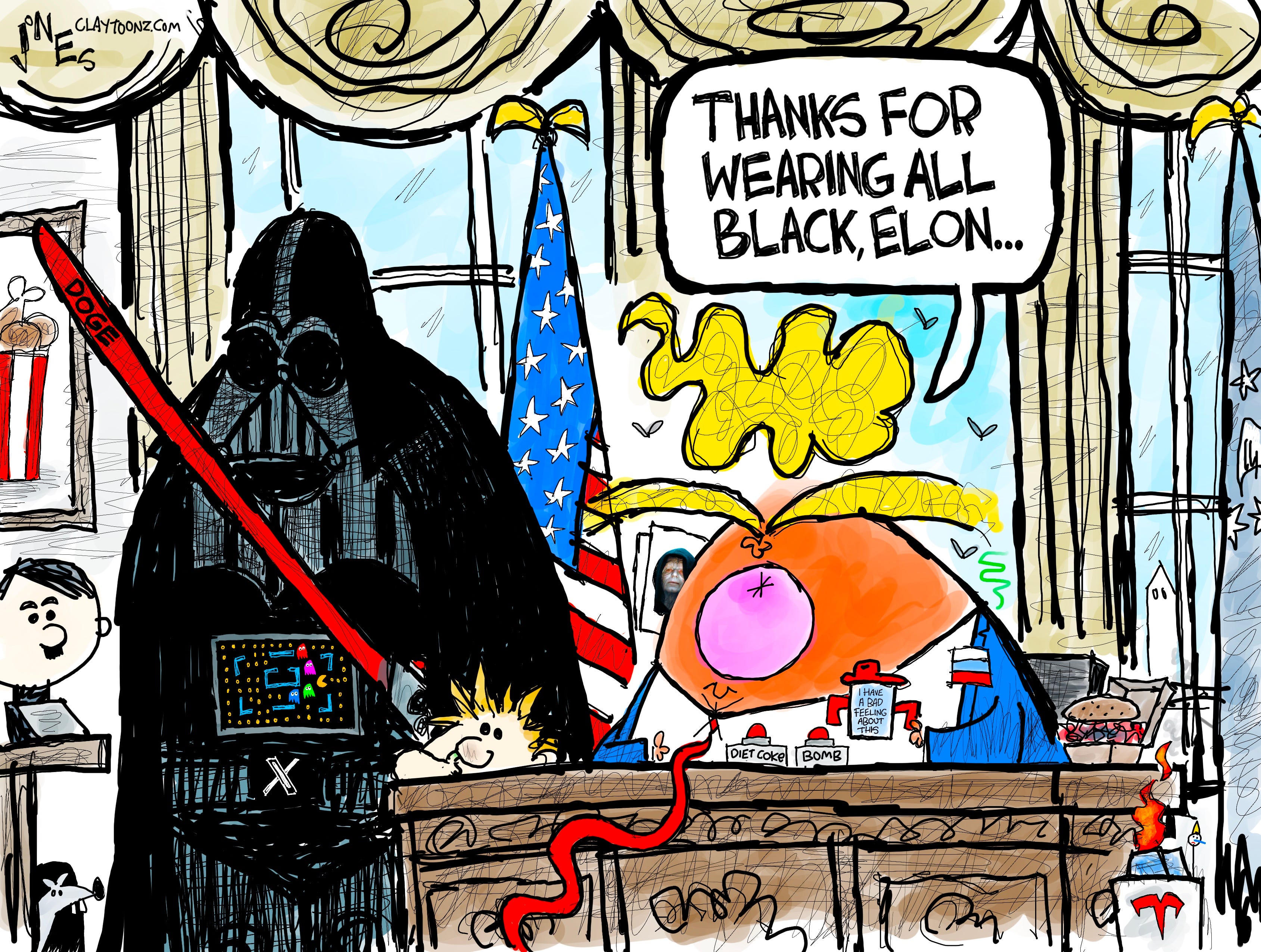
Elon Musk visited Donald Trump in the Oval Office yesterday and was a total disgrace.
Elon, who was in all black, wearing a black T-shirt and a black MAGA hat, said he was “open” and “honest” in his work finding waste and fraud in federal spending.
When asked about his lie that $50 million was spent on condoms for Gaza, Elon said, “Some of the things that I say will be incorrect and should be corrected. Nobody’s going to bat 1.000.” A good example of “some” of the things he says that are incorrect is his statement that DOGE was “open” and “honest.”
Before you tell a lie, like Elon’s condom bullshit, you can easily look up the facts, like when Elon lied about the last budget and claimed it included $300 billion for a football stadium in Washington DC, Congress would get a 40 percent pay increase, or that it funded bioweapons labs. Elon could have looked all this shit up before posting about it on his platform X/Twitter…over 100 times within 24 hours.
Unfortunately, we can’t fact-check Elon’s claims that the federal bureaucracy had been corrupted by cheats and officials who had approved money for “fraudsters.”
We can’t fact-check his claim that officials at USAID were taking “kickbacks.”
We can’t fact-check his claim that some officials “managed to accrue tens of millions of dollars in net worth while they are in that position.”
We can’t fact-check his claim that some people were receiving Social Security benefits at the age of 150.
We can’t fact-check his statement, “There are quite a few people in the bureaucracy who have ostensibly a salary of a few hundred thousand dollars but somehow managed to accrue tens of millions of dollars in net worth while they are in that position.”
The reason we can’t fact-check any of that is because Elon didn’t provide any proof of his claims and DOGE is operating in secret. There is no transparency with DOGE. None, nada, zip, zip, zippity-doo-dah, none.
Here’s a case of irony: The employee Musk claims made millions off the government had to file a financial disclosure form. Elon does not because Trump designated him a “special employee.” So just as we can’t see Trump’s tax returns, we can’t see Elon’s either.
When asked about the conflict of interest of him scouring billion-dollar contracts while his company Space X has billion-dollar contracts with the government, he said, “First of all, I’m not the one filing the contract. It’s the people at SpaceX or something.” As Sarah Marshall said in the great film Forgetting Sarah Marshall, “bullshit, bullshit, bullshit, bullshit.” It’s still a conflict of interest, even if he’s not lying.
Elon said, “I don’t know of a case where an organization has been more transparent than the DOGE organization. He also said, “We are actually trying to be as transparent as possible,” and then some more crap came out of his mouth when he said, “So all of our actions are maximally transparent.”
Bullshit, bullshit, bullshit, bullshit.
Without exhibiting any self-awareness, Elon said the bureaucracy is an “unelected, fourth, unconstitutional branch of government, which has, in a lot of ways, currently, more power than any elected representative. That might be the only thing Elon said that is true other than when he said, “There are boogers in my ears.” We’ll get to that.
Elon also lacked self-awareness when he said this bureaucracy “does not match the will of the people.” That’s true because nobody voted for Elon.
A lot of Elon/Trump defenders say we did vote for Elon because Trump said Elon was going to find government waste if he won the election. What Trump did NOT say was that Elon would fire people himself, cut government spending himself, gain access to all our financial information, or hire Nazis to help (which he has rehired after momentarily firing him).
Elon also really really really really really lacked all fucking self-awareness when he said, “The goal is to “restore democracy. If the bureaucracy’s in charge, then what meaning does democracy actually have?”
People like Musk and Trump don’t know the meaning of words like “democracy.” When they say “democracy,” they mean fascism. When they say “patriot,” they mean traitor beholden to Vladimir Putin, whom Trump surprised with a phone call today because it’s two days before Valentine’s. And when Trump says “vegetable,” he means ketchup.
Every MAGAt who defends Elon’s claims is too stupid to realize they don’t see any evidence of his claims. A few days ago, an Elon-defending MAGAt asked me, “What do you have against transparency?”. Again, total lack of awareness. People who defend Elon and Trump take them at their word, which is bizarre because they’re both huge sack-of-shit liars.
Trump and Elon talk about fraud and theft in the federal government while taxpayers are paying millions for Trump to sleep in his own bed at his bedbug-ridden golf resorts. Remember when Trump tried to host an international summit at one of his golf clubs? If you believe that was the best venue in the nation for a G7 summit, then let me sell you some golf club memberships and some bridges.
The only person who didn’t lie to the press in the Oval Office yesterday was Elon’s booger-mining kid, named X. At one point, X, who is Elon’s 11th child, stuck his fingers in his father’s ears…the same fingers he was picking his nose with. Trump seemed very uncomfortable with the kid in the room, probably because he’s jealous that X has at least outgrown his diapers. X can probably also hold a water bottle with one hand.
Elon wants to cut funding to feed children living in poverty, but his little trust-fund baby has so much White privilege that he gets to pick his nose in the Oval Office because his dad has so much White Privilege that he’s not required to wear a suit and tie in the Oval and instead can come dressed as a Bond villain.
Now there will have to be DNA experts to figure out which boogers under the Resolute Desk belong to Little X…and which belong to Trump.
February 13, 1912 Labor leader Mary Harris “Mother” Jones was placed under house arrest at Pratt (Kanawha Co.), West Virginia, for inciting to riot. An organizer for the United Mine Workers, she had come to the Paint Creek and Cabin Creek mines where a long and nasty struggle had escalated. Jones was known for her fiery (and often obscene) verbal attacks on coal operators and politicians. A native of Ireland, she had been organizing for more than 15 years.The coal operators had hired mine guards to intimidate the workers and discourage formation of a union. Besides asking to be paid what other area miners were making, the union demanded • the right to organize • recognition of their rights to free speech and assembly • an end to blacklisting of union organizers • alternatives to company stores • an end to the practice of using mine guards • prohibition of cribbing • installation of scales at all mines for accurately weighing coal unions be allowed to hire their own checkweighmen to make sure the companies’ checkweighmen were not cheating the miners who were not paid hourly, but by the ton. 68 years old (though claiming to be over 80) and suffering from pneumonia, Jones was never charged with a crime (martial law had been declared). A few weeks later, the new governor, Henry Hatfield, was sworn in and examined Mother Jones (he was also a doctor) but refused to release her from house arrest for two months. Mother Jones biography Mother Jones magazine (They have a great free newsletter!)
February 13, 1960 France became the world’s fourth nuclear power, conducting its first plutonium bomb test at the Reggane base in the Sahara Desert in what was then French Algeria. “Gerboise Bleue” was detonated from a 330-foot tower and had a yield of 60-70 kilotons (equivalent to nearly 70,000 tons of TNT).
February 13, 1967 Carrying huge photos of Vietnamese children who had been victims of Napalm (a flammable defoliant used extensively in the war there), 2,500 members of the group Women Strike for Peace stormed the Pentagon, demanding to see “the generals who send our sons to Vietnam.” When Pentagon guards locked the main entrance doors, the women took off their shoes and banged on the doors with their heels. They were eventually allowed inside, but Defense Secretary Robert McNamara would not meet with them. Senator Jacob Javits (R-New York) agreed to meet a few hundred of the women, but he was booed by the women when he denied the U.S. was using toxic gas in Vietnam.
February 13, 1968 Five soldiers were arrested at a pray-in for peace in Vietnam at Fort Jackson, South Carolina. Two were court-martialed for refusing to stop praying. The pray-in was repeated a year later.
February 13, 1991 Two precision-guided missiles destroyed the Amiriyah subterranean bunker in Baghdad while being used as an air-raid shelter by 408 Iraqi civilians during the first Gulf War. The resulting deaths of all inside made it the single most lethal incident for non-combatants in modern air warfare. The U.S. had detected signals coming from the bunker and considered it a military command and control center. There was an antenna atop the bunker but it was connected by cable to the actual command center 300 yards away, which was not hit by the 2000 lb. bombs which landed precisely on their intended target, penetrating ten feet of hardened concrete. Only 3% of the 250,000 bombs and missiles fired during that conflict were considered such “smart bombs.” Visitors tour the Amiriyah Bunker. The Iraqi government has preserved the bunker as a public memorial.
But please don’t delete without scrolling down to the Extra Credit item, which is of particular and specific pertinence to our interests here on Playtime, and just do that one if you can’t stomach bothering your congresscritters today. Seriously, just do the Extra Credit item-you won’t be sorry, and you will make a difference!!!Thanks, A.
I hope you’re hanging in there today. I know things remain gobsmackingly awful, but I remain cautiously optimistic that the opposition is at last finding its sea legs.
A few reasons for this are:
1) House Democrats announced this morning that they have formally established a Rapid Response Task Force and Litigation Working Group! Good! We need a committee specifically dedicated to this fight, and this one, it seems, will be. I also happen to know that a huge political influencer is meeting with the Democrats this morning (and all week) to teach them how to make effective posts for social media. It’s overdue, and I’m very glad it’s happening.
2) There are now several big rallies or actions in the works—a nationwide protest on February 17, a one-day general strike on February 28, and a “total shutdown” on March 15. I’m sure many more things are being planned. There’s also now a website for a General Strike, and 200K people—including me—have already signed a strike card. The organizers offer a weekly Discord discussion, by the way, if you have questions about how a general strike might work. All are welcome.
3) Finally, my sister Lily went to her first Indivisible meeting last night. She called me from her car—in high excitement, I might add—to tell me that the meeting, which was hosted by a brand new Indivisible group, Rockland Indivisible, was so full that she couldn’t even get into the parking lot of the library where it was being held! Cars were backed up on the freeway trying to get in! She eventually found parking a ways away and walked over, but the room was so full she couldn’t get inside. She listened from the hallway and was blown away by the energy and enthusiasm of the 300 people (!!) in the room. More were watching on Zoom. This kind of out-of-control enthusiasm for (and turnout at) a new Indivisible group is just wildly encouraging.
I could go on. It’s building. It’s coming. I feel it. We just need to keep fanning the flames.
Our job is to not quit while it’s hard. They want us to. They’re counting on it. They literally think we’re snowflakes. They think their orgy of destruction will force us to walk away in exhaustion.
They’re going to find out that they’re very wrong.
Breathe in strength. Breathe out fear. I’m not downplaying the danger. It’s real. I simply believe in our power more than I fear their malevolence. You should too.
Hi, I’m a constituent calling from [zip]. My name is ______.
I’m calling to demand that the Senator vocally support the Consumer Financial Protection Bureau and protect it from being dismantled by the Trump administration. The CFPB does vital work to protect consumers like me from being scammed by predators. A block to its funding is both illegal and also puts me at direct risk for financial harm. [H/T]
Speaking of which, almost everything Elon Musk is doing is illegal. Does the Senator stand for law and order or doesn’t s/he? If s/he does, then s/he needs to fight to take Congress’s power back. Agencies like the CFPB and USAID can’t be shut down without Congressional approval. That’s the LAW. Standing up for it is literally the Senator’s job. Thanks.
Hi, I’m a constituent calling from [zip]. My name is _______.
[If Republican:]
I’m calling in strong opposition to defunding USAID. Why is Congress letting Musk do this? It’s illegal. Any closing of an agency established by Congress can only be approved by Congress. Also, USAID gives the US massive influence overseas, it keeps diseases at bay, and it gives U.S. farmers a place to sell their produce. By gutting it you are hurting Americans. Please restore support for USAID immediately. I didn’t vote for Elon Musk and I’ll be damned if I’m going to let him hurt my country. Thanks.
[If Democrat]
I’m upset about the gutting of USAID. I appreciate Democrats’ support for it, but the message needs to be stronger, louder and more effective. Congress needs to take its power back—any major reform or closing of an agency established by Congress can only be approved by Congress. More needs to be done now to stop the dismantling of USAID and other vital agencies, and to provide appropriate protections to the federal workforce. Thanks.
The Children’s Hospital of Los Angeles, a former leader in gender-affirming health care in the bluest of blue states, has stopped offering vital health care to new patients, cancelling scheduled appointments for hormone treatments. We know that a lack of access for trans kids leads to higher rates of depression and suicide so we must call this out for what it is, a callous and fear-based decision to capitulate in advance to a transphobic White House trying to rule by Executive Order. Gender affirming care is protected under California state law so denying this care is also illegal.
CHLA’s patient relations line is 323-361-4682 (you have to let the entire outgoing message play to get to the VM. The “press pound” function doesn’t work.
Say something like:
My name is ____ and I am deeply disappointed by CHLA’s decision to stop providing gender-affirming care to new patients. This sends a terrible message to the rest of the country that even hospitals in blue states are unwilling to provide vital healthcare for trans patients. It also goes against California State Law. Please reverse this horrible decision. It will only lead to increased rates of depression and suicide for trans children. Thank you.
You can also call California Attorney General Rob Bonta. He’s written a letter to put CHLA on notice, but needs to know that is not enough. His office’s number is 1-800-952-5225 (press 1 for English, then 7 to leave a message). If you live in CA be sure to say that but you can call even if you don’t.
My name is ____ and I want to make sure you’re doing everything you can to protect trans kids in our communities. I was extremely disappointed to hear that Children’s Hospital of LA recently stopped providing gender-affirming care for new patients. This sets a dangerous precedent for other medical providers in California and violates the Unruh Civil Rights Act. I understand your office has put CHLA on notice but we need you to do more until this dangerous decision is reversed. Thank you.
Get Organized
Join Indivisible’s weekly discussion with co-founders Ezra Levin and Leah Greenberg on Thursdays, 3pm ET/12pm PT.
When horrendous news comes at us as fast as it has the last few weeks, the only way to process it and stay grounded is to come together in community and discuss what’s happening. And, more importantly, discuss how we fight back. I can’t adequately describe how helpful these weekly Indivisible calls are to me. Ezra and Leah are so smart, so strategic, and so tough. They give me a lot of hope.
Want to stay apprised of what’s happening in the news but need it in a not-overwhelming format? I really like Matt Kiser’s Substack “What the F**k Just Happened Today?” (The actual name contains the full curse word, so if that’s a dealbreaker don’t click on it.)
Matt describes it this way:
WTF Just Happened Today? is a clear, once-a-day newsletter helping normal people make sense of the news. It’s curated daily and delivered every afternoon around 3 pm PT.
My job is to help distill news that deserves attention into a clear, understandable, and accurate first draft of history for normal people who might not otherwise engage with the news. WTFJHT covers the news through the lens of the executive branch specifically – and the president in particular – followed by the legislative and judicial branches in general, and in that order.
I find it to be a useful way of keeping track of the top headlines without drowning in information overload. Maybe you will, too. Check it out here.
Messaging! Messaging! Messaging! 📣
Truth Bombing is a new means of communicating that tackles the misinformation problem. Learn to use your creativity and social media to create & distribute pro-democracy messaging where it will do the most good.
This is Civic Sunday’s 6th zoom about it, by popular demand. Thursday Feb 13, 2pm PST/5pm EST.
Join Grassroots Democrats HQ and WisDems to make calls to voters for the Wisconsin Supreme Court election! Join them every week on Wednesdays to recruit volunteers from 3-5pm PT/6-8pm ET and Sundays to contact voters from 10am-12pm/1pm-3pm ET.
You’ll be making calls to talk to voters in Wisconsin about what issues are important to them & the importance of the Supreme Court Race and Spring Elections!
First time making calls? Phone banking is easy, fun, and rewarding! You’ll receive comprehensive training at the start of your shift.
Right now, ICE agents and other federal immigration officers are racially profiling and detaining U.S. citizens and people with valid visas because of how they look. For example, some Native residents of Arizona and New Mexico have already been questioned or detained by federal immigration agents. Some federal agents have also rejected Tribal ID cards or Certificates of Degree of Indian Blood (CDIB) as proof of citizenship. In response to these civil rights violations, Tribal leaders across the country are encouraging their members to carry documentation and to know their rights if ICE agents stop them on the street or knock on their door.
In these ICE roundups, federal agents are also violating people’s constitutional rights — which apply regardless of immigration status — by arresting people without reasonable suspicion. Additionally, although being here as an undocumented person is a civil violation and not a crime, federal agents are arresting undocumented people who have no criminal records.
Please do everything in your power to stop the presidential administration’s illegal and unconstitutional actions, including by rejecting Trump nominees who plan to break the law, speaking out forcefully to pressure the White House to walk back violations of the law, refusing to fund immigration raids and detention, and conducting oversight visits of immigration detention centers. Immigrants and Indigenous people make America great. Thanks.
OK, you did it again! You’re helping to save democracy! You’re amazing.
Feb. 12th always reminds me of the time we were sitting in a Wendy’s eating on the way to/from a karate tournament. Someone in the restaurant sneezed (it wasn’t crowded,) and I automatically said “God bless you!” then the kid said, “Science could have prevented that.” It was pretty awesome. Happy Darwin Day!
February 12, 1809
Charles Robert Darwin, who first described the process of evolution of species in the plant and animal kingdoms through natural selection, was born. It is now celebrated as Darwin Day, when the common language of science, bridging language and culture, is recognized and appreciated.
Darwin Day ideas ================================================ February 12, 1909 The National Association for the Advancement of Colored People (NAACP) was founded by sixty Americans, both black and white, in a call to safeguard civil, legal, economic, human, and political rights of black Americans. The call was partly in reaction to a race riot in 1908 in Springfield, Illinois, home of Abraham Lincoln. The call was issued on the centennial of his birth, and principally written by Oswald Garrison Villard, president of the N.Y. Evening Post Company: “If Mr. Lincoln could revisit this country in the flesh, he would be disheartened and discouraged.” Oswald Garrison Villard NAACP’s beginnings ================================================== February 12, 1947 An estimated 400-500 veterans and conscientious objectors from World Wars I and II burned their draft cards during two demonstrations, in front of the White House and at New York City’s Labor Temple, in protest of a proposed universal conscription law. This was the first peacetime draft-card burning. ================================================== February 12, 1993 About 5,000 demonstrators marched on Atlanta’s State Capitol to protest the Georgia state flag (on left) because its principal element was the Confederate battle flag. That flag was adopted in 1956 by the state legislature in reaction to the Supreme Court decision of Brown v. Board of Education ordering the racial integration of public schools. Several newspaper editorials opposed the flag as well as 18 local patriotic organizations, including the United Daughters of the Confederacy, stating the flag “would cause strife.”
In 2001 the Georgia state flag was redesigned, shown above. ==================================================== February 12, 1997 In “Prince of Peace Plowshares,” six activists poured blood and symbolically disarmed U.S.S. The Sullivans, a nuclear-capable Arleigh Burke-class destroyer, at the Bath Iron Works in Bath, Maine. All were eventually convicted of destruction of government property and conspiracy. Read more about this action
with which to address and direct our government, the American Bar Association has provided very good such words. I was thinking I was going to make this a morning post, but I’m going ahead and publishing so people can get to work in the morning. Thanks for everything you can do! It matters, and we have to really push our legislators to do the right things, now more than ever before in my own lifetime, and I thought that was when we invaded Iraq. This is exponential amounts of that.-A.
The American Bar Association Pulls The Fire Alarm by Rebecca Schoenkopf
Yesterday, the American Bar Association did something it pretty much never does: It spoke out on politics. If you’re a cow with a head injury or an alien from outer space or a typical Trump supporter, you might think the organization is being partisan in so doing, but that word doesn’t apply when the president and his party are in the midst of committing a Nazi terrorist attack to destroy the United States once and for all, and with it, the Constitution, the rule of law, and the rest of our 249-year experiment.
But that’s what’s happening, which means groups like the ABA must speak out. It’s not the kind of thing that’s going to make a ripple at the next Make Cousins Love Again Trump Nazi Jamboree in Pig Whistle, Alabama, but it might be instructive for some of the real lawyers currently trading their integrity and legal ethics to work for Donald Trump, or real lawyers quietly hanging on in government agencies facing a choice over whether or not to do that.
Y’all know how lawyers who work for Trump tend to get disbarred, right?
The Trump regime, unsurprisingly, is being very clear that if the choice for lawyers is between following the law and breaking it for Trump, they’ll pick the latter every time. Pam Bondi’s Justice Department has already let it be known in no uncertain terms that their alliance is to den Führer.
Letters have been drafted begging the ABA to stand up against the two-bit dictator. The ABA has already had to come out in opposition to Trump’s executive order threatening targeted investigations into DEI in bar associations of all kinds, at all levels. The clear implication being that if you speak out against Stupid Hitler in any way, Stupid Hitler will target you. NBC News has much more on what the conversations surrounding bar associations are looking like right now.
Now we have this very long statement from Bill Bay, the president of the ABA. Again, if you’re a MAGA Nazi supporter, it might seem “partisan.” To normal people who don’t hate America and everything it stands for, it’s just patriotic.
The full statement, which is titled “The ABA Supports The Rule Of Law,” with a few things bolded for emphasis:
It has been three weeks since Inauguration Day. Most Americans recognize that newly elected leaders bring change. That is expected. But most Americans also expect that changes will take place in accordance with the rule of law and in an orderly manner that respects the lives of affected individuals and the work they have been asked to perform.
Instead, we see wide-scale affronts to the rule of law itself, such as attacks on constitutionally protected birthright citizenship, the dismantling of USAID and the attempts to criminalize those who support lawful programs to eliminate bias and enhance diversity.
We have seen attempts at wholesale dismantling of departments and entities created by Congress without seeking the required congressional approval to change the law. There are efforts to dismiss employees with little regard for the law and protections they merit, and social media announcements that disparage and appear to be motivated by a desire to inflame without any stated factual basis. This is chaotic. It may appeal to a few. But it is wrong. And most Americans recognize it is wrong. It is also contrary to the rule of law.
The American Bar Association supports the rule of law. That means holding governments, including our own, accountable under law. We stand for a legal process that is orderly and fair. We have consistently urged the administrations of both parties to adhere to the rule of law. We stand in that familiar place again today. And we do not stand alone. Our courts stand for the rule of law as well.
Just last week, in rejecting citizenship challenges, the U.S. District Judge John Coughenour said that the rule of law is, according to this administration, something to navigate around or simply ignore. “Nevertheless,” he said, “in this courtroom and under my watch, the rule of law is a bright beacon which I intend to follow.” He is correct. The rule of law is a bright beacon for our country.
In the last 21 days, more than a dozen lawsuits have been filed alleging that the administration’s actions violate the rule of law and are contrary to the Constitution or laws of the United States. The list grows longer every day.
These actions have forced affected parties to seek relief in the courts, which stand as a bulwark against these violations. We support our courts who are treating these cases with the urgency they require. Americans know there is a right way and a wrong way to proceed. What is being done is not the right way to pursue the change that is sought in our system of government.
These actions do not make America stronger. They make us weaker. Many Americans are rightly concerned about how leaders who are elected, confirmed or appointed are proceeding to make changes. The goals of eliminating departments and entire functions do not justify the means when the means are not in accordance with the law. Americans expect better. Even among those who want change, no one wants their neighbor or their family to be treated this way. Yet that is exactly what is happening.
These actions have real-world consequences. Recently hired employees fear they will lose their jobs because of some matter they were assigned to in the Justice Department or some training they attended in their agency. USAID employees assigned to build programs that benefit foreign countries are being doxed, harassed with name-calling and receiving conflicting information about their employment status. These stories should concern all Americans because they are our family members, neighbors and friends. No American can be proud of a government that carries out change in this way. Neither can these actions be rationalized by discussion of past grievances or appeals to efficiency. Everything can be more efficient, but adherence to the rule of law is paramount. We must be cognizant of the harm being done by these methods.
Moreover, refusing to spend money appropriated by Congress under the euphemism of a pause is a violation of the rule of law and suggests that the executive branch can overrule the other two co-equal branches of government. This is contrary to the constitutional framework and not the way our democracy works. The money appropriated by Congress must be spent in accordance with what Congress has said. It cannot be changed or paused because a newly elected administration desires it. Our elected representatives know this. The lawyers of this country know this. It must stop.
There is much that Americans disagree on, but all of us expect our government to follow the rule of law, protect due process and treat individuals in a way that we would treat others in our homes and workplaces. The ABA does not oppose any administration. Instead, we remain steadfast in our support for the rule of law.
We call upon our elected representatives to stand with us and to insist upon adherence to the rule of law and the legal processes and procedures that ensure orderly change. The administration cannot choose which law it will follow or ignore. These are not partisan or political issues. These are rule of law and process issues. We cannot afford to remain silent. We must stand up for the values we hold dear. The ABA will do its part and act to protect the rule of law.
We urge every attorney to join us and insist that our government, a government of the people, follow the law. It is part of the oath we took when we became lawyers. Whatever your political party or your views, change must be made in the right way. Americans expect no less.
– William R. Bay, president of the American Bar Association
Again, if you’re a Nazi Republican, that probably feels like an attack. All good and true things feel like attacks to Nazi Republicans, we reckon.
This is a plea to lawyers to remember that they’re lawyers and act accordingly, unlike the freaks Trump has installed atop the Justice Department and in OMB and everywhere else, many of whom have represented Trump so many times that the concept of legal ethics is probably a foreign language at this point. (Use it or lose it! It applies to high school Spanish and also legal ethics, we guess.) And it’s a plea to elected officials to at least pretend like they weren’t making jerk-off motions behind their backs when they took their oaths.
Note that the full statement, while referring to specific things, doesn’t invoke the dictator by name. That seems intentional.
Bay said last week at a speech in Phoenix that the ABA “will not shrink from the things we believe in.” More:
“We will stand tomorrow for what we stand for today and what we stood for yesterday: the rule of law, the importance of our judicial system, the essential role of lawyers, an inclusive profession,” he said. “These are our north stars. We will hold fast to our core principles in the face of shifting winds.”
Bay closed out his speech to a standing ovation, saying, “I believe this will be our finest hour.”
We certainly hope so. The times we live in require it.
EJ Dionne quotes Erwin Chemerinsky, dean of UC Berkeley Law, who emphasizes that “We are in the midst of a constitutional crisis right now. There have been so many unconstitutional and illegal actions in the first 18 days of the Trump presidency. We never have seen anything like this.” It’s not coming. We’re in the thick of it. The speaker of the House — an avowed Christian extremist insurrectionist — will not say out loud that Trump and Elon Musk should obey court orders. JD Vance and Elon Musk are pretty sure the answer to that is “no,” and that courts should have to physically make them obey orders.
Because guess what? The speaker of the House is one of those domestic enemies people swear to protect America from, and so is the president, and so is the vice president, and so is their unelected South African apartheid terrorist buddy.
because I’m somewhat compulsive about clutter, but everytime I finish one, I think, “I need to post that,” so I can’t close them. I’m going to do another multi-post here; links and a snip, but all are good/important/pertinent to our interests, so enjoy/read, anyway, these stories.
==========
Salient points in this one, and she’s not the only one to whom this has occurred:
<snip> So, the Bush folks felt ecstatic when they got the White House–finally! In 2001. After two long terms of the Bubbas! The grown-ups were in charge! And they pretended the little thing with the missing “W”‘s was a big old riot of Democrat malfeasing–
And they didn’t have their eye on the ball about the PDB that said Bin Laden was planning an attack on our soil.
This is where I think the Trump people are. Trump is off-gassing about “owning” Gaza, He wants to ship about 2 million human beings who have already been through some major shit to Jordan or Egypt. These countries obviously don’t want to be responsible for about 1 million each refugees. Trump should know that, because he doesn’t want any kind of refugees, ever, here in the US.
He’s taking out experienced foreign office and military professionals, He’s offending the hell out of our allies, and making the likelihood of sharing intelligence less favorable. He’s putting in naifs and flakes in important roles.
And then says really offensive shit absolutely guaran-damn-teed to stir up some pot somewhere.
It’s like he figured out antifa isn’t going do a Reichstag with any credibility, so he needs an international crisis to go create bizarre national powers for himself. <snip>
<snip> Not to be all Cassandra about it, but a very big part of the problem is that we are incapable of anticipating what Donald Trump can whip up in his imagination.
Like you know how sometimes you wake up from a dream and you say “oh my god I just had the funniest dream that the dog wouldn’t stop laughing, and her laugh sounded like James Earl Jones!!” and everyone is just thinking “stop telling me about your dreams.”
I think he wakes up from his dreams and says “I am the boss of Canada now.” Or, he takes an elderly man’s nappie-poo in the afternoon, wakes up groggy, slurps a Diet Coke and muses “wouldn’t it be fun to do a WWE RAW in the Concert Hall at the Kennedy Center? The acoustics are huge.” “Or what about one of those cool political rallies where we all do this random gesture together because no one is capable of stopping us?”
Well, we better damn well figure out how to stop this mayhem, because we are learning that things change quickly and without warning. <snip>
CHAPIN, S.C. (AP) — Rep. Nancy Mace of South Carolina on Monday used a nearly hour-long speech on the U.S. House floor to accuse her ex-fiancé of physically abusing her, recording sex acts with her and others without their consent, and conspiring with business associates in acts of rape and sexual misconduct.
Mace said she was speaking out because her home state’s top prosecutor didn’t take action even after she alerted investigators. That same prosecutor is likely to be Mace’s opponent if she runs for governor of South Carolina in 2026, which she is considering. <snip>
The AP wasn’t able to independently verify Mace’s claims. Bryant told AP: “I categorically deny these allegations. I take this matter seriously and will cooperate fully with any necessary legal processes to clear my name.”
Mace accused South Carolina Attorney General Alan Wilson of slow-walking any investigation of Bryant and the other men after she brought the photos and video to state authorities.<snip>
Mace, 47, won a third U.S. House term in November and has said that she is “seriously considering” a 2026 run for South Carolina governor. If she enters that race, she will likely face Wilson — in his fourth term and also the son of Rep. Joe Wilson — in the Republican primary. <snip-the whole thing makes better sense as a whole, but not a lot more sense.>
Civil rights lawyer Sherrilyn Ifill, on setting realistic expectations and saving enough of the foundational bricks of democracy to be able to rebuild in the future:
The truth is that we will NOT be able to stop every terrible thing that this administration seeks to do. Elections really do have consequences – as many of us tried with tremendous urgency to make clear last year. But we can slow things down, win some battles, throw sand in the gears of others. If we save some lives, some jobs, some critical government agencies, some measure of press freedom, some medical and subsistence benefits, academic freedom for some schools and universities, and protect the dignity, safety and constitutional rights of some of our most vulnerable fellow Americans, it will be worth it.
And it will be from whatever remainder of democratic structure, values, and policies we are able to protect that we will have the space and platform on which to do the work of building an urgently needed new democracy in our country. So our fight today is worth it.