I love dogs and people. I want living creatures to thrive. I love to cook, and share the food, but ya gotta get in line in front of the dog, and greatest good luck with that!
February 6, 1899 Spain agreed to abandon all claims of sovereignty over Cuba, the cession of Puerto Rico and Guam, the cession of the Philippine Islands; and in exchange the U.S. agreed to pay $20,000,000 in a treaty ratified by the U.S. Senate on this day. The previous July the U.S. took control of Gantanamo Bay, blockaded Cuba’s other ports and destroyed the Spanish fleet at Santiago Bay. The U.S. Army, landed at Guanica, near Ponce, Puerto Rico, and shortly took possession of the island with the exception of San Juan. The Spanish Pacific fleet was destroyed and the U.S. took control of Manila, the capital, and Luzon, the main island of the Philippines a few weeks later.
February 6, 1943 The U.S. government required the 110,000 disposessed Japanese Americans forcibly held in concentration (internment) camps to answer loyalty surveys. Some of the interned were U.S. citizens, and some volunteered to serve in the armed forces during the war with Japan. The Nisei, as they were known, were kept in the camps until the end of World War II. The Manzanar Relocation Center, a one of the concentration camps where Japanese-Americans were forced to live throughout World War II.
February 6, 1956 Autherine Lucy was excluded from classes just three days after becoming the first black person allowed to attend the University of Alabama. Her suspension “for her own safety” followed three days of riots over her Supreme Court-ordered enrollment. Autherine J. Lucy and her attorney Thurgood Marshall Crowds of students, townspeople and members of the Ku Klux Klan shouted, “Kill her!” among other things. It is unclear why the University did not suspend the students who were among the rioters. Lucy had originally applied for graduate study in library science in 1952, and had been accepted until the University realized her race, and claimed state law prevented her admission. A graduate of traditionally black Miles College, she was only admitted with the help of the National Association for Colored People Legal Defense and Education Fund (NAACP-LDEF) and lawyers Thurgood Marshall (later a Supreme Court justice), Constance Baker Motley (future federal judge) and Arthur Shores (elected to Birmingham City Council). Read more
February 6, 1959 The United States successfully test-fired its first intercontinental ballistic missile (ICBM), known as Titan, from Cape Canaveral. It was a two-stage rocket designed to carry nuclear warheads.Titans were also capable of boosting satellites and spacecraft into orbit. Before the last was produced in 2002, they launched several two-man Gemini missions in the 1960s and launched the first spacecraft to land on Mars. First test launch of Titan booster rocket from Cape Canaveral, Florida.
February 6, 1961 The civil rights jail-in movement began when ten negro students in Rock Hill, South Carolina, were arrested for requesting service at a segregated lunch counter. They refused to post bail and demanded jail time rather than paying fines, refusing to acknowledge any legitimacy of the laws under which they were arrested. More about Charles Sherrod Reverend Martin Luther King, Jr. wrote to Charles Sherrod, Diane Nash and the others in jail: ‘‘You have inspired all of us by such demonstrative courage and faith. It is good to know that there still remains a creative minority who would rather lose in a cause that will ultimately win than to win in a cause that will ultimately lose.’’
February 6, 1985 The Molesworth Common Peace Camp, just outside the Royal Air Force Base there, was evicted by the British Army. The 300 inhabitants and their many supporters had been nonviolently protesting the siting of nuclear-tipped U.S. cruise missiles at the base. Peace camps were established at several locations in Europe in the early 1980s to protest the destabilizing nuclear weapons buildup. Molesworth Common peace camp
The world is on fire and none of us can do much to stop it on our own, but we can each do a little to stop it, and those actions add up to a massive resistance.
Red state residents recognize the shock and awe doctrine that we are all seeing from the first few days of the Trump administration. It’s something we have a lot of experience working with. Our nervous systems are already familiar with the constant attacks on democracy — the constant need to keep up with our lawmakers and pushback on our lawmakers.
I live in Missouri. I have lived under the tyranny of a GOP supermajority for two decades.
It’s not easy, but I have learned to make calls and post and write and then get outside. Do the work and take a break.
My emboldened lawmakers do whatever they want. They will not honor the will of the people and they need constant pushback from the people. We have been fighting in this way for over two decades.
The only way to stop them is through constant resistance. Because screw them and their authoritarian instincts. We didn’t elect Kings and I won’t have a boot on my neck and I won’t stand for one on my neighbor’s neck.
We can’t be shocked into silence.
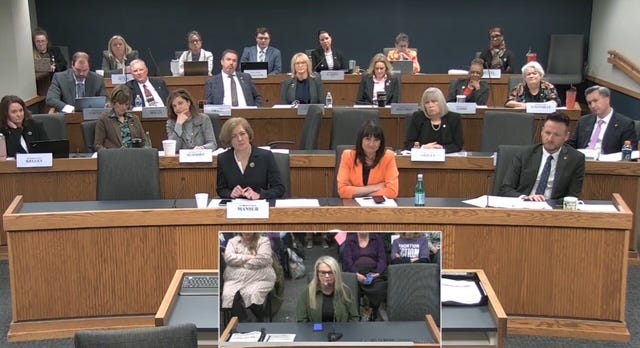
My testimony against SJR 54, Jefferson City, MO. 2/4/25.
Yesterday, I drove to the Missouri Capitol to testify against something that has already been resolved. Abortion.
I thought I would share my testimony to the committee. This was my one thing yesterday. This was my act of defiance and resistance.
Here is my testimony:
Hello. My name is Jess Piper and I am here to testify against HJR 54. This resolution is an attempt to overturn the will of Missouri voters.
The Republicans who are behind this fake resolution claim to represent rural people. They don’t and I am here to set that record straight.
I am a rural mom to five and grandmother to four. I live in Northwest Missouri and I am angry about the overreach of the Missouri GOP. I am here to testify on the disrespect – the absolute disdain – shown to every Missouri voter by some of the folks in this room.
Amendment 3 passed in Missouri. There is no reason why I had to drive eight hours round trip to testify against an abortion restriction. Why can’t you just accept the will of your constituents?
I collected signatures for Amendment 3 in some of the most rural areas of this state. Brookfield is a town of 4,000 and when I pulled up to set up my table and gather signatures, there were folks in the parking lot waiting. A woman signed her name and then texted her Bible group to remind them to come sign the amendment.
Ever heard of Marceline? The town has a population of 2,000. A woman I met in Marceline chored her animals and farm – and then came to sign the amendment in overalls and mucks.
She knew what she was signing, and I am here to give her voice. It’s hard to get your chores done and make it all the way to Jeff City to testify against legislation and your own lawmakers who won’t honor your vote or your voice.
I bet many of you know where Maryville is. We were able to get a few hundred signatures in that town. Maryville is a “huge urban space” in the middle of cornfields, population 11k. They even have a Starbucks. I sat at that coffee shop for hours one afternoon to get signatures. When I was about to pack up, a man named Gordon came in to add his name to the petition.
Gordon is 86 years old. He uses a walker and drove all the way to town and proudly signed his name to a petition to make sure his great-granddaughters would not suffer under the tyranny of an abortion ban.
I am here to remind you that lawmakers who would overturn the will of Missourians should remember they serve the folks who sent them here, and many of those folks voted to approve abortion rights in this state.
Those people include the Bible group from Brookfield and the farmer from Marceline and the great-grandfather from Maryville.
I am also here to express my disgust with the Missouri GOP. You claim to be the party of “small government” but that is a lie. You want to control books, curriculum, teachers, children’s private parts, and every uterus in the state. You overreach into the lives of Missouri citizens each day.
You can’t be the party of “small government” when your members act like tyrants. Do better.
It’s as easy as that.
Well, it wasn’t that easy — I had to drive all day to speak for 3 minutes, but it was worth every mile. They were forced to listen to someone they have tried to disenfranchise. They were forced to see my face and listen to my scathing review of their tenure. They couldn’t escape me or the dozens who testified against the resolution to ban abortion…again.
I know how hard every day is, but do one thing today.
Share an article with friends and then call your Congressional Rep to demand they hold the line with Musk. Call your Senators and demand they do the same. Call you AG and demand they stand with the American people on the biggest data breach in American history — sue Elon for stealing the data of the people of their state.
And then go outside if you can.
Don’t be paralyzed in front of the television or your phone. Doomscrolling without action will make you crazy and exhaust you. That’s the point of shock and awe.
Do one thing. And then rest.
Rinse. Repeat.
~Jess
P.S. I am so thankful for the Abortion Action group and the Missouri ACLU who planned the resistance event at the Capitol. There were so many Missourians there to oppose SJR 54, that we filled the hearing room and an overflow room. The hearing went on for several hours with testimony opposing the resolution.
Katelyn Burns explains the personal and professional toll of Trump’s anti-trans executive orders.
Katelyn Burns February 04, 2025
Source
A note from Marisa:Hi all. I’m proud to share the first-ever guest column on The Handbasket. It’s written by Katelyn Burns, a talented journalist and longtime internet pal of mine who has deeply covered trans rights and her experience as a trans journalist for nearly a decade. Trans people in this country are under direct attack by the Trump administration, and her perspective on navigating it all personally and professionally is crucial. Now I’ll hand it over to Katelyn…
I’ve covered trans issues for nine years now, going back to 2016. As a trans freelance journalist, I was there when the US right wing shifted from attacking gay marriage to attacking trans rights. I was there for the North Carolina bathroom bill and Trump’s first election. I covered every awful anti-trans policy introduced in the first Trump term in the White House, and I saw hundreds of red states pass bill after bill targeting people like me over the last few years.
But these first two weeks of Trump’s new term and the extensive executive orders removing nearly every right I have as a trans American have been by far the worst in all my professional years. Trump has already rolled trans rights back further than he did in his first term, and it’s only been two weeks. He sprayed the anti-trans firehose at us, obliterating the rights of my community immediately upon assuming office.
At the same time, I haven’t been this busy as a journalist since Trump was last in office. I’m hearing from editors who are looking for stories from me again. I’m sending my poor editors at MSNBC multiple column pitches each week, and my Patreon has hit a new record for subscribers. As I was writing about Trump’s new passport policy—one which will affect me when my own passport expires in two years—I noticed my Patreon broke 500 paid subscribers for the first time. Since then it has grown to more than 570 paid subsriptions and nearly 1,000 total subscribers.
Watching my own civil rights disappear while my bank account and workload grow is a total mindfuck.
I can’t help but feel guilt at profiting from the suffering of my community, while also feeling like I deserve to be fairly compensated for my work covering all of these horrible new policies—policies that I had predicted would come into being before the election (before being dismissed as “hysterical” by the centrist cabal of pundits that currently dominate American media).
I wrote a piece published the day before Election Day detailing all of the things I feared would happen should Trump get re-elected. In the piece, I said Trump would attempt to ban trans athletes from women’s sports, ban trans teens from accessing medically necessary transition care, punish doctors who administer that care, and crack down on trans inclusiveness in schools.
“Beyond the executive branch, a Trump win and an accompanying Republican-controlled Congress would be likely to try to nationalize the anti-trans efforts that were previously undertaken at the state level,” I wrote in that piece. “Over the last several years, hundreds of anti-trans bills have been proposed and passed in red states.”
Little did I know how quickly those national attacks would crystalize. In Trump’s first two weeks, he’s already pushed through anti-trans executive orders on all the topics I predicted he would, and has quickly gone significantly further than I anticipated.
It started on inauguration day when he signed an executive order defining male and female as “determined at conception” (a nod to the language used by anti-abortion activists). The order impacted trans people in two significant ways: trans women were now to be kept in men’s federal prison, where they would be subject to rampant prison rape; and the State Department would no longer allow gender markers to be changed on US Passports.
The passport rules were clarified shortly thereafter to say that passports with an X gender marker would be invalidated, and any previously issued passport would be reverted to birth sex upon renewal. Since then, there have been numerous anecdotal reports of trans people having their passports confiscated by passport office personnel who refuse to reissue a new one—even with their birth sex. With no official word from the State Department, trans people right now could be experiencing a shadow travel ban.
Over at the Equal Employment Opportunity Commission (EEOC), they stopped all anti-LGBTQ bias claims and declared that they would investigate employers who allowed trans employees to use the work bathroom of their gender identity. Last week, Trump re-instituted his trans military ban, an action that he took during his first term and one I’ve covered deeply. This time, instead of arguing that trans people are medically unfit to serve, the Trump administration has accused all trans service members of being untruthful and dishonorable in claiming a trans identity.
Later on last week, Trump issued yet another anti-trans executive order, this time about education. Not only did this order ban trans women from women’s school sports, it threatened to investigate and cut off federal funding for any school that allowed a trans student to use the bathroom of their gender identity, or even teachers who use a student’s names and pronouns consistent with their gender identity.
Earlier today, The Wall Street Journal reported that Trump will be signing his 10th anti-trans executive order since taking office. This one explicitly bans trans girls and women from girls’ and women’s school sports, and was perhaps the heaviest blow to me personally and to my career. I posted a thread on Bluesky of some of my most significant work on trans athletes, and it’s safe to say that coverage of trans athletes—more than any other issue—is what built my career as a journalist. It’s hard not to feel like my words have failed the trans girl athletes of this country.
In perhaps the cruelest order, last week Trump ordered that federal funding be denied to any medical facility that provides gender affirming care to anyone under the age of 19. In response, several major hospital systems suspended their trans-related practices, including NYU Langone in New York City and DC Children’s Hospital in Washington, DC.
I’d like to be running deep investigations on how each of these orders are impacting the estimated 1.6 million trans people in the US, but doing all of them at once is too much for just one person. There’s a common misconception pervading the editors in the American press industry that trans reporters are simply too biased to fairly cover trans issues, which means I am one of the few trans reporters who is able to actually cover national trans issues for mainstream press outlets. But that also means I feel the weight of my whole community. I want to cover every new problem with the depth my people deserve.
In the first Trump term, each new anti-trans action came months apart from each other, allowing me to cover one at a time with a much needed depth that I worry isn’t possible anymore. By piling all of these orders into a two week period, the Trump administration has effectively strangled the press from covering all of them.
By the time I finished my piece about Trump’s first anti-trans order of his second term, two more had been issued—and my editors didn’t have time to run a piece about the second. I managed to farm out a piece about the third executive order about the trans military ban to the San Francisco Chronicle, and I have a piece coming out soon about the puberty blocker ban. But the news hook on the education and employment orders is already expiring, and bigger problems within the Trump administration are taking up valuable journalistic time.
I will never stop covering the harm done by Trump’s anti-trans orders, but there is already so much of it. I learned in the first Trump term how to separate the personal from the professional, at least when on deadline. But once the draft is done, and edits are in the can, and I’m laying in bed at night trying to fall asleep, it all comes back to me:
Do I need to plan for a quick getaway if some Trump lackey decides the loudmouth tranny journalist needs to go? How do I prevent myself from burning out again like I did during the first Trump term? How do I deal with the guilt of not being able to cover everything? These are the thoughts that haunt me when I’m not pouring myself into work or whatever movie or video game I’m playing to distract myself.
During the first Trump administration, there were at least a dozen openly trans journalists scattered about the liberal online media covering trans issues. Now we are few and far between. The 19th has both Orion Rummler and Kate Sosin, two powerhouses of the trans reporting field, and beyond them, Erin Reed and Evan Urquhart are doing great work. So many of us are trying to make it on our own as freelancers or bloggers, but the headwinds are strong.
I worry about the future of my community, but there’s no time for that now. There are too many stories to write.
Katelyn Burns is a freelance journalist and columnist at MSNBC. She’s co-host of the Cancel Me, Daddy podcast, and a co-founder of The Flytrap. In a previous role she was the first ever openly trans Capitol Hill reporter in US history. You can find her on BlueSky and Patreon.
(There’s a slideshow on the user-friendly page; click through here.Some of these companies have been sued by Stephen Miller’s lawyer group, but were found by the Justice Dept. to be well within law. So there’s a thing I guess we watch, also…)
Despite a slew of companies like Walmart, Meta and Amazon rolling back their diversity, equity and inclusion efforts, other companies have remained firm in continuing these vital initiatives. Donald Trump has attacked diversity on both the campaign trail and now during his second presidential term. Even though Trump set on getting rid of inclusive practices, here’s a list of places advocating for marginalized communities to be part of their workforce.
A few things I’ve run across while doing other things. We’re having freezing rain until noon, though it’s mostly not slick out. Still cloudy. Yesterday it was heaven, but today, Ollie is sad about no sun. There are fewer visitors to the trees and lawn for him to watch and play with!
Here’s one about Dems getting in the middle of DOGE. It sounds collegial, but the plan, of course, is oversight. They have no majority, but they can tell us what’s happening.
A new GOP-led congressional caucus that supports President-elect Donald Trump’s push to cut trillions in federal spending has welcomed a Democrat.
This week, Rep. Jared Moskowitz of Florida joined the Department of Government Efficiency caucus in the U.S. House of Representatives, becoming the first Democrat to do so.
Moskowitz, who represents a “middle of the road” Florida district that includes Boca Raton and Ft. Lauderdale, said joining doesn’t mean he fully shares Trump’s agenda. <snip>
This I saw this morning, and it’s really heartening to see Kansas businesses organizing on behalf of customers! Here’s hoping businesses organizing for people becomes a thing.
by: Jeremiah Cook Posted: Feb 3, 2025 / 07:24 AM CST Updated: Feb 3, 2025 / 09:34 AM CST
KSNF/KODE — More than 100 Sunflower State pharmacies will close shop next week—to help send a message to lawmakers.
Wolkar Drug president and pharmacist Brian Caswell says on Wednesday, February 5, roughly 100 stores in 56 Kansas counties will close—including Wolkar Drug in Baxter Springs.
Roughly 400 people from those stores will be headed to Topeka—hoping to make a change in healthcare laws.
Caswell says pharmacy benefit managers—or PBM’s—have had a big, and negative, impact on the healthcare industry.
Caswell tells us PBM’s act as the middlemen between insurance companies and pharmacies—and can cause higher deductibles and even dictate what medications are covered, based on what makes them more money.
“PBM’s have been around for, like, well over 40 years, and they’ve slowly kind of changed the industry altogether and taken over. With the success of money and power, they’ve actually created a healthcare industry that’s just unsustainable right now,” said Brian Caswell, Wolkar Drug president & pharmacist. (snip-MORE)
“Dear Colleague: As we prepare to come back into session tomorrow, House Democrats will continue to push back against the far-right extremism that is being relentlessly unleashed on the American people. I write with an update on several urgent matters that we are working on for the country.
“First, I have made clear to House Republican leadership that any effort to steal taxpayer money from the American people, end Medicaid as we know it or defund programs important to everyday Americans, as contemplated by the illegal White House Office of Management and Budget order, must be choked off in the upcoming government funding bill, if not sooner.
“Second, at my direction, legislation will be introduced shortly to prevent unlawful access to the Department of Treasury Bureau of the Fiscal Service payment system that contains highly confidential and personal information related to Social Security and Medicare recipients, taxpayers, households, nonprofits, businesses and federal contractors.
“Third, in partnership with the Democratic Policy & Communications Comittee [sic], we will continue to highlight Republican policies that raise the already high cost of living for everyday Americans, including the wide-ranging tariffs directed at allies that risk dramatically increasing the price of groceries, fuel and automobiles in the United States of America.
“Fourth, Judiciary and Oversight Committee Democrats will detail for the Caucus the ongoing and anticipated litigation efforts to combat several of the unlawful executive actions, including, but not limited to, ending birthright citizenship, the firing of Inspectors General, terminations of federal civil service employees, the purge of the FBI and the suspension of funds appropriated by Congress. There are currently more than 20 different lawsuits challenging at least 11 executive orders.
“Fifth, Whip Katherine Clark will host a Caucus-wide meeting that includes the presence of outside experts, enhancing our ability to unpack and expose a recently uncovered Republican scheme to Rip Off the American taxpayer.
“Sixth, Chairman Pete Aguilar will continue to convene the ImmigrationWorking Group in connection with our efforts to secure the border, fix the broken system in a comprehensive manner, provide high-level constituent services to impacted communities and defend the Dreamers, farmworkers and families who contribute to our economy in a significant way.
“Seventh, House Appropriations Committee Democrats will continue to detail for the American people the federal funds that are at risk of being stolen, in the aftermath of our successful effort to halt the administration’s illegal so-called freeze by the Office of Management and Budget.
“Eighth, House Budget Committee Democrats will battle Republicans at the anticipated legislative hearing where the GOP will unveil a scheme to cut taxes for their billionaire donors and wealthy corporations while sticking working-class Americans with the bill.
“Ninth, our ongoing public safety accountability project will continue, as we detail for the American people the threat presented by violent felons who have been pardoned and released back into neighborhoods throughout the country, some of whom have a criminal record of predatory offenses including weapons charges, domestic violence and rape.
“Lastly, we urge all Members to once again conduct district-wide outreach today, or as soon as possible this week, in order to connect directly with our constituents and discuss the challenges we are decisively addressing on their behalf. For example, I will conduct a telephone town hall meeting in my district this evening. We will track participation throughout the Caucus.
“Thank you for your continued leadership during this perilous moment for our country. Together, we press onward.”
I’m not sanguine about 10-point plans that don’t include punching the Nazis, but he probably cannot say that in an official document. There’s a lot here to read (and read between the lines), so have at it.
Frankly, I’m glad that this got out, because like everyone else I want to know that they see this is a dangerous moment and that they are planning something other than whinging about the price of Super Bowl Pizza (Hi Chuck Schumer!) in the age of tariffs.
February 5, 1830 America’s first daily labor newspaper began publication in New York City. George Henry Evans, a 29-year-old journeyman printer, was the publisher of “New York Daily Sentinel.” George Henry Evans More about George Henry Evans
February 5, 1991 49 German troops conscientiously objected to serving in Turkey during the Gulf War. The German peace movement actively supported U.S. soldiers stationed there by helping them file for conscientious objector (CO) status. By the end of the month, there were nearly 30,000 civilian COs refusing to serve in the military.
February 5, 2007 Lieutenant Ehren Watada Lieutenant Ehren Watada faced a court martial for refusing to deploy to Iraq and for publicly criticizing the war, the first officer since Vietnam to be so tried. A volunteer from Hawaii who joined the U.S. Army prior to the invasion in 2003, he had refused to serve because: “It would be a violation of my oath because this war to me is illegal in the sense that it was waged in deception, and it was also in violation of international law.” Initially having served in South Korea, he learned more about the Iraqi conflict and the bogus claims of Saddam Hussein’s possession of weapons of mass destruction. He offered to resign or serve in Afghanistan but was refused: “Mistakes can happen but to think that it was deliberate and that a careful deception was done on the American people – you just had to question who you are as a serviceman, as an American.”
By SYLVIA HUI Updated 5:13 PM CST, February 3, 2025
LONDON (AP) — It was quite the journey for such tiny froglets: traveling thousands of miles from the forests of southern Chile to London, carried and brooded inside their fathers’ vocal sacs for safety.
London Zoo said Monday that 33 endangered Darwin’s frogs, named after scientist Charles Darwin who discovered the species, were born in their new home as part of a rescue mission to save the species from extinction.
Known populations of Darwin’s frogs have suffered a 90% decline within a year since a deadly disease known as chytrid fungus arrived in 2023 in their habitat, the Parque Tantauco forests in southern Chile. The fungus has affected hundreds of amphibian species around the world.
The creatures have a unique reproductive strategy: after the females lay eggs, the male frogs protect and rear the tiny tadpoles inside their distensible vocal sacs for them to develop in safety.
A team of conservationists traveled to Chile’s forests in October in search of healthy Darwin’s frogs free of the infectious disease. They collected 52 frogs, which were then placed in climate-controlled boxes for a 7,000-mile (11,265 kilometers) ride by boat, car and plane to their new home in London.
Of the group, 11 male frogs — each measuring under 3 centimeters (1.2 inches) — carried 33 tadpoles that were born at the zoo.
“We knew we were embarking on something special — the clock was ticking, and we needed to act quickly if we were going to save these frogs,” said Ben Tapley, curator of amphibians at London Zoo.
He said the successful parent-rearing of the froglets was a “powerful symbol of hope for the species.”
The frogs are now kept in pairs inside dozens of glass tanks filled with moss and with temperatures that mimic their natural habitat. Keepers said the zoo will set up a breeding program for them, and any frogs they breed may later be reintroduced into the wild.
Andres Valenzuela-Sanchez, a researcher at ZSL, the conservation charity behind London Zoo, said the project will ensure the species has a fighting chance of recovery.
“These frogs are not only vital for the future of their species but also help us better understand how we can combat chytrid fungus and safeguard other amphibians globally,” he said.