
Author: ali redford
I love dogs and people. I want living creatures to thrive. I love to cook, and share the food, but ya gotta get in line in front of the dog, and greatest good luck with that!
If A Person Wants to Know,
“Now you can look up detailed demographic information about thousands of private schools across the country and compare them to nearby public schools.”

ProPublica Releases New Private School Demographics Lookup
by Sergio Hernández, Nat Lash and Ken Schwencke
ProPublica is a nonprofit newsroom that investigates abuses of power. Sign up to receive our biggest stories as soon as they’re published.
Join us Jan. 31 at 3 p.m. Eastern for a live demonstration of this database’s features.
Private schools in the United States are, on the whole, whiter than public schools, with fewer Black, Hispanic or Latino students. This may not be a surprising statistic because private schools can often be expensive and exclusionary, but it’s not a simple one to pin down. There is no central list of private schools in the country, and the only demographic data about them comes from a little-known voluntary survey administered by the federal government.
While reporting our project on Segregation Academies in the South last year, we relied on that survey to find private schools founded during desegregation and analyzed their demographics compared to local public school districts. Our analysis of that survey revealed, among other things, Amite County, Mississippi, where about 900 children attend the local public schools — which, as of 2021, were 16% white. By comparison, the two private schools in the county, with more than 600 children, were 96% white.

In the course of our reporting, we realized that this data and analysis were illuminating and useful — even outside the South. We decided to create a database to allow anyone to look up a school and view years worth of data.
Today, we are releasing the Private School Demographics database. This is the first time anyone has taken past surveys and made them this easy to explore. Moreover, we’ve matched these schools to the surrounding public school districts, enabling parents, researchers and journalists to directly compare the makeup of private schools to local public systems. (snip-MORE. It’s interesting.)
I’ve Got More Work to do on the Health Care Issue Here in my State-
Probably the taxes, too. There is a sense that they’re about to decide to try yet another Brownback ‘grand experiment’ while not addressing their work on funding the state. It’s a thing everyone with a state legislature has to do, though; monitor and lobby.
Kansas lawmakers will debate the taxes you pay and access to trans health care this session
Big fights on issues like transgender health care access will be repeated again this session as Republicans lead with a stronger majority.
Property tax cuts and access to care for young, transgender people are likely to be top issues in the Kansas Statehouse this year.
Top Kansas Republicans said they’ll look at amending the state constitution to put a cap on appraised values used to determine property taxes.
“People see these rapid appraisal increases, which turn into rapid tax increases,” Kansas Senate President Ty Masterson said. “Our hand in that is really giving the people the choice (as) to whether or not they want to have a cap.”
Masterson and Republican House Speaker Dan Hawkins spoke to KCUR’s Up to Date about their priorities heading into the 2025 legislative session. They said they want to eliminate the small chunk of property taxes that go towards the state’s construction and maintenance fund.
There are 21.5 mills levied for statewide property taxes. One-and-a-half mills go to the state; the rest goes to local governments.
Meanwhile, Democratic Gov. Laura Kelly is advising caution as the Legislature considers more tax cuts. The state has a budget surplus, but Kelly argues too many cuts at once could negatively impact state infrastructure like schools and roads.
Kelly vetoed several attempts at tax cuts last year that she said would be too costly for the state in the future. She wants to wait a year before pursuing further property tax cuts.
Democratic leaders in the House and Senate, however, said they would be open to some cuts this session, as long as they’re sustainable and benefit low-income Kansans.
“If we’re just talking about homeowners, and not helping our renters, that’s not going to be fair,” Democratic Senate Minority Leader Dinah Sykes said.
To help renters, they want the state to consider limiting rent increases and reinstating a tax credit for renters that was eliminated under then-Gov. Sam Brownback, a Republican.
Republicans also said they plan to pursue a ban on gender-affirming care for transgender minors.
Advocates for gender-affirming care say an early transition can reduce the risk of suicide in transgender teens. But critics say it amounts to mutilation.
Kelly successfully vetoed similar bans in years past. But with Republicans gaining seats in the November election, they have better odds of overriding a potential veto.
“I will tell you with 100% certainty that that will be back,” Hawkins told the Kansas News Service. “And we will have votes on it, and (Kelly will) veto it again, and we’ll override that veto.”
House Minority Leader Brandon Woodard said Democratic leaders are willing to negotiate with Republicans on the topic this session.
“This is a much more complex issue than many of the legislators really understand,” he said.
“I think there is a way to hear the concerns without invading parental rights, without inserting ourselves into physician offices, and I know that we are open to having those discussions with leadership,” Woodard added.
“A Brilliant Ray of Light”
Science on Saturday
Ancient Celtic society may have been led by women
January 16, 2025

Not simply Roman propaganda, new research has found that women were at the centre of social networks in Celtic communities and may have been influential in many spheres of Iron Age life.
“When the Romans arrived [in Britain], they were astonished to find women occupying positions of power,” says archaeologist Dr Miles Russell. “Two of the earliest recorded rulers were queens – Boudica and Cartimandua – who commanded armies.
“It’s been suggested that the Romans exaggerated the liberties of British women to paint a picture of an untamed society.”
But Russell and a team examined the DNA of 57 individuals from a burial site in Dorset, Southern England, dating from 100 BC to 100 AD, and the results suggest women were influential in many spheres of Iron Age life.
“Indeed, it is possible that maternal ancestry was the primary shaper of group identities,” says Russel.
They found a striking three quarters of individuals were related through their maternal line, indicating the community, named the “Durotriges” by the Romans, was a “matrilocal” society.
“We reconstructed a family tree with many different branches and found most members traced their maternal lineage back to a single woman, who would have lived centuries before,” says Dr Lara Cassidy, assistant professor at Trinity College Dublin in Ireland and lead author of a paper describing the findings in Nature Communications.
In contrast, relationships through the father’s line were almost absent.
“This tells us that husbands moved to join their wives’ communities upon marriage, with land potentially passed down through the female line,” says Cassidy.
Patrilocal societies, in which married women move to their male partner’s community, are more commonly observed in European Neolithic, Copper and Bronze Age sites.

According to Cassidy, it is the first time a matrilocal system has been documented in European prehistory.
“It predicts female social and political empowerment,” says Cassidy. “It’s relatively rare in modern societies, but this might not always have been the case.”
Looking at data from previous genetic surveys of several other Iron Age burial sites revealed similar matrilocal patterns across Britain.
“We saw cemeteries where most individuals were maternally descended from a small set of female ancestors,” says Dan Bradley, professor of population genetics at Trinity and a co-author of the study.
“In Yorkshire, for example, one dominant matriline had been established before 400 BC. To our surprise, this was a widespread phenomenon with deep roots on the island.”
According to a related Nature News & Views article, matrilocality often correlates with women having a central role in maintaining family or social networks and determining who inherits land. Previous excavations of Durotriges burials have also found the tribe buried women with valuable items.
Russell, who directed the excavation and co-authored the DNA study, says that beyond archaeology, knowledge of Iron Age Britain has come primarily from the Greek and Roman writers.
“But they are not always considered the most trustworthy,” he says. “That said, their commentary on British women is remarkable in light of these findings.”
Peace & Justice History for 1/18
An example of actual “cancel culture” within, plus more.
| January 18, 1919 The peace conference to negotiate the end of the Great War (now know as World War I) opened in Paris, France. President Woodrow Wilson spent several months in Europe personally negotiating details of what became the Treaty of Versailles with heads of the allied powers or their foreign ministers. |
| January 18, 1962 The U.S. began spraying herbicides on foliage in Vietnam to eliminate jungle canopy cover for Viet Cong guerrillas (a policy known as “territory denial”).The U.S. ultimately dropped more than 20 million gallons of such defoliants, sparking charges the United States was violating international treaties against using chemical weapons. Many of the herbicides, particularly Agent Orange, manufactured by Dow Chemical, Monsanto and others, were later found to cause birth defects and rare forms of cancer in humans.  Agent Orange: An Ongoing Atrocity |
| January 18, 1968 Invited to a Women Doers luncheon at the Johnson White House, Eartha Kitt, singer and actor, spoke out about the effect of the Vietnam War on America’s youth. Lady Bird Johnson had convened 50 whites and Negroes to discuss President Lyndon Johnson’s anti-crime proposals. Ms. Kitt first asked the President, “what do you do about delinquent parents, those who have to work and are too busy to look after their children?” He said that there was Social Security money for day care, and the group should discuss such issues. Later, she told the women that young Americans were “angry because their parents are angry . . . because there is a war going on that they don’t understand . . . You send the best of this country off to be shot and maimed. They rebel in the street. They will take pot . . . and they will get high. They don’t want to go to school because they’re going to be snatched off from their mothers to be shot in Vietnam.”  Eartha Kitt and Lady Bird Johnson Eartha Kitt’s career took a severe downturn after this; for years afterward, Kitt performed almost exclusively overseas, while being investigated by several federal agencies. “The thing that hurts, that became anger, was when I realized that if you tell the truth – in a country that says you’re entitled to tell the truth – you get your face slapped and you get put out of work,” Kitt told Essence magazine two decades later. |
| January 18, 1971 In a televised speech, Senator George S. McGovern (D-South Dakota) began his anti-war campaign for the 1972 Democratic presidential nomination. He vowed to bring home all U.S. soldiers from Vietnam if elected. McGovern had served in the Army Air Corps during World War II, earning the Silver Star and the Distinguished Flying Cross.  George McGovern “. . . we must have the courage to admit that however sincere our motives, we made a dreadful mistake in trying to settle the affairs of the Vietnamese people with American troops and bombers . . . . “ But while our problems are great, certain steps can be taken to recover the confidence of the nation. The greatness of our nation is not confined to the past, but beckons us to the future. |
| January 18, 1985 Though a member of the World Court since 1946, the United States walked out during a case. The Court had charged the U.S. was in violation of international law through its support of paramilitary (Contra) activities against the Nicaraguan government. Efforts to undermine the Sandinista government in Nicaragua had been a keystone of Pres. Reagan’s anti-communist foreign policy from its inception. Congressman Michael Barnes (D-Maryland) said he was “shocked and saddened that the Reagan Administration had so little confidence in its own policies that it chose not even to defend them [in the World Court].” The Court still heard Nicaragua’s case and decided against the United States, and ordered it to pay reparations to Nicaragua in June 1986. |
| January 18, 1996 The Zapatista National Liberation Army (EZLN) and the Mexican government reached an agreement in San Andres to recognize and guarantee the constitutional, political, social, cultural, and economic rights of indigenous peoples in Mexico. Treated as second-class citizens since the first colonial entry into their country, the document guaranteed the autonomy and right to self-determination of native communities within the pluricultural Mexican nation. The Zapatistas took their name from Emilano Zapata who played a major role in the Mexican Revolution early in the 20th century.When they began their revolt in Chiapas state on New Year’s Day of 1994, They wrote: “We have nothing to lose, absolutely nothing, no decent roof over our heads, no land, no work, poor health, no food, no education, no right to freely and democratically choose our leaders, no independence from foreign interests, and no justice for ourselves or our children. But we say enough is enough! We are the descendants of those who truly built this nation, we are millions of dispossessed, and we call upon all our brethren to join our crusade, the only option to avoid dying of starvation!” The Mexican government, despite their signature on the agreement, refused later to implement it.  More background on the Zapatistas |
January 18, 2003 In frigid temperatures, 500,000 converged on Washington, D.C. There were also joined by many more elsewhere around the world to oppose the threatened U.S. war on Iraq.  Anti-war protesters march past the U.S. Capitol during the start of an anti-war protest that will culminate by a march to the Washington Naval Yard.Egyptian riot police and anti-war demonstrators face off in Cairo, Egypt. Banners at top read, ” Iraq . . . Another war for oil and American supremacy. “This was the largest U.S. peace demonstration since the Vietnam era.   < Pakistani peace activists hold a rally in Karachi. > Crowds estimated at 80,000 fill the civic center of San Francisco, California |
https://www.peacebuttons.info/E-News/peacehistoryjanuary.htm#january18
“The GOP Is Passing Anti-Trans Bills, But Damn The Dems Are Actually Fighting!”
by Crip Dyke Jan 17, 2025 | Rebecca Schoenkopf
Where’d all these shivs come from all of a sudden? Read on Substack
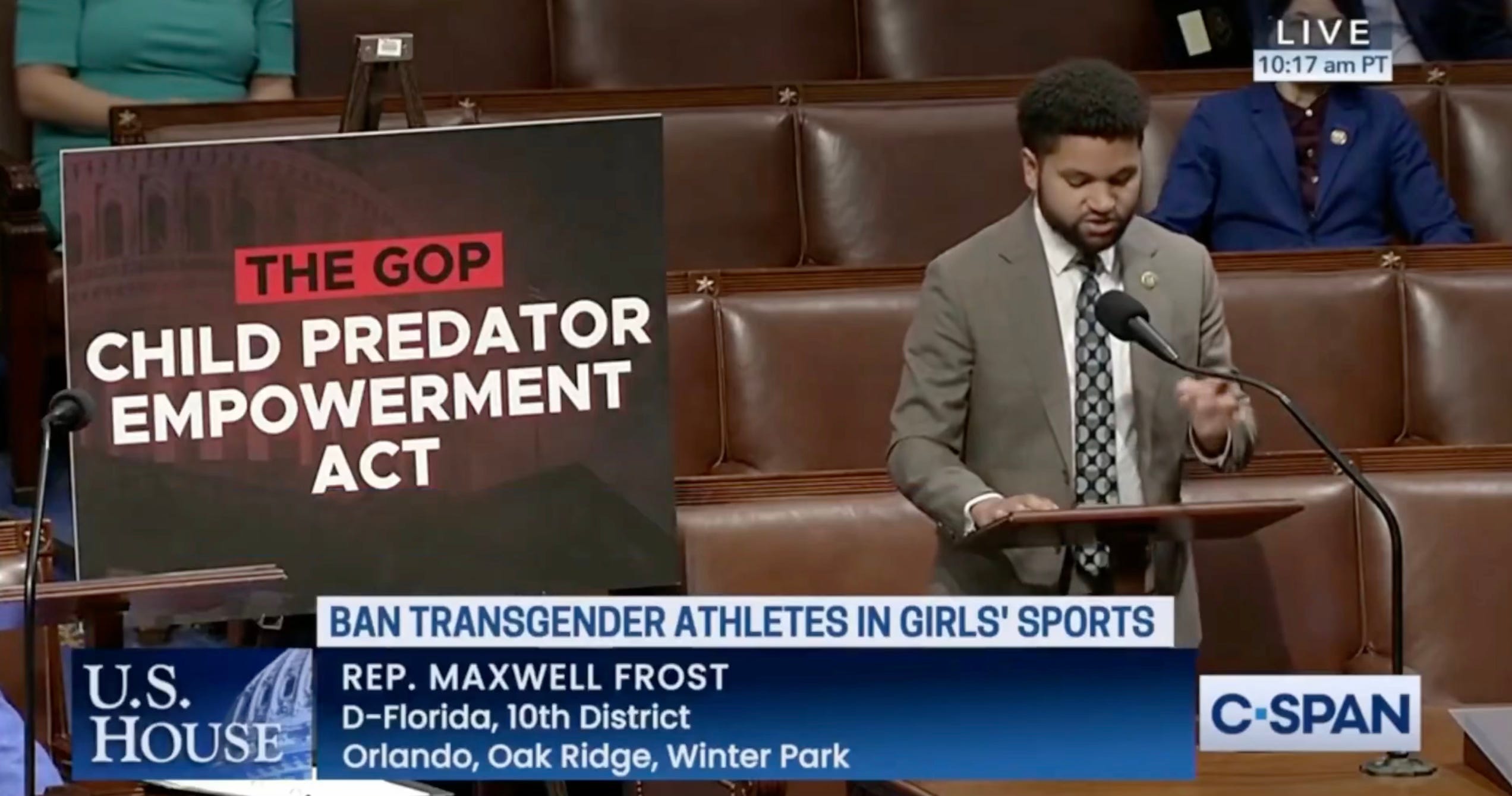
Over the last three years, the states have been on fire with anti-trans legislation, bathroom bills, healthcare bans, and most recently sports segregation bills. In 2024, the Heterosexism Santa Anas whipped these flames into a an actual fire tornado. But on Tuesday this week, Republican Congress members took new action that might just reverse this trend: They decided to take away states’ rights to regulate trans bodies and start making these bans national. First up was an amendment to Title IX that would ban trans sports participation. Grotesquely titled the “Protection of Women and Girls in Sports Act of 2025,” HB 28 passed the House 218-206 — but its fate in the Senate is uncertain given the 60 votes needed to break a filibuster (there are 53 Republicans in the Senate this year). If it reaches Trump’s desk, he’s guaranteed to sign it.
What’s more clear than the GOP’s chances to get the bill through the Senate, however, is that the Democratic approach to this Republican proposal is very different from how they have responded to anti-trans efforts in the past. This week only two Dems sided against trans people, Henry Cuellar and Vicente Gonzalez. (Both represent Texas swing districts, if that matters to you.) But more importantly than the relative unity of the Democrats — even from Reps. Tom Suozzi and Seth Moulton who just recently decided to broadside the party for liking trans people so much they threw the election — they actually sounded a bit salty that the GOP was trying this shit on their watch. Almost like hating trans people was an affront to their values or something.
Alexandria Ocasio-Cortez got a lot of attention for her speech:
She started on fire by calling out infamous anti-woman actions to make it clear that she isn’t buying GOP protestations that the bill is somehow motivated by concern for girls and women. Then she hit them for what they were actually doing:
“[You] open up gender, and, yes, genital examinations into little girls in this country in the so-called name of attacking trans girls. To that, today, what we have to say are two words: Not today.
“The majority right now says there is no place in this bill that says it opens up for genital examinations. Well, here is the thing: There is no enforcement mechanism in this bill. When there is no enforcement mechanism, you open the door to every enforcement mechanism.”
She also stressed that having these laws on the books limits the freedoms of cis (that is, “non-trans” if you’re new) women and girls:
“What this also opens the door for is for women to try to perform a very specific kind of femininity for the very kind of men who are drafting this bill, and to open up questioning of who is a woman because of how we look, how we present ourselves, and yes, what we choose to do with our bodies.”
AOC wasn’t the only one to body the misogynistic GOP. Congresswoman Sara Jacobs sharpened her shiv and stuck it right in,
“This bill doesn’t even come close to protecting women and girls in sports. In fact, it puts all women and girls in danger of sexual abuse.”
Lori Trahan, the only woman Division-1 athlete in Congress, attacked on the same line, this time asking, What about the children?
“[T]he consequences of that approach will be devastating: Girls as young as 4 years old being subjected to invasive lines of questioning about their bodies and even physical inspections by an adult, a stranger, a predator, all because some creep accuses them of not being a girl. What parent would want to put their daughter through that? I know I wouldn’t.”
Brand new Congressman Rep Maxwell Frost turned up the heat even more, if that’s possible, giving a few small but horrifying details about a recent investigation into a volleyball player in his home state of Florida. And he did it in front of a sign naming HB 28 “The GOP Child Predator Empowerment Act.”
That’s some shit, y’all. His video was posted to Twitter, which I will link this one time, because he’s almost as good at this as AOC.
And this Dem messaging? It got under Republican skin. When secret Wonkette girl crush Rep. Jasmine Crockett accused Nancy Mace of whipping up cissexism as a fundraising tactic, Mace actually challenged Crockett to step outside and fight. Joy Reid had a great take on this, but there’s nothing funnier than Mace herself, thinking she can take Crockett on when just five weeks ago she had her arm in a sling from shaking a man’s hand (yr Wonkette did not see any evidence she’d even visited medical staff or had any injury diagnosed, but damn that sling was sure real for a couple days).
This is, to use a technical term usually found only in the official records of the Parliamentarian of the House, some cool ass shit. I know that many of us have been waiting for Dems to hit the GOP and hit them hard when they come after minorities or rights or values that we on the Left would like to see them protect. So folks have to be wondering, what woke them up?
Though your friendly, neighborhood Crip Dyke doesn’t have hard information, it would be irresponsible not to speculate that last November’s election made a difference. And by this we mean not only the elevation of Trump, once again, to head of the executive branch which may indeed have lit a fire in some, but also the election of Sarah McBride, an election which elevated the entire US House of Representatives by finally making it possible for a trans legislator to participate in debates on the bills that target us.
Many noticed that McBride didn’t instantly and loudly fight back when Nancy Mace attacked her personally, using McBride’s election as an excuse to pass new bathroom restrictions for those working on Capitol Hill. But as yr Wonkette reminded at the time:
McBride [needs] a chance to work, a chance to develop reputation and influence. She needs to do some very careful relationship building now.
The House Dems did a fantastic job of articulating exactly how government interest in girls’ bodies becomes a predatory risk for cis and trans folks alike. But it wasn’t cis people that first noticed the problem or developed the argument. I know because I had to come up with these observations and arguments in 1996 without any cis help at all, and I spent 14 years teaching cis people patiently, over and over, how transphobia, like homophobia, is a weapon of sexism.
Whether McBride was secretly organizing Democratic rhetorical strategies and asking cis folks to take the point so that she couldn’t be marginalized as a trans radical, it’s certainly not an accident that it is now that congressional Dems are spending time on a daily basis talking to a real live trans person that they are figuring out how to talk about trans issues. Here’s hoping they’ll continue to make the GOP majorities bigoted victories more and more costly.
Friday Links
Last night, it got to be bedtime and I didn’t even realize I’d set nothing up for today, until I got up this morning. Scottie’s posted some important news here already, and I don’t want to knock it off the top, so instead of the posts I thought I’d make, I’m just gonna link ’em, and readers can just read whatever they like and still not miss those posts of Scottie’s.
Peace & Justice History for 1/17
The Way of Water: On the Quiet Power of Ursula K. Le Guin’s Activism
Explore the Newly-Launched Public Domain Image Archive with 10,000+ Free Historical Images
SCOTUS Takes Up Case Challenging the ACA’s No-Cost Coverage of PrEP
Peace & Justice History for 1/16
January 16, 1966 Joan Baez Folksinger Joan Baez was sentenced to 10 days in jail for participating in a protest which blocked the entrance to the Armed Forces Induction Center in Oakland, California. She was part of an action to impede the drafting of young men for the U.S. war in Vietnam. Joan Baez Press Conference On Vietnam War (1966) Read more about Joan Baez |
| January 16, 1979 Faced with strikes, violent demonstrations, an army mutiny and clerical opposition to his repressive rule, the Shah of Iran, its hereditary monarch since 1941, was forced to flee the country. He had been installed in a CIA- and British-engineered 1953 coup which overthrew elected Prime Minister Mohammad Mossadeq. Mossadeq’s government had voted to nationalize Iran’s oil industry, displacing the Anglo-Iranian Oil Company.The U.S. gave substantial and continuous military and intelligence support to the Shah throughout his regime. Despite having imposed martial law the previous October, Mohammad Reza Shah Pahlavi fled the Peacock Throne for Egypt and, later, the U.S. for medical care. Following the subsequent revolutionary overthrow, an Islamist state under Ayatollah Ruhollah Khomeini was established.  The Shah and family Chronology of Iran in the 20th century: More on the Shah |
| January 16, 1987 Eight members of the Nanoose Conversion Campaign were acquitted of trespassing on Canadian Department of National Defence property. The group had picnicked on Winchelsea Island, part of the Canadian Forces Maritime Experimental and Test Ranges, where both Canadian and U.S. weapons are tested, in the Georgia Strait along the British Columbia coast. |
| January 16, 1992 The government of El Salvador and rebel leaders signed a pact in Mexico City ending 12 years of civil war that had killed at least 75,000 people. |
| January 16, 2001 Eight Greenpeace activists were arrested by Gibraltar police as they boarded a damaged British nuclear submarine. The HMS Tireless was considered a radioactivity hazard because of a cracked pipe in its reactor’s cooling system. Those living near Gibraltar Harbour and in Spain were concerned for their safety as the ship had been docked for more than six months awaiting repair. The problem was serious enough that Great Britain removed twelve comparable subs from service until they could be checked for similar problems. Greenpeace unfurled a banner just before the arrests reading Mares Libres del Peligro Nuclear, or “For a Nuclear-Free Sea.” |
https://www.peacebuttons.info/E-News/peacehistoryjanuary.htm#january16
A Good Example, from Barry’s Blog
with my thanks.

