
Author: ali redford
I love dogs and people. I want living creatures to thrive. I love to cook, and share the food, but ya gotta get in line in front of the dog, and greatest good luck with that!
Grrr; US Media Suck
Wonkette does this better than I.
Politico Demands Karen Bass Explain How She’ll Make Politico Stop Smearing Her
Oh, the balls on these assholes. The BALLS!

Tuesday afternoon, Politico ran a very good story about media and political attacks against Los Angeles Mayor Karen Bass and her response to the ongoing wildfires. The piece, by reporter Melanie Mason, points out that much of the criticism has been unfair and often baldface lies. It also notes that Bass’s public persona as a detail-oriented consensus builder has in part led to the perception that she’s not an action-oriented take-charge leader in this crisis. It’s one of the better discussion of Bass and the wildfires we’ve read, in addition of course to our own, ahem.
The money quote for the story comes from Rob Quan, an organizer with good-government nonprofit Unrig LA. Says Quan,
“Nationally, there’s just a pile-on. […] If you look at her replies [on social media] now, she could be posting a video of her literally running into a burning building and taking a child out of there, and people would still be replying ‘resign!’”
Mason’s piece is a smart, thoughtful look at how an accomplished politician is being dragged in the media, and how her own political instincts and strengths aren’t proving to be much help in countering the overwhelmingly negative coverage. Kind of like having a municipal water system that’s perfectly capable of handling building fires, but not designed to contain a fire hurricane made far more catastrophic by climate change. By all means, you should read it!
But because we are doing a Doktor of Rhetoric post today, we’re only going to discuss Mason’s very good reporting and analysis in the context of how Politico distorted its own goddamn coverage for the sake of adding more cheap shots to the shitstorm of belligerent bellyaching with which Bass is contending.
Later yesterday afternoon, Politico’s “California PM Playbook” column took Mason’s thoughtful, nuanced reporting and ran it through a bullshit filter, resulting in a column that mentions the pile-on of disinformation that Bass has faced, but ultimately paints Bass as responsible for her own unfair coverage, darn her.
California Playbook editor Lindsay Holden quotes and paraphrases Mason liberally, but hypes up the negatives almost to the exclusion of all else, leaving the reader with the impression that Bass, as Holden’s headline puts it, “has lost the plot.”
Mason depicts Bass as a competent leader whose substance-over-style political instincts aren’t necessarily a great match for a crisis where cable news and rightwing social media are driving the narrative:
Bass has also been hampered by instincts she honed as a deal-making legislator and coalition-building community activist. Never someone to actively seek the spotlight, her unflashy demeanor now comes off as uninspiring for people seeking a leader projecting command.
An unnamed Democratic consultant says that right now, LA needs a media hero, “someone to stand up in the middle of the Pacific Palisades or the middle of Sylmar or the middle of Hollywood every day and say, ‘This is our community, and we will rebuild.’”
The consultant added, “I want her to show some emotion, that she’s tapping into the fear and anxiety that so many people feel, and not reflect this soft brand of optimism that she’s been known for.”
Soft optimism bad, Henry V filtered through Independence Day good. But Mason also notes that after the widespread devastation of the first horrible hours, when high winds kept water bombers grounded and blew the fires out of control,
firefighters have been remarkably successful in halting additional damage — despite new fires cropping up throughout the week.
“All of those could have been massive conflagrations had they expanded, and they didn’t,” said Doug Herman, a Democratic strategist who works with Bass.
That note doesn’t make it into Holden’s version, which instead seems to be cheering on style, and the hell with substance. After noting that Elon Musk’s attacks on Bass are “often half-baked or outright false,” Holden adds in an anecdote that wasn’t in Mason’s piece, bizarrely framing a dishonest video clip as somehow one more example of Bass’s “painfully poor messaging strategy” (a phrase Mason does not use):
The latest example came Tuesday afternoon, when CBS News sent out a misleading tweet suggesting its reporter asked Bass whether she “regrets” taking an overseas trip while the wildfires erupted. The accompanying video clip showed Bass answering “No.”
In fact, CBS’ Jonathan Vigliotti asked Bass whether, looking back, she still would’ve taken the diplomatic trip to Ghana.
CBS News subsequently revised the tweet to get the question right, and added a note to clarify that Bass was saying no, on reflection she wouldn’t have taken the trip. For all the good it did.
Here’s where we lost our patience with the Playbook piece: Holden went right ahead and insisted that Bass had fucked up:
The episode served as a mini illustration of Bass’ problems — specious information, followed by her own unwillingness to provide a fuller explanation, let alone a broader acknowledgement of her mistake. The narrative about her trip might have been put to bed last week, but Bass’ resistance to engage on it has allowed her enemies to continue painting her as an absent and ineffective leader.
Apparently, Bass should have anticipated that CBS would send a tweet distorting what she said, and she should have pre-debunked it, too. Shame on her! She really has lost the plot, all right.
Perhaps Mason should update her own piece with a close look at how her own outlet indulged in the kind of bullshit she was analyzing, but that might be a little too meta. And god knows Meta has enshittified itself plenty already.
Clay Jones Is Going to Be a National Treasure Before This Next Pres. Term is Up…
Not that he isn’t already, but this one is gold!
Mama Hegseth by Clay Jones
Mamas, don’t let your babies grow up to be Hegseth Read on Substack
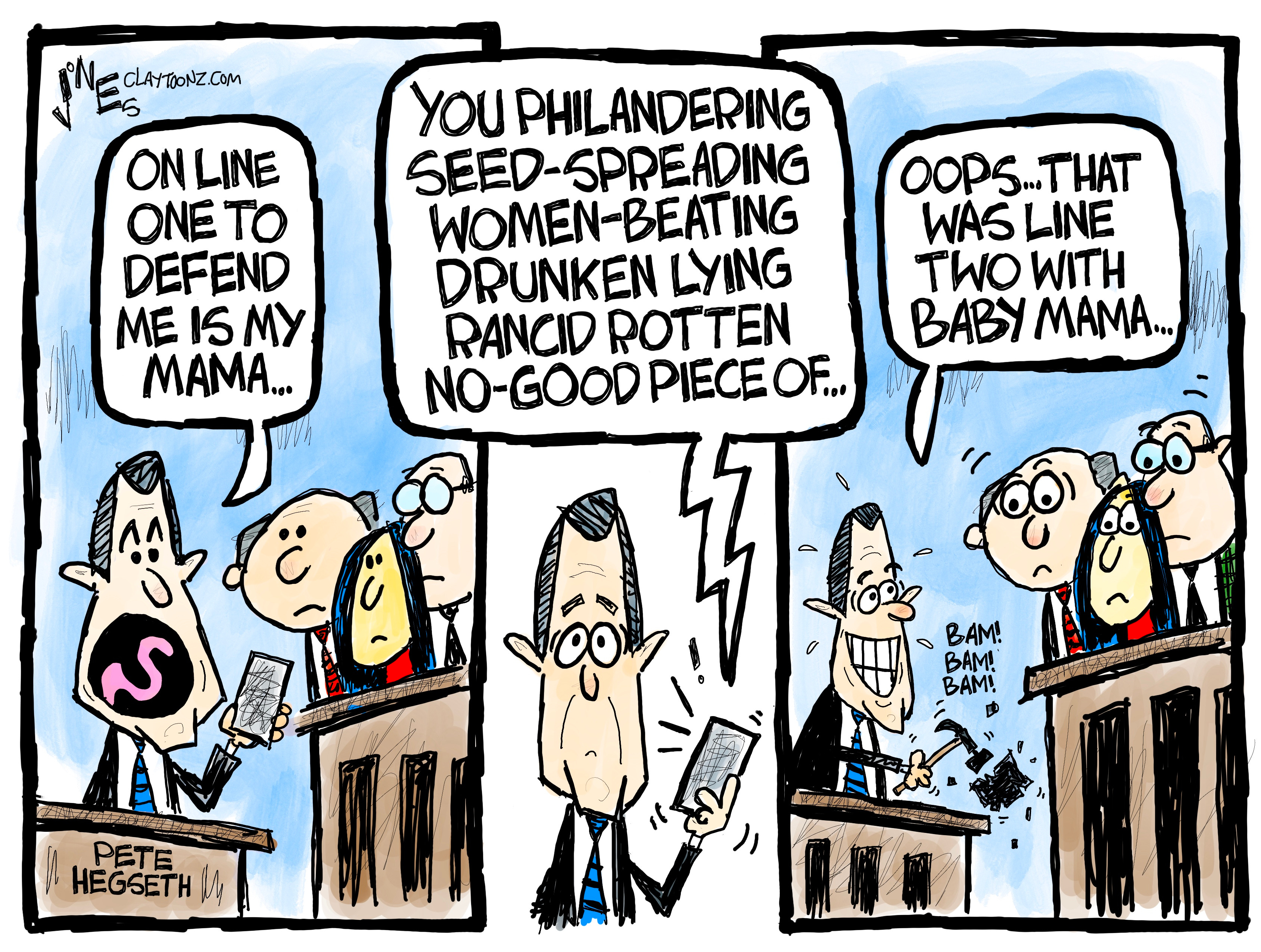
When asked about sexual assault, sexual harassment, alcohol abuse, financial mismanagement, and non-disclosure agreements (NDAs), Trump’s nominee for the Secretary of Defense and former Fox News fixture Pete Hegseth said, “Our left-wing media in America today, sadly, doesn’t care about the truth, All they were out to do was to destroy me because I’m a change agent and a threat to them. Despite the attacks, I stand committed to the truth and our warfighters.”
If Hegseth is so committed to the truth, then why did he refuse to answer so many questions during his confirmation hearing yesterday? Oh, yeah…because he’s a racist rapey liar. Also, if Hegeseth is so “committed” to the truth, then why is he working for the world’s biggest liar, Donald Trump?
Hegseth claimed he didn’t know if he had nondisclosure agreements with his two ex-wives. How do you not know that? He also dodged questions from my senator, Tim Kaine, about cheating on his wives, even shortly after one of them gave birth. Damn, he is like Donald Trump.
Hegseth refused to answer Senator Tammy Duckworth’s question about whether he had ever conducted a financial audit of the veterans organizations he once ran (that forced him out for being constantly drunk, sexually harassing female employees, and shouting, “Death to all Muslims”), given his insistence that the Pentagon undergo a deep-dive audit.
Pete is also a big fan of war criminals as he advocated on Fox News for Trump to pardon several in 2019 without disclosing he had private conversations with Trump on the matter. That was a violation of journalism ethics, even when working for Fox News.
Oklahoma Republican Senator Markwayne Mullin attempted to flip the script on Democrats, asking, “How many senators have shown up drunk to vote at night?”
Mullin also asked, “Have any of you guys asked them to step down and resign from their job? And then how many senators do you know who have gotten a divorce for cheating on their wives? Did you ask them to step down? No.” I’m pretty sure Mullin never asked Donald Trump to step down.
Mullin and the other Republicans on the committee are perfectly fine with an unqualified racist rapey lying drunk leading the defense department, just as they are for president, but Democrats are not. That wasn’t entirely fair of me. Donald Trump isn’t a drunk.
Hegseth refused to answer if he’d take an illegal order from Trump to shoot protesters in their legs, as he wanted his previous Defense Secretary to do to anti-racism protesters in Lafayette Square who scared Trump to retreat and hide in the White House bunker. But he seems in favor of it as he seemed to justify shooting protesters while criticizing them instead of answering the question.
Question: Will you follow Trump’s orders to shoot protesters?
Pete: Well a lot of them aren’t nice and they say things we don’t like, “Trump sucks” and “Trump wears diapers.”
Question: But will you order them to be shot?
Pete: They attacked a church.
Question: Again, will you order them to be shot?
Pete: They scared Trump and made him wet himself in the basement, and we had to sing lullabies to get him to sleep.
Question: But would you have the protester shot?
Pete: They looked like a bunch of dirty hippies.
Question: But will you have them shot?
Pete: The sex was consensual…wait…What was the question?
He also refused to say if he’d direct the military to invade Panama and Greenland.
Pete previously claimed he’d quit drinking if he’s confirmed. When asked if he would resign as Defense Secretary if he started drinking again, he refused to answer and said, “I’m too drunk to taste this chicken.” I may have made up that answer.
Pete claimed he was a “changed man” and unlike the deviant he used to be, thanks to Jesus. He said, “I have failed at things in my life, and I am redeemed by my Lord and savior, Jesus Christ.” Somehow, this redemption doesn’t affect his lying.
Pete claimed he was for women serving in combat despite only a few months ago saying he didn’t.
Pete said, “Writing a book is different than being Secretary of Defense,” which should be noted because writing a book doesn’t make you qualified to be Secretary of Defense anymore than being a racist barking yam qualifies you to be president.
At one point, Senator Mullin tried to say, “Give me a break,” but flubbed it and said, “Give me a joke.” During his monologue last night, Stephen Colbert delivered a joke for Senator Mullin, saying, “A drunk, a cheating husband, and an accused sexual predator walk into a bar, and the bartender says, ‘Table for one, Mr. Hegseth?’”
That’s funny, but the real joke is to believe that philandering seed spreading women-beating drunken lying rancid rotten no-good piece of shit Pete Hegseth is qualified to be Secretary of Defense. Colleagues, don’t steal that from me for a cartoon.
Creative notes: I think this is my fourth cartoon on Hegseth. I wrote this cartoon during my trip through the UK and Ireland, but I’m not sure which country or city it was written in. This was drawn in London, this was drawn in Dublin, and this was drawn in Reykjavik. I saved the idea for today’s cartoon for the confirmation hearing…and then I forgot about it. I remembered it just this morning.
On another note: I want to thank all my subscribers again, especially the paid subscribers for helping me continue to draw cartoons, write blogs, make videos, and continue my reign of sarcastic terror on MAGAts without the distractions of a real job and being required to show up at places I don’t want to be at specific times and attend boring meetings and stuff. I love you free subscribers too but honestly, the paid subscribers smell better. If you want to smell better too, like you’re wearing Irish Spring after an early morning rain while standing next to a bagel shop, then you should become a paid subscriber too.
I don’t know where I come up with this shit…but thank you again. Now I want a bagel.
Drawn in 30 seconds: (snip-go watch. Now I want a bagel, too!)
We Need This! 🦛
Good Environmental News, Too!
(Not to take away from the Love good news post.)
How Plankton Poop Could Hold the Key to Slowing Climate Change
December 19, 2024 · Written by Matthew Russell
In the fight against climate change, every small action counts. From renewable energy to forest conservation, many solutions are on the table, but one of the most unexpected contributors could be plankton poop. This tiny marine byproduct, aided by a unique natural process, could help the world combat rising carbon dioxide levels in the atmosphere.
The concept hinges on the “biological carbon pump,” a natural process in the ocean where microscopic marine life absorbs carbon dioxide and stores it in the deep sea. However, much of this carbon is returned to the atmosphere before it can reach the ocean floor, where it could remain sequestered for centuries. But what if we could enhance this process?

Photo: Pexels
Plankton poop could significantly enhance carbon sequestration in the ocean.
The Role of Plankton in Carbon Sequestration
Phytoplankton, tiny organisms that float in the ocean, are responsible for capturing a significant portion of atmospheric carbon dioxide through photosynthesis. As NASA Earth Observatory points out, these organisms form the base of the marine food chain, feeding zooplankton, small fish, and other sea life. As phytoplankton die or are consumed, some of their carbon sinks into the ocean, but a large portion of it is recycled by marine bacteria, eventually returning as CO2. This cycle presents a challenge in efficiently storing carbon in the ocean’s depths.
However, researchers from Dartmouth College and other institutions are exploring how to enhance the efficiency of this biological pump. Their solution involves adding clay dust to the surface of the ocean. This seemingly simple intervention could significantly boost carbon sequestration by aiding the formation of dense particles that sink rapidly, carrying carbon along with them.

Photo: Pexels
Adding clay dust to ocean waters can help carbon-rich particles sink deeper.
Clay as a Catalyst for Faster Carbon Sequestration
The Dartmouth team’s experiments demonstrated that when clay minerals are added to the ocean’s surface, they bond with organic carbon, forming sticky balls known as “flocs.” These flocs are irresistible to zooplankton, which feed on them, The Debrief, reports. As zooplankton ingest the flocs, they excrete carbon-laden feces, which sink deeper into the ocean. This process not only prevents carbon from escaping back into the atmosphere but also speeds up the ocean’s natural carbon sequestration process.
This enhancement could have profound implications. By accelerating the process by which carbon is transported from the ocean surface to the depths, this method offers a new, scalable approach to mitigate climate change. The addition of clay to phytoplankton blooms could significantly boost the amount of carbon trapped in the ocean, as demonstrated by the increased concentration of sticky organic particles—up to ten times more than usual—following the clay treatment.

Photo: Pexels
The biological carbon pump is the ocean’s natural system for removing CO2.
How Plankton Poop Becomes a Climate Solution
Plankton poop might seem like an unlikely hero in the climate crisis, but its potential is undeniable. Zooplankton, the tiny creatures that feed on plankton, play a crucial role in the ocean’s carbon cycle. Normally, only a small fraction of the carbon captured by phytoplankton makes it into the deep ocean for long-term storage. However, by feeding on clay-enhanced carbon particulates, zooplankton can create fecal pellets that sink faster, ensuring that the carbon is stored more effectively in the ocean’s depths.
The use of clay dust to enhance this process could be a game-changer. According to Oceanographic Magazine, the addition of clay allowed carbon to be captured in feces and sequestered at depths where it can stay for millennia, potentially reducing atmospheric CO2 levels significantly.

Photo: Pexels
Zooplankton ingest carbon-laden particles, trapping CO2 in their feces.
The Promise of Clay in the Fight Against Climate Change
As scientists continue to explore this technique, there’s growing optimism about its potential. The use of clay is particularly promising because of its low cost and abundance. Unlike other carbon capture methods that rely on expensive technology, clay dust is a natural material that could be dispersed across ocean regions with phytoplankton blooms.
The team is currently focused on identifying the best regions for applying this method, particularly areas with high primary production, such as the California Current and the Mediterranean Sea.
Looking Ahead: A Sustainable Solution?
Though the technique is still in its early stages, it holds promise as a sustainable and scalable solution for reducing atmospheric CO2 levels. The process, which relies on the ocean’s natural mechanisms, could complement other climate mitigation strategies, such as reforestation and direct air capture. Moreover, by enhancing the biological carbon pump with a simple addition of clay dust, the oceans could play an even greater role in addressing the climate crisis.
The next steps involve testing the method in real-world ocean settings. If successful, this approach could become an essential tool in the global effort to combat climate change, one tiny poop at a time.
https://shop.freetheocean.com/blogs/news/plankton-poo-climate-change
For Science! 🐜
Biologists antagonised ants and found out they can hold grudges
January 12, 2025 Imma Perfetto

Previous research has shown that ant colonies are more likely to behave aggressively towards neighbouring colonies, but less likely to do so against unfamiliar ones.
It’s known as the “nasty neighbour effect” and, until now, researchers weren’t sure why it exists.
A new Current Biology study has discovered that ants remember the smell of their enemies.
“We often have the idea that insects function like pre-programmed robots,” says Volker Nehring from the University of Freiburg, Germany.
“Our study provides new evidence that, on the contrary, ants also learn from their experiences and can hold a grudge.”
The researchers pitted colonies of the black garden ant, Lasius niger, against each other. In the first phase of the experiment, they were exposed either exposed to nestmates or to ants from a different colony.
Each meeting lasted for one minute and was repeated once per day for 5 consecutive days. Ants’ aggression when encountering non-nestmates increased significantly during this training phase.
On day 6, the team found that ants acted most aggressively when encountering the non-nestmate colony they had previously fought but were less aggressive towards ants from a non-nestmate colony they hadn’t yet encountered. Unsurprisingly, they weren’t aggressive towards their own nestmates.
In the second phase of the experiment, encounters were repeated with either aggressive or passive ants from a different colony. They found the ants that had previously only encountered passive competitors behaved significantly less aggressively.
Because ants use odours to distinguish between members of their own nest and those from other nests, the study suggests that ants learned to associate aggression with the non-nestmate colony’s specific scent.
Nehring and his team now plan to investigate whether and to what extent ants adapt their olfactory receptors to their experiences.
Originally published by Cosmos as Biologists antagonised ants and found out they can hold grudges
Peace & Justice History for 1/15
January 15, 1929 Martin Luther King, Jr. was born in Atlanta, Georgia. The son of a Baptist pastor, he followed in his father’s footsteps, then went on to lead the American civil rights movement in the 1950s and ’60s, and to speak out against the Vietnam war. In 1955 Dr. King organized the first major protest of the civil rights movement: the successful Montgomery Bus Boycott. Influenced by Mohandas Gandhi, he advocated nonviolent civil disobedience to end racial segregation. The peaceful protests he led throughout the American South were often met with violence and arrest, but King and his followers persisted. His inspiration, leadership and eloquence helped tens of millions claim the fundamental rights of citizenship, and changed the face of a nation. Dr. Martin Luther King Jr. biographical sketch Since 1986, the third Monday in January has been designated a federal holiday honoring the greatness and sacrifice of Dr. Martin Luther King, Jr. A chronology: April 4, 1968 Dr. King was assassinated. Shortly thereafter, U.S. Representative John Conyers (D-Michigan) introduced legislation to create a federal holiday to commemorate Dr. King’s life and work. January, 1973 Illinois became the first state to adopt MLK Day as a state holiday. January, 1983 Rep. Conyers’s law was passed after 15 years January, 1986 The United States first officially observed the federal King Day holiday. January, 1987 Arizona Governor Evan Mecham rescinded state recognition of MLK Day as his first act in office, setting off a national boycott of the state. January, 1993 Martin Luther King Day holiday was observed in all 50 states for the first time. Brief biography of Dr. King The greatest MLK speeches you may have never heard |
| January 15, 1968 The Jeanette Rankin Brigade marched on Washington to protest the war in Vietnam.It was led by 87-year-old Rankin herself, the first U.S. Congresswoman (R-Montana), and the only member of Congress to vote against U.S. entry to both world wars. After the march’s arrival in Washington, D.C. the New York Radical Women staged a “Burial of Traditional Womanhood.”  Jeanette Rankin More on Jeanette Rankin Documents from the New York Radical Women including Funeral Oration for the Burial of Traditional Womanhood by Kathy Amatniek (who coined “Sisterhood is Powerful”) (a .pdf) |
January 15, 1969 Janet McCloud Janet McCloud, her husband Don and four others from the Tulalip Indian tribe were tried for one of their “fish-ins” on the Nisqually River in Washington state. The Nisqually empties into Puget sound on the Tulalip reservation. Despite century-old treaties granting them half the salmon catch in their ancestral waters, state game officials harassed and arrested Indian fishermen. However, all were found not guilty. In a decision not reached for five years, U.S. District Judge George Boldt ruled in favor of 14 treaty tribes, including the Tulalip, upholding the language of their treaties. |
https://www.peacebuttons.info/E-News/peacehistoryjanuary.htm#january15
Peace & Justice History for 1/14
| January 14, 1601 Roman Catholic church authorities burned sacred Hebrew books in Rome during the papacy of Clement VIII. He had forbidden Jews from reading the Talmud (a collection of centuries of interpretation of Jewish law). He had confirmed Pope Paul III’s relegation of Jews to a Roman ghetto (a walled-in portion of the city), and their banning from residence in papal-controlled states by Pope Pius V. Other papal enemies of Jewish books included Innocent IV (1243-1254), Clement IV (1256-1268), John XXII (1316-1334), Paul IV (1555-1559), and Pius V (1566-1572). |
| January 14, 1784 The Confederation Congress, meeting in Annapolis, Maryland, ratified the Treaty of Paris with England, ending the Revolutionary War .  Signing the Treaty of Paris By its terms, “His Britannic Majesty” was bound to withdraw his armies without “carrying away any Negroes or other property of American inhabitants.” The treaty was negotiated by John Adams, John Jay and Benjamin Franklin for the colonies, and David Hartley representing the King of England, George III. |
| January 14, 1918 The U.S. Supreme Court upheld the constitutionality of the selective service law, affirming all criminal charges arising from non-compliance with the draft during World War I. In Arver v. United States, the Court found that a draft does not violate the 13th Amendment’s prohibition of involuntary servitude. |
| January 14, 1941 A. Philip Randolph, president of the Brotherhood of Sleeping Car Porters union, and widely considered de facto chief spokesperson for the African-American working class, called for a march on Washington, demanding racial integration of the military and equal access to defense-industry jobs.   Detail from painting by Betsy G. Reyneau, Asa Philip Randolph “On to Washington, ten thousand black Americans!” Randolph urged. He said in the fight to “stop discrimination in National Defense . . . While conferences have merit, they won’t get desired results by themselves.” |
| January 14, 1942 President Franklin D. Roosevelt issued Presidential Proclamation No. 2537, which required aliens from World War II enemy countries – Italy, Germany and Japan – to register with the United States Department of Justice. Registered persons received a “Certificate of Identification for Aliens of Enemy Nationality.” This proclamation facilitated the beginning of large-scale internment of Japanese Americans the following month.  |
| January 14, 1963 George Wallace was sworn in as Governor of Alabama. In his inaugural address he called for “segregation now; segregation tomorrow; segregation forever!” “The true brotherhood of America, of respecting the separateness of others — and uniting in effort — has been so twisted and distorted from its original concept that there is a small wonder that communism is winning the world. We invite the negro citizens of Alabama to work with us from his separate racial station — as we will work with him — to develop, to grow in individual freedom and enrichment. We want jobs and a good future for BOTH races — the tubercular and the infirm. This is the basic heritage of my religion, of which I make full practice — for we are all the handiwork of God.” The entire speech: |
January 14, 1966 A march in Atlanta was held to protest the ouster of Julian Bond, an African American, from the Georgia House of Representatives. Members of the General Assembly considered him unfit to serve after he endorsed a statement critical of U.S. involvement in Vietnam issued by the Student Non-Violent Coordinating Committee (SNCC). |
| January 14, 1994 An agreement was signed for Russia and the U.S. to assist newly independent Ukraine in ridding itself of nuclear weapons.Following the break-up of the Soviet Union, Ukraine’s leader Leonid Kravchuk found his country with the world’s third largest nuclear arsenal, including multiple-warhead long-range missiles and bombers, and 3000 tactical (battlefield or short-range) nuclear weapons.  former Ukranian missile silo  Leonid Kravchuk Kravchuk and his government had decided to eliminate all nuclear weapons from Ukrainian territory. Ukraine was the first country to go non-nuclear. |
| January 14, 1996 Sixteen protesters were arrested in a winter blockade of the rural Wisconsin site (in the Chequamegon National Forest) of the U.S. Navy’s ELF (Extremely Low Frequency) transmitter, which communicated (one-way) with deeply submerged U.S. submarines. Nearly 400 were arrested in 24 actions opposing ELF between 1991 and 1996. |
https://www.peacebuttons.info/E-News/peacehistoryjanuary.htm#january14
Breakfast Dance
Also Charlie Kirk, Ben Shapiro, and any other RWNJ who have trouble with ASL interpreters at this late date, follow this interpreter’s suggestion.
(I love this song!)
Items of Interest to Those of Us Who Read Here, and Who Blog:
There’s a lot; some of it we’ve seen discussed 8 ways to Sunday, but some I’ve not yet seen, that involve WordPress, Mastodon, and others. Not all is bad news, much is good. This came from my Werd.i/o newsletter, but there’s not a newsletter link. So, snippets below, with links:
https://werd.io/2025/the-people-should-own-the-town-square
Mastodon is growing up:
“Simply, we are going to transfer ownership of key Mastodon ecosystem and platform components (including name and copyrights, among other assets) to a new non-profit organization, affirming the intent that Mastodon should not be owned or controlled by a single individual.
[…] We are in the process of a phased transition. First we are establishing a new legal home for Mastodon and transferring ownership and stewardship. We are taking the time to select the appropriate jurisdiction and structure in Europe. Then we will determine which other (subsidiary) legal structures are needed to support operations and sustainability.”
Eugen, Mastodon’s CEO, will not be the leader of this new entity, although it’s not yet clear who will be. He’s going to focus on product instead. (snip)
https://werd.io/2025/content-policy-on-the-social-web (snip)
Content Policy on the Social Web
The Social Web Foundation‘s statement about Meta’s moderation changes is important:
“Ideas matter, and history shows that online misinformation and harassment can lead to violence in the real world.
[…] Meta is one of many ActivityPub implementers and a supporter of the Social Web Foundation. We strongly encourage Meta’s executive and content teams to come back in line with best practices of a zero harm social media ecosystem. Reconsidering this policy change would preserve the crucial distinction between political differences of opinion and dehumanizing harassment. The SWF is available to discuss Meta’s content moderation policies and processes to make them more humane and responsible.”
This feels right to me. By implication: the current policies are inhumane and irresponsible. And as such, worth calling out.
[Link] (snip)
https://werd.io/2025/doj-releases-its-tulsa-race-massacre-report-over-100-years
DoJ releases its Tulsa race massacre report over 100 years after initial review
[Adria R Walker at The Guardian]
A full century after the Bureau of Investigation blamed the Tulsa race massacre on Black men and claimed that the perpetrators didn’t break the law, the DoJ has issued an update:
““The Tulsa race massacre stands out as a civil rights crime unique in its magnitude, barbarity, racist hostility and its utter annihilation of a thriving Black community,” Kristen Clarke, the assistant attorney general of the DoJ’s civil rights division, said in a statement. “In 1921, white Tulsans murdered hundreds of residents of Greenwood, burned their homes and churches, looted their belongings, and locked the survivors in internment camps.””
Every one of the perpetrators is dead and can no longer be prosecuted. But this statement seeks to correct the record and ensure that the official history records what actually happened. There’s value in that, even if it comes a hundred years too late. (snip-MORE; this is history which should be recalled/learned)
https://werd.io/2025/mullenweg-shuts-down-wordpress-sustainability-team-igniting-backlash
Mullenweg Shuts Down WordPress Sustainability Team, Igniting Backlash
The bananas activity continues over at Automattic / Matt Mullenweg’s house:
“Members of the fledgling WordPress Sustainability Team have been left reeling after WordPress co-founder Matt Mullenweg abruptly dissolved the team this week.
[…] The disbandment happened after team rep Thijs Buijs announced in Making WordPress Slack on Wednesday that he was stepping down from his role, citing a Reddit thread Mullenweg created on Christmas Eve asking for suggestions to create WordPress drama in 2025.” (snip)
https://werd.io/2025/is-ignorance-bliss
Is Ignorance Bliss?
I’ve been thinking about this paragraph since I read it:
“In times past, we would worry about singular governmental officials such Joseph Goebbels becoming a master of propaganda for their cause. Today’s problem is massively scaled out in ways Goebbels could only dream of: now everyone can be their own Goebbels. Can someone please tell me what the difference is between an “influencer” holding a smartphone and…a propagandist? Because I simply can’t see the distinction anymore.”
This brings me back to Renee DiResta’s Invisible Rulers: whoever controls the memes controls the universe.
[Link]
===================
As I said, there is more. From the werd.i/o links, you can navigate to read to your heart’s content. I didn’t want to make too long a post here, so I put the most pertinent ones here, but this week’s newsletter is full of important stuff. -A

