I love dogs and people. I want living creatures to thrive. I love to cook, and share the food, but ya gotta get in line in front of the dog, and greatest good luck with that!
I’ve returned from the question the motherland a continually illegitimate relationship I’m a pretend immigrant afraid of coats and the cold stunned by space and the sun up in the face landlocked behind the barbed wire of mama’s house
what did I do there scratch twitch stare wandered with a prima and her daughters was asked about the prima who should have been there she left the world after her mama mi tía se fue nadie era nadie en esa casa only the men
it made my mama sick to see me leave into the hot night of her origins I return for the right to walk in the dark like the black cat family that roamed our alley in the valley of Sula
if I woke up at a decent hour I caught the colibrí little brown red god came around 9 10am humming into a tree of little red stems never know names a place of teeny overlooked gods
I drank tea at the white iron table another tía gave mama they got on so well about their nests in the capital of slurs will I be the only bird to be about the tree last one flitting do we want me to be
Some days I read this, and wonder how/why people want to allow some historical happenings to repeat, while ignoring history that ought to be recalled to keep earned progress. Then there are items that make me smile to recall how they were so bad when they happened, but wouldn’t it be great if misspellings were what is so bad these days?
December 21, 1919 Amidst a strike for union recognition by 395,000 steelworkers, the “Red Scare” was launched with the deportation of Alexander Berkman, Emma Goldman, and some 250 other radicals. They were deported to Russia aboard the S. S. Buford (“The Soviet Ark”). Emma Goldman and Alexander Berkman also organized against World War I J. Edgar Hoover, heading the Justice Department’s General Intelligence Division, advanced his career by implementing to the fullest extent possible the government’s plan to deport all foreign-born radicals. S.S. Buford “Sasha & Emma” Read more about Emma & Alex
December 21, 1956 The Montgomery, Alabama, public buses were officially integrated. This happened following a successful boycott of city buses led by Reverend Martin Luther King, Jr., and initiated by Rosa Parks’s refusal to move to the back of the bus. “UH UH, I’m not going your way!” Bus Boycott cartoon by Laura Gray from 1956
December 21, 1965 American political activists Tom Hayden, Staughton Lynd, and Herbert Aptheker began a visit to Hanoi, the capital of North Vietnam. Invited by the North Vietnamese, they went despite the U.S. travel ban. Lynd and Hayden wrote “The Other Side” following their trip, explaining the Vietnamese perspective.
December 21, 1968 Hundreds of supporters visited jailed Vietnam War resisters at Allenwood Federal Penitentiary in Pennsylvania, organized by the Fellowship of Reconciliation.
December 21, 1982 President Ronald Reagan signed, after Congress had passed it unanimously, the first Boland Amendment. Representative Edward Boland’s (D-Massachusetts) legislation prohibited the use of U.S. funds for either overt or covert efforts by its intelligence agencies to overthrow the Nicaraguan government.
December 21, 1989 Vice President Dan Quayle sent out 30,000 Christmas cards with the word beacon misspelled “beakon.” “May our nation continue to be the beakon of hope to the world.” — The Quayles’ 1989 Christmas card.
December 21, 1991 Eleven former Soviet republics and Russia peaceably declared an end to the Soviet Union and formed the Commonwealth of Independent States. Azerbaijan, Armenia, Belarus, Georgia, Kazakhstan, Kyrgyzstan, Moldova, Tajikistan, Turkmenistan, Uzbekistan and Ukraine agreed to cooperate on the basis on sovereign equality.
Snippet (this is so very good, and a bit long, with videos, etc. embedded as well. I know it has blue language; also, it skews Christian, but there’s a point-not proselytization, but Representation-it’s encouragement for all to be who we are):
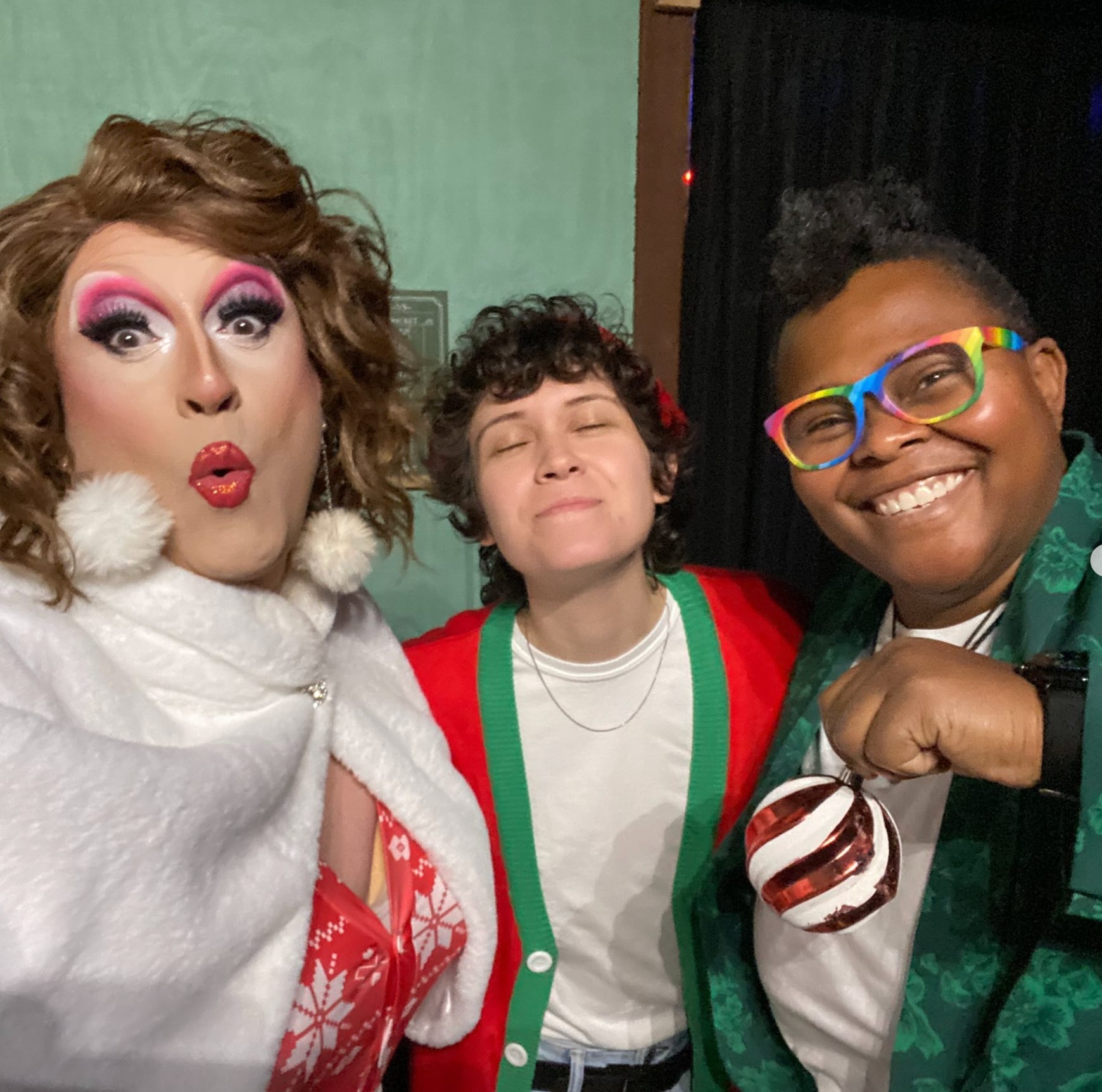
Flamy Grant, Spencer LaJoye and Crys Matthews, three of the artists on the Make The Yuletide Gay tour. (Courtesy Flamy Grant’s Insta)
Is the world still burning down? Is President Elon Musk shutting down the government, and are his pets Donald Trump, J.D. Vance and Speaker Mike Johnson completely powerless to stop it?
Is this happening?
Oh dear God.
Who wants to take a well-deserved break from talking about all that shit because Christmas is in five days and fuck it?
Let’s shift gears.
In the wee few months since the inception of this right here Moral High Ground newsletter, we’ve talked about lots of things that fall within the site’s description, about white conservative right-wing Christian fascist men, the Phyllis Schlafly clones who support them, and the extremely weird fears, feelings, emotions and autoerotic Braveheart fantasies that make them The Way That They Are.
Obviously we’ve talked a lot in these weekly Friday newsletters about the election and its horrifying aftermath.
But there’s another element here that I said I wanted to be present in this newsletter from the very first post, no matter if it’s just a little Substack or if it somehow grows into a great big media network.
I said this place is called “The Moral High Ground” because the bigoted, misogynistic assholes standing in the way of everything that’s good and holy are 100 percent certain they are the sole possessors of that high ground. I said that’s a toxic tumor of an idea that is unfortunately still given a shameful amount of weight in our society. You see this any time a corporate media source feels the need to host a hate-mongering bigot from a right-wing Christian group, to give “both sides” of whether LGBTQ+ kids should be allowed to live with dignity, or whether people should be forced to submit their bodies to the state for regular uterus inspections.
And I said that toxic tumor of an idea unfortunately still survives within far too many of us who have personally been abused by the conservative Christian church, or who are still currently enduring its abuse. It can be subconscious, like a vicious disease you think is gone, but then it rears its ugly head when something triggers it, telling LGBTQ people they’re not good enough, that maybe they really are going to hell, telling closeted LGBTQ kids in homeschooling households in East Cowfucker, Kansas, that they will never be able to get out, that Jesus really couldn’t ever love them.
And I said fuck that shit.
I said this isn’t a support group, and it isn’t a Christian website, but it’s a safe place for literally whoever you are, and I want the negation of the toxic messages I was just talking about to be loud and clear, front and center at The Moral High Ground at all fucking times.
And I want to showcase and bring together other people who are doing that work in their own brilliant ways.
So let’s talk about Christmas, Christian music, Christian drag queens, lesbians, non-binary people, and just generally ridiculously brilliant Christian and Christian-adjacent artists who, number one, EXIST — that’s right, LGBTQ kids living in right-wing Christian hell, they EXIST! — and who are out there this holiday season making the yuletide extremely totally fuckin’ gay.
I’m talking about Flamy Grant, Crys Matthews, Jennifer Knapp, Spencer LaJoye and Heather Mae, who have been out on tour this month that’s literally called Make The Yuletide Gay. I got to see them — well, three of them — last Friday night in Memphis, and it was so good, y’all.
If you read Wonkette AKA my day job where I am the managing editor, you may have heard of Flamy Grant. I posted the video above in 2022 in a piece about how a gay wedding was happening at Amy Grant’s house, and how it was pissing off pigfucks like Franklin Graham, AKA the ickiest byproduct of Billy Graham’s participation in the human reproductive process.
I mentioned in my post that my own personal first concert was in Little Rock, Arkansas, 1991, Amy Grant, on the Heart In Motion tour, front row, Baby Baby! (My church youth group really had the hookup on that one, I guess.)
Then in 2023, Flamy Grant started taking over the Gospel and Christian charts, for the best, funniest reason. You see, this dildo-witted MAGA preacher named Sean Feucht was birthing entire full-grown cows because Grant — a Christian drag queen for whom listening to Amy Grant was also quite formative — had collaborated with Derek Webb, who had huge success in the Christian music world back in the day with a band called Caedmon’s Call. (Webb, you might deduce, is also in a bit of a different place these days.)
This was obviously a sign of The Last Days to excitable types like Sean Feucht. Also that loud flamboyant Greg Locke creep. He’s real exercised about Flamy Grant.
So God, being the way God is, thought it’d be funny to use that moment to make sure Grant’s song with Webb and the album it came from went straight to the top of the charts. The Gospel and Christian charts.
It’s been one heck of a week, both on the public front, and here on the home front. It’s Friday afternoon, though, so here’s a toon about the public front from Clay Jones.
I’m going to use a colleague’s cartoon to point something out. Right-wing gaslighting lying fucknut Steve Kelley has a cartoon of a reporter asking White House Spokesperson Karine Jean-Pierre to clarify who she’s talking about when she says “the president,” Joe Biden or Donald Trump. In Steve’s defense, it’s hard to write even adequate cartoons when you’re a lying racist MAGAt.
Steve might be a little slow on his civics but the answer is President Joe Biden. How do I know this? Because for one thing, Jean-Pierre works for President Joe Biden so you would have be a real idiot to believe she’s referencing the other guy. Second, President Joe Biden is the current president. The third thing is, Donald Trump is NOT president right now no matter how hard he’s trying to destroy the nation before he’s sworn into office.
Other fucknut cartoonists may also believe Trump is the leader of our government. Look at this bullshit from Idiot One Gary Varvel and copied days later by Idiot Two Dana Summers. I don’t see how Trump sitting his fat ass at MAGA-Lardo grifting his Trump Bibles as Christmas gifts while trying to destroy the government he’ll inherit on January 20 is leadership, but whatevs.
Trump is pushing for a government shutdown, saying he’s OK with it either way. If there’s a shutdown, he’ll blame Biden even though he’s the one shitposting on Truth Social that Republicans shouldn’t cooperate with Democrats, but they should raise the debt ceiling so that he can give asshole billionaires such as himself and Elon Musk tax cuts in 2025.
Remember, Republicans hate raising the debt ceiling. The debt ceiling is to cover expenses Congress has already legislated but Republicans think it’s authorizing future spending. Trump is looking at future spending and wants the ceiling raised or done away with altogether. For once, I agree with Trump and the debt ceiling should be scrapped. Republicans won’t go along with that because for them, it’s a tool to hold the nation hostage.
Elon wants a shutdown because he wants to destroy the government except for the parts of it that pay him billions of dollars in government contracts. But he’s howling for a shutdown and that’s when Trump changed his mind. Elon did invest $277 million to get Trump elected, so his stake in that orange fat ass may be higher than Putin’s. And how much does Elon expect to reap for his quarter-billion-dollar purchase?
House Speaker Mike Johnson filed a stopgap spending bill Tuesday night which went to shit after Elon went into a tweet(X) frenzy consisting of over 100 posts in one night against a deal negotiated with Democrats. The bill would have provided $100 billion in disaster aid funding, billions in farm assistance, and other assorted projects like fighting cancer in children and kept the government running.
Among Elon’s tweets were lies that the bill included a 40 percent increase in congressional pay, $3 billion for a new stadium for the Washington Commanders, funding for bioweapon labs, and protecting the Jan. 6 Committee from being investigated. Why didn’t he also tweet it would fund Critical Race Theory, Drag Queen Story Time, trans men in women’s sports and restrooms, and buffets of cats and dogs to be eaten by illegal Haitian immigrants in Springfield, Ohio?
Here’s the thing: If you have to lie your tiny South African balls off, you’re on the wrong side of the issue. The reason creepy goons and idiots like Elon and Trump have to lie is that the truth doesn’t help them. They also know they’re lying because Google’s search engine works for Republicans too.
As of this writing, there are only about eight hours left to pass a funding bill to prevent a shutdown. Trump says the shutdown will be Biden’s problem, but the idiot doesn’t realize he’s inheriting this problem in January. Or maybe, he thinks Elon will inherit it. Just go play golf, Tiny. Elon’s got this (sic).
During his last administration (sic), Trump told Chuck Schumer and Nancy Pelosi he’d be glad to take the blame for a shutdown. When that shutdown happened, he blamed Schumer and Pelosi and eventually negotiated a deal where he lost funding for his stupid racist wall.
Trump is as good of a negotiator as George Constanza who negotiated his and Jerry’s salary for their NBC TV pilot down from $13,000 to $8,000.
The leader of this nation until January 20, 2025, is President Joe Biden, but the leader of the Republican Party is not Donald Trump or even Mike Johnson. It’s unelected Elon Musk.
This is a preview of the next four years. Republicans are in a rush to destroy this nation and they’re starting early.
Music note: I listened to Audioslave.
Drawn in 30 seconds: (snip-click through to help him out, and watch him draw!)
Vermont Freedom To Marry Passes, and more on this date:
December 20, 1946 The morning after Viet Minh forces under Ho Chi Minh launched a nighttime revolt in the Vietnamese capital of Hanoi, French colonial troops cracked down on the communist rebels.Ho and his soldiers immediately fled the city to regroup in the countryside. That evening, the communist leader issued a proclamation that read: Ho Chi Minh, Paris 1946
“All the Vietnamese must stand up to fight the French colonials to save the fatherland. Those who have rifles will use their rifles; those who have swords will use their swords; those who have no swords will use spades, hoes, or sticks. Everyone must endeavor to oppose the colonialists and save this country. Even if we have to endure hardship in the resistance war, with the determination to make sacrifices, victory will surely be ours.” The first Indochina War thus began.
December 20, 1960 North Vietnam announced the formation of the National Front for the Liberation of the South (usually known as the National Liberation Front or NLF), designed to replicate the success of the Viet Minh, the umbrella nationalist organization that successfully liberated Vietnam from French colonial rule. National Liberation Front flag Ho Chi Minh biography(two separate links.)
December 20, 1990 Kansas reservist Dr. Yolanda Huet-Vaughn refused orders to serve in the first Gulf War (Desert Storm) and was later sentenced to prison. The Kansas medical board withdrew her hospital privileges. “The issue was not whether I belonged in the military but whether the military belonged in the Middle East waging war. I did not want to focus on the personal decision. I was trying to focus on the decision for which each and every American would have to be responsible.” — Yolanda Huet-Vaughn What if they gave a war and nobody came?
December 20, 1994 100,000 Chechnyan civilians linked hands in a 65 km-long human chain (40 miles) to protest the Russian invasion of their country and attack on their capital, Grozny. Read moreOR TRY HERE if you don’t have an account with the NYWT.
December 20, 1999 The Vermont Supreme Court rulled in Baker v. State of Vermont that homosexual couples were entitled to the same benefits and protections as wedded couples of the opposite sex. History of the Freedom to Marry
The tropical cyclones Seroja and Odette came together in the Indian Ocean north-west of Australia in April 2021. After the two cyclones merged, TC Seroja abruptly changed course by 90 degrees. Credit: Provided by the Japanese Space Agency (JAXA), JAXA P-Tree System
In April 2021, tropical cyclones Seroja and Odette clashed in the southeastern Indian Ocean, just north-west of Australia, before finally merging completely.
The Australian Bureau of Meteorology describes this interaction as rare: “Seroja produc[ed] torrential rainfall and devastating floods in parts of Indonesia and Timor Leste. Later, it interacted with Tropical Cyclone Odette via the Fujiwara effect, a phenomenon rarely observed in the Australian region. Finally, it strengthened into a category 3 tropical cyclone producing a severe impact in the Mid-West region of Western Australia, unusually far south for a coastal crossing of a Severe Tropical Cyclone.”
These types of convergences are one of the most extreme interactions between the ocean and the atmosphere on Earth. But with the number and intensity of tropical cyclones increasing because of global warming, understanding their impacts has become more important than ever.
“Seroja first of all stalled the smaller cyclone Odette and then merged with it 3 days later,” says Oliver Wurl of the University of Oldenburg in Germany. After the cyclones merged, Seroja abruptly changed course by 90 degrees.
The whole encounter lasted for about a week.
“This chain of events not only influenced weather patterns but also triggered a previously unobserved interaction with the ocean underneath,” says Wurl.
In a new report in in the journal Tellus A: Dynamic Meteorology and Oceanography, Wurl and colleague Jens Meyerjürgens analysed the encounter between the 2 relatively weak tropical cyclones and found effects that have only been observed with much stronger systems.
They did this by combining satellite data, measurements of the upper ocean, such as salinity and water temperatures obtained from ARGO floats and autonomous drifters, and numerical modelling.
The researchers found that sea-surface temperatures dropped by 3°C in the aftermath of the merge due to cold water upwelling towards the sea surface from depths of 200m.
Given cyclones’ intensity as a Category 1 on the Hurricane Scale, this cooling effect and depth of upwelling was “exceptionally high” – on the scale observed in Category 4 or 5 hurricanes.
“As a result of the interactions of a cyclone with the ocean and the upwelling of cold, deep water, the ocean absorbs additional heat from the air and then transports it to higher latitudes – a crucial process that influences the climate worldwide,” explains Wurl.
The researchers conclude that the simultaneous formation and interaction between tropical cyclones could increase in the future with global warming and, with it, the extreme thermodynamic responses of the upper ocean.
The Ultramarine project – focussing on research and innovation in our marine environments – is supported by Minderoo Foundation.