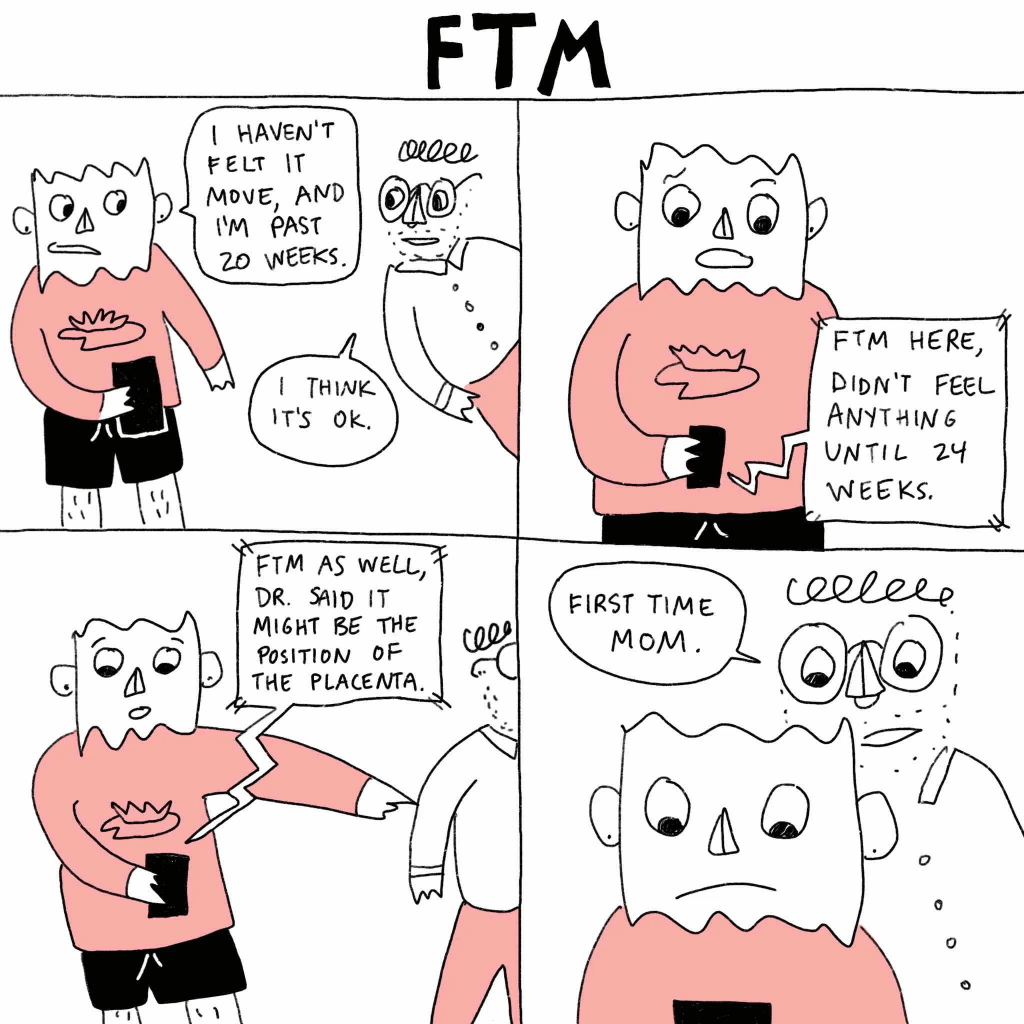
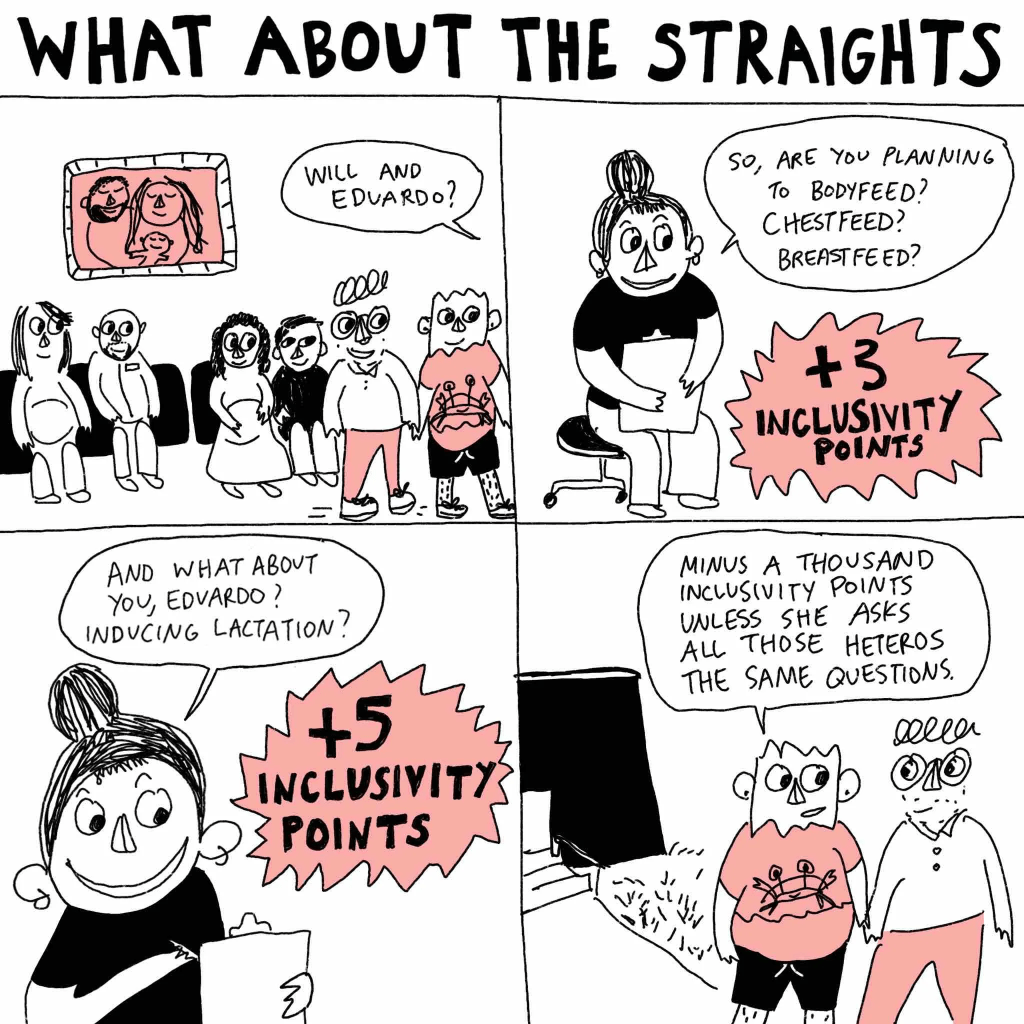
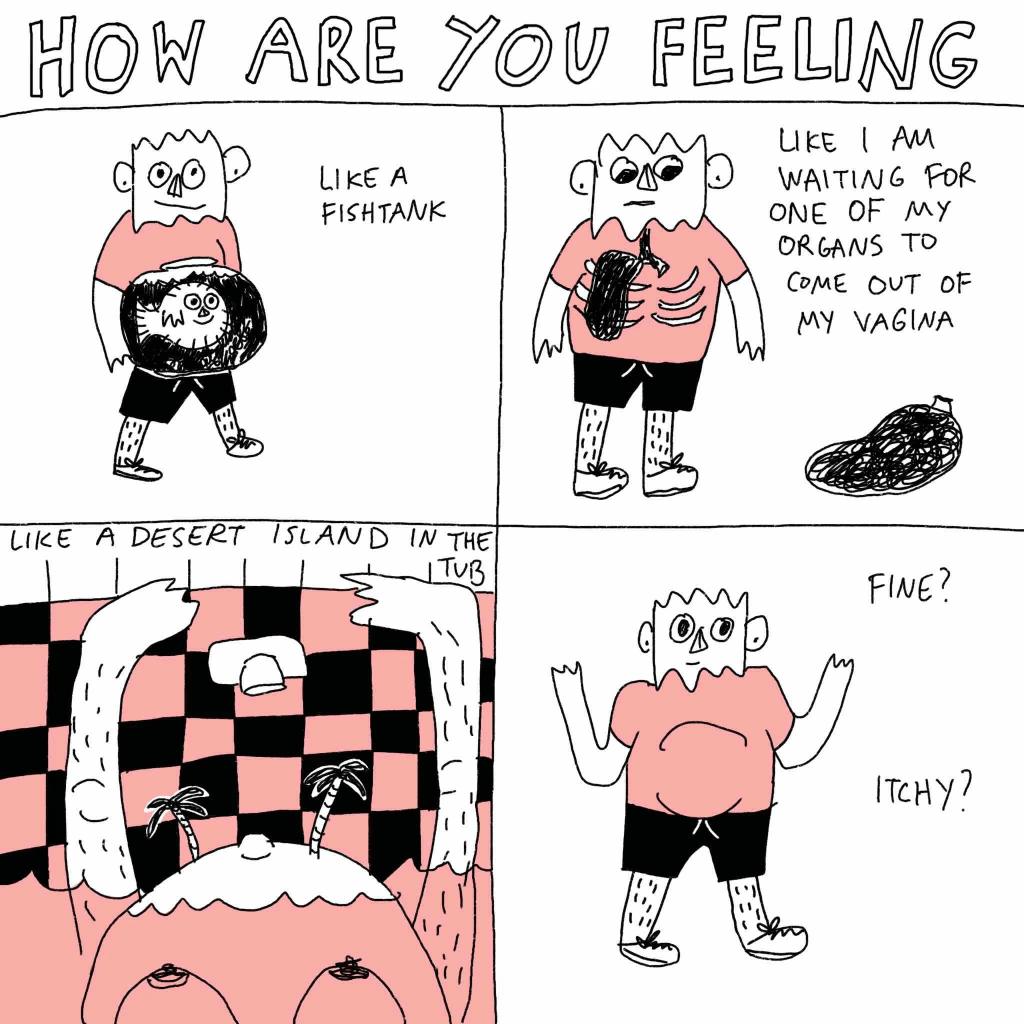
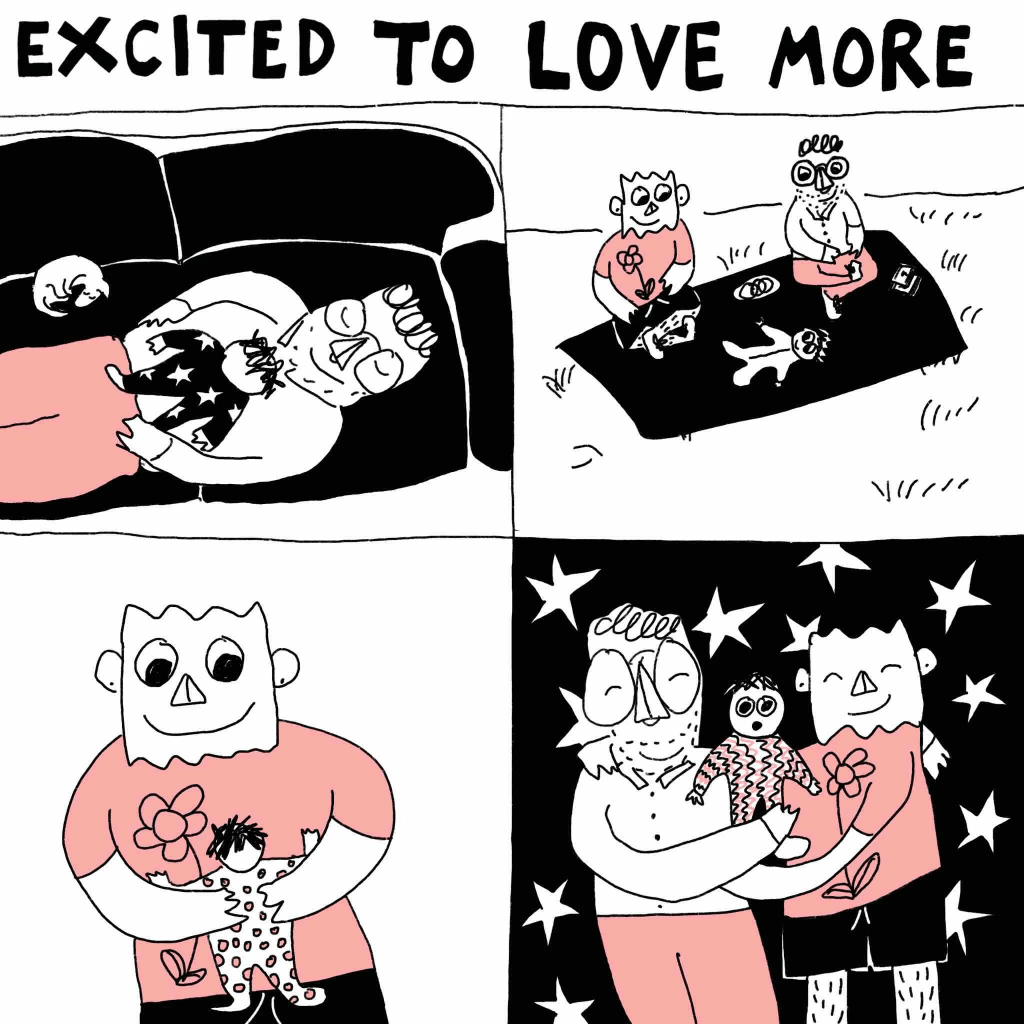
These pages are an excerpt of Will Betke-Brunswick’s work-in-progress book, Transpregnant.

These pages are an excerpt of Will Betke-Brunswick’s work-in-progress book, Transpregnant.
Being pregnant is a journey—especially when you’re transgender.
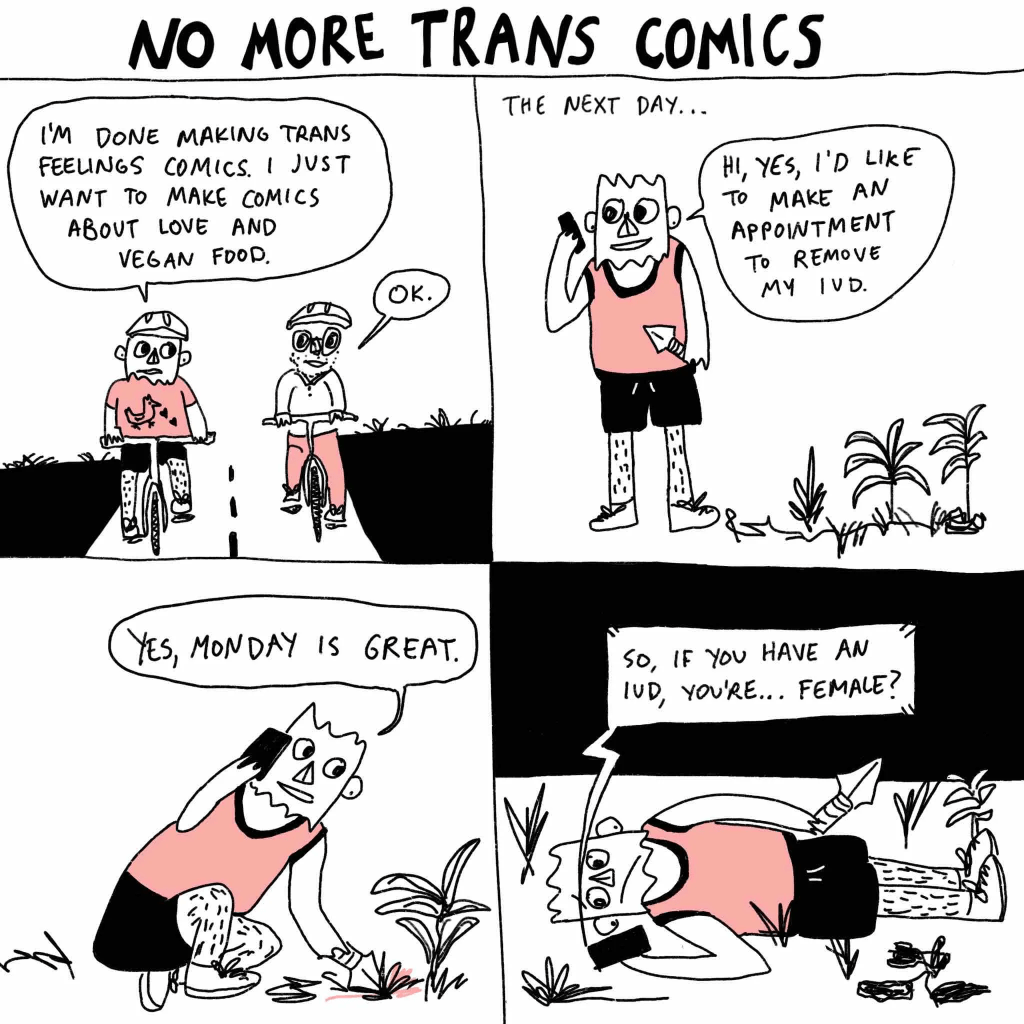
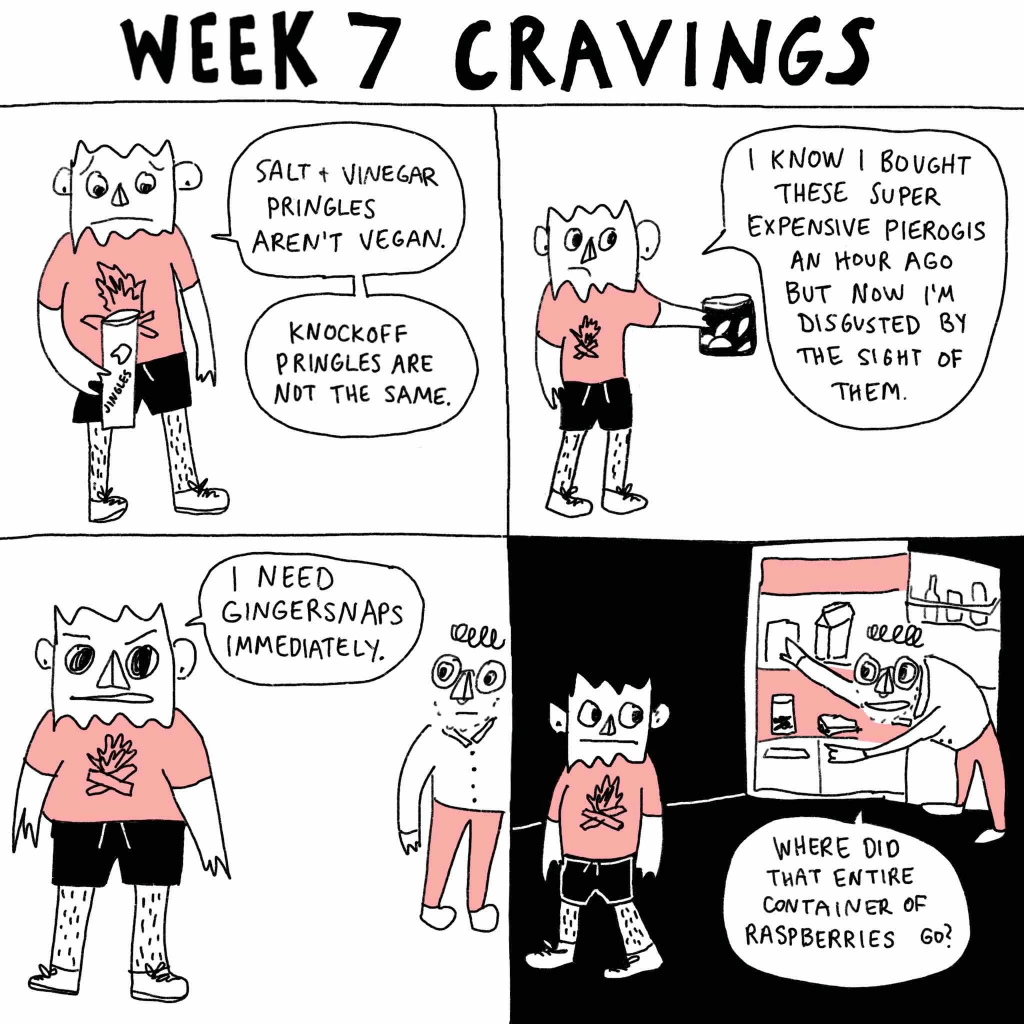
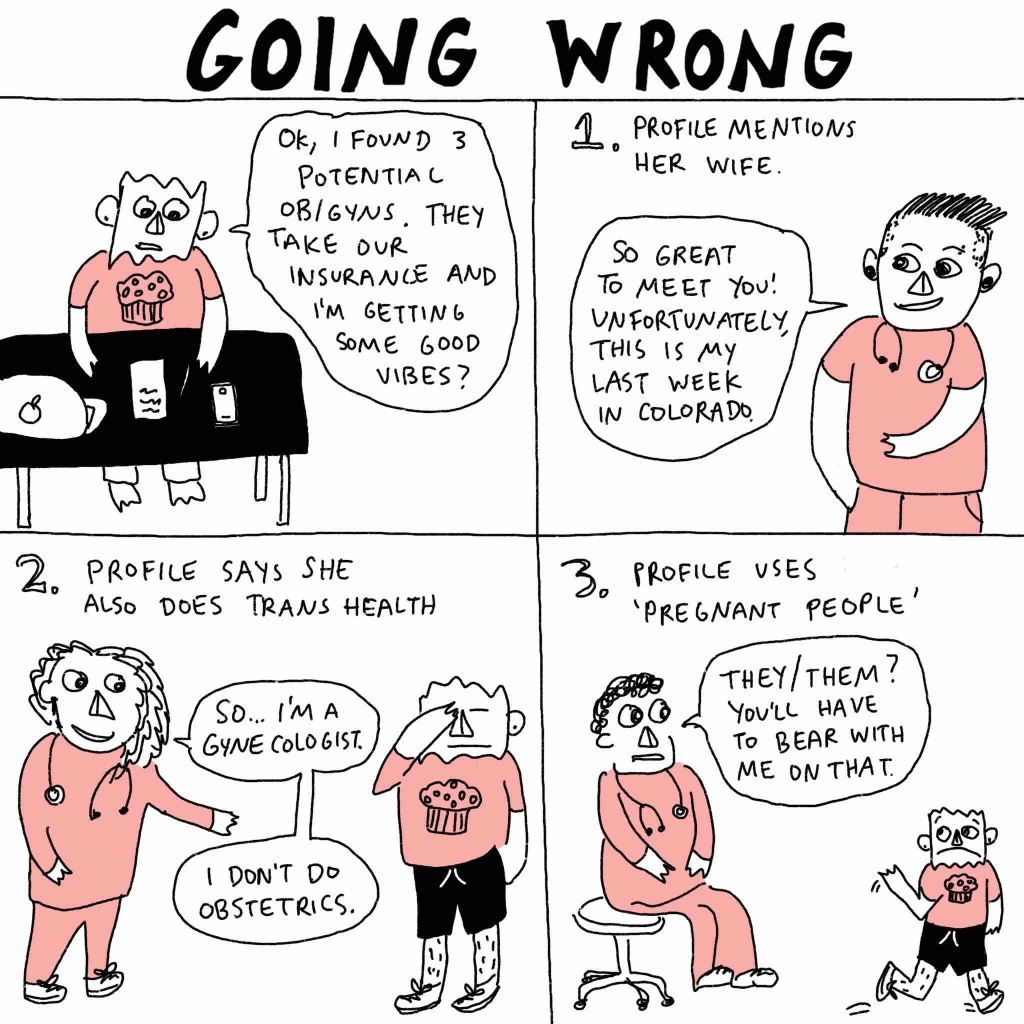
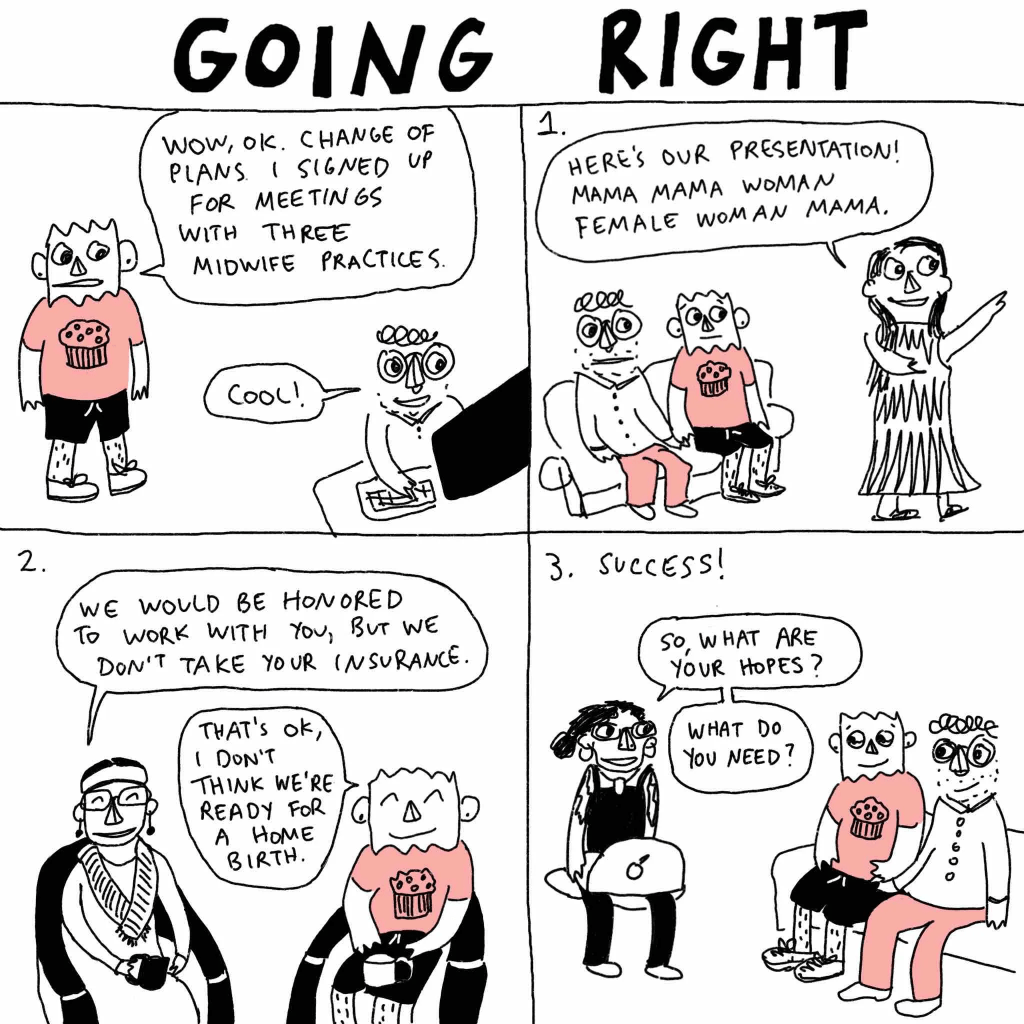
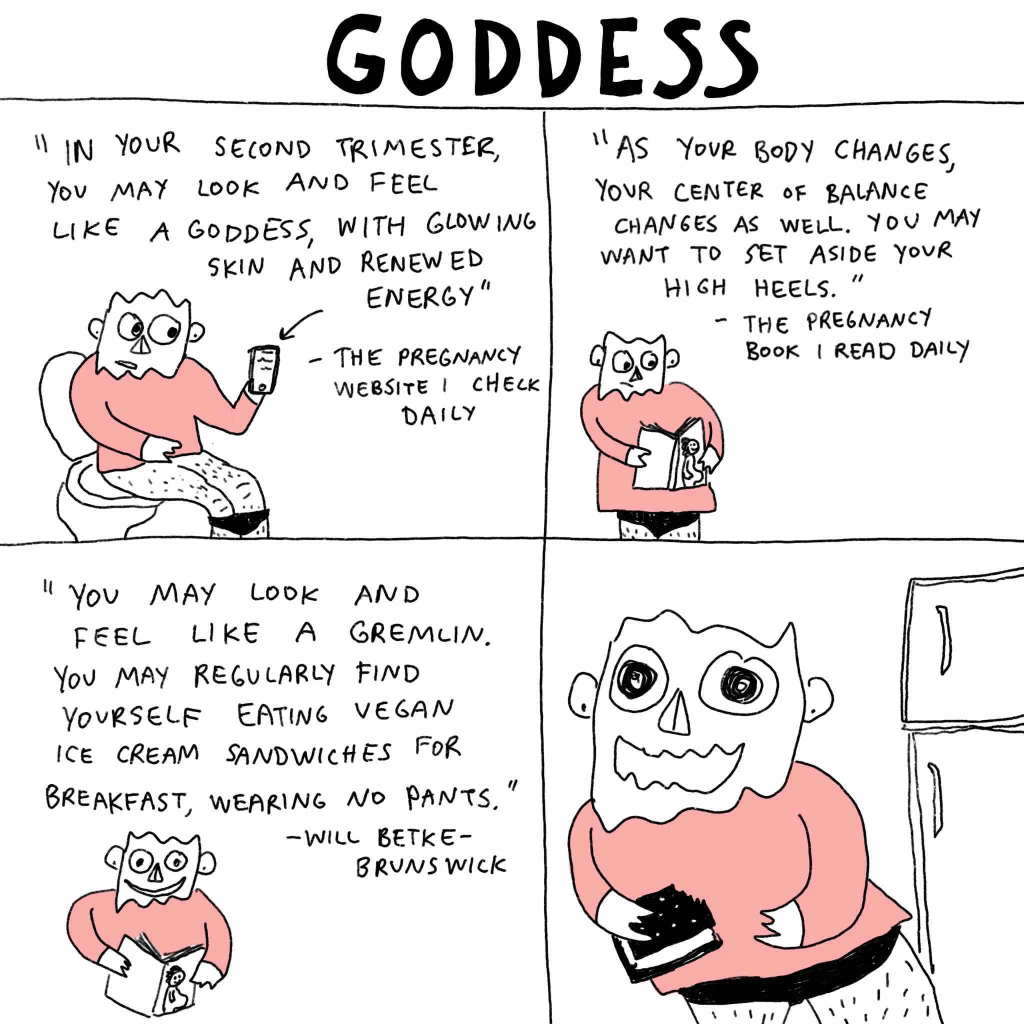
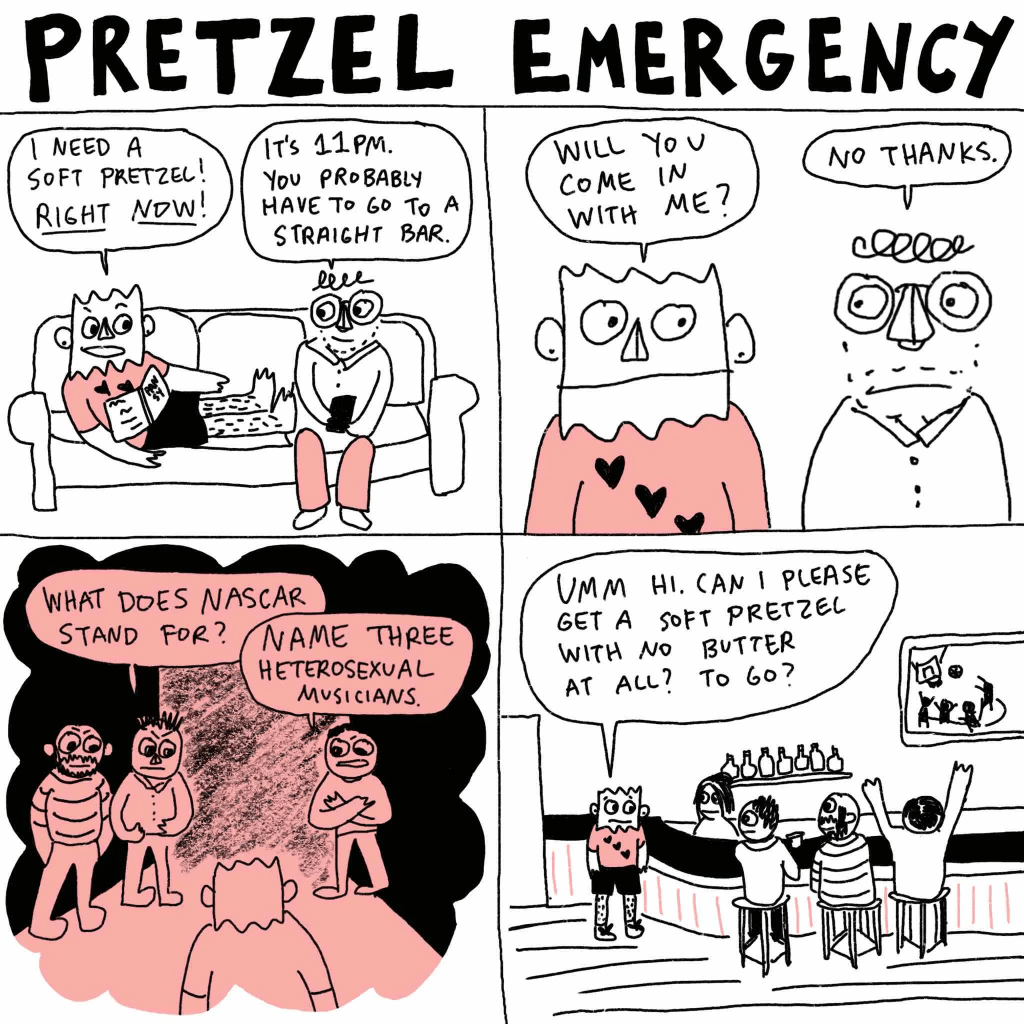
(continued next post)
There is a link within. Penguins are many of my favorite things! From that linked page:
It’s practically impossible to look at a penguin and feel angry. Joe Moore
Hello, friend!
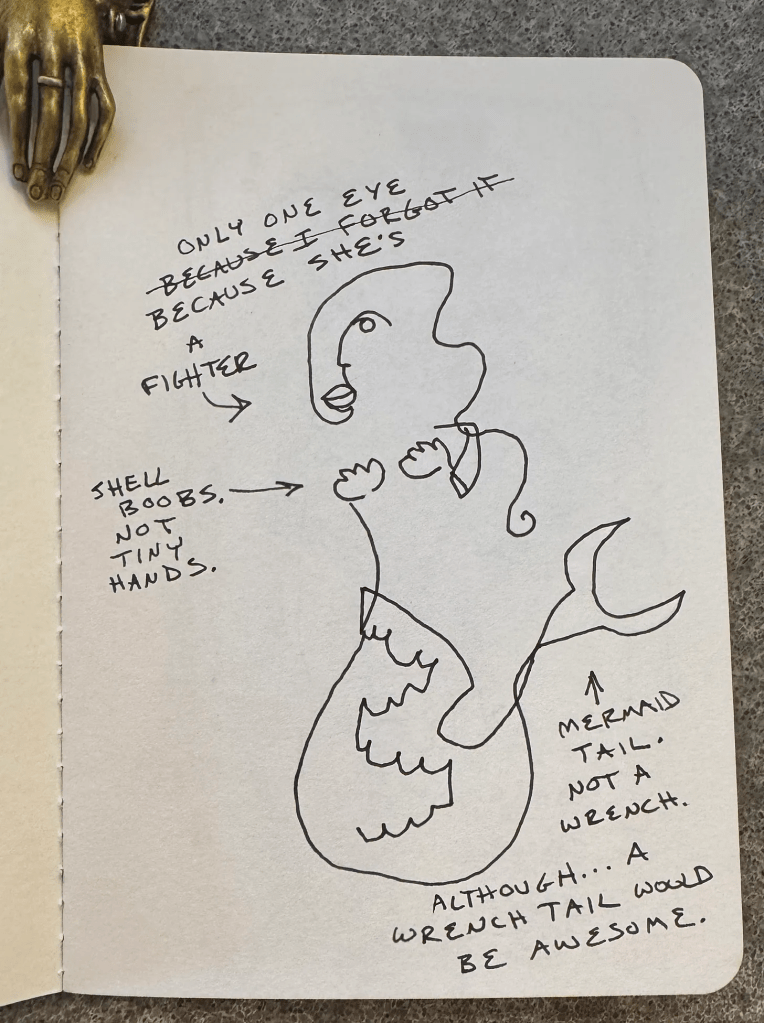
This week I revisited the Lynda Barry Making Comics book because I was on book tour and a tiny sketch book was easy to bring along on plane rides. The exercises were out of my comfort zone but sometimes I think that can be a good thing. This exercise was called “Close your eyes and draw a mermaid.”
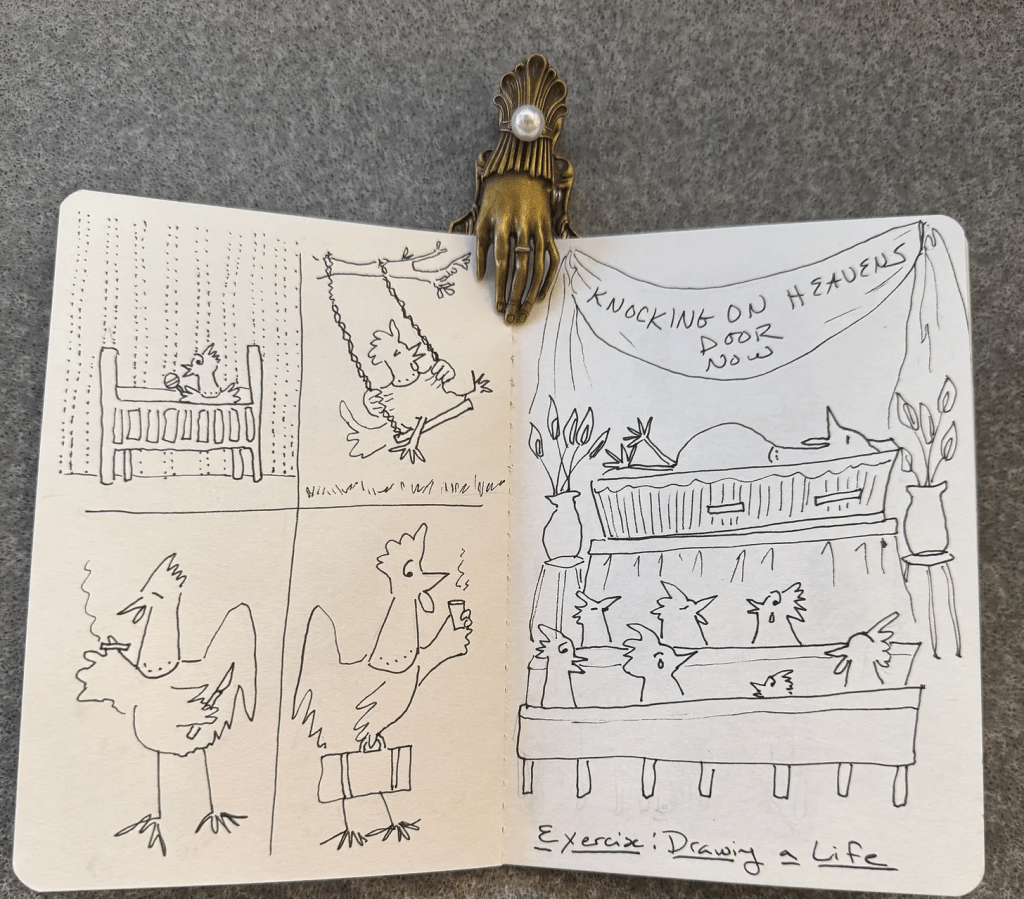
Another was to choose a character and sketch their entire life cycle. I chose Beyoncé the Giant Metal Chicken, obviously:
I did a self-portrait…sort of:
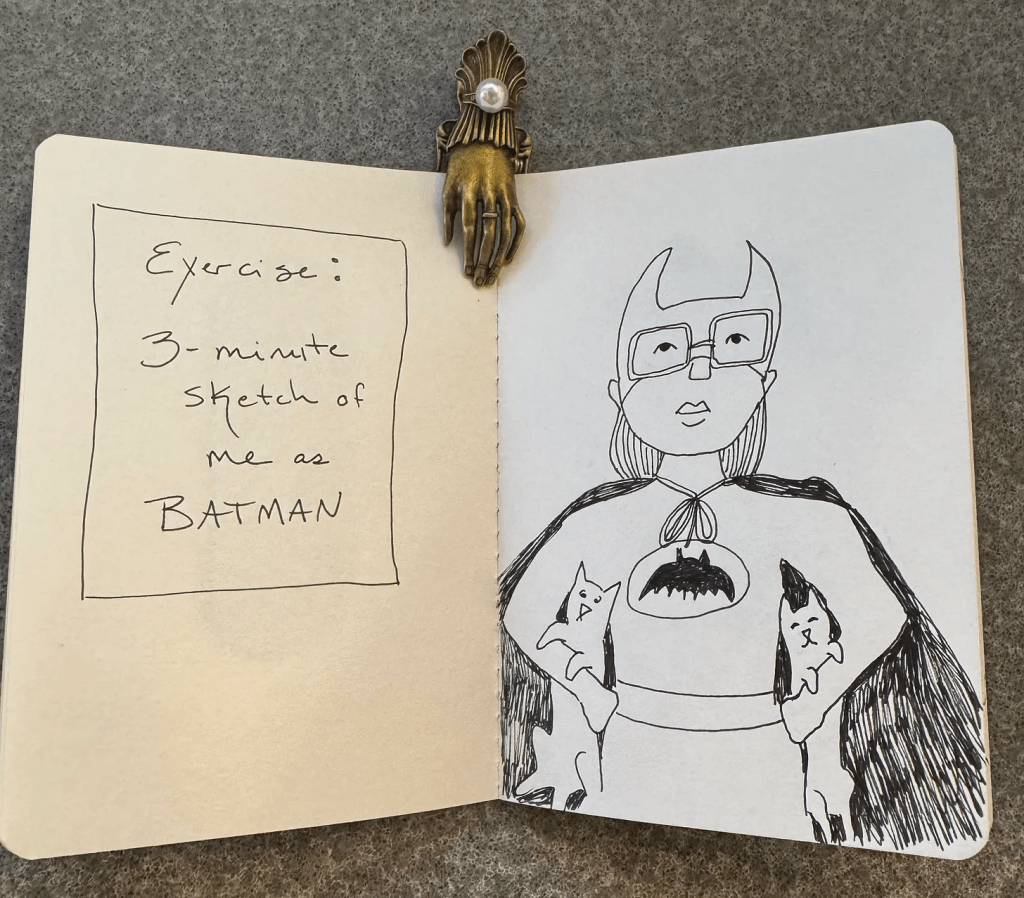
And drew with both hands at the same time, which is much harder than it sounds: (snip-MORE; go see!)
From Cornell Lab Bird Cams:
From American Bird Conservancy:
Procnias tricarunculatus
Also Known As
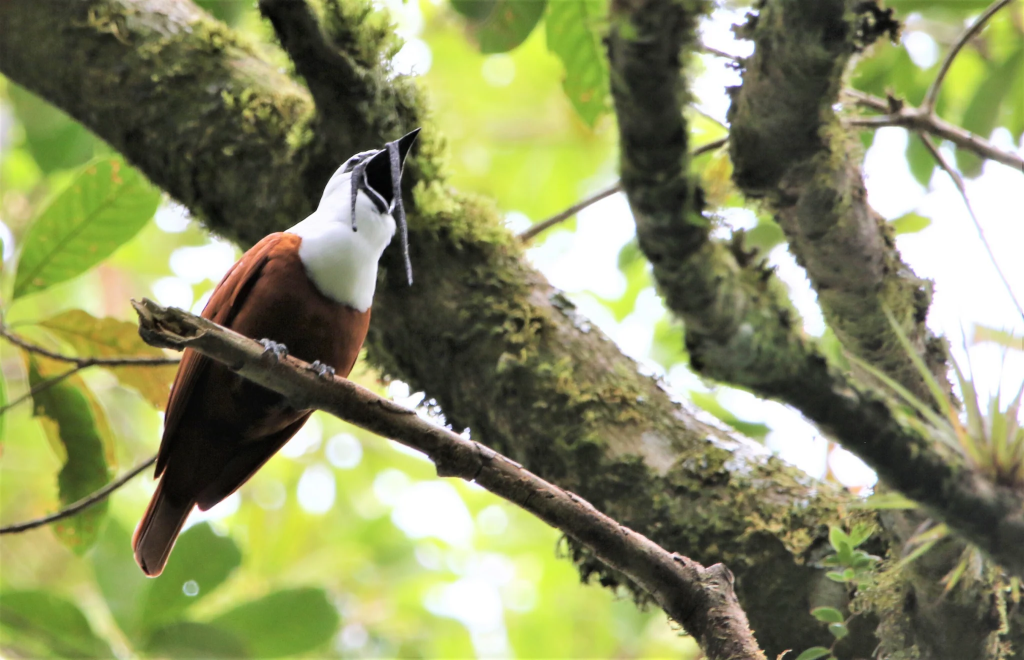
The Three-wattled Bellbird, like other Central and South American bellbirds in the Cotinga family, is a natural history paradox. Breeding males perch on exposed branches and sing one of the loudest songs of any bird, impossible to ignore and audible from more than half a mile away. However, despite this extremely conspicuous breeding season behavior, females and nonbreeding males are notoriously difficult to observe, foraging in the higher levels of the canopy and remaining remarkably silent. As a result, this species has been subject to fascinating and in-depth studies of its song and courtship behavior, but some of the most basic aspects of its natural history are unknown. For instance, only two nests have been recorded, one in 1975 and one in 2012, and no eggs or young have been documented.
But biologists have learned a great deal from studying the Three-wattled Bellbird’s song. The bellbirds belong to a group of perching birds known as the suboscines, which also includes tyrant flycatchers like the Western Kingbird and antbirds, such as the Marsh Antwren. While the “true” songbirds (or oscines) are famous for their song-learning abilities, suboscine songs are classically considered to be completely innate, with no learning taking place. However, the Three-wattled Bellbird shares an important feature with birds that learn their songs: dialects. Birds from Nicaragua sound noticeably different from Costa Rican birds in the Cordillera de Talamanca and the Cordillera de Tilarán, which each host populations with distinct songs. (snip-MORE)
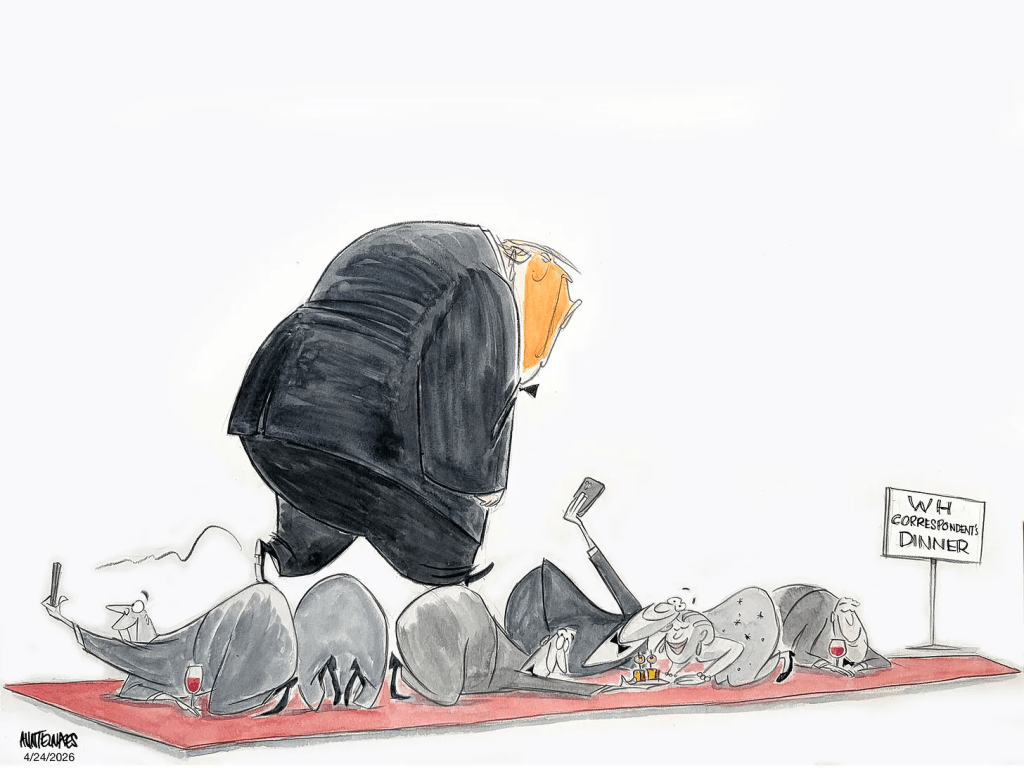
Never a good idea for journalists to become chummy with politicians and people in power but this year particularly, it’s allowing an autocrat to continue his attack against the free press.

Right-wing commentator, white nationalist, Vladimir Putin fan, former Fox News host, and former bowtie aficionado, Tucker Carlson, is now sorry that he helped elect Donald Trump to the presidency.
Tucker, who was often at Trump’s side during the presidential campaign in 2024 and who was a huge lobbyist to get JD Vance on the ticket, now says he will long be “tormented” for helping Donald Trump get to the White House and start a war with Iran.
Tucker is just one of several right-wing goons who have gone from being full-fledged MAGAts to personal enemies of Donald Trump. They include not just Tucker, but Marjorie Taylor Greene, Alex Jones, Megyn Kelly, and Candace Owens. (snip-MORE)
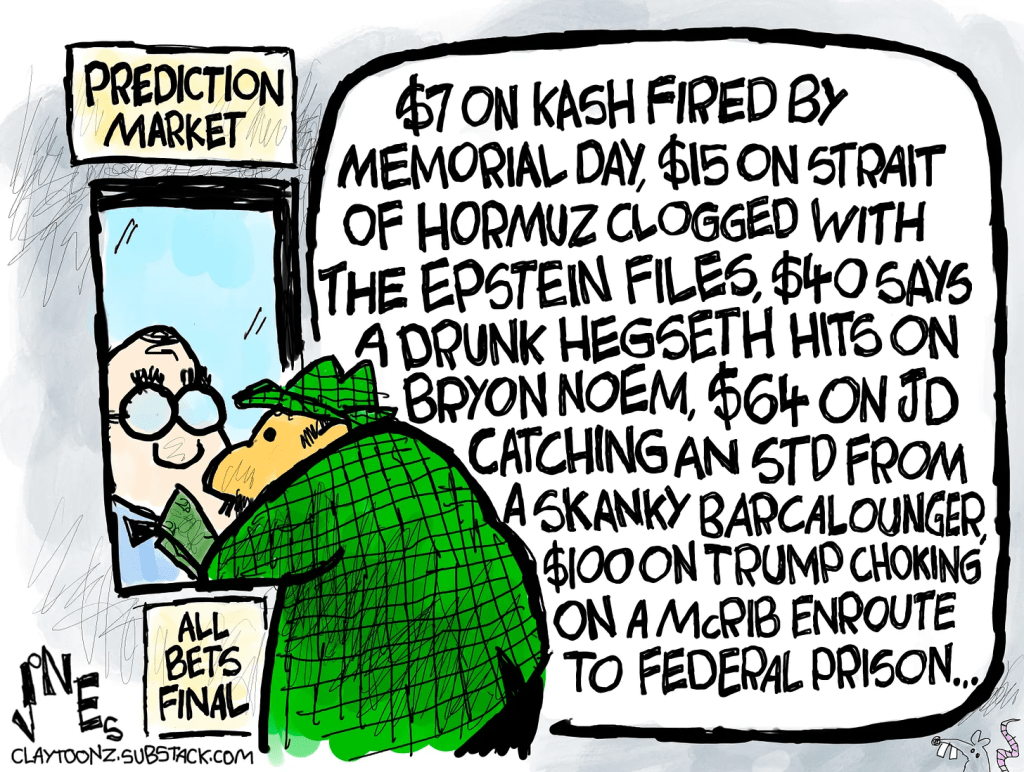
I was surprised a year or so ago when I learned that people were betting on professional wrestling. As you are probably aware, professional wrestling matches are pre-determined, as in, they are fake. I guess the only thing that prevents a writer of the matches from cleaning up is that the stakes are very low.
When I was a kid, my mother told me that people could not bet on who shot JR from the TV show Dallas because one of the writers could go to Vegas and place a large wager on it. That would have been insider trading. That’s not allowed, right?
Yesterday, a U.S. Army special forces soldier involved in the capture of President Nicolás Maduro of Venezuela was charged with using classified information to bet on events related to the mission. The soldier made more than $400,000 by betting on the prediction markets that the capture would happen. (snip-MORE)
A Wonkette Guest Substack. Also, a bit of blue language within.
Ali Davis Apr 24, 2026
Ali Davis invited us to reprint this post from The Camelopard. As always, we said yes.
Hello, Goopers!
Wow, things are getting wild, huh? Did you ever think, during all those long years when you boosted him and covered for him, that the Trump Train would be plowing through so many guardrails? Rumor has it — or at least a Gateway Pundit writer has it — he tried to use nukes last Saturday!
I would write something about you being the last hope and your duty to your country, but that’s clearly no incentive, so here’s something that will hit.
You must remove Trump before a) he goes undeniably off the rails or dies or b) another country’s investigation turns up his full involvement with Jeffrey Epstein and child sex trafficking. If you don’t, you, personally, go down in history as a willing toady to evil. Your name and your failure to act will be preserved forever. Family members will change their last names or claim no relation. Corporations will find hiring you too big a risk. No more political career, no cushy lobbying job, no lucrative TV punditry. Just burned relationships and strangers asking why the hell you didn’t stop it when you had the chance, right before they spit on you.
You see how Tucker is scrambling to position himself as A Guy Who Sees the Light and Wants to Stop Trump? Do you think he had a deep change of heart, or do you think he noticed the way the wind is blowing and is doing everything he could to save his own ass and future? You should study those instincts.
Tucker knows that he will need to be able to point, however ludicrously, however tenuously, to how he saw that Trump was dangerous and spoke up.
You need to do more than that. You must remove Trump from office before his own body removes him or you go on the Forever Trumpers list.
If you don’t have real moral fortitude, try to develop the sense and eyes that God gave a potato and read a few polls while you’re at it. Trump is losing, so you need to act like him one more time: Switch to the winning team and pretend you were always wearing that jersey.
Do it fast if you ever want to keep seeing your grandchildren after they’re old enough to understand this moment in history and what you failed to do.
Look into your soul and be real for a moment. At best — at best — he knew exactly what Epstein was up to and winked at it. The birthday card. The famous quote where he said “He’s a lot of fun to be with. It is even said that he likes beautiful women as much as I do, and many of them are on the younger side.” The constantly changing stories about when and why Epstein was removed (was he?) from Mar-a-Lago.
Trump knew. He at least knew.
Now factor in the purchase of a teen beauty pageant and the founding of a model management company, two perfect ways to move underage girls across international lines. His own on-air brag that he liked to burst into the changing rooms of teenage pageant contestants. The time he speculated on his dating prospects with a child on an escalator.
We may never know everything, but we will know more. You can be one of the heroes who bravely stood up to stop Trump, or you can be one of the craven sleazebags who went all out to shield an aspiring dictator and bunch of wealthy child molesters. Every moment you don’t choose the first one will itself be a black mark against your name, so you might want to hurry up and flip a coin or something.
I have news for you: There has never been a better time to get out from under being blackmailed. The crimes in the Epstein Files are so heinous that even Swalwell and Gonzales’s horrifying conduct barely made a blip. Make your peace with your family, take some responsibility, and hope that whatever the regime has on you isn’t as hilarious as what someone had on Kristy Noem’s husband.
Need a little more incentive? Not that I am diagnosing anyone, but people who become disinhibited as a part of their cognitive decline have an increasing tendency to just … blurt things out. Do you want to have a nice, preplanned statement to the press about respecting your privacy during this challenging time, or do you want the most personal thing you can imagine barfed out randomly during an official statement on the soybean trade?
I will also mention that people with some types of dementia have a tendency to fill in memory gaps with invented details. Do you really want to explain to the nation that yes, the thing about the carnival is overall true, just not the part about the plate spinner and the Tilt-a-Whirl?
Besides, if enough of you move quickly and work together, you might just get off scot-free.
I have news for you, Sparky: We are all being physically threatened. A man who has never in his life experienced a consequence has access to nuclear weapons and is eager to use them.
Move quickly. Get your family somewhere safe, choose a Democrat as a point person — do not trust your fellow Republicans, you know full well how craven they can be — and let the opposition party count up the votes. Move together, publicly report the threats, and save yourself by bravely impeaching the sumbitch.
Well, now you know what it’s like to be a victim of a powerful serial sex offender. Please use that perspective wisely in the future if you have any shreds of a political career left.
For real though — a lot of Trump’s power comes from the perception that he is powerful. Puncture that and the whole thing deflates.
You want to save your own tail? Help the Democrats start prosecuting him and his cronies immediately after impeachment. No professional courtesy, no putting this all behind us so we can move forward, no honoring the frantic pardons of a rogue President. Everything comes out and everyone gets real consequences. Seize and freeze assets, put Trump’s thugs and cronies on the no-fly list, and start the trials. Nobody squeaks by, not even the very wealthy ones.
Once you find some rudimentary bits of calcium spinning around your spinal nerve, you may even discover that you like using them in the service of something good.
But you must act immediately.
Trump is spinning out and trying to take the world with him. You can help put a stop to it, or you can forever be on the list of people who had the power but were too evil or craven to do anything about it.
You can choose the story that other people will tell about you.
But you’d better make it quick. (snip)
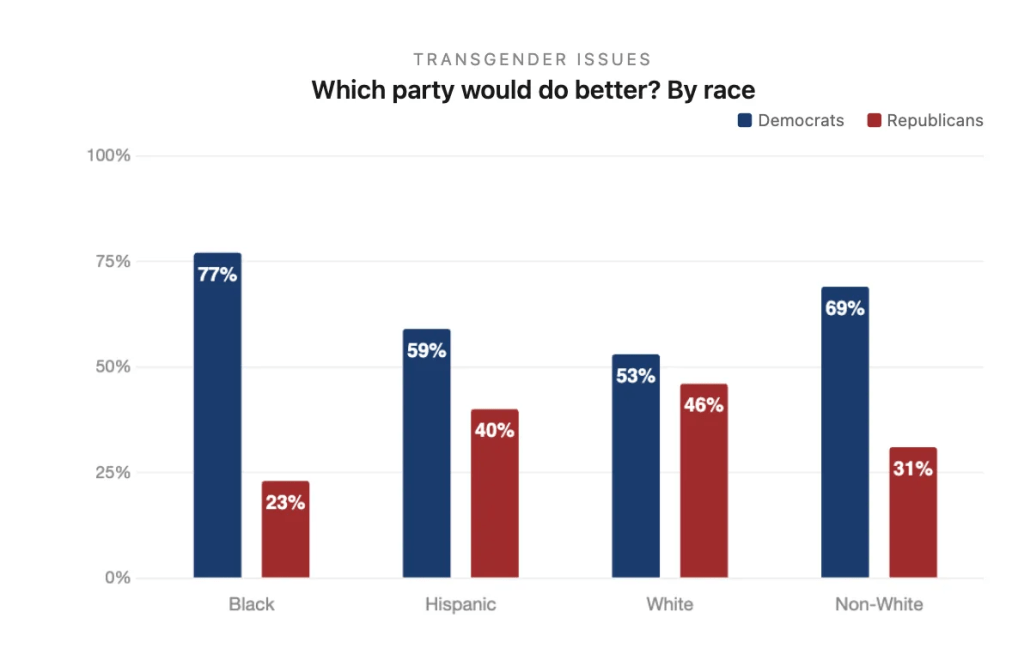
The Trump administration has made attacking transgender people one of its signature priorities. It has issued a orders threatening to defund hospitals that provide gender-affirming care to trans youth, targeted children’s television through the FCC for including transgender characters, and spent millions in taxpayer resources pursuing anti-trans executive orders across the federal government. But according to the latest Fox News poll, released this week, the American public is not on board. Voters say Democrats would do a better job on transgender issues by a 13-point margin, 56 to 43 percent—the second consecutive Fox News poll this year to show a significant Democratic advantage on the issue.
The finding is consistent with the January Fox News poll, which showed Democrats with a 22 point advantage on transgender issues. While the margin has narrowed somewhat, the direction has not changed: voters across nearly every demographic subgroup continue to say they trust Democrats more than Republicans on this issue.
The demographic breakdown is significant. Black voters backed Democrats on transgender issues by a 54-point margin, 77 to 23 percent. Hispanic voters favored Democrats 59 to 40 percent. White voters—a group Republicans depend on for their electoral coalition—sided with Democrats 53 to 46 percent. Every age group favored Democrats, with the strongest support coming from voters under 35, who backed the Democratic approach 61 to 39 percent. But the finding was not limited to young voters: Americans 65 and older also preferred Democrats on the issue, 58 to 38 percent—a 20-point margin among seniors.
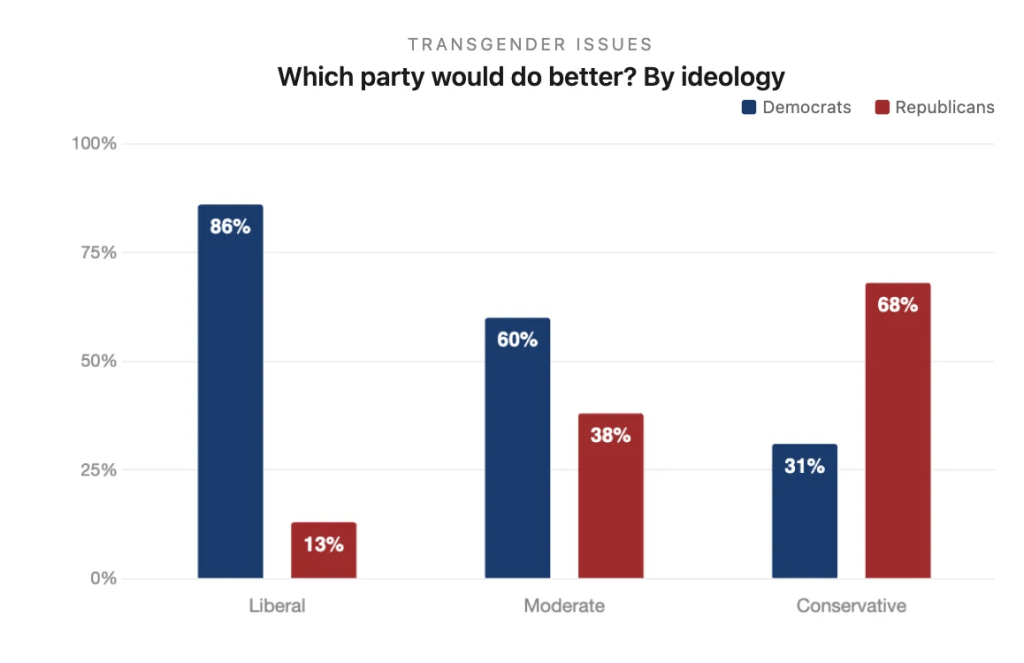
Self-identified moderates backed Democrats 60 to 38 percent—a 22-point margin that suggests anti-trans messaging continues to backfire outside the Republican base. Liberals preferred Democrats 86 to 13 percent. Even among self-identified conservatives, nearly a third—31 percent—said Democrats would do a better job. And among 2024 Trump voters, 27 percent crossed over to say they trusted Democrats more on the issue—more than one in four of the president’s own supporters.
The geographic breakdown was equally striking. Urban voters backed Democrats 68 to 31 percent and suburban voters—the decisive battleground in American politics—preferred Democrats 57 to 43 percent. Rural voters were the only geographic group to favor Republicans, 52 to 46 percent, but even that margin was narrow. Democrats also led among Catholics (54-45), white Catholics (51-48), Protestants (50-48), and military voters (54-44). White evangelicals were the only religious group to side with Republicans.
(snip-MORE, with more charts)
I was just telling Jill over on Filosofa’s that I’d totally missed that today is Arbor Day. I’m so sorry and a bit ashamed; DH was a tree planter, and we always did some sort of observation. This year it almost slipped by! Anyway, we can start with a couple of quotes; here are two of my favorites:
Trees are as close to immortality as the rest of us ever come.”
― Karen Joy Fowler
“You know me, I think there ought to be a big old tree right there. And let’s give him a friend. Everybody needs a friend.”
― Bob Ross
https://onetreeplanted.org/blogs/stories/inspirational-quotes-about-trees
Here at the Redford manse, we have two fine green ash trees, not young but not at all old. The Arbor Day Foundation sends (or used to) send little saplings out to elementary schools, and we took one two years in a row, then contributed the rest to the city. Anyway, those are some really nice trees! Here’s some info from the Foundation. In case Arbor Day about slipped past you, too, there could be a reason; some states observe on other days. On the page linked below, you can see that, along with when and how the rest of the world observes. Surf around the site, too; there are many resources to help us make good history with trees!
National Arbor Day is always celebrated on the last Friday in April, but many states observe Arbor Day on different dates throughout the year based on best tree planting times in their area. (snip-see the chart on the page)
From The Farmers Almanac (a good source for so very much in life!)
Home » Holidays & Events » Minor Holidays Arbor Day 2026: What and When is Arbor Day?
Arbor Day 2026: What and When is Arbor Day?

Arbor Day is a national holiday that recognizes the importance of trees. The most common way people celebrate Arbor Day is to get together in groups to plant trees. (snip)
The day was the brainchild of Julius Sterling Morton, a Nebraskan journalist who later became the U.S. Agriculture Secretary under President Grover Cleveland. Morton was an enthusiastic promoter of tree planting, had long championed the idea of a day dedicated to planting trees.
Arbor Day was first celebrated in Nebraska on April 10, 1874, following a proclamation by Gov. Robert W. Furnas. In less than a decade, the idea for the holiday caught on in other sates until, by 1882, its observance had become a national event. Nebraska made Arbor Day a legal holiday in 1885, moving it to April 22, Morton’s birthday. An estimated one million trees were planted during the first Arbor Day.
Many other countries around the world set aside one day each year to celebrate trees, though not all of them take place on the same day as Arbor Day. One of the oldest is Tu Bishvat, a minor Jewish holiday that usually falls in late January or early February. In ancient times, the people of Israel used this day to plant trees and celebrate their gifts by eating dried fruit and nuts, including figs, dates, raisins, carob, and almonds. (snip)
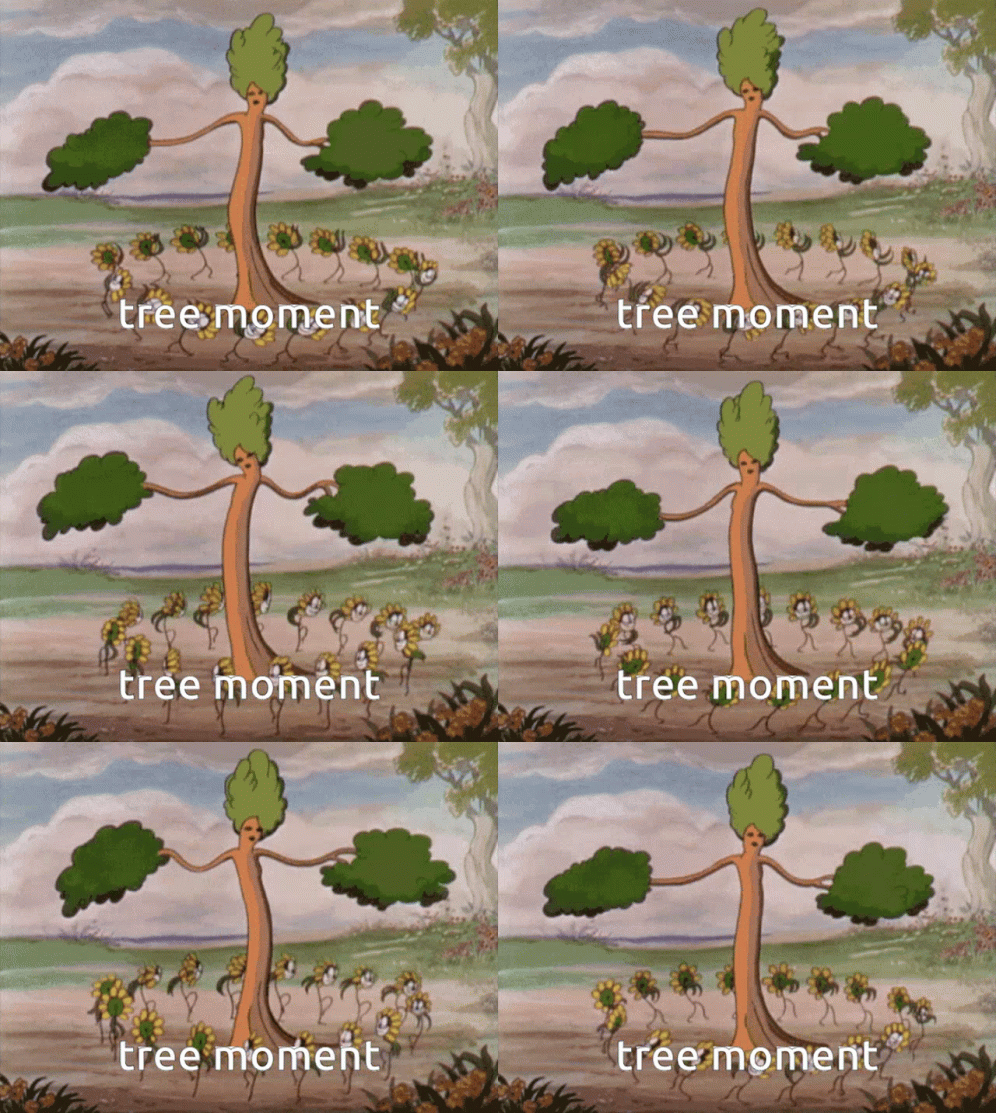
There is much more information on all of these pages. But most importantly, try to get out and hug a tree, and maybe facilitate the planting of another tree! Or draw a tree, or dream of trees…
I hope this is a fine day for all who read here!

