
It is almost 4 minutes. Watch it when you get a few minutes; not only is it history-making that she still sounds like this at 79, but the screen or screens behind her have their own little history bits. Enjoy! It’s not hard-rocking or loud or anything.
Author: ali redford
I love dogs and people. I want living creatures to thrive. I love to cook, and share the food, but ya gotta get in line in front of the dog.
More For Readers To Check Up On With Their State Legislatures
We read and write a great deal about the SAVE Act that may or may not pass. It is a federal law, and really it’s unconstitutional, because the states control their own elections. If it passes as a federal law, well, there are still a few things that can be done. In the meantime, state legislatures are busy. Depending upon your own state’s legislature, it’s at least likely there’s committee work happening on this. Or, possibly, your state has progressed (ha) as far as my state has. It’s a fine day to check in with your state’s business, so you aren’t caught unawares come your next election.
Kansas Legislature plots election suppression, one careful building block at a time
by Robin Monroe, Kansas Reflector
March 11, 2026
Kansas is not rewriting its election system with one sweeping law.
It is doing so in pieces.
A deadline adjustment here. A database requirement there. A repeal of mail-in ballot authority. A restriction on ballot return methods. A new reporting mandate. A rule centralizing constitutional challenges in one county. A provision that repeals advance voting if courts intervene.
Individually, each bill appears technical. Administrative. Procedural.
Collectively, they form a kind of architecture, and architecture is never accidental.
The justification offered repeatedly is election integrity, specifically, noncitizen voting. Yet documented cases of noncitizen voting in Kansas have been counted in the single digits through the decades.
National reviews of millions of ballots have found similarly rare occurrences. The problem, statistically, is exceedingly small.
The legislative response, however, is structurally expansive.
Consider what is being built.
One bill requires certain public assistance agencies to report identifying information about noncitizen recipients to the secretary of state. Another one mandates recurring comparisons between Kansas’s voter registration system and the federal SAVE database.
Others expand the removal triggers to include driver’s license status or database mismatches.
In practical terms, that creates a dubious data pipeline: Public benefits system data is sent to the Secretary of State, where it is cross-referenced against the federal immigration database, then checked against the statewide voter rolls and then returned to the secretary of state, who has removal authority.
Public benefits databases were designed to determine eligibility for food, health care, and housing assistance. The federal SAVE system was designed to verify immigration status for entitlement programs. Kansas’s voter registration system was designed to facilitate elections.
Now, these systems are being interconnected for enforcement.
Even small database error rates become significant when the right to vote is at stake. Federal oversight reports have documented reliability and oversight concerns within SAVE.
Legislative testimony in Kansas has acknowledged audit-tracking issues within the state’s voter system. When automated cross-checking expands and removal authority increases, the margin for error shrinks, and the constitutional risk grows.
At the same time, access pathways are narrowing.
Deadlines for advance mail ballots are shortened. Remote ballot return boxes are eliminated. The statutory authority for certain mail ballot elections is repealed. These changes do not eliminate voting, but they constrict time and space.
When time compresses, errors matter more.
If a voter is flagged incorrectly due to a database mismatch, an outdated record or a clerical error, there is less opportunity to correct the problem. Fewer alternatives. Less flexibility.
Then there is process.
Several of these election bills have moved rapidly through the House, advancing from committee to floor debate to final action within compressed timelines. Emergency procedural tools reduce the space between debate and final vote. Hearings are scheduled even when broad support is thin.
Procedure is not neutral.
When legislative time is compressed, public scrutiny thins. Stakeholder response shortens. Amendments shrink. The result may comply with formal rules, but deliberative depth diminishes.
Finally, litigation itself is being reshaped. House Bill 2569 centralizes constitutional challenges to election laws in Shawnee County. Another contains a provision that would repeal advance voting statutes if courts invalidate certain signature verification requirements. These measures alter the terrain of judicial review, raising the stakes of constitutional challenges.
States unquestionably possess the authority to regulate elections. That authority is granted by the Constitution. But it exists alongside equal protection guarantees, due process protections, and the Voting Rights Act.
The question is not whether Kansas can regulate elections.
The question is whether it should construct an expansive enforcement and restriction architecture in response to a statistically rare problem.
From a social work perspective, policy is not evaluated solely by its stated purpose but also by its impact.
Who is most likely to be flagged incorrectly in database cross-checks? Who relies most heavily on mail voting? Who has the least time and fewest resources to correct administrative errors?
Who bears the burden when access narrows, and timelines tighten? When election administration shifts from facilitation to filtration, those questions matter.
This is not about one bill. It is about the convergence of data centralization, verification expansion, access contraction, procedural acceleration and litigation hardening, all moving in the same direction, creating a cumulative burden on Kansas voters.
Kansas may not rewrite its election system in a single dramatic stroke.
But architecture does not require drama. It requires design. And Kansans deserve to understand the structure being built in their name.
Robin Monroe is a native Kansan living and working in Wichita. Through its opinion section, Kansas Reflector works to amplify the voices of people who are affected by public policies or excluded from public debate. Find information, including how to submit your own commentary, here.
Kansas Reflector is part of States Newsroom, a nonprofit news network supported by grants and a coalition of donors as a 501c(3) public charity. Kansas Reflector maintains editorial independence. Contact Editor Sherman Smith for questions: info@kansasreflector.com.
Follow-up On KS Anti-Trans Law
(I need to subscribe to Kansas Reflector, so I get these more timely than my phone brings them to me.)
Clergy-led activists block entry into Kansas Senate in protest over bathroom law
By:Anna Kaminski-March 10, 20265:11 pm
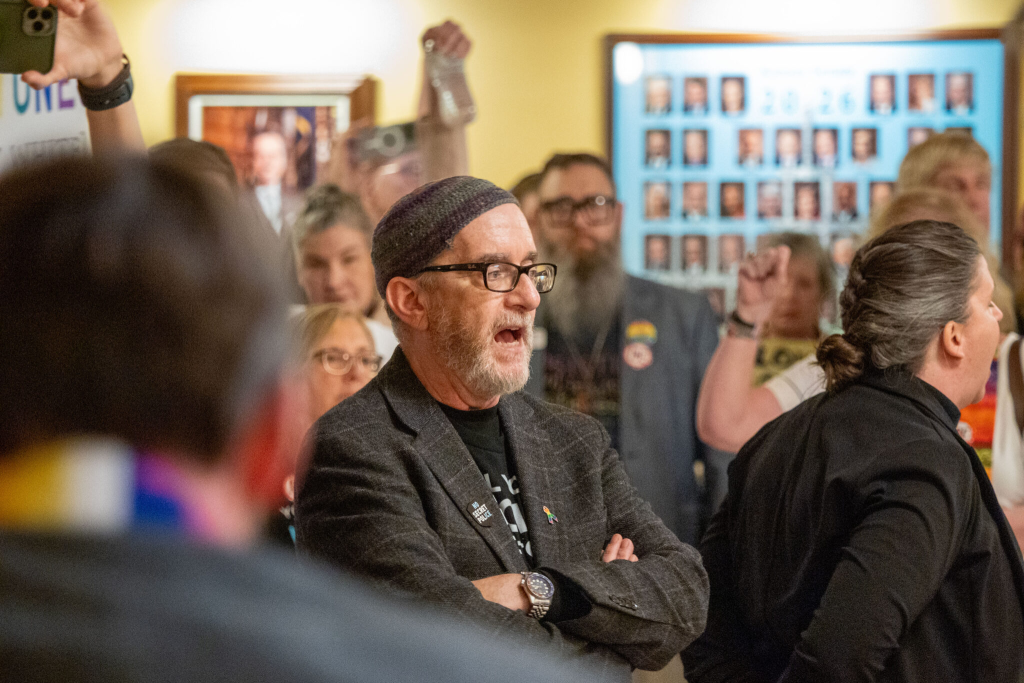
Rabbi Moti Rieber watches law enforcement as they confront protesters March 10, 2026, outside the Senate chamber in the Kansas Statehouse. (Photo by Sherman Smith/Kansas Reflector)
TOPEKA — Rabbi Moti Rieber sat on the tiled floor, legs akimbo, in front of the arched passage leading to the Kansas Senate chamber with at least 20 people behind him and more lining the walls with handmade signs.
“We are here because when injustice becomes law, then resistance is necessary,” Rieber said. “We are here as moral witnesses.”
Clergy members led a sit-in protest Tuesday in opposition to a recently passed anti-trans law. The Republican-controlled Legislature used tactics to avoid public input and overrode the governor’s veto to pass Senate Bill 244, requiring people in public buildings to use the bathroom that coincides with their biological sex and also mandating driver’s licenses include a person’s sex assigned at birth instead of their gender.
Sergeants-at-arms looked on from behind the group, and Kansas Highway Patrol troopers soon joined. But it wasn’t until the group prevented Sen. Tim Shallenburger, R-Baxter Springs, from entering the chamber that troopers grabbed people by the arms to clear a path.
As troopers hoisted activists up from their seats, encouraging them to disperse, the group sang in harmony: “No one is getting left behind this time. No one is getting left behind. No one is getting left behind this time. We get there together or never get there at all.”
At one point, a trooper knocked a woman to the ground as she tried to pass through the crowd, appearing to mistake her as part of the demonstration. Protesters responded with chants of “Shame!”
The woman declined to be identified or comment but told Kansas Reflector she was OK.
Rieber, executive director of Kansas Interfaith Action, said while sitting on the floor, addressing the crowd, that the process to pass SB 244 was “crooked.” (There is a TikTok embedded on the page, linked in the title above.)
The law has already been challenged in Douglas County District Court, where a judge decided Tuesday not to pause enforcement of the law. The state sent letters to 275 Kansans shortly before the law went into effect, telling them their driver’s licenses were invalid. Some experts say laws targeting trans people can harm their mental health and increase the likelihood of discrimination.
The Rev. Mandy Todd, pastor at Messiah Lutheran Church in Lindsborg, said SB 244 is hurtful, targeted and part of a culture war. She said the group is “disgusted by this Legislature’s treatment of trans people.”
The bill stokes fear and anxiety, she said.
Todd, the director of engagement for Kansas Interfaith Action, said trans people in her community have felt the immediate effects of SB 244. The closest driver’s license office is in the next town, which Todd said has hamstrung one Lindsborg woman, who now cannot legally drive to sort out her invalid license.
Pastor Charles McKinzie II of Grace United Methodist Church in Winfield is confident the law, which he said was flawed in process and in substance, will make its way to the Kansas Supreme Court to be overturned.
“In the meantime, people are hurting, and people need to know that they are seen,” McKinzie said.
Conversations about the effects of SB 244 aren’t limited to a courtroom. They are taking place in churches, synagogues and other small group settings across the state, McKinzie said, and the sit-in was meant as a show of nonviolence “to shed light on a violent system.”
About an hour after the protest, Master Trooper Scott Whitsell said that no one from the group had been cited or arrested to his knowledge. The only law the protestors broke was blocking an entryway, he said.
Sherman Smith contributed to this story.
Another Women’s History Post
Short, sweet, and simple, by an artist I have adored since Jr. high and my own radio.
A Post for Women’s History Month
(Well, another one!) I watched part of Sherri Shepherd’s interview of Jayne Kennedy yesterday morning. I didn’t catch the beginning, but recognized the name earlier when I read it. I looked her up, and found the following from BET, and that’s the post. In addition to what’s included, Jayne Kennedy seems to be living with depressive anxiety, from what I gleaned in the Sherri interview. I couldn’t find anything about that, but she’s written a book, Plain Jayne that I intend to read as soon as I can. From this article, I figured out how I recognized her name and her face; I recall when she was in the Miss USA pageant in the late 1970s. Then I recalled she got a job on some sports show, as covered below. Anyway, this woman, aside from being talented and beautiful, is also courageous. Follow the links within for more information.
Women’s History Month: Celebrating Jayne Kennedy, The First Black Woman To Conquer Network Sports
Explore the multifaceted journey of the Emmy-winning trailblazer who transitioned from Hollywood to the NFL, changing the game forever.
By Tamara Brown March 9, 2026

NEW YORK – JANUARY 1: Jayne Kennedy and Brent Musburger on “N.F.L. Today,” on the CBS Sports television network. Circa 1978.
In the late 1970s, the network TV sports was a club where the doors were mostly locked to anyone who wasn’t white and male. But Jayne Kennedy didn’t just knock; she blasted those doors off the hinges.
As we continue our Women’s History Month spotlight, we’re looking back at the woman who, in 1978, became the first Black woman to co-host a major national sports program. When Kennedy stepped into the anchor chair on CBS’s The NFL Today, she did more than just read highlights.
Jayne Kennedy, now 74, held that ground-breaking role from 1978 to 1980, quickly becoming one of the most recognizable faces in the country. Before her history-making run at CBS, the former Miss Ohio USA was already a star. She got her start as a dancer on Rowan and Martin’s Laugh-In and spent years touring with legends like Bob Hope and Dean Martin.
While her Hollywood resume is long, her impact on the sports world is what truly changed the culture. Beyond the NFL, Kennedy remains the only woman to host the long-running series Greatest Sports Legends. She even stepped into the ring as the first female color commentator for men’s professional boxing.
Even now, Kennedy isn’t slowing down. She was a key player in the LA28 Foundation, helping secure the bid for the 2028 Olympic Games in Los Angeles. She’s also sharing her full story in her new memoir, Plain Jayne, which dives into the grit, faith, and ambition it took to navigate a career filled with hurdles.
By breaking that ceiling nearly 50 years ago, Kennedy didn’t just make a name for herself. She made sure that for the rest of us, the path was already paved with the excellence she brought to the screen every Sunday.
News On The KS Anti-Trans Law
I emailed this to me on Sunday, but have only just gotten back to it to post here. My apologies on that, but it’s been both busy and stormy here! Anyway, I haven’t heard anything about the status of this; I hadn’t heard anything about it at all until I read it in Kansas Reflector. With no further ado:
Kansas AG offers to delay enforcement of anti-trans law until March 26 while judge weighs challenge
By:Morgan Chilson-March 6, 20266:25 pm
LAWRENCE — Kansans won’t know until at least Tuesday if a judge will delay implementation of the state’s new “bathroom law,” but a concession by Attorney General Kris Kobach means key components of the law can be delayed until March 26.
Douglas County District Judge James McCabria heard arguments Friday about Senate Bill 244, the controversial new law that forces people to use bathrooms in government buildings and gender markers on driver’s licenses based on sex assigned at birth.
The three-hour hearing focused on technicalities, including whether the law meets any one of five specific criteria that would lead the judge to approve a temporary restraining order and pause enforcement of the law for up to 14 days.
Attorneys with the American Civil Liberties Union and the Kansas Department of Administration said the law’s speedy implementation provided no grace period to Kansans needing a new driver’s license and for government leaders statewide to put a system in place for tracking bathroom usage.
The law took effect Feb. 26, a little over a week after the GOP-led Legislature overrode Gov. Laura Kelly’s veto. Kansans who held driver’s licenses with a gender marker that didn’t match their sex at birth were told their licenses were immediately invalidated and government leaders statewide were told they had to immediately enforce the bathroom portion of the bill.
Kobach told McCabria he agreed to give Kansans who needed to update driver’s licenses until March 26 to complete that. He also said he wouldn’t enforce the law’s penalties — which could be as high as $125,000 per day for violations — for cities, counties, municipalities and schools that might violate the bathroom rules, as well.
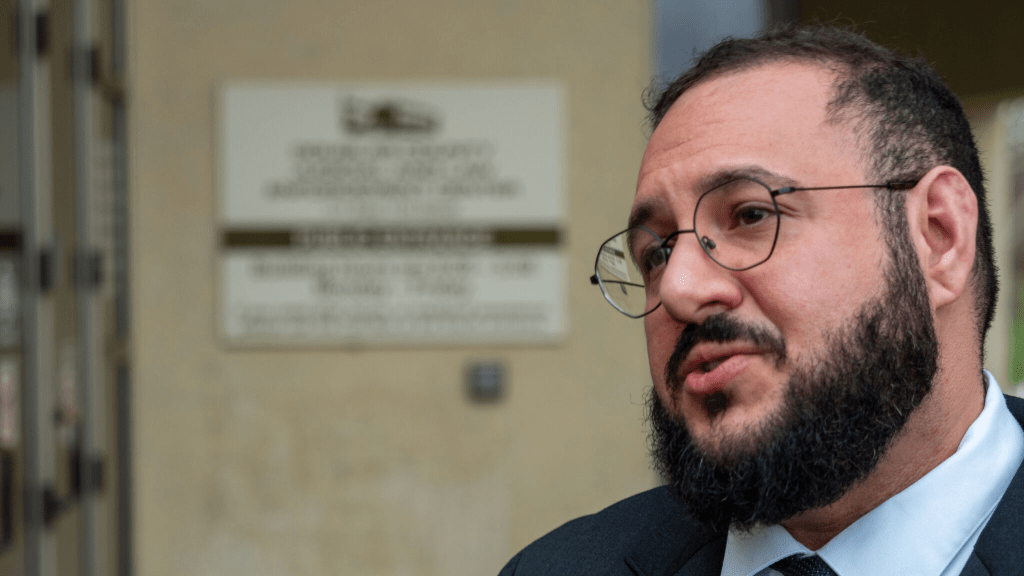
Harper Seldin, senior staff attorney for the American Civil Liberties Union, talks to reporters after a Douglas County District Court hearing on March 6, 2026. Seldin asked the judge to place a temporary restraining order on the state to stop implementation of a new law that forces Kansans to use bathrooms and have documentation in their biological sex at birth. (Photo by Sherman Smith/Kansas Reflector)
Harper Seldin, an ACLU attorney representing the two Lawrence transgender men who brought a case against the law under pseudonyms Daniel Doe and Matthew Moe, told the judge the law violates the Kansas Constitution.
SB 244 infringes on the rights of personal autonomy, expectations of privacy, and equal protection under the law, and has other issues, he said.
“The attorney general is incorrect when he says that we’re asking the court to break new ground,” Seldin said. “This is not a novel set of theories that require the government to do anything. The thread through these individual rights claims is that this is about Daniel and Matthew’s right to be left alone by the government.”
Seldin also said the law targets transgender individuals, which can be shown by the results of its implementation even if it’s not stated outright. He said the way SB 244 was implemented violated the Kansas Constitution when the bathroom portion of the bill was “logrolled” into the bill that originally addressed driver’s license and birth certificate gender markers.
Logrolling refers to dropping a bill into an unrelated bill, sidestepping the opportunity for public input. Seldin said cramming two separate subjects into one law violates the Kansas Constitution, which has a “single subject” clause.
Kobach said the two issues are congruent in that they both deal with defining sex within Kansas government.
“It’s this idea that bills should mean what they say and say what they mean,” Seldin said. “There’s a particular perniciousness to a law that hides the law.”
Kobach told the judge that a driver’s license is a government document, used for government purposes, and the state has the right to define the information contained in the document.
McCabria questioned Kobach about briefs included in the plaintiff testimony outlining the negative psychological effects on transgender people being made to use documents that don’t match their gender identity.
“Whatever a person may feel about their need to be perceived by the world in a certain way, what right do I have to compel the government to identify me in that way?” McCabria asked.
Kobach said the driver’s license is a document that records pertinent information, and sex is one of the elements, along with eye color and birthdate, that doesn’t change over time.
Kobach said the bathroom portion of the bill maintains the status quo in Kansas, where he contended residents have always gone to the bathroom that matches their biological sex at birth.
Seldin said trans people in the state have been going to the bathroom without any harms for decades.
Kobach said women who hear a man’s voice or see a man in private spaces could become anxious about their safety.
He acknowledged plaintiff’s assertions about the psychological or emotional harm they may suffer but told McCabria that in a balance of equities, that didn’t outweigh the harms of “99-plus percent of the population.”
When McCabria asked him to substantiate that number, Kobach said he didn’t mean to imply that everyone outside of transgender individuals were harmed by the law.
“Many courts have recognized the fear that ‘biological females’ have when a ‘biological male’ is in the bathroom with them, and that is something that I think any Kansan can identify with, especially a female,” Kobach said after the hearing.
Asked how women would be affected by seeing or hearing a transgender man who now has to use a woman’s bathroom, Kobach said, “All kinds of hypothetical cases are possible.”
McCabria said he had hoped to make a ruling Friday but that he needs more time to study the filings in the case and examine constitutional issues. He said he expects to rule by Tuesday.
“I think most people want to be respectful,” Seldin said after the hearing. “I think most people don’t want to pry into other people’s private lives. I think a law like this suggests the opposite, that Kansans have some prurient interest in other people’s habits and private spaces. And I don’t think that’s right.”
Z Kemp attended the hearing because her partner and many friends are affected. She said the law has caused “a lot of stress and anxiety.”
“That’s just unnecessary because as they’ve stated before, there was — especially with the bathroom situation —- no prior problem,” she said. “It’s only a problem whenever you make it a problem. I don’t think it’s that radical to just let trans people be. Just let them go to the bathroom.”
Avie Fallis said she has been through a lot of physical and legal changes to find herself. She said she is tired of well-meaning people recommending that she leave Kansas, which is her home state where her family and loved ones live.
“I feel like it’s a fire that’s just growing,” she said. “I’m not going to run away from fire. I feel like it should be extinguished.”
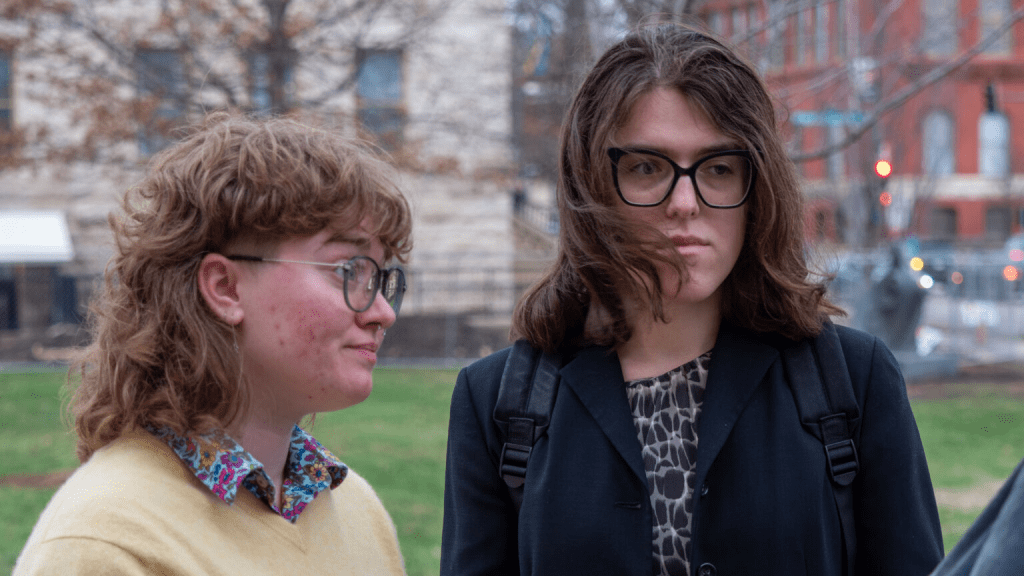
Z Kemp, left, and Avie Fallis attended a Douglas County District Court hearing March 6, 2026, about Kansas’ new law because it affects them and their loved ones. The law forces people to use the bathroom related to their biological sex at birth and to put that sex marker on their driver’s licenses and birth certificates. (Photo by Sherman Smith/Kansas Reflector)
Josh Day Next Day
Enjoy some time on your Wednesday!
The Good News About Sonny Burton From DPA-
I’m copy-pasting it from my email.
Amazing news! We were in the middle of of a zoom press conference about the Gas Suffocation aspect of the planned execution of Sonny Burton in Alabama on Thursday when a reporter put into the chat:
“Did you see that Governor Ivey just commuted Burton’s sentence?”
And with that, the news was broken. Governor Ivey heard YOUR messages, received YOUR petitions, read the articles YOU sent, heard YOU ringing her phone off the hook, heard us tolling our bell outside her house…. and she acted. Amen! THANK YOU!
Once again, this proves, sometimes, our united efforts work!
 Congratulations to Sonny and his legal team, his family, and to all who had a hand in creating this moment!
Governor Ivey has declared that “All Life is Precious,” which is why we made sure to bring along our 4×10 foot banner to the 24-hour vigil we helped coordinate in front of her house a few weeks ago. The banner could not be missed from any street-facing window of the Governor’s mansion. We know with certainty that the Governor was there…. NOW we know that she heard our message!
The other good news is that now we don’t have to drive all the way to Alabama. In fact, we had planned to go to Texas fiirst to toll the bell outside the prison in Huntsville at the execution of Cedrick Ricks on Wednesday, which is still on. Without our planned return through Alabama, making such a long drive makes less sense.
As you know, everything we do to support local activists working to halt executions is another expense. It’s not just the costs of being on the road that we must cover, but also the overhead…
- The four full time staff and our media consultant who do the behind-the-scenes work.
- The costs of the tools and services we use to communicate our message to the world.
- The price of existing as an organization that shows up to oppose every execution.
- (snip-donation request. You can get there from the page of any of these links.)
Thank you. Yours in the Struggle,
–abe
PS: New execution dates are being set regularly. Click here to oppose every upcoming execution.
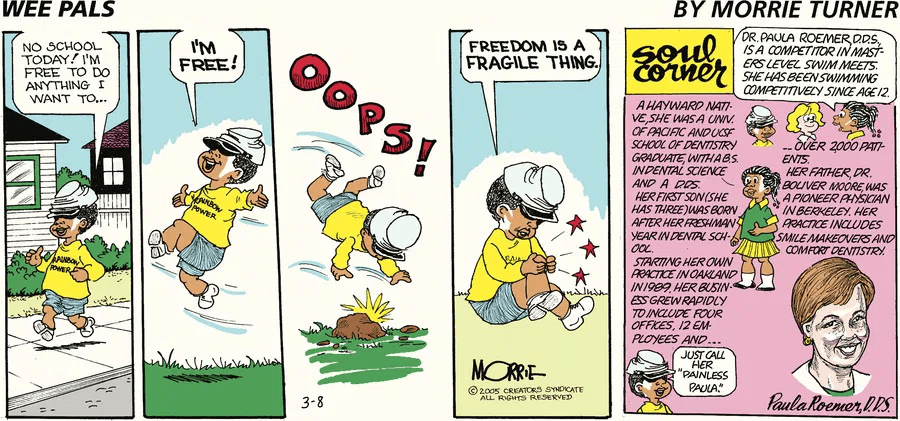
Lay Lines, As Requested
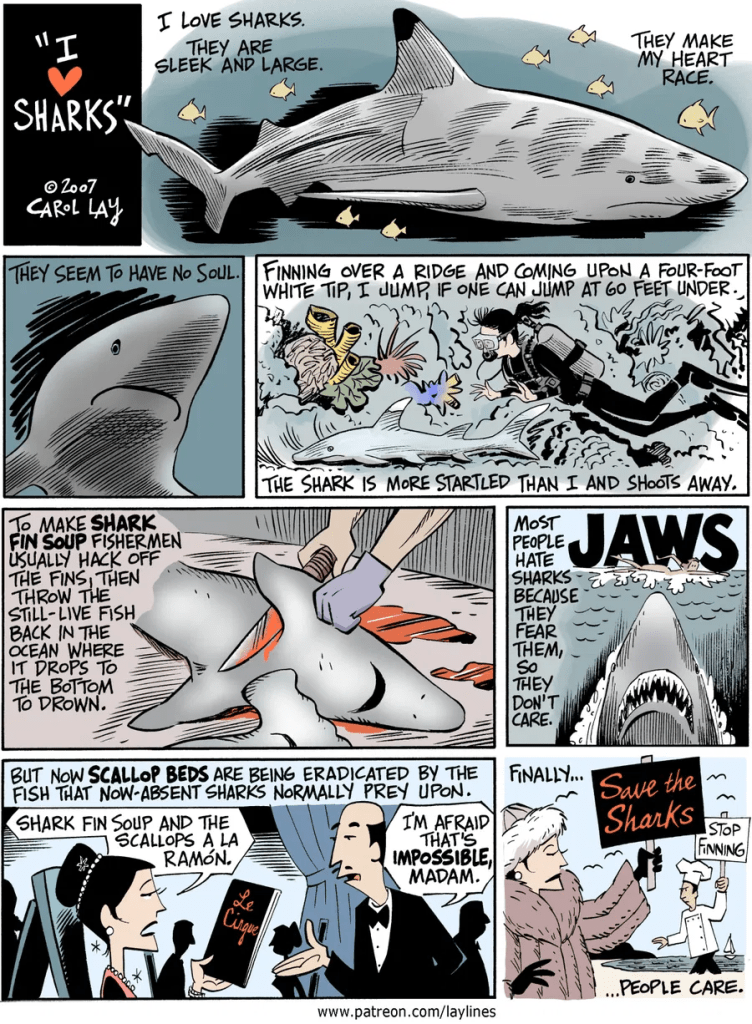
For Women’s History Month,
a Monday entry that isn’t toooo historical, but is a nice tidbit. Enjoy the comic; the Women’s History bit is in the Soul Corner: “Painless Paula.”
 Scottie's Playtime