I love dogs and people. I want living creatures to thrive. I love to cook, and share the food, but ya gotta get in line in front of the dog, and greatest good luck with that!
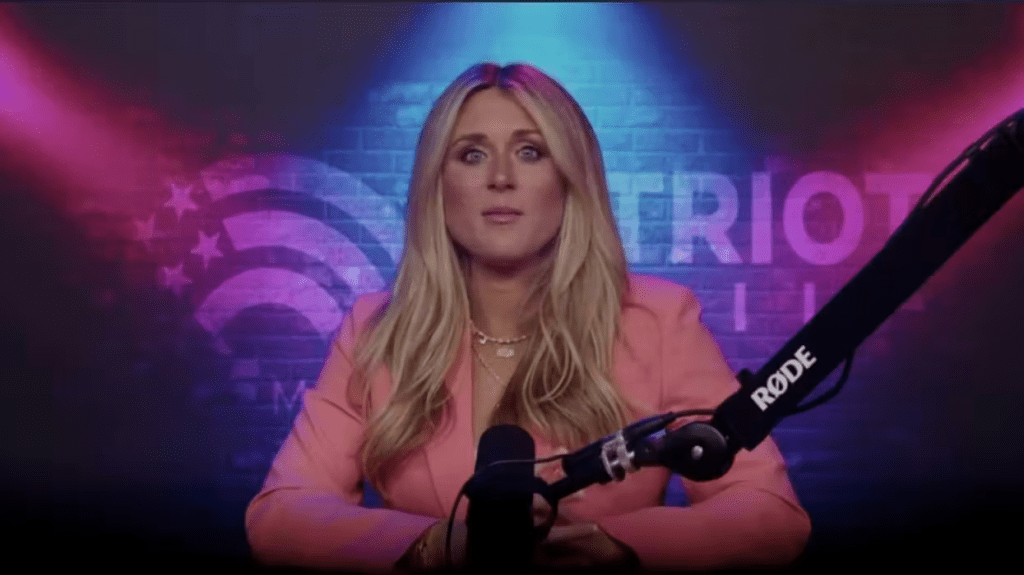
maga influencer Riley Gaines sparked controversy after a behind-the-scenes video of her practicing a spot for Patriot Mobile and repeatedly asking what conservative talking points she should hit went viral.
Fifth place collegiate swimmer turned anti-trans activist turned MAGA trad-wife influencer Riley Gaines is drawing new backlash and mockery online after requiring her sponsor, Patriot Mobile, to tell her what she “feels very passionately about” in a recently leaked behind-the-scenes video from an ad campaign video shoot.
In the clip, Gaines asks what the MAGA brand Patriot Mobile wants her to say, asking what the “pillars” of her beliefs are and counting on her fingers as she repeats them. An offscreen company representative can barely be heard answering her questions.
The pillars listed include the First Amendment, Second Amendment, reproductive freedom is bad, and something about veterans. Gaines then does a quick take before stopping again and asking how exactly to state the beliefs Patriot Mobile told her to have.
The clip quickly went viral across social media.
You can watch the clip here on multiple platforms:
(snip-above is YouTube; there are BlueSky and other social posts embedded on this story’s page, linked in the title above. The posts are hilarious, as one would infer. Enjoy!)
Gaines was once the darling of the MAGAsphere, garnering invitations to the White House, CPAC, and MAGA rallies, but has lost some of her shine. She’s since even drawn criticism from MAGA Republican President Donald Trump and ridicule from both the right and left.
An ad campaign for anti-trans clothing line XX-XY Athletics drew widespread mockery instead of the sympathy it was aiming for. The brand, who made transphobia their brand—literally—released an ad on X featuring Gaines claiming she had been “silenced” by trans rights activists.
With her single focus of anti-trans bigotry and hatred no longer paying off like it had in the past, Gaines has tried to branch out to embrace other MAGA core values, but with very limited success.
Since it’s a new angle for her, no wonder she needs to be told what it is she now believes.(snip-end)
(Republicans ruin everything; I was only checking the TV schedule! I included the entire article here; the position Marshall may take is quite far into the article. The thought is that RFK Jr. will be ousted after the ’26 elections.
This is why every election on the ballot matters, and why a Republican supermajority state legislature is to be avoided.)
TOPEKA — A Republican-conceived law usurping Democratic Gov. Laura Kelly’s discretion when filling vacancies in certain Kansas statewide elective offices could complicate the competitive race for U.S. Senate.
Candidates and political observers wonder whether Kansas Republicans could attempt to avoid holding an election for U.S. Senate this year by having the incumbent, Republican Roger Marshall, resign from office to take a position with President Donald Trump’s administration. The power play would raise constitutional questions.
The catalyst for this fear is a 2025 law requiring vacancies for U.S. Senate, state treasurer and state insurance commissioner to be filled by Kansas governors by choosing from a list of finalists endorsed by the full Legislature or a 12-person GOP-controlled legislative committee. A governor of Kansas in the past could immediately and unilaterally choose a person to temporarily fill these jobs pending an election, but the new law limited the governor’s options to members of the former officeholder’s party.
In addition, the same state law says if the vacancy were created after May 1 in an even-number year, such as 2026, the appointed replacement wouldn’t go before voters in an election until “two years following the year in which such vacancy occurs.” A simple reading of this Kansas statute — in isolation from the U.S. Constitution — suggests appointees chosen to fill these jobs this fall would avoid facing voters until 2028.
“This is certainly not the norm in the United States,” said Bob Beatty, a political science professor at Washburn University. “Waiting two years is pretty extreme.”
Despite confusing text in the 2025 Kansas law, the U.S. Constitution’s 17th Amendment, ratified in 1913, grants states the right to have temporary officials hold vacant U.S. Senate seats until an election could be held to determine who served out the unexpired term. The constitutional amendment wouldn’t permit states to artificially extend a U.S. Senate term beyond six years regardless of the number of people who were elected, appointed or resigned from the position during the six-year window.
This constitutional intent wouldn’t prohibit an individual or organization from raising legal challenges that portray Senate Bill 105 as a clever way of delaying an election amid a senator’s resignation.
Republican and Democratic strategists and candidates in Kansas have been weighing the possibility of Marshall prevailing in his August reelection primary and resigning a month or so later after securing a coveted appointment in the Trump administration. For the first time, under this scenario, Kelly and the Legislature would be responsible for implementing the 2025 law.
Without changing state statute on U.S. Senate vacancies, Marshall’s departure would have enabled Kelly to appoint a Democrat to his seat and weaken the GOP’s grip on the U.S. Senate.
Former Republican Gov. Jeff Colyer dropped out of the GOP’s gubernatorial race June 1 after Trump attempted to break the GOP candidate logjam by endorsing Senate President Ty Masterson for governor. If Colyer were to be nominated to a vacated U.S. Senate seat by Republicans in the Legislature and if he was chosen from among three finalists by the Democratic governor, the new state law could be interpreted to mean Colyer could avoid having his name on a ballot until November 2028.
“This would be helpful for Republicans,” said Beatty, who expected GOP candidates to suffer at the ballot box from Trump’s sagging approval rating. “You get two years for the handpicked person to raise money and avoid an off-year election.”
Statutory uncertainty
Marshall’s chief of staff, Brent Robertson, bluntly answered an inquiry Wednesday about his boss’ future: “Senator Marshall will be running for reelection.”
Nevertheless, Secretary of State Scott Schwab’s staff has been working on an analysis of SB 105 to outline how the process of filling a vacancy for U.S. Senate, state treasurer and insurance commissioner might unfold in 2026. The report hasn’t been released by Schwab, who is the state’s top elections official and a GOP candidate for governor.
In Kansas, the August primary ballot for U.S. Senate has been set. It includes Marshall and one GOP rival, Lawrence resident Pond Naramore, who filed with a campaign email address indicating he could be a “Republican in name only.” There are 11 Democratic candidates for U.S. Senate in Kansas.
If nominated on Aug. 4, Marshall’s name could legally be withdrawn from the November ballot if he was deceased, medically unable to perform the job, or he transferred his official residency outside of Kansas.
Colin McRoberts, an attorney and Democratic candidate for U.S. House in the 1st District, has questioned whether SB 105 could lead to the unprecedented postponement of the 2026 U.S. Senate election. He said Kansas would be forced to unravel the issue if U.S. Health and Human Services Secretary Robert Kennedy Jr. were ousted and the president nominated Marshall, a physician, for the HHS job.
“They probably want someone they can confirm relatively easily, and that would be Roger Marshall,” McRoberts said.
Impetus for amending the Kansas election law was driven by GOP anxiety about Marshall’s possible departure from the U.S. Senate and GOP frustration with Kelly’s decision in 2020 to name Democratic Lt. Gov. Lynn Rogers to replace Republican state Treasurer Jake LaTurner, who had been elected to the U.S. House.
The Legislature passed the vacancy statute in March 2025 on votes of 84-36 in the House and 31-9 in the Senate. Kelly choose not to veto the bill, but referred to it as a “partisan power grab” by the Legislature when she allowed it to become law without her signature.
“I was there the day they voted. I knew it was ill-advised,” said Christy Davis, who is seeking the Democratic nomination for U.S. Senate. “This is just another example of the Kansas Legislature changing the rules to take power that they’ve not been given by the public.”
Kobach’s assessment
During consideration of SB 105, Attorney General Kris Kobach said the U.S. Constitution required Senate vacancies to be filled temporarily so representation could continue until an election was organized. More than 35 states placed sole authority to fill vacancies for U.S. Senate with a governor, pending the election.
Ten states, including Kansas, now require appointees for U.S. Senate to be drawn from the same political party as the vacating senator. Kobach said a process in which the Legislature limited a Kansas governor’s appointment options in this way was “likely consistent with the 17th Amendment.”
However, he said, Kentucky Gov. Andy Beshear raised constitutional concerns about the Kentucky Legislature’s authority to constrain his appointment power by forcing him to choose from a list of candidates. Eventually, Kentucky lawmakers decided to cut governors out of the process and mandated special elections to fill vacancies.
“While appointment limitations have been implemented successfully in some states, they are not universally accepted and may be subject to legal or political challenges,” Kobach said.
Kobach said amendments to state law on replacing a state treasurer or state insurance commissioner had a good chance of withstanding legal challenge because those offices were a creation of the Legislature rather than a constitutionally mandated office, such as the U.S. Senate.
In the past three decades, four state treasurers have resigned before their terms expired. Three Republicans — Lynn Jenkins, Ron Estes and LaTurner — quit with two years left on their four-year terms after they won elections to Congress. Over that time, no state insurance commissioner has quit.
In the past 100 years, Kansas has had four vacancies for U.S. Senate. Republican Sen. Charles Curtis resigned in 1929 to become vice president, and a Republican was appointed pending a special election in 1930. Republican Sen. Clyde Reed died in 1949 with one year left on his term. A Republican appointee held the seat until a special election in 1950. Likewise, Sen. Andrew Schoeppel, a Republican, died in 1962. He was replaced by an appointee who won a special election in 1962.
In 1996, Sen. Robert Dole resigned to focus on his GOP presidential campaign. Gov. Bill Graves appointed Shelia Frahm, his lieutenant governor, to fill Dole’s seat. In a 1996 special election, then-U.S. Rep. Sam Brownback won a special election for Senate. He won a full term in the Senate in 1998.
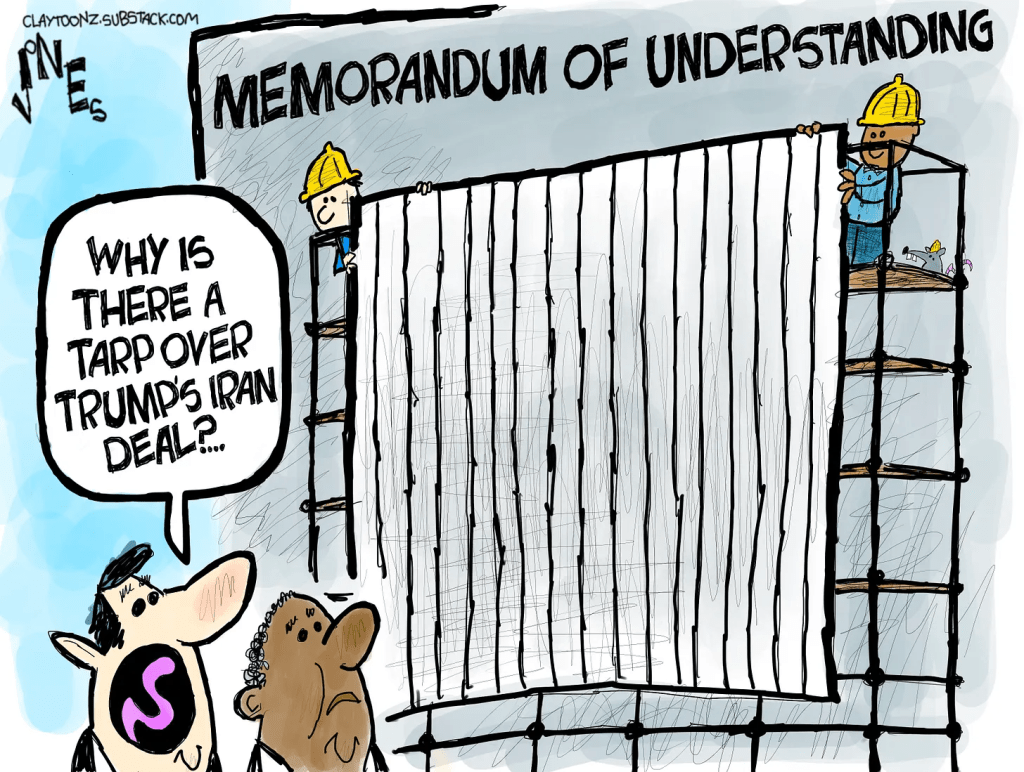
Today, this cartoon was challenged on Facebook by a couple of MAGAts.
One wrote, “One would think with the superior ‘intelligence’ of liberals, they could do a little better job at convincing the masses they’re right than grade school cartoons and hyperventilated delusions…….”
The other argued, “More dumbass dumbocrap shit.” Thank God, Donald Trump told him there’s a B in dumb.
The Trump regime and Iran have a peace deal to have a peace deal in 60 days. Donald Trump said that he digitally signed the deal on Sunday in Washington, and today, an administration official said Trump signed it in Versailles on Wednesday. We are not sure if Donald Trump signed it twice, or if he lied about signing it on Sunday, or what. Later, Trump said that he had signed it in Versailles. This regime that can’t even clean a swimming pool has not been straight about anything. Wasn’t this supposed to be the most transparent administration in American history?
Did they or did they not take Trump’s name off the Kennedy Center last Saturday? The Kennedy Center says they have, but we can’t be sure because the tarp is still in front of it.
It wasn’t until today that anonymous US officials read the language of the memorandum on ending the war to journalists after days of secrecy. The Trump regime blamed Iran for the secrecy, saying that’s how they wanted it. Who’s calling the shots here?
The terms of the agreement would reopen the Strait of Hormuz, outline a $300 billon plan for Iran’s reconstruction, and lift restrictions on the country’s oil exports. It kicks the can down the road on Iran giving up its nuclear material. It calls for Israel to end its attack against Hezbollah in Lebanon, despite the fact that Israel is not a party to the MOU, the Memorandum of Understanding.
The MOU is a 60-day extension of the ceasefire. It outlines that Iran and Oman will manage the Strait of Hormuz and that there will not be a toll for ships to pass through during the 60-day ceasefire. There’s no mention of there not being any tolls in the future.
This agreement is different from the Joint Comprehensive Plan of Action (JCPOA) negotiated by President Obama, which Trump ended, which eventually led to this war. The JCPOA was broad in detail and was working in preventing Iran from developing a nuclear weapon, while Trump’s Iran deal is about as vague as that peace treaty he signed with North Korea several years ago.
As you may recall, the so-called peace treaty with North Korea didn’t obligate North Korea to do anything. And this so-called peace deal with Iran achieves none of the goals that Donald Trump and Pete Hegseth laid out at the start of the war. But remember, Donald Trump is the greatest negotiator in the world.
This deal does not accomplish regime change in Iran. It doesn’t end their missile program. It does not end the persecution of its people. And Iran does not surrender unconditionally. What it really does for Donald Trump is that it gives him an out from this war, so maybe he can focus on his next conquest, Cuba.
Iran walks away from this conflict with more power and more money. The United States walks away with nothing it set out to do, and after spending billions of dollars.
Senator Bill Cassidy said, “Reagan is rolling over in his grave. Before the war, the strait was open, Iran was being crushed by sanctions, and 13 service members were still alive,” Cassidy said, “Now, 13 Americans are dead, families have paid billions at the pump, sanctions will be lifted, and the bombing has stopped.”
Cassidy found his spine after losing his primary reelection bid after Trump endorsed his challenger, and is now free to openly criticize Donald Trump. “This is the worst foreign policy blunder in decades,” he said.
Senator Ted Cruz, who doesn’t even have a spine, said, “Giving billions of dollars to theocratic lunatics who want to murder us is not a good idea. I think the president, unfortunately, is receiving bad advice.”
He also said, “Setting up Iran to be in charge of the Strait of Hormuz in perpetuity and to charge tolls is not in America’s interest. In my view, the Ayatollah should not reap a single penny from the free transit of the seas.”
What does it tell you when even Republicans are not happy with this deal?
Creative note: Right after I finish the lettering in this cartoon, news broke that some anonymous administration officials had read details of the agreement to reporters. So I almost shelved this. But after talking to Laura and another friend, they convinced me that I should still go with this, so I did. But while building up to that decision, I wrote two more ideas that I like, and I plan to do them over the next couple of days.
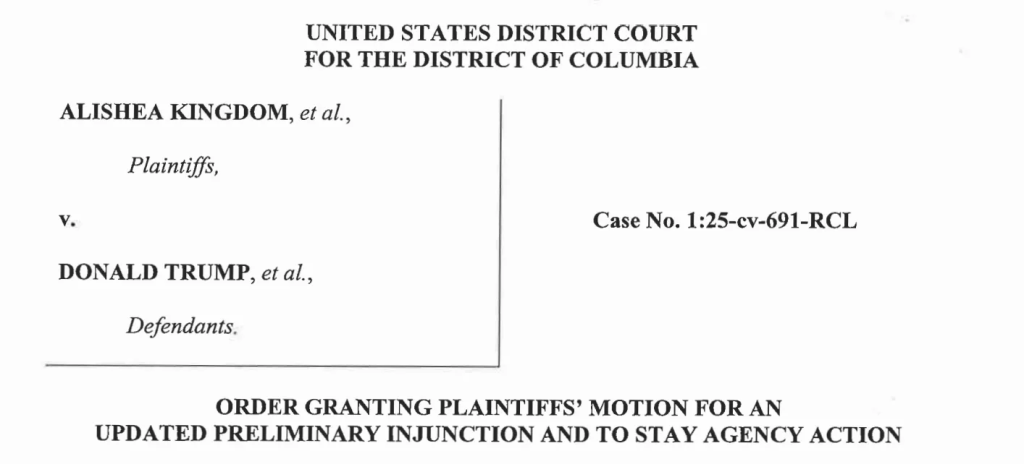
A D.C. Circuit ruling would have allowed the Trump admin’s anti-trans policy to go into effect, but a new district court injunction issued hours later blocked the policy yet again.
The Trump administration’s effort to end gender-affirming medical care for transgender people in federal prison is blocked again after a short lapse in protections on Wednesday.
About noon Wednesday, the U.S. Court of Appeals for the D.C. Circuit issued a 2-1 order that for two-and-a-half hours technically allowed the Trump administration to begin implementing the Federal Bureau of Prisons’s plan to “taper” — with a goal of ending — the provision of hormone therapy for transgender people in federal prison.
About 2:30 p.m., though, U.S. District Judge Royce Lamberth granted a request that had been pending from the plaintiffs challenging the BOP policy and issued a new preliminary injunction blocking the plan.
This was not the actions of a “rogue” judge or anything like that. The appeals court judges had even noted that the district court request was pending, but Judges Karen Henderson, a George W. Bush appointee, and Justin Walker, a Trump appointee, nonetheless issued the ruling on Wednesday — over the dissent of Judge Cornelia PIllard, an Obama appointee.
The D.C. Circuit move effectively forced Lamberth, a Reagan appointee, to act quickly if he wanted to keep the protections he had ordered in place.
He did so — continuing his role as the federal judge most clearly protecting the rights of trans people in prison.
David Wise’s new experimental play, “Fight Back,” opens a portal to an earlier era of organizing and spotlights the enduring power of slow-moving consensus building.
Imagine a murder mystery dinner party, where everyone sheds their true identity at the door and assumes a role to play in the night’s events — only instead of solving a crime, they must reenact a contentious activist meeting. That’s what artist David Wise tasks participants with in his immersive theater piece “Fight Back.” He recreates the AIDS Coalition to Unleash Power, or ACT UP, meeting on March 13, 1989 in the same room where it happened nearly 40 years ago.
It’s impossible to sit in the same room in New York City’s LGBT Community Center where their meetings happened nearly 40 years ago without feeling the echoes of today’s governmental failures, and the urgent need for both resistance and mutual aid.
At the May 18 performance of “Fight Back” — which takes its title from ACT UP’s chant: “Act up! Fight Back! Fight AIDS!” — I did something we rarely have to do these days: relinquish checking and doomscrolling on my phone to spend uninterrupted time face-to-face with strangers, co-creating something from scratch. Nearly 40 of us had two and a half hours to make our way through a 26-item agenda, an education in ACT UP’s work.
ACT UP is a direct action group formed during the AIDS epidemic to fight for visibility, healthcare access and an end to the crisis. To mark the second anniversary of the group’s formation, they were in the midst of planning Target City Hall — the kind of creative, high-profile direct action for which the group had become known — to protest Mayor Ed Koch’s failure to adequately address the AIDS crisis in New York City.
By the beginning of 1989, more than 18,000 New Yorkers had been diagnosed with AIDS and over 12,500 had died. ACT UP was demanding affordable access to the highly toxic but potentially life-saving drug AZT, which had just come on the market a year earlier. They also demanded housing for people living with AIDS and changes to the Food and Drug Administration’s drug trial policy to give more patients hope. They demanded dignity for the living and the dead. In the midst of all this, members still found the time and space to plan fundraising parties and, more importantly, to flirt.
The 1980s was an era of phone trees and answering machines. We checked our cell phones at the door. The experience is an invitation to follow the advice writer Mira Jacob gave on Instagram earlier this year: “Stop scrolling. Do literally anything else … We’re going to prevail, but only if you don’t let this app scare you numb.” If you were mad in 1989 because your friends were dying at the hands of the government and you wanted to yell at someone about it, you had to show up to a meeting or participate in a phone zap or volunteer to surreptitiously print flyers at your office denouncing Mayor Koch as a closet case. (One attendee politely corrected our pronunciation of “Koch” — no relation to the present-day billionaire brothers who pronounce their last name “coke.”)
A smaller group within ACT UP gathers during David Wise’s experimental theater piece, a reminder that the organization was not a monolith. (Hong-An Tran)
The atmosphere in the room was tentative. Every question opened up a minefield that only the basic tenets of improv could answer: Say “yes, and” to help the scene unfold; make bold choices, even when you are unsure of them, and don’t “break” the illusion. Most of us had brought hastily scribbled notes about our assigned historical personas, pulled from summaries and the ACT UP oral history archive. This background helped with questions like, “What affinity groups are you in?” and “Is this your first meeting?” But they offered little to lean on when it came to more quotidian conversation starters, “Are you coming from work?” or “Are you out to your family?” Those we stumbled through, together.
I had been assigned the role of Bill Bahlman, my first part since a non-speaking role in the middle school production of “Schoolhouse Rock!” A lifelong New Yorker and a music journalist, Bill had been a part of the Gay Activists Alliance and the Gay and Lesbain Alliance Against Defamation, or GLAAD. A self-described anarchist, he sometimes found the groups to be too soft, particularly the Gay Activists Alliance’s discussions of whether to drink mixed drinks or soft drinks at their dances. He splintered off from GLAAD into the Lavender Hill Mob, a direct action group formed in 1986 and named after a British comedy film. The dozen members focused on AIDS activism and organized disruptive “zaps,” interrupting a CDC meeting, a Catholic mass and other high-profile events with leaflets and banners bearing slogans like, “Gays and lesbians will not be silenced!”
When ACT UP formed in March 1987, Bill and many other Lavender Hill Mob members joined, but their affiliation and camaraderie with one another remained. While ACT UP is often remembered as a monolith, it was in practice a true coalition under which many smaller groups coalesced, including affinity groups like Delta Queens, La Cocina or Wave 3 that demonstrated together at actions.
Bill was slated to speak late in the agenda. The items were laborious in their minutia. Should the flyers Wave 3 planned to wheat paste around the city to gather people for Target City Hall in two weeks be printed in color, or black and white? Should we send three or four people to the Lesbian and Gay Health Conference in San Francisco? We rose from our chairs for civil disobedience training, half of us playing cops and half of us playing protesters gone limp to resist arrest, but then it was butts right back in seats.
By the two-hour mark, I could no longer stifle my yawns. There may have been flirting at meetings, and even a little in our reenactment, but the agenda was a reminder that there is little instant gratification in organizing. It took much longer than an Amazon delivery or a ChatGPT response. This focus on consensus decision making has undergirded some of the most visible movements and organizations, like Occupy Wall Street, Jewish Voice for Peace and the Democratic Socialists of America. While they don’t offer an instant dopamine hit, the memorable actions and ballot wins delivered by these groups are clear evidence of their effectiveness.
There are no professional actors associated with the production. Every meeting member was a stranger assigned to play their role for one night only. That said, I recognized an actor from an old TV show who attended as a curious citizen. She had been assigned the role of our chant leader Ron Goldberg, and I expected that, given her background, she might be the one to voice the most objections. Or, I thought, they might come from the tall, brawny and bespectacled man who wore a Larry Kramer name tag, a historical figure whose outspoken anger and divisive politics had been a catalyst for ACT UP’s formation. Instead, the objections came from Karen Ramspacher, a 24-year old curatorial assistant played by a middle-aged white woman seated in the back row with a bun on top of her head. “People are dying and we can’t cobble together the money for color printing?”
The meeting’s facilitators, one of whom I assumed must be Wise himself, tried to keep us on track. I kept glancing at my watch, hoping that time would run out before it was my turn to speak. When my name was called, my hands shook. I stood at the front of the room and looked out at the gathered crowd, some in their 50s, some in their 20s, many filling out the ages in between. I held the mic and spoke about Steve Zabel, my friend who I had found murdered in his apartment at the beginning of the month. The police had done nothing. What could we do to put pressure on them? Steve was just one man, but we all knew a Steve. To my surprise, everyone had ideas. The Media Committee wanted to take it to the press. The woman with the bun wanted to agitate with the neighbors. They had Bill’s back.
When the bell rang to return us to 2026, I made my way over to the outspoken woman, who in real life looked closer to 54 than 24.
“You were great!” I said, relieved to speak as myself again. “Really channeled the anger of the time.”
“I was there,” she said.
“What?”
The woman who had interjected so many times during “Fight Back” had attended ACT UP meetings as a teenager. She had a job in the 80s in Philly calling men to let them know where they were on the wait list to see the only doctor in the city who would treat AIDS patients. Many had died before their turn came.
A little group gathered around to hear her story. One man shared that he had come to the center that night with a friend who had also been a part of ACT UP, but he had turned around at the door because she wasn’t ready to reopen the emotions of that time. Wise revealed himself to have been Iris Long from the Treatment and Data Committee, a cancer researcher determined to publicize the life-saving uses of aerosolized pentamidine. The reenactment of the meeting had, in fact, been facilitated by everyday people.
Later, the woman continued, she had worked as a social worker in New York City with young transvestites, as they called themselves then, and sex workers. At one point she was given one dose of AZT and had to choose who to give it to in her community. She didn’t realize at the time that the medication had to be taken once every 12 hours to be effective. Of course she was still angry.
After everyone else dispersed, I lingered. The woman pointed across the room at her adopted daughter, a young Black woman whose biological parents had died of AIDS in Africa. She had remained in the global AIDS fight her whole life.
“If the AIDS crisis happened in New York today, we’d all be dead already,” she told me. “You had to be out there, you had to be visible, you had to be risking arrest to make yourself heard. Today everyone is stuck at home. You know what you have to do?”
I leaned in closer.
“Host a dinner party of strangers. You don’t even have to cook. Tell everyone to bring their favorite dish. People love to show off their culinary skills. Think about the seating arrangements. You don’t even need to set an agenda. That’s where political action comes from, talking to people.”
Wise had laid the groundwork for such unexpected offline encounters. His theatrical experiment will take place again on June 15, but Wise hopes to make his impressive research on these figures widely available someday, so school groups and others can try to reenact the meeting on their own.
Art about AIDS abounds. For starters, there’s “Rent”and there’s “Angels in America,” there’s Sarah Schulman’s “People in Trouble,” Rebecca Makkai’s “The Great Believers,”and, more recently, Natalie Adler’s “Waiting on a Friend.” Those pieces invite sorrow and rage, empathy and memory in equal measure. “Fight Back” invites you to act.
Amelia Possanza is a writer and book publicist who lives in Brooklyn. Her book “Lesbian Love Story: A Memoir in Archives” was the winner of a 2023 Lambda Literary Award.