
Author: ali redford
I love dogs and people. I want living creatures to thrive. I love to cook, and share the food, but ya gotta get in line in front of the dog.
Next Day Josh Day
As always, beverage alert!
I Admit I Want A Robot Vac,
I don’t know if I care if it looks like a drone, though. However, some people might, so here is this:
Admit It: You’ve Always Wanted a Robot Vac Built Like a Drone
DJI is now getting robot vacuums, and it’s making a splash with a transparent design.
By Kyle Barr
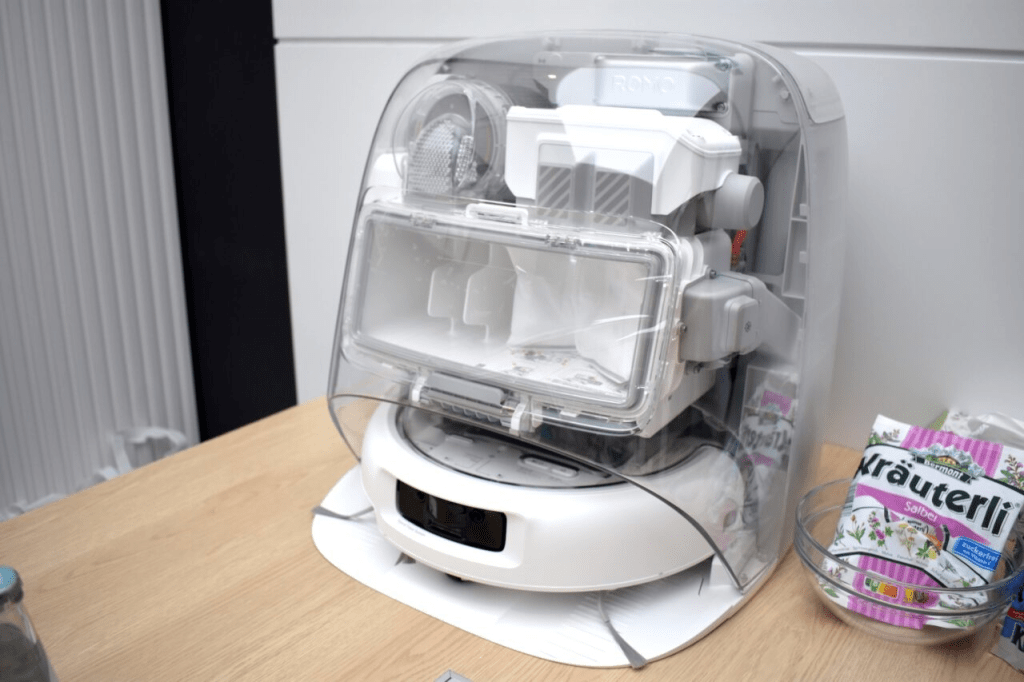
Did you ever want to watch the grubby guts of your robovac as it cleans? © Kyle Barr / Gizmodo
If you thought that it already sucked that you still can’t buy a new DJI drone in the U.S., get ready to learn about the company’s new robovac. The largest drone maker in the world now has its first smart home appliance in the form of the DJI Romo. The easiest way to describe it is as if a modern UAV removed its propellers and replaced them with wheels, fins, and mops but kept the obstacle detection technology. It’s a compelling idea that will inevitably have the U.S. government afraid that foreign actors will start spying on our messy, unwashed floors.

Back during IFA 2025, DJI took me into its back room to see a load of its upcoming tech. I went hands-on with the DJI Mini 5 Pro and DJI Osmo Nano. Then a company rep tore the sheet off the massive base station for a robovac. The first thing that came to mind looking at DJI’s Romo was, “Is this the Game Boy of Roombas?” Sure, I’ve been fully gamer pilled since I first held a controller, but the odd transparent plastic shell that DJI slapped onto its new product told me the company was offering a robovac that would appeal more to the tech-literate than many other automated suckers and mops.
DJI is known for its drones, though it has its feet in a plethora of product categories—from action cameras to microphones. The company’s first smart home tech product could make use of the company’s expertise in flying robotics—even though this device can’t fly (as much as we may wish it could).

DJI’s drones contain some truly impressive obstacle avoidance technology using multiple LiDAR sensors. These sensors combine with binocular fisheye vision sensors for its object detection. DJI claims its robot vacuum can spot objects as thin as 2mm, so it can maybe avoid swacking at any socks, dangling charging cables, or potentially even playing cards. The Romo may even be able to operate with better accuracy in low-light environments, thanks mostly to how LiDAR uses pulsing lasers to measure distances between itself and objects.
DJI says it developed novel algorithms for navigating a home. It’s supposed to recognize the areas of your home with carpets. The two side brooms are supposed to slow down when getting near your cat’s litter box. However, those cameras can also be used by owners to check on their homes. You have to use two-factor authentication to see those feeds. DJI also promises its video data is encrypted. (snip-embedded tweet on the page)
The Romo vacuum comes in three flavors: an S, A, and P version. The cheapest S tier starts at 1,300 euros (or $1,516) and goes up to 1,900 euros (around $2,216) at the P tier. You can expect most of the same features between each model, though the costliest P version includes a “floor deodorizer” solution the vacuum sprays in its wake and UV for disinfecting the drying bag. Either way, the unit will have 25,000Pa of suction power and contain a 164ml tank for mopping with its dual-spinning mop pads.
The Romo is currently only available in European markets. There’s no word when—or if—it’s ever coming to the U.S. Just like all DJI products, the U.S. government has effectively soft-banned any of its shipments to the States, and not just its drones. The U.S. government has until Dec. 23 to stop a full DJI ban from going into effect. The dronemaker needs a U.S. security agency to vouch for it, and DJI confirmed with The Verge that none have stepped up to bat for the China-based tech company.
Sure, there are plenty of other high-end robovacs like last year’s Roborock Qrevo Curv or more recent devices like the Roborock Saros 10 and the Dreame X50 vac/mop combo with suction power just below DJI’s. Some of those vacuums, like the Saros 10, have additional features that let them clear small hurdles as well. But one thing is for sure: none of those have a clear plastic shell.
Pertinent Snippets From WIRED
Be aware!
Chatbots Are Pushing Sanctioned Russian Propaganda
ChatGPT, Gemini, DeepSeek, and Grok are serving users propaganda from Russian-backed media when asked about the invasion of Ukraine, new research finds.
Snippet:
“It raises questions regarding how chatbots should deal when referencing these sources, considering many of them are sanctioned in the EU,” says Pablo Maristany de las Casas, an analyst at the ISD who led the research. The findings raise serious questions about the ability of large language models (LLMs) to restrict sanctioned media in the EU, which is a growing concern as more people use AI chatbots as an alternative to search engines to find information in real time, the ISD claims. For the six-month period ending September 30, 2025, ChatGPT search had approximately 120.4 million average monthly active recipients in the European Union, according to OpenAI data.
The researchers asked the chatbots 300 neutral, biased, and “malicious” questions relating to the perception of NATO, peace talks, Ukraine’s military recruitment, Ukrainian refugees, and war crimes committed during the Russian invasion of Ukraine. The researchers used separate accounts for each query in English, Spanish, French, German, and Italian in an experiment in July. The same propaganda issues are still present in October, Maristany de las Casas says.
Amid widespread sanctions imposed on Russia since its full-scale invasion of Ukraine in February 2022, European officials have sanctioned at least 27 Russian media sources for spreading disinformation and distorting facts as part of its “strategy of destabilizing” Europe and other nations.
The ISD research says chatbots cited Sputnik Globe, Sputnik China, RT (formerly Russia Today), EADaily, the Strategic Culture Foundation, and the R-FBI. Some of the chatbots also cited Russian disinformation networks and Russian journalists or influencers that amplified Kremlin narratives, the research says. Similar previous research has also found 10 of the most popular chatbots mimicking Russian narratives. (snip-MORE)
=====
Hundreds of People With ‘Top Secret’ Clearance Exposed by House Democrats’ Website
A database containing information on people who applied for jobs with Democrats in the US House of Representatives was left accessible on the open web.
Snippet:
“Today, our office was informed that an outside vendor potentially exposed information stored in an internal site,” Joy Lee, spokesperson for House Democratic whip Katherine Clark, told WIRED in a statement on October 22. DomeWatch is under the purview of Clark’s office. “We immediately alerted the Office of the Chief Administration Officer, and a full investigation has been launched to identify and rectify any security vulnerabilities.” Lee added that the outside vendor is “an independent consultant who helps with the backend” of DomeWatch.
There are many unsecured and publicly accessible databases across the internet, and the researcher says that they might not have paused to investigate the DomeWatch data had they not noticed key words involving top-secret security clearances. This underscores the concern, the researcher says, that while the database is small, it contains information that would be potentially valuable in nation-state espionage. One entry, for example, listed a person who had “intelligence” and “US-China relations” experience.
“Exposed databases are a widespread, non-partisan cybersecurity problem. Left unchecked, they enable targeted espionage, fraud, and identity abuse,” says Alexander Leslie, senior advisor for government affairs at the threat intelligence firm Recorded Future, who was not involved in the research. “If accurate, this dataset would be extremely sensitive. Military histories and clearance status give adversaries precise reconnaissance and pretexting opportunities, and foreign espionage actors could further use this data for spear-phishing, impersonation, and targeted social-engineering to gain access or compromise accounts.” (snip-MORE)
Tuesday A.M. Comics
Good for the BP!
https://www.gocomics.com/arloandjanis/2025/10/28
https://www.gocomics.com/broomhilda/2025/10/28

https://www.gocomics.com/calvinandhobbes/2025/10/28

https://www.gocomics.com/darksideofthehorse/2025/10/28
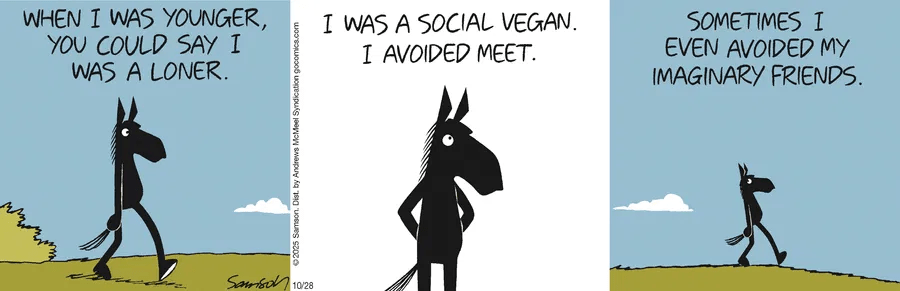
(I get this one, though I’m an introvert, not a vegan.)
https://www.gocomics.com/frazz/2025/10/28
https://www.gocomics.com/freerange/2025/10/28

Well, off to read the rest of the comics-everyone have a great day! Poor Ollie is sad; today’s our 3rd rainy day. I wish he enjoyed comics!
“’The reality is, if they sat down to try to negotiate, we could probably come up with something pretty quickly,’ [Chris] Murphy [Senator, D-Conn.] said Sunday on CNN’s ‘State of the Union.’ ‘We could open up the government on Tuesday or Wednesday, and there wouldn’t be any crisis in the food stamp program.’”
OK, so we’ve posted about this here at least a couple of times, and now we’re in the week where people will not be receiving benefits on which they depend, to eat. Here’s one more story. And, yes, this is a particular cause of mine, so I want to note that I’ve been looking around town to see where I might be able to help out should this come to fruition, as it appears to be doing. My posting may be sparser, because trying to help people get enough to eat will take up more time now. But, as we’ve also written here, building and sustaining community is important during times such as those we in the US find ourselves, and for me, helping people get enough to eat is sustaining community. So, while I’ll still be around, I may not post as often; the energy only goes so far. Here’s today’s AP story:
The U.S. Department of Agriculture has posted a notice on its website saying federal food aid will not go out Nov. 1, raising the stakes for families nationwide as the government shutdown drags on.
The new notice comes after the Trump administration said it would not tap roughly $5 billion in contingency funds to keep benefits through the Supplemental Nutrition Assistance Program, commonly referred to as SNAP, flowing into November. That program helps about 1 in 8 Americans buy groceries.
“Bottom line, the well has run dry,” the USDA notice says. “At this time, there will be no benefits issued November 01. We are approaching an inflection point for Senate Democrats.”
The shutdown, which began Oct. 1, is now the second-longest on record. While the Republican administration took steps leading up to the shutdown to ensure SNAP benefits were paid this month, the cutoff would expand the impact of the impasse to a wider swath of Americans — and some of those most in need — unless a political resolution is found in just a few days.
The administration blames Democrats, who say they will not agree to reopen the government until Republicans negotiate with them on extending expiring subsidies under the Affordable Care Act. Republicans say Democrats must first agree to reopen the government before negotiation.
Democratic lawmakers have written to Agriculture Secretary Brooke Rollins requesting to use contingency funds to cover the bulk of next month’s benefits.
Government shutdown
The AP has journalists around the country covering the shutdown of the federal government. What questions do you have for them?
But a USDA memo that surfaced Friday says “contingency funds are not legally available to cover regular benefits.” The document says the money is reserved for such things such as helping people in disaster areas.
It cited a storm named Melissa, which has strengthened into a major hurricane, as an example of why it’s important to have the money available to mobilize quickly in the event of a disaster.
The prospect of families not receiving food aid has deeply concerned states run by both parties.
Some states have pledged to keep SNAP benefits flowing even if the federal program halts payments, but there are questions about whether U.S. government directives may allow that to happen. The USDA memo also says states would not be reimbursed for temporarily picking up the cost.
Other states are telling SNAP recipients to be ready for the benefits to stop. Arkansas and Oklahoma, for example, are advising recipients to identify food pantries and other groups that help with food.
Sen. Chris Murphy, D-Conn., accused Republicans and Trump of not agreeing to negotiate.
“The reality is, if they sat down to try to negotiate, we could probably come up with something pretty quickly,” Murphy said Sunday on CNN’s “State of the Union.” “We could open up the government on Tuesday or Wednesday, and there wouldn’t be any crisis in the food stamp program.”

This Is Cool:
As Trump wields his power, Jack Smith and his top deputies step back into the spotlight
The man who brought two federal criminal cases against Donald Trump wants to testify publicly, as two of his top deputies set up a law firm to take on public corruption issues.

Molly Gaston and J.P. Cooney, both former top deputies to special counsel Jack Smith, launched their own firm this week.Gaston & Cooney PLLC
WASHINGTON — Two years ago, Molly Gaston stepped into the well of a courtroom in the nation’s capital and made history: informing a judge that a federal grand jury had returned a true bill and indicted a former United States president for attempting to overturn his election loss.
Now — nine months after President Donald Trump returned to the White House and his Justice Department fired her and other career prosecutors who worked with former special counsel Jack Smith — Gaston and another of Smith’s top deputies are stepping out on their own.
She and fellow Smith team alum J.P. Cooney rolled out a new law firm this week focused on helping state and local governments fill the void created by the Justice Department’s retreat from public corruption work. Gaston & Cooney PLLC will also represent the targets of criminal and congressional investigations as Trump flexes his ability to use federal law enforcement and his allies in Congress to target his political opponents.
Also this week, Smith’s lawyers informed Congress that he’s ready to re-enter the limelight, telling Trump allies Rep. Jim Jordan, R-Ohio, and Sen. Chuck Grassley, R-Iowa, that he’d be happy to testify before Congress. But he requested to do so publicly rather than behind closed doors to help combat the “many mischaracterizations” about his investigations into Trump, his attorneys said.
(snip-a video, tangentially related, on the page)
The public emergence of Smith and two of his top deputies comes as Trump has remade the Justice Department, tearing down the wall between the DOJ and the White House with open calls to go after his opponents; pardoning all participants in the Jan. 6, 2021, attack on the U.S. Capitol whom the department had spent years arresting and prosecuting; and firing scores of nonpolitical DOJ and FBI employees.
Smith gave a rare interview earlier this month, saying that attacks on public servants had an “incalculable” cost to the country. He also made an appearance in a video of DOJ alumni supporting fired employees.
Gaston and Cooney told NBC News that none of this — leaving the Justice Department and the relative anonymity of the life of a federal prosecutor to launch a law firm — was part of the plan. They had both expected to stay on at the Justice Department after Trump took office.
In retrospect, it may have been naive, but Gaston said they joked about getting demoted to work on misdemeanor cases in Superior Court in Washington, the low-level positions where many brand-new federal prosecutors start their careers.
They were fired in January. (Gaston and Cooney are challenging their firings, saying they are illegal and violate long-standing civil service protections.)
They chose not to join a big law firm, several of which have agreed to give free legal services to the Trump administration to avoid being targeted by executive orders, which judges later ruled violated the First Amendment.
Initially, they sought to work with universities to launch academic initiatives focusing on public corruption, with Gaston noting that’s what they spent most of their careers working on and were “really passionate about.” But it didn’t pan out.
“There were a lot of schools that were enthusiastic, but also anxious about working with us because of the environment right now,” Gaston said, adding they were unable to secure funding to launch the project.
Cooney said they want to “try and meet this moment,” which they think “is a particularly challenging one for our country in many respects.”
“Specifically in the area of the cost exacted by public corruption and turning a blind eye to it,” he said, there’s a real need for “independent, conflict-free representation and advocacy across many spectrums.”
The firings and departures of federal employees who worked on cases against Trump or the Jan. 6 prosecutions have been celebrated by many MAGA supporters. Current employees wonder if they’re next on the firing list, and those who departed face daunting challenges, including being targeted on social media, a heightened threat environment and a tough job market, with many employers hesitant to draw the Trump administration’s ire.
The campaign against Smith’s team hasn’t let up since Cooney and Gaston left. The Trump administration, just this month, fired FBI special agents and even administrative staffers who worked with Smith’s office. Gaston called the firing of “model public servants … outrageous” and sad.
“People who load documents into document review platforms were fired for no reason, except that they had worked for — done work for — the special counsel’s office,” Gaston said. “Those were the hardest moments for us in the last nine months.”
Gaston said she has “immense respect” for those still inside the DOJ who continue to follow the facts and the law.
“Career civil servants who are dedicated to doing their jobs without fear or favor — whether it’s judges or career prosecutors or FBI agents, or people who work at HHS and the like — are just now routinely the subject of such vehement personal attacks on social media and otherwise by politicians and public figures who know better,” Cooney said. “It really has no place in a civil society, and we are so inspired by the career civil servants who, under circumstances like that, go to work every day and do their job faithfully under the law and without fear or favor.”
Oh, Ste-eve!
(Click “Read on Substack”, enjoy! It’s less than 1 minute.)
Has anyone seen Steve???
– In Otter News Read on Substack
An Unalienable Right
The right to enough to eat. Meanwhile,
October 25, 2025 by Heather Cox Richardson
Read on Substack
Yesterday the Trump administration said it would not use any of the approximately $6 billion the U.S. Department of Agriculture (USDA) holds in reserve to fund the Supplemental Nutrition Assistance Program (SNAP). The government shutdown means that states have run out of funds to distribute to the more than 42 million Americans who rely on SNAP to put food on the table.
Roll Call’s Olivia M. Bridges notes that this position contradicts the shutdown plan the USDA released in late September. Then, it said: “Congressional intent is evident that SNAP’s operations should continue since the program has been provided with multi-year contingency funds that can be used for State Administrative Expenses to ensure that the State can also continue operations during a Federal Government shutdown. These multi-year contingency funds are also available to fund participant benefits in the event that a lapse occurs in the middle of the fiscal year.”
Yesterday’s USDA memo also says that any states that tap their own resources to provide food benefits will not be reimbursed.
Today, in yet another violation of the Hatch Act that prohibits the use of government resources for partisan ends, the USDA Food and Nutrition Service website reads: “Senate Democrats have now voted 12 times to not fund the food stamp program, also known as the Supplemental Nutrition Assistance Program (SNAP). Bottom line, the well has run dry. At this time, there will be no benefits issued November 01. We are approaching an inflection point for Senate Democrats. They can continue to hold out for healthcare for illegal aliens and gender mutilation procedures or reopen the government so mothers, babies, and the most vulnerable among us can receive critical nutrition assistance.”
It appears the administration is using those Americans who depend on food assistance as pawns to put more pressure on Democrats to cave to Trump’s will. Today, Annie Karni of the New York Times reported that Trump has joked, “I’m the speaker and the president,” and Trump ally Steven Bannon calls Congress “the state Duma,” a reference to Russia’s rubber-stamp assembly.
With Republicans refusing to negotiate with Democrats in the normal way, with House speaker Mike Johnson (R-LA) keeping the House out of session, and with Trump leaving for Asia for a week, Republicans are clearly making the calculation that Democrats who refused to give up their demand for the extension of the premium tax credit to stop dramatic hikes in the cost of healthcare premiums will cave when America falls into a hunger crisis.
What are we doing here, folks?
The nation’s nutrition program was once the symbol of government brokering between different interests to benefit everyone. When President Franklin Delano Roosevelt took office in 1933, one of the first crises he had to meet was the collapse of agricultural prices, which had been falling since the end of World War I and fell off a cliff after the stock market crash of October 1929. Farmers reacted to falling prices by increasing production, driving prices even lower.
In summer 1933, the government tried to raise prices by creating artificial scarcity. They paid farmers to plow their crops under and bought and slaughtered six million piglets, turning the carcasses into salt pork, lard, industrial grease, and fertilizer. The outcry over the slaughter of the pigs was immediate, and the escape of some intrepid animals into the streets of Omaha, Nebraska, and Chicago, Illinois, increased the protest at both the slaughter and the waste of food when Americans were going hungry.
So in fall 1933 the administration set up the Federal Surplus Relief Corporation, designed to raise commodity prices by buying surplus production and distributing that surplus through local charities. In a story about the history of nutrition assistance programs, journalist Matthew Algeo noted that in January 1934, the Federal Surplus Relief Corporation bought 234,600 hogs. This time, their meat went to hungry Americans.
But that fall, when officials from the FSRC announced they were planning to open a “goods exchange” or “commissary” outside Nashville, Tennessee, to distribute food directly to those who needed it, grocers protested that the government was infringing on private business and directly competing with them.
The next year, the agency became the Federal Surplus Commodities Corporation and began to distribute surplus food to schools to be used in school lunch programs. Needy students would not otherwise be able to afford food, so providing it for them did not compete with grocers. In 1937, Congress placed that agency within the Department of Agriculture.
To get food into the hands of Americans more generally, officials at the Department of Agriculture came up with the idea of “food stamps.” As Algeo explains, eligible recipients bought orange-colored stamps that could be redeemed for any food except alcohol, drugs, or food consumed on the premises. With the orange stamps, a buyer received blue stamps worth half the value of the orange stamps purchased. The blue stamps could be redeemed only for foods the government said were surplus: butter, flour, beans, and citrus fruits, for example.
Any grocery store could redeem the stamps, and grocers could then exchange all the stamps—orange and blue—for face value at any bank. The Treasury would pay back the banks.
It was a complicated system, but when the government launched it in May 1939 in Rochester, New York, it was a roaring success. By early December, Algeo notes, the government had sold more than a million dollars’ worth of orange stamps. That meant another half-million dollars’ worth of the blue stamps had been distributed, thus pumping a half a million dollars directly into the 1,200 grocery stores in Rochester, and from there into the local economy.
The program spread quickly. In the four years it existed, nearly 20 million Americans received benefits from it at a cost to the government of $262 million. With the economic boom caused by World War II, the government ended the program in 1943.
In 1959, Congress authorized the secretary of agriculture to restart a food stamp program, but it was not until 1961, after seeing the poverty in West Virginia during his campaign, that President John F. Kennedy announced a new program. Since then, the program has gone through several iterations, most notably when the Food Stamp Act of 1977 eliminated the requirement that beneficiaries purchase stamps, a requirement that had kept many of the nation’s neediest families from participating.
In 1990 the USDA began to replace stamps with Electronic Benefit Transfer (EBT) cards, and in 2008, Congress renamed the program the Supplemental Nutrition Assistance Program. In July 2025 the Republicans’ One Big Beautiful Bill Act cut about $186 billion from SNAP programs, and then in September 2025 the USDA announced it would no longer produce reports on food insecurity in the U.S., calling them “redundant, costly, politicized, and extraneous studies” that “do nothing more than fear monger.”
While a great deal has changed in nutrition support programs in the past sixty years, what has not changed is the importance of food assistance programs to retailers, and thus to local economies. In 2020, Ed Bolen and Elizabeth Wolkomir of the Center on Budget and Policy Priorities found that about 8% of the food U.S. families buy is funded by SNAP. In fiscal year 2019, that amounted to about $56 billion. Beneficiaries spent SNAP dollars at about 248,000 retailers. While about 80% of that money went to superstores or supermarkets—in 2025, Walmart alone captured about 25% of that money—the rest of it went to small businesses. Bolen and Wolkomir note that about 80% of stores that accept SNAP are small enterprises. SNAP benefits are an important part of revenue for those smaller businesses, especially in poorer areas, where they generate significant additional economic activity.
Not only will the loss of SNAP create more hunger in the richest country on earth, it will also rip a hole in local economies just as people’s health insurance premiums skyrocket.
And yet, at the same time the Department of Agriculture says it cannot spend its $6 billion in reserves to address the $8 billion needed for SNAP in November, the administration easily found $20 billion to prop up right-wing Trump ally Javier Milei in Argentina.
What are we doing here?
—
Notes:
https://rollcall.com/2025/10/24/usda-says-it-cant-use-contingency-fund-for-food-stamps/
George T. Blakey, “Ham That Never Was: The 1933 Emergency Hog Slaughter,” The Historian 30 (November 1967): 41–57. https://www.jstor.org/stable/24440624?seq=1
https://www.politico.com/f/?id=0000019a-17b3-dc69-abda-fff3f76a0000
https://www.politico.com/news/2025/10/24/snap-food-aid-shutdown-usda-00622690
https://www.jandonline.org/article/S0002-8223(07)01619-7/fulltext
https://www.cbpp.org/research/food-assistance/snap-boosts-retailers-and-local-economies
https://www.cnn.com/2025/10/18/politics/snap-food-stamps-november-government-shutdown
https://www.fns.usda.gov/newsroom/usda-0219.25
644 Cranes: “This is our cry, this is our prayer; peace in the world.” This Date in Peace & Justice History
October 25, 1955 Sadako Sasaki Sadako Sasaki, following the Japanese custom of folding paper cranes – symbols of good fortune and longevity – persisted daily in folding cranes, hoping to create senbazuru (1000 paper cranes strung together) when a person’s dream is believed to come true, died. The Sadako story  Sadako was two years old when the atom bomb was dropped on Hiroshima and at 12 was diagnosed with Leukemia, “the atom bomb” disease. Children’s Peace Monument in Hiroshima showing Sadako holding a golden crane Photo: Mark Bledstein  |
https://www.peacebuttons.info/E-News/peacehistoryoctober.htm#october25
 Scottie's Playtime