A.I. Does STEAM-

(Well, the Science and Art parts, anyway! This is originally a year-old story, republished by Cosmos today. I scouted around for some sort of an update, but didn’t find one. I still thought this is interesting, and at least now we know another area in which A.I. might be applied. I think that’s good to know, since A.I. does make mistakes, as noted below.)

The artificial intelligence program AlphaFold is proving to be a gamechanger for biological research, Imma Perfetto reports. This article was originally published in the Cosmos Print Magazine, September 2024.

October 11, 2025 Imma Perfetto
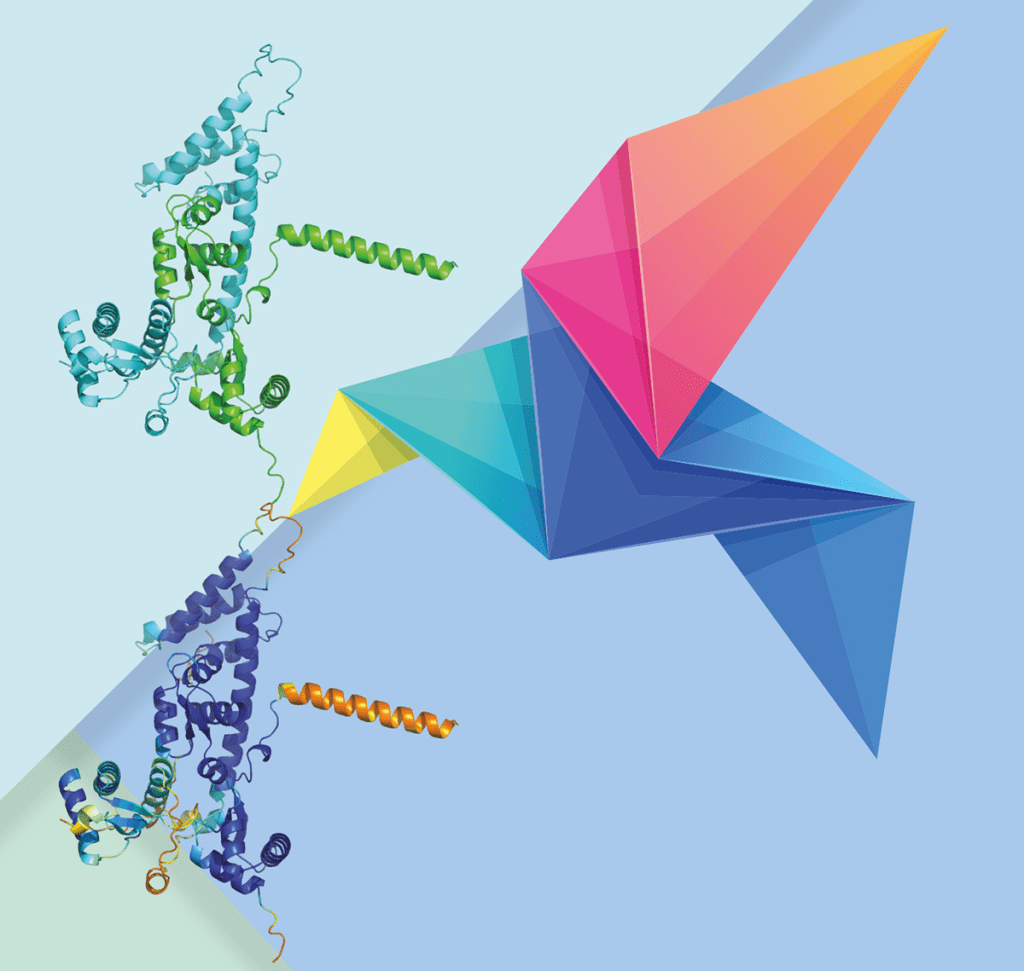
This artwork of an origami bird holds AlphaFold 3 predictions of a complex of two proteins (ScpA and ScpB) in its beak. The protein complex is important during cell division in bacteria. Top: ScpA is cyan and ScpB is green. Bottom: Confidence measures, where dark blue is very high confidence, light blue is confident, yellow is low confidence, and orange is very low confidence in the structural prediction. Credit: AlphaFold 3, Katie Michie.

A protein is made from of a chain of amino acids strung together like beads on a necklace. This chain spontaneously folds, like origami, into intricate pleats, folds, and loops through interactions between its amino acids. The resulting unique 3D structure largely determines its vital function within the lifeform. Solving the structure allows biologists to better understand how the protein works and design experiments to affect and modify it.

The smallest known protein, TAL, influences development of the fruit fly Drosophila melanogaster and has just 11 amino acids. The largest, Titin, is found in human muscle cells and is made up of roughly 35,000.

Proteins are far too tiny to inspect under a regular microscope. For decades researchers used complex experimental techniques, such as X-ray crystallography, nuclear magnetic resonance (NMR) spectroscopy, and cryogenic electron microscopy (cryo-EM) to solve their structures. It’s painstaking, time-consuming work that takes specialised skill and sometimes hundreds of thousands of dollars. And, as Kate Michie can attest, success is not always guaranteed.

“I spent four years trying to solve the crystal structure of a complex of two human proteins and got scooped. You know, I got nothing out of four years. I worked really hard at it, and it was a really difficult project. AlphaFold can calculate those in a few hours,” says Michie, who is chief scientist of the Structural Biology Facility at the Mark Wainwright Analytical Centre, of the University of New South Wales Sydney.

On 8 May 2024 Nature dropped a paper introducing the third and latest iteration of the artificial intelligence (AI) system AlphaFold, which predicts the 3D structure of proteins from their amino acid sequences. Google DeepMind and Isomorphic Labs, both subsidiaries of Alphabet, co-developed the new model. They say AlphaFold 3 (AF3) is “a revolutionary model that can predict the structure and interactions of all life’s molecules with unprecedented accuracy”. But, while AF3 has generated significant interest since its release, it has simultaneously sparked criticism among those in the scientific community.

Let’s take a closer look at how AI is changing the world of structural biology.

A revolution in protein structure

AF3’s predecessor, AlphaFold 2, was released as open source code in July 2021 and immediately changed the game in structural biology.

“I contacted the high-performance computation people and said, ‘we really need to get this piece of code running’. And then I asked my colleague, ‘Do you have any structures that you never submitted to the Protein Data Bank?’” says Michie.

The Protein Data Bank (PDB) is the global archive of all the experimentally solved structures for large biological molecules. As of June 2024, its estimated to include more than 220,000 proteins, which sounds like a lot until you consider the number of proteins we know of exceeds 200 million.

“My colleague sent me a sequence of a small protein he never submitted to the PDB, I ran it, and I just sent him the result. His email response to me was: ‘My mind is blown!’ And he said, ‘I immediately thought someone else must have solved the structure.’”

But they hadn’t, AF2 had accurately predicted the 3D structure of the protein from its amino acid sequence alone. What had taken years to describe experimentally had been done in just a few hours.

AF2 is a deep learning algorithm. In the world of AI that means it simulates the neural networks found in human brains. First, it takes the protein sequence of interest and searches several databases for similar proteins. By comparing these sequences, it can identify areas of similarity and difference to understand how the protein has changed across evolution.

For instance, if two amino acids are in close contact in 3D space then a mutation in one will usually be accompanied by a mutation in the other (to conserve the structure of the protein). But if they are far apart then they tend to evolve independently from each other. Using this to work out the relative positions of the amino acids, AF2 then takes its training on PDB structural data and iteratively constructs a 3D model of the protein’s structure with relatively high accuracy.

Scientists can take advantage of that predicted structure to accelerate their science by doing smarter, more strategic experiments in the laboratory right off the bat. “I’ve done work with some scientists working with immune complexes, and the models coming out of AlphaFold enable them to really trim down the number of animal experiments they do,” says Michie. “So instead of making say 20 CRISPR mice, they only might make two.”

Fos and jun transcription factors coloured in blues, yellow and orange depending on their confidence. A green box in the right is shaded to indicate binding confidence.
As seen in AlphaFold 3, a structural prediction of Fos and Jun transcription factors with the DNA sequence they bind. The top panel shows the model and confidence data, and the green chart shows the high confidence of them binding to each other. Credit: AlphaFold 3, Katie Michie.

Crystal clues

An accurate AlphaFold structure can also be the crucial missing piece of the puzzle that allows researchers to experimentally solve the structure using X-ray crystallography.

“One of my other colleagues is virologist and he’d been working on a protein that had eluded structural elucidation for 20–30 years. It was from the world’s first known retrovirus,” says Michie.

“The trick of crystallography is you need to know two components of the maths to solve them,” she continues. The diffraction data provided by X-ray crystallography gives you one of those components, but you don’t have the other: the phase.

Traditional methods of obtaining phase information had proved unsuccessful, until Michie suggested using AlphaFold instead.

“Immediately the structure came out. AlphaFold helped him get the crystals but then actually enabled him to phase the structure. It told us that the Alpha Fold model was very good, but it also fixed up this problem in structural biology.”

To Michie, AlphaFold represents a massive step forward: “it’s genuinely the biggest scientific advance in my career”.

“The Alpha Fold model was very good, but it also fixed up this problem in structural biology.”

Predicting the structures of life’s molecules

Proteins don’t exist in a vacuum. They move around, bind to and modify each other, and even form large, complicated complexes.

Peter Czabotar, joint head of the Structural Biology Division at WEHI, the oldest medical research institute in Australia, says one of the early limitations of AF2 was you could only ever get structural predictions of one protein, alone. “Often what you’re interested in is how different proteins will interact with each other. For example, we work on proteins that are involved with cell death and the interactions between those proteins will dictate whether a cell will live or die.”

The gap has since been bridged by other research groups adapting and building upon AF2’s open source code, and with the AlphaFold-Multimer extension in October 2021.

The newest version, AF3, extends upon this capability by predicting interactions of multiple proteins, and nucleic acids (DNA and RNA). It can predict the impact of ions and post-translational modifications – the addition of chemical groups to amino acids – on these molecular systems too. AF3 can also be used to predict how a selection of small molecules called ligands bind to proteins, though this is restricted to ligands that have high-quality experimental data available in the PDB.

“But where the real power is, something that we do a lot of, is in the drug discovery world,” says Czabotar. “And it is extremely powerful for that, potentially, but they haven’t enabled that in the way that it’s released. We’ve done drug discovery against cell death proteins, for example. I can’t take one of the drugs that we’ve worked with and see how it interacts with my target protein, I can only use the [ligands] that they’ve enabled us to use.”

That capability to predict the structure of novel drug molecules interacting with target proteins seems to be restricted to Isomorphic Labs, which was launched in 2021 to pursue commercial drug discovery.

AF3 uses a very different approach for this new suit of predictions: generative AI. After processing the sequence inputs, it assembles its predictions using a diffusion network, the likes of which power AI image generators. According to Isomorphic Labs’ website: “the diffusion process starts with a cloud of atoms, and over many steps converges on its final, most accurate molecular structure”. Diffusion has been applied to protein structure prediction before, for example, in the seminal RoseTTAFold diffusion (RFdiffusion) by the Baker Laboratory at the Institute for Protein Design, the University of Washington.

But generative AI is not without its limitations. AF3 will occasionally produce structures with overlapping atoms (this is physically impossible) or replace a detail of the structure with its mirror image (chemically impossible). As a generative model, it is also prone to hallucinations in which it invents plausible-looking structures – particularly in disordered regions of the protein that lack a stable 3D structure – similarly to how a text to image AI struggles to create realistic-looking hands. In-built confidence measures help to identify when AF3 isn’t so sure about its structural prediction, but ultimately it takes a scientist with understanding of the underlying structural biology to come along and identify what’s gone wrong, and why.

“It’s very, very powerful. But it doesn’t exclude the need to necessarily confirm things experimentally. Whether that is by solving structures themselves or by, for example, testing the structures in some way in an experiment,” says Czabotar.

Concerns about code

In a major departure from AF2, access to the newest iteration of AlphaFold is limited to a web server and for non-commercial research only. “We have various structure-based drug discovery projects and some of them are purely academic, as students, PhDs and honours projects. But we also have had commercial partnerships, because that’s a way to push your discoveries into a clinical setting,” says Czabotar. “So generally, anything that is going to make an impact is done by an academic lab in a commercial partnership. Now, I guess it puts us in a bit of an awkward situation. Even if we could look at our compounds bound to the target [protein], there’s some projects where we won’t be able to do it because, you know, we’ve ticked a box.”

AF3’s accompanying Nature paper was also published without the source code, but with a ‘pseudocode’ instead – a detailed description of what the code can do and how it works. This prompted an open letter to the Editors of Nature, published 16 May and endorsed by more than 1,000 scientists as of June.

The letter raised concerns that “the absence of available code compromises peer review” and that the pseudocode released would “require months of effort to turn into workable code that approximates the performance, wasting valuable time and resources”. Access to the web server was also initially capped at 10 predictions per day, which the letter stated, “restricts the scientific community’s capacity to verify the broad claims of the findings or apply the predictions on a large scale”.

The sentiments appear to have hit home. Shortly after the letter’s release, DeepMind’s Vice President of research, Pushmeet Kohli announced via X that they would double the daily job limit to 20 and are “working on releasing the AF3 model (incl weights) for academic use … within 6 months”.

On 22 May Nature responded in an editorial, stating its reasoning for publishing the paper without code: “the private sector funds most global research and development, and many of the results of such work are not published in peer-reviewed journals. We at Nature think it’s important that journals engage with the private sector and work with its scientists so they can submit their research for peer review and publication.”

In the meantime, other researchers won’t be sitting idly by until the code release at the end of 2024. Already, multiple teams are racing to develop their own open source versions of AlphaFold 3, without any strings attached.

Good News:

Students With Hearing and Vision Loss Get Funding Back Despite Trump’s Anti-DEI Campaign

Following public outcry, the Department of Education has reversed its decision to cut funding for students who have both hearing and vision loss, opting instead to reroute grants to an organization that will provide funding to these students.


by Jodi S. Cohen and Jennifer Smith Richards

Following public outcry, the U.S. Department of Education has restored funding for students who have both hearing and vision loss, about a month after cutting it.

But rather than sending the money directly to the four programs that are part of a national network helping students who are deaf and blind, a condition known as deafblindness, the department has instead rerouted the grants to a different organization that will provide funding for those vulnerable students.

The Trump administration targeted the programs in its attacks on diversity, equity and inclusion; a department spokesperson had cited concerns about “divisive concepts” and “fairness” in explaining the decision to withhold the funding.

ProPublica and other news organizations reported last month on the canceled grants to agencies that serve these students in Oregon, Washington and Wisconsin, as well as in five states that are part of a New England consortium.

Programs then appealed to the Education Department to retain their funding, but the appeals were denied. Last week, the National Center on Deafblindness, the parent organization of the agencies that were denied, told the four programs that the Education Department had provided it with additional grant money and the center was passing it on to them.

“This will enable families, schools, and early intervention programs to continue to … meet the unique needs of children who are deafblind,” according to the letter from the organization to the agencies, which was provided to ProPublica. Education Department officials did not respond to questions from ProPublica; automatic email replies cited the government shutdown. (snip-MORE)

AFL Boycotts This Date In Peace & Justice History for 10/13

October 13, 1934
The American Federation of Labor (AFL) voted to boycott all German-made products as a protest against Nazi antagonism to organized labor within Germany.
Watch The U.S. and the Holocaust , 2022, A new documentary by Ken Burns, Lynn Novick and Sarah Botstein

https://www.peacebuttons.info/E-News/peacehistoryoctober.htm#october13

From Charlotte On Sunday, Today-

Fun times with accidental noises, and I like the way she thinks for her birthday fundraiser!

Sounds I Still Make in My 30s by Charlotte Clymer

Last lap. Read on Substack

Today is my birthday.

This morning, I was in the backseat of an Uber ride and absentmindedly playing with my lips in the quiet way it’s socially acceptable for grown adults to do (or, perhaps, that’s me rationalizing) when, to my surprise, I accidentally forced too much air through the aperture of my mouth, creating a sound that could understandably be perceived by the driver as a fart.

Mildly panicked, I leapt into action by recreating the sound a few more times in quick succession in order to non-verbally (?) communicate to the driver:

Haha, see? That totally wasn’t what you thought it was! I accidentally made that sound with my lips! I’m now doing it again two or three more times to show that it’s just me playing with my mouth and not doing something very rude right behind you! Actually, making that sound is rude, too — look, I promise I am not blasting ass in the backseat of your car, okay?!

I am 39-years-old today. It’s my final year in this decade. It’s been a doozy.

I turned 30 a little over three weeks before the 2016 election. (I know. We won’t get into that because you already get it.)

All my life, I’ve heard of folks in their late-30s just dreading the big FOUR ZERO, and it’s not my place to judge them. I’m sure they had their reasons.

But me? I’m so ready for my 40s. If I could snap my fingers and make it happen now, I would have turned 40 today. Maybe I’ll just lie and say I’m 40 moving forward.

Being in your 40s sounds awesome. Being in your 50s and 60s sounds even better. I wanna fast-forward and get there already. I want the accumulated wisdom and experience and memories right now. I want that whole toolbox immediately.

Sadly, I cannot have it immediately. That is earned. I must brave the final year of my 30s in our oh-so-stable world to get a little closer to the benefits of being older and wiser.

To that end, I’m gonna make this a great Year 39. I plan to treat it like a final dress rehearsal for the second half of my life.

I’d like y’all to help me get things off to a great start.

Every year, for the past decade, I’ve hosted a birthday fundraiser for my favorite organization Running Start, a non-profit that trains young women in high school and college to run for office someday.

These programs are wide-ranging: from one-day workshops on college campuses (Elect Her) to congressional fellowships to the HBCU Women’s Leadership Summit, thousands of young women have been equipped with necessary skills to go on and do great things in politics, law, advocacy, and media.

I’ve served on the Board of Running Start since 2021, working harmoniously alongside my colleagues—Democrats and Republicans and independents—to ensure the next generation of young women get an exceptional head start toward leading our country someday.

In that time, I have seen a huge, diverse network of alums directly benefit from these programs and then watch as their campuses and communities benefit from them, too.

So, I am kindly asking y’all to help me celebrate my birthday by making a modest donation to Running Start: https://www.runningstart.org/charlotte

And believe me, I get it, everyone and their mother and their cousin is hitting y’all up for money right now — for that campaign or that non-profit or that candidate or that cause and on and on.

Thus, I am grateful for the consideration. It means a lot. I am thankful.

As always, those making very generous donations ($250 or more) should know you’ll be getting a phone call from me to thank you for your generosity, and if you really wanna go above and beyond ($1000 or more), that’ll mean coffee over zoom OR me treating you to lunch here in D.C. (or wherever you live if we can make it happen — no kidding, we will find a way.)

But also: everyone donating will get a personal email from me thanking them because every donation, no matter how much, means something to me and the young women who benefit from Running Start’s programs.

In the meantime, please wish me luck on this final lap of my 30s, and if you could offer up a prayer that I’ll avoid embarrassing sounds in cars, I’d appreciate that, too.

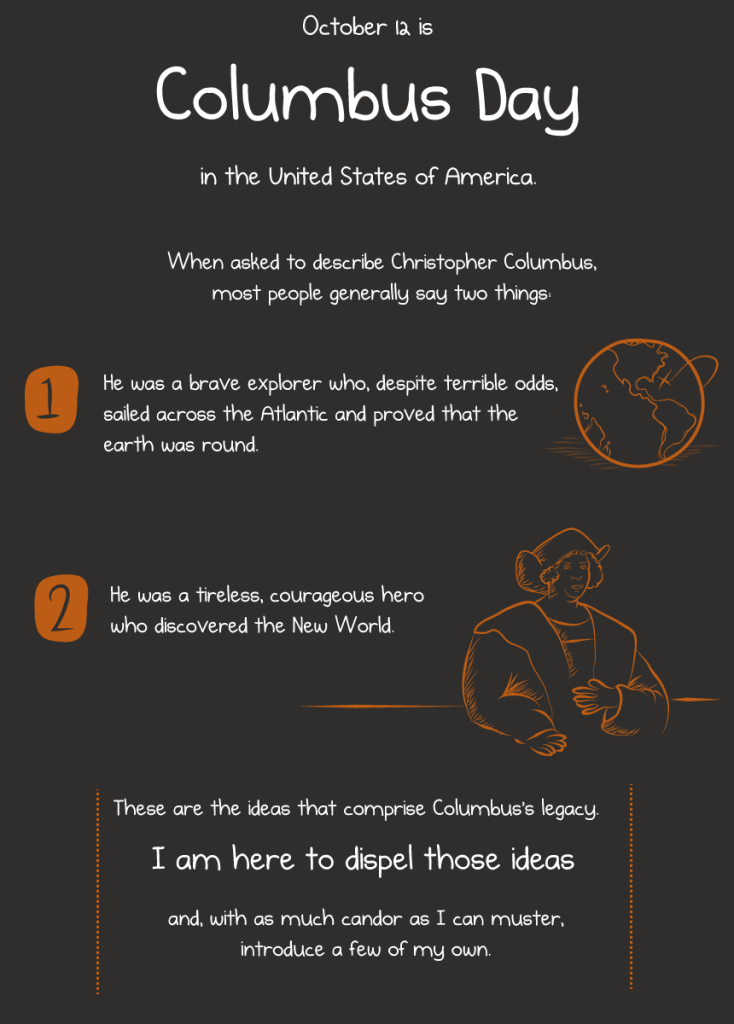
Another Look At October 12th

(Snip-please click through and read the whole thing; it only takes a minute or two. OK; here’s a bit more-)

(Snip-OK, now go read the whole thing! Seriously, it’ll only take a minute!)

https://theoatmeal.com/comics/columbus_day

A Vast Crime Indeed

Indigenous People Find Chris Columbus, A C.O. Is Awarded The Congressional Medal Of Honor, “A Call To Resist Illegitimate Authority,” & More, In Peace & Justice History For 10/12

October 12, 1492

Natives of islands off the Atlantic shore of North America came upon Italian explorer Christopher Columbus, who was searching for a water route to India for Spanish Queen Isabella.
October 12, 1945
Pfc. Desmond Doss became the first conscientious objector ever to be awarded the Congressional Medal of Honor. Doss, a Seventh Day Adventist, enlisted in 1942 but refused to carry a rifle or train on Saturdays. On the island of Okinawa, under heavy Japanese fire, he saved the lives of 75 sick and wounded soldiers by lowering them, one by one, down a 400-foot cliff.

The guest house at Walter Reed Army Medical Center is Doss Memorial Hall in his honor.
Read more (includes movie trailer)
October 12, 1958
A Reform Jewish Temple in Atlanta (the city’s oldest) was firebombed with fifty sticks of dynamite in retaliation for Jewish support of local black civil rights activists. The Temple’s Rabbi, Jacob Rothschild, was outspoken in his support of civil rights and integration, and was a friend of Reverend Martin Luther King, Jr. before he became well known nationally.

From Georgia PBS 
October 12, 1967
British zoologist Desmond Morris stunned the world with his book, “The Naked Ape,” a frank study of human behavior from a zoologist’s perspective. Morris had earlier studied the artistic abilities of apes and was appointed Curator of Mammals at the London Zoo.

Read more
October 12, 1967
“A Call to Resist Illegitimate Authority” appeared in The Nation and the New York Review of Books. 20,000 signed it, including academics, clergymen, writers. It urged “that every free man has a legal right and a moral duty to exert every effort to end this war [Vietnam], to avoid collusion with it, and to encourage others to do the same.”
This document became the main basis for the federal government’s criminal prosecution (for encouraging draft evasion) of five of the signers: Dr. Benjamin Spock, Marcus Raskin, Mitchell Goodman, Michael Ferber, and the Reverend William Sloane Coffin.

Read the Call 
October 12, 1970
Lt. William Calley was court-martialled for the massacre of 102 civilians in the Vietnamese village of My Lai; far more actually died during the incident.
 
The full sad story    

Lt. Calley
October 12, 1977
“Regents of the University of California v. Bakke” was argued in front
of the U.S. Supreme Court. The question: Did the University of California violate the Fourteenth Amendment’s equal protection clause, and the Civil Rights Act of 1964, by practicing an affirmative action policy that resulted in the repeated rejection of Bakke’s application for admission to its medical school?

Read more 

https://www.peacebuttons.info/E-News/peacehistoryoctober.htm#october12

Mmm. Popsicles.

The Boy Who Accidentally Invented the Popsicle

120 years ago, 11-year-old Frank Epperson left his drink on the front porch on a chilly night. That accident became one of the most successful frozen dessert brands in the nation.

Selina Alipour Tabrizi

An early advertisement for Popsicle (National Archives)

Whether their favorite is ice cream, popsicles, or gelato, most people would agree that frozen treats are delicious.

While the origins of frozen desserts are unclear, they likely trace their roots back to the Ancient Persians, who used ice houses to produce and store faloodeh and sorbets. First-century Roman cookbooks included recipes of sweet desserts sprinkled with snow. Marco Polo is (probably falsely) credited for introducing frozen desserts to Italy after his travels in China, and Thomas Jefferson popularized ice cream in the United States — his handwritten vanilla ice cream recipe from the 1780s was one of the earliest in the nation.

But one story in frozen dessert history stands out, and it is not about a United States president or a Silk Road explorer: It’s about an 11-year-old boy.

On a winter day in 1905, young Frank Epperson made a beverage mixing soda powder with water to stay hydrated. One night, he accidentally left his cup on the porch overnight with a stirring stick inside, according to popsicle.com. Temperatures dropped during the night, and the next morning, Epperson found his cup where he had left it, no longer liquid, but now an icy snack. He ran the cup under hot water, pulled it out using the wooden stick, and tasted the new frozen dessert. He named it the Epsicle — a combination of “Epperson” and “icicle” — but unlike the process of its invention, the product didn’t turn into a national success overnight.

Epperson continued making Epsicles for his friends, and later, his children — who began calling the treat “Pop’s Sicle” or “Popsicle,” the name the brand keeps to this day — for many years. He also sold popsicles around his neighborhood until 1923, when he decided to expand his market to Neptune Beach — known as the “West Coast Coney Island” — where it became a beloved treat, selling as many as 8,000 in one day.

Following this popularity, Epperson applied for a patent on June 11, 1924, describing the Popsicle as a “frozen confection of attractive appearance, which can be conveniently consumed without contamination by contact with the hand and without the need for a plate, spoon, fork or other implement.”

Epperson’s request was approved two months later, and he immediately sold all of the rights to the invention that had defined much of his life to the Joe Lowe Co., which later started a subsidiary called the Popsicle Industries. Epperson later regretted the loss, saying: “I was flat and had to liquidate all my assets. I haven’t been the same since,” according to NPR. The frozen dessert brand, however, continued on without him.

A few years later, the Great Depression began to weigh heavily on the American public. As the stock market crashed and employment declined, struggling families had to cut out the ten-cent popsicles from their purchases. In response, the Popsicle Corporation devised the first two-stick popsicles so that two children could enjoy a snack for the price of one. According to a 1931 advertisement, “People who could not afford dimes, quarters and halves for ice cream gladly bought Popsicles at a nickel each for children, family and friends.” The two-stick popsicle became a huge success, doubling the company’s sales in a year. The Popsicle Corporation later declared itself “Depression Proof.”

But not everything was as sweet as the dessert itself for the Popsicle brand. The Popsicle Corporation also had rivalries with the company Good Humor — a brand known for their chocolate-coated bars and the first ice cream trucks. The dispute resulted in a series of court cases over patent violations. The initial conflict ended with a compromise: The Popsicle Corporation would sell iced treats with no milk, and Good Humor would sell products containing milk. However, with the drop of dairy prices in 1932, Popsicle ignored the agreement and decided to tap into the ice cream market — coming out with a “Milk Popsicle” that included 4.48 percent butter fat.

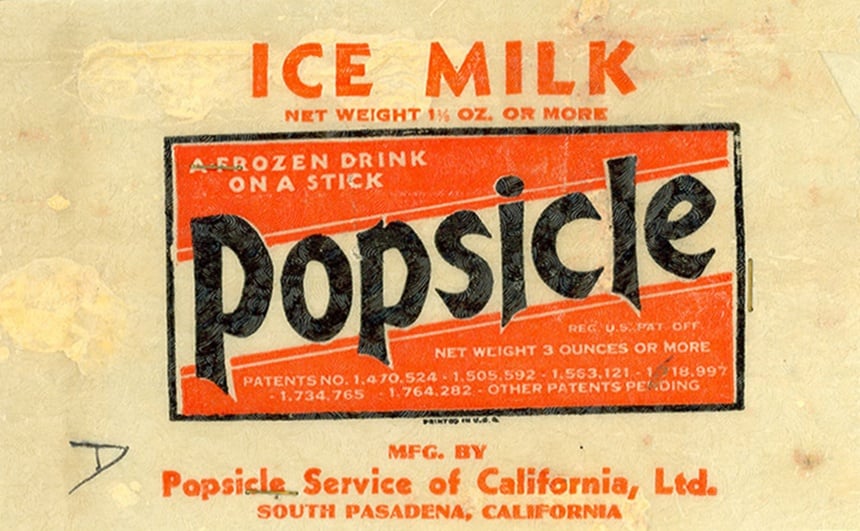
Wrapper for Popsicle’s “Ice Milk” product (National Archives)
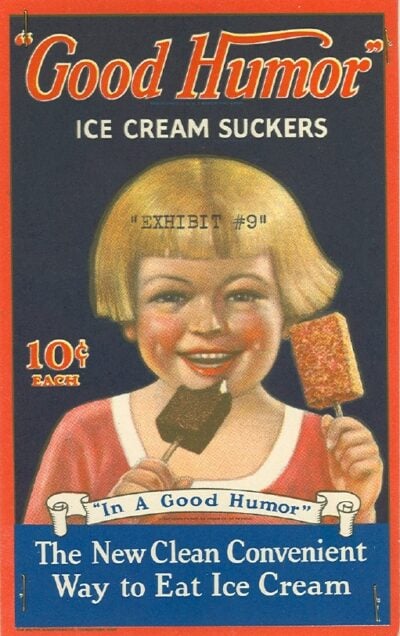
A Good Humor advertisement (National Archives)

Good Humor filed a lawsuit immediately. Both sides fought to define “sherbet.” Good Humor strictly defined it as “flavored water ice,” but Popsicle rebutted, claiming that most state regulators did not categorize the Milk Popsicle as ice cream, but with terms such as “imitation ice cream,” “frozen custard,” “milk sherbet,” or “ice milk.” The judge ruled for Good Humor, and both companies signed their new court-approved agreement on April 7, 1933. Ironically, over the next six decades, Unilever — one of the largest global consumer goods companies — bought the rights to both Good Humor and Popsicle, ending the Cold War between the two companies.

If you remember buying a cold treat from a neighborhood ice cream truck on a hot summer day, eating a Firecracker during a Fourth of July party, or splitting a two-stick pop with a friend, you’re one of millions that probably has nostalgic memories of Popsicles. It continues to be one of the most popular frozen dessert brands, and for that, we have an 11-year-old Frank Epperson to thank.

It Does Come Around

In case we’ve forgotten him, former OK Schools Supt. Ryan Walters did a lot of really expensive, very crazy stuff in the schools, later getting caught watching porn on school property; he was caught while chairing a meeting with Board members. I promised Scottie that I’d post whenever I found something about Ryan Walters. I read this here, where there is plenty more news.

Ryan Walters had ‘history of mismanaging tax dollars,’ AG says as he calls for audit

Alexia Aston, The Oklahoman Thu, October 2, 2025 at 9:17 AM CDT

Attorney General Gentner Drummond has called for an investigative audit into the Oklahoma State Department of Education following the resignation of Ryan Walters as the state’s top education official.

In a letter sent Wednesday, Oct. 1, to Oklahoma State Auditor and Inspector Cindy Byrd, Drummond ordered an audit covering Walters’ tenure from January 2023 to September 2025. The attorney general said several current and past state education employees had raised concerns about spending practices under Walters’ leadership, adding that the former superintendent has a “history of mishandling tax dollars.”

A spokesman for Byrd confirmed her office had received Drummond’s letter.

Walters, the controversial former state schools superintendent, resigned Tuesday to lead a new professional organization that touts itself as “an alternative to union membership” for teachers. The former education leader drew national attention Oklahoma through ultra-conservative, Christianity-focused initiatives. During his tenure, he ordered public schools to teach from the Bible, honor Kirk with a moment of silence and show students a video of him praying for President Donald Trump.

Madison Cercy, spokeswoman for the Department of Education, did not respond to a request for comment.

Grand jury findings blamed Ryan Walters for misspending COVID funds

Drummond, a Republican who’s running for governor, cited the state’s multicounty grand jury findings in 2024, which blamed Walters for misspending pandemic relief funds.

“You are well aware that the former superintendent has a documented history of mismanaging tax dollars, as it was your office that exposed Mr. Walters for granting ‘blanket approval’ for families to purchase non-educational items like Xboxes and refrigerators,” Drummond wrote in the letter to Byrd.

At the time, grand jurors did not issue any indictments, saying they found insufficient evidence to establish, beyond a reasonable doubt, that a crime was committed.

The grand jury specifically blamed Walters for the misspending of federal funds in a program called Bridge the Gap. The program fell underneath the Governor’s Emergency Education Relief Fund. Bridge the Gap’s purpose was to help children get supplies to learn at home during the pandemic. Some parents used funds from the program to buy things for themselves.

Walters has faulted ClassWallet, the out-of-state company hired to help disburse the federal funds.

Democratic lawmaker files ethics complaint against Walters

Drummond isn’t the only elected official requesting a state agency to investigate Walters’ oversight.

State Rep. Ellen Pogemiller, D-Oklahoma City, filed a formal complaint with the Oklahoma Ethics Commission on Sept. 29, saying Walters’ hiring as chief executive officer of the Teacher Freedom Alliance – which he announced during an appearance on Fox News Sept. 24 – raises ethics concerns. Walters repeatedly touted the organization in the months leading up to his hiring.

“This development strongly suggests that his prior actions were motivated by personal financial or professional gain, further underscoring the need for investigation,” Pogemiller wrote in her complaint, which was addressed to Lee Anne Bruce Boone, the Ethics Commission’s executive director.

(This story was updated to add new information.)

This article originally appeared on Oklahoman: After Ryan Walters resigns, AG calls for audit of education department

“Rarest of Its Kind”