Resistance Is Everywhere

Berkeley Students Make 300,000 Wikipedia Edits to Preserve Queer History Against Trump

Their work has already racked up nearly 100 million views.

By Abby Monteil January 27, 2026

Amid the Trump administration’s ongoing attempts to erase queer and trans history, a University of California Berkeley professor’s students are working to right these wrongs — through Wikipedia edits.

Over the past decade, students in ethnic studies, gender and women’s studies, and performance studies professor María Rodríguez’s courses have edited and even created Wikipedia articles about LGBTQ+ history, with an emphasis on queer and trans people of color. The assignment currently replaces a final paper in three of her classes: “Documenting Marginal Lives,” “Queer of Color Cultural Production,” and “Queer of Color Critique.”

Rodríguez’s Wikipedia assignments take place in partnership with Wiki Education, a nonprofit that works with university professors in the United States and Canada. The professors’ students add content to course-related Wikipedia articles, which, according to the organization’s website, helps them gain skills like “media literacy, writing and research development, and critical thinking,” while simultaneously filling Wikipedia “content gaps.”

“Wikipedia is a public-facing project — it’s the largest encyclopedia in the world,” Rodríguez told UC Berkeley News in a December interview. “In a political moment where these histories are actively being erased from public view, having students work on a platform like Wikipedia becomes even more important.”

According to The Daily Californian, as of January 26, Rodríguez’s students have contributed over 300,000 edits and 3,000 citations to Wikipedia. At the time of writing, their work has garnered a whopping 96 million-plus views. Her students’ topics run the gamut, touching upon local history like the resonance of queer life in San Francisco’s Chinatown, as well as more international focus areas (for instance: worldwide sex worker movements).

As Rodríguez explained to UC Berkeley News, her students’ edits often help address the disparities between the amount of Wikipedia information about white, Anglo LGBTQ+ populations versus LGBTQ+ populations of color.

“It becomes particularly important to document these subcultures within these communities,” she said. “Because it’s not just queer Latinas — it’s queer goth Latinas, it’s queer comics of color, it’s African American slaying, right? It’s very specific topics that might really vary by region, by historical moment, and of course at different places around the world. Those topics, in Wikipedia and in real life, remain really under-studied and really under-researched.”

These contributions carry a newfound weight during the second Trump administration, in which officials have repeatedly attempted to erase references to queer and trans history. In February 2025, National Park Service websites removed the word “transgender” from multiple pages for historical programs and monuments, as well as references to trans figures such as Marsha P. Johnson. Meanwhile, in June, an unnamed Defense Department official told Military.com that Trump timed an order to remove LGBTQ+ icon Harvey Milk’s name from a military ship to coincide with Pride Month.

“Right now, the Trump administration is trying to erase the very existence of transgender people, so having information about those histories, as well as present challenges facing queer and trans communities, is particularly urgent,” Rodríguez told The Daily Californian via email. “Queer and trans people have always been here, and adding that information to the world’s largest open access encyclopedia is one way to make sure that these stories remain available.”

https://www.them.us/story/berkeley-college-students-wikipedia-lgbtq-history-edits

Having A Hard Day?

I am. But, this made me lol. Enjoy!

https://www.gocomics.com/closetohome/2026/02/04

A Closer Look At USDOJ Court Order Defiance

plus more.

The Trump DOJ Has Utterly Collapsed and It Ain’t Pretty

INSIDE: Patrick J. Schiltz … Stephen Miller … Mark Kelly

David Kurtz Feb 04, 2026

The Destruction: DOJ Edition

One of the intended consequences of President Trump’s politicization of the Justice Department is to leave behind a weakened, overwhelmed, decimated organization that simply can’t do its job.

They’re hollowing out the DOJ by purging nonpartisan career attorneys, making life intolerable for those who remain, and replacing them with loyalists sucks the capacity out of the organization. It can’t handle as many cases, isn’t capable of tackling ambitious ones, and the quality of the lawyering suffers in all cases.

This is all coming home to roost in a very visible way in Minnesota, where the lawless Operation Metro Surge has produced hundreds of habeas cases filed by wrongfully detained immigrants. The chief federal judge in Minnesota, speaking for an overwhelmed judiciary, has already publicly castigated the Trump administration for not preparing for the flood of cases that its mass deportation operation in the state was bound to generate. (Chris Geidner explains the ins and outs of why we’re seeing so many cases.)

Meanwhile, the Minnesota U.S. Attorney’s Office has been crippled by mass resignations, including some of its most senior career attorneys. That has left the remaining DOJ attorneys in Minnesota inundated with more cases than they can keep up with. But I’m not sure that does justice to what’s been happening. It’s quite a bit worse than that.

The quality of lawyering has eroded to such a point that government lawyers have been unable to keep up with the court orders demanding that detainees be released. As a result, detainees have lingered in confinement even after courts have ordered their release.

Last week, as the Star Tribune first reported, Ana Voss, a career DOJer who was the chief of the civil division in the Minnesota U.S. Attorney’s Office, submitted an astonishing court filing in which she admitted that her office had not followed a judicial order to release a detainee because they hadn’t seen the email.

“I did not timely read these orders,” Voss reportedly said in the court filing. “I understand that is inexcusable.”

But it doesn’t appear to be a case of incompetence or willful disregard. As Voss explained in the filing: “It has become apparent to me that I am not able to effectively triage and review every order which is not an acceptable practice for me or the United States.”

Voss is reported to have subsequently resigned.

Numerous reports have suggested that mass resignations in the Minnesota U.S. Attorney’s Office are not due solely to the failure to investigate the fatal shootings of Renée Good and Alex Pretti. My suspicion is that the hell-on-wheels inundation of immigration cases is another contributing factor.

More evidence of that emerged yesterday, when Julie Le, an attorney for the government, essentially melted down in court, as FOX9’s Paul Blume reported :

“I wish you would just hold me in contempt of court so I can get 24 hours of sleep,” Le said. “The system sucks, this job sucks, I am trying with every breath I have to get you what I need.”

As Joyce Vance notes, Le is not a regular assistant U.S. attorney but a “special” AUSA. She is reported to have been working as a DHS attorney before being detailed to the Minnesota U.S. Attorney’s Office to help with the flood of immigration cases. Le had been assigned over more than 88 cases since December.

It’s easy to see this as attorneys getting what they deserve for participating in a corrupted system, but remember it’s the detainees who are languishing despite courts ordering their release. I’ve seen defiant DOJ political appointees in court telling judges to shove it. Le does not appear to be one of those kinds of attorneys:

“I am here to make sure the agency understands how important it is to comply with court orders,” said Le, who became visibly emotional during the court hearing.

Le was removed from the U.S. Attorney’s Office after her courtroom remarks, NBC News reports.

When chief Judge Patrick J. Schiltz said last week that the Trump administration had violated 96 court orders in 78 cases since Jan. 1 in Minnesota alone, I first thought this was another Trump administration gambit to defy the judicial branch. And it may be, but it’s not as direct as the confrontations in the Alien Enemies Act and Abrego Garcia cases.

As Princeton’s Deborah Pearlstein notes:

It seems increasingly clear the rampant noncompliance with court habeas orders happening in immigration cases now is not a problem of attorney ethics. It’s a symptom of structural, institutional collapse at the Department of Justice.

The Trump administration is tearing down U.S. Attorney’s offices and undermining Main Justice so that there simply aren’t the resources to even respond to the judicial branch. A burn it all down ethos. Catch me if you can.

Keep an Eye on This One …

U.S. District Judge Paul Magnuson of Minneapolis ordered the pretrial release of two immigrants accused of assaulting an ICE agent who shot one of the men in an incident last month. But the men did not make it out of the courthouse before they were re-detained, by ICE, the Star Tribune reports.

Attorneys for Alfredo Aljorna and Julio Sosa-Celis were quickly back in court, filing a habeas petition seeking their release from ICE custody. Last night, chief Judge Patrick J. Schiltz ordered the Trump administration not to remove the men from Minnesota and, if they already had, then to return them to Minnesota immediately.

Not to get overlooked: At the pretrial hearing, the mens’ attorneys introduced into evidence photos of the shooting scene that suggest the ICE agent shot through a closed door and undermine the government’s account what happened.

Quote of the Day

“In the last few weeks, our family took some consolation thinking that perhaps Nee’s death would bring about change in our country. And it has not.”—Luke Ganger, brother of Renee Good

Judge Protects Anti-ICE Protesters

U.S. District Judge Michael Simon issued a temporary restraining order barring federal agents from using tear gas and other crowd-control weapons against peaceful protesters and journalists outside an ICE facility in Portland, Oregon.

In his order, Simon was harshly critical of the Trump administration:

  • “the repeated shooting and teargassing of nonviolent protesters at the Portland ICE Building will likely keep recurring … Defendants’ violence is in no way isolated.”
  • “statements made by DHS officials and senior federal executives show that the culture of the agency and its employees is to celebrate violent responses over fair and diplomatic ones.”
  • “Rather than reprimanding DHS violence against protesters, senior officials have publicly condoned it.”
  • “There are clear instances of excessive force, including a use of force incident recorded by ICE’s own cameras and deemed “inappropriate” and “not reasonable” by a Federal Protective Service (“FPS”) Deputy Regional Director. Yet, the agents involved were not put on leave and do not appear to have been held accountable in any way.”

(snip-Stephen Miller and more)

Your Josh Day Next Day

All the usual computer/phone protection protocols should be in place.

As To DOJ’s Indictment Of Judge Boasberg:

I’m only about half-through reading this, and already know everyone else needs to see this, too. It’s important to keep up with the attacks on the judiciary. Only a decent-sized snippet here, but do go finish it. This is well written, and it informs. -A.

207. The Justice Department Beclowns Itself (Again)

The denouement of DOJ’s misconduct complaint against Chief Judge Boasberg provides useful lessons relating to both the Department’s continuing misbehavior and the emptiness of calls for impeachment.

Steve Vladeck Feb 02, 2026

There is, as ever, too much court- (and Court-)adjacent news to cover, including this morning’s New York Times double-feature on the Chief Justice’s move to have Court employees sign non-disclosure agreements and on the Times’s own expanding coverage of the Court. But I wanted to use today’s “Long Read” to come back to a post I wrote last July—shortly after the Department of Justice submitted (and then Attorney General Bondi tweeted about) an unprecedented judicial misconduct complaint against the chief judge of the D.C. federal district court, James E. Boasberg. As I wrote at the time, DOJ’s complaint was “almost laughably preposterous.” The gravamen of its charge was that Boasberg had violated the Code of Conduct for United States Judges by relaying (at a private breakfast with the Chief Justice and a group of other district judges before a meeting of the Judicial Conference of the United States) that several of his colleagues were worried about the Trump administration potentially defying their rulings.

That complaint is back in the news because late last week, we finally learned about its outcome. After a bit of procedural shuffling that I’ll explain below, it was dismissed, quite cursorily, by Sixth Circuit Chief Judge Jeffrey Sutton in a … brusque … seven-page memorandum and order. Not only did Sutton pour cold water on DOJ’s theor(ies) of Boasberg’s misconduct, but he also expressed understandable frustration with the fact that DOJ never produced the document that it claimed memorialized Boasberg’s alleged misconduct—even after it was specifically told that it needed to do so to substantiate its claims.

In other words, after filing an unprecedented complaint against a sitting federal judge, making a big public stink about it (which, by the way, was itself a violation of the law), and having its complaint invoked as one of the grounds for the proposed impeachment charges against Chief Judge Boasberg, DOJ … never followed through. It turns out, it was never about adjudicating Boasberg’s behavior; it was about making splashy headlines and fueling right-wing attacks on the judiciary without regard to whether DOJ’s specious charges would withstand meaningful scrutiny.

The obvious takeaway is that the Department of Justice has once again beclowned itself. I’d say it has shredded even more of its credibility, but when you’re publicly soliciting for new lawyers to apply via Twitter (with the primary qualification being that they “support President Trump”), there may not be any credibility left to shred. Instead, the more significant takeaway is that this really ought to be the final nail in the coffin of congressional Republicans’ breathless efforts to gin up impeachment charges against a judge whose only actual sin, as it turns out, was to decline to roll over when the government defied one of his orders, and then lied about it.

(snip-graphic of pleading filed; just click through to see it. Then there is info on other cases of which we may want to be at least aware, then back to this one; a bit more below. Use this link to skip the other cases and get back to this.)

The One First “Long Read”:
The Denouement of the Boasberg Misconduct Mess

My post from last July walked through the background and details of the Justice Department’s judicial misconduct complaint against Chief Judge Boasberg (and why it suffered from four independently fatal defects). I’d encourage folks to refer back to that post if you could use more context.

In a nutshell, DOJ’s chief accusation was that Boasberg had violated the Code of Conduct for United States Judges by publicly suggesting that he had “pre-judged” the merits of specific cases involving the Trump administration (even though, in fact, Boasberg had only privately relayed concerns that his colleagues had raised about how the Trump administration might behave in unnamed future cases). Indeed, at the time Boasberg made the relevant comments, the lawsuit in which his interactions with the Trump administration have been most visible—the J.G.G. Alien Enemies Act case—hadn’t even been filed yet. Nonetheless, DOJ decided to make hay out of Boasberg’s alleged misbehavior, and six Republican senators have since piled on by urging D.C. Circuit Chief Judge Sri Srinivasan (who, by law, was the recipient of DOJ’s misconduct complaint) to suspend Boasberg while the complaint (and a potential impeachment investigation) was pending.2

The process created by the Judicial Conduct and Disability Act of 1980 is supposed to be almost entirely confidential (which is why Attorney General Bondi’s tweet announcing the complaint was itself likely a violation of the act). But we often learn about the dispositions, at least, once the complaint has been fully resolved. That’s why we learned last week about the result of DOJ’s complaint; not only had Chief Judge Sutton dismissed it, but the 30-day period within which DOJ could have sought further review of Sutton’s decision (by filing a “petition for review” with the full Sixth Circuit Judicial Council) had expired.3

As for how DOJ’s complaint made its way to Sutton, Sutton’s memorandum explains the procedural history:

On November 26, in view of several appellate challenges to the judge’s rulings in the underlying case [J.G.G.] and of concerns that the judges on the D.C. Circuit might have to recuse themselves from any proceedings before the Judicial Council, Chief Judge Srinivasan asked Chief Justice Roberts to transfer the judicial misconduct proceeding to another circuit. On December 5, the Chief Justice transferred the matter to the Judicial Council of the United States Court of Appeals for the Sixth Circuit for resolution.

Sutton, who I have to think the Chief Justice did not pick at random (Roberts could have referred the complaint to any of the chief judges of the other circuits), made quick work of DOJ’s complaint—dismissing it just two weeks after he received it. His seven-page ruling is worth reading—not just for its thoroughness, but because, if you’re not used to reading these kinds of rulings, it is all-but-dripping with contempt for the Department of Justice’s behavior.

In short, Sutton found four different problems with DOJ’s complaint:

(snip. Yup, you know you want to know, so go read his piece and give it a like if you care to, after you finish.)

From ProPublica and MPS:

ICE’s Tracing Tool

I saw this yesterday and intended to post it for Sunday morning. It’s suppertime on Sunday, so it goes live Monday morning. It’ll keep until then. Click on through; it’s not too long. There are good graphics there, and that helped me.

Here is the User Guide for ELITE, the Tool Palantir Made for ICE

Joseph Cox ·Jan 30, 2026 at 9:49 AM

404 Media is publishing a version of the user guide for ELITE, which lets ICE bring up dossiers on individual people and provides a “confidence score” of their address.

Earlier this month we revealed Immigration and Customs Enforcement (ICE) is using a Palantir tool called ELITE to decide which neighborhoods to raid.

The tool lets ICE populate a map with potential deportation targets, bring up dossiers on each person, and view an address “confidence score” based on data sourced from the Department of Health and Human Services (HHS) and other government agencies. This is according to a user guide for ELITE 404 Media obtained.

404 Media is now publishing a version of that user guide so people can read it for themselves.  (snip-MORE)

An Especially Good One From The Bloggess

It’s okay to make due with what you have

Jenny Lawson (thebloggess) Jan 26, 2026

Hell, friend.

That was supposed to say “Hello, friend” but I fucked it up and I’m leaving it because it feels equally fitting. Maybe you, like me, are in the darkness right now and are just trying to get by until the light comes back. It will. I promise. Between the weather, tricksy brains and (motions wildly to everything) all of the traumatic bullshit going on in the world right now, your body is just acting the way it probably should and you need to take care of it and be gentle to yourself.

This week I was planning on getting organized but then a depression hit me and I found myself staring at the blank gridded planner I’d bought because SURELY THIS ONE WILL FIX ME but then it didn’t fix me and so instead of outlining all of the stuff I’m behind on I instead screamed into the internet for bit, donated to several important causes, amplified what I could and then I turned off my phone and found myself doodling on the planner because my brain was just not going to be able to work the way I needed it to.

Each line counted off a moment. A sort of meditation.

I didn’t even have the bandwidth to find my sketch book so I just kept drawing, using the strange grids to find my way, and knowing each mindless pattern would get me closer to the other side, when I’d have the energy to be human again.

Dorothy Barker helped.

I’m using the word “helped” lightly.

And each doodle got me through a bad hour.

The terrible messy ones I drew when my hands shook from anger or anxiety.

And the calmer ones I drew in the quiet, small hours of the night when I needed to remember that there is peace and light out there even if we can’t always see it.

I drew and drew and dropped each picture onto the floor where the cats could lay on them and contemplate why I still wasn’t in bed yet.

And as of today I have not gotten anything organized at all and my planner is a mess of pointless drawings. Except (I remind myself) they’re not pointless at all, if you look at them with the right eyes.

“I am not good at planning. Or organizing. Or calculations. Or any of the things this ledger is supposed to be for. But I am quite good at silly little doodles. And that is worthwhile too.”

So this is just my little reminder to you…find joy…create…don’t be afraid to use a ledger as an easel or a dog as a paperweight or this letter as a hug. It’s okay if all you are doing right now is surviving. That is sometimes one of the hardest things you will do.

Keep going.

It will get better.

Yours,

Jenny

It Gave Me A Good Giggle!

It’s a well done short.

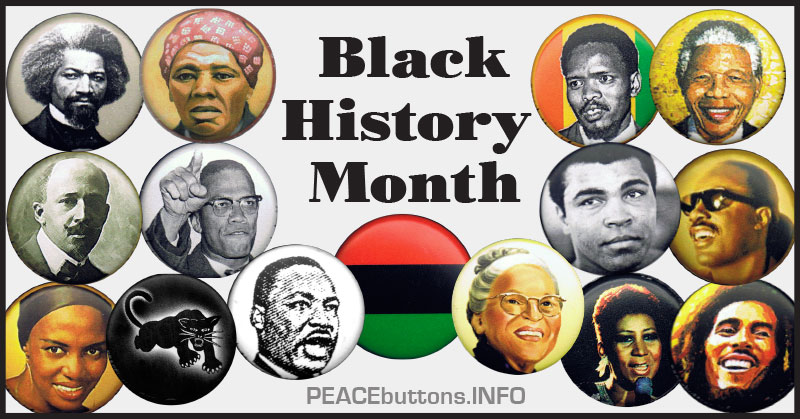
Beginning Black History Month 2026

So far, it’s not illegal for us to acknowledge that February is Black History Month, so here we are, doing just that. Ha! There is even some Black History for this very date in Peace and Justice History:

February 1, 1960

Greensboro first day: Ezell A. Blair, Jr. (now Jibreel Khazan), Franklin E. McCain, Joseph A. McNeil, and David L. Richmond leave the Woolworth store after the first sit-in on February 1, 1960.
Four black college students sat down at the Woolworth’s lunch counter in Greensboro, North Carolina, and were refused service because of their race. To protest the segregation of the eating facilities, they remained and sat-in at the lunch counter until the store closed.
Four students returned the next day, and the same thing happened. Similar protests subsequently took place all over the South and in some northern communities.
By September 1961, more than 70,000 students, both white and black, had participated, with many arrested, during sit-ins.


On the second day of the Greensboro sit-in, Joseph A. McNeil and Franklin E. McCain are joined by William Smith and Clarence Henderson at the Woolworth lunch counter in Greensboro, North Carolina.

“Segregation makes me feel that I’m unwanted,” Joseph McNeil, one of the four, said later in an interview, “I don’t want my children exposed to it.
Listen to Franklin McCain’s account of what happened 
February 1, 1961
On the first anniversary of the Greensboro sit-in, there were demonstrations all across the south, including a Nashville movie theater desegregation campaign (which sparked similar tactics in 10 other cities). Nine students were arrested at a lunch counter in Rock Hill, South Carolina, and chose to take 30 days hard labor on a road gang. The next week, four other students repeated the sit-in, also chose jail.

In light of current events, I thought it’d be good to review how Black History Month came to be. Below is a bit on its beginnings.

The History of Black History Month

Black History Month was first observed as Negro History Week in February 1926, but the inspiration for the commemoration began over a decade earlier through a steady stream of electrifying events, discoveries, and other celebrations of Black excellence. In 1915, American historian Dr. Carter G. Woodson attended the national celebration of the fiftieth anniversary of emancipation in Washington D.C. This event was widely attended and proved to be profoundly inspiring for Dr. Woodson who, later that year, joined forces with A. L. Jackson, William B. Hartgrove, George Cleveland Hall, and James E. Stamps to establish the Association for the Study of Negro Life and History, known today as the Association for the Study of African American Life and History ​(ASALH 2024)​. ASALH had the ambitious goal of educating the public about the achievements, inventions, and progress made by Black Americans, and though the Association’s intellectual efforts were remarkable – they began to publish The Journal of Negro History in 1916 and founded Negro History and Literature Week in 1924 – Dr. Woodson had a wider vision of his mission. Wishing to continue to discover and celebrate the history of the Black past, Dr. Woodson announced the celebration of Negro History Week through a press release. 

Accounts of the contributions of Black Americans were notably absent from history books, credited to white men, or omitted altogether. Progressive communities and schools were ripe for the rich history that Negro History Week offered. Matching the popularity of the week, Woodson and the Association established an annual theme for the celebration to guide and inspire educators. Weary of those simply wishing to capitalize on a popular event, “Woodson warned teachers not to invite speakers who had less knowledge than the students themselves” ​ (ASALH 2024)​. Additionally, ASALH expanded their offerings to provide study materials: pictures, lessons for teachers, plays for historical performances, and posters of important dates and people. This cemented the celebration of Black history in schools and communities, and Negro History Week grew in popularity throughout the following decades, with mayors across the United States endorsing it as a holiday. 

Negro History Week grew into Black History Month in 1970 under the leadership of Black educators and students at Kent State University and would become a federally recognized event six years later. President Gerald Ford recognized Black History Month in 1976 during the celebration of the United States Bicentennial. He urged Americans to “seize the opportunity to honor the too-often neglected accomplishments of Black Americans in every area of endeavor throughout our history” ​(Franklin 2022)​. Today, nearly one hundred years after that initial celebration, it is prudent to reflect on the designed purpose of Black History Month and discover that after all this time, these lessons are still relevant, inspiring, and necessary. As Dr. Woodson said, “Real education means to inspire people to live more abundantly, to learn to begin with life as they find it and make it better” ​(Woodson 1933)​. 

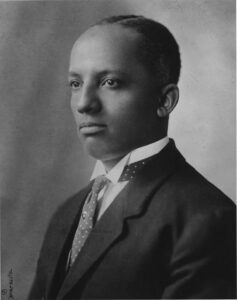
Pictured: Dr. Carter G. Woodson, The “father of Black history”

Photo Credit: Addison Norton Scurlock, Public domain, via Wikimedia Commons

​​Bibliography  

​​ASALH. 2024. The Founders of Black History Month: The Origins of Black History Month. December 18. Accessed January 16, 2025. asalh.org/about-us/origins-of-black-history-month/

​ASALH. 2024. Carter G. Woodson Timeline: ASALH – the Founders of Black History Month. December 19. Accessed January 16, 2025. asalh.org/carter-g-woodson-timeline/

​Franklin, Jonathan. 2022. Here’s the Story behind Black History Month – and Why It’s Celebrated in February. February 1. Accessed January 16, 2025. www.npr.org/2022/02/01/1075623826/why-is-february-black-history-month

​Woodson, Carter G. 1933. The Mis-Education of the Negro. Trenton: Africa World Press. 

==========

All right! So, we see that Black History Week then Month has been around for at least 20 years longer than our current POTUS, who seems to be ignoring the month’s existence. But, there’s no reason any of the rest of we the people have to! Including all history makes the US so much richer in knowledge. Most local historical and cultural organizations are going to have commemorations this month. What fun it will be, and how community-unifying for each of us to find an activity near us, and join in!