3 for Science on Labor Day

so I guess you may read them tomorrow, if you like. 😎

First, a tiny, acrobatic bug:

Biologists have studied an extreme gymnast of the animal kingdom, watching as it moves so quickly it appears to all but vanish.

The globular springtail (Dicyrtomina minuta) is a small but mighty bug that can backflip more than 60 times higher and 100 times longer than its own body length.

This tiny bug grows to only a couple of millimetres and can’t sting, bite, or fly its way out of danger. Instead, its preferred method of avoiding predators is to flip out so forcefully it seems to disappear! (snip-More on the page, with photos)

Next, a possible source of new antibiotics (and this brought Ten Bears to my mind, for some reason):

A study has found promising antibiotic candidates inside bacteria harvested from the deep Arctic Sea.

The research, by Finnish and Norwegian researchers, is published in Frontiers in Microbiology.

Antibiotic discovery has slowed in recent decades, which has exacerbated the risks of antibiotic resistance.

Most licensed antibiotics – about 70% – have been derived from a type of soil-dwelling bacteria called actinobacteria.

“For example, members of the Streptomyces genus produce several secondary metabolites, including clinically useful antibiotics such as tetracyclines, aminoglycocides and macrolides,” says corresponding author Dr Päivi Tammela, a professor at the University of Helsinki, Finland.

But soil isn’t the only place these bacteria can be found.

“Marine actinobacteria found in the sea, on the seafloor, or within the microbiome of marine organisms, have received far less attention as possible sources of antibiotics,” says Tammela. (snip-More on the page)

Then, an analysis for coal phase-out in Asia:

Countries in the Asia-Pacific region account for 76% of the world’s thermal coal power generation, and many of these plants will need to retire early to meet global emissions targets.

But according to a new analysis, it’s possible to phase these coal plants out and transition to renewable energy while investors still make money.

The study, done by Australian, Singaporean and Chinese researchers, is published in Energy Policy.

“There is a drive and interest from a number of different investors like the Asian Development Bank, but also private sector investors, to finance the early retirement coal fired power plants,” lead author Professor Christoph Nedopil Wang, director of Griffith University’s Asia Institute, tells Cosmos.

Nedopil and colleagues looked specifically at 6 Chinese-sponsored coal-fired power plants in Vietnam and Pakistan.

“With investors wanting to invest in, and ideally also providing lower cost financing for, green projects, refinancing of these coal fired power plants becomes possible at a lower cost,” says Nedopil.

The researchers modelled the future performance of these stations under a variety of financing and geoeconomic scenarios.

“That brought us to the conclusion that, depending on the age of the coal-fired power plant, we can retire these plants earlier than currently envisaged, while reducing the financing cost and therefore increasing enterprise value,” says Nedopil. (snip-More on the page)

I read about this young woman Saturday. You may be interested to read about her, too-

I do the free clicks on Free The Ocean, just to help make a dent in the amount of plastic in Earth’s oceans. The clicks are to answer trivia questions, and frequently I learn something, especially on days when I guess the answer. Yesterday’s (I had it up to post yesterday, too, but didn’t get it done until late) was about Autumn Peltier. I was interested, so I pulled up some more info on her, and she is post-worthy.

Free The Ocean tells us that “Autumn Peltier is a young Canadian activist known for advocacy for clean water and ocean protection. At the age of eight, she was inspired to make a difference. In the last 11 years, her voice has become powerful in the movement to protect marine environments and work toward a healthier planet for future generations.

Here is some biographical info. “Autumn Peltier is the chief water commissioner of the Anishinabek Nation, and a water-rights advocate and environmental activist.

“Peltier was born on September 17, 2004, in Wiikwemkoong Unceded Territory, Manitoulin Island, Ontario, Canada, and is a member of the Aniishnabek Nation.” There is more on the page, too.

An article from 2017 on CBC News tells us, “Even at the tender age of 12, Autumn Peltier speaks with the wisdom of someone much older.

“’I’m going to be an ancestor one day,’ says Peltier, from her home in Wikwemikong First Nation in northern Ontario. ‘I’m still going to have great-grandchildren on this land and I hope they are still able to drink the water.’

“Despite her youth, Peltier is already a veteran activist when it comes to the issue of clean drinking water — not just in First Nations communities, but across the country.

“’I do what I do for the water because water is sacred,’ says Peltier, who was honoured by the Assembly of First Nations as a water protector.

“Since water doesn’t have a voice, Peltier says she wants to lend hers to the cause. Even if that means taking on Prime Minister Justin Trudeau, as she did last December at the AFN’s annual winter gathering.”

There is even more information here, on CIWEM , the Chartered Institution of Water and Environmental Management. This one is current, with some family history. This is a remarkable young woman!

How Salamanders Skydive From the Tallest Trees in the World | Deep Look

When a hungry bird comes near them, wandering salamanders can jump off the tallest trees in the world, California’s coast redwoods, skydiving to a safe branch. Researchers decided to put them in a wind tunnel to investigate their daring moves in slow motion.

ABC’s Bird Library ›

Dovekie, “Little Auk”

  • Scientific Name: Alle alle
  • Population: Approximately 24 to 50 million
  • Trend:  Unknown, may be decreasing
  • Habitat: Breeds on rocky coastlines and islands; spends the rest the year at sea, often at the edges of pack ice.
Dovekie by Nick Pecker, Shutterstock
Dovekie
Dovekie on water. Photo by Lucas Liu, Macaulay Library at the Cornell Lab of Ornithology
Dovekie on water
Dovekie in winter plumage. Photo by Lillian Tveit, Shutterstock.
Dovekie in winter plumage
Dovekie egg hatching. Photo by Maximillian Cabinet, Shutterstock.
Dovekie egg hatching

You can see and hear more of this bird on the page. Take a look!

News for people who pay attention to storms

Hailstone library improves predictions of damaging storms

August 19, 2024 Imma Perfetto

Scientists have compiled a library of hailstones to help fine-tune hailstorm simulations and make weather forecasts more accurate.

To make calculations more simple, conventional scientific hailstorm modelling assumes all hailstones are perfectly spherical. In reality, they’re a little more complicated than that.

Photograph of a rough and bumpy hailstone being weighed on a scale
A hailstone, flecked with black paint to assist in 3-D scanning, is weighed as part of processing for the hail library. Credit: UQ

“Hail can be all sorts of weird shapes, from oblong to a flat disc or have spikes coming out – no two pieces of hail are the same,” says Dr Joshua Soderholm, honorary senior research fellow at University of Queensland and research scientist at the Bureau of Meteorology in Australia.

In their new study in the Journal of the Atmospheric Sciences, Soderholm and collaborators explored whether compiling a reference library of non-spherical, natural hail shapes could change the outcomes of hailstorm modelling.

“Our study used data from 217 hail samples, which were 3-D scanned and then sliced in half, to tell us more about how the hailstone formed,” says Soderholm.

“This is effectively a dataset to represent the many and varied shapes of hailstones.”

According to lead researcher Yuzhu Lin, a PhD candidate at Pennsylvania State University in the US, the differences were dramatic.

“Modelling of the more naturally shaped hail showed it took different pathways through the storm, experienced different growth and landed in different places,” she says.

A photograph of a man wearing a grey beanie photographing a hailstone
Dr Joshua Soderholm photographing a hailstone. Credit: UQ

“It also affected the speed and impact the hail had on the ground. This way of modelling had never been done before, so it’s exciting science.”

While the modelling is currently only used by scientists studying storms, Soderholm says the end game is to be able to predict how big hail will be and where it will fall in real-time.

“More accurate forecasts would of course warn the public so they can stay safe during hailstorms and mitigate damage,” he says.

“But it could also significantly benefit industries such as insurance, agriculture and solar farming which are all sensitive to hail.”

Scientists saved crocs from cane toads by making them sick

August 17, 2024 Imma Perfetto

https://cosmosmagazine.com/australia/scientists-saved-crocs-from-cane-toads-by-making-them-sick/

(I know cane toads are an abhorrent, invasive species, being moved [by humans!] from their original place on the planet to another place, to try to control another species. However, there is a YA novel about cane toads that ended up being a “banned book” one year. The then-kid was really into banned books, so we bought it, and it was a bit of a tear-jerker and I have a tiny soft spot for them, since it wasn’t their faults they got transplanted; they were only doing the best they could. Anyway, here’s this.)

Scientists have successfully saved freshwater crocodiles from toxic cane toads invading northern Australia with an unusual new tactic – doctored cane toad carcases.

By teaching freshwater crocodiles (Crocodylus johnstoni) to associate cane toads (Rhinella marina) with a bout of food poisoning, they reduced death rates by at least 95%.

Across the dry season (May to October) between 2019 and 2022, Macquarie University scientists worked on the project with Bunuba Indigenous rangers and the Department of Biodiversity, Conservation and Attractions (DBCA) in Western Australia.

They collected cane toads, removed the poisonous parts, and injected the bodies with a nausea-inducing chemical that caused the crocs eating them to feel temporarily sick.

A black and white photograph of a crocodile sticking its head out of the water. It is about to eat a piece of meat hanging from a stick next to the shoreline
Freshwater crocodile taking doctored cane toad bait. Credit: Georgia Ward-Fear

It’s a behavioural ecology method known as conditioned taste aversion, and it worked remarkably well.

“The first three days we noticed the crocodiles were taking the cane toads, then they would go away,” says Bunuba ranger coordinator Paul Bin Busu, whose team set up hundreds of bait stations across 4 large gorge systems in the Kimberley region of north-western Australia.

The doctored cane toads were deployed alongside chicken meat control baits to monitor the effectiveness of the training.

“Then we noticed they would smell the cane toad before eating, and on the last day we noticed that it was mostly the chicken necks getting eaten,” says Bin Busu.

The team used nocturnal ‘spotlighting’ surveys and remotely triggered wildlife cameras to monitor crocodile and toad numbers following the intervention.

“Our baiting completely prevented deaths in areas where cane toads were arriving and decreased deaths by 95% in areas where toads had been for a couple of years,” says Macquarie’s Dr Georgia Ward-Fear, who is lead author of the report detailing the findings in Proceedings of the Royal Society B.

A black and white photograph of a crocodile sticking its head out of the water. It is about to eat a piece of meat hanging from a stick next to the shoreline
Freshwater crocodile taking doctored cane toad bait. Credit: Georgia Ward-Fear

Ward-Fear says these effects continued in the years following.

Some populations of freshwater crocodiles in tropical Australia have fallen by more than 70% due to ingesting cane toads.

“Freshwater crocs can be heavily impacted as their river systems dry out during the late dry season,” says Ward-Fear.

“They end up congregating in large numbers with very little food, and as toads begin to use these waterbodies for rehydration, the two come into contact and we see large numbers of crocodile deaths over a few months.”

Now, conditioned taste aversion interventions can be planned both ahead of and behind the cane toad invasion front in areas with similar ecology.

Starry, Starry Nights at Dark Sky Preserves

Dark sky tourism is on the rise as travelers head to remote destinations to catch a glimpse of the dazzling night sky.

Crai S. Bower

Some time ago, many animals, including saber-toothed tiger and woolly mammoth, failed in their attempts to rid the community of grizzly bear, whose mean-spirited behavior had upset nature’s balance. That is until the birds, led by robin, pierced grizzly’s heart. Grizzly’s blood reddened the robin’s breast and, as he shook in pain, cloaked the autumn leaves in red and orange.

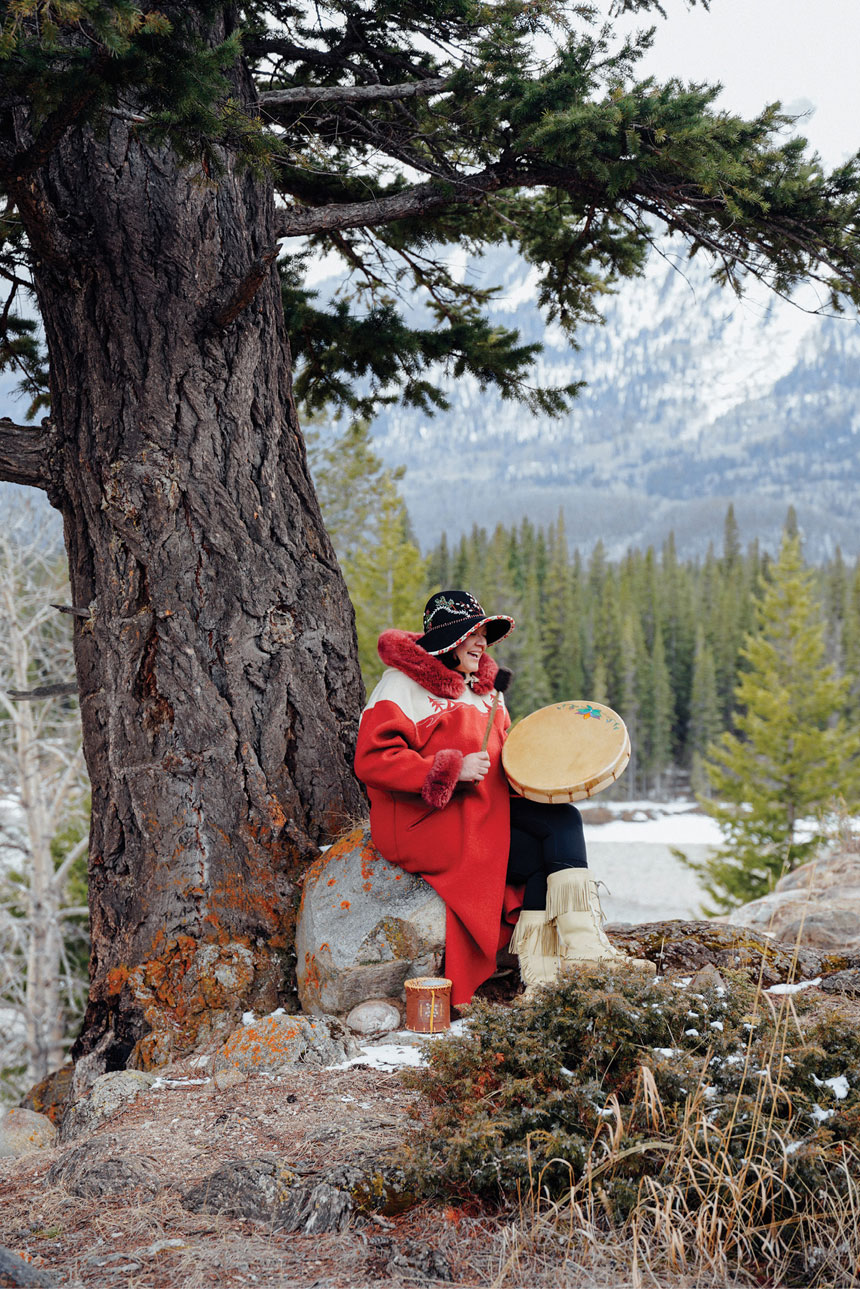
“The Creator placed the grizzly bear constellation in the night sky to remind us that bullying others carries consequences,” says Matricia Bauer, an Indigenous Knowledge Keeper from Sturgeon Lake Cree Nation. “Our creation story also tells of the star woman falling from the sky to become our people.”

It’s a brisk March evening, and I’m sitting with Bauer by the fire beside Beauvert Lake in Jasper, Alberta, waiting for the gunmetal-colored sky to darken and reveal a palette of seemingly infinite stars. I’m visiting to explore the most accessible and second-largest Dark Sky Reserve in the world.

Shining star: Matricia Bauer, Indigenous Knowledge Keeper from Sturgeon Lake Cree Nation, leads Warrior Women, a collective presenting cultural education through drum and song. (Courtesy Tourism Jasper)

“An elder taught me that when you used to look at the night sky and see all the stars, the Creator also looked down on Earth and saw our fires in reflection. Today, instead of fires sparkling across the landscape, our continents are outlined by the glare of artificial light. People must travel to find the night sky.” (snip-MORE )

Here’s a meme from email

How pit bulls got a bad reputation

Why do so many people think pit bulls are violent?

Like a walk in the park