Stonehenge’s 6-tonne Altar Stone was transported from Scotland
August 15, 2024 Evrim Yazgin
How was Stonehenge built in ancient Britain 5,000 years ago?
New evidence suggests the Late Stone Age people who made the colossal structure would have to have used advanced transport methods to move the stones even further than previously thought.
The Altar Stone at Stonehenge circled in black. Credit: English Heritage.
According to English Heritage, the largest stones – called sarsens and weighing up to 30 tonnes – are believed to have been transported from Marlborough Downs, about 32 kilometres away from the site.
The smaller stones weigh less than 10 tonnes. They were thought to have all come from the Preseli Hills in Wales more than 200km away. Transporting these gigantic stones this far would have been a monumental feat for ancient people in Britain.
But new research published in the journal Nature suggests that one stone, the 6-tonne Altar Stone, has its origins even further afield in Scotland.
The Altar Stone, seen here underneath two bigger Sarsen stones. Credit: Professor Nick Pearce, Aberystwyth University. (snip-More)
Gary Baker with the solvent. Credit: Sam O’Keefe/University of Missouri
US researchers have made substances that can extract nanoplastics from water.
The solvents, made from non-toxic components, could remove 98% of the tiny plastic particles from water in a lab environment.
The team has published its research in ACS Applied Engineering Materials.
“Our strategy uses a small amount of designer solvent to absorb plastic particles from a large volume of water,” says corresponding author Gary Baker, an associate professor at the department of chemistry in the University of Missouri-Columbia. (snip-More)
Scientists have made an unexpected discovery in a thousand-year-old abandoned fortress in Mongolia.
Buried in the walls of the fortress is the grave of an elite woman who pre-dates the rise of the founder of the Mongolian Empire, Genghis Khan (also known as Chinggis Khan). The frontier fortress is about 1.4 km west of Khar Nuur lake in eastern Dornod province of Mongolia, only kilometres from the Chinese border.
Khar Nuur lake. Credit: Tuul & Bruno Morandi / The Image Bank / Getty Images Plus.
Genghis Khan rose to prominence in 1206 CE. Before that, the Kitan-Liao Empire controlled great swaths of land between 916 and 1125 CE.
The period between these great dynasties is poorly understood as very few records survive. (snip-More)
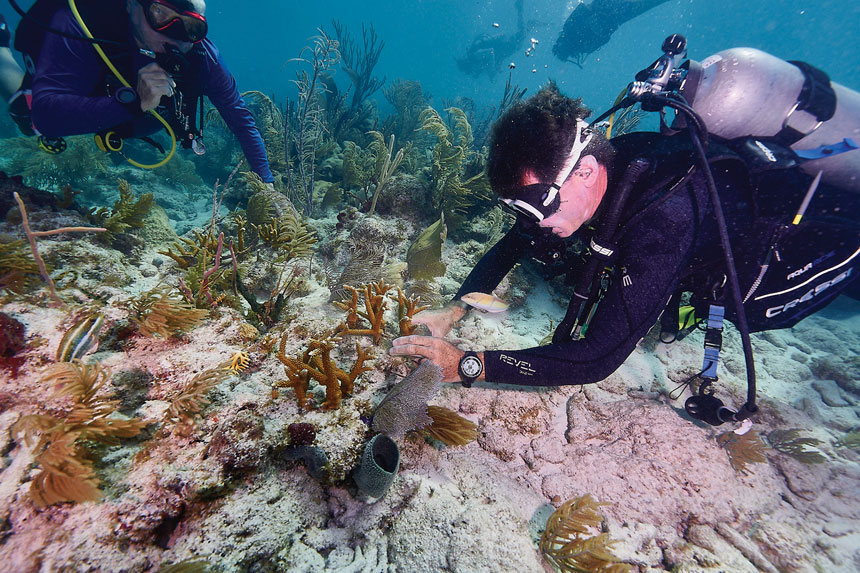
Thirty years ago, when Michael Goldberg would dive in the glimmering blue water of the British Virgin Islands, the reefs were teeming with life. “The expanse of these reefs was astounding,” says Goldberg, a cofounder of I.CARE, a Florida-based reef restoration organization. “The corals were so thick and lush.”
Today those reefs are dying. In much of the Atlantic Ocean, including the Florida Keys, where the 61-year-old Goldberg lives, roughly 70-95 percent of the coral is gone, devastated by disease, rising sea temperatures, and other existential threats.
By 2015, as the reefs declined, Goldberg faced a decision. He would either leave the scuba industry — since 2004, he has owned Key Dives, which provides diving and snorkeling on the Keys’ Islamorada reefs — or take action to restore the coral. Fortunately for Florida, the ocean, and humanity, he chose the latter.
In 2019, Goldberg cofounded I.CARE (Islamorada Conservation and Restoration Education). The mission: To restore and maintain Islamorada’s reefs by teaming with local businesses, residents, and visitors, including local dive shops and recreational divers. Activities range from underwater trash clean-ups — since 2021, divers have lugged 20,000 pounds of debris to the surface — to coral transplants. Over the past three years, I.CARE has planted over 15,000 corals on six different reefs.
The need is urgent. Coral reefs provide food and shelter to thousands of organisms — crustaceans, fish, anemones, sponges — and protect shorelines from storms and erosion. The reefs’ economic benefits include tourism and commercial and recreational fishing. Coral has even been used in medical technologies such as “bone grafting techniques and possible treatments for diseases including Alzheimer’s and cancer,” I.CARE notes.
“I love educating people about the importance of this, but the most gratifying thing for me is seeing the coral grow,” Goldberg says. “I love seeing little baby corals thrive in a harsher environment than I ever imagined, and knowing that despite all the challenges, we’re seeing success.”
Goldberg’s career initially focused on money management rather than ocean management. His love of the water began when he was a boy in Los Angeles, but his family moved to Chicago when he was 10, and he later studied finance at Northern Illinois University. On a summer trip to Acapulco, he dove for the first time, purely, he says, “as a lark.”
“Someone got me some gear, and I wasn’t certified, and I didn’t know what I was doing,” he says. Acapulco is not known for stellar diving experiences, but he loved it: “I was just so enamored with being underwater.”
After that, he was hooked. He earned his diving certification and then moved back to one of L.A.’s beach communities and became an instructor. Before long, he and his wife decided to move to the British Virgin Islands. Eight years later, the couple returned to the United States and opened Key Dives in Islamorada.
Hope and water: “If I wasn’t optimistic, I wouldn’t keep doing this,” says I.CARE cofounder Michael Goldberg. (Photo courtesy Michael Goldberg)
Goldberg has made over 10,000 dives, swimming not only with dolphins and schooling sharks, but within 15 feet of a humpback whale as it breached. And yet the vast coral reefs have always intrigued him most, whether diving alone or taking clients off the island of Virgin Gorda in the British Virgin Islands.
“There was this one unique piece of coral that I would swim underneath — it was like a tree,” he says. “Most people want to see fish, but to me, that coral was always the highlight of the dive.”
In 2017, Goldberg met Kylie Smith, who was working on her Ph.D. at Clemson University and studying coral in the Florida Keys. Smith would fill her tank at Key Dives, and Goldberg, who was “already shifting my business toward conservation,” would tap into her aquatic expertise.
“When I met Dr. Smith, I would pepper her with questions — she couldn’t walk in my store and leave in quick fashion,” Goldberg says. Their discussions eventually moved from the dive shop to a beer garden at The Florida Keys Brewing Company. “We would sit and chat, and I kept saying to her, I’ve got an idea to empower recreational divers so that they can become citizen scientists — not only because they want to be part of the solution, but because they need to be a part of the solution. That’s the largest potential boots-on-the-ground army that can enact so much of what we do.”
Those discussions led them to co-launch I.CARE. By January 2021, volunteer divers had transplanted I.CARE’s first corals.
For the coral restoration, divers use coral raised in nurseries. Once it’s planted on the reefs, the coral will, hopefully, reproduce into a coral colony — but the process is slow. It can take 20-50 years for coral to grow large enough to spawn.
To speed up reproduction, I.CARE uses a process called micro-fragmentation. Larger corals are cut into thumbnail-size pieces and grown in a nursery. When those pieces grow to about the size of a 50-cent piece, they are planted edge to edge on a living coral structure. After a few years, the coral fuse to become one larger coral, and they’ll start to spawn in about 7 to 10 years.
For the micro-fragmentation work, I.CARE rescues coral that has broken free from the main reef structure due to storms and substrate erosion.
“What is cool about these corals is that these are the survivors. They are the most resilient, the ones that have persisted despite all the disease and heat,” says Goldberg. “It’s survival of the fittest in the truest sense, and the ones we are using to rebuild our precious reefs.”
Despite the advances, the challenges are huge, both for I.CARE and the planet. During the intense heat of summer 2023, most of I.CARE’s seemingly healthy coral fragments died at one of Goldberg’s favorite reefs. “I cried underwater,” he admits. But he prefers to focus on the organization’s victories. Seventy-seven of the fragments survived and are thriving.
“If I wasn’t optimistic, I wouldn’t keep doing this,” he says. “We’ve had successes, and we can build on those successes.”
When it comes to restoring the reefs for future generations, he offers a simple vow: “We’re not gonna give up.”
Ken Budd has written for The Washington Post, The Atlantic, The New York Times, National Geographic Traveler, and many more. He is the author of an award-winning memoir, The Voluntourist.
This article is featured in the July/August 2024 issue of The Saturday Evening Post.
In a small town in the old west, a lone and weary gunfighter enters a saloon. As he walks through the room surrounded by the people of the town, a voice begins narrating the scene, telling us exactly who this gunfighter is. But unlike every classic western to use the narrator trope, the characters in this film can hear the voice. This omniscient narrator quickly begins divulging the deepest, darkest secrets of the people in the saloon. He exposes infidelity, homosexuality, prejudice and even a bit of bestiality. As the story unfolds it becomes evident that the voice is a bloodthirsty bastard that wants nothing more than to see the people of the town kill each other in a needless gunfight.
C’mon-we all at least wanted to drink pop this way when we were young. Heck, I have days I’d like to do it now! Not to mention the joy of being a hummingbird-enjoy.
Calvin and Hobbes by Bill Watterson for August 12, 2024
I subscribe to their newsletter because I love birds, but I don’t know a lot about them as to ID’ing them, their calls, etc. I love how birds simply keep on keeping on, not seeming to worry about much. Enjoy, if you like; there is lots of info, photos, and you can listen to calls. And more!
The Earthlings arrived unannounced, entered without knocking, removed their shoes and began clipping their toenails. They let the clippings fall wherever. They sighed loudly as if inconvenienced. We were patient. We knew our guests were in an unfamiliar environment; they needed time to adjust. For dinner, we prepared turkey meatloaf with a side of cauliflower. This is too dry, they said. This is not like what our mothers made. We wanted to offer a tour of our world, demonstrate how we freed ourselves from the prisons of linear time. But the Earthlings were already spelunking our closets, prying tools from their containers and holding them to the light. What’s this? they demanded. What’s this? What’s this? And what’s this? That’s a Quantum Annihilator; put that down. That’s a Particle Grinder; please put that down. We could show you how to heal the sick, we said. We could help you feed every nation, commune with the all-seeing sentient energy that palpitates through all known forms of matter. Nah! they said. Teach us to vaporize a mountain! Teach us to turn the moon into revenue! Then the Earthlings left a faucet running and flooded our basement.
Australian researchers have equipped sea lions with underwater cameras to map previously unexplored areas of the ocean floor.
In Australia – and the world – ocean seabeds and the surrounding benthic habitats remain shrouded in mystery. Remotely operated robots can gather ocean floor data, but they are expensive, require certain weather conditions and are difficult to operate in remote, offshore areas.
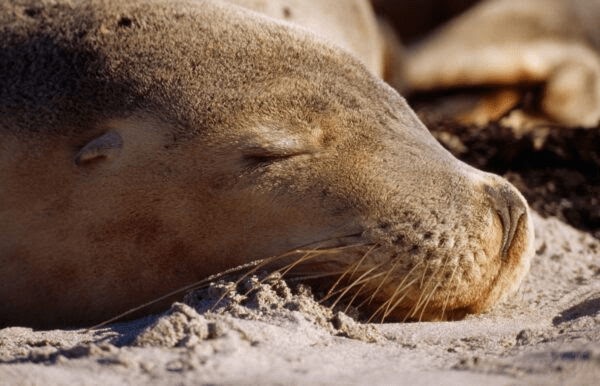
To overcome these challenges, the research team glued GPS units and lightweight cameras on Australian sea lions (Neophoca cinerea). These fast-swimming predators forage in several different benthic habitats, allowing the researchers to model over 5,000 square kilometres of ocean floor.
The results are published in Frontiers of Marine Science.
The eight enlisted sea lions came from the Olive Island and Seal Bay colonies on the coast of South Australia.
“We deployed the instruments on adult females so we could recover the equipment a few days later when they returned to land to nurse their pups,” explains first author Nathan Angelakis, a PhD student with The University of Adelaide and the South Australian Research and Development Institute.
The sea lions collected 89 hours of recordings in total, from which the researchers identified six distinct benthic habitats: macroalgae reef, macroalgae meadow, bare sand, sponge/sand, invertebrate reefs and invertebrate boulder.
The researchers then used machine learning models to predict the habitat type in nearby areas of continental shelf.
“The sea lions from both locations covered quite broad areas around the colonies. In our calculations, we kept the area in which we predicted habitats small to maximize the precision of our predictions,” said Angelakis. “This allowed us to model benthic habitats across more than 5,000 square km of the continental shelf.”
The findings have conservation implications for the endangered sea lion and for other benthic species that rely on these habitats.
“These data are useful both for mapping critical habitats for an endangered species such as the Australian sea lion, and more broadly, for mapping unexplored areas of the seabed,” said Angelakis.
“Phosphorus is a common component in the cathodes of lithium-ion batteries – specifically, lithium iron phosphate batteries, which represent about 60% of the lithium-ion market according to the researchers.
“As an important ingredient in fertilisers and industrial chemicals, mineral phosphorus is in high demand. Mining stocks of phosphorus are expected to be depleted in the next 50-100 years.
“But, point out the researchers, more than 250,000 tonnes of phosphorus pollutes Chinese wastewater every year, coming from food consumption and chemical waste. This is more phosphorus than the amount consumed each year to make batteries.” (snip)
“The researchers used their wastewater-derived mixture to build small lithium-ion batteries in the lab. These batteries could charge and discharge at the rates needed for electric vehicles and large-scale storage systems, and they kept 99.2% of their capacity after being charged and discharged 100 times.
“Batteries made with higher doses of the wastewater material performed better than batteries made with lower doses. The researchers believe that impurities from the sludge helped to stabilise the batteries, allowing them to perform better.
“’The amount of phosphorus recovered from municipal wastewater is projected to be sufficient to meet up to 35% of the phosphorus demand by the lithium-ion battery industry in China, enhancing the cost-effectiveness of phosphorus recovery and alleviating the global shortage of phosphorus resources to achieve both clean energy and sustainable development,’ conclude the researchers in their paper.”
“In the last few years, Australia has faced both flooding rains and some of the lowest rainfall on record. Now, researchers from the Chinese Academy of Sciences have the data that explains why rain in Australia has seemed so unpredictable.
“The researchers have shown that human-induced climate warming is driving increases in rainfall variability over 75% of the Earth’s land, and they say the effects are especially prominent in Australia.
“The study looked at increases in rainfall variability, which can mean wetter wet periods and drier dry periods. They found that daily variability has increased by 1.2% per decade globally, and that humans are largely to blame.
“’The increase in rainfall variability is mainly due to anthropogenic greenhouse gas emissions, which have led to a warmer and more humid atmosphere,’ said Dr Zhang Wenxia, lead author of the study.
“’This means that even if the atmospheric circulation remains the same, the additional moisture in the air leads to more intense rain events and more drastic fluctuations between them.’
“Professor Steven Sherwood at the UNSW Climate Change Research Centre, who was not involved in the study, told the AusSMC that this means rainier rainy periods and drier dry periods.
“’This is going to increase as global warming continues, enhancing the chances of droughts and/or floods.’
“The paper identified Australia as being a particular hotspot for rainfall variability. Dr Milton Speer from the University of Technology Sydney said the paper’s findings are significant, and that other recent studies have had similar conclusions.” (snip-More)




 Scottie's Playtime