if we all click our heels together three times, everything will be okay Read on Substack (Language NSFW, as always with Jeff Tiedrich’s writing)
the worthless scribblers of the corporate-controlled media utterly failed us during the 2024 campaign season.
New York Times executive editor Joe Kahn came right out and said it: defending democracy is a ‘partisan act,’ and we won’t do it — and, fuck us all, the press kept their word, and didn’t do it. they enthusiastically put their fingers on the scale for Donny Convict.
arguably, the media’s worst transgression was the sanewashing — the cleaning-up of Donny’s incomprehensible blitherings, to hide his obvious cognitive disintegration and make him sound coherent.
a minutes-long disjointed word-salad about how tariffs on Chinese goods were going to lower the cost of childcare became “a major economic speech.”
Donny’s inability to keep his increasingly-demented mind on the topic at hand — his crazypants pinballing from they’re eating the dawgs to Hannibal Lecter wants to have you for dinner to would you rather be eaten by a shark or electrocuted — was explained away by Donny as his brilliant “weave.”
[Wishcasting is] the act of interpreting information or a situation in a way that casts it as favorable or desired, despite the fact that there is no evidence for such a conclusion; a wishful forecast.
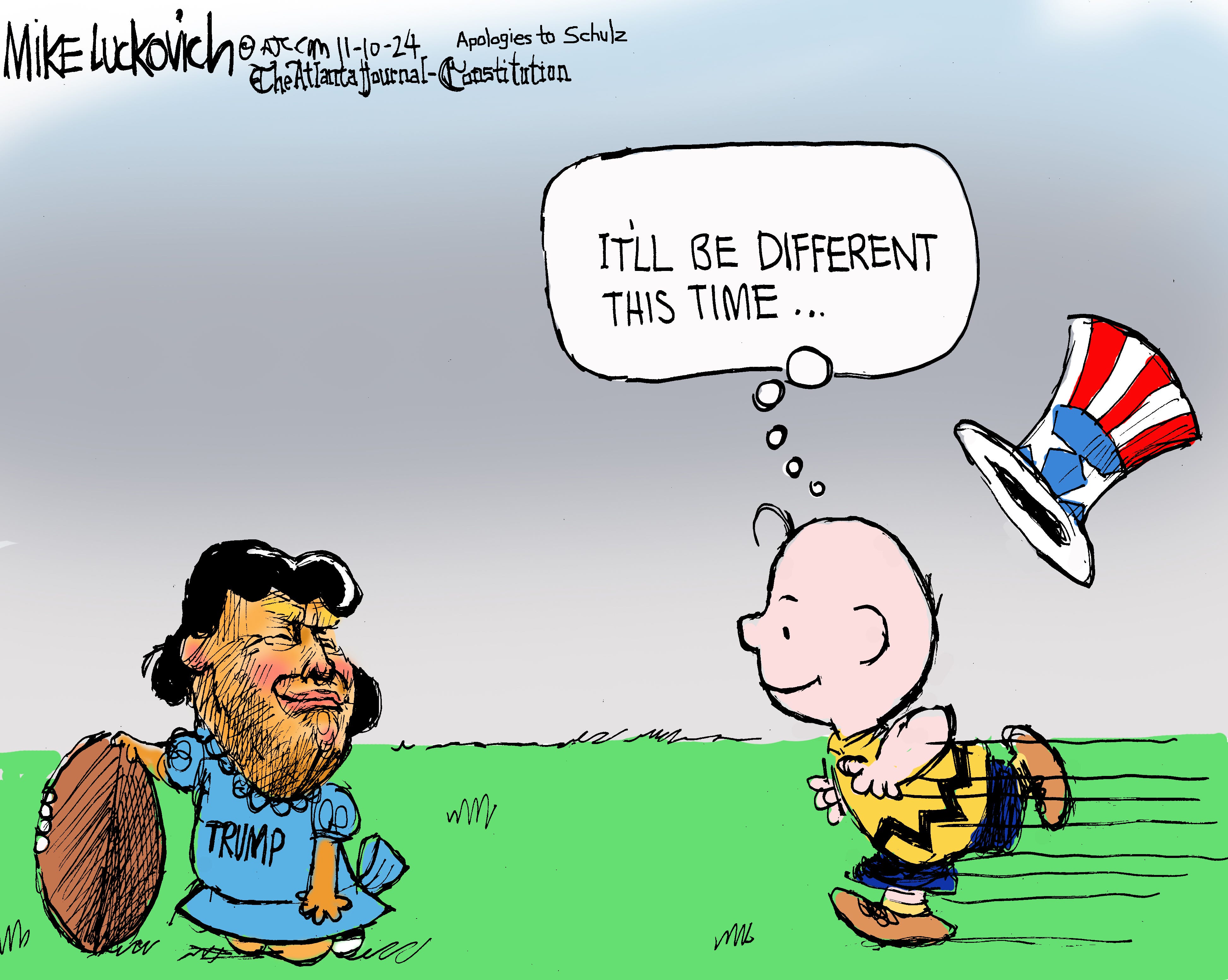
sure enough, the media has now gone into overdrive, churning out piece after piece in which they promise us that if we all click our heels together three times, everything will be okay.
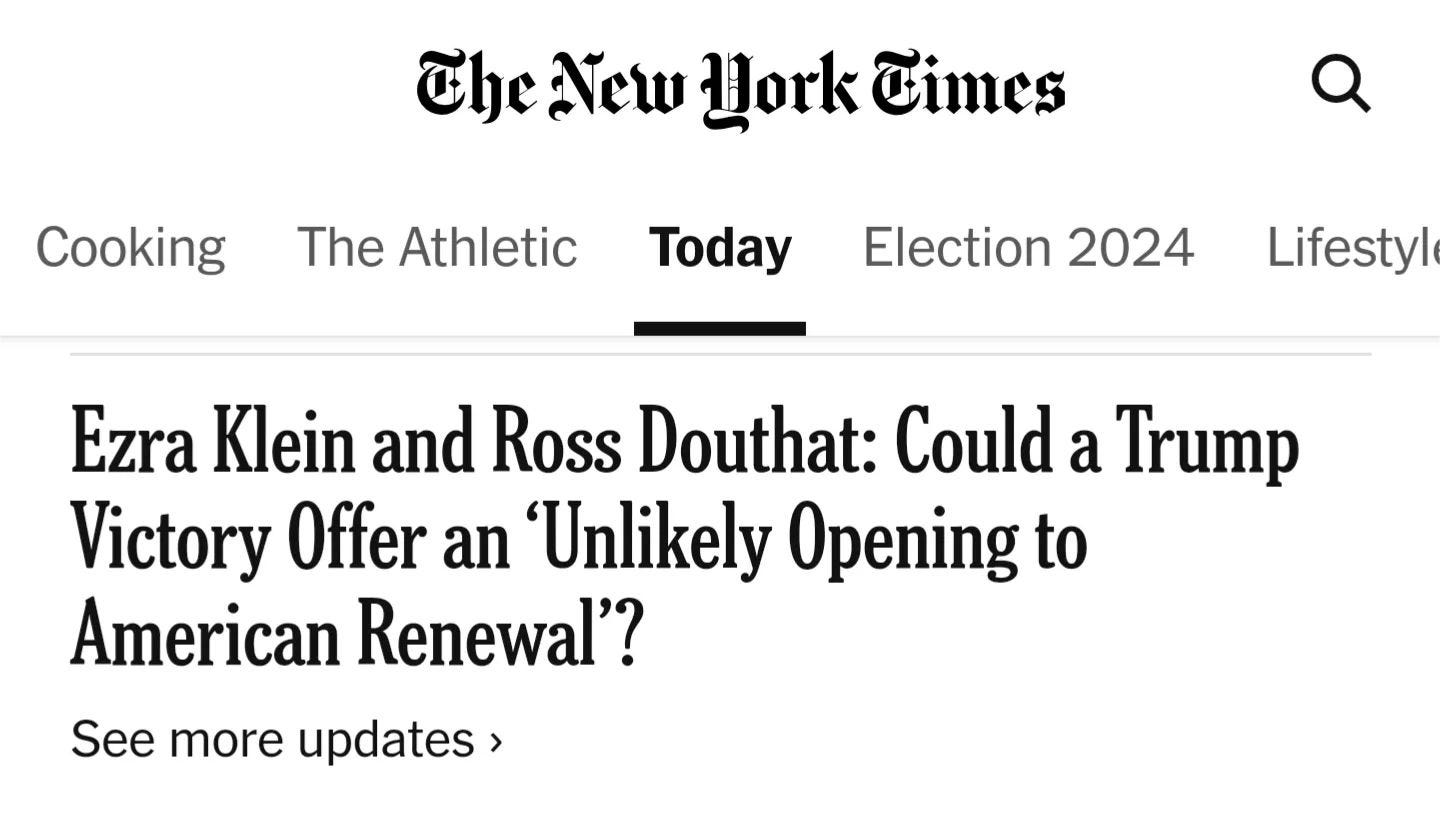
not twelve hours after the election had been called for Donny, the Times wasted no time in assuring us that the election of a vindictive fascist is an amazing opportunity for vindictive fascism not to happen.
what kind of magical, everybody-gets-a-pony thinking is this? just fucking stop it.
did Ezra Klein and Ross Douthat both experience some kind of recent head trauma that has caused them to forget the years 2017 through 2020? Donny’s first presidency was a dumpster fire of corruption, mismanagement and mass death — but somehow now, given a second chance to fuck shit up worse, Donny’s going to bring us an “American renewal”?
anything’s possible, right? overnight, Donny Convict could magically become a wise and fair statesman — also, technicolor pigs could fly out of my ass.
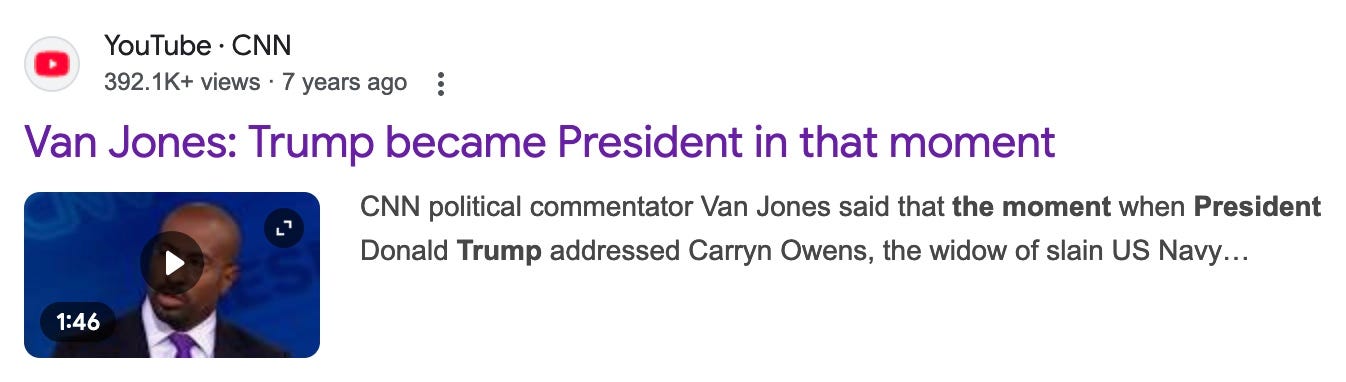
oh my god, the media never stops imagining that Donny is going to somehow become presidential. during his first term — over and over — every time Donny stopped short of taking out his dick and pissing on the floor, the press would fall all the fuck over itself in a mad dash to proclaim him presidential.
spoiler alert: Donny never became presidential. not from the the first time he threw a ketchup-hurling tantrum in the White House, to the moment he absconded back to his Florida golf motel, taking with him boxes of stolen classified documents.
the premise here is that if we’re respectful to Donny — if we fucking kowtow to him, and stop opposing him — he’ll be nice to us in return. he’ll become — dare I say it? — presidential.
Stop indulging the fantasy that outrage, social stigma, language policing, a special counsel, the Twenty-Fifth Amendment, or impeachment will disappear him. And stop talking as if normal political opposition is capitulation.
Everyone should normalize Trump. If he does something good, praise him. Trump is remarkably susceptible to flattery.
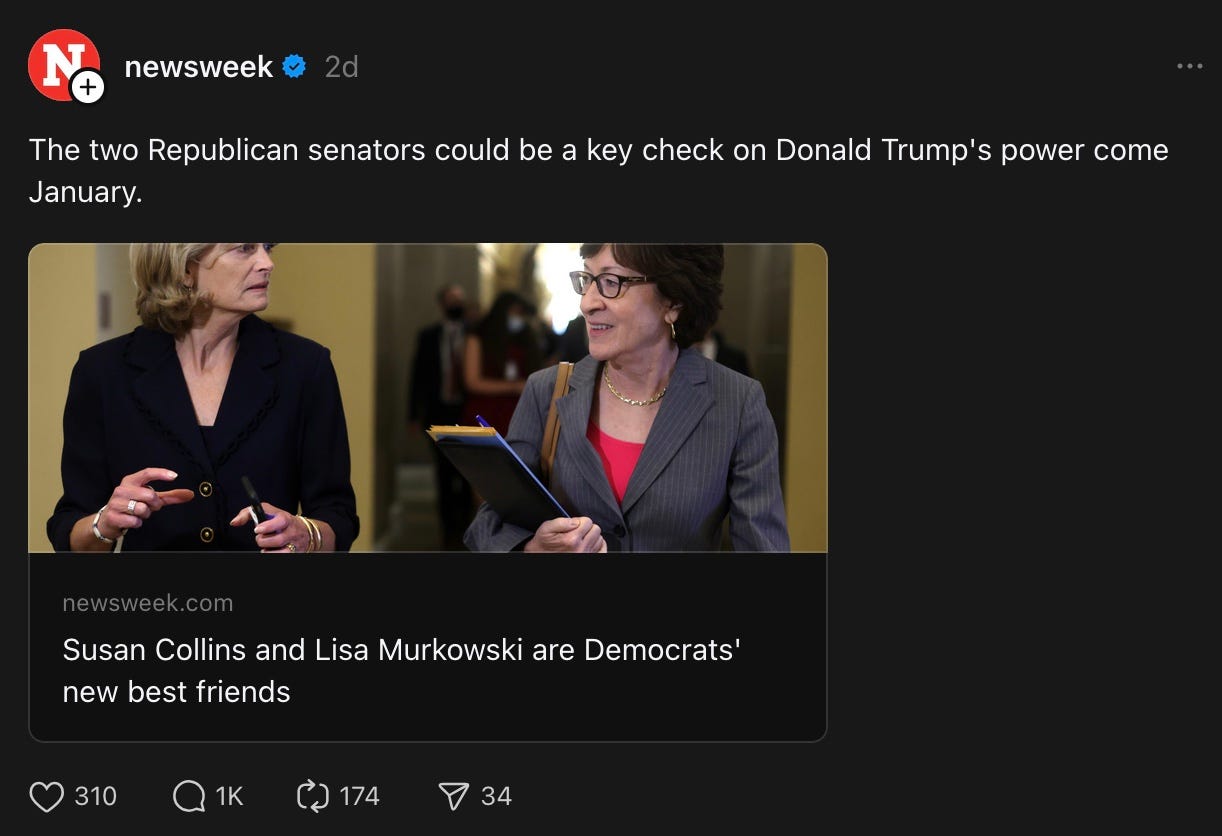
okay, I will grant that Newsweek may be half right. Lisa Murkowski seems to genuinely loathe Donny, and we can probably count on her to vote against the worst of his fuckery — but Susan Collins? the credulous naïf who assured us over and over again that Donny had learned his lesson, and would never transgress again?
now, let’s bask under some rays of hope from people who aren’t just blindly wishcasting, but are actually offering reasoned arguments.
in the middle of a fairly clear-eyed assessment of the Trumpian horrors to come, the Guardian gives us this:
Elaine Kamarck, a former official in the Bill Clinton administration, said: “For him to expand presidential power, Congress has to give up power and they’re not in the mood to do that. They’ve never done that. There are plenty of institutionalists in Congress.”
Kamarck also expressed faith in the federal courts, noting that judges appointed by Trump only constitute 11% of the total placed on the bench by former presidents. A Trump dictatorship is “not going to happen,” she added. “Now, there might be things that the president wants to do that people don’t like that the Republican Congress goes along with him on but that’s politics. That’s not a dictatorship.”
Paradoxically, however, Trump’s reckless venality is a reason for hope. Trump has the soul of a fascist but the mind of a disordered child. He will likely be surrounded by terrible but incompetent people. All of them can be beaten: in court, in Congress, in statehouses around the nation, and in the public arena. America is a federal republic, and the states—at least those in the union that will still care about democracy—have ways to protect their citizens from a rogue president. Nothing is inevitable, and democracy will not fall overnight.
Americans cannot vote themselves into a dictatorship any more than you as an individual can sell yourself into slavery. The restraints of the Constitution protect the American people from the unscrupulous designs of whatever lawless people might take the reins of their government, and that does not change simply because Trump believes that those restraints need not be respected by him. The Constitution does not allow a president to be a “dictator on day one,” or on any other day. The presidency will give Trump and his cronies the power to do many awful things. But that power does not make them moral or correct.
I sure hope to fuck they’re right.
This is going to be my closing message for the foreseeable future:
practice self-care. do what you need to do to keep sane. if that means disengaging with my daily posts for a while, I get it. this community of ours will still be here when you return.
to all the people who have signed on in the days since the election, welcome aboard. settle in as we all try to deal with the shitfuckery that’s ahead of us.
we are all in this together, and we are all here for each other.
Also, a question. On Kids Baking Championship, one of the items required is a chocolate-dipped item. One young baker decided to use butterscotch instead of chocolate. They tempered it, they dipped their item, and presented it. When asked about it, since it wasn’t chocolate, they stated that their technique was the same, and the item was dipped; also, that the butterscotch right there among the chocolate in the same area of the pantry.
So. While chocolate is not butterscotch and vice-versa, does this item count as a chocolate-dipped item? Discuss in comments.
Calvin and Hobbes by Bill Watterson for November 08, 2024
Lovable policy dork and new US Congresswoman Sarah McBride gives a hug to the kid who stole my pink unicorn dress. Yes, I will sue.
How do you do, fellow Wonks! It is I, your friendly neighborhood trans woman who is happy about a thing!
What? What is with those faces? Did something bad happen? No matter! For it is my job to give you the good news, with a spring in my step and a song in my heart and I am going to fucking do that because it is my job, melonfuckers, and I will not neglect my professional duty to be happy about a happy thing. Or three!
Yesterday, for those not in the know, the United States had an election. And during this election the transgenders worked their genderqueer asses off, not only running for election to the local sixth-grade softball team but also to at least 35 political positions around the country. And while we here at Wonkette salute every single one of those eager beavers, a couple stand out for their prominence and their victories.
No trans star shines brighter in, lo, these early morning hours as I write you this, than Sarah McBride. While McBride was not the first trans person to be elected to any ol’ thing, she was not elected to any ol’ thing. She was elected to the actual Congress of the US America. That’s right! We’re talking about the very same federal legislature made famous in Schoolhouse Rock’s song “I’m Just A Bill.”
This is not particularly surprising, as like some San Franciscans we could name, she was very well qualified for the position she sought. Before coming out or even turning 20 years old she worked as a junior staffer for Delaware Governor Jack Markell’s campaign in 2008 and Attorney General Beau Biden’s campaign in 2010. Next she lobbied for adding gender identity to Delaware’s equal protection law and interned at the White House in 2012 before graduating from college. She was on this shit young, I tell ya. And after she came out that year, her story was featured on American University Radio (later rebroadcast on NPR) including an anecdote about Beau telling her that after coming out she “was still part of the Biden family.”
After graduating she went to work as an activist with Equality Delaware and used her relationships to help pass positive bills before she became the first ever out trans speaker at a major party political convention in 2016 — something she’s sure as hell going to do again now. She then went on to write a book (foreword by some dude named “Joe Biden”), work for the Human Rights Campaign as their spokesperson, and then spend the most recent four years representing 50,000 Delawareaniteishers in the state Senate.
With her resumé and the Blue-leaning makeup of the state electorate, she had this. And it showed both during her campaign and in her 57/42 victory. (Which won me five bucks.) And now she’s going to Congress to make sure that Republican dickweasel bigots have to look a trans person in the eye as they ban driving through McDonalds while trans or whatever evil-ass bill they’re proposing next January. She lists her top two priorities as universal healthcare and reproductive rights, with other big ticket items like the John Lewis Voting Rights Act, the union-friendly PRO Act, curbing climate change, ending mass incarceration and more. She sounds too good to be true, but she’s real and she’s going to be kicking Matt Gaetz ass in just eight weeks.
Still convinced there’s a catch? Like maybe she’s great but replaced someone greater? Worry not: The woman she’s replacing is now your new US Senator from Delaware Lisa Blunt Rochester, making all kinds of demographic firsts from a state previously obsessed with sending only white men to the Senate but which has now elected a Black woman 56/39/4.
Yeah, we could use a lot more Delawares right now.
But if you’ll excuse Hawaii for not being Delaware, there’s also some good shit doing down on the islands. Over the last few decades indigenous Hawaiians have become homeless at a horrible rate — yes, this started long before Lahaina burned to the ground. The primary culprit is a tourism-first legislature full of corporate Democrats who never met a bit of housing they couldn’t rezone for rental to visiting mainlanders. Along with other forces making housing expensive even on the continent, this has made trying to find a place to live in the state a genuine crisis, especially for the people working those low-paying service jobs catering to tourists.
While Kim Coco Iwamoto isn’t the only Hawaiian to notice the problem, she made it her mission to knock off the incumbent Speaker of the Hawaiian state House in the Democratic primary. It took three tries, but this year she managed it and put the game away in the general last night. She only takes over the district of Scott Saiki, not his speakership, and the still pro-corporate Dem majority is certain to elect another tourism-pleasing Speaker, but Iwamoto becomes a trans voice against homelessness and for affordable housing. Iwamoto didn’t start off in politics going straight after Saiki. She was actually the first out trans person ever to hold statewide office anywhere in the US as she was elected to an at-large position on the Hawaii Board of Education and then later appointed to the state Civil Rights Commission. She is experienced and determined, she knows Hawaii politics, and she’s going to get things done.
Our third and final Trans Nice Times! for this morning comes to you from Los Angeles, where for the first time ever a trans-centric non-profit was designated a voting center. You may be used to voting in gymnasiums and churches, but yesterday in West Hollywood if you wanted to drop off your ballot (or fill one out if you hadn’t had a chance to vote from home as is the norm in California these days), your home precinct was The Connie Norman Transgender Empowerment Center where instead of having to to look at posters saying, “Jesus dies a little every time you touch your cooter! Don’t be chewed bubblegum!” as you walk through the lobby to cast your vote, you instead got to see signs saying, “Trans joy **is** resistance!” Won’t that just be a hoot for the two conservatives who still live in West Hollywood?
In summary and conclusion, there is still joy in this world, like trans people who kick ass and golden retrievers who know just a little too much English.
Now ain’t that some nice times?
Send this post to a friend who needs to read it! (I thought we all needed this here. -A)
it’s too cold here for butterflies. As it should be, in November.
Oooookay. I’ve got little to offer right now. We lost, we seem to have lost by not much numbers-wise, but big as to our government. So there are likely to be changes coming. I’ve got very little because while most of the ones who won lie constantly, sometimes they don’t lie. It’s easy to take all the very bad things they’ve said and decide they weren’t telling lies then, but they were otherwise. But, one could choose to take the opposite outlook, as well, deciding that they said the very bad stuff to get the ugly vote, but didn’t mean it. Or, we can just take care of ourselves now and for the future instead of worrying about changes that aren’t here yet. I hope we decide to retain our power to put ourselves in good positions to withstand any adversities that might be on the way.
November 5, 1872 Susan B. Anthony and a few other women in Rochester, New York, voted in the presidential election, all of them for the first time. Susan B. Anthony She wrote later that day to her fellow suffragist Elizabeth Cady Stanton, “If only now—all the women would work to this end of enforcing the existing constitution—supremacy of national law over state law—what strides we might make . . . .” Anthony’s vote went to U. S. Grant and other Republicans, based on that party’s promise to consider the legitimacy of women’s suffrage. Elizabeth Cady Stanton Read Susan B. Anthony’s speech On Women’s Right to Vote
November 5, 1949 The Peace Pledge Union in Great Britain set up the Non-Violence Commission to study nonviolent resistance and how the ideas of Gandhi could be used to reach the Union’s goals of getting U.S. troops out of Britain and to end production of nuclear weapons there.
November 5, 1969 Bobby Seale Bobby Seale, a founder of the Black Panther Party, was sentenced to four years in prison on sixteen counts of contempt of court during the federal Chicago Eight trial in Chicago; he was charged for his insistent claims to the right to choose his own lawyer, or to represent himself. After the Chicago Eight verdict, the contempt charges were withdrawn.
November 5, 1982 36 were arrested in a demonstration at Honeywell, Minnesota’s largest defense contractor. The “Honeywell Project,” a local campaign against the arms maker, dogged the company for over three decades, at times with success. It continues today, targeting Alliant Technologies, the arms-making branch of Honeywell that was spun off in the 1990s. Protests at Alliant continue today. Alliant is the manufacturer for the Pentagon of artillery shells made with depleted uranium (DU or U-238, a by-product of uranium enrichment) which have been used extensively in Iraq and Kosovo. The Defense Department denies any health effects from use of DU (though army manuals warn soldiers of its toxicity), and contests accusations of DU’s role in Gulf War Syndrome. More about the Honeywell project from War Resisters’ international
November 5, 1987 Govan Mbeki, an early leader of the African National Congress, was released from South Africa’s Robben Island prison after serving twenty-four years (for treason). He served his sentence alongside Nelson Mandela, Walter Sisulu and many others who fought apartheid. Govan Mbeki His son, Thabo Mbeki, was elected in 1998 (and force to resign in 2008) to succeed Mandela, who was the first president elected following a new constitution which granted the right to vote to the entire non-white population, comprising 85% of the country’s population. Read more about Govan Mbeki







 Susan B. Anthony
 Elizabeth Cady Stanton
 Bobby Seale
 Protests at Alliant continue today.
 Govan Mbeki

