Three Sam Seder clips that are important to watch

Before I share the clips a personal note.  I spend the morning with Ron.  We went to get blood work done.  Then we did some other things.  Then he went shopping while I did housework.  Then after he got home I started working on a computer project a friend asked me if I would do for him as he couldn’t do it.  I agreed to.  I still have a lot of work on it but I will get it done today I think.  

The lab work came back and I think I have a reason while I have been so tired, short of breath, and not able to concentrate or think clearly.   My blood work shows I am very anemic again.  I once had it get so bad I collapsed as I was entering my allergist office.  They thought I was having a heart attack and I ended up in the hospital.  Turned out my heart is great, but my damaged large bones don’t produce enough red blood cells.  Their solution was to eat more red meat and take iron supplements.  For a long time they watched for it but as I always managed to stay right inside the ok zone they stopped worrying about it.  But my diet changed, red meat got too expensive and I just don’t eat much anymore.  But my lab work showed my hematocrit is very low.  So I imagine the doctor will ask me to do some more tests.  I hope I don’t need a blood transfusion, that sucks.  Now on to the clips, enjoy.

Peace & Justice History for 12/21

Some days I read this, and wonder how/why people want to allow some historical happenings to repeat, while ignoring history that ought to be recalled to keep earned progress. Then there are items that make me smile to recall how they were so bad when they happened, but wouldn’t it be great if misspellings were what is so bad these days?

December 21, 1919
Amidst a strike for union recognition by 395,000 steelworkers, the “Red Scare” was launched with the deportation of Alexander Berkman, Emma Goldman, and some 250 other radicals. They were deported to Russia aboard the S. S. Buford (“The Soviet Ark”).
 
Emma Goldman and Alexander Berkman also organized against World War I
J. Edgar Hoover, heading the Justice Department’s General Intelligence Division, advanced his career by implementing to the fullest extent possible the government’s plan to deport all foreign-born radicals.
 
S.S. Buford 
“Sasha & Emma” 
Read more about Emma & Alex
December 21, 1956
The Montgomery, Alabama, public buses were officially integrated.
This happened following a successful boycott of city buses led by Reverend Martin Luther King, Jr., and initiated by Rosa Parks’s refusal to move to the back of the bus.

  
“UH UH, I’m not going your way!”
Bus Boycott cartoon by Laura Gray from 1956
December 21, 1965
American political activists Tom Hayden, Staughton Lynd, and Herbert Aptheker began a visit to Hanoi, the capital of North Vietnam. Invited by the North Vietnamese, they went despite the U.S. travel ban.
Lynd and Hayden wrote “The Other Side” following their trip,
explaining the Vietnamese perspective.
December 21, 1968
Hundreds of supporters visited jailed Vietnam War resisters at Allenwood Federal Penitentiary in Pennsylvania, organized by the Fellowship of Reconciliation.
December 21, 1982
President Ronald Reagan signed, after Congress had passed it unanimously, the first Boland Amendment. Representative Edward Boland’s (D-Massachusetts) legislation prohibited the use of U.S. funds for either overt or covert efforts by its intelligence agencies to overthrow the Nicaraguan government.
December 21, 1989
Vice President Dan Quayle sent out 30,000 Christmas cards with the word beacon misspelled “beakon.”

“May our nation continue to be the beakon of hope to the world.”
— The Quayles’ 1989 Christmas card.
December 21, 1991
Eleven former Soviet republics and Russia peaceably declared an end to the Soviet Union and formed the Commonwealth of Independent States. Azerbaijan, Armenia, Belarus, Georgia, Kazakhstan, Kyrgyzstan, Moldova, Tajikistan, Turkmenistan,  Uzbekistan and Ukraine agreed to cooperate on the basis on sovereign equality.

https://www.peacebuttons.info/E-News/peacehistorydecember.htm#december21

Another Cartoon

It’s been one heck of a week, both on the public front, and here on the home front. It’s Friday afternoon, though, so here’s a toon about the public front from Clay Jones.

Jerk In The Box by Clay Jones

Remember, MAGAts…you voted for this Read on Substack

I’m going to use a colleague’s cartoon to point something out. Right-wing gaslighting lying fucknut Steve Kelley has a cartoon of a reporter asking White House Spokesperson Karine Jean-Pierre to clarify who she’s talking about when she says “the president,” Joe Biden or Donald Trump. In Steve’s defense, it’s hard to write even adequate cartoons when you’re a lying racist MAGAt.

Steve might be a little slow on his civics but the answer is President Joe Biden. How do I know this? Because for one thing, Jean-Pierre works for President Joe Biden so you would have be a real idiot to believe she’s referencing the other guy. Second, President Joe Biden is the current president. The third thing is, Donald Trump is NOT president right now no matter how hard he’s trying to destroy the nation before he’s sworn into office.

Other fucknut cartoonists may also believe Trump is the leader of our government. Look at this bullshit from Idiot One Gary Varvel and copied days later by Idiot Two Dana Summers. I don’t see how Trump sitting his fat ass at MAGA-Lardo grifting his Trump Bibles as Christmas gifts while trying to destroy the government he’ll inherit on January 20 is leadership, but whatevs.

Trump is pushing for a government shutdown, saying he’s OK with it either way. If there’s a shutdown, he’ll blame Biden even though he’s the one shitposting on Truth Social that Republicans shouldn’t cooperate with Democrats, but they should raise the debt ceiling so that he can give asshole billionaires such as himself and Elon Musk tax cuts in 2025.

Remember, Republicans hate raising the debt ceiling. The debt ceiling is to cover expenses Congress has already legislated but Republicans think it’s authorizing future spending. Trump is looking at future spending and wants the ceiling raised or done away with altogether. For once, I agree with Trump and the debt ceiling should be scrapped. Republicans won’t go along with that because for them, it’s a tool to hold the nation hostage.

Elon wants a shutdown because he wants to destroy the government except for the parts of it that pay him billions of dollars in government contracts. But he’s howling for a shutdown and that’s when Trump changed his mind. Elon did invest $277 million to get Trump elected, so his stake in that orange fat ass may be higher than Putin’s. And how much does Elon expect to reap for his quarter-billion-dollar purchase?

House Speaker Mike Johnson filed a stopgap spending bill Tuesday night which went to shit after Elon went into a tweet(X) frenzy consisting of over 100 posts in one night against a deal negotiated with Democrats. The bill would have provided $100 billion in disaster aid funding, billions in farm assistance, and other assorted projects like fighting cancer in children and kept the government running.

Among Elon’s tweets were lies that the bill included a 40 percent increase in congressional pay, $3 billion for a new stadium for the Washington Commanders, funding for bioweapon labs, and protecting the Jan. 6 Committee from being investigated. Why didn’t he also tweet it would fund Critical Race Theory, Drag Queen Story Time, trans men in women’s sports and restrooms, and buffets of cats and dogs to be eaten by illegal Haitian immigrants in Springfield, Ohio?

Here’s the thing: If you have to lie your tiny South African balls off, you’re on the wrong side of the issue. The reason creepy goons and idiots like Elon and Trump have to lie is that the truth doesn’t help them. They also know they’re lying because Google’s search engine works for Republicans too.

As of this writing, there are only about eight hours left to pass a funding bill to prevent a shutdown. Trump says the shutdown will be Biden’s problem, but the idiot doesn’t realize he’s inheriting this problem in January. Or maybe, he thinks Elon will inherit it. Just go play golf, Tiny. Elon’s got this (sic).

During his last administration (sic), Trump told Chuck Schumer and Nancy Pelosi he’d be glad to take the blame for a shutdown. When that shutdown happened, he blamed Schumer and Pelosi and eventually negotiated a deal where he lost funding for his stupid racist wall.

Trump is as good of a negotiator as George Constanza who negotiated his and Jerry’s salary for their NBC TV pilot down from $13,000 to $8,000.

The leader of this nation until January 20, 2025, is President Joe Biden, but the leader of the Republican Party is not Donald Trump or even Mike Johnson. It’s unelected Elon Musk.

This is a preview of the next four years. Republicans are in a rush to destroy this nation and they’re starting early.

Music note: I listened to Audioslave.

Drawn in 30 seconds: (snip-click through to help him out, and watch him draw!)

The Chaos Monkeys Have Already Taken Over the Zoo by Paul Krugman

The peddlers of misinformation are high on their own supply Read on Substack

(Thanks to BruceDesertRat who comments here, for linking this really useful Substack!)

Well, I was going to post about proposals for bank deregulation, but I think that can wait for a bit. The news of the moment is the looming prospect that the federal government will shut down over the weekend.

We’ll have to see how much damage this does, but it’s already clear that assuming the worst happens — and it’s hard to see how it won’t — this will be the dumbest shutdown ever. I’d say that the incoming Musk administration (so far Musk, not Trump, appears to be calling the shots) is trying to hold itself up for ransom, but it doesn’t even rise to that level. This isn’t like 1995, when Newt Gingrich shut down the government in an attempt to extract cuts in Medicare and Medicaid — a move that seemed (and was) a foolish act of petulance, but at least had a ghost of motivation.

No, Musk is demanding — apparently successfully — that Republicans in Congress renege on a deal they had already agreed to, a continuing resolution that would keep the federal government going for the next few months. Why? Because, Musk says, of the outrageous provisions in that CR.

Except none of the items Musk is complaining about are actually in the bill. No, Congress isn’t giving itself a 40 percent raise. No, the bill doesn’t fund a $3 billion stadium in Washington. No, it doesn’t block future investigations into the Jan. 6 committee. No, it doesn’t fund bioweapons labs.

I have an embarrassing admission to make. I thought that Muskaswamy’s obvious problems with getting DOGE going would have inspired, not humility — never that — but at least a bit of caution. That is, I imagined that Musk would by now have at least an inkling of two things.

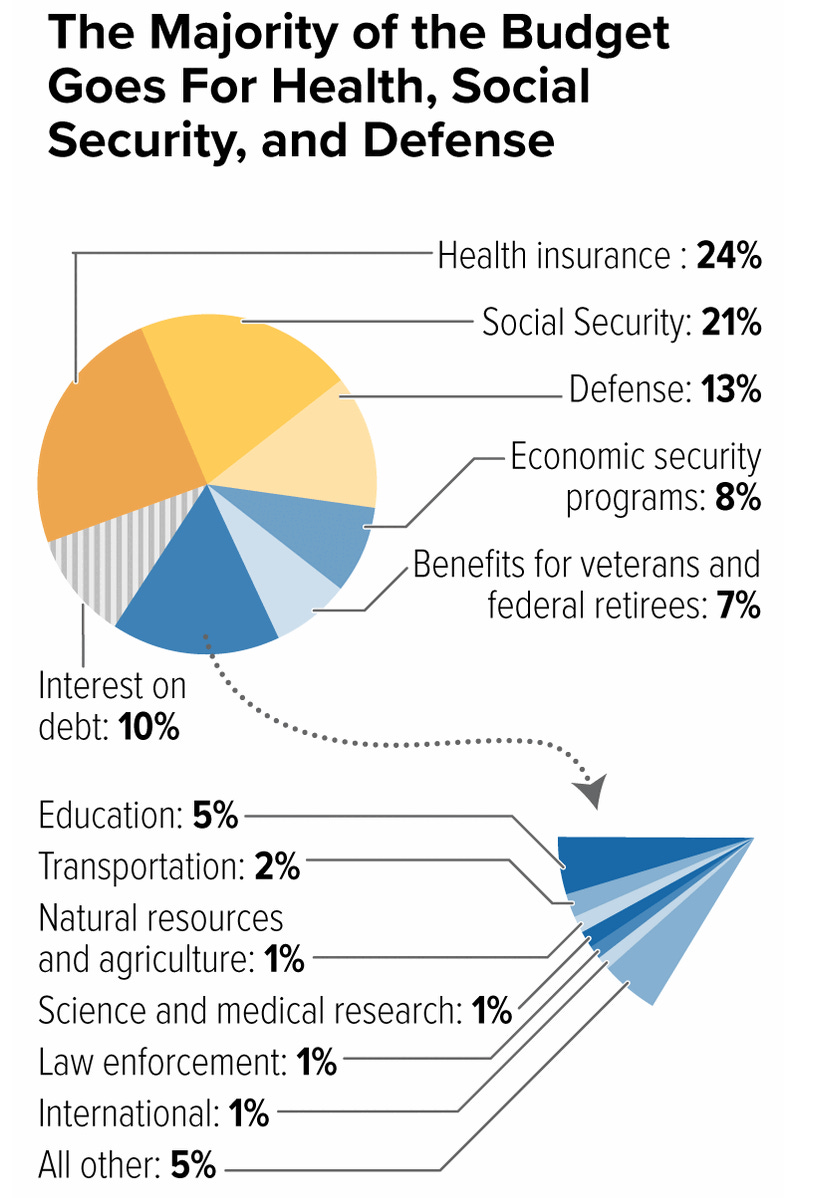
First, finding big-ticket examples of government waste is hard, because the government mostly spends money on things people want. Here’s a nice chart from the Center on Budget and Policy Priorities, showing where the money goes:

Yes, the federal government is an insurance company with an army.

Second, you shouldn’t trust claims about the budget coming from Some Guy on the Internet. You might have imagined that the world’s richest man could have a couple of fact-checkers on retainer to help ensure that he isn’t making clearly stupid assertions. But nooo.

In a barrage of posts on X Musk pushed misinformation about a more or less routine, place-holding bill that was basically a way to keep the ship of state afloat until Trump takes charge. Maybe this was in part a power play, an attempt to make Republicans in Congress show fealty to a man who clearly imagines that he’s the real president — and Trump, by meekly endorsing Musk’s position, did in fact convey the impression that Musk is leading the guy who is supposed to be in charge by the nose. But this political theater will have real consequences, for America, for Trump, and for Musk himself.

Musk has asserted that shutting the government down for a month would do no harm. And it’s true that Social Security, Medicare and Medicaid funding — which is where the bulk of the money goes — will continue. But many services people rely on will be disrupted, especially if the shutdown goes on for more than a month, which seems all too likely given Republicans’ razor-thin House majority and the dominance of misinformation in many members’ thinking.

Maybe Musk himself doesn’t expect to experience any hardship, but put it this way: I’m glad that I won’t need to renew my passport any time soon, that I don’t expect to be trying to get through airport security for a while, and especially glad that I don’t rely either on food stamps or on small business loans. For all of these things have been disrupted in past government shutdowns.

Do Musk and Trump know any of this? Almost surely not.

Beyond the specifics, my guess is that antics like the potential shutdown will do much more damage to the Musk/Trump administration than they realize. (There’s also this other guy — JV Dance or something? — but he clearly doesn’t matter.)

First, since the election financial markets have clearly been betting that Trump will do very little of what he promised during the campaign — that we won’t really have a trade war, just some minor trade skirmishes, that we’ll have symbolic deportations rather than a mass roundup of immigrants, and so on. Markets have, in effect, discounted the disastrous consequences that would follow if Trump honored his own promises.

But a government shutdown in response to completely false claims about what’s in an innocuous short-term funding measure suggests that the peddlers of misinformation are high on their own supply. Trump may really believe that foreigners will pay tariffs, that U.S. trade deficits subsidize the rest of the world, that there’s a reserve army of American workers available to fill the gaps deportation would create. I don’t want to put too much weight on the latest market fluctuations, but it is starting to look as if investors are questioning their own complacency.

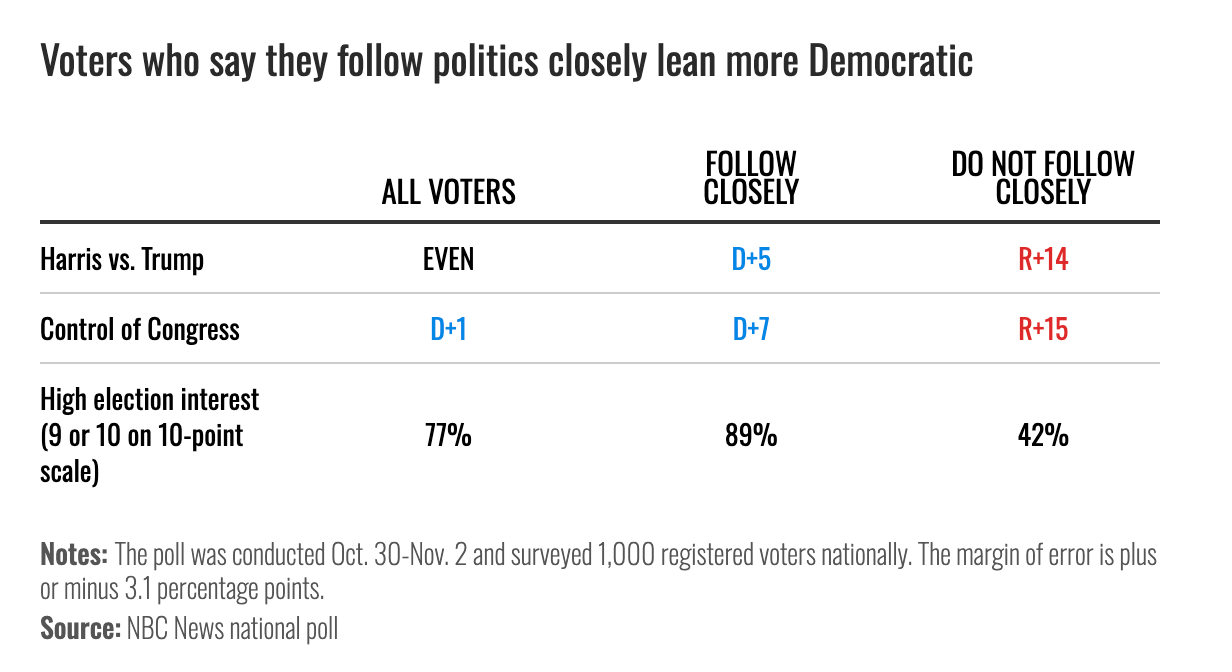
Second, many, probably most people who voted for Trump believed that he really is the character he played on The Apprentice — a highly competent manager. The other day I said that Trump was elected by low-information voters; this wasn’t a slur on Americans’ intelligence, it was a reference to survey results showing that Trump’s edge depended entirely on support from voters who don’t pay much attention to politics:

How will these voters react if, as seems all too likely, the second Trump administration is instead marked by rolling chaos?

Anyway, it’s pretty remarkable. Inauguration Day is still a month away, yet the chaos monkeys have already taken over. (snip)

More Uncommon Sense From Vixen Strangely

Thursday, December 19, 2024

Lab-Created Bullshit

Some western observers don’t quite understand why General Igor Kirillov was a legitimate military target (see: what is a “general”?)  or understand that lying war criminals are actually bad. Kirillov was behind the dumb propaganda that there were US/Ukrainian biolabs about to threaten the RU/UKR border. I always thought this was a little bit of a backhand at the US for claiming mobile biolabs in Iraq before 2003. But it is totally not the case and never was. And the fuckers who play games with the Zaporizhzhia nuclear plant have no business talking up Ukrainian “dirty” nuclear bomb threats anyway.

Which brings me to Elon Musk, incoming US president in fact if not in name, who is goofing with a government shutdown even before his old-age addled proxy is sworn in, threatening the GOP Speaker (presumptive) of the next Congress and also lying his dumb goofy pale face off. He says this on his dumb loss-leader propaganda site:

Remember me just recently pointing out Liz Churchill to you? Well, this is her, boosting hypnotically cult-like speaking pro RU and pro-Assad Trump DNI hopeful Tulsi Gabbard: (snip-embedded tweet on the page, also see some ‘shtuff’ from this blog’s nemesis, Libs Of TikTok)

https://vixenstrangelymakesuncommonsense.blogspot.com/2024/12/lab-created-bullshit.html#more

Exactly.

I love The Majority Report and the progressive factual style they have. Enjoy some clips on different subjects.

Hitting the Debt Limit: 3 Things to Know

December 17, 2024 By Joel Friedman and Richard Kogan

On January 1, 2025, the federal government will reach the debt limit, the maximum amount it is allowed to borrow. Accordingly, Congress will need to act to raise or suspend the limit in the coming months to cover existing commitments. Raising or suspending the debt limit does not authorize new spending or tax cuts; it merely acknowledges past budgetary decisions — that is, current budget law — and so allows the federal government to meet its existing legal obligations. The government must suspend or raise the limit to prevent default, which would be deeply damaging and disruptive for people across the U.S., financial markets, and the economy.

The debt limit has been suspended since the enactment of the bipartisan 2023 Fiscal Responsibility Act, allowing the federal government to borrow as needed. But under that law, the suspension expires at the start of 2025, and the new limit will be set at the level of debt outstanding on that day.

The Congressional Budget Office estimates that the deficit is currently running a bit below $2 trillion per year, which is therefore a reasonable approximation of the amount the federal government will need to borrow in 2025 to pay its bills in full, even if policymakers enact no further deficit-increasing measures.

Here are three key things to know about the debt limit:

1. January 1st is not a hard deadline.

When the U.S. reaches the debt limit, Treasury cannot increase borrowing to finance spending. But it will be several more months before the federal government lacks the resources to meet its legal obligations. That hard deadline, sometimes called the “X-date,” will likely not occur until the spring or summer, but it is difficult to estimate precisely at this point.

What allows the Treasury to spend when it cannot borrow more? First, it will have a buffer of cash on hand, which stood at around $700 billion on December 12. Second, Treasury will continue to collect revenues. Even though total revenues are less than total spending over the year, in certain months revenues exceed spending, generating a surplus. (See Figure 1 on the page; won’t embed.) This is particularly the case in April, around the tax filing deadline.

Finally, the Treasury Department can use certain accounting maneuvers, known as “extraordinary measures,” that let it finance expenditures without additional borrowing that counts against the limit. Both Democratic and Republican administrations have used these measures in recent decades after reaching the debt limit, allowing them to meet the federal government’s obligations while waiting for Congress to act. But these accounting maneuvers are not open-ended. In past years, they have given the Treasury several months of cushion before reaching the X-date. In 2023, for instance, Treasury relied on them for 135 days before Congress suspended the debt limit.

2. Prioritizing payments isn’t the answer to the debt ceiling.

If Congress does not raise or suspend the debt limit by the time Treasury has exhausted its cash balances and extraordinary measures, it would be unable to increase borrowing. It could not meet all the government’s legal obligations; it could pay only as much as it collects in revenues — on a day-to-day basis. Given that revenue is insufficient to cover spending, payments would need to be delayed and spending eventually cut — all of which would be illegal, because that would violate existing spending law. Default would not only hurt people who depend on timely government payments, but it would also shake financial markets and damage the economy.[1]

A number of Republican members of Congress have introduced legislation over the past dozen years that would authorize Treasury to prioritize certain payments if the federal government reached the debt limit. But that is not a way around the debt limit. The many budget statutes authorizing government’s various spending programs provide no legal authority to prioritize one payment over another. As a result, the government’s current payment system is designed to pay bills in the order in which they come due. And it relies on quite old technology that cannot be easily or quickly updated.

Even if prioritizing were legalized, many experts believe it is a practical impossibility under current technology and systems, particularly given that Treasury makes hundreds of millions of separate payments each month. And even if it were possible to administer on a large scale, prioritization is little more than picking winners and losers. Proposing to prioritize certain payments is merely an attempt to lessen some of the harm to some of the people. But it would increase the harm even further to those not favored — harms that would grow every month, as delays cumulated — while still failing to provide protection from default’s widespread fallout.[2]

3. The debt limit is not a way to control deficits.

In the past, some lawmakers have refused to support raising or suspending the debt limit without accompanying deep spending cuts — including to programs that help people afford health care and groceries — as a way to link the debt limit to deficit reduction. But the debt limit is neither an effective nor appropriate mechanism to limit federal deficits and borrowing.

By the time the debt limit is reached, virtually all of the spending and tax policies that determine the federal government’s near-term borrowing needs have already been enacted. Therefore, raising or suspending the limit merely enables the government to pay the bills that it has already incurred through previous tax and spending policies that created deficits in the first place; it does not create more spending or larger deficits, as reports from the Congressional Research Service and the Government Accountability Office agree.[3]

Additionally, the Congressional Budget Office has written, “By itself, setting a limit on the debt cannot control deficits because the decisions that trigger borrowing are made through other legislative actions that occur largely before the debt ceiling is reached. By the time an increase is needed, it is too late to curtail federal spending or to avoid paying pending obligations without incurring negative consequences.”[4]

While policymakers should consider the risks associated with a federal debt that’s growing faster than the economy and is projected to continue doing so, they should not hold the debt limit hostage to their policy preferences, creating uncertainty and risking a government default. A more appropriate place to debate the long-term fiscal outlook would be when policymakers are considering the revenue and spending effects of specific legislation.

Moreover, a focus on tying the debt limit to spending cuts mistakenly implies that growing spending is the cause of our fiscal challenges. While total spending is projected to rise faster than revenue, this is almost exclusively due to rising interest costs. Program costs (which exclude interest) and revenue are growing at roughly the same rate. Rising interest costs are the result of the large underlying mismatch between revenues and program spending, which is due primarily to tax cuts enacted over the last 25 years that have resulted in revenues lagging behind the cost of public services, like Social Security, Medicare, Medicaid, that are broadly supported by the public. This mismatch has necessitated greater borrowing, and higher interest rates have increased the cost of that borrowing.[5] Rising interest costs associated with tax cuts should not be understood as “higher spending” but rather the additional cost of enacting those tax cuts.

The United States is the only major industrialized nation that sets a binding legal limit on the total debt of its central government — a limit that, in its current form, dates back to World War I.[6] Policymakers should consider eliminating the debt limit because it serves no useful purpose and only seems to provide opportunities for political mischief while putting the nation’s financial standing at risk. But, at the very least, they should suspend or raise the debt limit in a timely way and for an extended period so that the government does not default or risk illegally defaulting on its obligations, which would cause a host of serious problems.

https://www.cbpp.org/research/federal-budget/hitting-the-debt-limit-3-things-to-know

Sci-Fi Writer Arthur C. Clarke Predicted the Rise of Artificial Intelligence & the Existential Questions We Would Need to Answer (1978)

We now live in the midst of an artificial-intelligence boom, but it’s hardly the first of its kind. In fact, the field has been subject to a boom-and-bust cycle since at least the early nineteen-fifties.

Source: Sci-Fi Writer Arthur C. Clarke Predicted the Rise of Artificial Intelligence & the Existential Questions We Would Need to Answer (1978)

A threat to the community?