Tuesday Poem

Amber McCrary

Stories

You are a Diné woman
A cosmic energy of earth and sky
Nihimá Nahasdzáán
Azhé’é Diyiní

Winter is over
So, we put our stories in the drawer
Then we take them out for the next winter

It is said stories are only told in the winter
So, the bears and snakes do not hear them

My father is not a traditional man
But he grew up as a traditional ashkii yázhí
He speaks the tongue of the sky and earth

of our people
He knows the ways of our land
But denies it al
l

One day I tell him
about watching coyote and lizard
stories as a young girl in boarding school
in my Navajo culture class

I tell him excitedly how the videos are now on youtube
but I still don’t understand them
because the videos are only in Navajo

I show him the cute coyote and lizard video
in hopes he will translate for me
He stops me the first ten seconds in
And tells me I shouldn’t watch it

Not because he doesn’t believe in cultural preservation
We are only supposed to watch and tell those stories during the winter, he says
Ohhhhhh, I say as I close the app

All the years my dad talks down on our traditions
I find it interesting, he still abides by the way of the seasons
because he knows snake and bear might hear

Or maybe he said it for other reasons

Copyright © 2024 by Amber McCrary. Originally published in Poem-a-Day on November 18, 2024, by the Academy of American Poets.

More about this poem and this poet here.

My reading headlines and talking about the stories11 19 2024

This is a completely different video than the one I posted before.  I am sorry that I posted that one.  I hated the glitches in it.   So I trashed it.  I did it before I looked to see if It had comments.  If you left comments please put them on this one.  This one is longer and more in depth, but done with a higher resolution and done at 3 am this morning so I sound better and more coherent.  There are no glitches of either video or audio that I could see / hear.  I hope you will enjoy it.  Today I am going to dump both computers starting at 12:30 pm.  I have the laptop running if I need it.  Hugs.  Scottie

I read a bunch of headlines I have in open tabs and I talk about the stories they pertain to briefly. Nothing in depth, just generalized information in the public sphere of information. If there is a topic you wish me to cover in more detail please mention it in the comments. Hugs

More Useful Info and a Couple More Resources

Originally published by The 19th

This story was published in partnership with Them.

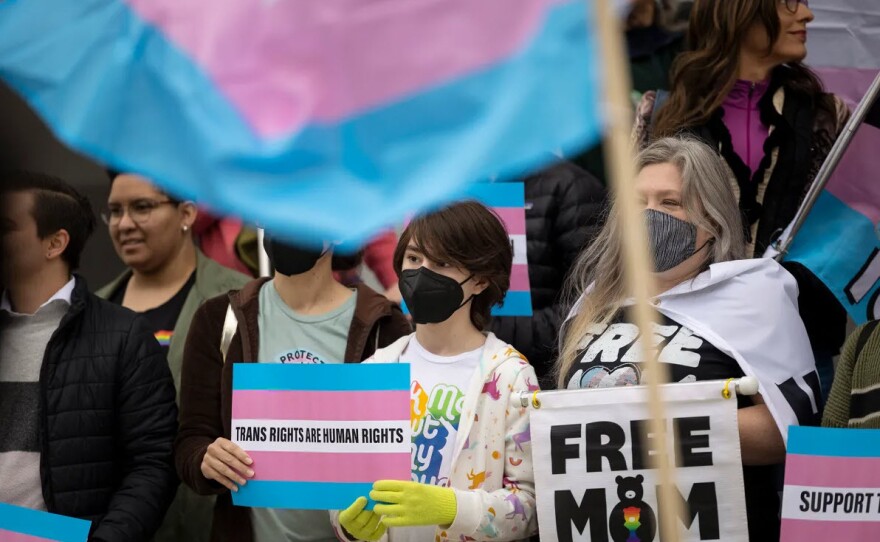
Reached by phone in the days following the election, LGBTQ+ movement leaders promised they are more prepared than ever to face off against a second Trump administration.

“We’re ready,” said Heron Greenesmith, deputy director of policy at the Transgender Law Center, a civil rights organization. “We did extensive scenario planning, internal and external. We did safety planning internally. We did scenario planning with partners, cross movement, inter movement, trans specific, LGBT.” 

For transgender Americans, the moment feels particularly vulnerable. President-elect Donald Trump has vowed to end what he has termed “transgender insanity” and cut Medicaid and Medicare funding to health providers offering gender-affirming health care on his first day in office. 

The result is that many trans Americans are reeling, feeling that the country has elected a man set on wiping them off the face of the earth.

Responding to the election, Sarah Warbelow’s voice broke. 

“There’s so much love,” she said. “Love is still out there, and that is not what this election was about.” 

Warbelow isn’t transgender. But her daughter is. And as the vice president of legal for the nation’s largest LGBTQ+ rights organization, the Human Rights Campaign, Warbelow will be tasked with shoring up protections for queer Americans as Trump retakes office.

Warbelow’s tone turned from teary to defiant as she talked about a slew of political ads attacking transgender Americans, many of them run by Trump and his surrogates. They don’t represent the feelings of the nation, she said.

“A majority of voters found the anti-trans advertisements were just mean-spirited,” she said. 

But Kierra Johnson, president of the National LGBTQ Task Force, one of the community’s largest organizations focused on field organizing and political change,  said 2024 is nothing like 2016 when Trump was first elected.

“The strategies are already in motion across movements,” Johnson said. 

“Yes, we should be worried,” Johnson said, adding that Project 2025, the blueprint for a second Trump term written by his former advisors, makes extremely concerning suggestions about how to approach LGBTQ+ rights. “They put it in black and white. If we don’t take that as serious, then that’s on us. Whether they execute or not, that’s something else.” 

Advocates said there are a number of things trans people can do immediately to protect their rights and safety before January. Here’s how the nation’s LGBTQ+ leaders feel things will go in the top policy areas impacting trans people and how trans folks can prepare ahead of January 2025.

Identification and gender markers

For people who need updated gender markers on their identification or have already obtained them, Greenesmith advised looking at state laws first if there are questions. 

“The laws in your state will impact a lot of everything else, including whether or not you can get your name and gender changed to match,” Greenesmith said. 

Some have expressed fears that having an “X” gender marker on a driver’s license or passport instead of the formerly standard “M” or “F” will make them a target in the new administration. Advocates advise that deciding on a gender marker is an incredibly personal decision. Some noted that removing the “X” might make one feel safer, but would be unlikely to erase the paper trail of a gender marker change in government records. In other words, if a trans person was trying to change a marker to conceal their gender identity from the federal government, updating gender markers would likely have minimal impact. 

Advocates for Transgender Equality has a full ID resources library with a state-by-state drop-down menu, as does Trans Lifeline, to help people navigate local laws. Both are nonprofit civil rights organizations.

The 19th will continue to provide guidance on IDs, documents and other paperwork as organizations release it. 

Freedom to be

Perhaps the greatest fear many trans people have is that simply being transgender will be criminalized. While experts acknowledge that it’s reasonable to be scared, they expressed that the federal government doesn’t have the same resources states have to target transgender people individually on the basis of identity alone. 

“When you look at the data and the polling, despite what people are pontificating about at this moment, the American public supports the existence of transgender people,” Warbelow said. Because Trump has shown himself to be incredibly fickle, it’s difficult to know at this point exactly what his plans are for carrying out his campaign promises. That said, Warbelow believes that the president-elect does care, on some level, about his popularity with the public.

Warbelow also believes that the administration does not have the levers to target transgender people in the ways that states have aimed to criminalize transgender life. 

Greenesmith is quick to add that worst-case scenario fears are already a reality for many of the most marginalized queer people. 

“This is why we can’t catastrophize at this moment, because catastrophization is white supremacy,” they said. “All the things that White people fear, Black people, Indigenous folks, migrants have been facing for centuries.”

Andrea Jenkins, a Minneapolis City Council member who made history as the first out Black trans woman elected to public office in the United States, said that for Black trans women, that also means coming together and rising up.

“What I will say to my sisters out there is we got to stand strong,” she said. “We’ve got to organize. We’ve got to build systems of support for each other.”

Moving

As some trans people consider relocating, “it’s not easy for people to just do that,” said Jamison Green, veteran trans organizer and health expert. 

Whether people are considering a move out of the country, or out of state, advocates acknowledge that the laws impacting trans lives in real ways differ from place to place. The 19th will be reporting more deeply on these options in the weeks to come, but Green advises that people in states with trans-friendly laws will be far safer than states with anti-trans laws, if they are able to get to affirming states because so many of the policies impacting trans lives are decided at a state level.

No matter what, “get connected to community,” he said. 

Organizations on the ground are ready to greet those who do need to move, said Jax Gonzalez, political director at LGBTQ+ statewide equality organization One Colorado. 

“We know that we are a sanctuary state, and that there are many families who have been coming here from Oklahoma, Florida, Arkansas, Texas, you name it, Missouri,” Gonzalez said. “We want to ensure that those folks who do come here, that we’re doing everything that we can to ensure that they are protected and can thrive in community.”

Health care

Trump has vowed to cut off federal funding to health providers offering gender-affirming care to transgender people via executive order. Many fear this will mean the end of gender-affirming care like hormones, puberty blockers and surgeries for transgender people on Trump’s first day in office. 

Before panicking, experts advise that this will be logistically complicated for the administration to pull off. For one, transgender people are protected by the Supreme Court’s 2020 Bostock v. Clayton County decision, which ruled that gender discrimination and sex discrimination are one in the same, meaning if the government barred gender-affirming care for a trans man, it would have to outlaw that same care (testosterone) for a cisgender man. 

Further, Green said the feasibility of the federal government tracking everyone’s prescriptions would get complicated quickly.

“The volume of prescriptions that are written in this country, it would be very difficult and time-consuming and costly to track at a federal level.”

State controls would have more access, he added. Some people have worried that the administration could threaten pharmacists, especially when it comes to prescriptions for testosterone, which is a schedule III class drug. Off-label use would not be allowed. Green, again, thinks this would be challenging for the administration.

“Most drugs are used off label, and that’s a fact,” he added. “Medicine is an extremely complex field. It’s an art as well as a science … this is why we license doctors to use their medical judgment in applying the chemistry of pharmaceuticals to their patients to help them.”

Further, Trump attempted to gut transgender health care protections in the Affordable Care Act during his first term. The fight over those protections wound through the courts, and the repeal was finalized in 2020, only to be reversed by President Joe Biden, another rule-making process and fight that took four years

In short, advocates said it’s difficult to anticipate how health care policy will play out. But whatever happens is not likely to happen immediately, and all major medical associations back gender-affirming care for transgender people.

Green said there is cause for concern. 

“But I think we have to not just roll over and let them do it,” he said. “Whatever, they think they’re going to do, we have to stay fighting for people’s health and rights and social safety.”

Marriage and family planning

Marriage will not immediately be at risk in the new administration because of legal precedent and a 2022 law passed by Congress called the Respect for Marriage Act, which requires states to recognize LGBTQ+ marriages already performed, even those from out of state.

“If something changes in the future, there will still be time to get married,” said Warbelow. “That is not something the Trump administration has the power to undo it any immediate term”

Still, a couple of Supreme Court justices have expressed interest in overturning Obergefell v. Hodges, the landmark 2015 ruling that established nationwide marriage equality

Advocates advise that for LGBTQ+ people who want to marry, now is not a bad time to do it. 

“I think people need to do everything they can to fortify their families and their finances, period,” said Johnson, adding that this can be applied to marriages, adoptions, powers of attorney or wills.

Trump Acts Cordial With Biden While Gaetz, Gabbard, and Hegseth Score Nominations | The Daily Show

It is OK and great to stop the video at the 8:30 mark.  After that it gets seriously stupid.  But before that it has a lot to say that is true and said in a semi comedic way.  Hugs

FBI: Text Messages Target LGBTQs For “Re-Education”


Via press release from the FBI:

The FBI is aware of the offensive and racist text messages sent to African American and Black communities around the country and is in contact with the Justice Department and other federal authorities on the matter.

The reports are not identical and vary in their specific language, but many say the recipient has been selected to pick cotton on a plantation.

The text message recipients have now expanded to high school students, as well as both the Hispanic and LGBTQIA+ communities.

Some recipients reported being told they were selected for deportation or to report to a re-education camp. The messages have also been reported as being received via email communication.

Although we have not received reports of violent acts stemming from these offensive messages, we are evaluating all reported incidents and engaging with the Department of Justice Civil Rights Division.

We are also sharing information with our law enforcement partners and community, academia, and faith leaders.

Read the full press release. Re-education = ex-gay torture.

CBPP Statement: November 14, 2024 – For Immediate Release

Republican Economic Proposals Would Harm the People Trump Promised to Help

Statement of Sharon Parrott, CBPP President, on key priorities for the 2025 policy agenda

While the new President and new Congress will not take office until early next year, they have already put forward an agenda — through Project 2025, Republican budget plans, and campaign proposals — that would increase poverty and diminish opportunity. Their proposals would raise costs for basics like housing, food, and health care and take health coverage away from people; slash funding for schools where our children learn, roads and bridges we use to get to work, and scientific and medical research that improve our health and strengthen our economy; double down on tax giveaways for wealthy households and corporations while imposing tariffs that fuel inflation; and further widen already glaring differences in people’s well-being and opportunity across income, race, and ethnicity.

These policymakers campaigned on promises to make the economy work better for people without big bank accounts who are trying to get ahead. But their proposals to date seldom match those promises.

Instead, a policy agenda designed to advance economic opportunity and racial justice and help families make ends meet would:

  • Make it easier for people to afford housing, food, health care, and prescription drugs.
  • Support children and families with an expanded Child Tax Credit, especially for children who don’t get the full credit today because their families’ incomes are too low; more affordable child care; and investment in our schools so that all of our nation’s children get what they need to thrive.
  • Invest in the things that will keep the economy strong and growing, including basic building blocks like roads, bridges, and research, as well as protections that keep our communities’ food, air, water, and workplaces safe.
  • Support these investments with a fairer federal tax system that requires wealthy households and corporations to pay their fair share and strengthens our fiscal outlook.
  • Create an immigration system that recognizes the critical role that immigrants and their families play in our communities and the economy, eschewing harsh deportation regimes that separate families and embracing reforms that provide people with a workable opportunity to gain legal status and a pathway to citizenship.

This kind of policy agenda would build toward a nation where everyone — regardless of their income or their background — can get the health care they need, afford to put groceries on the table, live in safe homes and strong communities, and have the income, education, and child and home care they need throughout their lives. And it would reflect the truth that our nation succeeds only when all of us succeed.

We are eager to work with policymakers who put forward policies that advance this agenda and we — together with our partners — will work hard against policies that make people less economically secure, less healthy, and have less access to opportunity.

A Russian ballistic missile with cluster munitions kills 11 people and injures 84 in Ukraine’s north

https://apnews.com/article/russia-ukraine-missile-attack-sumy-5cd4f9fe2cee1ae8aed67d63c22b0703

Russia has been doing this, dealing out pain to the people of Ukraine while Biden refused to let him use the weapons to hit Russia making them feel the same pain.  Biden now says OK when it looks like in three months there will be no choice but to give Russia what it wants or fight to the last person and lose anyway.  It is sick, but tRump is a Russian / Putin toady.  We failed to live up to a promise we made to Ukraine because of Biden’s out of touch fears from the 1950s.  Hugs

========================================================

Image

Image

Image

Image

Share

KYIV, Ukraine (AP) — A Russian ballistic missile with cluster munitions struck a residential area of a northern Ukraine city, killing 11 people including two children and injuring 84 others, officials said Monday.

The two children killed in the strike on Sumy late Sunday were a 9-year-old boy and a 14-year-old girl, the regional prosecutor’s office said. Six injured children are in critical condition, it said.

The attack damaged 15 buildings, including two educational facilities, the prosecutor’s office said. A search and rescue operation continued Monday, on the eve of the war’s 1,000-day milestone.

Sumy lies 40 kilometers (24 miles) from the Russian border.

Also Sunday, U.S. President Joe Biden authorized for the first time the use of U.S.-supplied longer-range missiles by Ukraine to strike inside Russia, after extensive lobbying by Ukrainian officials.

The weapons are likely to be used in response to North Korea’s decision to send thousands of troops to support Russia in the Kursk region where Ukraine mounted a military incursion over the summer.

It is the second time the U.S. has permitted the use of Western weapons inside Russian territory within limits after permitting the use of HIMARS systems, a shorter-range weapon, to stem Russia’s advance in Ukraine’s Kharkiv region in May.

The first reaction from Ukraine to the long-awaited decision from the U.S. was notably restrained.


“Today, much is being said in the media about us receiving permission for the relevant actions. But strikes are not made with words. Such things are not announced. The missiles will speak for themselves,” Ukrainian President Volodymyr Zelenskyy said in his nightly video address.

Earlier, Zelenskyy said that Russia had launched a total of 120 missiles and 90 drones in a large-scale attack across Ukraine, including Sumy. Russia deployed various types of drones, he said, including Iranian-made Shaheds, as well as cruise, ballistic and aircraft-launched ballistic missiles.

The attack, which targeted Ukraine’s energy infrastructure, came as fears are mounting about Moscow’s intentions to devastate Ukraine’s power generation capacity ahead of the winter.

Ukrainian defenses shot down 144 out of a total of 210 air targets, Ukraine’s air force reported.

“The enemy’s target was our energy infrastructure throughout Ukraine. Unfortunately, there is damage to objects from hits and falling debris. In Mykolaiv, as a result of a drone attack, two people were killed and six others were injured, including two children,” Zelenskyy said.

Two more people were killed in the Odesa region, where the attack damaged energy infrastructure and disrupted power and water supplies, said local Gov. Oleh Kiper. Both victims were employees of Ukraine’s state-owned power grid operator, Ukrenergo, the company said hours later.

The combined drone and missile attack was the most powerful in three months, according to the head of Kyiv’s City Military Administration, Serhii Popko.

One person was injured after the roof of a five-story residential building caught fire in Kyiv’s historic center, according to Popko.

A thermal power plant operated by private energy company DTEK was “seriously damaged,” the company said.

Russian strikes have hammered Ukraine’s power infrastructure since Moscow’s all-out invasion of its neighbor in February 2022, prompting repeated emergency power shutdowns and nationwide rolling blackouts. Ukrainian officials have routinely urged Western allies to bolster the country’s air defenses to counter assaults and allow for repairs.

Russia’s Defense Ministry on Sunday acknowledged carrying out a “mass” missile and drone attack on “critical energy infrastructure” in Ukraine, but claimed all targeted facilities were tied to Kyiv’s military industry.

Although Ukraine’s nuclear plants were not directly impacted, several electrical substations on which they depend suffered further damage, the U.N.’s nuclear energy watchdog said in a statement Sunday. According to the International Atomic Energy Agency, only two of Ukraine’s nine operational reactors continue to generate power at full capacity.


The Russian military said Monday it intercepted and destroyed 59 Ukrainian drones overnight over several Russian regions. Two were downed over the Moscow region that surrounds the Russian capital, and three others over the neighboring Tula region. A total of 54 drones were destroyed over the Bryansk, Kursk and Belgorod regions on the border with Ukraine, according to a statement by the Russian Defense Ministry.

Moscow Mayor Sergei Sobyanin said the drones shot down outside of Moscow were heading toward the capital.

========================================

Follow AP’s coverage of the war in Ukraine at https://apnews.com/hub/russia-ukraine

Image
Kullab is an Associated Press reporter covering Ukraine since June 2023. Before that, she covered Iraq and the wider Middle East from her base in Baghdad since joining the AP in 2019.

Portico’s Part in Telling the Story of Emmett Till

The Emmett Till Memory Project teaches new generations about the tragedy that kickstarted the Civil Rights Movement. Preserving its digital assets is vital.

Emmett Till Headstone

Photo by Dave Tell via ETMP

By: Sara Ivry

On a late August day in 1955, Emmett Till was murdered in Mississippi. A fourteen-year-old African American from Chicago, Till stopped with his cousins at Bryant’s Grocery & Meat Market to buy chewing gum. There, Till whistled at the clerk, a brazen act that violated the norms of the Jim Crow South and so angered the clerk’s husband and brother-in-law that they killed the boy.

The events and locations that tell the story of Till’s life and death have been memorialized in different ways and forms over the ensuing decades. The Emmett Till Memory Project (ETMP), an app,  is one of them. It uses digitized archival documents, photos of those involved and of sites central to that fateful August day, and more so that users may educate themselves about who Emmett Till was and why his death still resonates. The ETMP’s digital assets are vital to ensuring the ongoing preservation of Till’s memory as well as his legacy.

That’s where Portico comes in. Dedicated to digital preservation, Portico has partnered with the ETMP to ensure the safekeeping in perpetuity of these digital artifacts.

Historian Dave Tell, a professor of communication studies at the University of Kansas, as well as the co-founder and director of the Emmett Till Memory Project, spoke with JSTOR Daily’s Sara Ivry about the Project and why its partnership with Portico is so critical.

Sara Ivry: How did you first learn of Portico?

Dave Tell: Kate Wittenberg reached out to me as part of the DEI efforts of her organization, specifically, a pilot project to support the preservation of archival content about under-represented topics that might be at risk. Kate contacted me about the time that we were massively reorganizing the Emmett Till Memory Project. She asked if she could just come along and preserve the site as it existed. I said, “Well, yes, you can, but we’re also trying to make it way better.” She sat in on development meetings over the last few years with us and has been an integral partner, not only in helping us think about preserving the site but helping us make design decisions that would render the site preservable.

Can you describe a little what the site was before you revamped it and what you were trying to do in the renovation?

The short story is we went live in October of 2019, and then in the pandemic, we used our last $10,000 of grant money to pay a DEI consultancy to tell us what we did well and what we did poorly. They did this entire audit, focus groups, they talked to the family, they talked to scholars. They looked at analytics, and they came back to us. Essentially, they told us great content, very bad design, which in retrospect is not surprising. Everyone on the project had been a content expert; we had never had design people on board. We had never had UX people.

The design only works for people who already know the story, they told us, which of course was a devastating blow to us. They also said this reads as if it was written by a middle-aged white guy and I’m like, “Well, I wrote it and I’m a middle-aged white guy—so fair enough.”

Included by Favor 

So, we hired a woman named Renee Payne out of the Rhode Island School of Design who runs a graphic design firm called included. She specializes in computer design for veterans of the Civil Rights movement; her clients include the families of Andy Young, Harry Belafonte, and family of Malcolm X. She assembled a team of young designers of color, and I said to them, “Nothing is sacred here. Let’s make this as good of a project as it can be,” and they reimagined it from the ground up.

When exactly then did Portico come on board?

Kate came in in the middle of this revamped process, and one of the specific things she encouraged us to do was to avoid third-party dependencies. The example that I understood was if you embed a YouTube video, your content is only as secure as YouTube, which you have no control over.

We really thought long and hard about what technologies we could preserve, and Kate and her colleague Karen Hanson pushed us to think about what exactly we’re preserving. The technologies we are currently depending on do not last forever, right? We changed our mindset. We don’t want to preserve this project so that like it will look the same for everyone into the future, but we want to preserve the assets.

Make images preservable, the text—the component parts.

Eventually we’re going to have a lot of immersive stuff on there. It’s only halfway there now. Portico helped us understand better to preserve the components that make up immersive pieces. In the future, people can use whatever technology is then current, use our same data, and create their own project.

I hadn’t thought about the built-in obsolescence of technology, and that we have to account and plan for that in the design of an app or site as well as in the design of an archive. Had you considered that before Portico got involved?

No, I’m a humanist by training, so when I first started thinking about digital preservation, probably a decade ago now, my gut instinct was we make the website just like a book. It’ll sit there unchanged forever. And Portico has been instrumental in changing the way I think about preservation—that first of all, forever might not be the goal.

Emmett and Mamie Till-Mobley on the exterior of the house they lived in from 1950–1955. Photo by Dave Tell via ETMP

Second, what gets preserved is not necessarily the sort of same experience that our users have today. What really matters and what needs to be preserved is what we have. The Emmett Till Memory Project has amazing artifacts. We have hours of audio with the family that they’ve given us permission to use that no one else has. We can tell the story in incredibly intimate ways and that’s super important. When you open this app, you’ll hear the voice of Reverend Wheeler Parker, Till’s cousin, narrating the story as all this stuff flashes on the screen behind you—I don’t care if the flashy, immersive technologies are preserved forever. But I care deeply that the audio files—and the voice of Rev. Parker—gets preserved. Someone else can build their own tools with that stuff. My ability to make that distinction is a testament to Kate and Portico.

Why is digital preservation of these assets critical in any case?

It’s almost hard to answer this question without going into cliche other than to say: Ignoring the past is a critical component of white supremacy. Full stop. What we want to do and what the family wants to do is tell the story—not that telling the story is sufficient for the change that they and I want to see, but it’s a critical part of the change that they and I want to see.

The Interpretive Center—what’s the first line of their mission statement, “We believe that racial reconciliation begins with telling the truth,” right?—that’s a sentence that accurately describes the vision of the Till family and it certainly describes my vision.

What was the origin of this app?

If you start from the murder of Emmett Till in August 1955 you have to count 49 years and 11 months before the state of Mississippi dropped a single dollar on the Till story. Eighteen citizens of Tallahatchie County thought that was ridiculous; they put up a commemorative sign that got shot, defaced with acid, spray painted.

Tallahatchie Civil Rights Driving Tour sign, ca. 2015. Photo by Pablo Correa via ETMP

In 2014, I got invited to go down, I’d been writing about Till for a decade and a half by then, and the question was: How do we tell Till’s story in the context of vandalism?

It’s easy to shoot a sign in the middle of the country. It’s harder to shoot an app.

What are some of the assets on the app that stand out to you?

My favorite by far are the hours of audio, oral history we have of Reverend Parker that was taken in his church in Chicago. We also drove him from site to site; we put a microphone on his lapel and on the sun visor of the car. And we just asked him what these sites meant to him as we went from place to place. All that audio’s not up yet, but we have it. (snip-a bit More)

Some Resources

They’re accepting support, and offering support. Snippets here; there is more info about each on the page here:

https://www.them.us/story/trans-mutual-aid-funds-donate-support

This year’s Transgender Awareness Week (the leadup to Trans Day of Remembrance on November 19) has felt particularly macabre, arriving on the heels of a presidential election that will be disastrous for trans rights. Still, there’s never been a better time to help trans communities across the U.S. find shelter, obtain medical care, and protect themselves from state violence — and if you’re reading this, you can help by getting involved in mutual aid.

Although there are plenty of well-known LGBTQ+ nonprofit organizations and advocacy groups throughout the country, mutual aid funds prioritize giving directly to marginalized people in need, in order to survive crises and improve their material conditions. Numerous trans-led mutual aid funds exist on local, state, regional, and national scales, and while many may not be tax-deductible, we think that’s a small price to pay in order to help trans folks find safe shelter, obtain gender-affirming care, change legal identity documents, and more.

The phrase “we keep us safe” may have originated in prison abolition organizing, but it definitely applies to LGBTQ+ folks as well. Below, we’ve highlighted just a few trans mutual aid funds that are open to donations — or applications for assistance, if the trans person in need is you — as of November 2024. For more, check out our state-by-state list of mutual aid funds and advocacy groups. You can also search for #TransCrowdFund on your preferred social media platform to find individual trans people fundraising for their own needs.

Black Trans Fund

Organized by the Louisville, Kentucky-based nonprofit Change Today, Change Tomorrow, the Black Trans Fund offers “unrestricted assistance” for Black trans, nonbinary, and gender-nonconforming people. According to organizers, the fund has distributed over $35,000 for “bills, travel, food, medical needs, and recreational needs” over its four years in existence. Donations are tax-deductible. (snip)

Genderbands

Based in Utah, Genderbands offers individual grants for trans people seeking help with medical costs (including surgeries for those over 18), travel, name and identity document changes, and special grants for trans youth with parental consent. Any trans person in the U.S., Canada, or Mexico may apply, although surgical grants are limited to U.S. residents; the application period for 2025 grants, including one dedicated grant for a masculinizing top surgery procedure in Salt Lake City, ends November 30. Donations of gently used binders are also accepted. (snip)

Iowa Trans Mutual Aid Fund

A project of the Iowa Mutual Aid Network, this fund is dedicated to providing aid for gender-affirming medical care throughout the state, and has distributed over $100,000 since 2021, according to its website. Grant seekers may apply every month, and may receive funding for hormone therapy, surgeries, therapy, and some other medical fees, as well as name change costs, travel expenses for medical care, and gender-affirming clothing. (snip)

Point of Pride

One of the largest trans-led mutual aid networks in the U.S., Point of Pride has raised millions for trans mutual aid through its annual TikTok fundraisers. The organization funds gender-affirming surgeries, hormone therapy, hair removal, clothing, and more through its various dedicated funds, and offers free binders and shapewear for those who cannot afford to buy their own. In 2024, Point of Pride reported giving $163,000 to 117 trans people through their HRT Access Fund alone, including 49 Black recipients thanks to funding from the National Black Trans Advocacy Coalition. (snip)

Socialist Trans Initiative (STRIVE)

Based in Pensacola, Florida, STRIVE’s anticapitalist organizers say their mission is to “provide moral and material support to trans people who need it,” in the form of emergency housing, hormone therapy, food support, transportation, and “any other items needed for our survival.” In addition to its aid funds, STRIVE also holds trans community events and weekly political organizing meetings. (snip)

Transitional Justice

Although most of its organizers are based in Missouri, Transitional Justice seeks to facilitate travel and “temporary, transitional housing” for trans people fleeing harmful legislation throughout the U.S., as well as “people who have been evicted from their homes, fired from their jobs, or denied access to healthcare.” Applicants can request assistance by filling out the organization’s web form. (snip)

Trans Love Fund

Founded in 2013 through the South Carolina nonprofit We Are Family, the Trans Love Fund offers microgrants up to $200 for assorted “medical, legal, and emergency living expenses.” Grants are available to trans South Carolinians ages 16 and older, with applications opening one week out of every month (usually the first week, per the fund’s FAQ). We Are Family also operates the “Closet Case Thrift Store,” which offers free gender-affirming clothing to trans and gender-nonconforming youth. (snip)

Got our vaccines and tRump’s admin plan to put migrants in for profit prisons

We got our vaccines and tRump’s plan for mass for profit prison detention camps for migrants.

There are some distortions because I moved a lot due to pain in my hips and back. But it looks OK but if you want just listen to the audio.  I put a lot of effort into the video.  Hugs