
Palestinian villages in the West Bank are seeing an increase in illegal settler attacks since October 7, 2023, the start of the Israel-Hamas war. Some of the settlers are attacking farms and killing livestock. NBC News’ Hala Gorani has more on the increase in violence.
Category: Children / Kids / Minors / Teens / Family
Israeli settlers accused of using cover of war to build more settlements
Western Media BURIES Sickening Israeli Abuse of Palestinian
Messed up doesn’t even begin to sum this up.
Israel Invades West Bank – Declares Will Be Treated Like Gaza
When Israel threatens to turn the West Bank into the new Gaza, believe them.
I read about this young woman Saturday. You may be interested to read about her, too-
I do the free clicks on Free The Ocean, just to help make a dent in the amount of plastic in Earth’s oceans. The clicks are to answer trivia questions, and frequently I learn something, especially on days when I guess the answer. Yesterday’s (I had it up to post yesterday, too, but didn’t get it done until late) was about Autumn Peltier. I was interested, so I pulled up some more info on her, and she is post-worthy.
Here is some biographical info. “Autumn Peltier is the chief water commissioner of the Anishinabek Nation, and a water-rights advocate and environmental activist.
“Peltier was born on September 17, 2004, in Wiikwemkoong Unceded Territory, Manitoulin Island, Ontario, Canada, and is a member of the Aniishnabek Nation.” There is more on the page, too.
An article from 2017 on CBC News tells us, “Even at the tender age of 12, Autumn Peltier speaks with the wisdom of someone much older.
“’I’m going to be an ancestor one day,’ says Peltier, from her home in Wikwemikong First Nation in northern Ontario. ‘I’m still going to have great-grandchildren on this land and I hope they are still able to drink the water.’
“Despite her youth, Peltier is already a veteran activist when it comes to the issue of clean drinking water — not just in First Nations communities, but across the country.
“’I do what I do for the water because water is sacred,’ says Peltier, who was honoured by the Assembly of First Nations as a water protector.
“Since water doesn’t have a voice, Peltier says she wants to lend hers to the cause. Even if that means taking on Prime Minister Justin Trudeau, as she did last December at the AFN’s annual winter gathering.”
There is even more information here, on CIWEM , the Chartered Institution of Water and Environmental Management. This one is current, with some family history. This is a remarkable young woman!
Got a Republican State Legislature? Watch out carefully for this…
This is an opinion piece that contains news, and cites. Also, all Republicans are not Magas, but they’re still Republicans. This is important.
Snippet (it’s not a long piece, and it’s full of info.)
Let’s be clear about what Kansas Republican legislative leaders are doing with their planned overhaul of budgeting: They are launching a personal and political power grab against Gov. Laura Kelly.
They have never accepted or respected her mandate. Despite Kelly winning a second term and having two years left to go, they have continually attempted to usurp the executive branch’s authority. They have tried a constitutional amendment and prohibiting her ability to negotiate Medicaid contracts. Now they’re going after her yearly state budget proposal.
Usually, the Legislature begins its yearly budget process with a proposal from the governor. Her office submits it when lawmakers arrive for the annual session, in January. Now an interim committee wants to start the process earlier, as soon as October of the previous year.
In this new process, the governor’s budget would be a suggestion, not a starting point.
And never mind that it’s a direct attack on Kelly. House Speaker Dan Hawkins, R-Wichita, assured the audience that these changes had nothing to do with the governor.
“This process has nothing to do with the governor,” he said at the meeting earlier this month, according to Kansas Reflector reporter Tim Carpenter. “If you’re going to focus on the governor, probably not the wisest thing to do, because this process has happened over time with many, many different governors.”
He was contradicted by Senate President Ty Masterson, R-Andover, who let the proverbial cat out of the figurative bag.
“You’ll have a Republican governor, for example, or somebody you trust, and you trust the administration to build the budgets, and then you kind of rubber stamp stuff,” Masterson said. “And, then, you switch, and you have (the) opposition party and then there’s all that same power.”
Oh. So it’s like that, then.
(snip-More; also a vid of the sausage becoming sausage)
A little something to look at, if you’re enjoying the weekend looking at stuff
We had a Radio Shack here in town for a lot of years, but not as long as till 2015. The manager/co-owner also had a story in another, larger city, and eventually moved there. He and DH were really good friends before I came along, and then we all made friends. I used to do volunteer literacy tutoring; one time, our director asked me if I’d try working with a young woman who could read and pronounce English, but had no idea how to converse, having only ever used Farsi for communication. Of course I tried it. It turned out she was our Radio Shack friend’s sister in law! I still am not really sure I taught her much; she already knew how to greet people, and some rudimentary questions and answers, “What do you think about this weather?” “Do you know whose cat that is?” But, she was not confident. She could comprehend and repeat, but not necessarily always apply and respond conversationally in English (her husband sometimes came along, and did translation.) I worked with her for a few years and she seemed to feel better about it all and I saw improvement, but no real click. One time, they didn’t show up for a session, and I’ve never seen them again. I’d heard that our friend had had a little trouble, too, here in town; this would have been a few weeks after the plane crashes in Sept. of 2011. I finally got up the nerve to just ask him if they were OK. He said they moved a little farther East, by some other relatives. They were doing fine, and he’d tell them I said hello. I asked him to tell their little girl that our son said hello, too; she had a crush on him because he read to her while I was working with her mom. I guess I just needed to share that story; this Radio Shack piece reminded me of all of that. Thanks for hangin’ in with me on this!
At the Border, a Shelter By — And For — Muslim Women
I think this fits in as information relating to marginalized people. It is from a magazine that is religious, but it’s not pushy; I think everyone can read this article without feeling proselytized. It struck me as important, and overlooked. -A
By Ken Chitwood
Anyone crossing the U.S.-Mexico border faces a journey fraught with violence and danger.
But for women and children, that journey is even more treacherous. Not only are many fleeing violence at home — including gender-based violence — they also experience higher rates of violence en route. Torture, mutilation, sexual violence, femicide,disappearances, and additional health complications are common occurrences for female migrants making their way north.
That danger is amplified for the thousands of girls living in makeshift camps and tent cities along the U.S.-Mexico border without protection or accompanying support. According to the Washington, D.C.-based Kids In Need of Defense, “[u]naccompanied children are especially vulnerable to sexual violence, human trafficking, and exploitation by cartels and other criminal groups.”
Over the last few years, a group of Muslim women has stepped in to meet their needs in unique ways. Albergue Assabil (“the Shelter of the Path”), the first Muslim shelter along the U.S.-Mexico border, has been in operation since June 2022 under the leadership of Sonia Tinoco García, founder and president of the Latina Muslim Foundation. According to staff, the shelter served nearly 3,000 migrants in its first two years of operation. Many of those migrants have been women, attracted to the shelter because of its separate men’s and women’s facilities and the fact that Albergue Assabil is a female-led shelter.
And it’s not only Muslim women finding sanctuary under the shade of the shelter’s blue dome; there have also been other female immigrants looking to García and her team for assistance as they make the perilous journey north.
“A group of Muslim ladies”
When García first headed to the U.S.-Mexico border to help others in 2014, her goal was simple: to help women, especially mothers and unaccompanied children, in their attempts to claim asylum or start a new life in the United States. Having immigrated to the U.S. herself in the 1990s, García knew what it was like.
She also knew the statistics.
Though the share has fluctuated in recent decades, immigrant women and girls make up at least half of all migrants and asylum seekers, according to figures from the Migration Policy Institute. Women and girls made up a total of 53 percent of the immigrant population in 1980, 51 percent in 1990, 50 percent in 2000, and 51 percent in 2010 and 2022.
Given the scale, García gathered what she called “a group of Muslim ladies” from her mosque community in San Diego. Each had a profound understanding of the situation female immigrants were facing.
Angie Gely, who works in the office at Albergue Assabil, said being an immigrant who was deported back to Mexico and is now living in Tijuana, helps her understand what women in the shelter are going through — and what they face once they arrive in the U.S.
“Our families crossed the border to the U.S. too,” Gely said. “We can relate.”
Driven by their own past experiences and a deep desire to help female immigrants, García said she and other Muslim women started volunteering in Tijuana shelters, bringing food and clothing for people regardless of their religious, social, and cultural background.
Along the way, García and her “Muslim ladies” started noticing how many Muslims were mixed in with the larger population of immigrants and deportees. “It got my attention when I saw some women standing at the border with hijab,” García said. “I talked to them and discovered they were from Somalia, trying to go to the U.S. or Canada.”
The more time she spent in Tijuana, the more Muslims she saw arriving. At shelter after shelter, meanwhile, she witnessed staff too overwhelmed to cater to Muslim migrants’ unique needs.
“There were Muslims who didn’t feel safe in the shelters, because they were being discriminated against or questioned because of their faith,” Gely said. As a result, some would avoid the shelters altogether, struggling to find their own way on the streets or seeking help from Muslims at Centro Islámico de Baja — Tijuana’s only mosque at the time.
“The shelters didn’t have the time or money,” García said, “to provide halal food, to provide adequate space for prayer, or even understand their situations are different from those of migrants from Central America or elsewhere.”

García and the others did what they could to serve the immigrants sent their way — covering the cost of hotel rooms, providing home-cooked halal meals, or connecting them to the legal aid they so desperately needed, in a language they could communicate in. Overwhelmed, they turned to their mosque communities in San Diego and Orange counties to raise funds and procure translators who could speak Arabic or Urdu, Farsi or French, and many dialects in between.
But the need continued to increase. More and more Muslim immigrants were making their way to Tijuana, and the “ladies” could only do so much. Shelters were overwhelmed, and García said she was scrambling to field the many calls.
That’s why, in 2017, they decided to do more. Founding a nonprofit organization — the Latina Muslim Foundation — they raised more than $200,000 (USD) to construct a purpose-built Muslim shelter. Situated in the border city’s Zona Norte neighborhood, the shelter features separate men’s and women’s facilities, a prayer area, halal food, Quran classes, and legal services to assist migrants.
The hope, García said, was to provide a humane and helpful place for Muslim migrants to land in Tijuana. They are there to help transform the border from a topography of inhumanity into a place of dignity and opportunity, García said.
A growing number of Mexican Muslim women
García said that as a child, she always dreamed of helping people. “I wanted to become a surgeon, but do surgery for free, because people need it to save their lives,” García said. “Or an attorney who did pro bono work, to help families who don’t have justice.”
García grew up in a large family in a village of 200 people near La Paz, in the very south of the Baja California peninsula. She did not know whether such dreams would — or could — come true. “We had a simple lifestyle. We were not rich people,” she said. “Because we were 11 siblings, not everyone got education.”
García was one of the lucky ones able to finish high school. She moved to Ensenada — an hour and a half south of Tijuana — and started working with a local orthodontist serving medical tourists from the U.S. When she was 21, she met a man named Abu Hamza, a medical tourist from Lebanon living in Los Angeles. Abu Hamza spoke no Spanish at the time, and she did not speak English, but they communicated with books and through other people. Twenty days after meeting, they were married.
García had grown up Catholic and knew little of Islam. But when she saw Abu Hamza, she said, “I saw Islam in him.” After moving to the Los Angeles area with Abu Hamza, she learned English and Islam at the same time.
García joined the growing ranks of Latina converts to Islam. The first Latina and Latino converts can be identified as far back as the 1920s; others converted in the 1960s and ’70s as part of Black Muslim movements such as the Nation of Islam and the Five Percent Nation. In 2011, 6 percent of Muslim Americans identified as Hispanic, according to the Pew Research Center; by 2017, it was 8 percent. The vast majority of this cohort of Hispanic American Muslims are women, many of them from Mexico or having Mexican heritage.
Muslims remain a small minority in Mexico, said Arely Medina, a professor at the University of Guadalajara. There are multiple small groups and communities made up of both migrants and individuals native to Mexico in the country’s interior, all of which have a relatively recent history, Medina said. “Thus, one cannot speak of a ‘Mexican Islam’ per se,” she said, “even though Muslims have a history here stretching back to the conquest of the Americas and continuing with a series of Arab immigrations in the 19th and 20th centuries.”
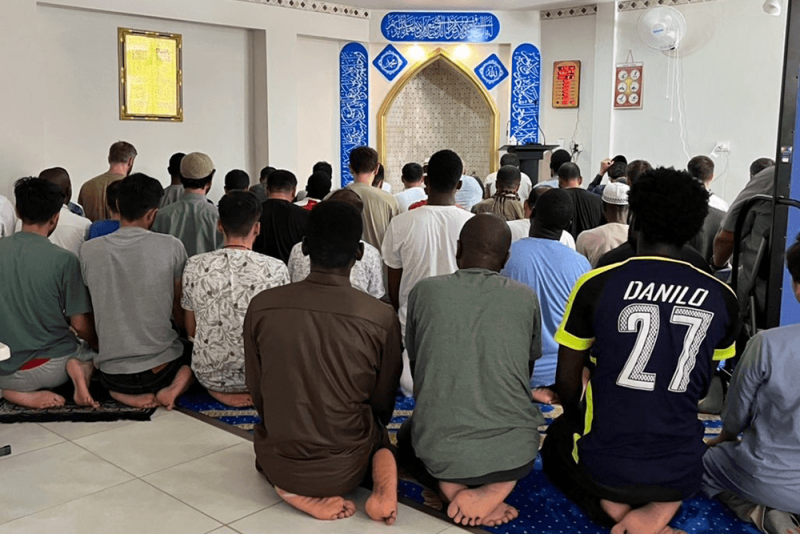
According to Medina and other experts, most Mexican converts to Islam are women. Among them are sizable numbers of female Muslim immigrants from places such as Egypt, Morocco, Syria, Pakistan, Ghana, and Turkey who have made Mexico home. “Some hope to reach the United States and are concentrated along the northern border,” Medina said. “Others concentrate in places like Mexico City, Guadalajara, or Monterrey.”
It is difficult, if not impossible, to generalize these women’s motivations, plans, or situations, Medina said. As is true of those staying at Albergue Assabil, “There is not a single story,” she said. “Each one carries a narrative.”
Because these women face a variety of challenges — such as wearing the veil in a cultural context where Islam is not a prominent reference point or searching for a sense of freedom and security in the face of domestic violence and harassment — Medina said they find in each other a sense of solidarity. “They are in search of a better life,” she said. As Europe, the United Kingdom, and even the U.S. are experienced as less welcoming, Medina said, “Latin America is now seen as a place of possible openness.”
Empowered to help others
Whether local converts or newcomers from elsewhere, Muslim women have carved out their own spaces in Mexico, including the Albergue Assabil shelter and the Nur Ashki Jerrahi Sufi order in Mexico City, which is headed by a woman — Shaykha Amina Teslima.
García often reminds donors, partners, volunteers, journalists, and authorities that Albergue Assabil is a shelter run by women. And not just any women, but Muslim women.
That, she said, makes a difference.
“We found that Islam gives women rights; it gave us empowerment,” she said of her and the other women running the show at Albergue Assabil. “I could do whatever I wanted to do — more than what I could do with my own culture or my own religion before,” she said. “Islam says that women can go study; men cannot tell you no. Men know this. My husband knows he doesn’t own me. He is my support.”
Indeed, her husband, Abu Hamza, is supportive of García’s work. He is often seen around the shelter too, pulling up on a motorcycle with García, bringing in donations, making phone calls, and generally doing whatever needs to be done. When asked about the shelter, he insistently points to his wife. “She knows better than me,” he said.
García said part of the shelter’s work is passing their own empowerment on to women who arrive at their gates. “In the shelter, when women come, we give them tools to be able to continue their education: English, Spanish, computers, cooking,” she said. “We want to give them the basics so that they are not reliant on men. In the time they stay in the shelter, we teach them as much as we can so that they can live for themselves.”
Increasingly, said Gely, that means more and more women are finding their way to Albergue Assabil — Muslim and non-Muslim. “Just yesterday, three ladies from Russia came here looking for shelter,” Gely said. “They’re not Muslim, no. But they hear how nice it is and want to come. Of course we take them in.”
One of them is Amie. Amie has struggled getting an appointment through the U.S. Customs and Border Protection app CBP One. She has spent three months in Mexico so far, arriving at Albergue Assabil six weeks after bouncing from shelter to shelter in Tijuana. Sojourners is withholding Amie’s last name, at her request, to protect her immigration status.
“They’ve been so kind to me,” she said, “out on the street, in other shelters, I feared for my life, worried I would be tortured, abused, or killed. This shelter is the only place I feel I could survive.”
As we talk, two more young Russian women walk through the front doors. They too are looking for shelter. Amie tells them to take a seat. Gely or García will be here soon, she says.
“They’ll take care of you,” Amie said. “They always do.”
https://sojo.net/articles/news/border-shelter-and-muslim-women
Kansas women rally adjacent to J.D. Vance fundraiser, with vulnerable plea for reproductive rights
By: Grace Hills – August 24, 2024 8:28 am
First some content warning; the article has a warning that it references rape. The article is below, but I’ll leave some space here; the first mention is in the first sentence beneath their warning. The article will be beneath the Xs; I can’t get formatting to leave space. Also, Sen. Marshall lies like a Trump.

Amber Dickinson speaks on reproductive rights at the “Kansas Women for Harris” rally Aug. 22, 2024, in Leawood. (Grace Hills/Kansas Reflector)
xxxxxxxxxxxxxxxxxxxxxxxxxxxxxxxxxxxxxxxxxxxxxxxxxxxxxxxxxxxxxxxxxxxxxxxxxxxxxxxxxxxxxxxxxxxxxxxxxxxxxxxxxxxxxxxxxxxxxxxxxxxxxxxxxxxxxxxxxxxxxxxxxxxxxxxxxxxxxxxxxxxxxxxxxxxxxxxxxxxxxxxxxxxxxxxxxxxxxxxxxxxxxxxxxxxxxxxxxxxxxxxxxxxxxxxxxxxxxxxxxxxxxxxxxxxxxxxxxxxxxxxxxxxxxxxxxxxxxxxxxxxxxxxxxxxxxxxxxxxxxxxxxxxxxxxxxxxxxxxxxxxxxxxxxxxxxxxxxxxxxxxxxxxxxxxxxxxxxxxxxxxxxxxxxxxxxxxxxxxxxxxxxxxxxxxxxxxxxxxxxxxxxxxxxxxxxxxxxxxxxxxxxxxxxxxxxxxxxxxxxxxxxxxxxxxxxxxxxxxxxxxxxxxxxxxxxxxxxxxxxxxxxxxxxxxxxxxxxxxxxxxxxxxxxxxxxxxxxxxxxxxxxxxxxxxxxxxxxxxxxxxxxxxxxxxxxxxxxxxxxxxxxxxxxxxxxxxxxxxxxxxxxxxxxxxxxxxxxxxxxxxxxxxxxxxxxxxxxxxxxxxxxxxxxxxxxxxxxxxxxxxxxxxxxxxxxxxxxxxxxxxxxxxxxxxxxxxxxxxxxxxxxxxxxxxxxxxxxxxxxxxxxxxxxxxxxxxxxxxxxxxxxxxxxxxxxxxxxxxxxxxxxxxxxxxxxxxxxxxxxxxxxxxxxxxxxxxxxxxxxxxxxxxxxxxxxxxxxxxxxxxxxxxxxxxxxxxxxxxxxxxxxxxxxxxxxxxxxxxxxxxxxxxxxxxxxxxxxxxxxxxxxxxxxxxxxxxxxxxxxxxxxxxxxxxxxxxxxxxxxxxxxxxxxxxxxxxxxxxxxxxxxxxxxxxxxxxxxxxxxxxxxxxxxxxxxxxxxxxx
Trigger warning: This story references rape.
LEAWOOD — Amber Dickinson took a personal and vulnerable stand for reproductive freedom as she talked publicly for the first time about being raped.
Before her speech Thursday in Leawood at a rally of “Kansas Women for Kamala Harris,” only a handful of people knew she is a survivor. Through tears, she explained that she was worried she would stand in front of strangers and cry, when she was supposed to be strong.
“But whose definition of strong are we obligated to adhere to? It is time that women create their own definition of strength,” Dickinson said. “Because strength is not sexually abusing women like Donald Trump. Strength is not belittling women like J.D. Vance.”
Dickinson, a political science professor at Washburn University who has written opinion columns for Kansas Reflector, joined speakers who highlighted the ways Harris’ and former President Donald Trump’s policies affect Kansans. The rally was a counter-protest to Vance’s nearby fundraiser, where Republicans claimed he raised $1.5 million.
Dickinson spoke on reproductive rights, highlighting experiences of women in Oklahoma, a neighboring state with a total abortion ban. She spoke of a fetus found in an Oklahoma college residence hall bathroom. She said this is what the future looks like “if you allow wicked men like J.D. Vance and Donald Trump get what they want from us.”
After Dickinson spoke on reproductive rights, other women spoke on gun safety and funding in public schools.
Kristen Blackton, a former middle school teacher and part of Moms Demand Action for Gun Sense in America, said she witnessed the rise of mass shootings in schools, resulting in her students asking her: “Can you protect us?”
“In our state, in Kansas, the rate of gun deaths has increased 48% from 2013 to 2022 and gun violence also disproportionately affects communities of color, with Black people in Kansas being over two times more likely to die by guns than white people in Kansas,” Blackton said. “This is not normal.”

She talked about legislation introduced by Rep. Linda Featherston, D-Overland Park, that would make safe storage of firearms a requirement. Blackton and other Moms from the group pushed for the bill, which failed to advance.
“Do you know why? We currently have a Republican supermajority in Topeka,” Blackton said. “This means that Republican lawmakers often act like they have no need to listen to their constituents and work across the aisle to improve the lives of Kansans.”
Rep. Mari-Lynn Poskin, D-Leawood, spoke about Moms for Liberty, a group that is known for challenging books in public schools.
Poskin praised Ruby Bridges, the first Black child to attend formerly a whites-only school after Brown v. Board, as a Civil Rights icon. Poskin said she donated copies of “Ruby Bridges’ Walk to School,” a children’s book written by Bridges, to local elementary schools.
“Moms for Liberty attempted to ban this sweet book from the second and third grade curriculums in the state of Tennessee,” Poskin said. “And if you don’t think it’s coming here, you’re wrong.”
Ten miles away from the Democratic women rally, at Indian Hills Country Club in Mission Hills, Republican vice presidential nominee J.D. Vance dined with donors who paid $5,000 to $50,000 to attend. Former U.S Secretary of State Mike Pompeo, Kansas U.S. Sen. Roger Marshall and Oklahoma U.S. Senator Markwayne Mullin also were part of the fundraiser.
Mike Brown, chairman for the Kansas Republican Party, called the dinner a “huge success” in the party’s weekly newsletter Friday. Brown said more than 300 people attended, and raised $1.5 million.
On Tuesday, Marshall told KWCH, a radio station in Wichita, that he has heard from Kansans whose top concerns are inflation, border security, and government overregulation.
Peace & Justice History for 8/29
| August 29, 1758 The first Indian reservation, Brotherton, was established in New Jersey. A tract of three thousand acres of land was purchased at Edge Pillock, in Burlington County. The treaty of 1758 required the Delaware Tribes, in exchange for the land, to renounce all further claim to lands anywhere else in New Jersey, except for the right to fish in all the rivers and bays north of the Raritan River, and to hunt on unenclosed land. History Of The Brotherton Reservation |
| August 29, 1949 The Soviet Union detonated its first atomic bomb in a test at Semipalatinsk in eastern Kazakhstan. It was known as Joe 1 after Josef Stalin, then General Secretary of the Communist Party.  ” Joe 1, the first Soviet atomic bomb ” Joe 1, the first Soviet atomic bombAndrei Dmitrievich Sakharov, key developer of the Soviet bomb, later worked for peace |
| August 29, 1957 Following consultations among the NATO allies and other nations, the Western (non-Communist) countries presented to the United Nations a working paper entitled, “Proposals for Partial Measures of Disarmament,” intended as “a practical, workable plan to start on world disarmament.” The plan proposed stopping all nuclear testing, halting production of nuclear weapons materials, starting a reduction in nuclear weapons stockpiles, reducing the danger of surprise attack through warning systems, and beginning reductions in armed forces and armaments. |
August 29, 1957 African Americans in Milledgeville, Georgia, wait in line to vote following the Civil Rights Act of 1957. African Americans in Milledgeville, Georgia, wait in line to vote following the Civil Rights Act of 1957.The U.S. Congress passed the Civil Rights Act, the first such law since reconstruction. The bill established a Civil Rights Commission which was given the authority to investigate discriminatory conditions. A Civil Rights Division was created in the Department of Justice, allowing federal prosecutors to obtain court injunctions against interference with the right to vote, among other things.In an ultimately futile attempt to block passage, then-Democrat, former Dixiecrat, and later Republican Senator Strom Thurmond of South Carolina set the all-time filibuster record: 24 hours, 19 minutes of non-stop speaking on the floor of the Senate. A filibuster is the deliberate use of prolonged debate and procedural delaying tactics to block action supported by a majority of members. It can only be stopped with a 60% majority voting to end debate.  Senator Strom Thurmond with his 24-hour filibustering speech Senator Strom Thurmond with his 24-hour filibustering speech |
August 29, 1961 Robert Moses, leader of SNCC Robert Moses, leader of SNCCThe Student Nonviolent Coordinating Committee (SNCC) was pursuing its voter registration drive in Amite County, Mississippi. Of 5000 eligible Negro voters in the county, just one was registered to vote. SNCC leader Robert Moses was attacked and beaten this day outside the registrar’s office while trying to sign up two voters. Nine stitches were required but the three white assailants were acquitted. Hear Moses recall the time |
| August 29, 1970 Between 15 and 30 thousand predominantly Chicanos (Americans of Mexican descent) gathered in East LA’s Laguna Park as the culmination of the Chicano National Moratorium. It was organized by Rosalio Munoz and others to protest the disproportionate number of deaths of Chicano soldiers in Vietnam (more than double their numbers in the population).  There had been more than 20 other such demonstrations in Latino communities across the southwest in recent months. Three died when the anti-war march turned violent. The Los Angeles Police Department attacked and one gunshot, fired into the Silver Dollar Bar, killed Ruben Salazar, a Los Angeles Times columnist and a commentator on KMEX-TV (he had been accused by the LAPD of inciting the Chicano community). The Chicano Moratorium Ruben Salazar LA Times |
https://www.peacebuttons.info/E-News/peacehistoryaugust.htm#august29
 Scottie's Playtime