Telling of the Scuba Spider & the Slow-Motion Climate Crisis Storm by Jerileewei
How a French Quarter Phantasm Teaches Writers to Stop Drowning Their Audience Read on Substack
Recently some of the Cajun Chronicles Podcast Corporation writer staff enjoyed a well attended writers conference at a ritzy island resort about as far away from Louisiana as you can get. Some of us were aware of the show Mother Nature was putting on there. Not only in terms of their native flowers and fruits, but also the job certain natural Apex Micro-Predators play around the world in the grand scheme of pest control and climate change globally.
Once home, those lessons and lessons about writing creative technical content were sources of wonderment and inspiration. Louisiana is no stranger to all things buggy, nor the climate change side-effects we have always been experiencing with rising waters all around us. Similarly, those among us struggle with solutions to writing and broadcasting the messages we all need to heed on such important topics.
A Fishing Spider Story Exercise In Creative Nonfiction Oddity
The thing about the Louisiana bayou country is that its weirdness is not just for show, cher. It’s a matter of absolute, high-stakes survival. It is an ecosystem that has perfected the art of the improbable. Take the Dark Fishing Spider,Dolomedes tenebrosus, the one whose leg span can cover half your hand. She is one of the largest spiders in North America, yet she operates with the silent precision of a naval scout.
You’re floating placidly in the moss-draped gloom of the Atchafalaya Basin, and there she is, perched carrément (directly) on a gnarled bald cypress knee. Her nickname is Scuba Spider. Unlike her cousin, the Six-spotted Fishing Spider (D. triton), who is a permanent waterside resident, D. tenebrosus often wanders about. She’s basically a French Quarter phantasm land tourist with aquatic superpowers. Uniquely, her front four long legs still rest on the water like silent radar antennae.
Here’s the first oddity: She doesn’t spin a trap-web to catch supper. She uses the very surface of the water as a vast, vibrating, liquid snare. That surface tension, which allows a single droplet of dew to hold its perfect sphere, is her hunting ground. To your amazement, a Yellow Fever (Aedes aegypti) mosquito lands, an unlucky Cocahoe Minnow (Fundulus grandis) minnow surfaces, or you see a mayfly struggling.
Those water disturbances, even a tiny ripple, are all the information she needs. She bolts across the water, comme ça (like that), defying gravity and the laws of physics with a waxy-haired gait, grabs her prey, and retreats just as swiftly. She is an apex-predator extraordinaire! As an Eight-Legged Lagniappe
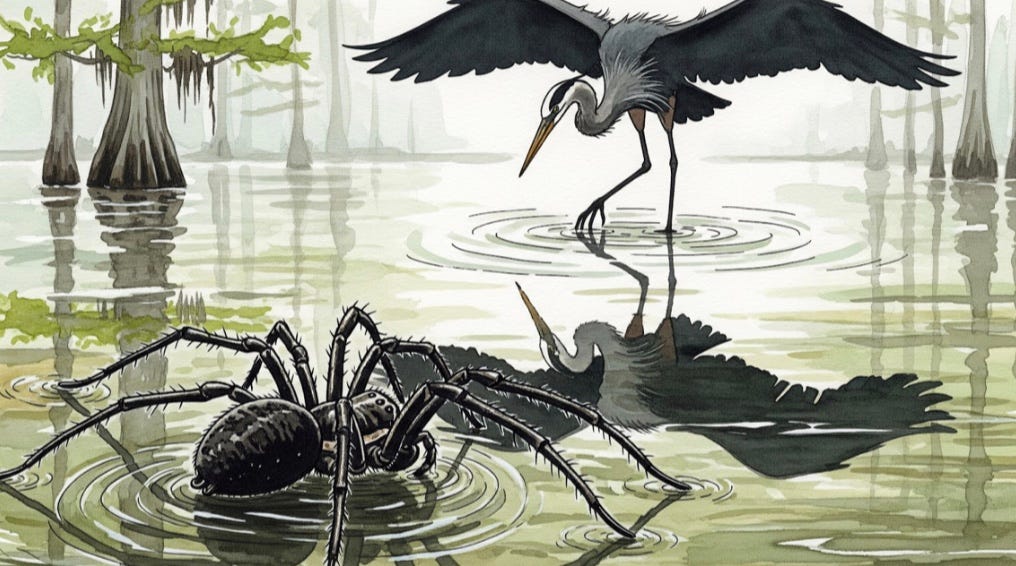
The truly bizarre part of her story happens when danger comes. If a hungry Great Heron swoops too close, or a massive Alligator Gar glides by, this spider doesn’t run toward the shore. She, as we say in Cajun French, simply plonges (plunges/dives). Happily, for her, she’s not drowning. She’s engaging in a peculiar act of biological brilliance.
Her entire body is covered in fine, dense hairs. As she slips beneath the surface, these hairs trap a thin, glistening layer of air, her personal silvery scuba suit, that surrounds her like a portable bubble. She becomes a living submarine. She can cling to an underwater root, or the submerged bark of a Bald Cypress tree.
There she sits, breathing her little pocket of swamp-air, and waiting out the trouble for up to half an hour. She makes the L’Affaire Fini threat simply disappear. That fact, c’est vrai (that’s true), is a mighty fine trick.
Now, here is where the bayou’s natural spider oddity connects to a deeper, more human reality. She shows how to tell scientific facts about climate change and its effect on nature factually without putting your audience to sleep. That’s because the constantly-evolving existential crisis of the climate often feels a lot like that of the ol’ White Heron. It’s a huge bad case of the vois-là, an inevitable danger that you can’t run away from.
The way some creative technical writers are trying to capture that reality is just as strange as a certain spider species’ scuba dive. When you can’t outrun the misère (misery/trouble), you have to find a new way to tell the story.
This is so much like very act of writing creative nonfiction through the climate crisis has its own set of odd, profound, and fun facts:
Odd Fun Facts of Writing the Existential Reality
1. The “Slow Violence” Problem Demands New Forms
The climate crisis rarely involves a neat, dramatic explosion. It’s mostly “slow violence.” The gradual, almost invisible rising of the water, the creeping salinity, the erosion of the marsh. The odd challenge for the Louisiana writer, is that they have to invent entirely new, often experimental, narrative techniques just to make a slow-motion disaster feel as urgent as a gunshot.
This is why you sometimes see writers like us using techniques like fractured chronology, list-memoirs, or braided essays. They are desperate attempts to make the un-dramatic and continuous nature of environmental trauma feel viscéral (visceral) to the reader.
2. The Rise of the “Carrier Bag Narrative”
Forget the epic traditional story of the single hero conquering the storm. Many climate writers are advocating for author Ursula K. Le Guin’s concept of the “Carrier Bag Theory of Fiction.” The odd fun fact here is that the best climate stories shouldn’t have a single, satisfying plot arc (a triumph!). They should be a messy “bag” full of diverse voices, ongoing processes, small acts of loss, and fragments of hope.
Strive for mirroring the complex, non-linear reality of the crisis. This form rejects the idea that a single person can ‘solve’ the problem, instead emphasizing the power of collective, ongoing endurance. (snip)
October 10, 1699 The Spanish issued a royal decree which stated that every African-American who came to St. Augustine, Florida, and adopted Catholicism would be free and protected from the English.
October 10, 1963 The Limited Test Ban Treaty—banning nuclear tests in the oceans, in the atmosphere, and in outer space—went into effect. The nuclear powers of the time—the United States, Great Britain, and the Soviet Union—had signed the treaty earlier in the year. In 1957, Nobel Prize-winner (Chemistry) Linus Pauling drafted the Scientists’ Bomb-Test Appeal with two colleagues, Barry Commoner and Ted Condon, eventually gaining the support of 11,000 scientists from 49 countries for an end to the testing of nuclear weapons. These included Bertrand Russell, Albert Einstein, and Albert Schweitzer. Linus Pauling Pauling then took the resolution to Dag Hammarskjöld, then Secretary-General of the United Nations, and sent copies to both President John F. Kennedy and Soviet Premier Nikita Kruschev. The final treaty had many similarities to Pauling’s draft. It went into effect the same day as the announcement of Pauling’s second Nobel Prize, this time for Peace.
October 10, 1967 The Outer Space Treaty (Treaty on Principles Governing the Activities of States in the Exploration and Use of Outer Space, Including the Moon and Other Celestial Bodies) demilitarizing outer space went into force.It sought to avoid “a new form of colonial competition” as in the Antarctic Treaty, and the possible damage that self-seeking exploitation might cause. Discussions on banning weapons of mass destruction in orbit had begun among the major powers ten years earlier. 1949 painting by Frank Tinsley of the infamous “Military Space Platform” proposed by then Secretary of Defense James Forrestal in the December 1948 military budget. The text of the treaty Read more
October 10, 1986 Elliott Abrams, then assistant secretary of state for inter-American affairs, testified before the Senate Foreign Relations Committee (in closed executive session) that he did not know that Marine Lt. Col. Oliver North, a White House employee in the Reagan administration, was directing illegal arms sales to Iran and diverting the proceeds to assist the Nicaraguan contras. Abrams pled guilty in 1991 to withholding information on the Iran-contra affair during that congressional testimony, but was pardoned by President George H.W. Bush. Elliott Abrams Presidents George W. Bush & George H.W. Bush Oliver North Read more about the pardons
October 10, 1987 Thirty thousand Germans demonstrated against construction of a large-scale nuclear reprocessing installation at Wackersdorf in mostly rural northern Bavaria.
October 10, 2002 The House voted 296-133 to pass the “Joint Resolution to Authorize the Use of United States Armed Forces Against Iraq,” giving President George W. Bush broad authority to use military force against Iraqi leader Saddam Hussein, with or without U.N. support.
October 4, 1976 Earl Butz resigned as President Gerald Ford’s agriculture secretary with an apology for what he called the “gross indiscretion” of uttering a racist remark.
October 4, 1997 Demonstrations across the country occurred protesting the scheduled launch of the space probe Cassini because its power source was three plutonium-fueled Radioisotope Thermoelectric Generators.The probe carried 72.3 pounds of plutonium, the most ever put on a device to be launched into space. The concern was for an accidental release in the event of a launch mishap. Plutonium is the most toxic substance known. “It is so toxic,” says Helen Caldicott, president emeritus of Physicians for Social Responsibility, “that less than one-millionth of a gram is a carcinogenic dose. One pound, if uniformly distributed, could hypothetically induce lung cancer in every person on Earth.” The Risk of Cassini Probe Plutonium An interview with Dr. Caldicott
TOPEKA (KSNT) – If you’ve been outside lately you may have noticed some annoying little bugs are out and about.
The arrival of late summer and early fall brings with it an irritating insect known as the minute pirate bug. These pesky bugs, while not dangerous, have a bad habit of biting people.
Minute pirate bugs feed on everything from smaller insects to pollen grains, according to Kansas State University’s Research and Extension Office. While small in size, about as big as the head of a pin, the bugs are usually found flying around in fields. The bugs may start to move out of these areas in late summer and make themselves known by biting people.
“Though small, these insects have a surprisingly painful bite. They use their short, blunt beak to try to probe into the skin. They do not feed on blood, inject a venom or saliva, or transmit any disease.”Kansas State University Research and Extension Office publication excerpt
A minute pirate bug. (Getty Images)
People bitten by the bugs may find themselves covered in reddened skin, experience swelling or become itchy. K-State reports that repellents aren’t usually effective against the bugs but instead recommends wearing long darker-colored clothes to appear less attractive to them.
While minute pirate bugs might be annoying, they are very beneficial to the local environment. Minute pirate bugs feed on other insects, such as aphids and caterpillars, which helps manage garden areas. (snip-a bit MORE)
Jane Goodall, the conservationist renowned for her groundbreaking chimpanzee field research and globe-spanning environmental advocacy, has died
By HALLIE GOLDEN – Associated Press Updated 37 minutes ago
Jane Goodall, the conservationist renowned for her groundbreaking chimpanzee field research and globe-spanning environmental advocacy, has died. She was 91.
The Jane Goodall Institute announced the primatologist’s death Wednesday in an Instagram post. According to the Washington, D.C.-based institute, Goodall died of natural causes while in California on a U.S. speaking tour.
Her discoveries “revolutionized science, and she was a tireless advocate for the protection and restoration of our natural world,” it said. (snip-MORE on the page)
September 29, 2025 Velentina BoulterVelentina Boulter is science journalist based in Melbourne.
Composite image, or orthomosaic, of the wreck of Benzonia lying partially on top of the wreck of Caribou, in the “Ghost Fleet” of World War 1 shipwrecks in Mallows Bay, USA. Credit: Duke Marine Robotics and Remote Sensing Lab
Two recently published studies showcase how underwater human structures can become essential habitats for marine life, with discarded munitions and ships from the World Wars now home to vibrant ecological communities.
The first study found that more marine life lives on World War II munitions on the Baltic Sea floor than on the surrounding sediment. Some of the marine organisms can tolerate the high levels of toxic compounds leaking from the unexploded bombs, as long as there is a hard surface for them to live on.
In a separate study, published in Scientific Data, researchers from Duke University’s Marine Robotics and Remote Sensing lab mapped a “Ghost Fleet” of World War I shipwrecks which have become habitat for a variety of wildlife, such as ospreys.
“For the first time, the composition and structure of epifauna on the surface of marine munitions are described,” write the authors of the first study, which has recently been published in Communications Earth & Environment. Epifauna refers to sea creatures that live on the seafloor.
Unused explosive munitions were often disposed of by dumping them at sea prior to the signing of the 1972 London Convention on the Prevention of Marine Pollution. The team used a remotely controlled submersible to examine a dumpsite in Lübeck Bay in the Baltic Sea to investigate the impact the munitions have had on marine environments.
The remotely controlled submersible Käpt’n Blaubär being inspected on the deck of RV Alkor during the research cruise AL628, March 2025. Credit: Ilka Thomsen, GEOMAR
Only 2 of the 9 objects examined were intact. The other 7 were in varying stages of degradation, which meant the explosive chemicals were exposed.
They identified the munitions as being from discarded warheads from V-1 flying bombs which were used by Nazi Germany in the late stages of World War II. Concentrations of the explosive compounds, mainly TNT and RDX, were found to vary between 30 nanograms and 2.7 milligrams per litre in the surrounding water.
Despite this, an average of about 43,000 organisms per square metre (m2) were found living on the munitions, with only 8,200 organisms per m2 on natural sediment nearby.
“On the individual objects,” write the authors, “the majority of epifauna was found on metal carcasses, while the exposed explosive was usually free of visible overgrowth.”
These results suggest the advantages of living on the surfaces of munitions outweigh the potential exposure to explosive and toxic chemicals for many marine organisms.
“This suggests that the high measured explosive chemical concentrations are not sustained long-term, or that they, in fact, do not have a major negative effect on nearby organisms,” the authors write.
“Overall, the epifaunal community on the dumped munition in the study area reaches a high density, with the elevated metal structures providing a suitable habitat for benthic organisms.”
While the munitions seem to be an important habitat for this local ecosystem, the researchers suggest replacing them with a safer artificial surface that does not contain explosives to further benefit marine life.
Composite image of the entire “Ghost Fleet” of Mallows Bay, with individual wrecks labelled. Credit: Duke Marine Robotics and Remote Sensing Lab
In the second study, a team of researchers conducted aerial surveys to capture images of 147 abandoned World War I steamships at Mallows Bay on the Potomac River in Maryland, USA. It is the largest known shipwreck in the Western Hemisphere.
“Since their arrival, the ships have become an integral part of the ecology at Mallows Bay,” write the authors.
“However, sea level rise, sediment infill, plant colonisation, and physical deterioration are changing the nature of these shipwrecks over time.”
Like the previous study, the researchers found a variety of creatures have made the shipwreck their home. One of the species includes the endangered Atlantic sturgeon, which uses the ship as its nursery.
As the “Ghost Fleet” shipwrecks become islands, they are shaping both the coastal and aquatic habitats of Mallows Bay. The “Three Sisters” are pictured in the bottom right. Credit: Duke Marine Robotics and Remote Sensing Lab
The authors are hopeful their map will be an insightful resource for future ecological and archaeological research into the area.
“These data and products will enable researchers to monitor and study the changing terrestrial and aquatic ecosystems,” write the authors.
“The use of unoccupied aircraft systems allows for the creation of detailed orthomosaics and digital surface models, which provide valuable baseline data for archaeological, geological, and ecological assessments.”