When I tell people about this they think I am crazy. This is how far modern religious Puritan morality has pushed into the public. We went from times when boys being nude was OK, fun, and pretty normal to now just the idea of young people seeing a nude statue like David of Michelangelo got a Florida principle fired. How ridiculous has this become. Seeing a nude human, even one in a painting or work of art, will destroy a child? Will cause the downfall of a nation? There are states trying to outlaw watching porn for adults because the religious people have to regulate all behavior, even adults private consensual behavior. It is time to stop this march of the moral vice police / the US Christian Taliban. I know I have enjoyed the times in my life I was able to swim nude, in public and private. I think growing up if more boys had been forced to be nude for more than a quick run under the locker shower, they may have been less self-conscious about themselves and their development. I know it surprised me when I went to church boarding school that the male dorm showers were just a large room with many shower heads on the wall but most of the kids except a few were OK with it. In fact me and my friends often planned our mornings to shower together. And it was not a sexual thing, it was the normal start of the day when we first got together. Hugs
I don’t have the background nor the education to evaluate these claims. They make sense to me as I read the argument. I would be interested in those that come to my playtime that do engage more in the Christian religion or have studied the bible. Hugs
Let’s explore what the Bible says about transgender people, its general perspective on gender and identity, and common misinterpretations.
Many people wonder, “What does the Bible say about transgender people?” — from conservative Christians who want to point to “Biblical truths” about gender identity, biological sex, and men and women to LGBTQ+ and ally Christians who want to support diverse identities. But even though trans people have existed throughout history, the Bible doesn’t directly mention trans people because the term “transgender” wasn’t coined until the 1960s.
Despite this, the Bible does examine some issues having to do with gender identity, biological sex, and also men and women. Queer and progressive theologians spoke with LGBTQ Nation about some commonly misinterpreted Bible verses, verses that seem to affirm trans people, and different ways of understanding Christianity’s message to transgender people.
Trans people have been kings and queens, fought in wars, and led the fight for LGBTQ+ rights, thriving despite widespread social oppression.
Understanding gender in the Bible
British theologian Rev. Jonathan Tallon says that some people point to Bible verses as proof that God created only two distinct genders and, because “God doesn’t make mistakes,” changing gender is “against God and God’s plan.”
But these empty slogans ignore the existence of transgender people as well as intersex individuals, those born “with a reproductive or sexual anatomy that doesn’t seem to fit the typical definitions of female or male.”
Two such verses illustrate the narrow way that some Christians misinterpret the Bible and how history and modern perspectives can provide new insights into the ancient text.
Genesis 1:27 – So God is a man?… and he only created two genders?
“So God created humankind in his image, in the image of God he created them; male and female he created them.”
Some people point to this verse, the first mention of gender in the Bible, as “proof” that God only created two genders — man and woman — and nothing in between. But this is a misinterpretation that ignores that most things in the world exist on a spectrum, says Dr. Justin Sabia-Tanis, Assistant Professor of Christian Ethics and Social Transformation at the United Theological Seminary of the Twin Cities.
Dr. Sabia-Tanis tells LGBTQ Nation, “In the original Hebrew, the verbs used for God are both feminine and masculine; God is shown here as embracing more than one gender, so we know more complex things are happening with gender here.”
He also points out that, before creating humans, God created the day and night as well as water and land.
“Day transitions to the night at dusk; night becomes day at dawn — it’s not an on/off switch but a continual process,” Sabia-Tanis writes. “And then, in a similar way, the sky and the waters, and then the waters and the land, are separated. We know, however, there are many places in which both water and land mingle — wetlands, estuaries, beaches. And places where sky and water are one — clouds, the cycle of evaporation. The sky and the water, the water and the land has never been a binary system, but a cyclical, dynamic one.”
Deuteronomy 22:5 – Is God super-judgy about personal fashion choices?
“A woman shall not wear a man’s apparel, nor shall a man put on a woman’s garment; for whoever does such things is abhorrent to the Lord your God.”
This verse is the only one that directly references gender-based notions of clothing.
While the Bible honors many women of faith who act bravely, there are also many verses that dictate what men and women should do: how women should behave, how husbands and wives should treat each other, and how children should honor their mothers or fathers.
The Bible’s Old Testament contains 613 commandments known as Old Testament Law, ancient Biblical law, or Mosaic Law. These laws were created around 1393 to 1273 BC and were issued to regulate almost every aspect of Jewish life at a time when the Jewish people were still a group of ex-slaves struggling to survive in the desert. In fact, Biblical scholars have theorized that this specific law about clothing may have been established as a way to differentiate Jews from other religious cultures or as a way to ensure that the Jews’ gender-segregated society stayed truly segregated.
“This would prevent things like men and women engaging in various forms of forbidden sexual contact, women from entering the temple, men evading military service, women signing up for military service, and other behaviors perceived as contrary to the boundaries between the distinct parts of God’s created order,” three queer theologians told the Human Rights Campaign (HRC).
Mosaic Law also contains prohibitions against wearing garments of linen and wool together; burning incense; eating pork, rabbit, and shellfish; charging interest on loans; and working on Saturdays. In fact, the Old Testament refers to each of these things as “abominations” and states that the latter two items should be punished by death. Other parts of the Old Testament say it’s okay to kill women who have pre-marital sex, to smear animal feces on the faces of lazy priests, and that it’s okay to own and beat slaves.
Of course, most contemporary Christians don’t follow these ancient Biblical laws because they don’t make any sense in modern-day life. As such, people who point to Deuteronomy 22:5 to demonize trans people and other “gender-nonconformists” should question why they’re willing to uphold this particular Biblical law while ignoring all the rest — it’s likely because they want a religious-based reason to punish people they disapprove of.
However, another verse in the Bible, Hebrews 8:13, explicitly states that people no longer need to follow ancient Biblical laws now that Jesus Christ established a new covenant between man and God. The verse states, “By calling this covenant ‘new,’ he has made the first one (Mosaic Law) obsolete; and what is obsolete and outdated will soon disappear.”
Perspectives on Being Transgender in Christianity
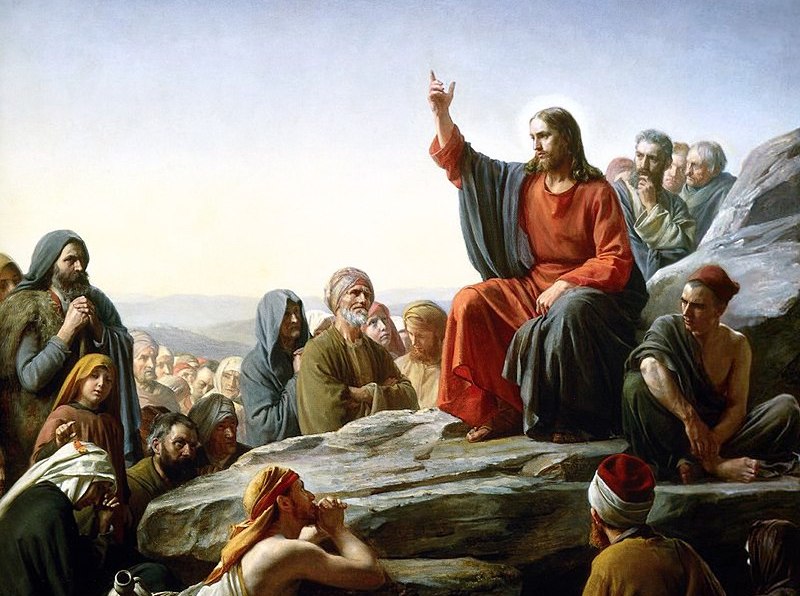
Jesus’s Sermon on the Mount by Carl Bloch (1877)
While the Bible literally says nothing about transgender people, biological sex, or gender dysphoria, there are still a handful of verses that show how the earliest Christians embraced marginalized people as well as eunuchs, people whose bodily changes subjected them to widespread oppression.
Galatians 3:28 – All are equal in the love of Christ
“There is neither Jew nor Greek, there is neither bond nor free, there is neither male nor female: for ye are all one in Christ Jesus.”
This verse appears in the apostle Paul’s letters to early Christian churches. In his letter, he angrily begins, “You foolish Galatians! Who has bewitched you?” He then asks church leaders who taught them to judge other Christians by their physical bodies and how well they follow laws rather than by their spirit or faith.
Paul says that ancient Biblical law was only put in place to help guide and protect people until Jesus arrived. But after Jesus arrived, one’s faith mattered more than one’s adherence to old laws.
Queer theologians told the HRC that when Paul says “there is neither male nor female,” that doesn’t mean that individual differences shouldn’t matter. Indeed, Paul’s other letters reveal that he considered personal differences important within the church. But Paul’s letter says that if we are all children of God, then that should be the basis for building a community together rather than discriminating against others based on nationality, race, social standing, class, or gender.
This sentiment is echoed in 2 Corinthians 4:7, a verse that compares the light of God inside of humans to “treasure in jars of clay.” Reflecting on this verse, queer-affirming Rev. Tallon asked LGBTQ Nation, “Which is more important: the clay jar or the treasure?”
“Yes, we need to take our physical bodies seriously – we follow an incarnate Christ. Our bodies are real. But so is what is going on inside us. Our minds are real too.” Rev. Tallon continues. “Your gender identity is how you think of (and feel about) yourself … Is making a commitment to Christ real, or just a feeling? Is having an identity in Christ real, or just psychology? To reduce biology to being the only reality is sub-Christian.”
Matthew 25:40 – We honor God by loving trans people
“And the King answering shall say to them, Verily, I say to you, Inasmuch as ye have done it to one of the least of these my brethren, ye have done it to me.”
This verse comes from a parable Jesus tells about God returning to the Earth as a messianic king who separates righteous people from the wicked. The king knows the righteous because they are the ones who fed, sheltered, clothed, and healed the poor, sick, and imprisoned. When the wicked people protest that the poor, sick, and imprisoned have nothing to do with their king, God essentially says, “But that which you did to the lowest of people, you also did to me.”
Put another way, Jesus says that a person’s relationship with the most marginalized people in society reflects their relationship with God — people honor God by honoring oppressed people. When people ignore or abuse trans folks, they ignore and abuse God as well as God’s commandment to love the most oppressed people in society.
“Here Jesus brings a notion of the least: those marginalized and scapegoated [and] the persons or groups targeted for exclusion and violence,” priest and theologian author Robert E. Goss tells LGBTQ Nation. “What I love about Jesus is that he consistently teaches us that compassion is justice. When we stand in solidarity with those who are marginalized we stand for [Jesus Christ].”
Psalms 139:13-16 – God’s gift of life blesses trans people and their bodies
“For you created my inmost being; you knit me together in my mother’s womb. I praise you because I am fearfully and wonderfully made; your works are wonderful, I know that full well. My frame was not hidden from you when I was made in the secret place, when I was woven together in the depths of the earth. Your eyes saw my unformed body; all the days ordained for me were written in your book before one of them came to be.”
These verses appear in the middle of a hymn that praises God for being ever-present and all-knowing of everyone’s innermost thoughts and beings. Some people point to this verse as proof that God purposefully created each person’s soul and body before birth, and thus changing one’s body goes against God’s creation.
But queer-affirming theologians see no textual basis in the Bible to think that God’s creation of bodies and souls should exclude any person’s gender identity or gender expression. Indeed, cisgender people regularly undergo medical and non-medical “gender-affirming care” — including styling their hair, wearing certain fashions, taking medications, having surgeries, and otherwise altering their appearance — in ways that affirm their God-given bodies while fitting the self-image they hold in their hearts and minds.
“[Many trans people who undergo physical transformations are] acting on the conviction that being ‘fearfully and wonderfully made’ means that peace and wholeness is actually what God wants for us and for the world, whatever that journey looks like to each person,” several theologians wrote.
The Eunuchs: proto-transgender people in the Bible
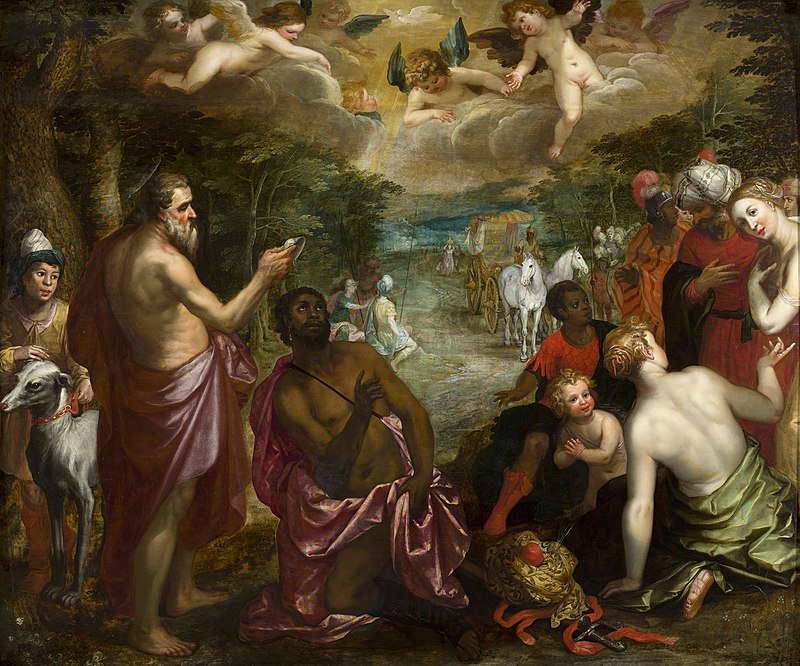
The Baptism of Queen Candace’s Eunuch (c. 1625–30, attributed to Hendrick van Balen and Jan Brueghel the Younger)
The Bible doesn’t explicitly mention trans people, but it does contain several references to “eunuchs.” Eunuchs weren’t exactly transgender — they were people who were either intersex or who were assigned male at birth and had their external genitals removed before puberty. A Biblical law from Deuteronomy 23:1 forbids eunuchs from participating in Israelite society. As such, eunuchs in ancient Isreal experienced discrimination and oppression similar to what some trans people face today.
“Eunuchs have been proto-transgender individuals in the ancient world and even in the modern world as Hijras, religious eunuchs in Hinduism,” priest and theologian author Robert E. Goss tells LGBTQ Nation. “The eunuch was not religiously acceptable in the ancient world as transgender folks are not acceptable to many conservative Christians today.”
Dr. Sabia-Tanis tells LGBTQ Nation, “I think the value of looking at the eunuchs is not that we (trans people) share persecution with them, but that we embody similar variations in human society and physiology. I’m not sure if this helps address religiously-based transphobia, simply because I’m not sure how much it helps change those who have already firmly made up their minds to exclude and reject trans people. But, these points do, I think, provide information and comfort to those who are open to hearing it.”
Matthew 19:12 – Loving trans people is a divinely radical act
“For there are eunuchs who were born that way, and there are eunuchs who have been made eunuchs by others—and there are those who choose to live like eunuchs for the sake of the kingdom of heaven. The one who can accept this should accept it.”
Jesus says these words when speaking to Judeans asking whether divorce should be legal. Numerous verses command married people to treat their spouses with love and respect, and Jesus tells the Judeans that it’s actually better for people not to marry in the first place rather than to get divorced later on.
Understanding that some Judeans may reject his radical opposition to divorce, Jesus then mentions that there are many types of eunuchs and that people should accept them as well, even though some may find that too radical.
Isaiah 56:5 – Trans people (and their names) are included in God’s many blessings
“To the eunuchs who keep my Sabbaths, who choose the things that please me and hold fast my covenant, I will give, in my house and within my walls, a monument and a name better than sons and daughters; I will give them an everlasting name that shall not be cut off.”
In this section, the prophet Isaiah conveys the voice of God, urging the people of Israel to keep their covenant with God by observing the Sabbath, a religious day when one isn’t supposed to work. “Blessed is the one who does this,” God is quoted as saying in book of Isaiah.
God then states that this commandment includes foreigners and eunuchs, even those who think that they fall outside of God’s blessing. Put another way, God says that no one is excluded from God’s blessings, even outcasts who were traditionally excluded from the socio-cultural life of ancient Isreal.
Dr. Sabia-Tanis tells LGBTQ Nation, “In fact, [God’s] promises are directed precisely towards those who have been treated unjustly and excluded from society. God never reserves privileges for those who follow societal norms or behaves ‘properly’ in human terms — God’s call is to be just and faithful according to God’s commandments, which include how we treat the poor and outcast.”
Sabia-Tanis also points out that God’s reward of an everlasting name makes Isaiah 56:5 a particularly beautiful verse for nonbinary and trans people who may change their names. “It affirms the promise of an authentic name that is everlasting and blessed by God,” he said.
Acts 8:26-36 – God wants Christians to welcome trans people with open arms
While traveling, Phillip, an evangelist who cares for poor Christians in Jerusalem, meets an Ethiopian on a chariot who is also a eunuch. The Ethiopian, who is reading a scroll of Isaiah, asks Philip to explain a Bible verse to him, and Philip does. When the two later encounter a body of water, the eunuch asks, “Look, here is water. What can stand in the way of my being baptized?” Finding that there is nothing that should prevent, exclude, or deny the eunuch, Philip baptizes him, and the Ethiopian leaves rejoicing.
Dr. Sabia-Tanis told LGBTQ Nation that this Biblical story about a eunuch isn’t about discrimination or dehumanization. Instead, the Ethiopian “is treated as a person, who has riches (which we know because of his position in the queen’s court, his chariot, and his scroll), and is included.”
“While there are earlier baptisms in the book of Acts, this is the first really detailed account in which we get to know a bit about a person who desires to join the emerging Christian faith,” Dr. Sabia-Tanis adds. “The author chose this [story in partcular], I believe, to illustrate the inclusion of all kinds of people into the Jesus movement. It would have been easy to tell the story of an upstanding male pillar of the Jewish community being baptized — no controversies about Gentiles or women or eunuchs — but instead, the story was told about an outsider. That’s important.”
“This is a Biblical model about how to respond to nonbinary and transgender people — and one that the church should follow,” Dr. Sabia-Tanis continues. “There is no litmus test or exclusions because of who the person is, what their ethnicity or gender, or nationality is, or any other category. Just inclusion.”
Goss tells LGBTQ Nation, “The post-Easter Jesus movement reflected Jesus’ radical inclusive practices of inviting outsiders and marginalized into his table fellowship. If God in the Isaiah scripture, Jesus in the eunuch statement in Matthew, and Luke in Acts on the baptism of the Ethiopian eunuch [all welcome eunuchs] into the body of Christ, then we can stand [with trans people] in solidarity.”
A complex topic for Christianity
The topic of transgender individuals and their place in Christianity is intricate and layered. While the Bible may not explicitly refer to transgender individuals, it does offer insight into the larger concepts of gender and identity.
It’s worth noting that the way different denominations and individuals approach this issue varies widely – some condemning, while others accepting and showing love.
Ultimately, it’s important to approach all interactions with individuals, regardless of their gender identity or how they choose to express themselves, with love and empathy as a guide.
Stay informed on the latest issues impacting the LGBTQ+ community by subscribing to the LGBTQ Nation newsletter.
Along with their parents and two health care providers, two trans teens are suing the state of Montana for its recent ban on gender-affirming care for trans youth.
The plaintiffs argue that the law, S.B. 99, violates the state constitution, which guarantees the right to equal protection, the right of parents to direct the upbringing of their children, the right to dignity, and the right to seek healthcare.
Her lawsuit to be allowed back in failed right as the legislative session ended. Some of her colleagues were happy to see her.
The lawsuit, which was filed on behalf of the plaintiffs by the ACLU of Montana and Lambda Legal, also argues the unjust nature of the law because it bans gender-affirming care for trans youth but allows cisgender youth access to the same medical care for other reasons.
“The Act is so damaging to the health and well-being of transgender adolescents that some of these adolescents’ families with the resources to do so have taken steps to uproot their entire lives to move out of Montana in light of the Act,” the lawsuit states.
“For many more, however, that devastating option is not available, so these families and youth will have no choice but to remain and endure the harms that the Act inflicts.”
The litigants include 16-year-old trans girl Scarlet, along with her parents Jessica and Ewout van Garderen; 15-year-old trans boy Phoebe, along with his parents Molly and Paul Cross; Dr. Katy Mistretta of Bozeman Creek Family Health; and Dr. Juanita Hodax of Community Medical Center.
“I will never understand why my representatives are working to strip me of my rights and the rights of other transgender kids,” said Phoebe Cross in a statement. “Just living as a trans teenager is difficult enough, the last thing me and my peers need is to have our rights taken away. There were many things I hoped my elected officials would achieve, this regression in human rights is not one of those things. The blatant disrespect for my humanity and existence is deeply unsettling.”
Jessica van Garderen added, “It is mentally and physically painful to feel like you are trapped in the wrong body. Going through puberty for the wrong sex is like having your body betray you on a daily basis. The only treatment we have found to be effective and give our daughter hope again is hormone therapy. The difference we have experienced is night and day and there is no going back. Taking away this crucial medical care is inhumane and a violation of our rights. We will fight this law for our daughter and every other family whose rights are being trampled.”
The legislation was signed in April by Republican Gov. Greg Gianforte and will go into effect on October 1. The state became the center of national discourse after the anti-trans Republicans banned trans Montana state Rep. Zooey Zephyr (D) from the state house floor for speaking out against the bill.
Zephyr accused Republicans of having “blood on your hands” for supporting the bill. They then voted to prevent her from entering the chamber after she raised an inactive microphone toward protestors in the state house gallery who chanted, “Let her speak!” The protestors were later arrested.
Zephyr was forced to vote remotely on bills while sitting on a bench outside the chamber in the state Capitol building. She also filed a lawsuit, but the judge declined to grant her relief from the Republicans’ censure order.
She would remain barred from the state house floor until the legislative session was adjourned. It has since ended, and she made a triumphant return.
I live in Michigan, so I am allowed to make this statement: The Lions have demonstrated an ability to consistently disappoint their fans to a level only surpassed, maybe, by the Cleveland Browns. And yet, my uncle was not only a great fan of the Lions team but wouldn’t miss a game on tv. That, my friends, is the mark of a true fan: it isn’t the fact that the product is the best in quality, best in performance, best in taste, it’s the fact that a fan is a fan for no better reason than he has chosen to be a fan. Thereby lives a love of heartbreak, ridicule, and a test of loyalty sufficient to scar any soul forever. I of course come from much better stock: I am a fan of the Chicago Bears. Da Bears! If you’ve not solved this puzzle by now, this is not about the Lions. Don’t get me wrong, they will forever disappoint – Sorry Uncle Bob – but this post regards how a beer company has received backlash for sending beer to someone who is an internet influencer. Now, there are few things in this world that I purposely choose not to pay attention to, and among those are the Lions and things that republicans and rednecks have chosen to cancel in their anti-cancel-culture rants. Yes, that’s confusing. It makes more sense if you drink a lot of low-quality beer and believe what Tucker Calson tells you.
Loyalty trumps Competence, as the saying goes. And, while there are those who believe Bud Light cheated on them, I expect to find all of those who have made a lifetime commitment with their Bud Light beer that has weathered two marriages, four kids, eight teeth and 29-stories that start with “dude, hold my beer…” will be drinking again like nothing happened. In time they will forget why they were mad at a beer – because let’s face it, who gets mad at beer? And, those of us watching from the sidelines, even as reluctantly as I, will remember that this was never about the beer, never about the internet influencer, but was ultimately about the homo- and the trans-phobic prejudice and hate that was so easily stirred to cause the easily led to put down their favorite beer.
I, for one, am going to continue to buy Bud Light. Mainly because it’s very drinkable – as the joke goes it’s much like sex in a canoe. What I would like to hear them ask these detractors is why they are so against someone being who they are? Who are they to not only disparage the character of that person, but to speak as if a beer company deserves to be shot for treating a person as a living and worthwhile person? Each of us in America is born with the freedom to voice our opinion. It bothers me that so many have chosen to use this freedom to be so manipulated as to only be able to speak hate and so weak as to give up a beer they appear to love for the affront of giving another citizen simple respect. What are they truly angry or afraid of?
I love Randy’s writing. He has a way of getting his heartfelt ideas across with words that few can manage. I am glad he has offered to add his voice here. When Randy was talking with me on this post, he mentioned it might help people understand how stupid this unwarranted hate response was if people could see the video that these bigots are responding to. Also remember that these cans of beer with Dylan Mulvaney’s picture on them were not mass-produced, were never for sale to the public. These few cans were just a promotional gimmick and were not intended for putting in stores. This was not a national commercial but only on social media. If the bigots and haters had ignored it, then very few would even have known of the entire thing. But the haters managed to gin this up using a fake outrage over something not happening and getting people who drink a mediocre mass-produced beer to question their own manhood. That was what this was about, men fearing a beer that had let a trans woman promote it made them less than a man if they drank it, made them less masculine, maybe others would question the size of their penis by the beer they drank because a few cans had a trans woman on them. That is what this is really about, look at how the men reacted in destroying the cans of beer, with displays of macho destruction while yelling about how manly they are. In fact most hate of trans people is about fear of measuring up to some mythical stereotypical standards for what is masculine or feminine. Below is the social media promotion by Dylan Mulvaney. Hugs
*** it was hard to find just the video with no commentary added. The comments are the YouTube page constantly cisgender Dylan as he and calling her a gay man. Dylan Mulvaney identifies as a trans woman, and she is proud to be a woman. Hugs
A remarkable student comes forward at a school board meeting and shares the importance of lgbtq+ rights and transgender rights. The students shares the struggles the trans community faces in states like Missouri, North Carolina and Florida. The transgender community needs support now more than ever, especially in the young people like this student here.
Damn amazing! I think this boy will go far in life, and it gives me hope for the future. We need more young people like him. Sadly the school board won’t listen to him or his supporters. They have their idea that adults know so much more than kids do about their own body. Why because their god tells them this in a book written 2,500 years ago amended and incorrectly translated over centuries, that this boy can not exist. Their personal view of 1950s gender ideology and their political desires make this boy’s testimony something they scoff at and won’t hear. Yet in a few years this boy and his friends will vote these people out of office if we still have a democracy. And that terrifies these religious conservative bigots enough that they want to do way with democracy and allowing people to vote. Hugs
This post is for those that mistakenly thought these anti-drag bills were about protecting kids from sexualized burlesque type shows. The law is written very clearly to stop men from dressing like women and women from dressing like men in public. That was the intent from the beginning of this anti-drag queens stuff, the republicans just had to frame it as protecting kids from sex to get the public to accept it. Hugs
It’s aimed at banning minors from “sexually oriented performance,” which the bill initially defined as a “male performer exhibiting as a female, or a female performer exhibiting as a male.” If the bill becomes law, drag performers could face a criminal misdemeanor charge if they perform in front of children or on public property, and venues that host drag performances could face penalties up to $10,000.
“This legislature has spent more time targeting queer people than gun violence.”
A Texas drag performer was escorted out of a public hearing on one of the state’s anti-drag bills.
As NBC affiliate KXAN reports, the Texas House of Representatives State Affairs committee held a public hearing on Wednesday to discuss S.B. 12, which was passed by the state senate last month. It’s aimed at banning minors from “sexually oriented performance,” which the bill initially defined as a “male performer exhibiting as a female, or a female performer exhibiting as a male.” If the bill becomes law, drag performers could face a criminal misdemeanor charge if they perform in front of children or on public property, and venues that host drag performances could face penalties up to $10,000.
RELATED STORIES
Texas House votes unanimously to expel “anti-grooming” Republican after he groomed a teenager
He used to rail against drag queens performing in front of kids. Now one of his colleagues said he’s the “type of man who steals innocence.”
At Wednesday’s hearing, the committee was considering removing any mention of drag from S.B. 12.
Get the Daily Brief
The news you care about, reported on by the people who care about you.
Austin drag performer Brigitte Bandit was one of nearly 400 people who signed up to testify, the overwhelming majority of them opposing the bill, according to KXAN. Bandit appeared before the committee in a dress bearing the names of the victims of the Uvalde and Allen mass shootings to argue that the real danger facing the state’s children is gun violence, not drag queens.
“This legislature has spent more time targeting queer people than gun violence, even following yet another mass shooting in our state,” she tweeted on Wednesday.
After reportedly speaking 15 seconds over her allotted time, Bandit was escorted out of the hearing by security.
while wearing the names of the victims of the Uvalde and Allen shootings and after waiting 13 hours to speak, I was escorted out by police for testifying seconds over my allotted time to address the real harm that threatens TX kids: gun violence, not drag queens. pic.twitter.com/nyQiEg20n9
Republicans refuse to allow anyone to speak against what they want to do, even if that person is a fellow republican. This is because they demand to rule the public, not to serve the public. They demand power so they can use that power to force all others to follow their conservative religious dictates. And this is happening all over the country, as we have seen. Hugs
It happened again. Representative Chris Sander, a gay Republican, raised his hand to speak on a bill. Republicans instead chose to silence opposition and did not allow him to speak.
Please support my independent reporting and activism on transgender legislation by subscribing. You help me keep this going and keep people informed.
Subscribe
——————————————————————————
The Republican Party has repeatedly barred discussion on LGBTQ+ bills this year. Despite holding supermajorities in numerous instances, they have frequently silenced oppositional voices. Notably, in Oklahoma, GOP members censured Representative Mauree Turner, a Black, nonbinary representative. In Kentucky, an attempt was made to hold a hearing without any Democratic representatives. This was announced during a lunch break when microphones were turned off. A recent incident in Montana saw transgender Rep. Zooey Zephyr ejected from the house floor and silenced simply for speaking to the harm these bills cause, preventing her from commenting on anti-trans bills. Today, in Missouri, the GOP restricted Democrats to 15 minutes of debate against a bill prohibiting gender-affirming care for trans youth. During the vote, gay Republican Rep. Chris Sander was denied the opportunity to speak against the bill despite signaling his intent, keeping his hand raised for the entirety of the vote.
The bill itself, SB49, bans gender affirming care for transgender youth. Though it grandfathers youth already receiving treatment in, there will be many trans youth on waitlists who will be entirely shut out. It also bans Medicaid coverage for transgender adults and surgery for transgender incarcerated individuals. All of these provisions are separate from the ongoing attempt by Missouri Attorney General Andrew Bailey’s decision to limit most care for transgender adults, banning many of them from transitioning – that decision is currently blocked in court awaiting a final decision.
In a scene eerily familiar to many people who have paid attention to floor debates over anti-trans legislation, Missouri House Speaker, Rep. Dean Plocher, enacted a motion that restricted Democrats to a meager 15 minutes of total discourse on the bill. This appeared to be a calculated move to expedite the bill’s passage with minimal opposition. House Minority Leader, Representative Crystal Quade, used some of her time to denounce this tactic, arguing it silenced representatives’ speech and, in effect, muffled the voice of the citizenry they represent. This contention closely mirrors a recent incident in Montana involving Rep. Zooey Zephyr, who faced silencing and exile when the house speaker there denied her the right to speak.
That comparison would quickly grow stronger as a Republican, Representative Chris Sander, raised his own hand to speak. Local reporter Emily Manley reported that he was never called on despite continually keeping his hand raised. Because Republicans have a choice as to whether they acknowledge their own party member, they opted to not do so.
You can see Rep. Quade’s initial criticism of the GOP’s silencing tactics and Rep. Sander’s hand raised in this video:
Please support my independent reporting and activism on transgender legislation by subscribing. You help me keep this going and keep people informed.
A clear easy to understand explanation of the difference between sex and gender, and how transitioning makes the body intersex. Which doesn’t determine gender. Also I like how he gives the medical information about how all fetus templates have the ability to be both sexes or somewhere between, and he asks how a trans woman and a cis woman who can not produce children are both still women. Hugs
It has progressed to crazy town the rights’ obsession with gender stereotypes. Don’t they get that kids don’t care about what people in the 1950s were forced to endure in gender roles? Kids like bright colors and manufactures like to use the same patterns for each gender as it saves them money. These people have to get over the idea that somehow putting a 2 year old in a pink onesie is going to make them gay or trans. This is taking the culture gender war to extremes and a really weird place. Hugs
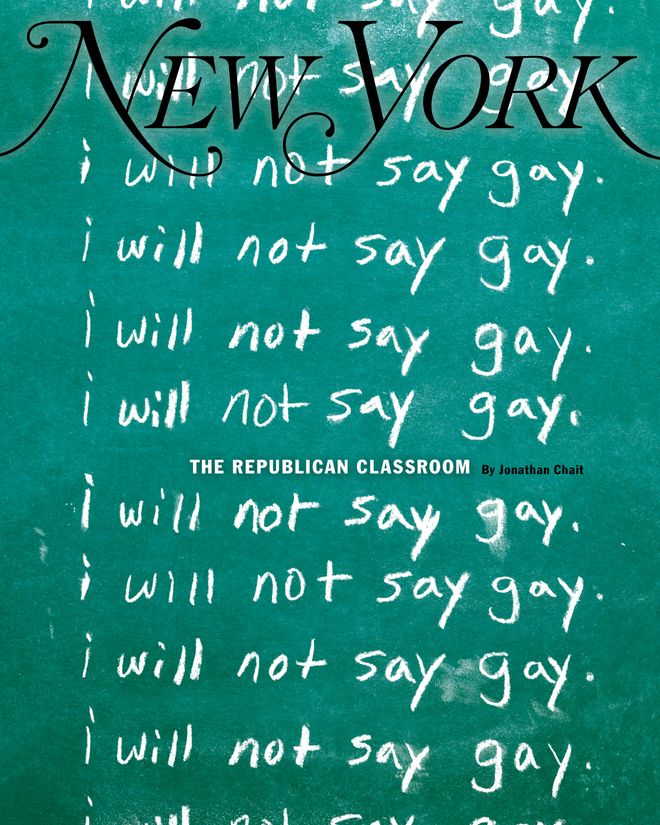
I am sorry but the current way WordPress classic editor is working it is too hard to bold and color the articles. I am still trying to find a work around. The block editor only allows a limited array of colors that are weak and not bold enough to be useful. The block editor is designed for businesses and if you look at the WordPress plans and what they market themes toward is businesses. Built for business and to make businesses happy. Blogers no longer matter to WordPress and are being pushed out of their buisness model. If you have ablog like I try to do with videos, memes, and full articles I will run out of storage space very soon. Plus the block editor is designed to allow businesses to quickly and easily replace blocks as things on their websites change. The classic editor is still there but no longer works smoothly as it did to edit what you post. Wordpress support warned me a year ago they planned to phase it out by making it harder to use until no one would use it. At the time I did not believe them as it seemed to me blogging was a big thing. I guess all the bloggers are going to substack. So I again have to find a new host company. But until I do, this is the way I have to post. The article below is very important and even though it is long I hope you will read it. It talks of the republican / right war on education and why. They point out that the right is no longer concern with US youth keeping up with other countries youth in education but instead the right is entirely consumed with indoctrinated kids with the right wing ideology out of a need to stay in power. In other words the right / republicans are afraid if schools teach reality and allow the changes in society to be accepted then the right will keep losing young people who beleive as they do and they will go exstinct. What sets the current movement apart from these previous efforts is not merely its greater intensity but its focus. Academic-achievement levels are incidental to Republicans’ concern. Their main preoccupation is not the ways in which Chinese and Swedish kids may be outpacing their American counterparts. They are instead accusing schools of carrying out an insidious indoctrination campaign that, they believe, poses an existential threat to their party’s future and their way of life. When an audience member asked how he had been able to find common ground with people who disagreed with him, Corcoran responded, “I have fought … There’s no negotiation. I don’t think antifa wants to sit down and have a conversation with me about how can we make this society better.” Corcoran went on to compare America’s disputes over education to “the warring in the streets” in Germany before World War II between the Nazis and the communists. “The war will be won in education,” he vowed. “Education is our sword. That’s our weapon. Our weapon is education.” So for republicans it is not about the good of the country or what is best for children, but instead entirely about keeping their party / their ideals in power. it is about keeping their lifestyle forced on the population no matter how wrong it might by. Notice part of that is teaching children not to question authority or what they are told to do. Hugs
Republicans have begun saying things about American schools that not long ago would have struck them as peculiar, even insane. Senator Marco Rubio of Florida has called schools “a cesspool of Marxist indoctrination.” Former secretary of State Mike Pompeo predicts that “teachers’ unions, and the filth that they’re teaching our kids,” will “take this republic down.” Against the backdrop of his party, Donald Trump, complaining about “pink-haired communists teaching our kids” and “Marxist maniacs and lunatics” running our universities, sounds practically calm.
More ominously, at every level of government, Republicans have begun to act on these beliefs. Over the past three years, legislators in 28 states have passed at least 71 bills controlling what teachers and students can say and do at school. A wave of library purges, subject-matter restrictions, and potential legal threats against educators has followed.
Education has become an obsession on the political right, which now sees it as the central battlefield upon which this country’s future will be settled. Schoolhouses are being conscripted into a cataclysmic war in which no compromise is possible — in which a child in a red state will be discouraged from asking questions about sexual identity, or a professor will be barred from exploring the ways in which white supremacy has shaped America today, or a trans athlete will be prohibited from playing sports.
In the spring of 2021, Richard Corcoran delivered a fire-breathing speech at Hillsdale, a right-wing Christian college in Michigan, touting the agenda he had helped implement as education commissioner in Florida. When an audience member asked how he had been able to find common ground with people who disagreed with him, Corcoran responded, “I have fought … There’s no negotiation. I don’t think antifa wants to sit down and have a conversation with me about how can we make this society better.” Corcoran went on to compare America’s disputes over education to “the warring in the streets” in Germany before World War II between the Nazis and the communists. “The war will be won in education,” he vowed. “Education is our sword. That’s our weapon. Our weapon is education.”
It is hardly novel for Republicans to emphasize the need to improve schools. Ronald Reagan’s administration published a report, A Nation at Risk, that inaugurated the modern education-reform debate. Reagan’s successor, George H.W. Bush, claimed he would be “the education president.” Bush’s son, George W., signed the No Child Left Behind Act, a historic education reform that used testing to hold schools to account. What little attention Trump paid to education when he ran for president in 2016 gestured in this direction, championing educational choice as a tool to lift student achievement. All these Republican executives saw education as a technocratic issue they could use to appeal to voters outside their base.
What sets the current movement apart from these previous efforts is not merely its greater intensity but its focus. Academic-achievement levels are incidental to Republicans’ concern. Their main preoccupation is not the ways in which Chinese and Swedish kids may be outpacing their American counterparts. They are instead accusing schools of carrying out an insidious indoctrination campaign that, they believe, poses an existential threat to their party’s future and their way of life.
Dubya once said, famously, “Rarely is the question asked, Is our children learning?” The complaint of Republicans today is not that the schools aren’t working but that they are working all too well at the objective of brainwashing children in left-wing thought. Education, as Corcoran reportedly put it, is “100 percent ideological.”
Media coverage of the Republicans’ education crusade has largely treated it as a messaging exercise. A New York Times headline from earlier this year, “DeSantis Takes On the Education Establishment, and Builds His Brand,” reflects the cynical assumption that this is mostly a way for him to rile up the Fox News audience. One progressive pollster recently told The Atlantic that for Republican voters, liberal control of schools “is a psychological, not policy, threat,” even as their elected officials strike back with policy. Some Democrats have mocked Republicans for pursuing arcane obsessions that fail to connect with voters’ concerns. And it’s true the voters are not driving this crusade: A recent poll found only 4 percent of the public lists education as the most important issue. Politico reports that “mounds of research by Democratic pollsters over the last several months” have found Republican book bans to be utterly toxic with swing voters.
You might wonder why Republicans would throw themselves into such a risky venture. The answer is that they aren’t looking to enrage their base or get their face on Fox News. They have come to believe with deadly seriousness that they not only must but can seize control of the ideological tenor in American schools, from the primary to the university level. If accomplishing this social transformation carries a near-term political cost, they are willing to pay it. And to imagine that they will fail, or grow bored and move on, and that the education system will more or less remain the same as it ever was, is to lack an appreciation for their conviction and the powers they have at their disposal to realize their goal.
Culture wars can break out over almost anything, but the political content of education is the most classic venue. Kulturkampf, the German word for “culture struggle” and the linguistic origin of “culture war,” describes a wrenching conflict over whether the church or the state would control the schools in 19th-century Prussia. Around the same time, France had a similar schism, largely between monarchists and republicans, both of whom believed that if they controlled the schools, they would own the hearts and minds of future citizens.
The nature of these fights is raw. Schools are a foundational institution for inscribing the value system of the state. Nothing enrages parents more than the idea that their children are being turned against them, and few things worry a partisan more than the fear the opposing party is using schools to inculcate its beliefs in the young. “Wherever two or more groups within a state differ in religion, or in language and in nationality, the immediate concern of each group is to use the schools to preserve its own faith and tradition,” wrote Walter Lippmann in 1928. “For it is in the school that the child is drawn toward or drawn away from the religion and patriotism of its parents.”
France’s conflict eventually led to the Dreyfus affair, in which false charges of treason against Alfred Dreyfus, a Jewish artillery captain, unleashed a torrent of antisemitism that pitted much of France’s secular republican left against the theocratic monarchist right. Germany’s Kulturkampf preceded … well, you know.
It was perhaps just a matter of time until the Republican Party’s perambulatory culture-war fixations, which have roamed from hippies to flag-burners to Muslims to gay marriage, landed on the schoolhouse.
Throughout American history, fights over the political content of school have broken out from time to time, usually centering on history textbooks and their treatment of racism, immigration, communism, and other social divides. Generations of conservatives have been shocked by the experience of their children reporting some unattractive facts about the Founders or the Civil War and came to suspect educators were plotting to steer children to some new worldview.
Some progressive education reformers embraced this very goal. George S. Counts, an educator and activist who went on to serve as head of the American Federation of Teachers and founded New York’s Liberal Party, wrote a pamphlet in 1932 called Dare the School Build a New Social Order? in which he argued frankly that schools should be used to inculcate progressive beliefs. “Progressive education,” he wrote, should “become less frightened than it is today at the bogies of imposition and indoctrination.” He added, “Every Progressive school will use whatever power it may possess in opposing and checking the forces of social conservatism and reaction.”
Later that decade, a number of history textbooks written by Harold Rugg swept into popularity. The Rugg history scalded the Founders as aristocratic landowners using the Constitution to preserve their wealth from the masses. Critics denounced it as left-wing propaganda, while his supporters insisted that educators alone were qualified to choose the proper historical emphasis. “Judgment as to the merits of a textbook is the function of those most competent to form a judgment: the teachers concerned and professional scholars,” maintained the American Historical Association.
As the New Deal lost momentum in Washington, Rugg’s ideas, held aloft by the assumption that liberalism had entered a new permanent ascendancy, fell out of favor. Sales of his texts plunged from a peak of 289,000 in 1938 to just 21,000 half a dozen years later, and they soon dropped out of usage altogether. The heady liberal dream that schools could serve as a vanguard of a social revolution had met political reality.
After the Rugg conflict, American history and civics texts generally adopted a mushy, consensus-oriented tone that offended very few people. Among the aggrieved minority was William F. Buckley Jr., who shortly before the founding of National Review in 1955 helped establish a publication called the Educational Reviewer dedicated to demanding right-wing content in the schools. Buckley’s first book, God and Man at Yale, proposed that the left-leaning faculty be denied academic freedom, which, he charged, they were abusing to warp the minds of impressionable college students.
Buckley is generally credited as the founder of the modern American conservative movement, but his call to conscript schools into the cause of promoting right-wing thought, like many of Buckley’s ideas, failed to catch on at the time. As Jonathan Zimmerman recounts in Whose America? Culture Wars in the Public Schools (2002), the campaign to censor textbooks never made it far in the halls of power after World War II: “Even at the height of its frenzied search for subversion,” the McCarthy era, “Congress refused to extend the quest into textbooks.”
Eventually, the fights over indoctrination largely receded. “By the early 1980s, the shared sense across the political spectrum that public schools were sites worthy of intense contestation began to diminish,” writes education historian Natalia Mehlman Petrzela in Classroom Wars (2015).
The return came very fast at a magnitude and with a vehemence unlike anything that has ever occurred in American history.
The Republican Party emerged from the Trump era deeply embittered. A large share of the party believed that Democrats had stolen their way back into power. But this sentiment took another form that was not as absurd or, at least, not as clearly disprovable. The theory was that Republicans were subverted by a vast institutional conspiracy. Left-wing beliefs had taken hold among elite institutions: the media, the bureaucracy, corporations, and, especially, schools.
This theory maintains that this invisible progressive network makes successful Republican government impossible. Because the enemy permanently controls the cultural high ground, Republicans lose even when they win. Their only recourse is to seize back these nonelected institutions.
“Left-wing radicals have spent the past 50 years on a ‘long march through the institutions,’” claims Manhattan Institute fellow and conservative activist Chris Rufo, who is perhaps the school movement’s chief ideologist. “We are going to reverse that process, starting now.”
Many institutions figure in Republicans’ plans. They are developing proposals to cleanse the federal workforce of politically subversive elements, to pressure corporations to resist demands by their “woke employees,” and to freeze out the mainstream media. But their attention has centered on the schools. “It is the schools — where our children spend much of their waking hours — that have disproportionate influence over American society, seeding every other institution that has succumbed to left-wing ideological capture,” writes conservative commentator Benjamin Weingarten.
Or, as Florida governor Ron DeSantishas said in his most revealing comments on the issue, “Our K–12 schools are public institutions that are funded by our taxpayers. And so that line of thinking is saying, even though they’re public institutions, the people that are elected to direct those institutions have no right to get involved. If the left is pursuing the agenda. So basically, we can win every election and we still lose on all these different things. That is totally untenable. So these are public institutions, and they have to reflect the mission that the state of Florida has in our case, not just K–12, but also higher education.”
A recent study by the Manhattan Institute illustrates why the right finds this cause so urgent. The paper surveys 18-to-20-year-olds about what it calls “critical social justice” concepts they learned in school, such as “America is a systemically racist country,” “white people have unconscious biases that negatively affect nonwhite people,” “America is built on stolen land,” or “America is a patriarchal society.” The survey proposes that adults exposed to these concepts develop liberal beliefs: “CSJ and school ideology appear to be having a major impact in converting young people to left-wing beliefs and Democratic partisanship.”
The report finds that these concepts are being taught in private, religious, and charter schools and spread through social media and entertainment. Therefore, the old conservative method of promoting choice between public and private schools stands little chance of holding back the progressive tide. The biggest shift among young people seems to have occurred among those whose parents were Republicans or independents.
Put aside for a moment whether this finding is correct. What it shows us is why Republicans are acting so urgently (or, to their bewildered critics, hysterically). They believe the schools have become factories for turning children into Democrats, that progressives are so powerful the children of Republican parents cannot resist them, and that their old remedy of exiting the public-school system is nearly useless. Working from these assumptions, Republicans’ determination to seize control of the indoctrination machinery makes perfect sense.
Even the most paranoid belief systems often contain elements of reality. It is true that American society has polarized, pushing its most conservative communities rightward and its liberal communities leftward. Schools, largely being run by people who have college educations, have likely undergone the same kind of socially progressive shift that has rippled through the rest of the knowledge economy.
In California, public schools are rolling out required ethnic studies and have pushed schools to decelerate adoption of algebra in order to advance equity goals. Thousands of classrooms have used the New York Times’ “The 1619 Project,” a provocative interpretation of American history that has drawn criticism from some respected historians, including one approached by the Times to fact-check it.
Some teachers and administrators see the role of the school, like Rugg and Counts did, as a vanguard institution driving social change. In 2021, the National Education Association approved a resolution for “increasing the implementation of culturally responsive education, critical race theory, and ethnic (Native people, Asian, Black, Latin[o/a/x], Middle Eastern, North African, and Pacific Islander) Studies curriculum in pre-K–12 and higher education.” The NEA can’t simply dictate classroom pedagogy, but its desires do reflect a popular sentiment within the profession that has left its mark on many classrooms. A national report by Bellwether, a nonprofit firm analyzing education, reported, “Much of the backlash to teachers’ efforts to teach about racism in the classroom or to DEI trainings comes from lessons and programs that are poorly designed and poorly implemented, often because of limited or nonexistent resources and support or politicized approaches.”
Many parents, understandably, don’t like this stuff. A poll last year by the American Federation of Teachers found that voters would be more likely to support a Republican candidate who endorsed propositions like “public schools should focus less on teaching students about race and racism, and more on core academic subjects,” giving parents more say over content, and other right-leaning criticisms of the pedagogy. The idea that some schools have gone farther left on social policy than the public as a whole shouldn’t come as a surprise. Progressive educators can implement change that’s far more radical in character than anything Democrats could pass in Congress.
It is possible for legislatures to restrict some of the pedagogical fads of recent years without preventing children from learning unvarnished historical truths about slavery, reconstruction, Jim Crow, and its aftermath. Reports have described bans on lessons that make students feel guilty, when they have merely restricted lessons that instruct them to feel guilty, a reasonable thing to ask. Commentators on the internet likewise depicted Florida as banning the teaching of African American history, when in fact the state merely objected to elements of the AP African American History curriculum, ultimately resulting in a revised version.
And aspects of the Republican legislation confines itself to these limited measures. But other bills attempt far more expansive levels of ideological control over the classroom, and they suffer from either sweeping vagueness or paralyzing specificity.
As an example of the former, a Montana bill currently tabled in committee would restrict science education to “scientific fact,” defined in the bill as “an indisputable and repeatable observation of a natural phenomenon,” which would present a serious challenge to teaching a field composed in large part of scientific theories. A South Carolina bill introduced in 2021 would have forbidden any lesson that “omits relevant and important context” and created a hotline to report violations of this hopelessly subjective criteria.
An example of the latter can be seen in an Oklahoma bill that tried to stamp out social-emotional learning, a strategy to help students manage their emotions that conservatives have bizarrely associated with indoctrination. (“The intention of SEL,” Rufo has claimed, “is to soften children at an emotional level, reinterpret their normative behavior as an expression of ‘repression,’ ‘whiteness,’ or ‘internalized racism,’ and then rewire their behavior according to the dictates of left-wing ideology.”) But how can a legislature ban an entire style of teaching? The solution settled upon by Oklahoma would have prohibited an array of concepts so vast it has to be beheld in its entirety:
Any evidence-based or non-evidence-based programming that promotes school or civic engagement or builds an equitable learning framework that creates or uses evidence-based benchmarks, standards, surveys, activities, learning indicators, programs, policies, processes, professional development, or assessments that address noncognitive social factors including but not limited to self-awareness, self-management, social awareness, relationship skills, responsible decision-making, and other attributes, dispositions, social skills, attitudes, behaviors, beliefs, feelings, emotions, mind-sets, metacognitive learning skills, motivation, grit, self-regulation, tenacity, perseverance, resilience, and intrapersonal resources.
Imagine attempting to teach a class for a year while keeping this entire list of forbidden ideas in your head at all times.
A broader problem with the wave of conservative legislation is that it is responding to a wildly hyperbolic version of reality. In a very large country with a fragmented education system, there are going to be plenty of examples of outrageous or radical teaching in the schools on a daily basis without necessarily indicating anything about the system’s overall character. As conservatives grew alarmed about left-wing teachers, their favorite media sources started curating examples of it to stoke their outrage.
Chaya Raichik’s account Libs of TikTok has amassed more than 2 million followers — DeSantis once invited her to stay at the governor’s mansion in Florida — partly by finding posts by left-wing teachers on social media. Her audience has come to see these cherry-picked examples as representing the normal experience in an American classroom. In response to a post by a teacher with brightly dyed hair and tattoos appearing to pledge allegiance to the Pride flag, National Review editor-in-chief Rich Lowry commented, “Don’t laugh — this pledge is probably coming soon to blue jurisdictions.” In apparent response to a viral but false Libs of TikTok post claiming a school was placing litter boxes in the bathroom for children who identify as cats, North Dakota’s House passed a bill that would, among other restrictions, forbid any “policy establishing or providing a place, facility, school program, or accommodation that caters to a student’s perception of being any animal species other than human.”
These sorts of lurid fantasies inspired Republicans in Florida, Iowa, and Mississippi to introduce bills to put microphones, cameras, or livestreams inside classrooms. An Indiana Republican bill proposed to require school officials to create parent-led curricular advisory committees. Louisiana attorney general Jeff Landry, who is running for governor, created a “Protecting Minors” tip line to field complaints about libraries and schools.
Inevitably, perhaps, conservative fears of sexual indoctrination have led them to seek out evidence of heresy in school libraries. Concerned parents have been pestering school boards to keep scary books away from little Susie’s innocent eyes since the school library was invented. But the movement to do so has taken on a wholly novel scale. PEN America, a literary-freedom organization, has tracked some 50 organizations dedicated to restricting library content — nearly three-quarters of which have formed since 2021. The most prominent, Moms for Liberty, presented DeSantis with a “liberty sword” when he spoke at its summit in July.
About two-fifths of the bans are tied to rules or political pressure from state officials or elected lawmakers, an “unprecedented shift,” according to PEN America, which notes that book bans have historically been initiated by locals in a community, not their governments. Seven states are considering bills to restrict books containing things like “profane language” or “depictions of gender identity.” Twelve states have introduced bills that could make school employees and librarians subject to being charged with violating obscenity laws.
In Florida, HB 1467 — a law requiring all books in schools to be “suited to student needs” — prompted school libraries across the state to frantically pull texts for fear they would violate the new regime. The Florida Freedom to Read Project reported that some 20 school districts in the state eliminated books to comply with this law or DeSantis’s “Don’t Say Gay” and Stop WOKE acts. School officials in two counties covered up all the books in the library until the entire catalogue could be vetted for compliance. “There appears to be confusion over what books or materials could actually lead to a criminal charge,” conceded a report in National Review. Citing DeSantis’s HB 1557, what critics called the “Don’t Say Gay” law, the Lake County district removed And Tango Makes Three, which tells the true story of two male penguins who had built a nest together in the Central Park Zoo, then, when provided an egg by the zookeeper, raised the baby penguin. The book contains no sexual content, not even between consenting penguins.
One of DeSantis’s allies has introduced a bill requiring schools to “teach that the male and female reproductive roles are binary, stable, and unchangeable” and another to remove children from their parents if a court deems that they have been “subjected to” gender-affirming care, making a mockery of their professed concern for parental rights. DeSantis’s state-imposed ideology is being extended to student-run clubs: One high school shut down a meeting by its Queer and Ally Alliance, a student group, after Florida’s Department of Education reportedly sent the school administration a threatening message. <b>Both in theory and in practice, the Republican schools campaign has attacked even basic expressions of respect for gay and trans people.</b>
The difference between the old conservative approach to education and the new variant can be seen most starkly in the realm of higher education. American conservatives have never exactly adored universities, and the feeling is mutual. One study found that left-leaning faculty members outnumber conservatives by about six to one, and among administrators the ratio is twice as high. For many years, conservatives have deplored the left-wing tilt of academia and supported the complaint, along with many moderates and liberals, that the hothouse atmosphere on campus was suppressing dissent.
Allan Bloom’s 1987 book The Closing of the American Mind and Dinesh D’Souza’s 1991 Illiberal Education expressed the conservative view of academia: It had become close-minded and abandoned its historic commitment to open inquiry. Conservatives joined groups like the National Association of Scholars to protect conservative professors — or a liberal one who happened to say something provocative — from being intimidated or fired.
In recent years, a rising class of conservative intellectuals has advanced a different critique. Rufo, in particular, has pressed the case that the far left has infiltrated schools and other institutions so thoroughly that conservatives must take drastic action. “We’re going to actually learn the left-wing playbook,” he vowed in one lecture, calling for a “counterrevolutionary strategy for recapturing the institutions.”
Like many radicals who studied the methods of their adversaries, Rufo seemed to come away not with horror but a strange respect. “One thing I almost admire about the political left is that they want to achieve dominance and nothing less than dominance,” he said. In other words, conservatives must discard their attachment to fusty principles of academic freedom and open debate. When laying siege to institutions, Rufo has said, “You have to be very aggressive. You have to fight on terms that you define. You have to create your own frame, your own language. And you have to be ruthless and brutal in pursuit of something good.”
Academic freedom is no longer the solution. It is now the problem.
The world of politics and activism has plenty of would-be Lenins, but few have a direct plan for conservatives to use their power of the state to shape the ideological character of schools. And the place demonstrating the feasibility of this method is Florida, which represents the most advanced proving ground of the right’s new campaign against education.
DeSantis has placed his stamp on K–12 schools with an array of creative methods. His law restricting gender education and another, the Stop WOKE Act, which bans the teaching of certain progressive racial theories, have both had a chilling effect on liberal teachers. He also held voluntary training sessions for civics teachers with the lure of a $700 stipend for those who attend and the chance to receive $3,000 if they complete an online course. <b>The sessions, reportedly developed in part by Hillsdale, had a distinctly conservative slant, according to several attendees. “It was very skewed,” one government teacher told the Miami Herald. “There was a very strong Christian fundamentalist way toward analyzing different quotes and different documents.”</b>
State and local governments traditionally observe some limits on their control of subject matter. DeSantis’s K–12 agenda has at least pushed that line. When it comes to universities, DeSantis has obliterated the line completely.
He began with a takeover of New College, a public university in the state, stacking its board with right-wing ideologues, several of whom have praised him, including Rufo.
The pretext for tearing down the school leaned heavily on its alleged budgetary woes, but DeSantis immediately allocated $15 million in state spending and the board hired Corcoran as president with a base salary above that of presidents of other Florida universities that have nearly 100 times more students. DeSantis hoped to turn New College into “Florida’s classical college, more along the lines of a Hillsdale of the South,” his chief of staff told the Daily Caller. “We are now over the walls and ready to transform higher education from within,” exclaimed Rufo.
Having supplied proof of concept, DeSantis is now turning to the other, vastly larger components of the state’s higher-education system. His allies have introduced legislation that would impose rigid ideological control over every state university. The original text of the bill held that no core American-history course could teach a narrative except one “based on universal principles stated in the Declaration of Independence” and shunted teaching any “unproven, theoretical, or exploratory content” to electives. The current version bars any general-education courses from teaching “theories that systemic racism, sexism, oppression, or privilege are inherent in the institutions of the United States and were created to maintain social, political, or economic inequities.”
To backstop these changes, DeSantis, who had already signed a law in 2022 scaling back tenure protections for faculty, is now considering all but doing away with them. DeSantis would additionally consolidate power over hiring and firing in the hands of university presidents, some of whom owe their appointments to DeSantis. Any professors wandering too close to his vague regulations on progressive thought could find their career at the mercy of political operatives.
Ken Burns, the documentary filmmaker, recently called the DeSantis education program Soviet, which is a tad melodramatic, given that the Soviets arrested or murdered millions and millions of people. But there does happen to be a comparison at hand that is chilling in its own right: the Hungarian strongman Viktor Orbán, whom DeSantis and the Republican Party have adopted as a model.
When he won his first election in 1998, Orbán identified the universities as the primary institutional source of opposition. Orbán placed most state universities under the control of close allies. He drove the prestigious Central European University, which had been founded by his enemy George Soros, out of the country — not by sending in troops to seize the school but through the blandly bureaucratic method of imposing new operating requirements.
At first, the scholar Kim Lane Scheppele noted at the time, his critics joked darkly that “since educated people don’t vote for Orbán, his long-term plan for staying in power in Hungary has been to create fewer educated people.” But Orbán’s vision turned out to be much more strategic than that. Universities cut back on academic departments with the most liberals and expanded funding for departments with conservative leanings. Orbán opened a lavishly funded new campus for conservative intellectuals. His supporters publicly invited students to submit the names of faculty who professed “unasked-for left-wing political opinions.”
Last September, Balázs Orbán, the political director for the Hungarian prime minister, visited Florida, where he praised DeSantis and likened his governing style to that of his own boss. Rufo just spent a month in Budapest as a fellow at the Danube Institute, a pro-Orbán group, where he gave speeches denouncing critical race theory and reportedly met with Orbán’s government. (Rufo declined to confirm whether they actually met.) The two men appear to be swapping notes.
DeSantis seems to have absorbed the notion that conservatives have an existential need to use their political power to seize the commanding heights of the culture, especially its schools. His new book argues against the old conservative notion of supporting academic freedom, warning that “elected officials who do nothing more than get out of the way are essentially greenlighting these institutions to continue their unimpeded march through society.”
Orbán’s example has shown the government’s power over the academy can be absolute. DeSantis is simply the first Republican to appreciate the potential of this once-unimaginable use of state power to win the culture wars. Even before DeSantis’s plan has passed, Republicans in North Carolina, Texas, and North Dakota rushed out bills to eliminate tenure for professors.
Trump, racing to catch up with DeSantis on the education issue, has vowed to eliminate federal funding for any school promoting critical race theory, “transgender insanity,” or “any other inappropriate racial, sexual, or political content on our children.” He promises to fire existing college accreditors and appoint new ones who will implement his ideological dictates, and to back up this threat by imposing confiscatory taxes on the endowment of any university that resists.
Conservatives as a whole have fled from any pretense of respecting academic freedom. “To complain that the governor and the state legislature are interfering with” public universities “is, in effect, to complain that the governor and the state legislature are interfering with the government that they run,” editorialized National Review, neatly sweeping away any concern that a Republican state could ever go too far in dictating content to its universities.
With DeSantis and Trump now vying for supremacy with a boot on the neck of American education, the Republican Party appears to have quickly settled on this strategy. There is not any assurance that the campaign to control the ideology of the schools will remain confined to the public sphere. Representative Dan Bishop of North Carolina and Senator Tom Cotton of Arkansas have put forth a bill that would deny federal funding to public and private universities that promote CRT concepts.
And what has been revealed in these early days of the Republican plan to conquer the academy merely represents the powers of state governments. Should Republicans win control of the White House and Congress, they would have far more authority at their disposal. Federal research dollars and tuition subsidies give the federal government leverage over every institution of higher learning, public and private alike.
There is little sign Democrats have grasped the ultimate ambitions they are confronting. When DeSantis began pushing through yet another expansion of his restrictions on gender instruction — a bill that would, among other things, require “certain materials” facing objections by any parent to be removed before they were vetted — his opponents dismissed it as mere pandering. Democrats “see it as an attempt by DeSantis to excite the conservative base and, ultimately, win the GOP 2024 presidential nomination,” reported Politico.
<b>This pat assumption fails to appreciate that seizing political control of the schools is not a campaign slogan. It’s a plan to turn power into more power.</b>
When Republicans last had control of government, admiration of Orbán was confined to a marginal fringe of right-wing intellectuals, and the whole idea of imposing their will on schools had yet to be invented. It was well into his final year in office before Trump glommed onto the issue. Trump called the George Floyd demonstrations “the direct result of decades of left-wing indoctrination in our schools.” That is when he brought Rufo in for a visit and began ranting on the campaign trail about the “wokes” in the classroom. In November 2020, to counter the narrative of “The 1619 Project,” Trump created a “1776 Commission,” which released its report on Trump’s penultimate day in office.
This futile departing gesture seemed at the time to signify the superficiality and ridiculousness of the Republican interest in the subject. But now members of the party elite have fully invested themselves in this objective. They have only just begun to explore their powers, and their statements on the matter recognize no theoretical limit as to how far they might go. In retrospect, Trump’s late embrace of the crusade to purify the schools was not a fleeting interest but a new turn, the first shots fired in what we now see is a full-scale war.

 • Naked Swimming In… Part 3-

 That, my friends, is the mark of a true fan: it isn’t the fact that the product is the best in quality, best in performance, best in taste, it’s the fact that a fan is a fan for no better reason than he has chosen to be a fan. Thereby lives a love of heartbreak, ridicule, and a test of loyalty sufficient to scar any soul forever. I of course come from much better stock: I am a fan of the Chicago Bears. Da Bears! If you’ve not solved this puzzle by now, this is not about the Lions. Don’t get me wrong, they will forever disappoint – Sorry Uncle Bob – but this post regards how a beer company has received backlash for sending beer to someone who is an internet influencer. Now, there are few things in this world that I purposely choose not to pay attention to, and among those are the Lions and things that republicans and rednecks have chosen to cancel in their anti-cancel-culture rants. Yes, that’s confusing. It makes more sense if you drink a lot of low-quality beer and believe what Tucker Calson tells you.
 lifetime commitment with their Bud Light beer that has weathered two marriages, four kids, eight teeth and 29-stories that start with “dude, hold my beer…” will be drinking again like nothing happened. In time they will forget why they were mad at a beer – because let’s face it, who gets mad at beer? And, those of us watching from the sidelines, even as reluctantly as I, will remember that this was never about the beer, never about the internet influencer, but was ultimately about the homo- and the trans-phobic prejudice and hate that was so easily stirred to cause the easily led to put down their favorite beer.
 Who are they to not only disparage the character of that person, but to speak as if a beer company deserves to be shot for treating a person as a living and worthwhile person? Each of us in America is born with the freedom to voice our opinion. It bothers me that so many have chosen to use this freedom to be so manipulated as to only be able to speak hate and so weak as to give up a beer they appear to love for the affront of giving another citizen simple respect. What are they truly angry or afraid of?