The 19th Explains: How Trump’s Cabinet nominees will get confirmed

Originally published by The 19th

The 119th Congress was officially sworn in Friday, meaning the Republican-controlled U.S. Senate will soon begin the process of confirming President-elect Donald Trump’s Cabinet nominees. 

Article II of the U.S. Constitution enables the president to appoint officials to the Cabinet and other positions with the “advice and consent” of the Senate. Many of the committees, all of which have a majority of Republicans, will hold hearings on the nominees related to their area of expertise: the Senate Judiciary Committee, for example, holds hearings for the nominees for attorney general and other top posts at the Department of Justice. Those hearings will begin soon, with senators likely prioritizing confirming nominees to national security positions. 

Republicans will control the Senate 53 to 47 seats once Senator-elect Jim Justice of West Virginia is sworn in later in January and Ohio Gov. Mike DeWine appoints a senator to fill Vice President-elect JD Vance’s seat. 

Some nominees like Sen. Marco Rubio of Florida, Trump’s nominee for secretary of state, are expected to easily sail through the Senate, while others are likely to garner more opposition and scrutiny. Here’s how the process will work: 

When do hearings start?

Sen. Roger Wicker, who leads the Senate Armed Services Committee, is set to hold Pete Hegseth’s confirmation hearing for secretary of defense starting January 14, even before Trump’s inauguration. The hearing for former Rep. Tulsi Gabbard’s nomination for director of national intelligence in the Senate Intelligence Committee is also set to take place that week, according to Punchbowl News. The Senate Judiciary Committee is expected to prioritize confirming Pam Bondi, Trump’s nominee for attorney general, and his nominees for deputy attorneys general before taking up the nomination of Kash Patel to lead the FBI, the outlet reported.  

Are hearings required for every nominee?  

Not necessarily. There are over 1,300 political appointee positions that require Senate confirmation, and some nominees, like military promotions, often go straight to the Senate floor. But nominees for the Cabinet and other high-profile political appointments almost always have confirmation hearings. 

What happens at a confirmation hearing?

Before a hearing, senators on relevant committees will request biographical information and a financial disclosure from the nominee. At the hearing, senators will ask questions about a nominee’s background, their qualifications and their views. Nominees for positions that require a security clearance also traditionally undergo an FBI background check. 

Gabbard and Patel are expected to draw scrutiny for their records and stances on national security issues. Democrats will likely question Hegseth about a past allegation of sexual assault against him, which he denies, as well as his previous comments opposing women in combat roles. Senators on both sides of the aisle are also likely to question Robert F. Kennedy Jr., Trump’s nominee for Health and Human Services secretary, on his views on abortion, vaccines and food policy. 

How does a nominee get confirmed after a hearing?  

After a committee holds a hearing, its members can report the nomination favorably or unfavorably to the full Senate for a final vote. In 2013, then-Senate Majority Leader Harry Reid led his fellow Senate Democrats in changing the chamber’s rules to require only a simple majority to invoke cloture, or end debate, on presidential nominations other than Supreme Court nominees. A simple majority is also needed for final confirmation. In 2017, then-Majority Leader Mitch McConnell and Senate Republicans also lowered the threshold for Supreme Court nominees.  

Historically, it’s been very rare for the Senate to reject a president’s Cabinet nominee. The last time the Senate voted down a Cabinet nominee was in 1989, when senators rejected Sen. John Tower, then-President George H.W. Bush’s nominee for defense secretary, due to concerns about his drinking. Some Cabinet nominees like former Rep. Matt Gaetz, Trump’s first pick for attorney general, also bow out of the process before they go up for confirmation. 
Yesterday’s asshat news headlines.

Hi Everyone.  I woke at 12:22 last night.  But I got up at 1 am and started making posts and doing things.   So I just finished the asshat yesterday news posts.  So now before I answer the comments … and I love comments everyone sends to me, I have to make a red sauce.   Ron promised to make me a grand lasagna if I make the sauce.   So with ear buds in, off I go to make the sauce.   Hugs and loves to everyone.  Remember that I really care for everyone.  Add any questions or comments in the comments and I will reply there.   Hugs.  


JoeMyGod
Moda day ago

Two months ago Fat Hitler vowed to imprison Zuckerberg.

This is the result.

If you criticize the dear leader of the maga cult then you are forever an enemy.  Death to the nonbelievers.   This is why the current republicans and maga is very much a cult.  Hugs. 

This is great.  The tRump world crowed about this citizen of Greenland who praised tRump’s plan to take over Greenland.  Yet the truth did come out … He was a tRump  loving fanboy violent felon drug dealer prison escapee.   Hugs.

“This is some of what we must do to reform our dysfunctional healthcare system”

Bernie Sanders

We are the wealthiest nation on Earth. There is no rational reason as to why we are not the healthiest nation on Earth

Over the past year, I’ve had the privilege of serving as chair of the US Senate committee on health, education, labor and pensions (Help). As I leave that position, let me reflect upon where I think our country should be going in healthcare, and the obstacles we face.

We are the wealthiest nation on Earth. There is no rational reason as to why we are not the healthiest nation on Earth. We should be leading the world in terms of life expectancy, disease prevention, low infant and maternal mortality, quality of life and human happiness. Sadly, study after study shows just the opposite. Despite spending almost twice as much per capita on healthcare, we trail most wealthy nations in all these areas.

If we’re going to reform our broken and dysfunctional healthcare system and “Make America healthy again”, this is some of what we must do.

Medicare for All

Healthcare is a human right. The function of a rational healthcare system is to guarantee quality healthcare to all, not huge profits for the insurance industry. The United States cannot continue to be the only wealthy nation that does not provide universal healthcare. It is not acceptable that, while spending almost 18% of our GDP on healthcare, millions of Americans delay going to the doctor and 60,000 Americans die each year because they can’t afford the care they need.

Lower the cost of prescription drugs

As Americans, we should not be paying, by far, the highest prices in the world for life-saving medications. It is absurd that while the pharmaceutical industry enjoys huge profits and benefits from US taxpayer research, one out of four Americans cannot afford to purchase the prescription drugs their doctors prescribe. We must cut prescription drug prices in half by making sure that we pay no more for medicine than the Europeans or Canadians.

Workers should not have to go to work when they are sick. Mothers and fathers should have ample time to stay home with their newborn babies. A parent should not get fired when they stay home with a sick child. We must guarantee at least 12 weeks of paid family and medical leave to every worker in America.

Reform the food industry

Large food corporations should not make record-breaking profits making children addicted to processed foods, which make them overweight and prone to diabetes and other diseases. As a start, we must ban junk-food ads targeted to kids and put strong warning labels on products high in sugar, salt and saturated fat. Longer term, we can rebuild rural America with family farms that are producing healthy, nutritious food.

Raise the minimum wage to a living wage

Millions of workers should not have to worry about how they’ll pay the rent or buy food for their kids. Working-class Americans live far shorter lives than the rich because of the stress of trying to survive on a paycheck-to-paycheck existence. Stress kills. Stress makes us sick. We must raise the minimum wage to at least $17 an hour.

Lower the work week to 32 hours with no loss of pay

People will live longer and healthier lives if they can spend more time with family and friends and have the opportunity to enjoy their leisure time. Advancements in technology, automation and artificial intelligence must benefit workers, not just billionaires on Wall Street or in Silicon Valley.

Combat the epidemic of loneliness, isolation and mental illness

Too many Americans are struggling with intense anxiety and “diseases of despair” – alcoholism, drug addiction and even suicide. Not only do we need to greatly increase access to mental healthcare, we must rebuild our sense of community and create a culture in which we better enjoy and appreciate each other as human beings. We must also take a very hard look at the impact smartphones and social media are having on our mental and physical health.

Address the climate and environmental crisis

Every American is affected when the Earth’s temperature rises and the air we breathe is polluted. Climate crisis and extreme weather disturbances will cause more widespread suffering and disease, economic disruptions and population dislocation. Air pollution is a major risk factor for respiratory and heart disease, cancer and other health problems. The fossil-fuel industry cannot be allowed to continue making us sick, shortening our lives and destroying the planet.

Create a high-quality public education system

Life-long education is a human right and should be obtainable for all in a wealthy nation like ours. Health, life expectancy and economic wellbeing are often tied to educational attainment. Instead of spending $1tn a year on the military we should make certain that all Americans, from childcare to graduate school, are able to enjoy free, high-quality education and job training.

Let’s be clear. The way forward to creating a healthy society is not radical or complicated. Many of the components that I’ve outlined already exist, in one form or another, in numerous countries throughout the world.

Our real problem is not so much a healthcare crisis as it is a political and economic one. We need to end the unprecedented level of corporate greed we are experiencing. We need to create a government and economy that works for all and not just the wealthy and powerful few.

  • Bernie Sanders is a US senator, and chair of the health education labor and pensions committee. He represents the state of Vermont, and is the longest-serving independent in the history of Congress

https://www.theguardian.com/commentisfree/2024/dec/31/bernie-sanders-healthcare-reform-opinion

Israeli Strikes Yemen’s Civilian International Airport | HasanAbi reacts

It’s Always Something.

How much fossil carbon is stored in our stuff?

Ellen Phiddian December 21, 2024

Human-made materials – the “technosphere” – are a deep store of fossil carbon – and possibly a ticking time bomb.

That’s according to a fascinating new study published in Cell Reports Sustainability.

“We have no idea of how much carbon has been accumulated in the technosphere, how long it stays and what might happen to it once it is released,” says co-author Professor Klaus Hubaeck, a researcher at the University of Groningen, the Netherlands.

The researchers found that the technosphere accumulated 8.4 billion tonnes of fossil carbon from 1995-2019.

Were all this carbon to be burned and sent into the atmosphere, it would be equivalent to 30 billion tonnes of CO2. The world’s annual greenhouse gas emissions into the atmosphere over that period were roughly 770 billion tonnes.

“Carbon is used as a feedstock everywhere in our daily items, even the laptop I type on, and we were wondering if there is a potential time bomb of all that carbon contributing further to climate heating as it gets released to the atmosphere,” Hubaeck tells Cosmos over email.

Human-made materials are often made from fossil carbon sources like oil and gas. Plastics, for instance, are 74% fossil carbon on average. When these items reach end of life, the carbon makes its way back into the environment via dumping – or into the atmosphere via combustion.

The researchers calculated the amount of fossil carbon stored in the technosphere in the year 2011, using economic data to judge how much was flowing in and out of various industries.

They found that most of this carbon was going into rubber and plastic (30%), while 24% was put in bitumen, and 16% in machinery and equipment.

They found that 9% of extracted fossil carbon was stored in the technosphere in 2011, or about 0.4 billion tonnes of fossil carbon.

The team extrapolated these findings to a 25-year time period (1995-2019), which told them that 8.4 billion tonnes of fossil carbon had been accumulated.

Hubaeck says that the technosphere is nearing the stage where it stores more carbon than the natural world.

“We are not far from that turning point. Indeed, the accumulated fossil carbon is in the same order of magnitude, and indeed already higher than that stored in animals.”

What happens to all of this carbon? The researchers estimate that 3.7 billion tonnes of fossil carbon was disposed of over this time period: 1.2 billion tonnes sent to landfill, 1.2 billion tonnes incinerated and sent into the atmosphere, 1.1 billion tonnes recycled, and the rest littered.

“On the one hand, you can consider it as a form of carbon sequestration if this fossil carbon ends up sequestered in landfill, but on the other hand, it poses an environmental hazard, and if you burn it, you increase carbon emissions,” says co-author Dr Franco Ruzzenenti, also from the University of Groningen.

This means it is very important to make sure the waste is being processed properly, according to the researchers. They say that product lifetimes and recycling rates need to increase, and landfill and waste discharges need to be minimised.

“It’s best to avoid or reduce the throughput in the first place,” says Hubaeck.

“Certainly in rich countries, we have too much stuff (whereas the Global South still needs to catch up), we should question the amount of durable products and (inefficient) infrastructure we produce.

“Shifting to bio-based carbon also has environmental impacts, land requirements, biodiversity, and impacts on food prices.”

The researchers say that circular economy strategies are important for reducing the amount of waste as well, alongside managing waste better after disposal.

Three Sam Seder clips that are important to watch

Before I share the clips a personal note.  I spend the morning with Ron.  We went to get blood work done.  Then we did some other things.  Then he went shopping while I did housework.  Then after he got home I started working on a computer project a friend asked me if I would do for him as he couldn’t do it.  I agreed to.  I still have a lot of work on it but I will get it done today I think.  

The lab work came back and I think I have a reason while I have been so tired, short of breath, and not able to concentrate or think clearly.   My blood work shows I am very anemic again.  I once had it get so bad I collapsed as I was entering my allergist office.  They thought I was having a heart attack and I ended up in the hospital.  Turned out my heart is great, but my damaged large bones don’t produce enough red blood cells.  Their solution was to eat more red meat and take iron supplements.  For a long time they watched for it but as I always managed to stay right inside the ok zone they stopped worrying about it.  But my diet changed, red meat got too expensive and I just don’t eat much anymore.  But my lab work showed my hematocrit is very low.  So I imagine the doctor will ask me to do some more tests.  I hope I don’t need a blood transfusion, that sucks.  Now on to the clips, enjoy.

The Chaos Monkeys Have Already Taken Over the Zoo by Paul Krugman

The peddlers of misinformation are high on their own supply Read on Substack

(Thanks to BruceDesertRat who comments here, for linking this really useful Substack!)

Well, I was going to post about proposals for bank deregulation, but I think that can wait for a bit. The news of the moment is the looming prospect that the federal government will shut down over the weekend.

We’ll have to see how much damage this does, but it’s already clear that assuming the worst happens — and it’s hard to see how it won’t — this will be the dumbest shutdown ever. I’d say that the incoming Musk administration (so far Musk, not Trump, appears to be calling the shots) is trying to hold itself up for ransom, but it doesn’t even rise to that level. This isn’t like 1995, when Newt Gingrich shut down the government in an attempt to extract cuts in Medicare and Medicaid — a move that seemed (and was) a foolish act of petulance, but at least had a ghost of motivation.

No, Musk is demanding — apparently successfully — that Republicans in Congress renege on a deal they had already agreed to, a continuing resolution that would keep the federal government going for the next few months. Why? Because, Musk says, of the outrageous provisions in that CR.

Except none of the items Musk is complaining about are actually in the bill. No, Congress isn’t giving itself a 40 percent raise. No, the bill doesn’t fund a $3 billion stadium in Washington. No, it doesn’t block future investigations into the Jan. 6 committee. No, it doesn’t fund bioweapons labs.

I have an embarrassing admission to make. I thought that Muskaswamy’s obvious problems with getting DOGE going would have inspired, not humility — never that — but at least a bit of caution. That is, I imagined that Musk would by now have at least an inkling of two things.

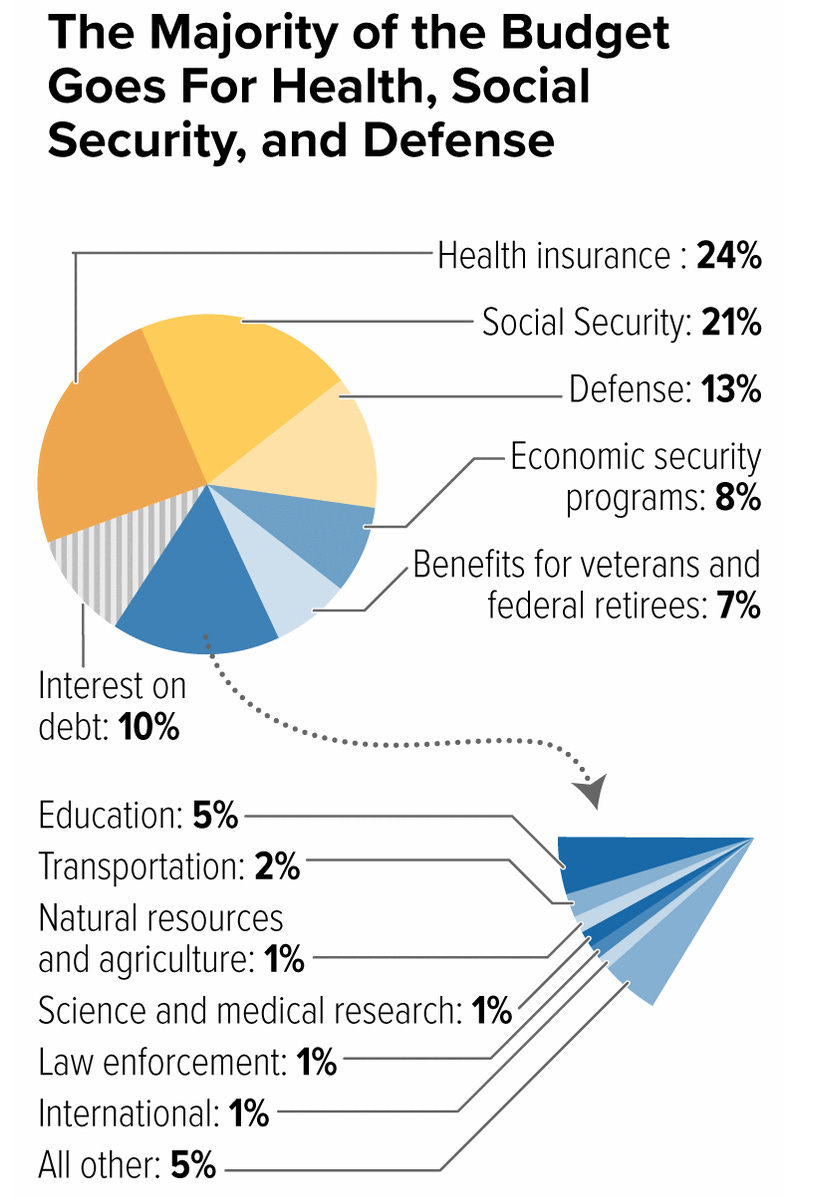
First, finding big-ticket examples of government waste is hard, because the government mostly spends money on things people want. Here’s a nice chart from the Center on Budget and Policy Priorities, showing where the money goes:

Yes, the federal government is an insurance company with an army.

Second, you shouldn’t trust claims about the budget coming from Some Guy on the Internet. You might have imagined that the world’s richest man could have a couple of fact-checkers on retainer to help ensure that he isn’t making clearly stupid assertions. But nooo.

In a barrage of posts on X Musk pushed misinformation about a more or less routine, place-holding bill that was basically a way to keep the ship of state afloat until Trump takes charge. Maybe this was in part a power play, an attempt to make Republicans in Congress show fealty to a man who clearly imagines that he’s the real president — and Trump, by meekly endorsing Musk’s position, did in fact convey the impression that Musk is leading the guy who is supposed to be in charge by the nose. But this political theater will have real consequences, for America, for Trump, and for Musk himself.

Musk has asserted that shutting the government down for a month would do no harm. And it’s true that Social Security, Medicare and Medicaid funding — which is where the bulk of the money goes — will continue. But many services people rely on will be disrupted, especially if the shutdown goes on for more than a month, which seems all too likely given Republicans’ razor-thin House majority and the dominance of misinformation in many members’ thinking.

Maybe Musk himself doesn’t expect to experience any hardship, but put it this way: I’m glad that I won’t need to renew my passport any time soon, that I don’t expect to be trying to get through airport security for a while, and especially glad that I don’t rely either on food stamps or on small business loans. For all of these things have been disrupted in past government shutdowns.

Do Musk and Trump know any of this? Almost surely not.

Beyond the specifics, my guess is that antics like the potential shutdown will do much more damage to the Musk/Trump administration than they realize. (There’s also this other guy — JV Dance or something? — but he clearly doesn’t matter.)

First, since the election financial markets have clearly been betting that Trump will do very little of what he promised during the campaign — that we won’t really have a trade war, just some minor trade skirmishes, that we’ll have symbolic deportations rather than a mass roundup of immigrants, and so on. Markets have, in effect, discounted the disastrous consequences that would follow if Trump honored his own promises.

But a government shutdown in response to completely false claims about what’s in an innocuous short-term funding measure suggests that the peddlers of misinformation are high on their own supply. Trump may really believe that foreigners will pay tariffs, that U.S. trade deficits subsidize the rest of the world, that there’s a reserve army of American workers available to fill the gaps deportation would create. I don’t want to put too much weight on the latest market fluctuations, but it is starting to look as if investors are questioning their own complacency.

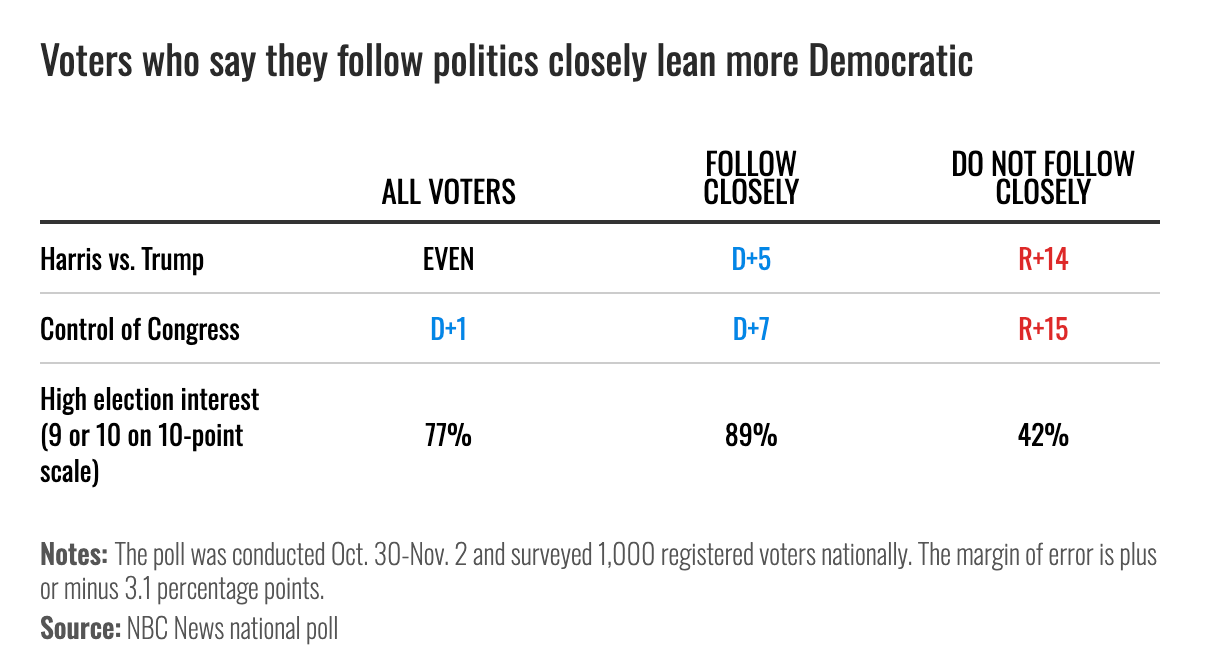
Second, many, probably most people who voted for Trump believed that he really is the character he played on The Apprentice — a highly competent manager. The other day I said that Trump was elected by low-information voters; this wasn’t a slur on Americans’ intelligence, it was a reference to survey results showing that Trump’s edge depended entirely on support from voters who don’t pay much attention to politics:

How will these voters react if, as seems all too likely, the second Trump administration is instead marked by rolling chaos?

Anyway, it’s pretty remarkable. Inauguration Day is still a month away, yet the chaos monkeys have already taken over. (snip)

Cookies In The Oven

but this is so nice, I had to share it. Sorry about the cookies, though. Our moon isn’t full here until 3:01 Sunday AM.

december full moon by onecloud

fri 13, 2024 over richmond st. at spadina ave. Read on Substack

december full moon

over richmond at spadina

at 5 PM

under full moon 
traffic west bound
bound for home

at oxford st

at richmond

Covers Everything Well

Israel Executing Land Grabs In Syria