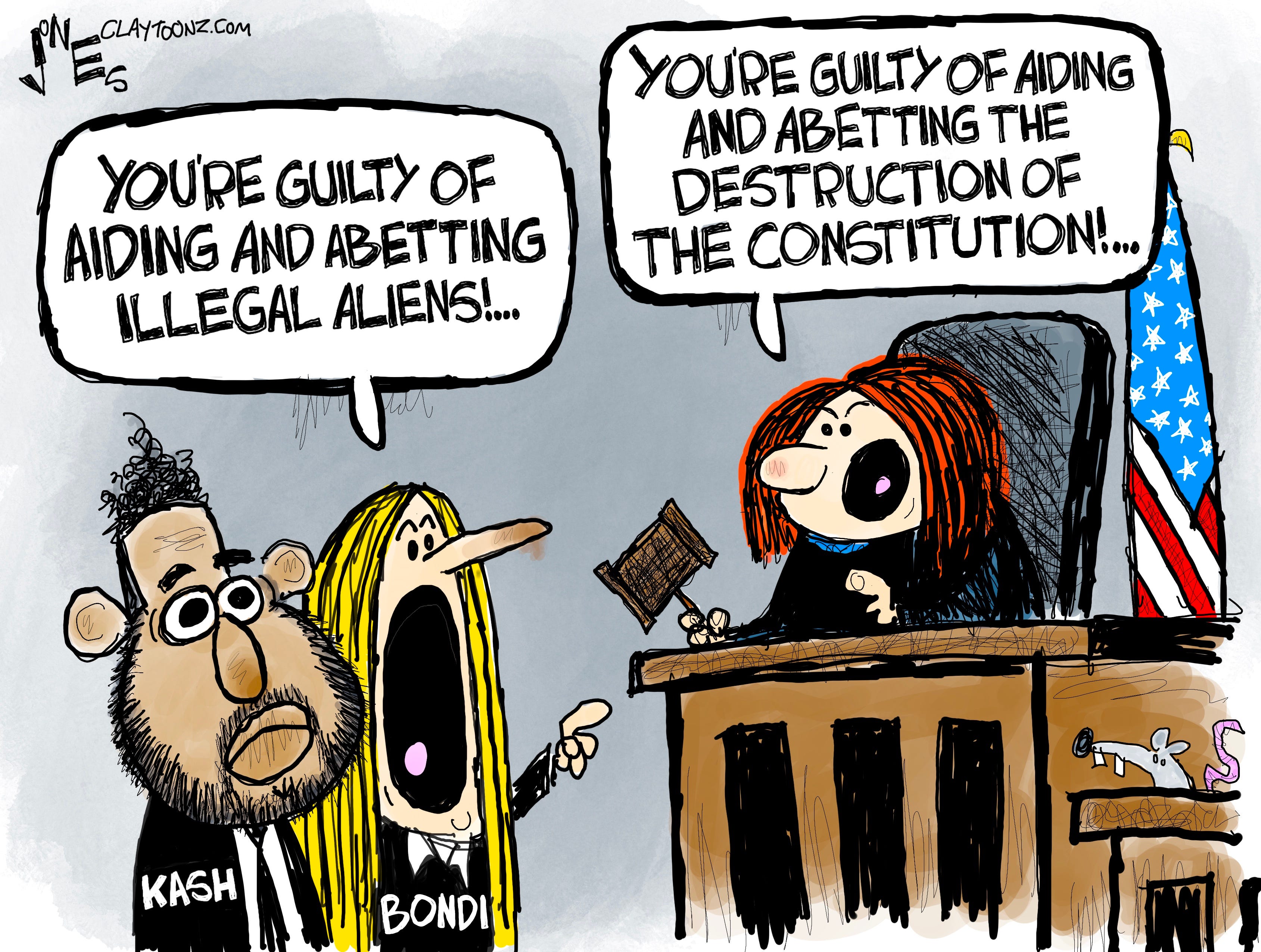
Milwaukee County Circuit Judge Hannah Dugan was arrested by the FBI and charged with obstructing an immigration arrest operation. This is a further step away from democracy and toward fascism.
FBI Director (sic) bug-eyed hatchet man KashPatel announced the arrest on TwitterX, accusing her of “intentionally misdirecting” federal agents as they sought to detain an immigrant who was set to appear for an unrelated proceeding last week. Announcing this on social media makes it clear that this is political and is meant to set an example for other judges.
The regime has been publicly attacking judges who are delaying or halting Trump’s fascist moves, like deporting legal residents and canceling student visas. One GOP representative has even filed legislation to impeach judges who go against Trump. Kash Patel, another Trump appointee not qualified for his position, was more than happy to send thugs to arrest a judge.
This is another court fight that Trump should lose, and even be thrown out.
Attorney General (sic) and MAGA hack Pam Bondi said, “These judges think they’re above the law. They are not. We will come after you and prosecute you. We will find you.” She also called judges “deranged.”
Stephen “Baby Goebbels” Miller, the White House deputy chief of staff, said on social media, “No. One. Is. Above. The. Law,” which is ironic coming from a guy who works for a felon.
While these fascist idiots are tweeting and yammering about arresting a judge, the judge can’t comment about it at all because the judicial code of conduct restricts judges from commenting on pending or impending matters in any court.
I expect that the regime will cut out the bullshit reasons and excuses and soon start arresting judges on the charges of “obstructing Trump.”
Creative note: I drew this cartoon, then drew a local cartoon for the Advance. It’s not 6:40 p.m. and I haven’t eaten yet. That means this is all the blog you’re getting today. Clay tired. I’m off the clock until tomorrow, so if you email me anything today, I’m not replying until Sunday.
Music note: I’m still feeling Chicago, so I listened to the Blues Brothers.
I read a theory on Facebook yesterday, which means there was heavy research behind it (sarcasm), that Trump only hired morons because they would provide distractions from all the Trump Fuckery he’s implementing. I think that might be a bonus, but I don’t agree with it.
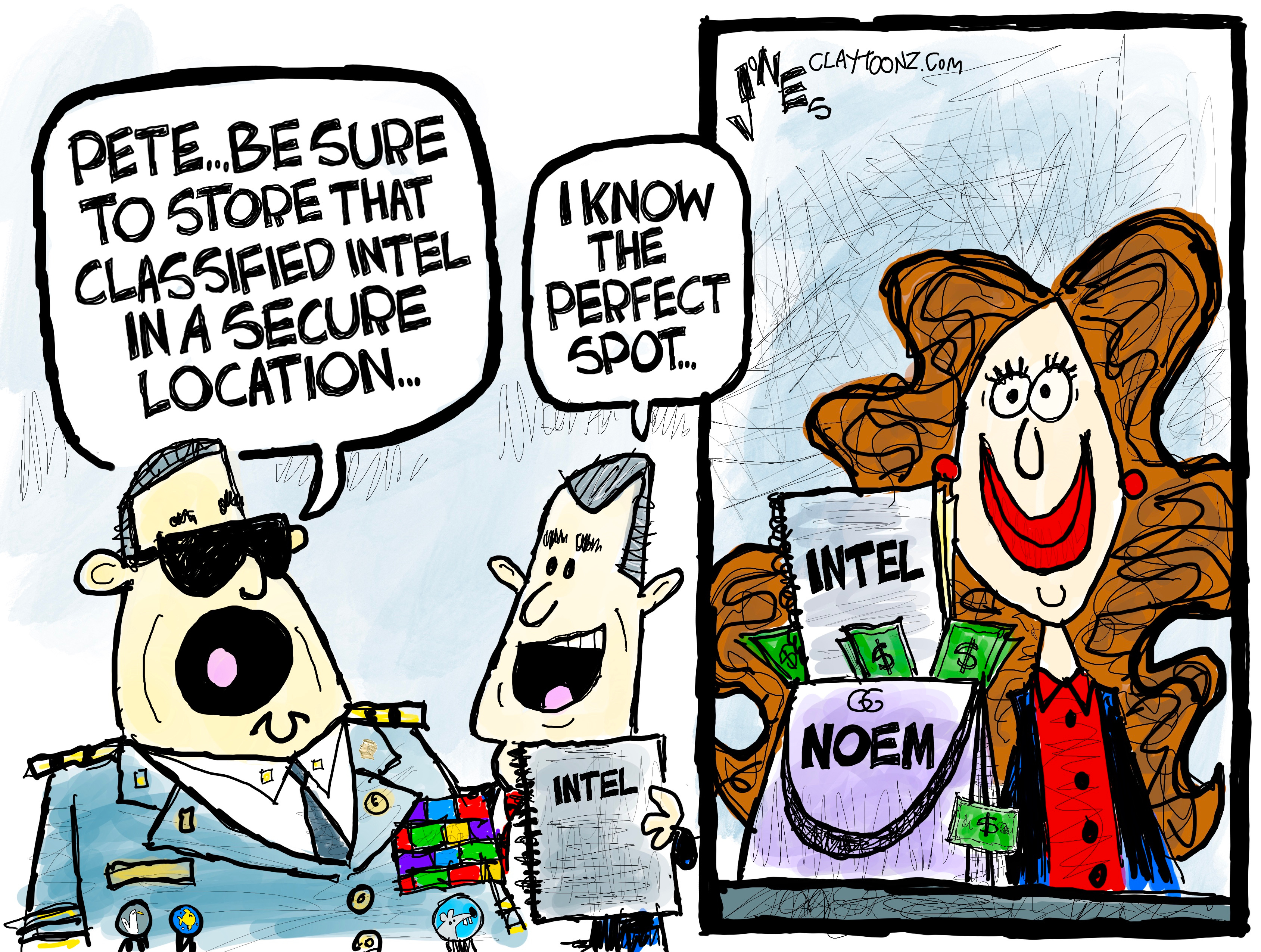
I think Trump only hires morons, not because they’re morons, but because they’re all sycophants and none will challenge his Trump Fuckery. For the love of God, Kristi Noem even got the Melania hairstyle. I’m kinda shocked JD Vance didn’t get it too.
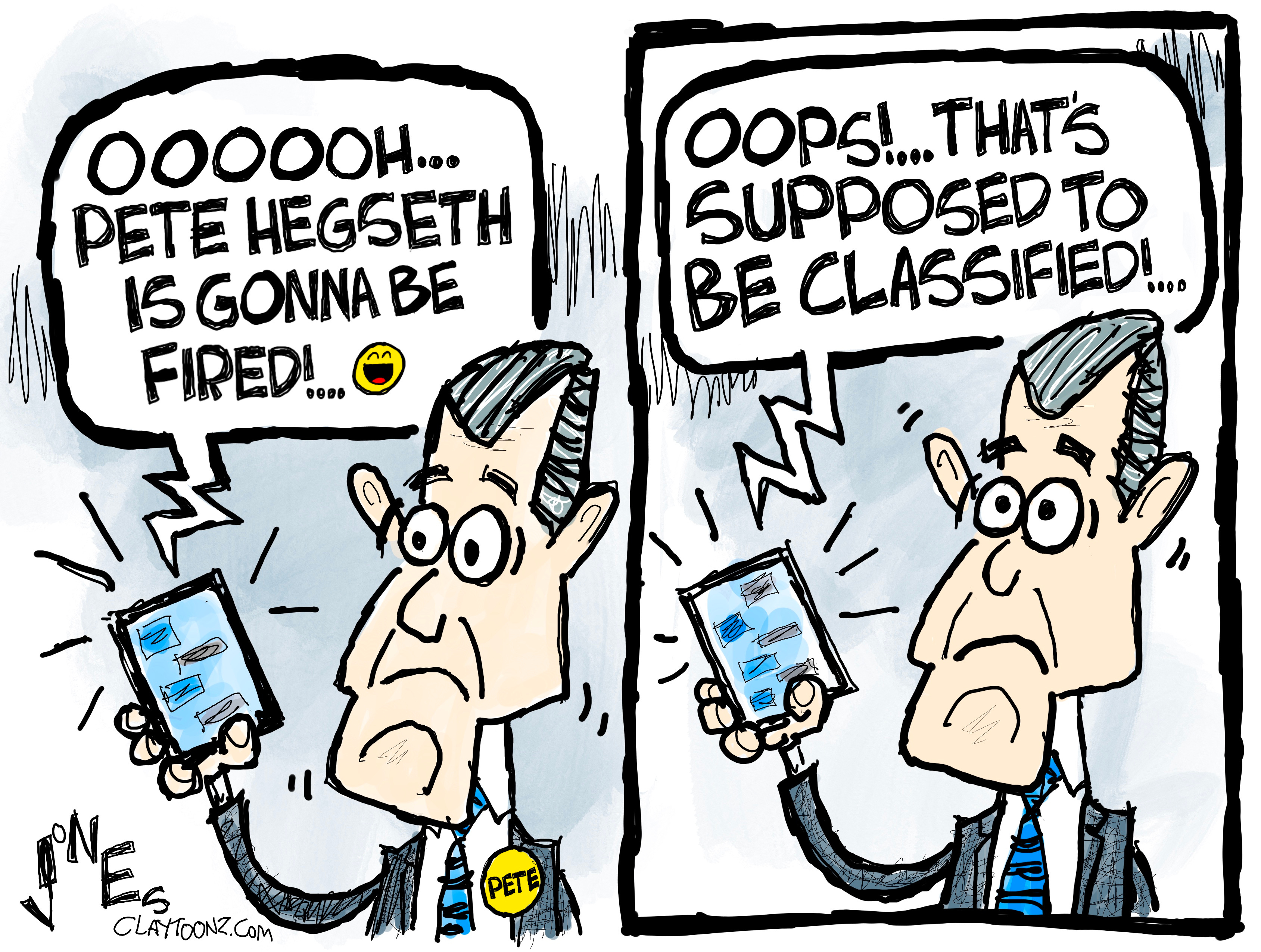
We’ve gone over the idiot picked from Fox & Friends in the Defense Department, Pete Hegseth, inadvertently leaking classified intel, so let’s discuss the puppy-murdering idiot at Homeland Security.
Kristi Noem had her purse snatched while at Capital Burger in Washington, DC. Surveillance footage showed the suspect purposefully moving close to Noem as he zeroed in on her Gucci bag near her feet.
A source said the thief, dressed in dark clothing, sat down at an empty table next to Noem with his back facing her and used his left foot to slide the bag away. He surveyed the restaurant before eventually picking up the bag, covering it with his jacket, and leaving.
He was a smooth criminal, but ya ain’t gotta be that smooth to steal from a Trump dummy.
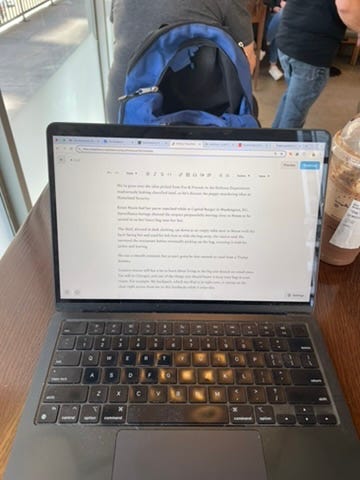
Country mouse still has a lot to learn about living in the big city (knock on wood since I’m still in Chicago), and one of the things you should know is to keep your bag in your vision. For example: My backpack, which my iPad, passport, keys, and other items is in right now, is sitting on the chair right across from me in this Starbucks while I write this.
See? No one’s gonna steal my Mocha Frappe either.
So Kristi doesn’t know how to traverse the big city, but what’s her detail’s excuse? While Noem was dining with her family, who still hasn’t alienated her despite the puppy killing, the Secret Service inside the restaurant keeping an eye on things. Well, most things.
The thief managed to swipe Noem’s purse right in from of her, the Secret Service, and every member of those yee-haw fuckers she calls her family. This must be a criminal mastermind. If the government catches him, I suggest they hire him. He can teach the Secret Service how thieves steal from MAGA morons.
But what’s interesting is what was inside Noem’s Gucci bag, as it included a Louis Vuitton Clemence wallet, her driver’s license, medication, apartment keys, passport, DHS access badge, makeup bag, blank checks, and about $3,000 in cash.
Ya know, if a Russian, North Korean, or Chinese spy wanted to access our government, they don’t have to do none of that Tom Cruise Mission Impossible crap. They would just need to snatch Kristi Noem’s purse…or just wait for Pete Hegseth to share classified intel on a chat app, or for Trump to Tweet it or hand it to Russians in the Oval Office.
But what was Kristi doing with $3,000 in cash? Did the thief also steal her pager? Paging Director Dumbass! A DHS spokesgoon said, “Her entire family was in town, including her children and grandchildren – she was using the withdrawal to treat her family to dinner, activities, and Easter gifts.”
Hey, country mouse. Have you ever heard of a bank card? Even the food trucks in DC take them. Try the Venezuelan food truck by the L’Enfant Metro station. It’s amazeballs.
Sure, we should all keep some cash on us, because you never know, but $3,000 is a bit much. And why is she carrying blank checks? Hardly anyone takes checks anymore, and everyone should be advised not to take checks from Trumpers. Elon’s probably still waiting for Trump’s check to clear for the Tesla he purchased on the White House lawn.
Jonathan Wackrow, a CNN law enforcement analyst and former Secret Service agent, said, “If necessary, the Secret Service will need to make operational changes on how they deal with these types of private events moving forward.” If anything, it’ll be necessary for the Secret Service to adjust and realize they’re guarding very stupid people now, people who aren’t smart enough to keep their stuff in their sight.
Wackrow also said Noem remains “at higher risk for targeted threats, both by foreign and domestic actors, and just her public profile alone makes her a symbolic target.”
Well, she’s a higher target now that everyone knows how stupid she is.
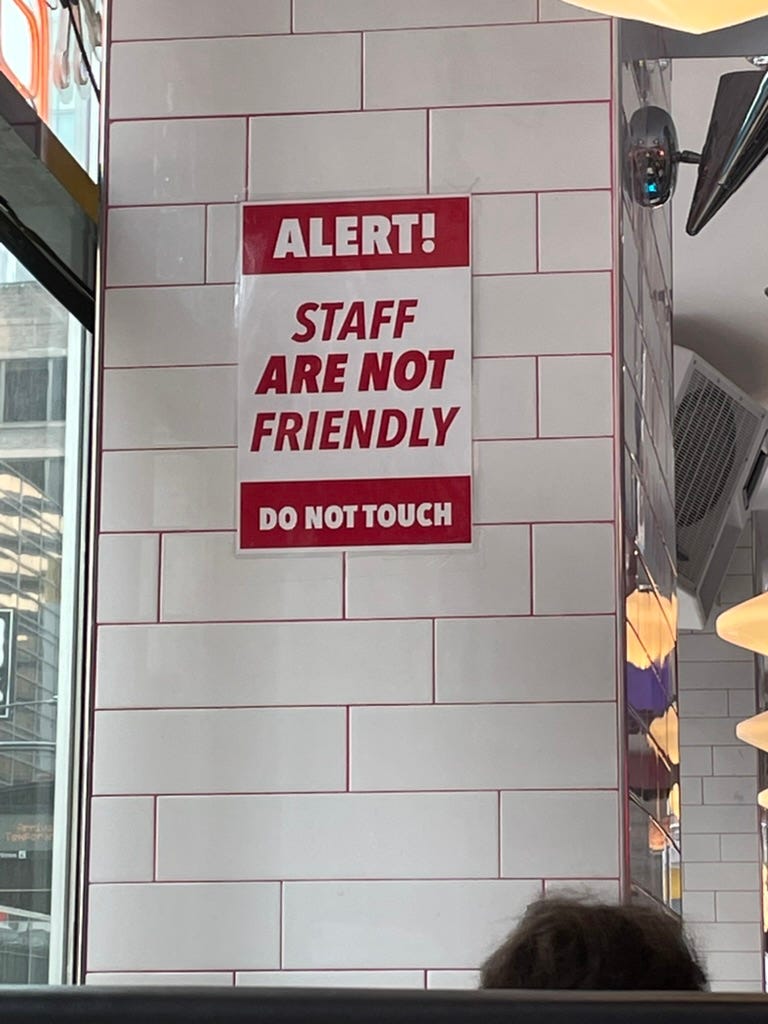
Chicago note: After my deadlines were met yesterday, I was free to go exploring. I got a meatloaf sandwich at a place where the waiters insult you.
“We’re going to miss you, Pete,” is a phrase no one will be saying Read on Substack
Let it be known that just because you might look and sound good on TV, it doesn’t qualify you to be Defense Secretary (and you didn’t look or sound good on TV or anywhere else, Pete). Nobody wants Alan Alda to conduct surgery on them because he played a convincing Hawkeye on M.A.S.H. Though, I’m sure Alan Alda would make a better Secretary of Defense than Pete Hegseth.
For that matter, Michael Douglas, Martin Sheen, Morgan Freeman, Harrison Ford, Bill Pullman, Terry Crews, and Tommy Lister would all make a better president than our current one (sic).
Remember when a journalist was added to a Pete Hegseth-led government group chat containing classified information about an upcoming strike against Houthi rebels in Yemen? Pete did it twice.
Minutes before American fighter jets took off to begin strikes against the Iranian-backed rebels in Yemen last month, Army Gen. Michael Erik Kurilla, who leads U.S. Central Command, used a secure U.S. government system to send detailed information about the operation to Hegseth.
The material Kurilla sent included details about when US fighters would take off and when they would hit their targets. These were the kind of details that if they fell into the wrong hands, could put the pilots’ lives at severe risk. But this is what the general was supposed to do, provide his superior (oh, dear god), with information he needed to know and using a system specifically designed to safely transmit sensitive and classified information. So what did Pete do with this information? He shared it with the wrong people. (snip-MORE)
============================
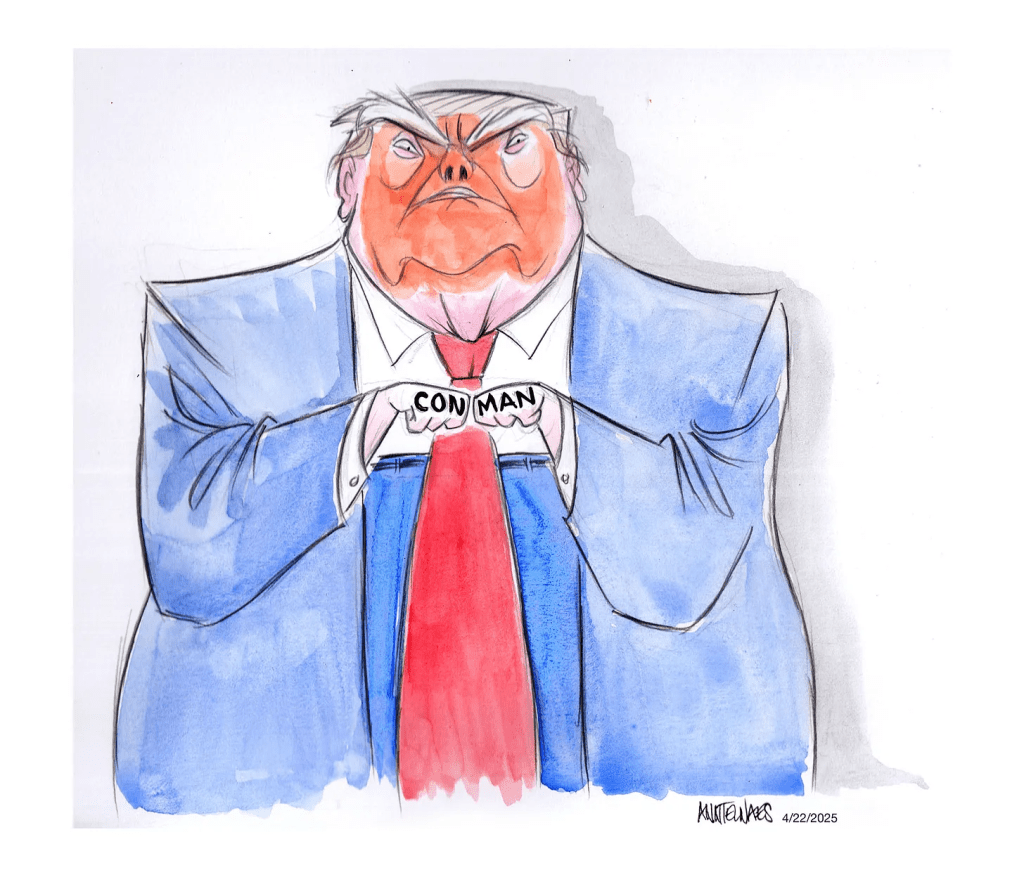
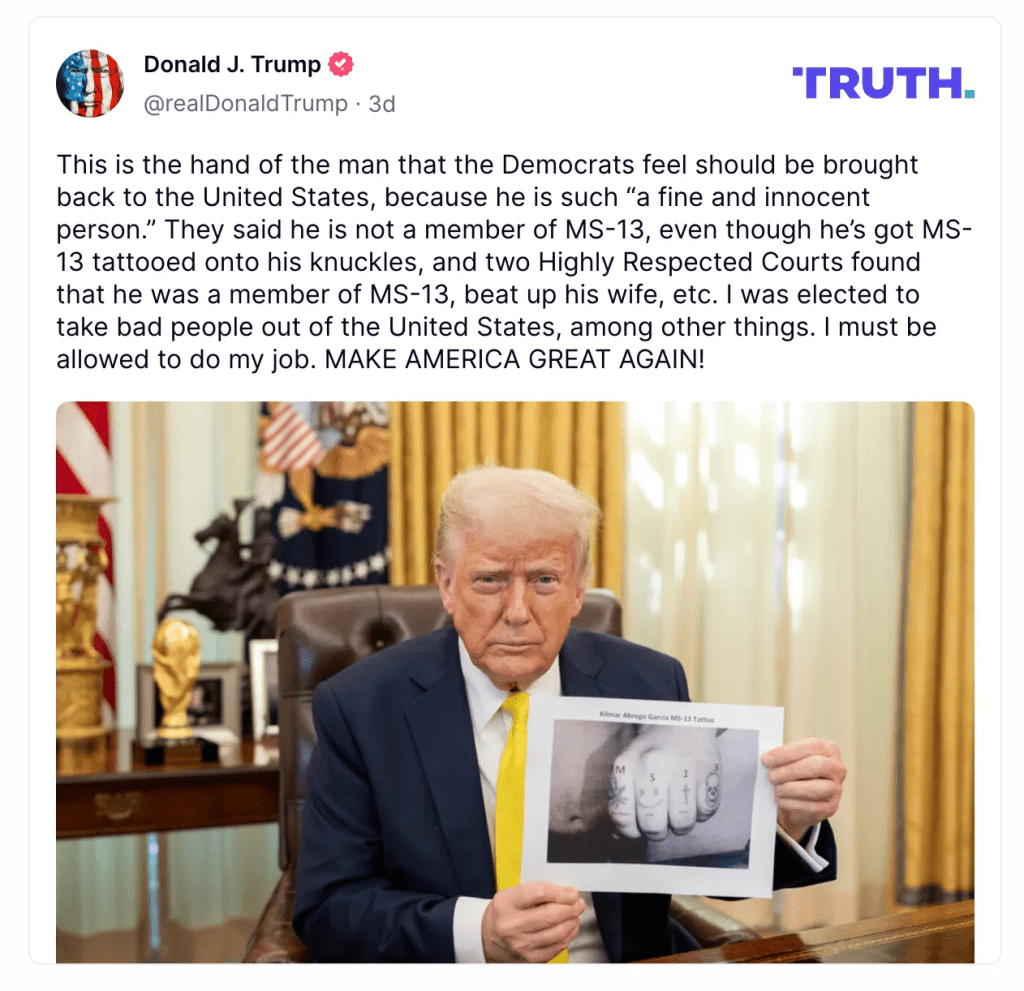
Trump’s tattoos by Ann Telnaes
Trump shows a doctored photo of Kilmar Abrego Garcia’s Read on Substack
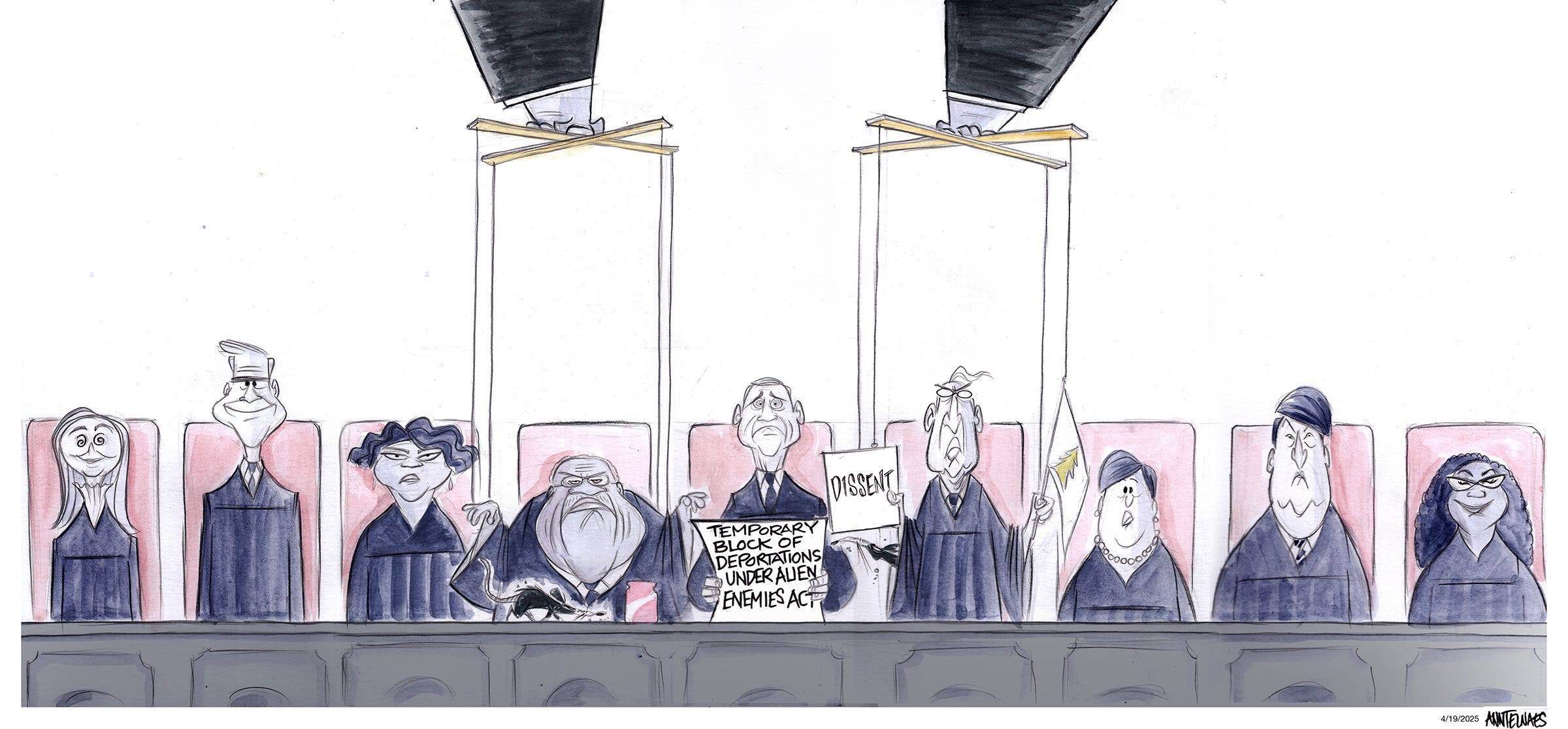
At 1 a.m. today, the Supreme Court paused the deportation of immigrants who are subject Donald Trump’s abuse of the Alien Enemies Act (a measure that’s only supposed to be used during an invasion or times of war), just as the Trump regime was on the verge of flying a group of Venezuelans from Texas to El Salvador to rot in that nation’s hellhole of a prison.
Breaking news at 1 a.m. is usually about an explosion, an invasion, a tsunami, a tweet from Trump containing an incomprehensible new word, but rarely a Supreme Court ruling.
SCOTUS had previously told the regime that it’d be OK if they used the illegal Alien Enemies Act, just so long as each immigrant (and maybe US citizen) received due process first. The regime apparently ignored that last part about due process and was about to go all-skippy with deporting more Venezuelans.
The court ordered the Trump administration to respond to the emergency appeal once a federal appeals court in Louisiana takes action in the case. The court said, “The government is directed not to remove any member of the putative class of detainees from the United States until further order of this court.” That means the regime will probably go ahead and do it.
SCOTUS did not explain the ruling, maybe because it was 1 a.m. and a rumor started that Denny’s was about to close, and Sotomayor is a real grouch if she doesn’t get her Moons Over My Hammy.
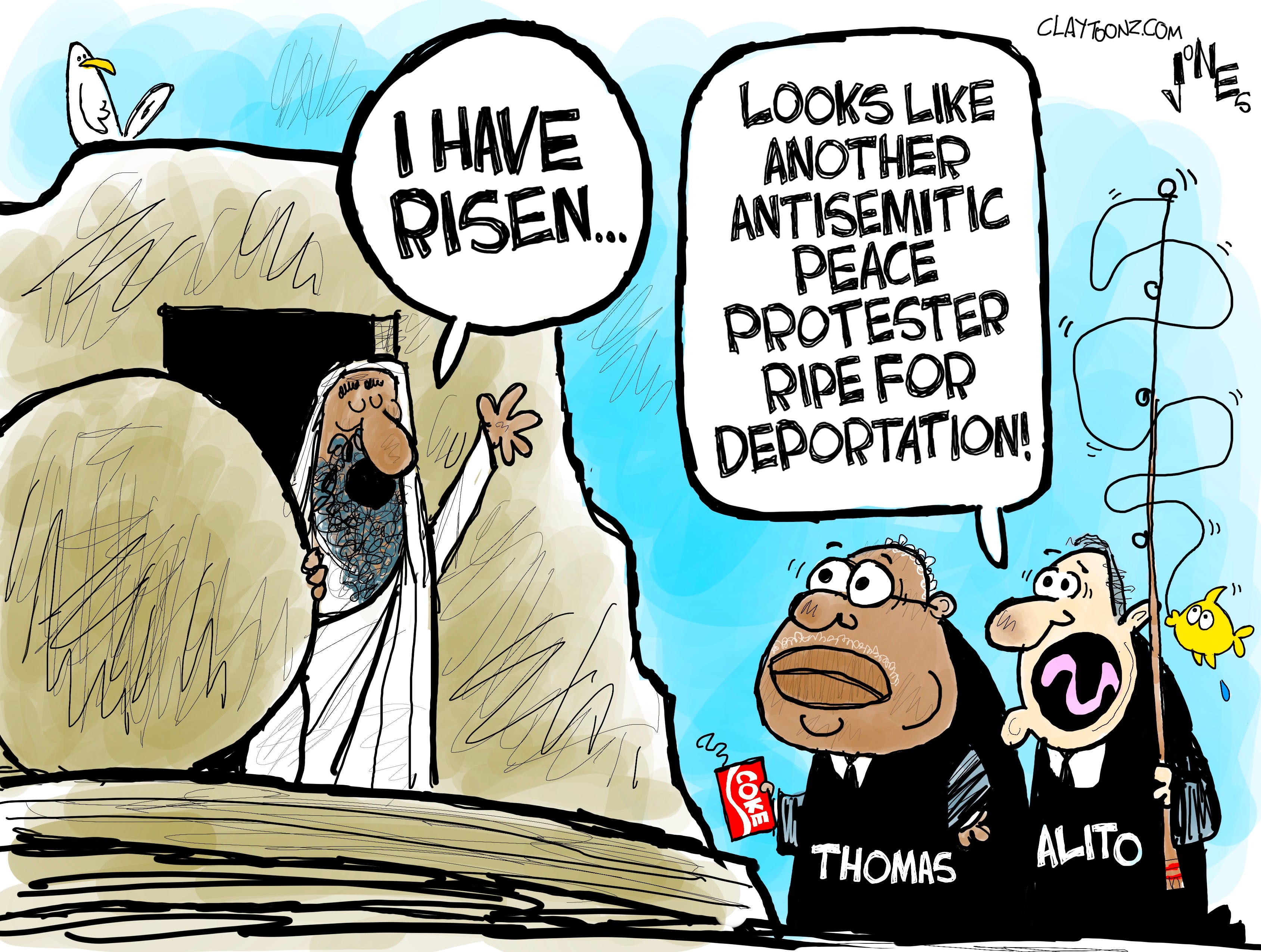
But we probably don’t need an explanation for why the only two dissenters were (be ready to be surprised) Clarence Thomas and Samuel Alito (OK, that wasn’t surprising).
Why would those two oppose delaying the deportation of immigrants without due process and support the regime violating the last order from SCOTUS? There are several possible reasons, and I’m sure none of them are good.
The first reason could, they’re fascist goons.
The second one could be that they just don’t give a shit about the Constitution and know this is the side they’re supposed to be on.
The third reason could be that they don’t care what the issue is and all they need is to be pointed in the direction Trump’s going, and they will follow.
The fourth reason could be that it’s booty night, Clarence doesn’t want to upset Ginny Thomas, and Samuel is hoping Mrs. Alito will help raise his flag.
The fifth reason could be that they’re both corrupt and were bought off to vote this way.
Even Trump’s justices, Neil Gorsuch, Brett Kavanaugh, and Amy Coney Barrett, voted for this delay.
These guys would deport Jesus, especially since he’s not a blue-eyed blonde like White Christians make him out to be.
This part of the blog is short because I want to clean my apartment before I fly to Chicago on Monday. I like coming home to a clean apartment.
I have a beef, and it’s not the Italian beef sandwich I’m planning to try in Chicago: I may be starting a fight I don’t want to fight, but dammit. Somebody has to.
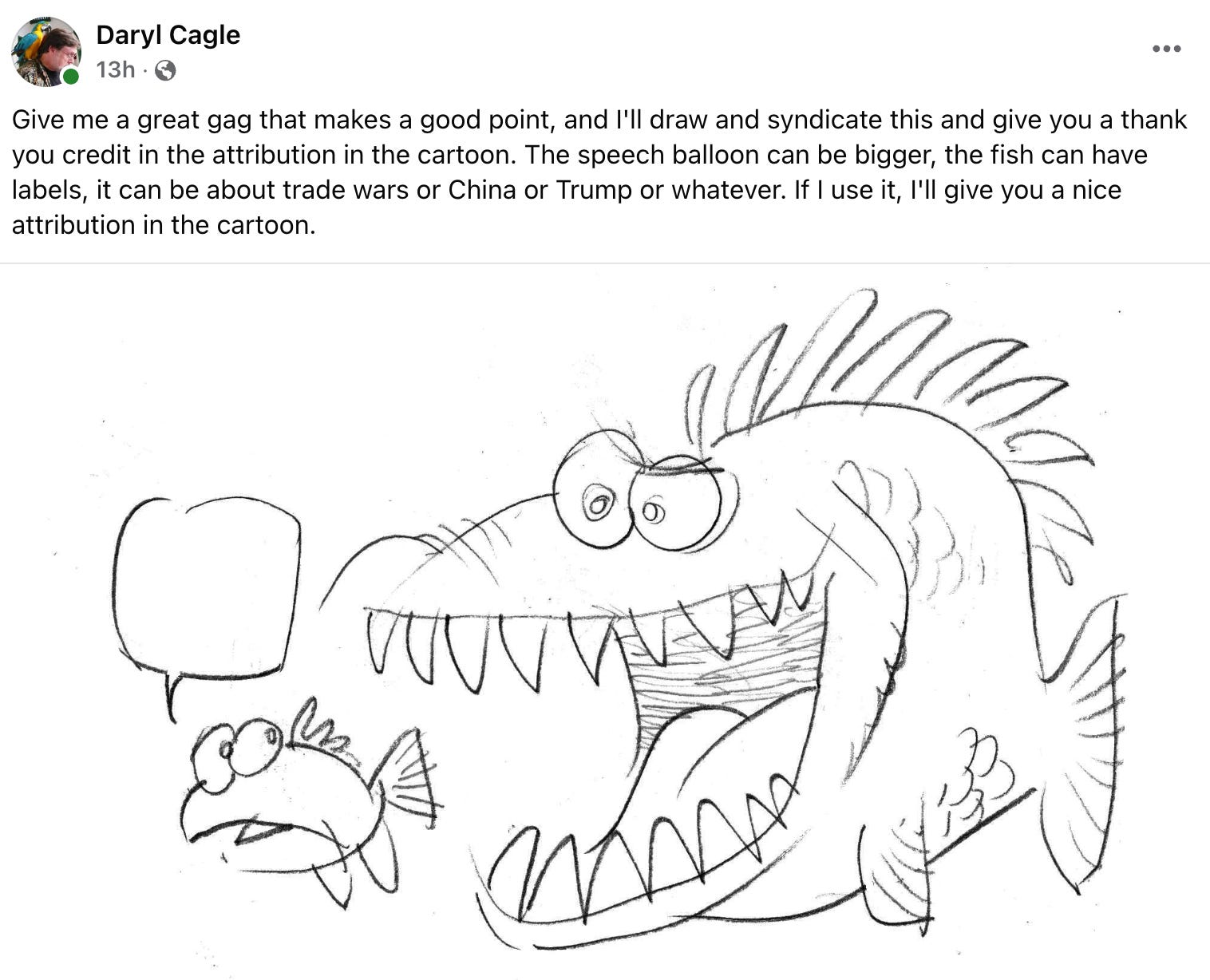
A caption contest is where a cartoonist draws a cartoon, but doesn’t finish writing it. He creates an image and leaves a blank speech bubble/balloon. He then invites the readers to fill in the bubble and makes a contest out of it. It’s fun for the readers, gets them to engage with the cartoonist and the publication, and brings more hits and views to the publication’s website. I always felt it was a cheap way to make readers come back to look at other same page, and I openly admitted that when I did a caption contest for The Free Lance-Star. I hated the caption contest, but knew my readers loved it and my editors liked the views. I don’t see anything wrong ethically with the caption contest because I don’t see it as political cartooning. I saw it as a newspaper feature similar to the crossword puzzle, the jumble, or today’s Wordle. I’ll occasionally bump into a reader who’ll bring up the caption contest…that I hated.
My friend Walt Handelsman is doing a caption contest, and he does it well.
I saw something similar last night that’s kinda similar to the caption contest, but it’s entirely unethical, diminishes political cartooning, lazy, and is screwing readers over.
This is what I saw, and it’s by Daryl Cagle, who operates the largest syndication company for political cartoons.
If this were just a game for his website, I’d think nothing of it, but it’s not a game.
Daryl is shopping for his reader to write his ideas, and then he plans to sell them. If he does manage to sell them, they won’t be next to a crossword puzzle, but on the opinion page. It’s not like editors will care if they suck, and they will. And if he sells them, he’s not sharing the money with the person who wrote the idea. They’ll just get an “attribution.”
Remember my blog about why I don’t use cartoon ideas I didn’t write? The reason boils down to ethics, which Daryl doesn’t have. Even though I might be the goofiest guy in this industry, I take this industry seriously. I care about my work. Obviously, Daryl doesn’t care about his. He once drew two versions of a cartoon, one version from the Right and the other from the Left. It was a total hack job. He doesn’t care.
I commented on Daryl’s Facebook page, telling him to write his own cartoons. He replied, “According to the Pulitzer people, we’re all just illustrators now, Clay.” That’s pretty much true as the Pulitzers have taken away the contest category for political cartoons and combined it with “illustrated reporting” or some shit like that, but I wasn’t going to let Daryl use it as an excuse.
I replied to Dayl’s reply, saying, “Then why are you helping the Pulitzers diminish us? You already used the anonymous cartoonist to tell editors and publishers that we’re not journalists. Most political cartoonists have too much integrity to take ideas submitted by readers, and here you are shopping for them. Do you not care about your work? If you don’t want to be a political cartoonist, then get out of the political cartoon business. And then on top of all that, you’re not going to pay the person who writes the cartoon you’re going to sell.”
Daryl previously syndicated an anonymous cartoonist who signed his work as Rivers. Rivers is a lying racist idiot MAGAt in Canada (that was a secret too). By syndicating Rivers, Daryl was telling editors and publishers that political cartoons didn’t have to abide by their ethics policies, thus cartoonists aren’t journalists anymore. That’s a weird position for a cartoonist to take. Even letters to the editor must be signed. When asked to justify this a couple of years ago, Daryl replied to me, “I don’t see a problem with this,” which wasn’t answering the question.
I first met Daryl in 1997 when I was in Hawaii. He flew out and bought me a burrito. I liked him. He’s a nice guy personally, and I thought at the time with his website, that he was a huge advocate for our entire industry, but over the years, he started doing shit like this, shit I can’t remain silent about. Other cartoonists have told me to shut up and not make noise, but you know I’m not good at that. I’m a noisy motherfucker. I rock a Gibson. And then others send me private messages encouraging me on, but won’t add their voices to my one-man protest. Those cartoonists are smarter than I am.
I would rather support other cartoonists than criticize them. I try to make any criticism about the message in it, like if it’s lying or racist, never just because I think it sucks. I don’t want to go after Daryl, but here I am.
Daryl could come after all my clients and try to chase me out of the business, but there’s no sign he’s ever tried that, though I have lost newspapers to his syndicate, which sells dozens of cartoons in one package for a flat fee. It’s hard to compete against that. Once, every cartoonist could submit to USA Today, but then Daryl made a deal with Gannett that shut out every cartoonist from their entire chain except for his cartoonists. Now, Gannett doesn’t publish political cartoons at all.
But he can’t come after my Substack. To all you paid subscribers, this is one of the things you’re helping me fight, and you’re giving me more freedom to speak out. So I thank you again.
I’m going to open the comments today to be fair, to give Daryl a chance to respond to this. I don’t think he will, but I’m trying to be fair.
I’m not going to fight a war or carry a torch for this. I’m going to move on and focus on my work, but somebody had to say something. I’ll end this with one more message to Daryl: Write your own fucking cartoons.
Creative note: I already did one Easter cartoon, which has a higher chance of being published than this one. I wanted to do something like this cartoon just to rouse up the conservatives on Easter Sunday. It’s so much better than the he-has-risen bullshit from the fake Christians like Gary Varvel.
Snippet-go read this, the videos are delightful- Sen. Prof. Warren remains outstanding!
Oh yeah, baby, talk dirty to us.
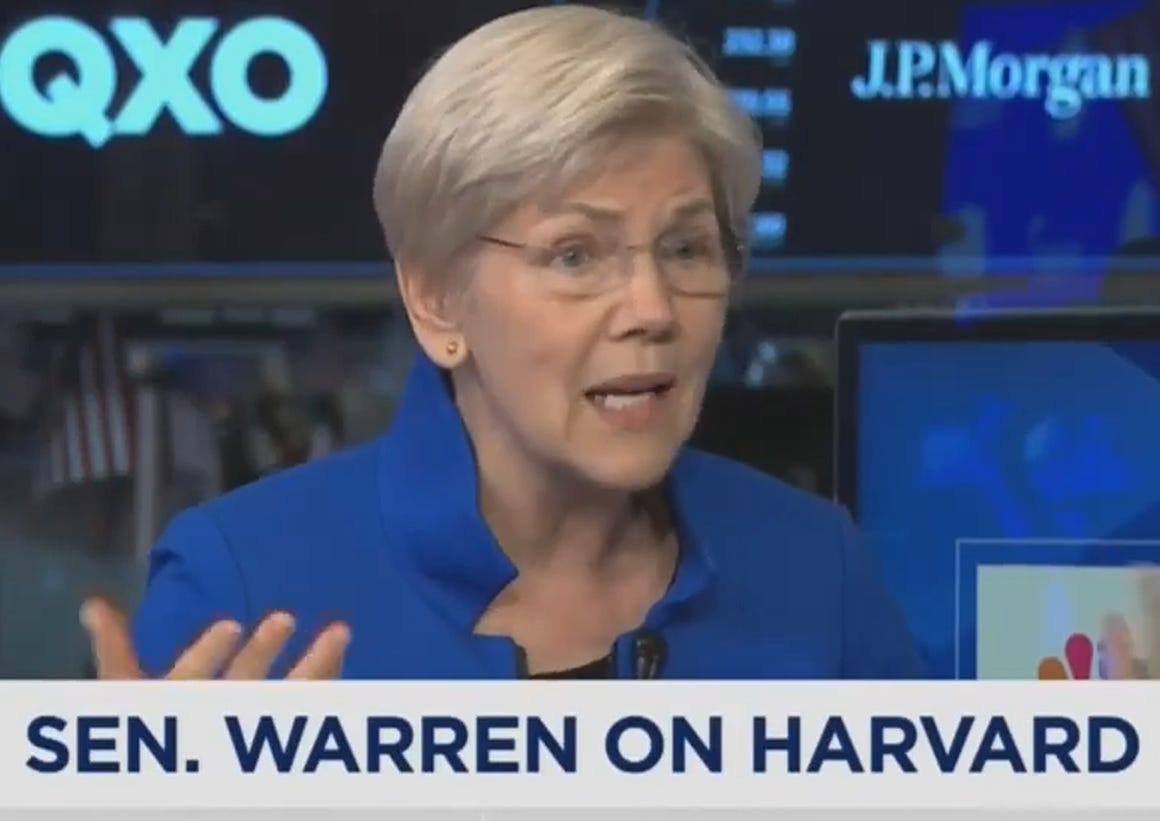
Professor Senator Elizabeth Warren stopped by CNBC’s “Squawk on the Street”on Friday for some chattin’ and some rantin’ and some tarriffsplainin’ for the benefit of the show’s blow-dried hosts. We don’t normally watch financial news shows, because what are we, the Vanderbilts? But put Warren on anytime, and we’ll consider tuning in more. She can be entertaining!
Especially if your anchor isn’t following her argument, which sends her into her professorial did-you-not-do-the-reading voice. Which is what happened to Sara Eisen, who must have thought for one moment that she was back at the Medill School and had skipped that week’s assignment. (snip)
Black Mirror, eat your heart out. Researchers have apparently just figured out how to make people see a color completely new to humanity.
Scientists at the University of California, Berkeley conducted the research, published Friday in Science Advances. Using a technique called Oz, the research team induced human volunteers into seeing a color beyond the “natural human gamut.” Oz could allow scientists to conduct experiments previously not possible before, the authors say, and the lessons we learn from it might even someday help color-blind people regain their missing color vision.
Our retinas contain certain photoreceptive cells, known as cones, that allow us to see color. There are three cone types that correspond to different wavelengths of light: short-wavelength (S) cones, medium-wavelength (M) cones, and long-wavelength (L) cones.
Typically, when we try to reproduce color in front of someone’s eyes, we do so by manipulating the spectrum of light seen by the retina’s cones. But since some of our cones, particularly M cones, share overlap in how they respond to certain wavelengths, there are theoretically colors out there that our eyes can never truly see. The UC Berkeley researchers, based on their earlier work studying cone cells, say they’ve found a way around this limitation. (snip)
What is the South African Renewable Energy Masterplan?
It is an industrial strategy that sets out how South Africa can set up a new manufacturing industry in renewable energy and battery storage value chains.
The masterplan was developed by the government, some sections of organised labour, a non-profit organisation advocating for renewable energy, and representatives of the renewable energy industries. It sets out a framework to produce renewable technologies locally. These include solar photovoltaic panels, wind turbines and batteries.
The masterplan has been drawn up so that it aligns with South Africa’s existing national target of adding 3–5 gigawatts of renewable energy capacity each year to 2030. This is a scale that can support the development of local manufacturing hubs. (One gigawatt can supply electricity to about 700,000 average homes.) This steady supply will be enough to give businesses and investors the confidence to commit to long-term investments in local manufacturing hubs. These are zones where renewable systems and components are produced or assembled for domestic and export markets.
The state-owned electricity company, Eskom, has not directly guaranteed that it will buy 3-5 gigawatts of renewable energy each year. But the government’s national electricity plan (the Integrated Resource Plan) provides a strong indication of future demand. (snip)
I want to thank brucedesertrat who sent me the link to this substack article. I enjoy learning about history but sadly this hits home too deeply. It is so close it is scary. Hugs.
Today President Trump is threatening to pull funds if Harvard does not comply with his demands for the school to shape it’s curricula to favor Trumpism. Harvard has refused to caved to Trump’s fascist demands which clearly violate free speech.
“The University will not surrender its independence or its constitutional rights,” Harvard President Alan M. Garber
The seizure of power by the MAGA Republicans in 2025, led by Donald Trump, brought far-reaching changes to American Universities. Some caved, some obeyed in advance.
The seizure of power by the Nazis in 1933, led by Adolph Hitler, brought far-reaching changes to German Universities. All caved. All obeyed in advance.
There is a parallel in German history for this American moment when books are banned, educational institutions are battered and a brutal and barbaric anti-intellectual ethos is on the rise.
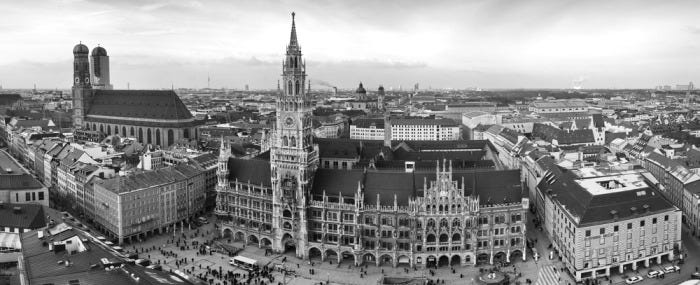
A timeline of the Nazification of Munich University
1933
Hitler demands The University of Munich restructure its curriculum in accordance with the new ruling ideology of Nazism.
Trump demands Harvard University restructure its curriculum in accordance with the new ruling ideology of Trumpism. Abandon DEI. Police your students and faculty for viewpoint “diversity”.
Those faculty members who are not Nazi sympathizers are dismissed.
Trump’s letter calls for political undesirables to be gone.
The numbers of Jews admitted to university are restricted.
Munich University is the site of book burnings led by pro-Nazi students.
With the passage of these laws, the Nazis attempted to root out any opposition to their ideology that remain in German higher education.
Trump wants all of America’s Universities to root out anti-Trumpist thought, to be citadels of Trumpism, to employ MAGA professors who will teach American students how Trumpism will make America and her institutions of higher learning great again.
1941
Munich University appoints of Walther Wüst, an Aryan ideologue, Führer-Rektor of the University. By this time the Nazification of Munich University is complete. The once prestigious Munich University employs an all Nazi faculty.
1943
Sophie Scholl, a student attending Munich University, is guillotined for distributing anti-Nazi broadsides on campus.
Under President Trump students are deported or “disappeared”. I can safely assume an American student will be martyred for resisting fascism here in our nation in t he months ahead.
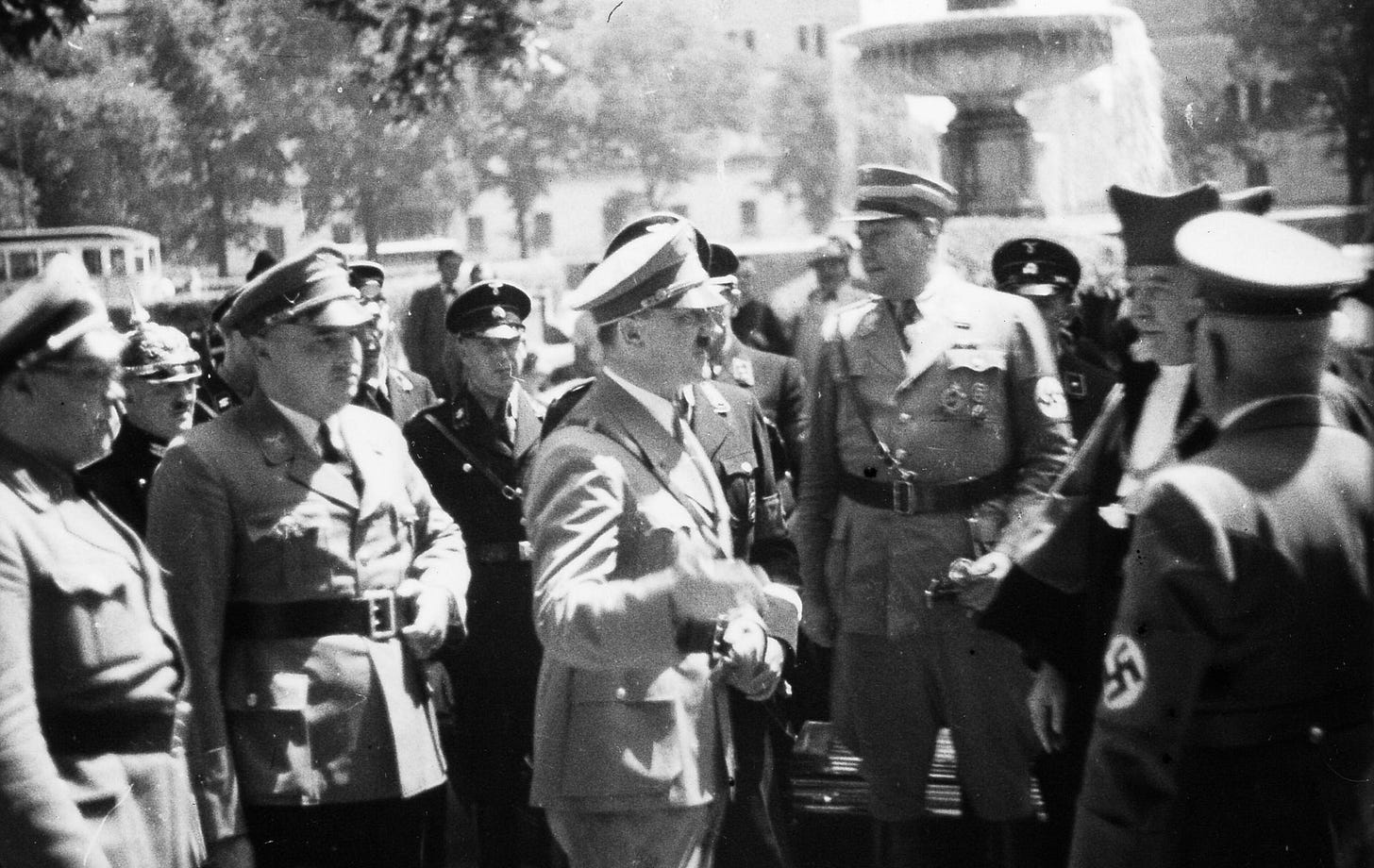
Hitler visiting the University of Munich
Here is a harrowing account of the Nazification of Frankfurt University witnessed by young Austrian economist named Peter Drucker:
Frankfurt was the first university the Nazis tackled, precisely because it was the most self-confidently liberal of major German universities, with a faculty that prided itself on its allegiance to scholarship, freedom of conscience, and democracy. The Nazis knew that control of Frankfurt University would mean control of German academia. And so did everyone at the university.
Above all, Frankfurt had a science faculty distinguished both by its scholarship and by its liberal convictions; and outstanding among the Frankfurt scientists was a biochemist-physiologist of Nobel-Prize caliber and impeccable liberal credentials. When the appointment of a Nazi commissar was announced . . . and every teacher and graduate assistant at the university was summoned to a faculty meeting to hear this new master, everybody knew that a trial of strength was at hand. I had never before attended a faculty meeting, but I did attend this one.
The new Nazi commissar wasted no time on the amenities. He immediately announced that Jews would be forbidden to enter university premises and would be dismissed without salary on March 15; this was something that no one had thought possible despite the Nazis’ loud antisemitism. Then he launched into a tirade of abuse, filth, and four-letter words such as had been heard rarely even in the barracks and never before in academia. . . . [He] pointed his finger at one department chairman after another and said, “You either do what I tell you or we’ll put you into a concentration camp.” There was silence when he finished; everybody waited for the distinguished biochemist-physiologist. The great liberal got up, cleared his throat, and said, “Very interesting, Mr. Commissar, and in some respects very illuminating: but one point I didn’t get too clearly. Will there be more money for research in physiology?”
The meeting broke up shortly thereafter with the commissar assuring the scholars that indeed there would be plenty of money for “racially pure science.” A few of the professors had the courage to walk out with their Jewish colleagues, but most kept a safe distance from these who only a few hours earlier had been their close friends. I went out sick unto death—and I knew that I was going to leave Germany within forty-eight hours.
The Nazis attacked academic dissent with lethal cruelty
Some went to nearby Dachau. Some, such as our heroic young student Sophie, were beheaded.
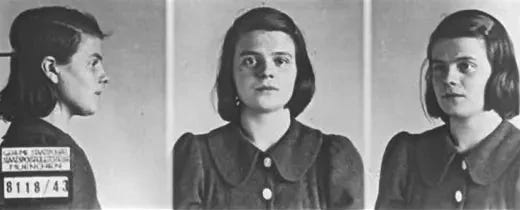
Sophie Scholl, photographed by the Gestapo
Here is the text of the pamphlet that cost Munich University student Sophie Scholl her life. Her haunting critique of Hitler resonates eerily with the familiar critiques of our current leader:
Fellow Students!
Shaken, our people faces the downfall of our men of Stalingrad. Three hundred thirty thousand German men have been senselessly and irresponsibly rushed into death and ruin by the brilliant strategy of the man who served as a private in the Great War. Führer, we thank you!
It is festering in the German people: Do we want to continue entrusting the fate of our armies to a dilettante? Do we want to sacrifice the rest of our young Germans to the base, power-seeking instincts of a Party clique? Nevermore.
The day of reckoning has come, our German youth’s reckoning with the most abhorrent tyranny that our people has ever endured. In the name of all young Germans, we demand that Adolf Hitler’s State return to us our personal freedom, the German’s most valuable possession, which he has cheated us out of in the most disgraceful way.
We have grown up in a State where every free expression of opinion has been ruthlessly gagged. The HJ, SA, and SS have tried to make us uniform, to revolutionize us, to narcotize us in the most fruitful educational years of our lives. “Ideological training” was the name given to the despicable method of stifling our budding independent thought and self-esteem in a haze of empty phrases. A “Führerauslese”1 of a kind as fiendish and at the same time as narrow-minded as one can possibly imagine, grooming its future Party bosses at Ordensburgen [special educational centers for Party cadres] to become godless, shameless, and unscrupulous exploiters and cutthroats, to become blind, mindless followers of the Führer. We “brain-workers” were exactly right for becoming the cudgel of this new ruling class. Front-line soldiers are disciplined like schoolboys by student leaders and would-be Gauleiter; Gauleiter, with prurient jests, assault the honor of female students. German female students at the university in Munich have given a dignified reply to the insult to their honor, and German male students have intervened and stood their ground on behalf of their female classmates. That is a first step toward gaining our right to free self-determination, without which intellectual values cannot be created. We are grateful to our brave fellow students, female and male, who have led the way by setting this shining example!
For us, there is only one watchword: Fight against the Party! Get out of the Party formations, in which the goal is to keep us politically muzzled! Get out of the lecture rooms of the SS Unter- or Oberführer and the Party bootlickers! True scholarly activities and genuine intellectual freedom are at stake! No threat of any kind can frighten us, not even the closing of our universities. Each of us must fight for our future, our freedom and honor in a body politic that is aware of its moral responsibility.
Freedom and honor! For ten long years, Hitler and his comrades have squeezed these two magnificent German words and made them loathsome, have banged on them and twisted them as only dilettantes can, dilettantes who cast the highest values of a nation before swine. They have sufficiently demonstrated what freedom and honor mean to them during ten years of the destruction of all physical and intellectual freedom, of all moral substance in the German people. Even the dumbest German’s eyes have been opened by the dreadful blood bath which they have brought about everywhere in Europe and continue to bring about each day. The German name will remain forever disgraced unless German youth stand up at last, engage simultaneously in revenge and expiation, smash their tormentors, and bring about a new intellectual and spiritual Europe.
Students! The German people is watching us! It expects us, as in 1813 with the breaking of Napoleon’s domination, now also in 1943 to break the domination of National Socialist terror through the power of the mind.
Berezina and Stalingrad blaze in the East; the dead of Stalingrad implore us!
“Fresh on, my people, the flame signals are smoking!”2
Our people is rising up against the enslavement of Europe by National Socialism, in a new, trustful breakthrough of freedom and honor!
As you read her courageous words consider how and why a regime would loathe and fear such a voice for liberty.
Now is the time to stand with all who see Trump for the terrifying tyrant he is.
Now is the time to stand with all educators and students who courageously stand against this tyranny.
Now is the time to join Thomas Jefferson in swearing “upon the altar of god eternal hostility against every form of tyranny over the mind of man.”
Now is the time to stand with Harvard University.
Now is the time to stand with all educators and educational institutions threatened by MAGA fascism.
David Fitzsimmons: Arizona’s Progressive Voice is a reader-supported publication. To receive new posts and support my work, consider becoming a free or paid subscriber.
Talk about weaponizing the government. tRump seems to think that the DOJ and all agencies work for him personally. The Department of Justice was founded not to be the presidents personal lawyer but the peoples attorneys to protect the rights of the public. The FBI was founded as the countries police not the private cops of tRump to do his dirty work. How far the US has fallen due to these people who think they are the superior race and that they are so great. Hugs
Graham Kates,
Katrina Kaufman
/ CBS News
The Department of Justice wants to stand in for President Trump in his ongoing appeal of a defamation case that could cost him tens of millions of dollars.
Lawyers for the taxpayer-funded agency and Mr. Trump’s personal attorneys said in a filing on April 11 that the Justice Department believes the federal Westfall Act shields Mr. Trump in the case, which has pitted him against the writer E. Jean Carroll.
A federal jury awarded Carroll $83.3 million in January 2024, after concluding that Mr. Trump made defamatory statements when denying that he sexually abused Carroll. That award came less than a year after a separate federal jury concluded Trump was liable for sexual abuse, and instructed him to pay her $5 million.
The Justice Department asserts that Mr. Trump was acting in his official capacity as president when he made the allegedly defamatory statements about Carroll in 2019, and therefore the court is required to substitute the United States for Mr. Trump in the case. Under the Westfall Act, federal employees are entitled to absolute immunity from personal lawsuits for conduct occurring within the scope of their employment.
Legal scholar James Pfander said Mr. Trump still needs to show that his actions, publicly denying Carroll’s claims, were within the scope of the presidency.
“As a legal issue ultimately for the courts, the [Justice Department’s] certification alone does not decide the question,” said Pfander, a Northwestern School of Law professor.
Pfander noted that the Westfall Act says it permits government employees to petition courts to certify they were acting within the scope of their office “at any time before trial.”
“By allowing an employee to pursue certification but limiting the time to ‘before trial,’ the statute would seem to suggest that a motion to substitute at the appellate stage of the litigation comes too late,” Pfander said.
A longtime advice columnist, Carroll published a book excerpt in New York magazine in 2019 accusing Mr. Trump of sexually assaulting her in a department store dressing room in the mid-1990s. Mr. Trump denied the allegations and called Carroll a “whack job.” He claimed he had never met Carroll, accused her of “totally lying” and said, “she’s not my type.”
Mr. Trump would go on to repeat similar denials in public appearances, social media posts and depositions.
The Justice Department initially supported Mr. Trump’s effort to have the case dismissed, arguing the Westfall Act protected Mr. Trump from liability because he was acting as a federal employee when he denied Carroll’s allegations.
A lawyer for the department argued in 2021 — while Mr. Trump was out of office after losing the 2020 election to former President Joe Biden — that even though Mr. Trump “made crude and offensive comments in response to the very serious accusations of sexual assault” the law protecting employees from such a suit should be upheld.
The agency reversed its position in July 2023. An official for the Justice Department wrote at the time that the decision factored in the jury’s conclusion in the $5 million case that Mr. Trump was liable for sexual abuse.
“The allegations that prompted the statements related to a purely personal incident: an alleged sexual assault that occurred decades prior to Mr. Trump’s Presidency,” former Principal Deputy Assistant Attorney General Brian Boynton wrote. “That sexual assault was obviously not job related.”
Paul Figley, a former deputy director of the Justice Department’s Torts Branch, said Boynton’s decision was unexpected.
“I was very surprised by the withdrawal because we always viewed the president as behaving within the scope of office for anything he did,” said Figley, an American University professor emeritus who worked at the Justice Department for more than three decades.
An exhibit included with the case’s latest filing shows that the Justice Department, now under the purview of Mr. Trump, has again reversed course.
“I find that Donald J. Trump was acting within the scope of his office or employment at the time of the incidents out of which the plaintiff’s claims arose,” wrote Kirsten Wilkinson, the director of the agency’s Torts Branch Civil Division.
Columbia Law School professor Caroline Polisi said she believes the decision fits a pattern within the Trump administration.
“This is not at all a surprising move for this Justice Department. Trump has shown time and time again that he considers this DOJ to be his personal attorney,” said Polisi, a federal criminal defense attorney
“On their face, the comments at issue were purely personal in nature, and therefore outside of his scope of duties as president, thus excluding him from governmental immunity,” said Polisi. “However, the fact that the former administration took the same position – at least initially – shows that the argument is not entirely frivolous, and that a court may entertain arguments on the issue.”
The highest ranks of the Justice Department are filled with lawyers who just last year were Mr. Trump’s personal attorneys, but Figley said Wilkinson does not fit that description. He noted she’s risen steadily while serving through multiple administrations, before being appointed director in January.
“That appointment was an obvious choice, she’d been the deputy director in that office for many years, and the previous director retired,” Figley said.
A lawyer for Mr. Trump also argued last year that the case should be dismissed due to a Supreme Court ruling granting presidents immunity from criminal prosecution for “official acts”while they are in office.
Roberta Kaplan, an attorney for Carroll, argued in a January brief that the Supreme Court’s ruling did not apply to Carroll’s claims.
“If there were ever a case where immunity does not shield a president’s speech, this one is it,” Kaplan wrote.
Kaplan declined to comment Wednesday on Mr. Trump’s latest move, telling CBS News her response was forthcoming in opposition papers she expects to file next week.
April 19, 1911 More than 6,000 Grand Rapids, Michigan, furniture workers—Germans, Dutch, Lithuanians, and Poles—put down their tools and struck 59 factories in what became known as the Great Furniture Strike. For four months they campaigned and picketed for higher pay, shorter hours, and an end to the piecework pay system that was common in the plants of America’s “Furniture City.” Although the strike ended after four months without a resolution, Gordon Olson, Grand Rapids city historian emeritus, said once employees returned to work, most owners did increase pay and reduce hours.
April 19, 1943 On the eve of Passover, the Warsaw Ghetto Uprising began when Nazi forces attempted to clear out the Jewish ghetto in Warsaw, Poland, to send them to concentration camps. The Germans were met by unexpected gunfire from Jewish resistance fighters. The destruction of the ghetto had been ordered in February by SS Chief Heinrich Himmler: “An overall plan for the razing of the ghetto is to be submitted to me. In any case we must achieve the disappearance from sight of the living-space for 500,000 sub-humans (Untermenschen) that has existed up to now, but could never be suitable for Germans, and reduce the size of this city of millions—Warsaw—which has always been a center of corruption and revolt.”
These two women, soon to be executed, were members of the Jewish resistance. ” …Jews and Jewesses shot from two pistols at the same time… The Jewesses carried loaded pistols in their clothing with the safety catches off… At the last moment, they would pull hand grenades out…and throw them at the soldiers….” Captured Jews in the Warsaw Ghetto Uprising Learn more about The Warsaw Ghetto Uprising (it’s the search page for the national Holocaust Museum.)
April 19, 1971 As a prelude to a massive anti-war protest, Vietnam Veterans Against the War (VVAW) began a five-day demonstration in Washington, D.C. The generally peaceful protest was called Dewey Canyon III in honor of the operation of the same name conducted in Laos. They lobbied their congressmen, laid wreaths at Arlington National Cemetery, and staged mock “search-and-destroy” missions. Read more about this action
April 19, 1997 Two Swedish Plowshares peace activists, Cecelia Redner, a priest in the Church of Sweden, and Marija Fischer, a student, entered the Bufors Arms factory in Karlskoga, Sweden, planted an apple tree and attempted to disarm a naval cannon being exported to Indonesia. Cecelia was charged with attempt to commit malicious damage and Marija with assisting in what was called the Choose Life Disarmament Action. Both were also charged with violating a law which protects facilities “important to society.” Both women were convicted, arguing over repeated interruptions by the judge, that, in Redner’s words, “When my country is arming a dictator I am not allowed to be passive and obedient, since it would make me guilty to the crime of genocide in East Timor. I know what is going on and I cannot only blame the Indonesian dictatorship or my own government.” Fischer added, “We tried to prevent a crime, and that is an obligation according to our law.” Redner was sentenced to fines and three years of correctional education. Fischer was sentenced to fines and two years’ suspended sentence. Both the prosecutor and defendants appealed the case. No jail sentences were imposed.