Kegseth is hyper fixated on the the male physique and the idea of a white male hyper agressive toxic masculinity that he thinks the Russian military has. But while our inclusive military is considered one of the best Russia’s hyper all white military is getting its ass handed to it by the inclusive diverse Ukrainian military. I posted earlier that Kegseth has again blocked the promotion of well qualified female and black officers to two star rank in his goal of an all white male military. This guy won’t be in charge of the military in two more years if the people are allowed to to have a free election and his successor hopefully won’t be such a misogynist bigot. But the damage will be done and the careers of these officers damaged. Kegseth couldn’t take serving a full career of at least 20 years, but these people who he is denying promotion to have well more than 20 years in the military. How come testosterone for trans kids / people is somehow in Kegseth’s view bad and trans people taking hormones are unfit for military service, yet having straight white men all on testosterone some how makes the military better? Hugs
Service members 30 and over will test annually and can choose to receive testosterone replacement therapy if they are recommended for treatment.
“We owe our warriors the absolute best medical care in the world, and this program delivers on that obligation,” Defense Secretary Pete Hegseth said. Julia Demaree Nikhinson/AP Photo
The Pentagon will begin annually testing service members 30 and over for testosterone deficiencies, Defense Secretary Pete Hegseth announced Tuesday.
Hegseth said in a video posted to social media that the new screening would become part of the Defense Department’s periodic health assessment for military personnel. The health exam has been mandatory since 2016 and is used to measure medical condition, behavioral health, mental health and readiness to deploy.
Service members who are recommended for treatment will have the choice to receive testosterone replacement therapy, Hegseth said. Personnel under 30 can volunteer for an examination.
Hegseth’s post referred to “High-T,” a social media fad pushed by influencers that encourages men to seek higher levels of testosterone to maintain their strength and masculinity. Discussions around masculinity have seeped into culture wars and national politics. In May, James Talarico, the Democratic nominee for Senate in Texas, defended his masculinity after personal attacks from conservatives about his physical appearance.
“This initiative — it’s not about artificial enhancement; it’s about restoring and optimizing your natural capabilities, protecting your longevity, and ensuring you have the biological foundation required to sustain the fight,” Hegseth said in the video. “We owe our warriors the absolute best medical care in the world, and this program delivers on that obligation.”
Testosterone levels in males decline about 1% a year after the age of 30 or 40, according to the Mayo Clinic. It is considered a typical sign of aging.
The U.S. Food and Drug Administration does not approve testosterone replacement therapy for males without specific forms of hypogonadism, a medical condition associated with a malfunction of the organs that produce testosterone. Testosterone replacement therapy consists of injections, pellets, patches or gels that release hormones into the body.
Some medical groups, such as the Endocrine Society and the American Urological Association “recommend against routine screening” for hypogonadism in the general male population, according to Helen Bernie, a urologist and director of male sexual and reproductive medicine at Indiana University.
Bernie said testing could still be valuable in some military populations with symptoms or certain risk factors, but warned that a single low testosterone result should not lead directly to a diagnosis or treatment. Instead, testosterone levels should be measured twice in the early morning and considered alongside symptoms and possible underlying causes.
“Screening should open the door to a thoughtful medical evaluation, not automatically to a prescription,” Bernie told NOTUS.
Sleep deprivation, intense physical training, weight changes, illness and certain medications can temporarily lower testosterone, Bernie said. Doctors should evaluate those factors before determining that a service member has a testosterone deficiency.
Bernie said testosterone therapy is generally safe for appropriately selected and monitored patients, but it can “impair their sperm production or impair their fertility,” especially in young men.
She said service members should be counseled about fertility and other risks before beginning therapy and monitored throughout treatment.
“If the Pentagon moves forward with a screening program, I do think it’s important that there’s clear evidence-based guidelines in place so that every service member is evaluated consistently and safely.”
“The goal should be appropriate diagnosis, appropriate treatment, not simply increasing the number of men receiving testosterone,” she said.
The Defense Department declined to comment further on Hegseth’s video. It did not answer questions regarding the FDA’s guidance on testosterone replacement therapy.
The FDAdid not immediately respond to requests for comment.
Another person who has questions about the reporting and evaluating what was said in in those reports. Suris is trying very hard to be even handed and fair to all involved. He does point out some of the issues many people have with the entire affair. Again this is a serious accusation that is not only at this point. Again no one is under oath and some of the things reported have been found incorrect. Such as her telling her ex at the time it happened, but that is not true. Now she is not under any obligation to tell anyone. Every person who has been abused deals with it and opens up about it in their own time when they feel they can do so. Some never do. But if you are using the fact that you told someone and it turns out you did not, that is important information to know. I want to add two things. Suris is not a misogynist and is very openly pro-female and pro-LGBTQ+. He is really trying to just understand the facts and evaluate them without making a moral snap judgment or purity testing either party. But he has no advanced training in sexual abuse nor in court procedures of interrogation. He simply is listening and giving his best reasoning on it. Hugs
OK I should go to bed but the war between my pain and my steroids that got me able to walk again. So after a visit with the most understanding primary care provider I have ever had, he started talking about how I am still very anemic, and I am showing my iron is very low. He went over the three situations why that could be happening.
He explained his reasoning, I either am bleeding out like a woman with her normal monthly discharge. He smiled as he said I doubt that is this case. He then looked over the rest of the results and informed me I have a serious problem developing.
The doctor looked at my elevated results and the other bottoming out results and quietly explained there are three causes. None of them are good.
I could be not getting enough iron in my diet which I explained to him Ron with our limited budget tries to at least twice a week to give me red meat. He will deny himself that beef even when I beg him to take some. He wants our limited funds to give this to, to me
The doctor explained that there were two other reasons I was having these results. He worried I was bleeding, and that would be internal. Also I could not be absorbing iron which is a thing a lot of people have. I did not know that.
So I listened to the doctor who is very responsive to me and knows my abuse I and told him I was OK with doing a lower GI. He tried to offer me an out but I explained I had listened to what he told me the last visit and if he felt it was so important, I would do it.
Then he asked about the PSA raising numbers and I am sad to say I reacted badly. When he brought it up I started to freak out. He was saying how the numbers were progressing, and I got very upset, interrupting him, grabbing at my hair and told him … look I just got myself willing to let a lower GI happen where something will be put up my butt by people I don’t know ……
At this point I was standing pressed back against the wall of the room I was panicking because of what I thought he meant. To the doctor’s credit, he was not suggesting that. He stayed calmly on his chair and told me he wouldn’t ever ask that of me. He only was suggesting that if it was warranted, he would work with me on an appropriate echo or MRI for the procedure.
Because I was so upset he did not do the normal touching of the body but did ask if he could listen to my front with his scope and then when he asked to put the stethoscope down my back I agreed but I guess I got so upset he only did two. In my defense afterward, I offered to take off my shirt and let him repeat the tests. But he refused to do that to me, saying never would he put me through that.
I am going to bed, but the cartoons / memes / news posts may not get out. It is 8 pm my time. I will have to get up by 3 am to do it for everyone. And to tell you honestly right now I am very tired. I love doing this post.
However this weekend I have told Ron I will sharpen all the knives in the house. I do it because I can and it is good for the house. So if I am not posting or such just Know I am dealing with home stuff. Which I love as much as this blog. Hugs and good night
These complete no exception bans have pretend exceptions that no doctor can trust. These paws and the people who push them do not see a woman as a whole real person, just a vessel for a possible offspring. Women are dying when there is no viable fetus to protect because these laws do not see women as people. Only men are human people. Plus these laws are pushed by religious fanatics and not doctors. Hugs
Texas resident Lynn Callaway filed a federal complaint against two Texas area hospitals that denied her treatment while she was having a miscarriage. “It has been a whirlwind, very traumatic,” Callaway said. In order to treat her miscarriage, she needed to receive the same procedure used in abortions. “I was someone who also did not realize that the abortion ban, particularly how it bans the pill, as well as the D&C, could also impact miscarriage care. That just never came to my mind, and that’s why it’s very important to understand these laws and understand how they impact everyone.”
I will be having surgery soon. I had a long visit with my pain doctor. She had studied my last set of MRIs. She also confered with the pain surgeon who I also see. Seems I have all the bad things a back can have. I have ruptured discs, herniated discs, and torn discs, but they hope that will heal, I have protruding discs, bulging discs. I have arthritis in the length of the spine. I also have a thickening ligament cord. If I want to walk again I have to have a procedure called MILD. The will put me under and then my current pain surgeon will make a 1-inch incision in my back and “shred” the ligament down to the proper size. I simply have no choice, it is this or the wheelchair and ever larger amounts of pain. They are not decreasing my pain medication my MRIs back them up, I have a limited quality of life now and would have none with less pain medication. Ron asked me to ask her the prognosis of where she saw me in the future with my issues. Because of the way my bones are thickening, thinning, and growing wrong, and the trauma of my childhood it will get worse. I will some day lose the ability to stand and walk. Unless things change even surgery to fuse the vertebra will not give me much relief and will cause me more issues. But I still have my computers and the grand people it lets me stay in touch with. Best wishes to all and hugs to those that want them. Scottie
I barely got the cartoons / memes /news post out for the morning of the 13th on time. I have been struggling the last four days. I set my alarm and pulled my old ass out of bed this morning even though Ron protested I need far more sleep and I managed to get today’s cartoons / memes / news post out around noon my time. It takes 6 or more hours to put it together as I have to sort them as I put them in the post page. And if something comes up that needs to be inserted before hitting the post I have to work that in. I am not complaining. I love doing them and it seems many love seeing them. There are over 60 separate web pages with each having many things on each one.
Yesterday I went back through the comments and opened a new tab for everyone I could see addressed to me and a few to Ali that caught my attention. I really do love the comments. I will be honest if I could have a blog of just comments I would do that and not post. I love the interaction with people, and yes even with people I disagree with.
So today dealing with everything else I got the first one out. I listened to the mostly biased bulls**t corporate broadcast media and grew ever more upset over the lies and misinformation.
Then I started on the cartoons / memes / and news post for tomorrow. At some point Ron told me we had to do supper and we had agreed on ribs, ear corn, and small new potatoes chunked. As time for supper came near Ron had me take my blood sugar and because I am eating so little / infrequently it was 72, below what my endrochonoligest wants for me because of my pain levels. He again explained to me that the kind of pain I have causes my body to produce blood sugar to protect itself.
We started to eat. I ate two ribs, about four potato chunks and started on an ear of corn when I got so sleepy and tired. I couldn’t finish. Ron came to the door of my office and saw me sort of dozing over my plate and demanded I go to bed. I pointed to the nearly eaten ear of corn and the rest while pretending I had not fallen asleep. He asked me to eat the small amount of corn left on the ear as he knows how much I like that and then reached in front of me and took the plate with the other stuff away.
He has already set the bed up for the pile of cat towels that rest close to me on the king size bed because Ron’s cat Tupac clings to and cuddles me at night. But the multiple layers are needed because he is incontenate and when he wakes up noticing he is lying in his own pee soaked towels he will nudge me to remove them so he has fresh clean towels to then lie back down on. Why me and not Ron?
Tomorrow morning I have a pain doctor appointment where I hope they will be able to give me enough trigger point steroid injections that I will be able to walk again. After that I will try to finish the post I started today, but it will have to be after noon my time as my appointment is for 10 am. Plus I have new information on Ron’s eye surgery as well as mine.
I apologize to everyone for being so weak that I cannot get these posts out on time. My health has gotten so much better and I am starting to grow hair and fingernails again. I have more energy than even a month ago, but I still get so very tired that I need to go to bed at weird times. For example I was working on posting something a few days ago and suddenly I had to go laydown for an hour / half before I could get back up to finish it.
Thank you for understanding, especially about the comments. Please keep sending them in on posts even if you feel I have not responded. I try to go back through the WordPress dashboard to open those I missed in new tabs. I do miss some and if you think I missed your comment you want me to address please send it to me again. I am not ghosting you; I am just very tired.
Best wishes to everyone and hugs / love to all who want them. I really care about people and the people here seem like grand people to care about. Scottie
I read the article linked below. To show how badly these papers were done one paper used reports made in the Vaccine Adverse Event Reporting System (VAERS) to find what he said were “unusual patterns and safety signals highly suggestive of a causal relationship” between vaccination and Sids. VAERS is a vaccine safety monitoring program where anyone can submit a report about any suspected adverse health event that happens after a vaccination. Morgan McSweeney, a scientist who posts on social media as Dr.Noc said of the people running the CDC “They have a strong opinion about what is true. And then they go looking for whatever scrap of low-quality evidence they can find to support that opinion,” McSweeney said. “If that finding supports the story that they believe, they’re willing to overlook data points from hundreds of thousands or millions of children and go with the one that fits their story.” “This was a low-quality, very small study that was not replicated. So yeah, the CDC page now says that some studies supporting a link have been ignored by health authorities,” McSweeney said in the video, which now has more than 5m views between Instagram and TikTok. “And maybe that’s a little bit true, because the studies they’re showing here are worth less than a fart in the summer breeze.” Hugs
When approaching recent historical events, where the scope of destruction and loss can be unfathomable in scale, oral history can bring both connection and immediacy through individual stories of loss, grief, rescue, or triumph that would otherwise disappear in the grand sweep of “Great Men and their Deeds.”
[T]he method enables the documentation of certain aspects of historical experience that are often missing from other kinds of historical sources. Oral historians not only interview and engage in conversation with living sources, they also find themselves challenged in a unique way—the historian is transformed into a protagonist in the dialogue. Oral history is perhaps the only field where the sources talk back to the historian, confronting, disputing, disrupting, and sometimes resisting the historian’s understanding of the past (Frisch 1990; Shopes 2012). Oral history works with the interviewee as a partner in dialogue and the verbal form historical truth can take is always co-constructed (Cook and Goodall 2013; Goodall and Cadzow 2009; Portelli 1991).
Some of the most effective (and affecting) projects using this approach concern communities that may be far outside of the audience’s experience, whether due to time, geography, or identity. Works like Shoah by Claude Lanzmann, Hard Times by Studs Terkel, and Boots of Leather, Slippers of Gold by Elizabeth Lapovsky Kennedy document their subjects through the voices of those who lived through specific moments and events that can be overwhelming or remain unknown without a more interpersonal method.
“Many of the best works about this disease have been produced by people at various stages of HIV infection.”
The history of the HIV/AIDS epidemic has recently become the subject of numerous oral history projects, where the stories of survivors, caregivers, activists, and health care professionals have been collected and made available online, traditionally published, and edited into documentaries.
One such collection, Visual Arts and the AIDS Epidemic, was begun in 2015 by the Smithsonian Archives of American Art after receiving a grant from The Keith Haring Foundation. Haring founded the foundation in 1989, a year before his death from HIV-related illness, to maintain his artistic and philanthropic legacy. The project interviewed forty artists about their lives, their work, and how the AIDS crisis intersected and permeated both.
The interviews in the Visual Arts and the AIDS Epidemic collection cover wide ranges of personal and creative history, ranging from insider gossip and “name-dropping” to theoretical discussions of method and art history. They benefit from interviewers who bring their own experience as artists, art scholars, and historians to the conversation, with questions and insights that make this collection a rich multifaceted history of AIDS, the arts, and activism.
as if the artist were immersed in dealing with the epidemic—as so many are. Many of the best works about this disease have been produced by people at various stages of HIV infection. Perhaps they have lost a lover, nursed a dear friend, or attended a dozen funerals at a young age, and feel themselves to be, in every sense, set apart by the experience. They are implicated. Their art signifies a collective trauma—mass death in the midst of life.
Reveal Digital, an initiative “to amplify important, long-overlooked voices of the twentieth century,” has made these histories, and more, available in their developing open access collection HIV, AIDS and the Arts.
Artists in The Early Years of the Epidemic
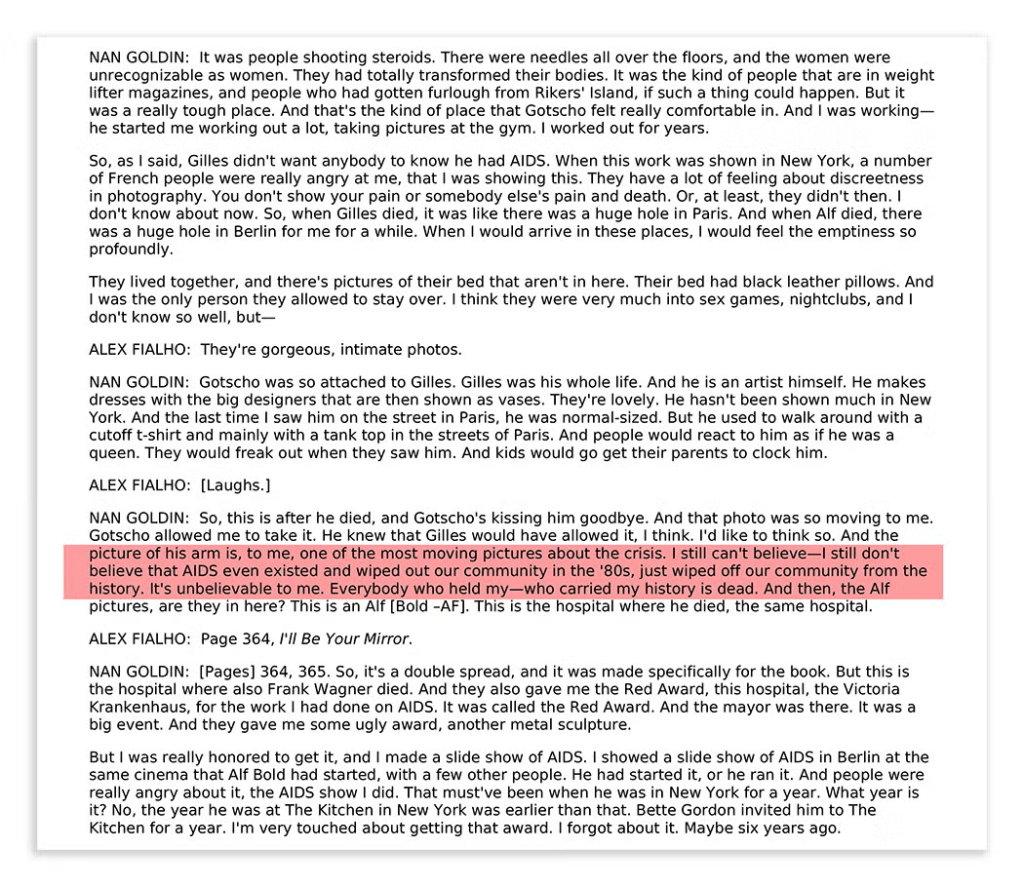
“I still can’t believe—I still don’t believe that AIDS even existed and wiped out our community in the ’80s, just wiped off our community from the history. It’s unbelievable to me. Everybody who held my—who carried my history is dead.” —Nan Goldin
One year later, William F. Buckley published a New York Times op-ed calling for HIV-positive people to be tattooed on the upper arm and buttocks to protect others (assuming that would protect both future sexual partners and intravenous drug users who might share needles). News reports about the disease largely focused on fear of contagion, the promiscuity and danger of gay men, and the threat of HIV to “normal” Americans.
In the interviews gathered in the Visual Arts and the AIDS Epidemic collection, artists describe how they first became aware of AIDS: from a loved one diagnosed after an illness; from hearing of a friend’s passing after not seeing them for a while; from a doctor telling them to stay with a partner because “there’s something going around”; or by learning of their own diagnosis. Friends were lost to the disease, and surviving family members denied the illness or sometimes actively excluded partners from funerals.
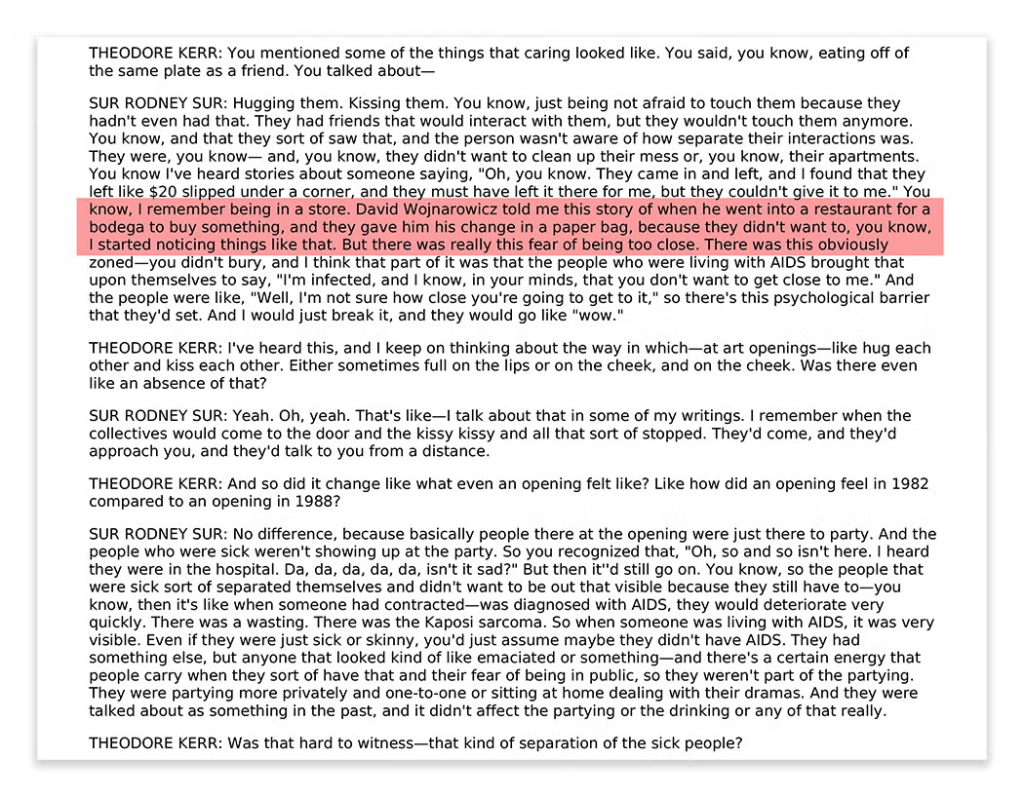
Sur Rodney (Sur), a New York City-based writer, gallery co-director, and archivist, relates that the late artist David Wojnarowicz would go to his local bodega in New York City where the clerks returned his change in a paper bag, out of fear. He describes his own anxieties when stepping in after a friend’s death to help save and archive their artworks and collections so they wouldn’t be destroyed (before there were nonprofit organizations to do so).
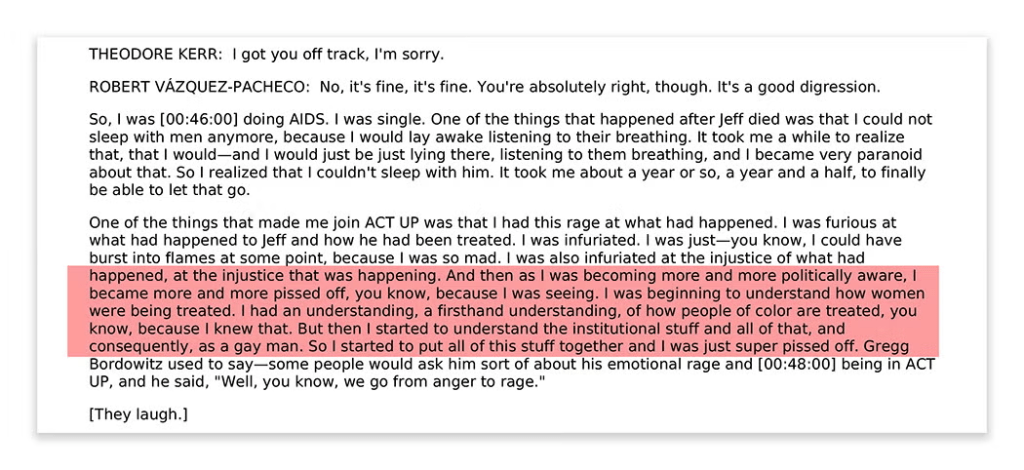
These personal experiences unfolded within the larger context of governmental indifference, active discrimination against people with the disease (or belonging to groups that were deemed “at risk”), and a growing consciousness of the political landscape of the epidemic. Robert Vasquez-Pacheco, a member of ACT UP and Gran Fury, recounts,
as I was becoming more and more politically aware, I became more and more pissed off, you know, because I was seeing. I was beginning to understand how women were being treated. I had an understanding, a firsthand understanding, of how people of color are treated, you know, because I knew that. But then I started to understand the institutional stuff and all of that, and consequently, as a gay man. So I started to put all of this stuff together and I was just super pissed off.
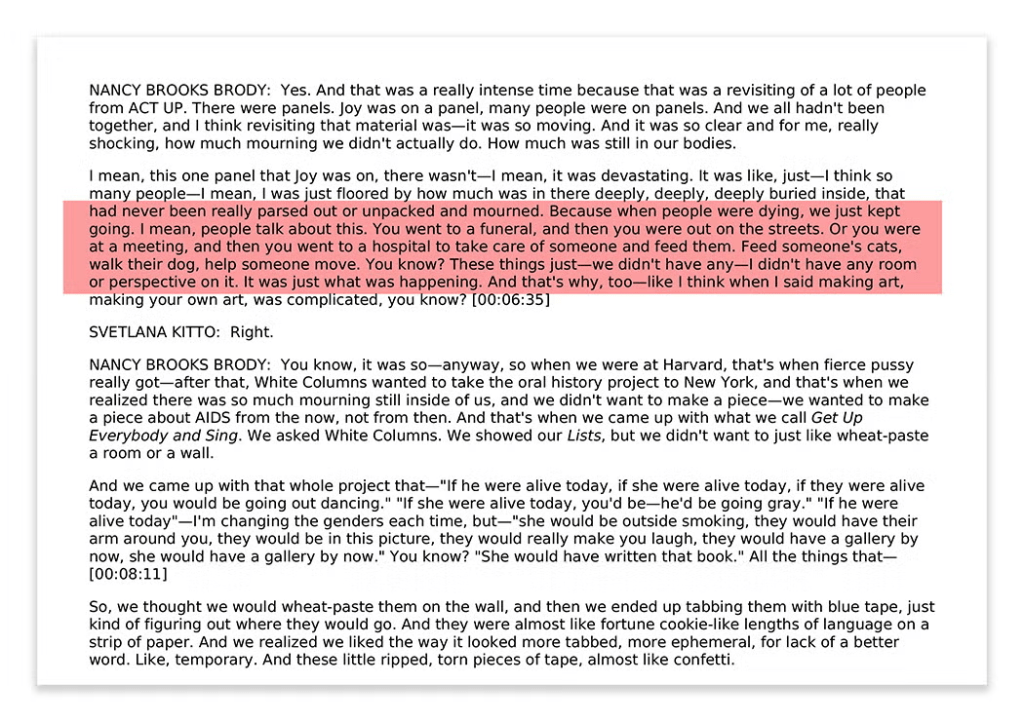
Some version of this process, repeated for many of the subjects, led people to activism, whether through art, volunteer work, protest, or sometimes all three. Nancy Brooks Brody (1962-2023), a visual artist and member of the fierce pussy collective, describes the progression in her interview.“Because when people were dying,” she explains,
we just kept going. […] You went to a funeral, and then you were out on the streets. Or you were at a meeting, and then you went to a hospital to take care of someone and feed them. Feed someone’s cats, walk their dog, help someone move. You know? These things just—we didn’t have any—I didn’t have any room or perspective on it. It was just what was happening.
The meetings she, and others, refer to were those of ACT UP New York (The AIDS Coalition to Unleash Power), which began in 1987 at a community meeting where Larry Kramer asked, “How long does it take before you get angry and fight back?” Kramer, a playwright and essayist who had been covering AIDS since the beginning through journalism, had co-founded the non-profit Gay Men’s Health Crisis in 1982. His play The Normal Heart, an impassioned call to action, spurred members of the audience to meet and subsequently take part in one of the most significant and effective activist movements of the twentieth century.
Creating Art in an Epidemic
The artistic works of those interviewed are diverse, both in media and approach: photographing people living with AIDS, using détournement to turn existing works into calls to action via graphic design, or using their body to confront audiences with the existence of the disease through performance. In some cases, their illness became an essential component of their art: John Dugdale, a former commercial photographer, began using nineteenth-century methods to capture and produce his work after HIV-related retinitis and a stroke left his sight significantly impaired. Ron Athey, one of the NEA Four, used his own HIV-positive body to create work exploring sex, trauma, and desire. The place of the artist within (or outside) a community could become a contentious issue, especially at a time when representation of people with AIDS was so fraught.
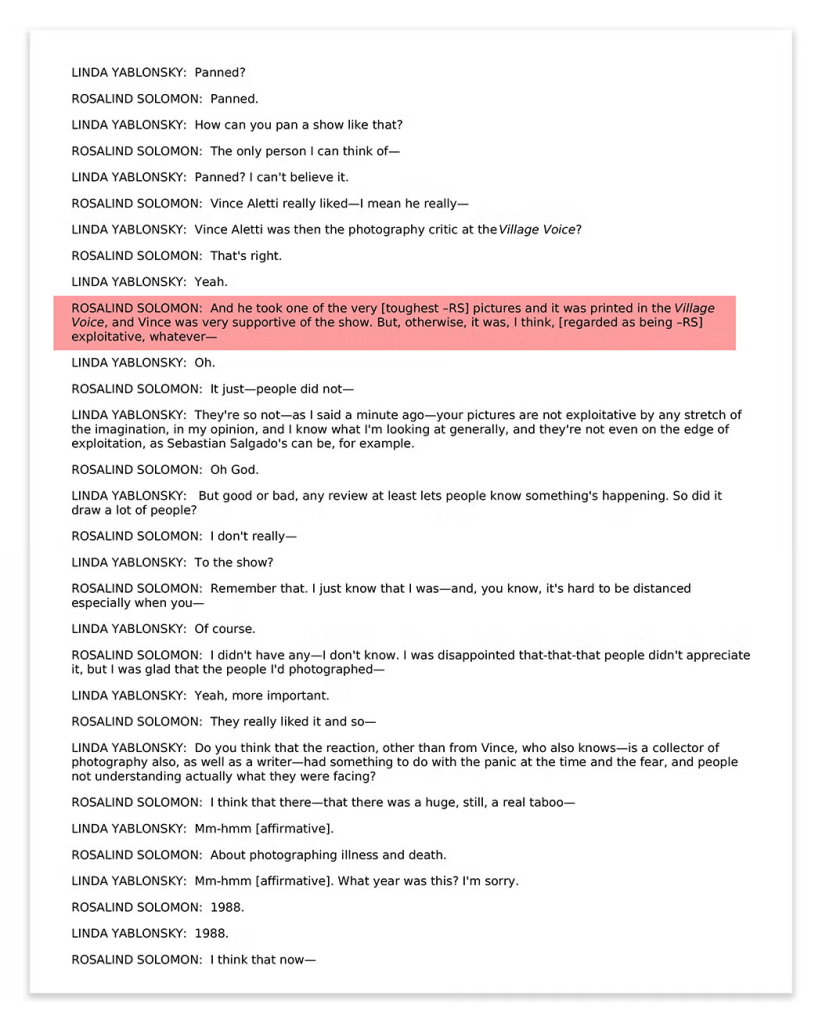
Rosalind Fox Solomon, whose 1988 show Portraits in the Time of AIDS featured photographs of the subject alone or with loved ones, some with visible lesions or in the hospital, relates that her project was critically panned and called “exploitative” at the time.
Some of the most vibrant, and now iconic, images of AIDS were created as (and for) protest: Silence = Death, the work of the Silence = Death Collective (and not ACT UP, as Avram Finkelstein relates in his interview) became the primary pictorial representation of ACT UP and a rallying slogan for the fight against the disease. Keith Haring did his own take on it for a poster, adding “Ignorance = Fear” to a “See No Evil, Hear No Evil, Speak No Evil” scene.
Collectives like Gran Fury and fierce pussy, which organized inside the ACT UP activist group, created posters for wheat-pasting that served as art, education, and calls to action around AIDS, homophobia, health care, and visibility. Whether newsprint works of text, guerrilla-installed bus station “ads,” or rolls of stickers of bloody hands announcing “One AIDS Death Every 10 Minutes,” the art of AIDS activism used any means available to communicate the urgency of the crisis.
The Visual Arts and the AIDS Epidemic collection demonstrates the power of oral history to preserve not just historical events, but what it felt like to live in the moment and survive it when so many people did not. Together with Reveal Digital’s HIV, AIDS, and the Arts archive, the collection ensures that these voices, experiences, and creative histories continue to be available to inform and educate future generations.
The Trump administration has made an aggressive push to add the president’s name to buildings, battleships, money and government websites.
President Donald Trump is physically leaving his mark on Washington and beyond, more so than any other president in modern U.S. history.Andrew Harnik / Getty Images file
The federal government is undergoing an unprecedented presidential branding makeover, with Donald Trump’s name being added to everything from buildings and battleships to a drug website and a park pass.
While Trump has had roads and even an airport named after him since winning a second term in office, his administration has initiated a series of actions to imprint his name and likeness on the federal government well beyond internal documents and communications.
The branding is in stark contrast to prior presidencies, including Trump’s first term, when the largest branding controversy involved having his name added to Covid relief checks during an election year.
Here’s a look at all the places and items where the administration has added Trump’s name during his second term.
Donald J. Trump U.S. Institute of Peace
The U.S. Institute of Peace headquarters in Washington last year.Alex Kent / Bloomberg via Getty Images file
The first federal building to be named after a sitting U.S. president was the U.S. Institute of Peace headquarters in downtown Washington in December 2025. The agency was named by Congress when it was established through legislation in 1984.
The renaming was carried out by the State Department.
“President Trump will be remembered by history as the President of Peace. It’s time our State Department display that,” Secretary of State Marco Rubio said in a post on social media on Dec. 3, 2025.
The Donald J. Trump and John F. Kennedy Memorial Center for the Performing Arts
The Kennedy Center in Washington last year.Al Drago / Bloomberg via Getty Images file
About two weeks after the Institute of Peace renaming, the president’s handpicked board at the John F. Kennedy Memorial Center for the Performing Arts voted to add his name to the storied performance venue as well.
“The unanimous vote recognizes that the current Chairman saved the institution from financial ruin and physical destruction,” a spokesperson for the center said at the time.
Democrats and some Kennedy family members say the name change is illegal, since the center was established as a living memorial to Kennedy. Rep. Joyce Beatty, D-Ohio, who’s an ex officio member of the board, filed a suit challenging the change. The case is still in litigation.
Trump-class battleships
“Trump-class” battleships were announced at Mar-a-Lago last year.Tasos Katopodis / Getty Images file
Also in December, then-Navy Secretary John Phelan unveiled “Trump-class” warships during an event at Trump’s Mar-a-Lago estate in Florida.
The “Trump-class battleships,” including a vessel dubbed the USS Defiant, will be “the largest, deadliest and most versatile and best-looking warship anywhere on the world’s oceans,” Phelan said.
“Hopefully we never have to use them, but there will never be anything built like these,” Trump said at the event.
The Trump gold card
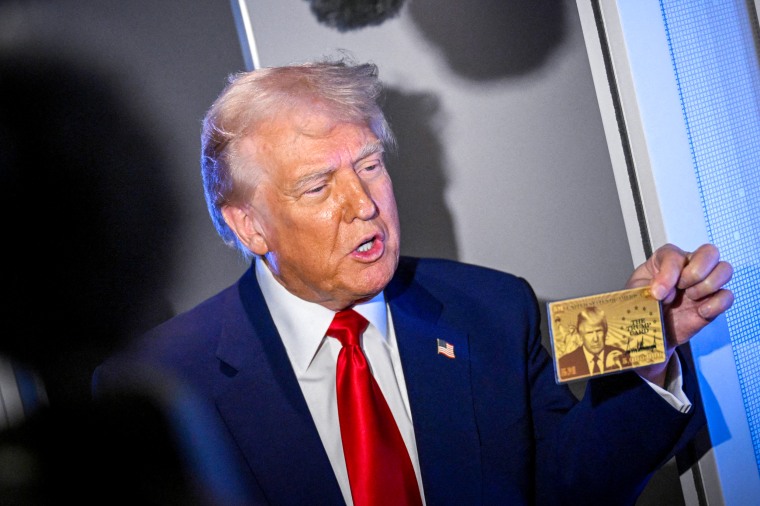
President Donald Trump displayed a “Trump gold card” visa aboard Air Force One last year.Mandel Ngan / AFP – Getty Images file
The president unveiled his “Trump gold card” visa in December. Foreign nationals can pay $1 million to obtain the card, which enables them to legally live and work in the U.S. once they’re approved.
It’s “the green card on steroids,” Trump said as he displayed the card at the White House. He said companies can buy the gold cards for students so they can stay in the country instead of being “shipped out” after graduation.
As of late April, only one person has been approved for the card, The Associated Press reported.
Trump coins
Designs for Semiquincentennial gold coins featuring President Trump.Treasury United States Mint
In March, a federal commission consisting solely of Trump-appointed members approved a 24-carat commemorative gold coin depicting the president in honor of the country’s 250th anniversary.
The design approved by the Commission of Fine Arts features an image of Trump in the Oval Office on one side and a bald eagle on the other. The coin needs to be approved by the Treasury Department, which has already announced plans to release a separate $1 coin featuring the president as part of the anniversary celebration.
Trump dollar bills
The President boarding Air Force One with a $50 bill sticking out of his pocket last year.Jim Watson / AFP via Getty Images file
The Treasury Department announced in March it would be adding Trump’s signature to “future paper currency” as another part of the country’s 250th anniversary.
“There is no more powerful way to recognize the historic achievements of our great country and President Donald J. Trump than U.S dollar bills bearing his name, and it is only appropriate that this historic currency be issued at the Semiquincentennial,” Treasury Secretary Scott Bessent said in his announcement.
Paper currency typically only bears the signature of the treasury secretary and treasurer, and has never featured that of a sitting president.
Trump passports
The State Department will be releasing a limited series of U.S. passports featuring an image of President Trump.U.S. State Dept.
The State Department announced in April that it would be issuing a limited number of U.S. passports with a large image of Trump on the inside cover as part of the 250th celebration as well.
Olivia Wales, a White House spokesperson, said in a statement that the “new patriotic passport design provides yet another great way Americans can join in the spectacular celebrations for America’s 250th birthday.”
Trump national park pass
The Interior Department revealed in November that it was featuring Trump and George Washington on the front of its annual park pass, citing the 250th anniversary.
That move led to a lawsuit from an environmental group, alleging the department violated a 2004 law requiring the pass to carry a picture by the winner of an annual photo contest. The winner for this year had been image of Glacier National Park in Montana.
Trump banners
The Department of Justice headquarters in Washington earlier this year.Brendan Smialowski / AFP – Getty Images
Large banners of Trump have been hung from the Justice, Agriculture and Labor departments.
“We are proud at this Department of Justice to celebrate 250 years of our great country and our historic work to make America safe again at President Trump’s direction,” a DOJ spokesperson said when the banner was hung in February.
TrumpIRA.gov
Trump issued an executive order in April directing the Treasury Department to launch a new website called TrumpIRA.gov.
A “Trump Accounts” event in Washington in January.Win McNamee / Getty Images file
The Trump administration is launching new savings accounts for children this summer called Trump Accounts.
Created under the “big, beautiful bill,” Trump Accounts are tax-advantaged investment accounts for children under 18. Babies born from Jan. 1, 2025, to Dec. 31, 2028, will get $1,000 from the Treasury Department to kick-start their accounts.
“This is something that’s so special,” Trump said at his State of the Union speech in February.
TrumpRx.gov
The launch of “TrumpRx.gov”, which the adminstration said would help to lower prescription drug prices, at the White House in February.Nathan Howard / Getty Images file
In February, the administration launched TrumpRx.gov, a self-pay prescription drug website. It offers coupons that people can take to the pharmacy where they fill their prescriptions.
“You’re going to save a fortune,” Trump said at the news conference launching the site. “And this is also so good for overall healthcare.”
This video explains what everyone on the real left already knew instead of forgetting the trans / woke culture wars and moving right, the center left keeps demanding which is simply code speak for leaning right. While all the same democratic strategists since the Bill Clinton days demand candidates move to the right to “triangulate” to capture republican voters these polls show what we already knew. The culture wars are losing for the republicans. After republicans spent nearly 3 million dollars in ads against trans people the polls showed almost no one felt those adverts influenced their vote. Even as red states rail against higher education, acceptance, and tolerance of people who are different it is losing them votes. Some thing the Christian nationalists who are in the height of their influence now in political circles don’t understand is that people who grew up with LGBTQ+ classmates, friends, and even dated some do not find them the evil that these hate religions preach they are.
*** Personal note. I explained to Ali in an email that I am not functioning. For what ever reason wheither it be anemia or something worse I am desperately tired from the time I manage to get up. I often get up only to a few hours later go back to bed for four or more hours. I have started taking vitamin B-12 and a woman’s one-a-day vitamin. That with more red meat which was recommended to me in the past every time I go into anemia. How ever I get up, I have coffee and stuff with Ron then I need to go back to bed for normally 4 hours, get up and do dishes while watching The Majority Report. How ever some days like yesterday I did not even get that far, going to back to bed by 2 pm only to have Ron wake me and beg me to eat.
I have done better today only going back to bed for 3 hours later in the morning. I wanted to go to bed two hours ago, but Ron was all upset he couldn’t sleep due to the neighbors having new skirting put around their home outside our bedroom. So I got him in his recliner and moved his CPAP out to his chair. Still he was not tracking. Good news as I was falling asleep at my desk he woke up and is fixing supper. At this point I am so tired I don’t really care whether I eat or not.
I tried to reply to comments, but I couldn’t. I even started to move old saved open tabs out by making a new cartoon / memes post but I simply couldn’t do it. Right now the best I can do to function is make doctors appointments and watch videos that don’t take too much thought to understand. That means most political videos are outside my ability. I am sorry but right now I am functioning at the level of a confused grandpa. Sorry. I hope to get better soon. Ron says if I don’t clear up by next week we will demand the primary care see me and deal with it. I’m not sure if I want that as my last visit he was insisting I think about getting a colonoscopy. Anyway. This is a good video and one I watched several hours ago when I was much sharper than I feel now. *** Hugs