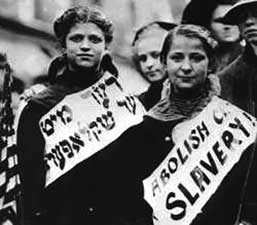
November 22, 1909 In New York City, the International Ladies Garment Workers Union went on strike against sweatshop conditions in what became known as the “Uprising of the 20,000” and the “Girl’s Revolt.” The strikers won the support of other workers and the women’s suffrage movement for their persistence and unity in the face of police brutality and biased courts. A judge told arrested pickets: “You are on strike against God.” This was the first mass strike by women in the U.S. ILGWU timeline
November 22, 1963 President John F. Kennedy was shot dead in Dallas during a motorcade. Vice President Lyndon Johnson was sworn in as president within hours.
November 22, 1968 What is believed to be the first interracial kiss on U.S. broadcast television occurred in an episode of Star Trek between William Shatner and Nichelle Nichols. More about this kiss
November 22, 1998 7,000 marched on the U.S. Army’s School of the Americas (SOA) at Fort Benning, outside Columbus, Georgia.They were protesting the school’s training of Latin American soldiers and other security personnel who return to their countries and are involved in violence and oppression of their populations. 2,319 people were arrested for trespassing. Protests at the School of the Americas, organized by SOA Watch, occur every November. The school is now known by the U.S. Army as the Western Hemisphere Institute for Security Cooperation. 2002 protest at SOA Visit School of the Americas watch.
President-elect Trump made rolling back transgender rights a key issue in his campaign. He promised to limit access to gender-affirming care and to prevent trans athletes from participating in school sports. His election has communities of trans people and allies fearful of widespread discrimination and a loss of health care access. Amna Nawaz discussed more with Orion Rummler of The 19th.
November 21, 1945 200,000 members of the United Auto Workers went on strike against General Motors, the first major strike following World War II. The UAW’s demand for a 30% wage increase was based on the increase in the cost of living during the war (28% according to the Department of Labor), the wartime freeze on wages, and the cut in the average workweek with the disappearance of overtime pay in manufacturing. But the UAW also considered profits and prices a subject for negotiation, a position rejected by GM. The union did not merely say that labor was entitled to enough wages to live on. It also said that labor was entitled to share in the wealth produced by industry.“… Unless we get a more realistic distribution of America’s wealth, we won’t get enough to keep this machine going.”–Walter Reuther, UAW President More about the strike
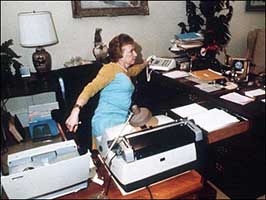
November 21, 1973 President Richard Nixon’s attorney, J. Fred Buzhardt, revealed the existence of an 18 1/2-minute gap in one of the subpoenaed White House tape recordings of Watergate conversations made by President Richard Nixon in the days after the Watergate break-in.The erasure was blamed on an accident by Nixon’s private secretary, Rose Mary Woods, but scientific analysis determined the erasures to be deliberate. White House Chief of Staff Alexander Haig later attributed the gap to “sinister forces.” Rose Mary Woods, demonstrating how she might have created the Watergate tape gap More about Rose Mary Woods
November 21, 1974 Both Houses of Congress voted to override President Gerald Ford’s veto of updates to the Freedom of Information Act. Originally passed in 1966, it required federal agencies to release information upon request to citizens and journalists.The amendments put an end to governmental resistance to compliance, including excessive fees, bureaucratic delays, and the need to sometimes resort to expensive litigation to force the government to share copies of documents. Ford advisors Chief of Staff Donald Rumsfeld, his deputy Dick Cheney, and government lawyer Antonin Scalia advised him to veto it. Chief of Staff Donald Rumsfeld, President Gerald Ford and Deputy Chief of Staff Richard Cheney April 28, 1975 What was the dispute?
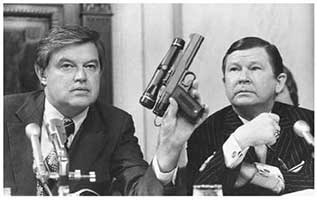
November 21, 1975 The Senate Select Committee to Study Governmental Operations with Respect to Intelligence Activities, led by Senator Frank Church (D-Idaho), issued a report charging U.S. government officials were behind assassination plots against two foreign leaders – Fidel Castro (Cuba) and Patrice Lumumba (Congo), and were heavily involved in at least three other plots: Rafael Trujillo (Dominican Republic), Ngo Dinh Diem (Vietnam), Rene Schneider (Chile). Senator Frank Church, left, chairman of the Senate Select Intelligence Committee, displays a poison dart gun as co-chairman Senator John Tower (R-TX) watches.
The committee, a precursor to the Senate Intelligence Committee, was established to look into misuse of and abuse by intelligence agencies, particularly the CIA and FBI, some of which had been revealed by the Watergate investigations. Fidel Castro / Patrice Lumumba / Rafael Trujillo / Ngo Dinh Diem / Rene Schneider Read more
November 21, 1981 More than 350,000 demonstrated in Amsterdam against U.S. nuclear-armed cruise missiles on European soil.
November 21, 1985 A full-scale summit conference, the first of five between the President Ronald Reagan of the U.S. and General Secretary Mikhail Gorbachev of the Soviet Union concluded. There was optimism over beginning a more productive and cooperative relationship between the two countries, each of which had thousands of nuclear warheads targeted at the other.The U.S. had proposed building a space-based anti-ballistic missile system, commonly known as “Star Wars,” which the Soviets had strongly opposed as an escalation of the nuclear arms race.In an unofficial meeting the previous evening, President Reagan had noted that he and Gorbachev were meeting for the first time at this level and had little practice. Nevertheless, having read the history of previous summit meetings, he had concluded that those earlier leaders had not accomplished very much. Therefore, he suggested that he and Gorbachev say, “To hell with the past, we’ll do it our way and get something done.” Gorbachev concurred. Reagan and Gorbachev at their first summit
November 21, 1986 National Security Council member Oliver North and his secretary, Fawn Hall, began shredding documents that would have exposed their participation in a range of illegal activities regarding the sale of arms to Iran in an attempt to free hostages, and the diversion of the proceeds to an insurgent Nicaraguan group known as the contras. Fawn Hall Oliver North More on Fawn Hall
November 21, 1995 China officially charged well-known human rights activist and political dissident Wei Jingsheng with trying to “overthrow the government.” Wei had not been seen for a year and a half after disappearing into police custody after meeting with a U.S. assistant secretary of state for human rights and humanitarian affairs.“If the people allow the power holders, in the peoples’ name, to violate and ignore the rights of some of the people then, at the same time, they are giving the power holders the power to violate the rights of all the people.” “ Most people wait until others are standing to make their move, very few are willing to stand up first or to stand alone. That’s why my friends call me a fool! But I don’t have any regrets.” – Wei Jingsheng Wei Jingsheng He had been imprisoned previously for his involvement with the Democracy Wall movement, including years in solitary confinement. He had also spoken out on behalf of the Tibetans.
Yesterday morning after not sleeping all night I wiped the hard drives and reinstall Windows from an old version of Windows 10 I have. One computer, the XPS which I just added 64 GB of ram to, seemed to be going wonderful, with no hiccups or problems. Sadly the Inspiron computer just wouldn’t install windows or other programs correctly. So last night I went to bed about 9 pm. The XPS seemed ready for finial steps. That was last night when I shut them all down.
However this morning when I went to start the computers, the XPS refused to start windows. The computer started and the bios would work but windows wouldn’t start. It seems something was preventing the boot manger from working. Even trying to reinstall windows wouldn’t let the boot manager start. In fact when I install a new version of windows and I delete the partition set up by the last installation. However it was not deleting them and as soon as I tried to reinstall the partitions would reappear. Well I was not out of tricks yet. I pulled out another older version of Windows 10 and partitioned the C drive. I could have done it with the same USB Windows install stick I had been using but I worried if there was a problem with that USB stick software. Then installed the even older version of Windows. Then I took the newer version and repeated that. Then spent an hour setting up settings. However after spending the morning doing updates and even installing some licensed programs which I do at the last as some of them have a limit to how many times they can be installed. The full stop hard wall happened that screwed everything I had done on both computers.
Well shit and damn. I have a keyboard and mouse that works on three different devices so I have my keyboard set to each computer and my phone. My mouse I set the third device to what ever third device I am working on. But during all this I couldn’t get the flow system from the company to work. That moves the mouse from monitor / computer by going to the edge of the monitor so that I had to manually change the computer via a button on the bottom of the mouse. That meant I had to pick up the mouse and use the button every time I switched computers. That is not something I can keep doing. I race between computers hundreds of times an hour. So I sat here and thought. Each computer I dumped and reloaded and did the updates for hours over the last several days. I figured out a workaround. Since I had already done clean installs, I went into settings, to recovery and set both computers to “recover Windows from the cloud”, that would reset settings that were preventing my programs from working.
Yes, yes, yes! Well it worked. It is 3 pm and I am sitting here typing on the blogging computer and watching Sam Seder on the other. Once the recovery was done I installed the Logitech program for the mouse / keyboard which worked fine. Then I installed the Norton antivirus malware, then installed my VPN, Nordvpn with its anti-malware, advance browser protection, and ad and tracker prevention. So far everything is working grand.
I am on day three with 6 hours sleep. I stopped eating yesterday morning. Yes I am tired, yes I got sick to my stomach this morning. Yes my blood sugar got too low and I had to take glucose tablets. But when I am focused on a problem food and sleep wait until I get it all fixed. So all I have to do today is install all my licensed programs and clean the computers up.
One last thing. Several days ago an elderly lady I gave a printer to because she is poor and did not have one. It is a nice brother printer that in its day was expensive but I had bought a new one and it was in my hoarder closet of electrical parts / equipment gathering dust. The printer’s computer was in error mode with an unable to clean error. Sadly that is part of the built-in obsolescence of our for-profit businesses. The error is caused due to the sponge that the print head uses to clean itself after use so ink doesn’t run all over the desk and the floor. Since they don’t bother to put a sensor in the sponge it is much easier (cheaper) for manufactures to simply put in a number of pages that will shut the machine down. Once you get to that number the “brain” in the printer assumes the sponge is full. If you know the magical steps and the correct numbers to input, you can clear the number of pages back to zero and your printer works again. And tech people can charge you big money for doing this. Sadly I did not like that game years ago and even as poor as Ron and I are, I only took donations for my skills as a technician.
So either to your joy or bad disappointment after 3 days and 6 hours of sleep and only two meals even as Ron threatened to force feed me, I am back online with my computers fully running. Oh during the time I worked on the two main computers I had the big 55 inch TV in my office on the wonderful swing arm Ron mounted running off my Xbox One and a small barely able to function laptop that I used to write most of this. Hugs and loves to all. Scottie
Eric Meyer delivers advice to journalists in a speech at the Kansas Press Association Hall of Fame ceremony on Nov. 15, 2024, in Topeka. (Evert Nelson for Kansas Press Association)
TOPEKA — The editor of the Kansas newspaper raided by police last year has a message for journalists struggling with their sense of purpose.
Go on the offensive.
Eric Meyer, editor and publisher of the Marion County Record, delivered remarks Friday as he was inducted alongside his mother, Joan, into the Kansas Press Association Newspaper Hall of Fame.
“I think this is a time when we have to establish for the people of this country the fact that we are important, that we have things that we can tell them that they will want to know, that they will want to change their positions about,” Meyer said.
He added, in a nod to the results of the presidential election: “Let’s not make America great again. Let’s make democracy great again.”
Police raided the Marion County Record newsroom and the home where Meyer lived with his mother in August 2023 under the false pretense that journalists had committed a crime by looking up a public record. Joan Meyer, the 98-year-old co-owner whose profane clash with police officers was captured on camera, died a day after the raid from stress-induced cardiac arrest. The raid spawned five civil lawsuits and a criminal charge against the police chief who led the attack on a free press.
Meyer said he is “an odd duck” because he retired to run a newspaper, rather than retire from it. He returned to Kansas during the COVID-19 pandemic to take over the publication his parents had operated for decades. After teaching journalism for 20 years at University of Illinois at Urbana-Champaign, Meyer wanted to practice what he had been preaching — that journalism is still vital. (snip-MORE)
November 20, 1816 The term “scab” was first used in print by the Albany (N.Y.) Typographical Society. A scab is someone who crosses a union’s picket line and takes the job of a striking worker. Read The Scab by Jack London
November 20, 1945 The International War Crimes Tribunal began in Nuremberg, Germany, and continued until October 1, 1946, establishing that military and political subordinates are responsible for their own actions even if ordered by their superiors.Twenty-four high-ranking Nazis were on trial for atrocities committed during World War II, ranging from crimes against peace to crimes of war, to crimes against humanity. The Nuremberg Trials were conducted by judges from the United States, the Soviet Union, France, and Great Britain.The Nuremberg defendants Read more
November 20, 1959 The United Nations proclaimed “The Declaration of the Rights of the Child,” because “the child, by reason of his physical and mental immaturity, needs special safeguards and care, including appropriate legal protection, before as well as after birth.” Read the text of the Declaration
November 20, 1962 President John F. Kennedy issued an executive order forbidding racial discrimination in public housing.
November 20, 1969 Eighty-nine American Indians seized Alcatraz Island in San Francisco Bay, offering to buy the island from the federal government for $24 worth of beads (the alleged price paid to the Canarsee Delaware Indians for Manhattan Island; it was actually 60 Dutch guilders). Their numbers swelled into the hundreds at times; the General Services Administration, which had responsibility for the site of the former federal prison, and Coast Guard gave them the opportunity to leave the island peacefully.They were reclaiming it as Indian land by right of discovery, and demanding fairness and respect for native peoples. The occupation lasted for more than a year. Said Richard Oakes, a Mohawk from New York, “We hold The Rock.” Indian people and their supporters wait for the ferry. Photo/Ilka Hartmann a new entrance to Alcatraz; Photo/Michelle Vignes Read more about the occupation LaNada Boyer (formerly Means) inside one of the Alcatraz guard barracks where occupiers lived from 1969-71. Much of the graffiti from 30 years ago remains throughout the island today. Photo by Linda Sue Scott.
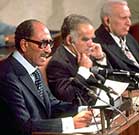
November 20, 1977 Egyptian President Anwar El-Sadat addressed the Israeli Knesset (parliament). “I come to you today on solid ground to shape a new life and to establish peace. “But to be absolutely frank with you, I took this decision after long thought, knowing that it constitutes a great risk….” Text of Sadat’s speech to the Israeli Knesset Listen to the speech
November 20, 1987 SANE (The Committee for a Sane Nuclear Policy) and FREEZE (the campaign to freeze all testing of nuclear weapons) merged at their first combined convention in Cleveland, Ohio, becoming the largest U.S. peace organization. Peace Action today
November 20, 1993 The U.S. Senate approved the North American Free Trade Agreement (NAFTA), creating the world’s largest trade area covering Canada, the U.S. and Mexico.
On Friday, Secretary of Commerce Gina Raimondo locked in a $6.6 billion deal with the Taiwan Semiconductor Manufacturing Company for it to invest $65 billion in three state-of-the-art fabrication plants in Arizona. This will bring thousands of jobs to the state. The money comes from the CHIPS and Science Act, about which Trump told podcaster Joe Rogan on October 25: “That CHIPS deal is so bad.” House speaker Mike Johnson (R-LA) said he would work to repeal the law, although he backed off that statement when Republicans noted the jobs the law has brought to their states.
Also on Friday, a Trump-appointed federal judge struck down a Biden administration rule that would have made 4 million workers eligible for overtime pay. The rule raised the salary level below which an employer has to pay overtime from $35,568 to $43,888 this year and up to $58,656 in 2025. The decision by Texas judge Sean D. Jordan kills the measure nationally.
On Sunday, speaking from the Amazon rainforest in Brazil, President Joe Biden said that it would not be possible to reverse America’s “clean energy revolution,” which has now provided jobs across the country, primarily in Republican-dominated states. Biden noted that the U.S. would spend $11 billion on financing international responses to climate change in 2024, an increase of six times from when he began his term.
But President-elect Trump has called climate change a hoax and has vowed to claw back money from the Inflation Reduction Act appropriated to mitigate it, and to turn the U.S. back to fossil fuels. What Trump will have a harder time disrupting, according to Nicolás Rivero of the Washington Post, is the new efficiency standards the Biden administration put in place for appliances. He can, though, refuse to advance those standards.
Meanwhile Trump and his team are announcing a complete reworking of the American government. They claim a mandate, although as final vote tallies are coming in, it turns out that Trump did not win 50% of the vote, and CNN statistician Harry Enten notes that his margin comes in at 44th out of the 51 elections that have been held since 1824. He also had very short coattails—four Democrats won in states Trump carried—and the Republicans have the smallest House majority since there have been 50 states, despite the help their numbers have had from the extreme gerrymandering in states like North Carolina.
More Americans voted for someone other than Trump than voted for him. (Emphases mine- A.)
Although Trump ran on lowering the cost of consumer goods, Trump and his sidekick Elon Musk, along with pharmaceutical entrepreneur Vivek Ramaswamy, have vowed to slash the U.S. government, apparently taking their cue from Argentina’s self-described anarcho-capitalist president Javier Milei, who was the first foreign leader to visit Trump after the election. Milei’s “shock therapy” to his country threw the nation into a deep recession, just as Musk says his plans will create “hardship” for Americans before enabling the country to rebuild with security.
Ramaswamy today posted on social media, “A reasonable formula to fix the U.S. government: Milei-style cuts, on steroids.” He has suggested that cuts are easier than people think. The Washington Post’s Philip Bump noted that on a podcast in September, Ramaswamy said as an example: “If your Social Security number ends in an odd number, you’re out. If it ends in an even number, you’re in. There’s a 50 percent cut right there. Of those who remain, if your Social Security number starts in an even number, you’re in, and if it starts with an odd number, you’re out. Boom. That’s a 75 percent reduction done.”
But, as Bump notes, this reveals Ramaswamy’s lack of understanding of how the government actually works. Social Security numbers aren’t random; the first digit refers to where the number was obtained. So this seemingly random system would target certain areas of the country.
Today, both Jacob Bogage, Jeff Stein, and Dan Diamond of the Washington Post and Robert Tait of The Guardian reported that Trump’s economic advisors are talking with Republicans in Congress about cuts to Medicaid, the Supplemental Nutrition Assistance Program (SNAP) formerly known as food stamps, and other welfare programs, in order to cover the enormous costs of extending tax cuts for the wealthy and corporations. Medicaid is the nation’s health insurance for low-income Americans and long-term care. It covers more than 90 million Americans, one in five of us. Rural populations, which tend to vote Republican, use supplemental nutrition programs more than urban dwellers do.
The Washington Post reporters note that Republicans deny that they are trying to reduce benefits for the poor. They are, they say, trying to reduce wasteful and unnecessary spending. “We know there’s tremendous waste,” said House Budget Committee chairman Jodey Arrington (R-TX). “What we don’t seem to have in the hour of action, like when we have the trifecta and unified Republican leadership, is the political courage to do it for the love of country. [Trump] does.”
Those cuts will likely not sit well with the Republicans whose constituents think Trump promised there would be no cuts to the programs on which they depend.
Trump’s planned nominations of unqualified extremists have also run into trouble. Senate Republicans are so far refusing to abandon their constitutional powers in order to act as a rubber stamp to enable Trump’s worst instincts. Former representative Matt Gaetz (R-FL), a Trump bomb thrower, was unqualified to be the nation’s attorney general in any case, but as more information comes out about his alleged participation in drug fueled orgies, including the news that a woman allegedly told the House Ethics Committee that she saw him engage in sex with a minor, those problems have gotten worse.
Legal analyst Marcy Wheeler notes that the lawyers representing the witnesses for the committee are pushing for the release of the ethics committee’s report at least in part out of concern that if he becomes attorney general, Gaetz will retaliate against them.
According to Vanity Fair’s Gabriel Sherman, fear of the MAGA Republican colleagues who are already trying to bully them into becoming Trump loyalists is infecting congress members, too. When asked if Gaetz was qualified for the attorney general post, Representative Mike Simpson (R-ID) answered: “Are you sh*tting me, that you just asked that question? No. But hell, you’ll print that and now I’m going to be investigated.”
The many fringe medical ideas of Trump’s pick for secretary of health and human services, Robert F. Kennedy Jr., earned him the right-wing New York Post editorial board’s denigration as “nuts on a lot of fronts.” The board called his views “a head-scratching spaghetti of what we can only call warped conspiracy theories, and not just on vaccines.” Kennedy is a well-known opponent of vaccines—he called Covid-19 vaccines a “crime against humanity”—and has called for the National Institutes of Health to “take a break” of about eight years from studying infectious diseases, insisting that they should focus on chronic diseases instead.
Writing in the New York Times yesterday, Peter Baker noted that Trump “has rolled a giant grenade into the middle of the nation’s capital and watched with mischievous glee to see who runs away and who throws themselves on it.” Mischievous glee is one way to put it; another is that he is trying to destroy the foundations of the American government.
Baker notes that none of Trump’s selections would have been anything but laughable in the pre-Trump era when, for example, Democratic cabinet nominations were sunk for a failure to pay employment taxes for a nanny, or for a donor-provided car. Nor would a president-elect in the past have presumed to tap three of his own defense lawyers for top positions in the Department of Justice, effectively guaranteeing that he will be protected from scrutiny.
A former deputy White House press secretary during Trump’s first term, Sarah Matthews, said Trump is “drunk on power right now because he feels like he was given a mandate by winning the popular vote.”
Today Trump confirmed that he intends to bypass normal legal constraints on his actions by declaring a national emergency on his first day in office in order to launch his mass deportation of undocumented migrants. While the Congressional Budget Office estimates this mass deportation will cost at least $88 billion a year, another cost that is rarely mentioned is that according to Bloomberg, undocumented immigrants currently pay about $100 billion a year in taxes. Losing that income, too, will likely have to be made up with cuts from elsewhere.
Finally, today, CNBC’s economic analyst Carl Quintanilla noted today that average gasoline prices are expected to fall below $3.00 a gallon before the Thanksgiving holiday.
This is a completely different video than the one I posted before. I am sorry that I posted that one. I hated the glitches in it. So I trashed it. I did it before I looked to see if It had comments. If you left comments please put them on this one. This one is longer and more in depth, but done with a higher resolution and done at 3 am this morning so I sound better and more coherent. There are no glitches of either video or audio that I could see / hear. I hope you will enjoy it. Today I am going to dump both computers starting at 12:30 pm. I have the laptop running if I need it. Hugs. Scottie
I read a bunch of headlines I have in open tabs and I talk about the stories they pertain to briefly. Nothing in depth, just generalized information in the public sphere of information. If there is a topic you wish me to cover in more detail please mention it in the comments. Hugs
This story was published in partnership with Them.
Reached by phone in the days following the election, LGBTQ+ movement leaders promised they are more prepared than ever to face off against a second Trump administration.
“We’re ready,” said Heron Greenesmith, deputy director of policy at the Transgender Law Center, a civil rights organization. “We did extensive scenario planning, internal and external. We did safety planning internally. We did scenario planning with partners, cross movement, inter movement, trans specific, LGBT.”
For transgender Americans, the moment feels particularly vulnerable. President-elect Donald Trump has vowed to end what he has termed “transgender insanity” and cut Medicaid and Medicare funding to health providers offering gender-affirming health care on his first day in office.
The result is that many trans Americans are reeling, feeling that the country has elected a man set on wiping them off the face of the earth.
Responding to the election, Sarah Warbelow’s voice broke.
“There’s so much love,” she said. “Love is still out there, and that is not what this election was about.”
Warbelow isn’t transgender. But her daughter is. And as the vice president of legal for the nation’s largest LGBTQ+ rights organization, the Human Rights Campaign, Warbelow will be tasked with shoring up protections for queer Americans as Trump retakes office.
Warbelow’s tone turned from teary to defiant as she talked about a slew of political ads attacking transgender Americans, many of them run by Trump and his surrogates. They don’t represent the feelings of the nation, she said.
“A majority of voters found the anti-trans advertisements were just mean-spirited,” she said.
But Kierra Johnson, president of the National LGBTQ Task Force, one of the community’s largest organizations focused on field organizing and political change, said 2024 is nothing like 2016 when Trump was first elected.
“The strategies are already in motion across movements,” Johnson said.
“Yes, we should be worried,” Johnson said, adding that Project 2025, the blueprint for a second Trump term written by his former advisors, makes extremely concerning suggestions about how to approach LGBTQ+ rights. “They put it in black and white. If we don’t take that as serious, then that’s on us. Whether they execute or not, that’s something else.”
Advocates said there are a number of things trans people can do immediately to protect their rights and safety before January. Here’s how the nation’s LGBTQ+ leaders feel things will go in the top policy areas impacting trans people and how trans folks can prepare ahead of January 2025.
Identification and gender markers
For people who need updated gender markers on their identification or have already obtained them, Greenesmith advised looking at state laws first if there are questions.
“The laws in your state will impact a lot of everything else, including whether or not you can get your name and gender changed to match,” Greenesmith said.
Some have expressed fears that having an “X” gender marker on a driver’s license or passport instead of the formerly standard “M” or “F” will make them a target in the new administration. Advocates advise that deciding on a gender marker is an incredibly personal decision. Some noted that removing the “X” might make one feel safer, but would be unlikely to erase the paper trail of a gender marker change in government records. In other words, if a trans person was trying to change a marker to conceal their gender identity from the federal government, updating gender markers would likely have minimal impact.
Advocates for Transgender Equality has a full ID resources library with a state-by-state drop-down menu, as does Trans Lifeline, to help people navigate local laws. Both are nonprofit civil rights organizations.
The 19th will continue to provide guidance on IDs, documents and other paperwork as organizations release it.
Freedom to be
Perhaps the greatest fear many trans people have is that simply being transgender will be criminalized. While experts acknowledge that it’s reasonable to be scared, they expressed that the federal government doesn’t have the same resources states have to target transgender people individually on the basis of identity alone.
“When you look at the data and the polling, despite what people are pontificating about at this moment, the American public supports the existence of transgender people,” Warbelow said. Because Trump has shown himself to be incredibly fickle, it’s difficult to know at this point exactly what his plans are for carrying out his campaign promises. That said, Warbelow believes that the president-elect does care, on some level, about his popularity with the public.
Warbelow also believes that the administration does not have the levers to target transgender people in the ways that states have aimed to criminalize transgender life.
Greenesmith is quick to add that worst-case scenario fears are already a reality for many of the most marginalized queer people.
“This is why we can’t catastrophize at this moment, because catastrophization is white supremacy,” they said. “All the things that White people fear, Black people, Indigenous folks, migrants have been facing for centuries.”
Andrea Jenkins, a Minneapolis City Council member who made history as the first out Black trans woman elected to public office in the United States, said that for Black trans women, that also means coming together and rising up.
“What I will say to my sisters out there is we got to stand strong,” she said. “We’ve got to organize. We’ve got to build systems of support for each other.”
Moving
As some trans people consider relocating, “it’s not easy for people to just do that,” said Jamison Green, veteran trans organizer and health expert.
Whether people are considering a move out of the country, or out of state, advocates acknowledge that the laws impacting trans lives in real ways differ from place to place. The 19th will be reporting more deeply on these options in the weeks to come, but Green advises that people in states with trans-friendly laws will be far safer than states with anti-trans laws, if they are able to get to affirming states because so many of the policies impacting trans lives are decided at a state level.
No matter what, “get connected to community,” he said.
Organizations on the ground are ready to greet those who do need to move, said Jax Gonzalez, political director at LGBTQ+ statewide equality organization One Colorado.
“We know that we are a sanctuary state, and that there are many families who have been coming here from Oklahoma, Florida, Arkansas, Texas, you name it, Missouri,” Gonzalez said. “We want to ensure that those folks who do come here, that we’re doing everything that we can to ensure that they are protected and can thrive in community.”
Health care
Trump has vowed to cut off federal funding to health providers offering gender-affirming care to transgender people via executive order. Many fear this will mean the end of gender-affirming care like hormones, puberty blockers and surgeries for transgender people on Trump’s first day in office.
Before panicking, experts advise that this will be logistically complicated for the administration to pull off. For one, transgender people are protected by the Supreme Court’s 2020 Bostock v. Clayton County decision, which ruled that gender discrimination and sex discrimination are one in the same, meaning if the government barred gender-affirming care for a trans man, it would have to outlaw that same care (testosterone) for a cisgender man.
Further, Green said the feasibility of the federal government tracking everyone’s prescriptions would get complicated quickly.
“The volume of prescriptions that are written in this country, it would be very difficult and time-consuming and costly to track at a federal level.”
State controls would have more access, he added. Some people have worried that the administration could threaten pharmacists, especially when it comes to prescriptions for testosterone, which is a schedule III class drug. Off-label use would not be allowed. Green, again, thinks this would be challenging for the administration.
“Most drugs are used off label, and that’s a fact,” he added. “Medicine is an extremely complex field. It’s an art as well as a science … this is why we license doctors to use their medical judgment in applying the chemistry of pharmaceuticals to their patients to help them.”
Further, Trump attempted to gut transgender health care protections in the Affordable Care Act during his first term. The fight over those protections wound through the courts, and the repeal was finalized in 2020, only to be reversed by President Joe Biden, another rule-making process and fight that took four years.
In short, advocates said it’s difficult to anticipate how health care policy will play out. But whatever happens is not likely to happen immediately, and all major medical associations back gender-affirming care for transgender people.
Green said there is cause for concern.
“But I think we have to not just roll over and let them do it,” he said. “Whatever, they think they’re going to do, we have to stay fighting for people’s health and rights and social safety.”
Marriage and family planning
Marriage will not immediately be at risk in the new administration because of legal precedent and a 2022 law passed by Congress called the Respect for Marriage Act, which requires states to recognize LGBTQ+ marriages already performed, even those from out of state.
“If something changes in the future, there will still be time to get married,” said Warbelow. “That is not something the Trump administration has the power to undo it any immediate term”
Advocates advise that for LGBTQ+ people who want to marry, now is not a bad time to do it.
“I think people need to do everything they can to fortify their families and their finances, period,” said Johnson, adding that this can be applied to marriages, adoptions, powers of attorney or wills.
Tonight is a break from the craziness of the news.
I often say that 1883 is my favorite year in history because of all that happened in that pivotal year, and one of those things is the way modernity swept across the United States of America in a way that was shocking at the time but that is now so much a part of our world we rarely even think of it….
Until November 18, 1883, railroads across the United States operated under 53 different time schedules, differentiated on railroad maps by a complicated system of colors. For travelers, time shifts meant constant confusion and, frequently, missed trains. And then, at noon on Sunday, November 18, 1883, railroads across the North American continent shifted their schedules to conform to a new standard time. Under the new system, North America would have just five time zones.
Fifteen minutes before the time of the shift, the telegraph company Western Union shut down all telegraph lines for anything but the declaration of the new time. It identified the moment the new time went into effect in telegraph messages to local railroad offices and to the jewelers known in cities for keeping time. In offices that got the message, men had their timepieces in their hands and ready to reset when the chief operator shouted “twelve o’clock!”
In Boston the change meant that the clocks would move forward about 16 minutes; in New York City, clocks were set back about four minutes. For Baltimore the time would move forward six minutes and twenty-eight seconds; in Atlanta it went back 22 minutes.
The system was a dramatic wrench for the rural United States, bringing it into the modern world. Uniform time zones had been proposed by pioneering meteorologist Cleveland Abbe, who developed the U.S. system of weather forecasting. Having joined the United States Weather Bureau as chief meteorologist in 1871, he recognized that predicting the weather required a nationally coordinated team and worked with Western Union to collect information about temperature, wind direction, precipitation, and sunset times from across the country.
Coordinating that information required keeping time across all the stations he had set up. To do so, Abbe divided the United States into four time zones, each one hour apart, and in 1879 he suggested those zones might smooth out the chaos of the railroad systems, each trying to coordinate schedules across a patchwork of local times. Railroad executives, who were concerned that if they didn’t do something, the government would, listened to Abbe, and by 1883 they had concluded to put his new system in place.
Members of the new professional class who traveled by train from city to city were on board because they thought the need to regularize train schedules was imperative. But standard time was controversial. In the United States, people had operated entirely by the rhythms of the sun until the establishment of factories in New England in the 1830s, and most people still lived by those rhythms, their local time adjusting to solar time according to their geographical location.
Telling the time by sundial and history not only was custom, but also was understood as following God’s time. The idea of overriding traditional timekeeping because of the needs of the modern world seemed positively sacrilegious. “People…must eat, sleep and work…by railroad time,” wrote a contributor to the Indianapolis Daily Sentinel. “People will have to marry by railroad time…. Ministers will be required to preach by railroad time…. Banks will open and close by railroad time; notes will be paid or protested by railroad time.”
The mayor of Bangor, Maine, vetoed an ordinance in favor of standard time, saying it was unconstitutional, that it changed the immutable law of God, that the people didn’t want it, and that it was hard on the working men because it changed day into night. Those planning for a switch to standard time tried to ease fears by providing that Americans would operate on both local time and standard time, with both times represented on clocks.
On November 18, no one quite knew what the dramatic wrench into the future might mean.
What did it mean to gain or lose time? Many people expected “a sensation, a stoppage of business, and some sort of a disaster, the nature of which could not be exactly ascertained,” a New York Times reporter recorded. As the great moment approached, people crowded the streets in front of jewelers to see the “great transformation.”
They were disappointed when, after all the buildup, the future arrived quietly.
The New York Times explained: “When the reader of THE TIMES consults his paper at 8 o’clock this morning at his breakfast table it will be 9 o’clock in St. John, New Brunswick, 7 o’clock in Chicago, or rather in St. Louis—for Chicago authorities have refused to adopt the standard time, perhaps because the Chicago meridian was not selected as the one on which all time must be based—6 o’clock in Denver, Col. and 5 o’clock in San Francisco. That is the whole story in a nut-shell.”
—
Notes:
Chicago Daily Tribune, “At Noon today Most of the Railroads Will Discard the Old and Adopt the New,” November 18, 1883, p. 12.
Boston Daily Globe, “Modern Joshuas: They Make Clocks, If Not the Sun, Stand Still,” November 19, 1883, p. 5.
Boston Daily Globe, “At the Railroad Stations, At the Churches,” November 19, 1883, p. 5.
Washington Post, “New Time in Other Cities,” November 18, 1883, p. 1.
Chicago Daily Tribune, “Standard Time,” November 19, 1883, p. 1.
Indianapolis Daily Sentinel, November 21, 1883, p. 4, Quoted in Ian R. Bartky, Selling the True Time: Nineteenth-Century Timekeeping in America (Stanford: Stanford University Press, 2000), p. 144.








 Reagan and Gorbachev at their first summit
 Fawn Hall
 Oliver North


 The Nuremberg defendants