Conservative pundit Ben Shapiro gave his take on the Israeli Defense Forces killing veteran Palestinian-American Al Jazeera journalist Shireen Abu Akleh in the West Bank. Unsurprisingly, Shapiro went after Rep. Rashida Tlaib’s condemning tweet of the killing by calling her an anti-semite.
Veteran Palestinian-American Al Jazeera journalist Shireen Abu Akleh was killed by the Israeli Defense Forces in the West Bank during her assignment covering Israeli raids in the Jenin refugee camp. Israel disputes that she was killed on purpose by Israeli gunfire, even though multiple eyewitnesses claim that there was no fighting before Abu Akleh and her crew arrived as well as her wearing an obviously marked press vest.
“Israeli forces killed a Palestinian American journalist for the Al Jazeera news network in the West Bank early Wednesday, according to the network and the Palestinian Health Ministry. Israeli officials said the journalist, Shireen Abu Akleh, was killed in an exchange of gunfire but said they had not determined who fired the fatal shot. Abu Akleh, 51, a longtime Al Jazeera correspondent and a revered figure on Arab television screens, was shot in the neck while covering Israeli raids in the Jenin refugee camp, according to witness accounts. In a statement, Al Jazeera accused Israeli forces of killing Abu Akleh “in cold blood” and said she had been “clearly wearing a press jacket that identifies her as a journalist.” In interviews, multiple eyewitnesses — including two journalists who were standing next to Abu Akleh — disputed Israeli assertions that she was killed during crossfire, saying there was no fighting in the area just before Abu Akleh was shot.”
Rep. Marjorie Taylor Greene used donors’ campaign contributions to buy herself a luxury vehicle worth over $92,000, FEC records show. The expenditure will prove controversial as the May 24 primary approaches, not just because of the expensive, swanky nature of the vehicle, but because Greene’s second biggest source of donations is retired Americans—meaning she effectively raided donors’ Social Security checks to buy a tricked-out vehicle from a Buick/GMC dealership. OpenSecrets.org shows that Taylor Greene’s second biggest “industry” donating to her was “retired,” meaning senior citizens.
Read the full article. According to the above report, it appears the vehicle is a fully tricked-out 2022 GMC Yukon XL SUV. And the purchase is legal.
$92,000 of the money Marge Greene raised from senior citizens and small donors from across the country to drain the swamp went to a luxury SUV for her? That thing must have a Space Laser on it or something. https://t.co/52JSaUa4fR
— Ron Filipkowski 🇺🇦 (@RonFilipkowski) May 10, 2022
Hey .@Marcus4Georgia I wonder if her elderly donors might want to know where their donations to her campaign went.
"Rep. Marjorie Taylor Greene used donors’ campaign contributions to buy herself a luxury vehicle worth over $92,000, FEC records show." https://t.co/zRCP3iK530
— Laura *is tired of GOP BS* Talbott (@LauraTalbott) May 10, 2022
I bet a whole LOT of ppl in Rome, Ga area & thereabouts, wish they could afford to pay (with someone else's $$, natch) cash for a $92,000 vehicle. Must be nice eh, @RepMTG? Do you soak those Meemaws & Pawpaws for gas $ as well or nah? https://t.co/PvRoLa91ay
Not one of her voters will give a shit about this – as long as she continues to hate Democrats and trash everyone on the left (aka “own the libs”) – she can do anything she wants we that money
When retired people on Social Security send money to hucksters like, say, Franklin Graham or Tony Perkins, they’re helping feed one of the most malignant forces in America — rightwing fundamentalist religion.
Not to mention those hucksters’ personal mansions and the like.
Hey everyone. An update on our car. So yesterday we got a call from Bob, a service manager, that the car was ready and to call him. Ron did not want to deal with it yesterday, so he called him this morning about 9 AM. At 9:46 I got a call from a desk person saying that Bob was busy with meetings but our car was ready and we could just come in and get it. I said but we wanted to have a meeting with Bob first. The person said she was just told us to tell us the car was ready and we could come get it. I said OK we would, but I wanted her to register with management that I was disgusted that after all this time they thought we should just come get the car like nothing had happened and no one was willing to talk to us about it or give me the detailed list of damage. At 9:50 Bob called back. He said it was not meant that way, he was busy in meetings and did not want us to think he was ignoring us and it was not meant that he wouldn’t meet with us … and so on.
I had a really bad night; I am on day three of the cold which is gone from my head but seems to have settled in my spine. I have been in a lot of pain from my stupid lifting of the bags of soda, but this morning I was really hurting.
So we told Bob that if he had time we would come in this morning. I also told him that the sales department had never contacted us, not even to say they couldn’t work anything out with us. I explained that I was really pissed at that and wouldn’t buy another vehicle from the dealership. He really was upset over that and when we met with him he showed us his texts to the person at the dealership and the assurances they would contact us. He said he was going to contact the person again and raise hell as his word was on the line and it lost the company customers.
We drove down there and turned in the Lincoln they gave us. Then we explained we were there to speak to Bob. He came out and got us. He talked to us and took us out to the car. It was a bit of a walk, and he first took us to the wrong car. It was the wrong color and model, and I was laughing. He asked what was funny and I said nice car but not ours. He laughed also. He found ours nearby. It was not a big deal. We looked over the car and talked about a lot of stuff including the value of the car and he told us something we did not know. Our car is the most sought after model in used cars and that was why he was shocked the salespeople had not contacted us. I told him how KBB had valued the car at $24,500 and he said we could get a lot more than that for it. Especially as it has low milage and is pristine inside and out.
After a while my back was getting to the point where I couldn’t stand upright and was in danger of falling. I asked if we could go back inside and sit down to keep talking as there was nothing more to be found out by looking at the car. He agreed and said his back was also bad and it was hurting him also to stand out there.
Weird thing he served in both the Army and Air Force, and I had served in the Navy and the Army. It is rare to meet someone who has done more than one branch of the military.
Back in his office he went through it all, showed us and gave to us not only the parts breakdown but the costs of the repairs. He was open and honest. Ron and I told him the history of events before he got involved and after up to the present meeting. He was very apologetic, and he offered to put it up on a lift so we could look at the underside. I told him I wouldn’t know what I was looking at and Ron who would know said it was not needed. He answered every question and spent a lot of time with us. He gave each of us his card so if we have any questions we could call him. He even talked to us about which cars were worth looking into and what Ford cars to avoid. As we were checking out, he came up and gave us a bunch of Ford stuff like hats, key rings, and other things. He also asked again if I minded if he contacted the sales department because he felt that they wronged us and him, and he did not like that. Ron was like why bother but I said yes if they call me I might feel more inclined to buy a car from the dealership but if they did not, I wouldn’t ever buy a car from them again and listed nearby Ford dealerships I would look into.
By this time my back had gone from hurting to super painful. I couldn’t stand sitting in the chair in his office but when I went to stand up Ron had to help me. Then on the trip home while the firm seat back felt good against my back every bump, slow down, acceleration, lane switch caused me such pain I was near tears as we were near the store we had planned to get subs from. Instead Ron brought me home. Once home I took an extra morphine and two tramadol. I am still in pain but the medication has dulled the super sharp pain now at an hour plus 30 minutes after taking them. I can think better again. The pain was so bad I was almost crying, it was hard to think, and even breathing made it worse. Ron has decided that I have to schedule the spine shots even though it will cost $300 dollars. We had a lot of bills hit in February and March so I thought we couldn’t afford the shots. But while it is not something I am willing to do every two months we can afford it every 4 to 6 months. And the doctor says I need them, and my body says I need them.
Ron went out and opened the hood and did some minor vacuuming of the vent trays. Everything he looked at looked very good to him. I had asked Bob why the car was in the paint shop, and he explained that the fenders and other parts are neutral color to be painted the color of the car they are going on. Everything looks great. The only concern I have is on the way home a person cut us off by moving from the far left lane into the side of our car in the middle lane continuing to the far right lane. Ron hit the brakes and blew the horn which the person in the car did not care about, but the sensors never registered the near collision. We also noticed that the Lane Assist system had trouble picking up the lane markings which it always did before. Ron will call Bob in a bit. I had hoped the car adventure was over, but it seems to be there are a few more chapters to be written.
State officials freed up cash for Operation Lone Star with the help of federal funds meant to respond to the coronavirus crisis.
BY TONY ROMM, THE WASHINGTON POST
State Troopers arrest an undocumented Mexican migrant for trespassing as part of Operation Lone Star after he was caught with others in private property in Kinney County, Texas on Nov. 9, 2021. Credit: Verónica G. Cárdenas for The Texas Tribune/ProPublica
Sign up for The Brief, our daily newsletter that keeps readers up to speed on the most essential Texas news.
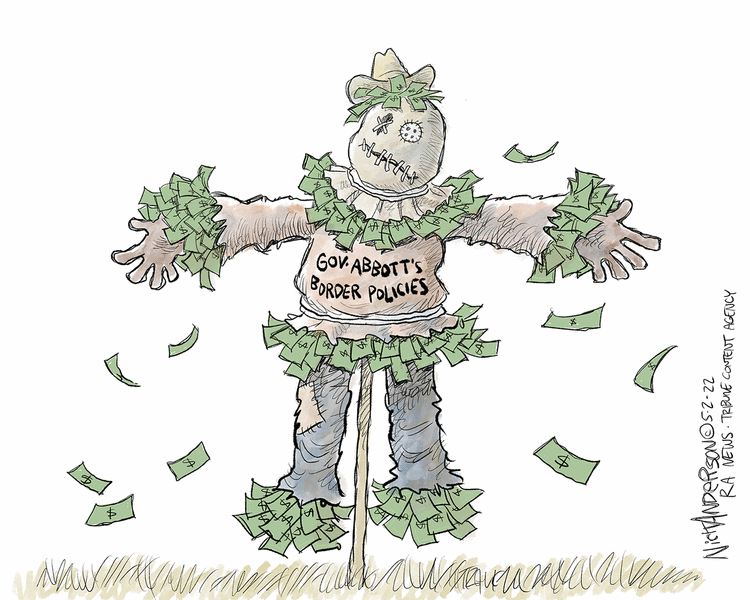
Texas Gov. Greg Abbott and top state lawmakers shifted around roughly $1 billion in federal coronavirus aid to help pay for their campaign to arrest migrants at the U.S.-Mexico border, exposing gaps in a law meant to bolster the country’s response to the ongoing pandemic.
Relying on the availability of generous federal relief funds, Texas repeatedly in recent months rerouted state money toward its controversial immigration crackdown — all without leaving a massive hole in its budget. But critics say the money would have been put to better use tending to a public health crisis that has killed more than 86,000 people in the state.
The trouble centers on Operation Lone Star, an initiative announced by Abbott last year, when he promised that law enforcement would “start arresting everybody” crossing the U.S.-Mexico border illegally. The campaign, which detains migrants on state trespassing and other charges, relies on extensive and expensive deployments of National Guard troops.
Civil rights groups have widely derided the effort as discriminatory — and some have urged the Biden administration to intervene — calling it a harmful political stunt by a Republican governor who harbors aspirations for the presidency. The operation even has seen Texas send buses of arrested migrants to other cities, including Washington, as Abbott argues his state “should not have to bear the burden” at the border.
But the program also has been expensive, and to help pay for it, Texas has eased the financial burden using money received under a 2020 law meant to help states battle the coronavirus. The state did so through a series of little-noticed “swaps,” in the words of one aide to the governor, who explained the setup to state lawmakers at a hearing in early April.
Essentially, Texas this year transferred money away from its public health and safety agencies and to the governor’s office to administer Operation Lone Star. That cash, totaling nearly $1 billion, was available because the state had backfilled those same public health and safety agencies with stimulus funds it received from Washington, according to interviews with local officials, submissions to the Texas legislature and missives from the governor’s office itself.
The moves appear to be legal under the stimulus law known as the Cares Act, enacted in March 2020. Congress never prohibited states from rejiggering their budgets to take full advantage of a program called the Coronavirus Relief Fund, which aimed to help cities and states pay front-line workers, purchase supplies and tend to other pandemic needs. The approach helped states save their money, which some local governments later reinvested in their efforts to arrest the spread of the virus. Others, like Texas, however, seized on the federal program to redirect their newly found savings for unrelated uses — including immigration enforcement.
Congress initially had considered barring such a practice, prohibiting states from “supplanting” their own spending with generous federal aid, according to an early version of the Cares Act obtained by The Post. But lawmakers opted against including any such restrictions in the bill they sent to then-President Donald Trump that spring. More than two years later, the result has frustrated local advocates, who say that Texas should have spent its savings far differently — helping Americans who were out of work, at risk of losing their homes or facing unprecedented financial constraints.
“At this point, they’re just trying to go back and refinance state payroll expenses to come up with general revenue that can be spent today,” said Eva DeLuna Castro, a program director overseeing fiscal and budget policy for Every Texan, a left-leaning advocacy group that has argued for more health-care and education spending. “When we get federal money and there’s any flexibility attached to it,” she added, “the first instinct is, ‘How can I use this dollar instead of a state tax dollar?’”
Asked about the funding, Renae Eze, a spokeswoman for Abbott, attacked the Biden administration for creating “an ongoing crisis along our southern border and throughout Texas, with millions of illegal immigrants from over 150 countries surging across the border.” Without addressing the funding, she added in a statement: “The President continues turning a blind eye to the suffering of Texans, as his administration dumps migrants in our border communities that are already overwhelmed and overrun by the historic level of illegal crossings.”
The White House did not respond to a request for comment. The Treasury Department said it is reviewing the spending in Texas — as well as every other state — as part of its normal diligence over such stimulus expenses.
For Washington, the windfall that federal lawmakers granted to states over the past two years has proved to be one of its most vexing fiscal challenges in the still-simmering pandemic.
Dating back to the earliest days of the crisis, Congress approved a series of rescue packages that in total set aside about $500 billion for local governments believed to be in financial peril. The money complemented the trillions of dollars in direct housing, education, health-care and nutrition assistance that lawmakers asked states to manage and disburse with record speed.
The wellspring of local aid marked an attempt to stave off a deeper recession, as lawmakers came to fear a repeat of the financial crisis more than a decade ago — when the downturn cleaved deeply into local governments’ revenue, sparking massive layoffs that devastated local economies. Congress imposed few restrictions on how the money could be spent, hoping to give cities, counties and states great flexibility to address needs as they saw fit.
States’ finances proved more stable than some in Washington had anticipated, thanks in part to a historic burst of roughly $6 trillion in total stimulus spending. In the wake of the improvements, some local governments began to eye the federal aid as an enticing pool of cash that could free up scarce budgetary resources and pave the way for long-stalled pet projects, according to an earlier Post analysis of federal data.
Alabama devoted some of its funding toward the construction of a new prison. A Florida town channeled some toward helping to equip a forthcoming golf course. Others refurbished parks and trails, expanded airports and constructed gas pipelines — backfilling projects stalled amid the pandemic downturn even though many were not related to public health. Many of those investments came about after the adoption of the American Rescue Plan in March 2021, which allowed governments to put their cash toward projects stalled as a result of the pandemic.
But every dollar spent this way has meant one fewer dollar available in the event of a worsening public health crisis. Sensing potential trouble, the Biden administration has urged Congress in recent weeks to approve as much as $22.5 billion in new coronavirus aid, hoping to shore up the country’s reserves in the event new variants emerge. Congress has struggled to provide less than half that amount — while state governments continue to shell out sizable sums toward seemingly unrelated causes — leaving some in the nation’s capital alarmed.
Under the first major coronavirus aid package, the Cares Act, Texas received more than $8 billion in direct aid. Like other states, it was required to put that money — awarded on the basis of population — specifically toward new pandemic-related expenses. Texas predominantly tapped its funds to provide excess medical capacity at hospitals, purchase tests and protective equipment and offer hazard pay to front-line workers, according to state data furnished to the federal government.
None of the money under the program directly went toward the state’s newly enhanced campaign to find, detain and deport migrants. But state officials in recent months acknowledged that federal covid aid dollars did essentially free up other cash for the immigration crackdown, saving Texas from the need to tap its own reserves to ramp up operations at the border.
Two months after launching Operation Lone Star, the Texas legislature took a critical budgetary step that appeared to ease the cost burden of its new immigration program. Lawmakers in May 2021 approved a supplemental plan to tap $2.4 billion under the federal Coronavirus Relief Fund, which it put to use on salaries for public health and safety employees, according to state budget documents.
That approach returned money to the state’s vast, general pool of funds for use elsewhere. Lawmakers would soon tap that expanded pot in the fall: They approved an emergency spending bill in September 2021 that appropriated roughly $1.8 billion to a slew of agencies that oversee border crossings, state records show.
Most of the money went to Abbott’s office for a wide array of purposes, according to legislative documents, including improvements to local security, border-security grants, the hiring of more border officials and enhanced prosecutions of border-crossing crimes. But Operation Lone Star ultimately would prove even more expensive, requiring the state to continue to rearrange its budget with the help of federal aid. By this January, state officials had to act again: They transferred roughly $480 million from domestic agencies that had been backfilled with Cares Act money, invoking the governor’s special powers under state disaster laws.
The funding situation caught the eye of Texas lawmakers by early April, as they convened to consider Abbott’s program and the state of their border security operations generally. Pointing out that Operation Lone Star is “costing the state taxpayers about $2.5 million a week,” state Sen. Juan “Chuy” Hinojosa (D) questioned one of the governor’s top officials as to “what happens” when the latest tranche of funds runs dry.
Sarah Hicks, an adviser to Abbott on the budget, acknowledged the $480 million transfer and explained the governor’s strategy — an effort to “maximize that use” of federal funds on public health “to the benefit” of the state’s coffers.
“For the agency, it was a dollar for dollar,” Hicks said. “It was just a swap.”
Hicks would go on to fault the federal government for failing to provide direct border assistance to Texas, adding there is a “strong possibility next spring that Congress looks a little bit different” since “elections ultimately matter.”
Until then, though, she said there would be “funds available and salaries to do another $600 million-plus in salary swaps” in the months to come — potentially freeing up even greater sums for border operations.
“I don’t think we’re going to look up in April and say, oh shoot, there’s nothing possible to do here,” Hicks said. She did not respond to a request for comment.
About four weeks later, six Texas agencies put Hicks’s comments into motion. They transferred about $495 million to the governor in late April “to support the deployment of the National Guard” and other border-related operations, according to a letter from Abbott’s office. The missive only said that the transfer had been “fully funded with other sources,” without specifying any, adding that the move “will not affect any agency or program function.”
But a top official on the Legislative Budget Board, a fiscal advisory arm for state lawmakers, confirmed a week later that the governor had additional funds “available to it through the Cares Act” that it ultimately “gave to the agencies for public safety and public health employee salaries.” Testifying at a state House hearing in early May, Katy Fallon-Brown said the decision “freed up general revenue” that the governor’s office took over, putting it to use on its immigration enforcement campaign.
A related presentation, shared with lawmakers, in total details about $4 billion in border security appropriations over the past year. In a subsequent statement, the Legislative Budget Board confirmed that at least $975 million “are related to the general revenue freed up from the application of additional [stimulus] dollars.” Some experts, however, say the amount of federal aid involved reaches into the billions given the extent to which the key Cares Act program had allowed Texas to save money over the past year.
The entire arrangement has troubled civil rights advocates, who have asked the Justice Department in Washington to open an investigation into Operation Lone Star broadly. In a complaint filed last year, the ACLU of Texas has stressed that the crackdown on migrants violated federal civil rights laws. Such a finding would warrant a clawback of some of the state’s coronavirus aid, the group has argued, since federal law prohibits the government from providing help to state agencies engaging in abuse.
Kate Huddleston, a staff attorney at ACLU of Texas, said this week that the Biden administration has not provided a “substantive update” on the request. But she lamented the use of pandemic relief dollars as one of the problems in the state’s controversial immigration campaign.
“Gov. Abbott has poured money into Operation Lone Star that could be going toward literally anything actually productive for the state,” Huddleston said.
Is this what the religious SCOTUS want for US women. The men to control their lives to the point where the men get punished for a woman’s actions because women have no agency and must be controlled like livestock? We see the extremes when religion takes over a country, yet a segment of the US is driving us to that. For years people said it couldn’t happen because we have a constitution and laws … well now we see what can happen if you install religious ideologues on the highest court that makes rulings on if a law is legal, and they are driven to support their religion’s rules over the constitution’s protections. We become a country where religion becomes the most important aspect, where religion has the final say in a person’s rights or life. This so against what the founders of this country really wanted it is stunning it is happening. But one small group of the population wanted it and they worked hard through decades to get it. This is the first time ever that SCOTUS has ruled that the constitution doesn’t support existing rights. Never has SCOTUS been regressive, it was always progressive. Until it was stacked with complete republican ideologs.
“This is not about religion,” says Amna Nawaz on the heels of the Taliban’s announcement that women must cover entirely and stay indoors except for necessity. “This is about control.” »
Professor Nina Khrushcheva and Gen. Steph Twitty join Morning Joe to discuss the status of the Russian invasion of Ukraine as Russia marks Victory Day in Moscow.

/https://static.texastribune.org/media/files/f7586418b7ab68c1f15bc404d67d5952/Operation%20Lone%20Star%20VGC%20TT%2054.jpg)