We’re bringing the ocean to the desert

Bazaar Mar is opening Wednesday in Las Vegas!

José Andrés Aug 05, 2024 Read on Substack

If you know one thing about me…you know I absolutely love the sea and everything that comes from it. Over the last couple of years (we passed our two year mark here at Longer Tables and I didn’t say anything! Happy anniversary, friends!) I’ve told you about my love of oysters, and crabs, and octopus, and all kinds of fish, as well as the beauty of drinking seafoam, and watching the stars from the beach at night, and sailing across the ocean on a tall ship. So you know this is true!

And you know something else about me, which is that I love Vegas. It’s a city where anything can truly happen…there’s magic, there’s mystery, there’s great energy, and of course there’s some of the best dining in the world.

So friends—I’m thrilled to be able to share with you the news that my team and I, we are bringing two of my favorite things together: we are opening Bazaar Mar in Vegas! I don’t know if any of you were able to make it to Bazaar Mar in Miami when it was open in Brickell from 2016 to 2019, but I’m not lying when I tell you it was one of my favorite restaurants we ever opened (no offense to the others, of course! I love them all…). The design, these beautiful blue and white tiles everywhere, the art from my friend Sergio Mora, the feeling like you’re under the sea, were amazing. And the menu! We did some of our best R&D there, and served some incredible seafood to happy guests. I was so sad we had to close it five years ago.

But now, it’s as if it’s rising again from the ashes, crossing the country to become a beautiful oasis of seafood in the middle of the Nevada desert.

Friends—Bazaar Mar is back, and I couldn’t be happier.

If you’ve never been to a Bazaar, I’ll tell you this: it’s a place of discovery, of wonder, of surprise. You can visit a Bazaar multiple times and still find new things. Think of exploring a spice bazaar or a market in a new city: what do you think you’ll find? What will you taste, what will you smell, what will you see? There’s always something new around the corner!

Some of you know that I also have Bazaar Meat in Vegas, which celebrates everything carnivorous, from jamón to suckling pig to thick grilled chuletón steaks. Steak is great, but sometimes you need to go to the open ocean! I hope that Bazaar Mar is that place of wonder and surprise for everyone who’s excited to explore a bit deeper below the surface..

Chef Manny and Chef Daniela, with Chef Victor from Bazaar NY!

Enough talk, José, more food! Okay, okay, so what am I excited to eat there? Well, I know what I’m excited to have, but I also spoke with two of my chefs from the restaurant—Daniela Romero, the restaurant’s head chef, and Manny Echevarri, the head chef of all of the Bazaars. Like me, they both loved Bazaar Mar in Miami, and are so excited to be able to open the restaurant again in an amazing city like Vegas. Here are a few of our favorites!

Got friends in Vegas, or someone who always seems to be there?

River Trout Cone: Every Bazaar has a unique cone—which, if you’ve never been to any of my restaurants, is a little beautiful crunchy two-bite snack that can be savory or sweet. The one we’ve made for Bazaar Mar has a flower made of a very very special trout from Virginia, raised by the Walker family in a 1930s-era fishery (I’ll tell you more about Ty and Shannon Walker and their trout sometime!). It’s got a little preserved Meyer lemon and dill on it…an amazing way to start the meal.

bazaarbyjose

A post shared by @bazaarbyjose

Cobia Rosa Ceviche: Have you ever had the fish called Cobia? It’s an amazing mild, buttery, firm fish, absolutely perfect with leche de tigre (the very famous Peruvian lime dressing for ceviche). This was one of my absolute favorites from The Bazaar in Miami, and I’m so happy to be bringing it back (a bit updated from the earlier version, and still amazing). Oh, and the Cobia is coming from Panama, from Open Blue, a project promoting the sustainability of this delicious fish.
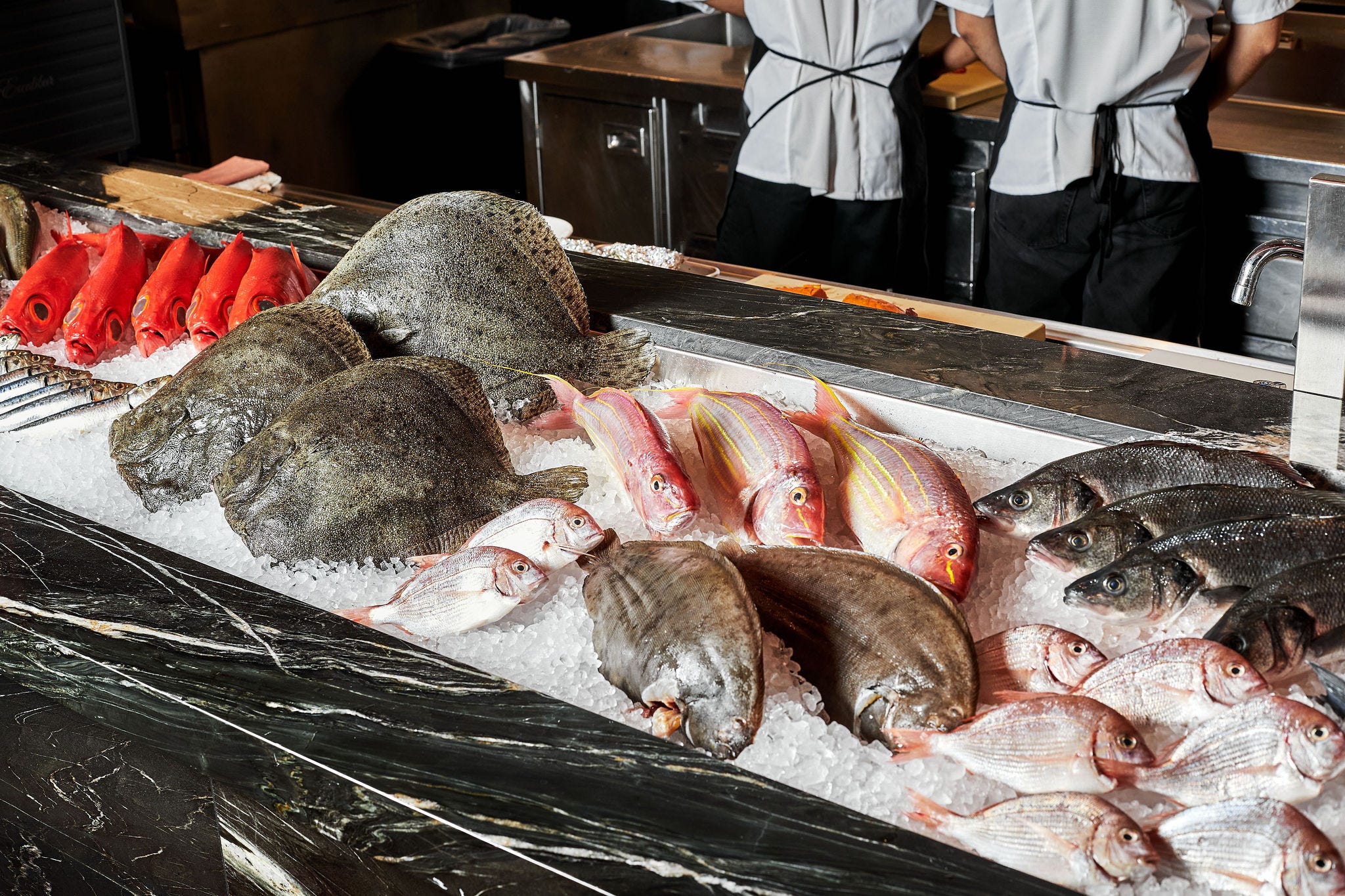
Salt-Baked Whole Fish, served tableside: It’s just what it sounds like…just as theatrical and amazing as you can imagine. You’ll be able to pick your fish of choice, whether it’s turbot, lubina, red snapper, sea bream, or whatever we have from the fishers that day, and you can tell us how to prepare it: fried, like they do it in Ibiza; grilled over wood; Donostiarra-style (which you know how to do at home!) or baked in salt. I don’t know if I have a favorite, but I do know that to have a salt-baked fish prepared for me by a great server is an amazing thing! By the way, we won’t have this available immediately at opening, but we’ll be introducing it soon after!

Maybe you can tell—the fish we are serving is from the very best places in the country and the world. We care so much about the ingredients we’re serving, so we’ve found the best. And of course, fish, like produce, is seasonal…so you won’t always find the same dishes on the menu.

Okay, enough of me telling you guys what I love about this restaurant. I’m getting so excited thinking about it, and I hope you are too! I know maybe not everyone goes to Vegas very often, but I think maybe it’s time to give it a visit, just to feast for a few days…? You don’t even need to gamble!

Check Out Bazaar Mar!

So bad

I had to share it.

Lard’s World Peace Tips by Keith Tutt and Daniel Saunders for August 07, 2024

Lard's World Peace Tips Comic Strip for August 07, 2024

https://www.gocomics.com/lards-world-peace-tips/2024/08/07

A Prayer for Resistance. Please join, if you will.

“Put The Ten Commandments in Corporate Boardrooms…”


@jasonalaimo4787

14 hours ago
“We have capitalism for the poor and socialism for the rich.” MLK

More Science!

Bright future for medicines and farming after fluorine discovery

July 30, 2024 Ellen Phiddian

US researchers have figured out an environmentally friendly way to mix fluorine into carbon molecules using enzymes and light.

The discovery illuminates a path for safer and more ecologically sound materials, particularly pharmaceuticals and agricultural chemicals.

“This work could pave the way for new, greener technologies in chemical production,” says senior researcher Professor Huimin Zhao, from the University of Illinois at Urbana-Champaign.

The discovery is published in Science.

Fluorine atoms can be very powerful additions to bioactive materials. They can make medicines easier to absorb, more stable in biological systems, and better at interacting with other proteins. About 20% of pharmaceuticals on the market contain fluorine.

But these organic (carbon-containing) molecules all typically need a bond between a fluorine atom and a carbon atom to work.

This bond is rare in nature, and difficult to make in a lab. At the moment, most fluorine-containing substances are made using super-toxic hydrogen fluoride, which can be fatal with just a small splash to the skin.

This has spurred chemists to hunt for other ways to fluorinate molecules.

In this research, the scientists used a protein that responds to light, called a photoenzyme.

Using this enzyme, they were able to add fluorine to a class of molecules called olefins. These carbon-containing molecules are widely used as a feedstock in the chemical industry, because they’re easy to turn into a range of other molecules.

The reaction is also “stereoselective”: it can differentiate between molecules that are chemically identical, but optically different. This is a difficult property to achieve in a lab, but crucial to the pharmaceutical and agricultural market because biological organisms can react differently to optically different molecules.

Two people smiling in lab
Maolin Li (seated) and Huimin Zhao in the lab. Credit: Center for Advanced Bioenergy and Bioproducts Innovation (CABBI)

“Our research opens up fascinating possibilities for the future of pharmaceutical and agrochemical development,” says Dr Maolin Li, a postdoctoral researcher at the University of Illinois at Urbana-Champaign.

“By integrating fluorine into organic molecules through a photoenzymatic process, we are not only enhancing the beneficial properties of these compounds but also doing so in a manner that’s more environmentally responsible.

“It’s thrilling to think about the potential applications of our work in creating more effective and sustainable products for everyday use.”

https://cosmosmagazine.com/science/chemistry/fluorine-addition-pharmaceuticals/

Nebraska’s $1.85 Billion Math Problem

JULY 24, 2024, 1:49 PM

Same as in every state that tries this.

=====

Nebraska Gov. Jim Pillen is calling legislators back into session this week, assigning them the impossible task of finding $1.85 billion to redirect toward local property tax cuts. Policymakers can run the numbers as many times as they want, but the problem remains that the state will either face deep budget cuts or must raise taxes elsewhere to fund Pillen’s latest plan — or both.

Last year, Nebraska used the cover of temporary budget surpluses to pass sweeping income tax cuts that primarily benefitted wealthy people and out-of-state corporations. These cuts will cost more than $900 million each year once fully phased in. That leaves legislators bent on cutting local property taxes with three options: abandon the income tax cuts, embrace massive spending cuts, or expand regressive fees and sales taxes on everything from vet services to car repairs to home maintenance.

Nebraska families with the lowest incomes — those making about $50,000 a year or less — would bear the brunt of a sales tax expansion. They already pay five times more in sales taxes as a share of income than families with the top 1 percent of incomes, and relying more heavily on the sales tax would only make things worse.

A sweeping property tax cut would also jeopardize hundreds of millions of dollars in funding for the state’s K-12 education system, which has been weakened by a new private school voucher program that siphons money away from public schools. Property taxes are the primary revenue stream for public education in Nebraska and nationally, accounting for more than one in three dollars spent by schools. They pay for classroom books, vocational and technical programs, mental health counseling, and teachers’ salaries, among many other things.

Research suggests that property tax cuts result in disproportionately less funding for districts that serve large numbers of students of color and low-income students. In Nebraska, districts serving the most students of color receive roughly $3,500 less in funding per student than districts serving the fewest students of color. The governor’s proposal could worsen this divide. 

Collectively, these changes are a recipe for weaker schools, greater inequality, and higher taxes for working people. Creating a fairer tax system — one that generates enough revenue to fund public education and many services Nebraska families rely on — requires a balanced approach, not a wholesale shift to the state’s most regressive tax.

If policymakers really want to help Nebraskans stay in their homes, they should explore “circuit breaker” policies, which guarantee that people’s property tax bills don’t exceed their ability to pay. And longer term, the state should grapple with how to adequately fund K-12 education, lessening local school districts’ reliance on property taxes to keep the lights on and increasing the amount of funding going to schools overall. But a special session is not the right mechanism for such a massive undertaking, which must balance the needs of students and all Nebraskans.

https://www.cbpp.org/blog/nebraskas-185-billion-math-problem

-yours Ukrainian.

This is linked in a Substack I read. In and on its own merit, I’m bringing it here for people to take a look. I think it’ll be worthwhile. I wish that people in Yemen and refugees from Gaza and people in all troubled places had this opportunity, but there it is; we have this. Anyway, take a look, subscribe if you like, or pass it along, and send a good thought into the universe on behalf of parents and children and stopping war.

Becoming a mother amid war in Ukraine by Anastasiia Lapatina

Two days after the birth of my daughter, Russia launched one of its largest air attacks on Kyiv. It was terrifying, but also entirely expected, and that’s the worst part. Read on Substack

How Brazilian Women Challenged Slavery and Patriarchy Through Food

Hope I’m not pushing the feminism too hard. But seriously! Feminism, food, successful resistance, with food, what’s not to love? Enjoy the article.

BEATRIZ MIRANDA AND ÍRIA BORGES

LAST UPDATED JULY 24, 2024, 9:18 AM

n the quaint district of Milho Verde, it’s impossible to go without hearing about Geralda Francisca dos Santos and her biscoito de polvilho (a cassava flour and cheese puff). At 81, Dona Geralda is one of the region’s traditional cooks of quitanda, pastries typical of Brazil’s food culture, especially in the state of Minas Gerais.

Ahead of festivities like the Three Kings’ Day and the Feast of Our Lady of the Rosary, her daughters and granddaughters — even those living in other districts — join her in the kitchen, surrounding the termite mound, clay, and tile shard oven that Dona Geralda built. They aim to help the matriarch meet the extraordinary demand, but these gatherings always mean something else. 

“When my mother and I cook around her oven, she tells me stories of Milho Verde and our family that I didn’t know about,” Silvana Aparecida Santos, 38, who learned the quitanda alchemy from a very young age by watching and listening to her mother, tells Refinery29 Somos. “When we cook quitanda together, we shorten distances between us.” 

Quitanda goes beyond the kitchen. Before the dish became a local culinary symbol, it helped fuel a resistance movement.”

BEATRIZ MIRANDA

For many women like Aparecida Santos and Dona Geralda, quitanda goes beyond the kitchen. Before the dish became a local culinary symbol, it helped fuel a resistance movement. The tradition of cooking these pastries has crossed generations of women workers (predominantly in Minas Gerais), with the food continuing to represent the means to a better living. Quitanda is the technology through which artisanal cooks build their self-esteem, identity, community belonging, financial autonomy, and female networks of mutual support.

According to scholar Juliana Bonomo, quitanda originated in the 18th century when lords sent women enslaved workers to the nearest urban centers to generate complementary income. The word “quitanda” derives from the Kimbundu language, alluding to the tray where one sells food. But back in those days, it referred, as Bonomo explains, “to everything from haberdashery items to snacks.”

Mariana Gontijo

PHOTO: NEREU JR.

To this day, despite industrialization, most quintandeiras use no artificial ingredients. These snacks blended local ingredients (such as coconut, corn, peanuts, and cassava) with Portuguese recipes (cakes, biscuits, and pastries) and African techniques, rites, and beliefs. “Quitanda is a multicultural food,” Bonomo adds. “Pastry would often be prepared in silence. One couldn’t hit the pan with the spoon because it would bring bad luck.” 

But it’s this move from the private to the public sphere that transformed this slave lord-run business into something revolutionary.

“As these women left their lords’ houses to work on the streets, they started learning and sharing ideas about freedom with other quitandeiras and their own customers — many of them also enslaved workers,” the researcher says, pointing to Luiza Mahin, a quitandeira from Bahia State who played a pivotal role in the Revolta dos Malês (1835), the biggest uprising of enslaved workers in Brazil. Once authorities perceived them as a threat to the slavery system, the first quitandeiras faced persecution. 

As these women left their lords’ houses to work on the streets, they started learning and sharing ideas about freedom with other quitandeiras and their own customers — many of them also enslaved workers.”

JULIANA BONOMO

However, quitandas ultimately emancipated many women. “By finding a way to sell quitanda, they were able to buy manumission for themselves and their relatives,” Bonomo says. The food ensured dignity for women in the 18th and 19th centuries, something that resonates in the lives of quitandeiras even today. 

“The selling of quitanda helped me raise my 10 children,” says Dona Geralda, who grew up in the Ausente quilombo, a community that descends from enslaved workers who fought the system. Even though Aparecida Santos runs a bar in Milho Verde, she cites quitanda as a major source of income.

Quitanda spread made by Angela Resende

PHOTO: MARCELO RAMOS.

In the historical village of Congonhas (home to Minas Gerais’s biggest quitanda festival), Raquel Ramalho tenderly recalls her first memories with the pastries. “When I close my eyes, I can visualize my grandmother making biscoito de polvilho for us in the wood-burning stove before we went to school,” she says. 

While quitanda has always been intrinsic to her identity, Ramalho’s life changed 15 years ago when she established herself as a professional quitandeira. “I used to be a housewife and felt excluded from social life. As I started working with quitanda, I started traveling to promote my work in other places, meeting new people, and conquering my own space,” she says. “It raised my self-esteem and gave me autonomy.” The 47-year-old now has a dedicated YouTube channel to share her quitanda knowledge with the world.“

“By finding a way to sell quitanda, they were able to buy manumission for themselves and their relatives.”

JULIANA BONOMO

Quitanda is also a protagonist in the life of 60-year-old Angela Resende, who wakes up every day at 4 a.m. to cook. In the last 20 years, she has spent many of her mornings preparing quitanda in the Minas Gerais city of Paracatu, where she serves customers a homemade breakfast in her yard. In spite of the hard work, Resende asserts she wouldn’t choose any other profession.

“People used to think that we were quitandeiras because we had no option because we didn’t go to university,” she says. “There used to be this prejudice.”

For Bonomo, this misunderstanding of quitandeiras stems from the patriarchal work division that prevails in society. “Professions that have historically been connected to domestic work (like cooking) are still seen as not real work,” she says, pointing out how empowering the role is. “[With her income], the quitandeira is responsible for buying her son’s school uniform, for example, or helping pay the family’s food expenses.”

Angela Resende

PHOTO: MARCELO RAMOS.

Being a quitandeira can also be a lifeline. “When my grandfather became physically disabled, my grandmother became the breadwinner,” says Mariana Gontijo, 40, a culinary school professor born in Moema. “By selling quitanda and washing and ironing clothes, she provided for a family of seven people.” 

After years of working as a lawyer, Gontijo returned to her roots. “My first source of research was my mother’s cookbook, where I reconnected to recipes that have accompanied me through my whole life,” Gontijo says. An advocate of local traditional cooking, she now runs O Tacho, a food consultancy company, and Roça Grande, a restaurant in the capital of Minas Gerais that celebrates the food of her land.

For Gontijo, quitanda is a tradition that has long represented a means of survival and emancipation for many women. Or simply put, “quitanda is an act of resistance.” 

Quitanda is an act of resistance.”

MARIANA GONTIJO

It also requires a profound knowledge of nature and themselves. “By using corn flour, banana tree leaves, and even their own arms to measure the temperature of the wood-burning stove, they ensure the food preparation is on point,” she says. “These are purely empirical and poetic techniques that shouldn’t be taken for granted.

Gontijo continues: “Before we look to international cuisine, we need to understand, respect, and value what we have here — like the quitanda culture. If you don’t know where you come from, you don’t know where to go.”

https://www.refinery29.com/en-us/black-women-resistence-brazil-quitanda

Poliovirus Detected In Gaza Water Sources [VIDEO]


Bloomberg News reports:

Humanitarian groups are considering a mass vaccination campaign for Palestinians in the Gaza Strip after traces of variant poliovirus type 2 were found in water sources in the war-torn territory. The disease was detected in six locations in Gaza, the World Health Organization said.

Geneva-based WHO said it was working with partners – including UNICEF and United Nations Relief and Works Agency for Palestine Refugees in the Near East (UNRWA) – to conduct a risk assessment. Polio vaccination rates in Gaza before the war were “optimal,” according to the organization.

Israel on Sunday confirmed the resurgence of the virus, which can be spread by contaminated water and direct person-to-person contact, and said it would offer booster shots to its soldiers operating in and around the Gaza Strip.

Read the full article.

https://x.com/AJEnglish/status/1814280276681322595


What Food was Served at Wild West Saloons?