A driver involved in a car accident in Los Angeles gave rubberneckers something to gawk at when he got out of his vehicle naked at the scene, video shows. The two-vehicle crash occurred shortly before 12:30 p.m. Thursday, police said.
A bystander’s footage shows a naked man then exiting the blue truck via the passenger door. He does not appear to be injured and is holding some clothing in one hand. The man, who has not been identified, calmly walks up the street and drops the clothing.
This is what the anti-trans rhetoric creates. A culture where harming LGBTQ+ is done for fun, again to make them shut up and go away. Decades of working for tolerance and acceptance are being wiped out by the open racism and bigotry of the republicans and the rabid right thugs. I watched the video she did on this and her treatment by the police was horrifying. She woke up with guns in her face, she was arrested, booked under her dead name, the police were horribly anti-trans and homophobic. Hugs
Clara Sorrenti went into hiding at a hotel out of fear for her safety. The trolls started to send her pizzas to let her know they found her.
Weeks after online trolls sent police to her door on false pretenses, popular transgender Twitch streamer and activist Clara Sorrenti was once again doxed.
Earlier this month, Sorrenti, who goes by the name Keffals on social media, was the victim of a tactic known as “swatting.” Police raided her London, Ontario home and arrested her after someone using her deadname reportedly sent violent threats to local city hall officials. She was released without charges and later cleared of all wrongdoing. London police chief Steve Williams said that he will review how officers treated Sorrenti, who says she was consistently addressed with her deadname, which is not her legal name.
“The hotel I was staying at got doxed so I had to move hotels,” Sorrenti told Canada’s Global News. “Five different pizza companies sent pizzas to my hotel room in my (birth) name. Obviously, the pizza itself isn’t the problem. It’s the threat they send by telling me they know where I live and are willing to act on it in the real world.”
Sorrenti, who was a Communist Party candidate in Canada’s 2019 federal election and frequently posts about trans issues on her Twitch channel, has been the target of relentless anti-transgender harassment. In July, Twitch banned Sorrenti from the platform after a stream she was doing highlighting examples of the hateful abuse she receives was mass reported by trolls.
Sorrenti speculates that online trolls may have managed to find her using a photo she posted of her fiancée’s cat on their hotel bed following the swatting ordeal.
“The people who have been harassing me [must have] spent hours looking at the bedsheets, cross-referencing them with every hotel in my city until they found a match,” she said.
London Police Service is investigating both the swatting and doxing.
“We’re concerned,” deputy police chief Trish McIntyre said. “It’s harassment. Is it police’s responsibility to investigate those occurrences? One hundred percent. We’re aware of them, they’re under investigation.”
Note the paragraph that states because the school spying on the kids, those same kids / parents have been visited by law enforcement. One district used the software to learn the student’s sexual orientation and outed the student their parents.
As the post-Roe era underscores the risks of digital surveillance, a new survey shows that teens face increased monitoring from teachers—and police.
PHOTOGRAPH: MASKOT/GETTY IMAGES
THIS IS WHAT high school teachers see when they open GoGuardian, a popular software application used to monitor student activity: The interface is familiar, like the gallery view of a large Zoom call. But instead of seeing teenaged faces in each frame, the teacher sees thumbnail images showing the screens of each student’s laptop. They watch as students’ cursors skim across the lines of a sonnet or the word “chlorofluorocarbon” appears, painstakingly typed into a search bar. If a student is enticed by a distraction—an online game, a stunt video—the teacher can see that too and can remind the student to stay on task via a private message sent through GoGuardian. If this student has veered away from the assignment a few too many times, the teacher can take remote control of the device and zap the tab themselves.
Student-monitoring software has come under renewed scrutiny over the course of the Covid-19 pandemic. When students in the US were forced to continue their schooling virtually, many brought home school-issued devices. Baked into these machines was software that can allow teachers to view and control students’ screens, use AI to scan text from student emails and cloud-based documents, and, in severe cases, send alerts of potential violent threats or mental health harms to educators and local law enforcement after school hours.
Now that the majority of American students are finally going back to school in-person, the surveillance software that proliferated during the pandemic will stay on their school-issued devices, where it will continue to watch them. According to a report published today from the Center for Democracy and Technology, 89 percent of teachers have said that their schools will continue using student-monitoring software, up 5 percentage points from last year. At the same time, the overturning of Roe v. Wade has led to new concerns about digital surveillance in states that have made abortion care illegal. Proposals targeting LGBTQ youth, such as the Texas governor’s calls to investigate the families of kids seeking gender-affirming care, raise additional worries about how data collected through school-issued devices might be weaponized in September.
The CDT report also reveals how monitoring software can shrink the distance between classrooms and carceral systems. Forty-four percent of teachers reported that at least one student at their school has been contacted by law enforcement as a result of behaviors flagged by the monitoring software. And 37 percent of teachers who say their school uses activity monitoring outside of regular hours report that such alerts are directed to “a third party focused on public safety” (e.g., local police department, immigration enforcement). “Schools have institutionalized and routinized law enforcement’s access to students’ information,” says Elizabeth Laird, the director of equity in civic technology at the CDT.
US senators Elizabeth Warren and Ed Markey have recently raised concerns about the software’s facilitation of contact with law enforcement, suggesting that the products may also be used to criminalize students who seek reproductive health resources on school-issued devices. The senators have sought responses from four major monitoring companies: GoGuardian, Gaggle, Securly, and Bark for Schools, which together reach thousands of school districts and millions of American students.
Widespread concerns about teen mental health and school violence lend a grim backdrop to the back-to-school season. After the mass shooting at an elementary school in Uvalde, Texas, Congress passed a law that directs $300 million for schools to strengthen security infrastructure. Monitoring companies speak to educators’ fears, often touting their products’ ability to zero in on would-be student attackers. Securly’s website offers educators “AI-powered insight into student activity for email, Google Drive, and Microsoft OneDrive files.” It invites them to “approach student safety from every angle, across every platform, and identify students who may be at risk of harming themselves or others.”
See Me After Class
Before the Roe decision brought more attention to the risks of digital surveillance, lawmakers and privacy advocates were already concerned about student-monitoring software. In March 2022, an investigation led by senators Warren and Markey found that the four aforementioned companies—which sell digital student-monitoring services to K-12 schools—raised “significant privacy and equity concerns.” The investigation pointed out that low-income students (who tend to be disproportionately Black and Hispanic) rely more heavily on school devices and are exposed to more surveillance than affluent students; it also uncovered that schools and companies were often not required to disclose the use and extent of their monitoring to students and parents. In some cases, districts can opt to have a company send alerts directly to law enforcement instead of a school contact.
Students are often aware that their AI hall monitors are imperfect and can be misused. An investigation by The 74 Million found that Gaggle would send students warning emails for harmless content, like profanity in a fiction submission to the school literary magazine. One high school newspaper reported that the district used monitoring software to reveal a student’s sexuality and out the student to their parents. (Today’s CDT report revealed that 13 percent of students knew someone who had been outed as a result of student-monitoring software.) A Texas student newspaper’s editorial board argued that their school’s use of the software might prevent students from seeking mental health support.
Also disquieting are the accounts of monitoring software breaching students’ after-school lives. One associate principal I spoke to for this story says his district would receive “Questionable Content” email alerts from Gaggle about pornographic photos and profanities from students’ text messages. But the students weren’t texting on their school-issued Chromebooks. When administrators investigated, they learned that while teens were home, they would charge their phones by connecting them to their laptops via USB cables. The teens would then proceed to have what they believed to be private conversations via text, in some cases exchanging nude photos with significant others—which the Gaggle software running on the Chromebook could detect.
After this was first reported by Wired, Gaggle said in a statement that it does not scan private texts on charging phones, but that a phone’s photos do get uploaded to a school’s account (and scanned) when the student plugs their phone into a school-issued laptop. The associate principal I spoke to says he advises students not to plug their personal devices into their school-issued laptops.
This pervasive surveillance has always been disconcerting to privacy advocates, but the criminalization of reproductive health care in some states makes those problems more acute. It’s not difficult to envision a student who lives in a state where ending a pregnancy is illegal using a search engine to find out-of-state abortion clinics, or chatting online with a friend about an unplanned pregnancy. From there, teachers and administrators could take it upon themselves to inform the student’s parent or local law enforcement.
So could the monitoring algorithm scan directly for students who type “abortion clinic near me” or “gender-affirming care” and trigger an alert to educators or the police? Paget Hetherington, the vice president of marketing at Gaggle, says that Gaggle’s dictionary of keywords does not scan for words and phrases related to abortion, reproductive health care, or gender-affirming health care. Districts can, to an extent, ask Gaggle to customize and localize which keywords are flagged by the algorithm. When WIRED asked whether a district could request that Gaggle specifically track words related to reproductive or gender-affirming health care, Hetherington replied, “It’s possible that a school district in one of these states could potentially ask us to track some of these words and phrases, and we will say no.”
When reached for comment, GoGuardian directed us to the following statement: “As a company committed to creating safer learning environments for all students, GoGuardian continually evaluates our product frameworks and their implications for student data privacy. We are currently reviewing the letter we received from Senators Warren and Markey and will be providing a response.”
When reached for comment, Bark for Schools initially agreed to speak to us, then went silent. After this story was first published, the company released a statement saying, in part, that its policy is to “immediately and permanently delete data which comes into its possession that contains a student’s reproductive health data or searches for reproductive health information.” Therefore, the company says, it cannot be compelled to turn over such data to law enforcement because “it is not in our possession and therefore not produceable.”
Securly did not respond to requests for comment.
All Monitor
Even if student-monitoring algorithms don’t actively scan for content related to abortion or gender-affirming care, the sensitive student information they’re privy to can still get kids in trouble with police. “It is hardly a stretch to believe that school districts would be compelled to use the information that they collect to ensure enforcement of state law,” says Doug Levin, national director of the K12 Security Information Exchange, a nonprofit focused on protecting schools from emerging cybersecurity risks.
Schools can and do share student data with law enforcement. In 2020, The Boston Globereported that information about Boston Public School students was shared on over 100 occasions with an intelligence group based in the city’s police department, exposing the records of the district’s undocumented students and putting those students at greater risk of deportation.
When it comes to safeguarding the privacy of students’ web searches and communications, Levin says current federal protections are insufficient. The primary federal law governing the type and amount of student data that companies can slurp up is the Family Education Rights and Privacy Act. While FERPA has been updated a handful of times since it passed in 1974, Levin says it hasn’t kept pace with the technology that shapes reality for schools and students in 2022. The current national privacy bill in Congress (which might, in other respects, actually be good) won’t do anything for most students either, as it excludes public institutions such as public schools and vendors that handle student data.
For teachers, the value of remote monitoring can be significant. Stacy Recker, a high school social studies teacher in the Cincinnati area, says GoGuardian was “invaluable” during the pandemic. She used the software to provide remote support for students who struggled with the technical demands of remote learning. Now that her students have returned to the classroom, she continues to use GoGuardian to help her kids stay off YouTube and focus on a lesson on W.E.B. DuBois. At the time of WIRED’s interview, she was not aware of the alerting system that claims to detect a student’s risk of self-harm or harm to others, a service GoGuardian offers as a separate product.
Educators are shouldering the unprecedented responsibility of helping students recover from two extremely disruptive years while providing mental health support in the wake of campus tragedies. The monitoring companies’ websites share stories of their products flagging students’ expressions of suicidal ideation, with testimonies from teachers who credit the software with helping them intervene in the nick of time.
Especially after school shootings, educators are understandably fearful. But the evidence that monitoring software actually helps prevent violence is scant. Privacy advocates would also argue that forcing schools to weigh surveillance against safety perpetuates a false choice. “Surveillance always comes with inherent forms of abuse,” says Evan Greer, the director of the nonprofit Fight for the Future. “There are other ways to support and protect kids that don’t.”
Some educators would agree. When the Columbine shooting shook American schools in 1999, Lee Ann Wentzel was an assistant principal at Ridley Public Schools in Pennsylvania. She remembers how her school scrambled to come up with new safety protocols, like issuing ID badges. When she became superintendent in 2010, Wentzel helped design a rigorous student privacy rubric against which her district could measure all software they would be using with students. The rubric included items like whether the student’s data was disposed of and whether it was shared with other parties. Her district does not use GoGuardian, Gaggle, Securly, or Bark for Schools.
She’s wary of the promises student-monitoring companies make. “Those systems provide A) a false sense of security, and B) it kills the curiosity that you want to inspire in learning,” she says. “If you’re going to rely on a technology system to tell you a kid’s unhappy, that’s concerning to me because you’re not developing relationships with kids who are in front of you.”
As to the companies’ claims about bolstering safety and anticipating school violence, she says, “There’s no single answer to these issues. Anyone that promises, ‘We’re gonna be able to predict that sort of thing’—No. You’re not.”
Serbian Orthodox Church bishop Nikanor Bogunović of Bana. (Screen capture via YouTube)
A senior bishop in Serbia has been condemned for encouraging armed attacks against an LGBTQ+ Pride event in Belgrade.
In September, the Serbian capital will host EuroPride, which celebrates LGBTQ+ rights across the continent, in a first for a southeastern European country.
But Serbian Orthodox Church bishop Nikanor Bogunović of Banat, a region that covers parts of Serbia, Romania and Hungary, has vowed to “curse” all those who attend the week-long festival.
“I will curse all those who organize and participate in something like that,” Nikanor said in remarks made on 11 August, according to Balkan Insight.
“I can do that much. If I had a weapon, I would use it, I would use that force if only I had it, but I do not.”
He added that EuroPride participants “will come to Belgrade and flaunt and desecrate the city of Belgrade, the holy Serbian city,” and that “we raise our voice against such [people]”.
Serbian president Aleksandar Vučić said Nicanor’s sermon had another clear target – the country’s lesbian prime minister, Ana Brnabić, elected in 2017.
“Bishop Nicanor insulted himself and our church, humiliated our church, much more than Ana Brnabić or anyone else ever did,” he told TV network Prva TV on 12 August.
Only three days after Nikanor’s comments, chants of “Hands off our children” and “Stop the parade of shame” boomed through the streets of Belgrade as part of a protest against EuroPride.
Tens of thousands of people gathered outside Serbian Orthodox Church Patriarchate offices before ending at the Sain Marko Church. The demonstration was backed by the Serbian Orthodox Church, according to local media reports.
Queer Serbs do enjoy some protections in the eyes of the law, but same-gender couples are not legally recognised and marriage equality remains firmly banned by the constitution.
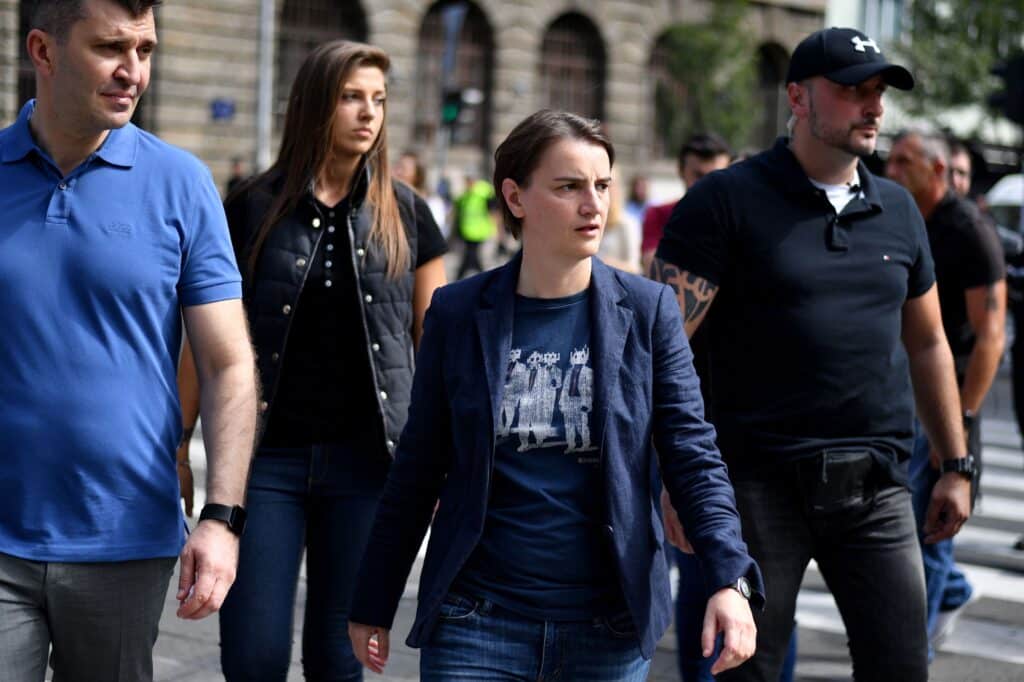
Serbia’s prime minister Ana Brnabić (2-R) at Belgrade Pride in 2017. (ANDREJ ISAKOVIC/AFP via Getty Images)
The knock-on effect of this is easy to see. Almost 60 per cent of LGBTQ+ Serbs have reported physical or emotional abuse in the course of a year, according to a 2020 report by the human rights group Center for Research and Development of Society IDEAS.
So for a high-ranking religious figure like Nikanor to call congregants for arms wasn’t exactly unexpected to some activists.
“It’s deeply disturbing to see a bishop incite armed violence against the LGBTQ+ community, however, it’s not surprising,” Nik Jovčić-Sas, a British-Serbian LGBTQ+ activist, told PinkNews.
“The Serbian Orthodox Church’s response to the queer and trans community for the past 20 years has been one of implicit and explicit violence.”
Jovčić-Sas said the first Belgrade Pride ever held in 2001 has come to be known as “Крви Прајд, ‘the bloody Pride’, for its extreme violence”.
Football hooligans joined right-wing nationalists to beat up and stone Pride-goers wishing to celebrate who they are. The violence only ended when police fired in the air to disperse the seething crowds.
The haunting scene was repeated nearly a decade later in 2010 when the second Belgrade Pride was held. Thugs tore through the march, lobbing Molotov cocktails, bricks, stones, glass bottles and firecrackers at Pride-goers and police in a protest egged on by religious leaders.
More than 100 people were arrested after the office of the ruling Democratic Party was set on fire and at least one shot was fired in clashes with the police.
“The church has always allowed itself to be the heart of the country’s most virulent anti-queer campaigns,” Jovčić-Sas added.
“However considering that he has not condemned Bishop Nikanor for his comments and allowed the church to be the rallying point for this weekend’s anti-Pride march,” Jovčić-Sas said, “I am not optimistic we will see any change from this Patriarch.”
This is what we face in future elections. No republican candidate will admit they lost even to other republicans. No republican candidate will accept reality and will use threats and intimidation to get what they want. Power before truth. But worse there is now a bunch of these maga cult members in charge of the elections going forward. They believe in the ability to simply deny the votes of the public to put their preferred candidate in office. Scary. Hugs
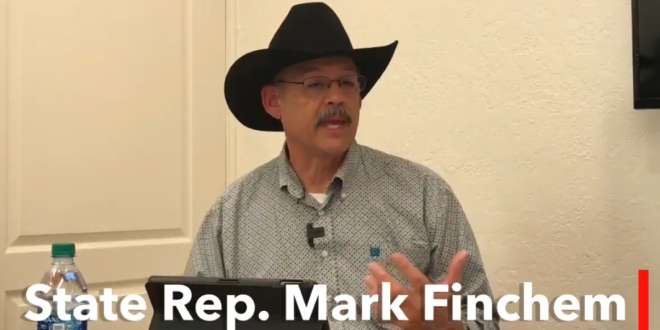
The Republican nominee for secretary of state in Arizona is a self-proclaimed member of the far-right extremist group the Oath Keepers who repeatedly shared anti-government conspiracies and posts about stockpiling ammunition on social media. CNN’s KFile team uncovered previously unreported posts from Mark Finchem, an Arizona state representative who won his party’s nomination with the endorsement of former President Donald Trump, on several social media websites linked from his since-deleted former Twitter account.
The posts included a Pinterest account with a “Treason Watch List,” and pins of photos of Barack Obama alongside imagery of a man clad in Nazi attire making a Nazi salute; Finchem also shared photos of the Holocaust claiming it could happen in the United States. On Twitter, he shared conspiracies that multiple ships docked at a Virginia naval station might be a target for a second Pearl Harbor-type attack. He said Satan ruled the United States and said gun ownership should be mandatory.
Finchem first appeared on JMG when he declared that COVID does not exist and that everybody who got the “poisonous” vaccine will be dead within two years. The January 6th committee has subpoenaed him for his role as a fake Arizona elector.
Arizona Republican secretary of state nominee kept 'Treason Watch List' and posted about stockpiling ammunition on Pinterest, @KFILE @emsteck report https://t.co/PQxsUPCuuh
We’re about to end up with large portions of the country being run by those with no interest, experience or qualifications whatsoever in actually doing the jobs they will have been elected to do. And who are mentally unhinged enough to do great damage to everything as they flail about in destructive rampages.
This is what happens when a major political party decides that being loyal to the party matters more than absolutely anything else.
It’s what happens when fascism rises. In my readings about the rise of fascism in Italy, Germany and Spain, I keep seeing these kinds of scenarios again and again. It’s all about taking power, looting the state and persecuting minorities.
Political commentators have observed this: Today’s Republican Party is rudderless. It has no “policy agenda,” no long-range goals for the future. It merely exists to serve tyrants like Donald Trump and Ron DeSantis.
Another_steve shoos away the cat and reaches clumsily for his glass of chardonnay…
Joe Walsh — a former Republican congressman who’s seen the light and is now a Biden supporter — said something on cable the other day that’s stuck with me. He seems to have good “radar” when it comes to this stuff. Has a good sense of what the Republican electorate is like today.
He estimates that something like 85% of all Republican voters believe everything that Donald Trump says. You name it. Everything. However outlandish.
These treasonous criminals — like Finchem — who have Trump’s support may very well win in November.
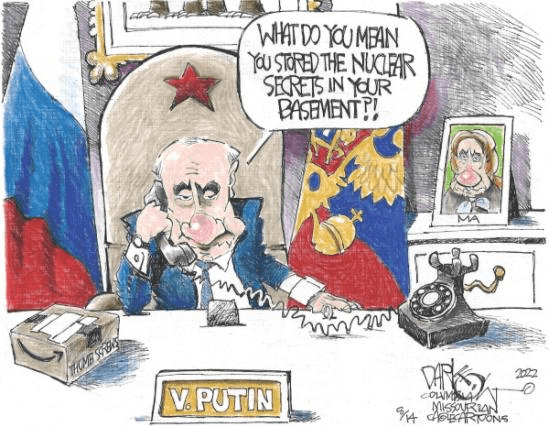
“More questions are being raised this morning. Did former President Trump try to sell or share the highly classified material to the Russians or to the Saudis or others?
“Or were the documents innocently mishandled and stored because he thought he had a legal right to have them?
“And Russia’s state media already is claiming that Russian officials have seen the material. Empty boasts or has there been a leak that officials fear could pose a grave danger to the United States security?
“How would they get this if it’s under lock and key or was it? Because the Feds apparently told them back in June that you got to put all padlock on that on the storage room.
“We don’t know where this stuff was floating around.” – Fox News host Eric Shawn.
Ask yourself the question: “Can he get any money for the documents ? Then think about what the Orange twat would do — would he care that by selling them he’d be a traitor or would he rather be that much richer ? Evil traitor or Cash in the pocket ???
Fox is cutting TFG loose, they’re going to throw their adulation towards DeathSantis, you watch he’ll start appearing on all their ‘shows’ soon and they’ll start pushing his agendas.
We are learning that the DOJ had video recordings of the storage area that caused them a lot of concern. We see that these documents are very valuable to a foreign government. Imagine the damage to nation security this information about who is a spy could cause. The fact that trump is this careless with national secrets of the highest level really shows he shouldn’t ever have been president and must never be again. Nor should any of his maga supporters in any elected office at any level. It is well known that trump is in money troubles and that he faces over 600 million dollars of loans coming due this next year. How much would any government give him for the spy information or the nation’s nuclear secrets? Hugs
In pursuing the unprecedented search of Donald Trump’s residence on Monday, the FBI was seeking to retrieve Top Secret and “compartmented” documents dealing with intelligence “sources and methods,” two federal government sources tell Newsweek—documents with the potential to reveal U.S. intelligence sources, including human sources on the American government payroll.
This greatly complicates any public discussion of the documents or any substantiation of Trump’s potential violation of U.S. law. The sources, who were briefed on the investigation, requested anonymity in order to discuss sensitive information.
I read where tRump threatened Garland, saying he was making some of tRump’s friends very angry. Literally mob-like threats. He has all kinds of knowledge that he can use to blackmail the government and keep them from prosecuting him. He is the biggest threat to our democracy in American history.
I know he’s a shit bag and a nasty individual, but this… this level of espionage shocked and saddened me. At this point I don’t know why I’m shocked, but I’m definitely sad…
What’s worse is the 30% of the country defending him… declaring that serial liar Trump has more credibility that the entirety of the US government’s national security and intelligence apparatus.
They rest easy in the comfort of that security while they cheer Trump’s attempts to tear it all down.
This will get real ugly real quick. Most Republicans backed themselves in a corner, and actually do not support treason. But their lip flapping and now the evidence is going to put them in a quandary, and just before the midterms. Which is always a good thing.
Trump possibly could’ve had foreign powers look at those documents or he could’ve transmitted those documents to foreign powers. This is the very definition of treason.
If the Democrats are smart, and they usually are not, this would be the question they would ask their constituents. Is it OK to support a candidate who commits treason? There will always be the few who do. But the majority will not.






 Scottie's Playtime