
Category: History
Peace & Justice History for 6/5
| June 5, 1851 Uncle Tom’s Cabin or, Life Among the Lowly began to appear in serial form in the Washington National Era, an abolitionist weekly. The novel by Harriet Beecher Stowe, a tear-jerking tale of the hardships of slavery, became a central reference point in the national debate over the issue.  Read more |
June 5, [since 1972] World Environment Day was established by the U.N. General Assembly to commemorate the opening of the Stockholm Conference on the Human Environment in Sweden. The United Nations Environment Program (UNEP) was established as a result of the conference. The 1972 Stockholm conference UNEP’s mission: To provide leadership and encourage partnership in caring for the environment by inspiring, informing, and enabling nations and peoples to improve their quality of life without compromising that of future generations. Each year World Environment Day adopts a different theme. |
| June 5, 1989 Just a few days before the first fission reaction was to be allowed at New Hampshire’s Seabrook Station nuclear power plant, hundreds breached the security fence, leading to 627 arrests. They carried signs reading, “In Mourning for the Late, Great State of New Hampshire,” and “Remember Chernobyl.” Led by the Clamshell Alliance, their concern was for the safety of local residents in the event of a nuclear accident, as well as environmental pollution and the unsolved problem of safe disposal of nuclear waste generated by the reactor. There were also concerns for increased electricity rates to cover the costs of the project. Repeated significant protests occurred as early as 1976 at the beginning of construction when sometimes more than a thousand would be arrested. Ron Sher, a Seabrook spokesman, termed the demonstrators “very vocal but a small minority . . . They don’t represent the millions of people in New England that recognize that nuclear energy is a viable energy option.” The plant was projected to produce up to 1.15 gigawatts, enough for one million homes. |
| June 5, 1993 Thousands marched to protest neo-Nazi violence against foreigners, particularly ethnic Turks, living in Germany. |
https://www.peacebuttons.info/E-News/peacehistoryjune.htm#june5
Peace & Justice History for 6/4

| June 4, 1939 During what became known as the “Voyage of the Damned,” the SS St. Louis, carrying more than 900 Jewish refugees from Germany to the U.S., was turned away from the Florida coast. The ship, also denied permission to dock in Cuba, eventually returned to Europe; many of the refugees later died in Nazi concentration camps.  The reality of what happened The movie based on the history |
| June 4, 1972 Angela Y. Davis, a former philosophy professor at the University of California, outspoken black leader and self-proclaimed communist, was acquitted on charges of conspiracy, murder, and kidnapping by an all-white jury in San Jose, California.  More on Angela Davis  Angela Davis wearing a peace button from peacebuttons.info, speaking at The Grays Harbor Institute, Hoquiam, Washington April, 2007  |
June 4, 1987 New Zealand passed legislation declaring itself nuclear-free. In 1986, New Zealand had banned the entry of U.S. Navy ships from their ports in the belief that they were carrying nuclear weapons or were nuclear-powered. U.S. government protests of the policy led to breakup of the ANZUS (Australia-New Zealand-United States) defense alliance.The New Zealand Nuclear Free Zone, Disarmament and Arms Control Act of 1987 (which ratified the Nuclear Non-Proliferation Treaty) prohibits the: • manufacture, acquisition, possession, control of any nuclear explosive device • aiding, abetting or procuring any person to manufacture, acquire, possess, or have control over any nuclear explosive device • transport, stockpiling, storage, installation, or deployment of any nuclear explosive device. |
| June 4, 1989 Hundreds of civilians were shot dead by China’s People’s Liberation Army during a bloody military operation in Beijing’s Tiananmen Square. Students and workers had become part of a growing pro-democracy movement, gathering there continuously for weeks. The Chinese government still officially denies any deaths occurred; thousands who were arrested “disappeared” and remain unaccounted for. “… deaths from the military assault on Tiananmen Square range from 180 to 500; thousands more have been injured . . . thousands of civilians stood their ground or swarmed around military vehicles. APCs [armored personnel carriers] were set on fire, and demonstrators besieged troops with rocks, bottles, and Molotov cocktails.”*   *From a comprehensive overview prepared by the National Security Archive based on formerly classified U.S. Government documents |
https://www.peacebuttons.info/E-News/peacehistoryjune.htm#june4
Everybody Get Together
Nationalism is wrong-headed. -A.
Genetic Study shows “Phoenicians,” like all “Nations” were a Multi-Ethnic Franchise
Juan Cole 06/01/2025
Ann Arbor (Informed Comment) – Harald Ringbauer et al. writing in Nature report on a genetic study of the ancient Phoenicians that is really going to anger Lebanese Christian nationalists. In fact, it contains a profound lesson for nationalists and nationalism in general, which is that the whole thing is a scam thought up in the last 250 years.
The 19th century racist thinker Ernest Renan saw a racial distinction between “Aryans” and “Semites.” From that point of view, the Punic wars between Rome and Carthage had a racial element, since Phoenicians were classed as “Semites.” But it turns out it was all a tiff among people we would now class as Italians.
The Phoenicians had been thought to be a unified civilization that began in what is today Lebanon. Well, they did start off in what is today Lebanon. But the “unified civilization” bit turns out to be a misconception.
The Phoenicians developed an alphabet. Like most alphabets, the letters had originally been pictograms. The Hebrew, Aramaic and Arabic, as well as the Greek and Roman alphabets (we still use the latter) derived from the Phoenician. For instance a picture of waves stood for water (ma’), and that became our M, which still looks like waves. Or a circle stood for eye (`ayn), which became our ‘o.’
Since the Phoenicians founded city-states all around the Mediterranean and left inscriptions in that alphabet, scholars had assumed that they were a related people. Phoenician settlements in the western Mediterranean were called “Punic,” but the language and customs were the same.
Regarding the Lebanese origins of this civlizational complex, Ringbauer et al. write, “We find that individuals from the Levantine Phoenician site of Akhziv in present-day Israel cluster together with previously published Bronze and Iron Age Levantine individuals, including from Megiddo in present-day Israel and the Phoenician cities of Sidon and Beirut in present-day Lebanon.” That is, they looked at ancient individuals from around the Levant and found that they all had shared haplotypes, i.e. they were Canaanites. Phoenicians, Hebrews, Nabataeans, etc. were all Canaanites culturally and genetically.
Now imagine the scientists’ astonishment when they looked at DNA from individuals who had lived in Phoenician cities such as Ibiza off Spain or Carthage in Tunisia to find that it did not display the ancient haplotypes or genetic sequences associated with Levantine peoples.
They write, “However, a mitochondrial genome from Carthage and whole-genome data from 12 individuals from the nearby rural Punic site of Kerkouane show substantial south European ancestry as well as indigenous North African ancestry. Partial North African ancestry was also found in genome-wide data from eight individuals from two Punic sites in Sardinia, combined with a broad eastern Mediterranean ancestry. Together with analysis of the whole-genome sequence of an individual from Ibiza, which was also interpreted to harbour eastern Mediterranean ancestry, this suggested that Punic people had complex ancestry.”
They observe of these “Phoenicians of the middle and western Mediterranean, “They are broadly distributed with a primary mode overlapping Bronze and Iron Age individuals from Sicily and the Aegean, regardless of sampled location.” There were only three exceptions: two persons from Sicily and one from Sardinia showed Canaanite genetic heritage.
In all the other 119 samples from “Punic” sites, the genetic heritage was mixed, showing patterns similar to those in ancient Greece and Sicily. After around 550 BC, when Carthage was founded by the “Phoenicians” in what is now Tunisia, some North African [Amazigh] genetic heritage starts to circulate among some of them. But this was a minority population. The authors observe, “Even in North Africa, 10 out of the 27 individuals from Kerkouane and 5 out of the 17 individuals from Carthage can be modelled with no indigenous North African ancestry, and 84% of individuals from these sites have more than 50% Sicilian–Aegean ancestry, making it the dominant ancestry component also in North African Punic sites.”
Also, the Iberians were mostly not Iberians. “Only two Iberian individuals, from Ibiza and Cádiz, had confidently high proportions of Bronze Age Iberian ancestry… Instead, Punic sites in the western Mediterranean share similar ancestry distributions of predominantly Sicilian–Aegean or North African origin.”
So how did all this happen? The authors hypothesize that Lebanese Phoenicians colonized Sicily, which had earlier had Greek colonies, and the Sicilians adopted Phoenician language, religion and culture. They they were the ones who struck out west, establishing Phoenician colonies in the central and western Mediterranean.
Ringbauer and his colleagues explain, “A critical question raised by our results is how and when Canaanite–Phoenician culture and language were adopted by people without any detectable Levantine ancestry. One hypothesis is that, after Levantine Phoenicians founded settlements in the central and western Mediterranean in the early first millennium bce, these communities continuously incorporated people with Sicilian–Aegean ancestry.”
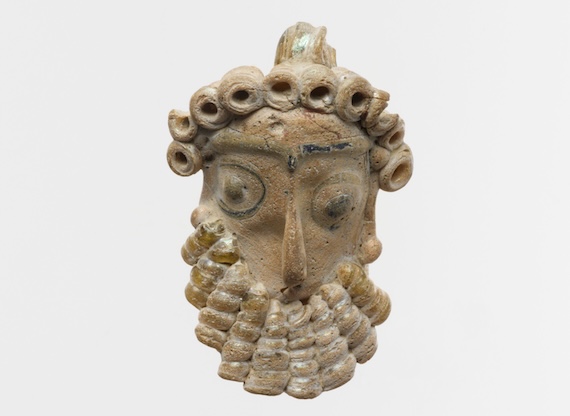
Glass head pendant, Phoenician or Carthaginian, ca. 450–300 BCE. Metropolitan Museum. Public Domain.
Reporting on the study for a Nature briefing, Ewen Callaway quotes Ringbauer as asking how it was that many Mediterranean peoples abandoned their own local cultures for that of the Phoenicians. “Does this mean Phoenician culture was like a franchise that others could adopt? That’s one for the archaeologists.”
Of course they were a franchise. So were the ancient Greeks, whose culture was adopted by so many Egyptians in places like Alexandria. As late as the 200s and 300s, there are no Arabic or Aramaic inscriptions in and around Damascus, only Greek ones. Ashkenazi Jews in Europe were also a franchise, which was joined by many gentiles — especially but not only women.
Nineteenth century European theorists of nationalism confused language groups with kinship groups, assuming that people who spoke a language were a “race,” perhaps even a “pure” one.
Today many Lebanese Christians claim to be “Phoenicians,” as though it was a pure “race” unconnected to the “Arabs.” And they take pride in Carthage, a Phoenician city, and in the Phoenician outposts of Spain, imagining they were all “Lebanese.” Ringbauer has knocked that down.
There are no nations or races of that sort. There are no “Aryans” and “Semites.” This was a linguistic distinction that was stupidly racialized. Racial “nation” was all a fevered racist fantasy. Even modern genetics only traces two lines of ancestry, the Y chromosome and the mitochondrial DNA of the X chromosome, whereas we have millions of ancestors. We’re all mongrels, all mixed up, and people in the Mediterranean basin all have a common ancestor from not so long ago. All humans have one likely only 200,000 years ago.
Peace & Justice History for 6/3

June 3, 1900 The International Ladies’ Garment Workers Union (ILGWU), a consolidation of seven smaller east coast needle trades unions, was founded. Read more  Herman Grossman, ILGWU president |
| June 3, 1946 In Irene Morgan v. Virginia, the U.S. Supreme Court ruled that racial segregation in interstate travel was unconstitutional as “an undue burden on commerce.”  The southern states refused to enforce it, however, and Jim Crow (the term for laws, local and state, that enforced segregation) continued as the way of life in the South. Eleven years before Rosa Parks refused to give up her seat on a city bus in Montgomery, Alabama, a young woman named Irene Morgan rejected that same demand on an interstate bus headed to Maryland from Gloucester, Virginia. Read more about Irene Morgan Recovering from surgery and already sitting far in the back, she defied the driver’s order to surrender her seat to a white couple. Like Parks, Morgan was arrested and jailed. But her action caught the attention of lawyers from the NAACP, led by (future Supreme Court justice) Thurgood Marshall, and two years later her case reached the Court.  Headlines when Irene Morgan won out over Jim Crow (JC) segregation law |
| June 3, 1957 Thousands of scientists, led by Barry Commoner and Nobel laureate Linus Pauling, issued a call for banning nuclear weapons testing: “As scientists we have knowledge of the dangers involved and therefore a special responsibility to make those dangers known.” “…Then on May 15, 1957, with the help of some of the scientists in Washington University, St. Louis, I wrote the Scientists’ Bomb Test Appeal, which within two weeks was signed by over two thousand American scientists and within a few months by 11,021 scientists, of forty-nine countries….” –Linus Pauling  Linus Pauling at a disarmament demonstration photo: Robert Carl Cohen Read “An Appeal by American Scientists to the Governments and People of the World.” Pauling is the only person to win two unshared Nobel Prizes, for Chemistry in 1954; for Peace in 1962. Read his acceptance speech, “Science and Peace” |
| June 3, 1964 Conscientious objection, the refusal to bear arms in time of war on the grounds of moral or religious principles, became legally recognized in Belgium. A history of European conscientious objection |
https://www.peacebuttons.info/E-News/peacehistoryjune.htm#june3
Cool Video On AP Today

Thanks to Jill at Filosofa’s Word for this fabulous rainbow graphic!!
Before the word ‘transgender’ existed, icon Bambi already danced for the stars
The moment which changed queer history occurred on a sweltering summer day in early 1950s Algeria. An effeminate teenage boy named Jean-Pierre Pruvot stood mesmerized as traffic halted and crowds swarmed around a scandalous spectacle unfolding in the conservative Algiers streets. (AP Video: Oleg Cetinic)Published 11:32 PM CDT, May 22, 2025.)
Peace & Justice History For 6/2
| June 2, 1783 At the urging of General George Washington, the United States Congress agreed to gradually disband the Revolutionary army following the end of the war. Subject only to the signing of a final peace treaty with Great Britain, all soldiers and non-commissioned officers were discharged; additionally, a full pardon was granted to privates and non-coms in confinement. |
| June 2, 1863 Abolitionist and former slave James Montgomery led 300 African-American troops of the Union Army’s 2nd South Carolina Volunteers on a raid of plantations along the Combahee River. Meanwhile, backed by three gunboats, Harriet Tubman’s forces set fire to the plantations and freed 750 slaves.  Harriet Tubman More on General Tubman |
| June 2, 1936 General Anastasio Somoza, head of the U.S. Marine-trained National Guard, forced the resignation of Nicaragua’s elected President, Juan Bautista Sacasa. This followed a seven-year U.S. occupation of the country and was followed by Somoza family control of the country for the next four decades. More about Somoza and other U.S.-friendly Central American dictators |
| June 2, 1952 The U.S. Supreme court ruled illegal President Truman’s order two months earlier for the Army to seize the nation’s steel mills in order to avert a strike during the Korean war. The decision |
Many Items in Peace & Justice History for 6/1
Also, I want to mention that I’ve been publishing here at Scottie’s Playtime since 7/10 or 11, and normally, have posted one of these each day. There hasn’t been much change or updating for a while; the newsletter and history website is Carl Bunin’s labor of love, depending upon the sales of buttons, pencils, and other merch. I’ve been reading these since 2001, and have noted it feels as if we here may have seen some of these before, and definitely will have by next month. So: should I continue after July 10th, or has everyone seen these, and enough is enough for a while? I don’t mind either way, but I don’t want to use up space and give people repeats. Just let me know in comments over the next few days, OK? And thanks for visiting Scottie’s Playtime!
June 1, 1845 Sojourner Truth (born Isabella Baumfree, but went by the name she believed God had given her as a symbolic representation of her mission in life) set out from New York City on a journey across America, preaching about the evils of slavery and promoting women’s rights. She had been a slave with several owners but was legally free when slavery was abolished in New York state. Read more about Sojourner Truth (There’s a very cool yet somewhat incendiary comment there on this page; go see it.) |
| June 1, 1921 America’s worst race massacre, begun the day before over the threat of a lynching, culminated in the complete destruction of the African-American neighborhood of Greenwood in Tulsa leaving nearly 10,000 homeless.  The ruins of Tulsa Oklahoma’s Greenwood District following the assault by the white community. Death in a Promised Land: The Tulsa Race Massacre of 1921 read more Meet The Last Surviving Witness To The Tulsa Race Riot Of 1921 |
| June 1, 1932 Gay rights organizer Henry Gerber published an article in Modern Thinker magazine attacking the view that homosexuality is a neurosis. In 1924, Henry Gerber, a postal worker in Chicago, started the Society for Human Rights, America’s first known gay rights organization.  “The Society for Human Rights is formed to promote and protect the interests of people who are abused and hindered in the legal pursuit of happiness which is guaranteed them by the Declaration of Independence, and to combat the public prejudices against them.” After having created and distributed a newsletter called “Friendship and Freedom,” Gerber was arrested and held for 3 days without a warrant or being charged with any infractions. Upon release he lost his job for “conduct unbecoming a postal worker.” Following the last of his three trials, in which the charges were ultimately dismissed, Gerber moved to new York City and re-enlisted in the U.S. Army, serving another 17 years. He lived until 1972, passing away at the the U.S. Soldiers’ and Airmen’s Home in Washington, D.C., living long enough to see the Stonewall Rebellion [see June 28, 1969], the beginning of the modern gay rights movement. More on Henry Gerber |
June 1, 1942 On the advice of Nazi propaganda minister Joseph Goebbels, German Chancellor Adolf Hitler ordered all Jews in occupied Paris to wear an identifying yellow star on the left side of their coats. The following month 13,000 French Jews were deported to the Auschwitz-Birkenau concentration camps.  |
| June 1, 1950 Senator Margaret Chase Smith (R-Maine), then the only woman in the Senate, and just the second in U.S. history, denounced Senator Joseph McCarthy (R-Wisconsin) and his “red-baiting” tactics on the floor of the U.S. Senate, in a speech called “A Declaration of Conscience.”  “Those of us who shout the loudest about Americanism in making character assassinations are all too frequently those who, by our own words and acts, ignore some of the basic principles of Americanism—the right to criticize; the right to hold unpopular beliefs; the right to protest; the right of independent thought.” Text of the Senator Smith’s Declaration |
| June 1, 1963 The U.S. Supreme Court ruled that recitation of the Lord’s Prayer and readings from the Bible in public schools violated the establishment clause of the first amendment to the U.S. Constitution in School Dist. Of Abington Township v. Schempp. The Court reasoned that the daily practice was unconstitutional because a public institution was conducting a religious exercise and “that public funds, though small in amount, are being used to promote” a particular religion. “It is not the amount of public funds expended; as this case illustrates, it is the use to which public funds are put . . . .” The decision |
| June 1, 1967 The Vietnam Veterans Against War (VVAW) was founded in New York City after six Vietnam vets marched together in a peace demonstration. The group was organized to give voice to the growing opposition to the escalating war in Indochina among returning servicemen and women.  VVAW, through open discussion of soldiers’ first-hand experiences, revealed the truth about the nature of U.S. involvement in Southeast Asia.  VVAW demonstrating against Iraq war 2004 The VVAW today |
https://www.peacebuttons.info/E-News/peacehistoryjune.htm#june1
Responding to Charlie Kirk on homosexuality & the Bible
OK I admit this guy is a scholar so he uses words and phrases that are sometimes hard for me to follow with my limited education. But I do understand enough to follow what he is saying. Charley Kirk is full of shit on what he thinks they bible says because he is letting his own bigotry and prejudices create what the passages mean for him rather than research it with people more knowledgeable. Jesus and the bible were not against homosexuality as we understand it because they did not see sexuality and sex acts the same way we do. The sin of Sodom was lack of hospitality and men wanting to take a higher sexual role than angels. The people of the time of the bible were like young macho men types today, worried about what looked manly enough, and putting your penis in someone regardless of sex was manly. But the person who took another person in them was not, they were lessor. Women were viewed as lessor, inferior, and so were men that took another male’s penis inside them. It was not about pleasure or love, it was all about status. One thing I like about this guy is he freely admits the bible is context driven and doesn’t know what we know and understand today, that in some areas the morals we have today are superior to that of the bibles for example slavery. Hugs.
Brown v. BOE, and more, in Peace & Justice History for 5/31
| May 31, 1955 The U.S. Supreme Court ordered (in a unanimous decision known as Brown II after the 1954 decision Brown v. Board of Education) that school integration be implemented “with all deliberate speed,” ordering the lower federal courts to require the desegregation of public schools. Between 1955 and 1960, federal judges held more than 200 school desegregation hearings. The decision reiterated “the fundamental principle that racial discrimination in public education is unconstitutional . . . . All provisions of federal, state or local law requiring or permitting such discrimination must yield to this principle.”  A timeline of school integration |
May 31, 1957 U.S. playwright Arthur Miller was convicted of contempt of Congress for refusing to reveal the names of associates who were alleged to be Communists. The conviction was ultimately set aside on appeal. More about Arthur Miller |
| May 31, 1966 Nguyen Thi Can, a 17-year-old Buddhist girl, committed suicide by setting herself afire (self-immolation) on a street in the city of Hue, Vietnam. She was protesting against the South Vietnamese regime and the war being waged by the U.S., the separate armies of the north and south, and the insurgent Viet Cong; it was the fifth such death in three days.  |
| May 31, 1973 A bipartisan majority (69-19) of the U.S. Senate voted to cut off funds for the bombing of Cambodia (Vietnam’s neighbor) despite pleas from U.S. President Richard Nixon’s Secretary of State, Henry Kissinger. |
https://www.peacebuttons.info/E-News/peacehistorymay.htm#may31
 Scottie's Playtime