March 26, 1966 Over 50,000 marched peacefully in the Fifth Avenue Vietnam Peace Parade in New York City. They were part of the second International Days of Protest with marches in several cities in North America. Fifth Avenue anti-Vietnam War demonstration photo: Robert Parent Early efforts opposing the war in Vietnam
March 26, 1979 In a ceremony at the White House, Egyptian President Anwar el-Sadat and Israeli Prime Minister Menachem Begin signed a peace agreement they had worked out with the assistance of President Jimmy Carter at Camp David, the U.S. president’s rural retreat. The agreement ended three decades of hostilities between Egypt and Israel, establishing diplomatic and commercial ties. The two countries have remained at peace for 40 years. Less than two years earlier, in an unprecedented move for an Arab leader, Sadat had traveled to Jerusalem to seek a permanent peace settlement with Egypt’s Jewish neighbor. Coverage by the BBC
March 26, 1986 The Oklahoma Supreme Court (Post v. State of Oklahoma) upheld a ruling that an Oklahoma anti-sodomy law could not be constitutionally applied to private, consensual activity.
March 26, 2003 Over one million students in Spain went on strike in opposition to their government’s support of the U.S./U.K. invasion of Iraq. The demonstration in Barcelona
March 25, 1965 Their numbers having swelled to 25,000, the Selma-to-Montgomery marchers arrived at the Alabama state capitol. “Yes, we are on the move and no wave of racism can stop us. (Yes, sir) We are on the move now. The burning of our churches will not deter us. (Yes, sir) The bombing of our homes will not dissuade us. (Yes, sir) We are on the move now. (Yes, sir) The beating and killing of our clergymen and young people will not divert us. We are on the move now.” Read all of Rev. King’s speech Martin Luther King Jr. and wife Coretta lead march into Montgomery, Alabama.
March 25, 1965 Viola Gregg Liuzzo, a housewife and mother from Detroit, driving marchers back to Selma from Montgomery, was shot and killed by Klansmen in a passing car. She had driven down to Alabama to join the march after seeing on television the Bloody Sunday attacks at Selma’s Edmund Pettus Bridge earlier in the month. It was later learned that riding with the Klansmen was an FBI informant. read more about Viola Liuzzo Anthony & Viola Liuzzo
March 25, 1969 The newly wed John Lennon and Yoko Ono-Lennon began their seven-day “bed-in for peace” against the Vietnam War at the Amsterdam Hilton in New York City. read more about their bed-ins for peace bed-in photo album “Yoko and I are quite willing to be the world’s clowns, if by so doing it will do some good.”
Sam and Emma in the fun half. Normally there is only two ways to watch the fun half. You can be a member which they admit that some people can not afford which they have a way to get free membership if you need it. Or you can catch the first half while it is playing live and in the description box will be a link to the free fun half. If you click on that you can watch the entire thing. If you save it like I do for later you can go back and watch it at any time because if you don’t the link will disappear so you can’t see it. They make the second half private. Hugs
Watch the Majority Report live Monday–Friday at 12 p.m. EST on YouTube OR listen via daily podcast at http://www.Majority.FM …OR become a member at JoinTheMajorityReport.com: https://fans.fm/majority/join
March 24, 1616 William Leddra was executed by the Charter government of Massachusetts for being a Quaker. He was the fourth and last of his religion to be hanged with the approval of Governor John Endicott. Though the court did not find him “evil,” he had sympathized with the Quakers who were executed before him; he had refused to remove his hat, and he used the words “thee” and “thou,” which, to Quakers, implied the equality of all people. (Check out the way the link works for this. Much better than the terrible transcription I read the other day.-Newsletter author) Contemporaneous letter describing Leddra’s and other Quakers’ persecution (starts p.58) =========================================== March 24, 1918 Native-born Canadian women over 21 (except native, or First Nations, women) won the right to vote in federal elections, but not to run for office for yet another year. Suffrage was not granted to women in Quebec provincial elections until 1940. Read about Thérèse Casgrain =========================================== March 24, 1964 In a sit-down against nuclear weapons at Parliament Square in London, England, 1,172 were arrested. ============================================ March 24, 1965 The first Teach-In on the Vietnam War was held at the University of Michigan a month after President Lyndon Johnson ordered bombing of North Vietnam. The U-M teach-in was among the first of a new form of campus protest that was to spread nationwide, as a means of mobilizing students to examine policies of their government that they previously had taken for granted. About the 1st Teach-In view original leaflets Very few Americans had ever heard of the country in southeast Asia, and the event was intended to educate the participants in the history of Vietnam and foreign aggression there. Young protester in Chicago march, photo Jo Freeman ============================================= March 24, 1967 Reverend Martin Luther King, Jr. led an anti-war march for the first time in Chicago, opposing the Vietnam War by saying: “Our arrogance can be our doom. It can bring the curtains down on our national drama . . . Ultimately, a great nation is a compassionate nation The bombs in Vietnam explode at home—they destroy the dream and possibility for a decent America . . . .” Reverend King addresses rally at the end of the Chicago march, photo: Jo Freeman ============================================== March 24, 1980 The Coalition of Labor Union Women (CLUW) was founded, electing as their first president Olga Madar, a vice president of the United Auto Workers. The convention adopted four goals: organize the unorganized; promote affirmative action; increase women’s participation in their unions; and increase women’s participation in political and legislative activities. CLUW history CLUW today ============================================= March 24, 1980 The archbishop of San Salvador, Óscar Arnulfo Romero y Galdámez was assassinated while consecrating the Eucharist during mass. Monseñor Romero had become a well-known critic of violence and injustice and, as such, was perceived in the right-wing civilian and military circles of El Salvador as an enemy, and criticized by the Roman Catholic church. Romero had exhorted the police and soldiers to disobey orders to kill innocent people, refusing to be silenced. Worshippers had interrupted, with ovations, his homilies condemning the terrorism of the state. The ongoing legacy of Monsignor Romero (The Fransiscans have scrubbed him away. Here’s another place to read about him) ============================================== March 24, 1989 The most environmentally damaging oil spill to date began when the supertanker Exxon Valdez, owned and operated by the Exxon Corporation, ran aground on Bligh Reef in southern Alaska’s Prince William Sound. An estimated 11 million gallons of oil (257,000 barrels or 38,800 metric tons) eventually leaked into the water.Attempts to contain the massive spill were unsuccessful, and wind and currents spread the oil nearly 500 miles from its source, eventually polluting more than 1300 miles of coastline. Hundreds of thousands of birds and thousands of sea mammals were lost in the disaster. A dead murrelet, one of the hardest-hit sea birds in the Valdez spill. 25 years after the Exxon Valdez Oil Spill, read more
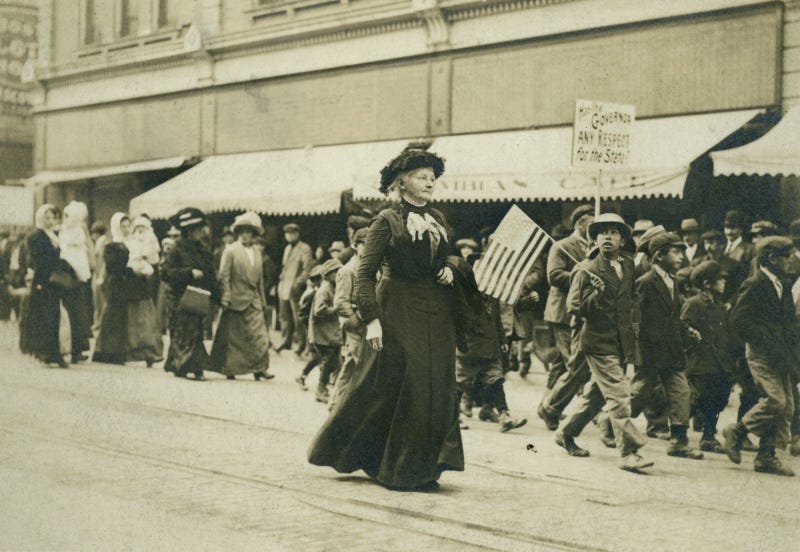
Mother Jones, c. 1910, marching in Trinidad, Colo. Photo courtesy of The Newberry Library, Chicago. Call # MMS Kerr Archives.
On March 22, 1914, Mary “Mother” Jones was arrested on a train in southern Colorado for her work in fighting for the coal miners on strike that area. This was her second arrest in this conflict, as she had previously been detained by the state militia in Trinidad and then sent to Denver. Upon release in Denver, she immediately went back to the coal fields, daring the mine owners and their bought police forces to arrest her again. Her work here was typical of the sacrifices this iconic organizer made in the second half of her life as she fought for the miners so badly exploited in late nineteenth and early twentieth century America.
Mother Jones is one of the most fascinating characters in American history. An Irish housewife who had little connection to political activism for much of her adult life, she emerged in middle age as a fiery agitator after her husband and all four of her children died of yellow fever in Memphis and her dress shop burned in the Chicago fire of 1871. She quickly became the voice of the mineworkers, especially in the coal country of Pennsylvania and West Virginia. She bridged generations of activism, being extremely close friends with Terence Powderly while also hailing the rise of the United Mine Workers and radical activists that Powderly could barely understand at his peak in the 1880s. She said she was much older than she actually was, which had both rhetorical powers and helped cement her in our historical memory, as she claimed to be 100 years old the year she died when in fact she was probably 93.
By 1897, she was known as Mother Jones, wearing out of style Victorian black dresses and using the mantle of motherhood as central to her organizing prowess. Calling her “mother” both established her as a maternal figure among the miners but also centered her emphasis on childhood and motherhood in organizing. For instance, she opposed women’s suffrage and ultimately believed that women should be taking care of their children rather than getting involved in politics. Her own life story made this stance not hypocritical. She also used children in her organizing, including the 1903 Children’s Crusade, a march of miners’ children from Pennsylvania to Theodore Roosevelt’s home in Oyster Bay, New York, where the children carried signs reading, “We want to go to School and not the mines.” Roosevelt refused to meet with them. She worked for the UMWA but attended the founding convention of the Industrial Workers of the World in 1905 and worked as an organizer for the Socialist Party in the late 1900s, returning to the UMWA as a paid organizer in 1911.
Though all of these actions, Mother Jones became known as “the most dangerous woman in America,” a title given to her by a district attorney in West Virginia named Reese Blizzard. During a 1902 trial where she was charged with ignoring injunctions against miners holding union meetings (First Amendment in the coal fields indeed!), Blizzard pointed at her, saying, “There sits the most dangerous woman in America. She comes into a state where peace and prosperity reign … crooks her finger [and] twenty thousand contented men lay down their tools and walk out.” That wasn’t true and served the interests of the owners to say that their employees were actually good people but stupid and easily led astray by outside agitators, instead of admitting their employees had a bloody good reason to go on strike. Anyway, the nickname stuck and this attitude from employers was something Jones reveled in.
In the fall of 1913, Mother Jones traveled to Colorado to participate in mineworkers’ organizing in the coal fields in the southern part of that state. Conditions in the coal fields were all too typical of the time: complete industry control over a workforce that was polyglot and desperate. Working conditions were horribly dangerous. Between 1884 and 1912, 1,708 workers died in Colorado coal mines (over 42,000 nationwide). Companies controlled not only the mines but housing, stores, and education. Union organizing was met with brutality and murder. Effectively, the coal companies controlled workers’ lives in Colorado as they did in West Virginia and Pennsylvania. These were Mother Jones’s people.
The companies did not welcome Jones’s presence. She was thrown off company property several times. She was arrested twice. After the first arrest, she was placed in a comfortable hospital for a month. After all, she was an elderly woman and a bit harder to crack the whip on than the miners themselves. But on March 22, 1914, she was arrested again. This time, the companies were less kind. They threw her into the Huerfano County jail in Walsenburg. This was no nice hospital. She spent 23 days in the jail.
The United Mine Workers tried to capitalize on Jones’s arrest. They issued a pamphlet describing (and perhaps exaggerating a bit) the conditions this old woman had to suffer through as she lived her faith of defending the miners. The pamphlet discussed the filth, the rats in the cell, the snow pouring in a broken window, a guard jabbing her with a bayonet. On the other hand, the mine owners and their friends accused Mother Jones of having been a prostitute in a Denver brothel in 1904 and said her support for Coxey’s Army had consisted of procuring women for sex. On both sides, Mother Jones elicited strong opinions.
After her second release, Mother Jones went to Washington DC to testify on the conditions in the coal country. A few days later, the Colorado coal wars would see their most violent incident, with the Ludlow Massacre. Between Ludlow and the aftermath when enraged miners went on a rampage against anyone associated with the coal companies, up to 200 people died in this strike, possibly the most deadly in American history. John D. Rockefeller Jr. agreed to meet with her about the conditions of the miners as part of his public relations effort when he was savagely attacked for his role at Ludlow.
Mary Jones died in 1930. Earlier that year, on the day she supposedly turned 100, Mother Jones was filmed with sound about workers’ rights.
FURTHER READING:
Elliott Gorn’s The Most Dangerous Woman in America.
Thomas Andrews, Killing for Coal: America’s Deadliest Labor War.
March 23, 1918 The trial of 101 Wobblies (members of the Industrial Workers of the World or IWW) began in Chicago, for opposition to World War I. In September 1917, 165 IWW members were arrested for conspiring to hinder the draft, encourage desertion, and intimidate others in connection with labor disputes. The trial lasted five months, the longest criminal trial in American history at the time.The jury found them all guilty. The judge sentenced IWW leader “Big Bill” Haywood and 14 others to 20 years in prison; 33 were given 10 years, the rest shorter sentences. They were fined a total of $2,500,000 and the IWW was shattered as a result. Haywood jumped bail and fled to the Soviet Union, where he remained until his death 10 years later. “Big Bill” Haywood Read more
March 23, 1942 The U.S. government began moving all those of Japanese ancestry, including some native-born U.S. citizens (known as nisei), from their west coast homes to indefinite imprisonment in detention centers, beginning with Manzanar in California which eventually held more than 10,000 Americans. Located on 60,000 acres west of Los Angeles, it is now a national historic site; only 3 of the original 800 buildings remain. Gallery of photos and other materials about Manzanar
March 23, 1961 Army Major Lawrence Robert Bailey was the first recorded American to be held as a prisoner of war in Southeast Asia. One of eight crew members of a C-47 surveillance aircraft shot down over Laos, Bailey was held by the Pathet Lao for 17 months, losing one-third of his body weight (down to 53 kg, or 117 lbs) during that time. The other occupants of the plane are presumed to have died in the crash; Bailey always wore a parachute.
March 23, 1984 USS Queenfish nuclear submarine student die-in outside the U.S. Consulate. One thousand boats, known informally as the Auckland Harbour Peace Squadron, demonstrated against arrival of the nuclear submarine, U.S.S. Queenfish in New Zealand.
March 22, 1933 The Nazi German concentration camp at Dachau was opened, the first of many such camps built for the incarceration and extermination of those considered unfit: Jews, Polish Catholics, Communists, the Roma (frequently referred to as Gypsies), the “work-shy,” homosexuals, the “hereditary asocial,” and those with mental and/or physical handicaps. The gate to Dachau “Work will make you free” Over 200,000 prisoners were registered at Dachau, nearly all of whom died there. The early days of Dachau
March 22, 1956 Civil rights leader Reverend Martin Luther King, Jr., was convicted of organizing an allegedly illegal boycott by black passengers of buses in Montgomery, Alabama. He was fined $500 but when his lawyers indicated his intent to appeal, the sentence was changed to 386 days of imprisonment. Story of the Montgomery Bus Boycott
March 22, 1965 3,200 civil rights demonstrators, led by the Reverend Martin Luther King, Jr., and under protection of a federalized National Guard, began a third attempt at a week-long march from Selma, Alabama, to the state capitol at Montgomery in support of voting rights for black Americans. Marchers on their way to Montgomery A week before, the march had been violently stopped before leaving Selma. People from all over the country arrived to support the effort for enfranchisement of African Americans in the South whose right to vote had been systematically denied. From Selma to Montgomery: An Introduction to the 1965 Marches – Lesson Plan
March 22, 1974 The Equal Rights Amendment to the U.S. Constitution (ERA) was passed by both houses of Congress with two-thirds majorities. The amendment, to give women full equality under law, was ratified by the legislatures of only 35 states, short of the required three-quarters of the 50 states, and thus never became law. Detailed history of the Equal Rights Amendment
March 22, 1980 30,000 marched in Washington, DC against re-introduction of draft registration. Denise Levertov’s lines from her poem, “A Speech for Antidraft Rally, D.C., March 22, 1980″”…Let our different dream, and more than dream, our acts of constructive refusal generate struggle. And love. We must dare to win not wars, but a future in which to live.” The entire poem(pdf)
March 21, 1937 On Palm Sunday (the Sunday before Easter), the Nationalist Party of Puerto Rico was to march in Ponce (city on the southern coast of the island) in support of Puerto Rican independence. They were also protesting the imprisonment of Albizu Campos, leader of the Party and the lawyer for the sugarcane workers who had led a general strike.The colonial military governor, Blanton Winship (a Georgian who had been Judge Advocate General of the U.S. Army), revoked the parade permit at the last minute. Nationalists insisted on marching regardless and, surrounded by the well armed police, were fired upon as they began. Whoever fired the first shot, 18 Nationalists and 2 policemen died. 200 others, Nationalists and bystanders, were injured, 150 arrested. This incident is known as Masacre de Ponce, or “The Ponce Massacre.” Families of those who died in the Ponce Massacre A history of Puerto Rico The Ponce massacre remembered
March 21, 1960 South African police opened fire on unarmed demonstrators in the black township of Sharpeville near Johannesburg. The demonstrators were protesting the establishment of apartheid pass laws which restricted movement of non-whites. In Sharpeville itself, 69 were killed and 176 wounded when police fired on the crowd, 63 of them shot in the back. In the aftermath of the Sharpeville massacre, protests broke out in Cape Town and elsewhere, and there were further casualties. Overall, 13,000 were jailed. The organizer, Robert Mangaliso Sobukwe, head of the Pan-Africanist Congress, had written to the police commissioner, notifying him of the plans, and had said at a press conference, “I have appealed to the African people to make sure that this campaign is conducted in a spirit of absolute nonviolence, and I am quite certain they will heed my call.” The Sharpeville Massacre and its significance in South African history
March 21, 2003 The report of the Truth and Reconciliation Commission of South Africa was released. The commission was led by the Reverend Desmond Tutu, a bishop in the Anglican Church, the first black General Secretary of the South African Council of Churches, and Nobel Peace Prize winner for his efforts to bring peace and justice to all South Africans. .Archbishop Desmond Mpilo Tutu The Commission was charged with investigating and providing “as complete a picture as possible of the nature, causes and extent of gross violations of human rights” under the racial separatist apartheid regime from 1960 until the inauguration of Nelson Mandela in 1994, South Africa’s first black president. But the Commission sought to go beyond truth-finding to promote national unity and reconciliation, to facilitate the granting of amnesty to those who made full factual disclosure, to restore the human and civil dignity of victims by providing them an opportunity to tell their own stories, and to make recommendations to the president on measures to prevent future human rights violations. Reverand Tutu concluded in his foreword to the report, “Quite improbably, we as South Africans have become a beacon of hope to others locked in deadly conflict that peace, that a just resolution, is possible. If it could happen in South Africa, then it can certainly happen anywhere else. Such is the exquisite divine sense of humour.” The complete report of the Commission
March 21, 2008 More than 300 people participated in an annual Good Friday peace action at the Lawrence Livermore National Laboratory, organized by Tri-Valley Communities Against a Radioactive Environment (CARES). The lab is a key participant in the design of all weapons in the U.S. nuclear arsenal. The Alameda County Sheriff arrested 91 of the protesters. CARES Executive Director Marylia Kelley said, “The emphasis is on nonviolence and rejecting violence.” The organization behind the action
March 21, 2011 An estimated 14 million Egyptians voted in an essentially problem-free election. 77% voted to endorse a process that would bring elections for parliament within six months and a presidential election later.




 Scottie's Playtime