
Category: History
Sure, We’ll Do That …
I don’t know if it’s a scam, phish, spam, or real. I wonder if anyone else got one of these, though, so let me know, and please don’t click anything within it. Meanwhile, I got a macabre giggle out of this email I received this morning from noreply@studentaid.gov ; Help your child submit their FAFSA form today. (You know how I love my giggles.)
Yeah, after all the news for over a week about access to such sites by unauthorized, unsworn, unelected, non-government employees actually younger than our “child,” who needs no help with such things nor even needs such things, we’re gonna log right on and put all that info in there! (Yes, we did it way back when he did need it done.)
The graphic won’t show here, but the body is very like my recollection of things from FAFSA.
I don’t know if anyone here has or knows someone who will need to fill out these forms with their kids for college in Fall. I simply hope we all remember to not click through from anything in an email, but to go directly to the site to do our work, OK? Thanks!
Peace & Justice History for 2/10

February 10, 1961 Pirate radio ship The Voice of Nuclear Disarmament, a pirate radio station, began operation offshore of Great Britain. It was run by John Hasted, a physicist, a musician, and a radio expert in World War II. He was active with mathematician and philosopher Bertrand Russell in the Committee for Nuclear Disarmament, a group that practiced Gandhian an nonviolent civil disobedience. |
February 10, 1964 Bob Dylan’s ”The Times They Are A-Changin’” was released. The album’s title song captured the emerging, principally generational gap in American culture concerning war and racism. Come mothers and fathers Throughout the land And don’t criticize What you can’t understand Your sons and your daughters Are beyond your command Your old road is Rapidly agin’ watch video (1964) the lyrics |
| February 10, 2003 Iraq acceded to U-2 surveillance flights over its territory, meeting a key demand by U.N. inspectors searching for banned weapons of mass destruction (WMD) there.The 60 weapons inspectors in Baghdad and Mosul were under the U.N. Monitoring, Verification and Inspection Commission (UNMOVIC), led by Hans Blix, and the International Atomic Energy Agency under Mohamed El Baradei. The U.N. had destroyed all of Iraq’s banned weapons by 1994, as well as production and development facilities later, though Saddam Hussein expelled the U.N. representatives in 1998.  U-2 spy plane.  Hans Blix gives his report at the UN as Mohamed El Baradei listens. The economic and trade embargo during the inter-war period prevented resumption of the weapons programs. CIA and other intelligence estimates, however, insisted upon the existence of WMDs in Iraq. None have ever been found. |
https://www.peacebuttons.info/E-News/peacehistoryfebruary.htm#february10
Two More Poems I Ran Across Yesterday,
posted in observance of Black History Month. The titles link to the pages with more info about the poet and their works.
Angelina Weld Grimké 1880 – 1958
We ask for peace. We, at the bound
O life, are weary of the round
In search of Truth. We know the quest
Is not for us, the vision blest
Is meant for other eyes. Uncrowned,
We go, with heads bowed to the ground,
And old hands, gnarled and hard and browned.
Let us forget the past unrest,—
We ask for peace.
Our strainéd ears are deaf,—no sound
May reach them more; no sight may wound
Our worn-out eyes. We gave our best,
And, while we totter down the West,
Unto that last, that open mound,—
We ask for peace.
This poem is in the public domain. Published in Poem-a-Day on February 8, 2025, by the Academy of American Poets.
=============================
I do not care for sleep, I’ll wait awhile
For Love to come out of the darkness, wait
For laughter, gifted with the frequent fate
Of dusk-lit hope, to touch me with the smile
Of moon and star and joy of that last mile
Before I reach the sea. The ships are late
And mayhap laden with the precious freight
Dawn brings from Life’s eternal summer isle.
And should I find the sweeter fruits of dream—
The oranges of love and mating song—
I’ll laugh so true the morn will gayly seem
Endless and ships full laden with a throng
Of beauty, dreams and loves will come to me
Out of the surge of yonder silver sea.
This poem is in the public domain. Published in Poem-a-Day on February 9, 2025, by the Academy of American Poets.
Here’s An Important Resource!
Mid Century Women’s Publications Did Important Medical Work
It reminds me of how “Cosmopolitan” was one of the early ‘mainstream’ magazines honestly discussing the AIDS virus, where to find care, and knowledge to avoid contracting it. They knew and reported early on that any- and everyone can catch what we now know as HIV. This piece is about early cancer info dissemination.
How Midcentury Women’s Magazines Fought Cancer
At a time when people wouldn’t even say the word, journalists at Good Housekeeping, Redbook, and other women’s magazines were informing readers how to recognize, protect against, and talk about cancer.
Maxine Davis wrote about plenty of tough topics during her long career in journalism, but none of them frightened her as much as the assignment she received in the spring of 1940. Her editors at Good Housekeeping wanted her to cover cancer, a disease so cloaked in stigma that Davis, like many other Americans, was afraid to say its name out loud.
The sweeping series of articles she produced that year changed her thinking. “My research has dispelled that terror,” she wrote in an article that appeared in Good Housekeeping’s April 1940 issue, declaring that cancer could be cured especially if it was caught early through education and hypervigilance. Cancer, she explained, was “sneaking, insidious. Only you and you alone can guard yourself against it.”
At the time Davis wrote these words, cancer was a taboo topic. The term itself wouldn’t be spoken on the radio until 1945. Rumors about its causes were rampant. (Many Americans at the time believed it to be contagious or a sign of poor character.) Physicians routinely withheld cancer diagnoses from patients to spare them shame. Although it wasn’t always a death sentence, the treatments we rely on today were nascent or nonexistent. And yet, the editors at Good Housekeeping still decided to devote pages and pages to in-depth coverage of the disease.
This is one example of how, during the 1940s and 1950s, women’s magazines played a vital and largely forgotten role in educating average Americans about burgeoning efforts to prevent and treat cancer. It was a pivotal era for modern medicine thanks to scientific advancements and increased attention to public health. Cancer was among the leading causes of death, and rates were increasing in part because people were living longer. Print media in all its forms played a major role in normalizing public conversations about cancer, but women’s magazines took a unique approach. They made disease prevention personal, calling upon women to become cancer watchdogs for themselves and their families.
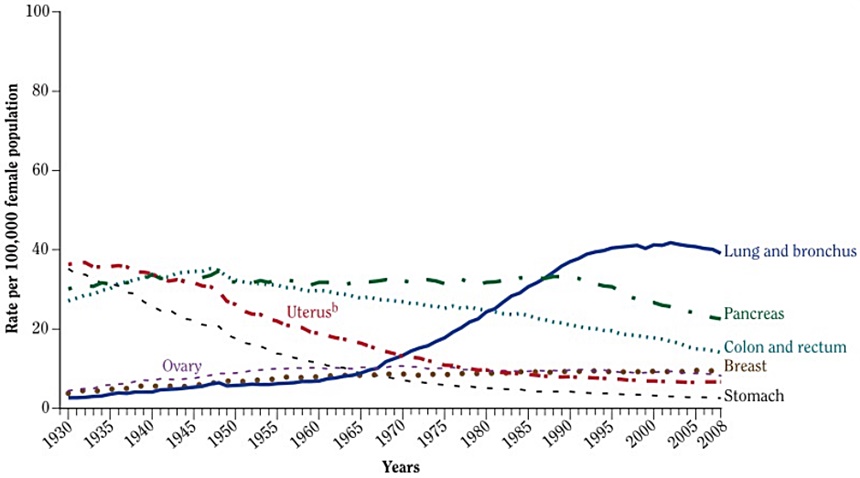
Davis was among the best-known of the women’s magazine journalists covering cancer. By the early 1940s, she had reported on the League of Nations, driven all over the United States to research a book about American youth, and founded a wire service aimed at explaining politics to women. Her cancer stories for Good Housekeeping launched her to a new level of prominence, one akin to modern day health influencers. Her editors promoted her work heavily, framing her as a lay expert with carefully cultivated sources. “Doctors like to work with her,” they wrote in an introduction to her spring 1940 cancer series, “and they give her all the help they can.”
Writing in May of 1940, Davis introduced readers to the basics of cancer treatment, explaining in plain language how surgery, X-rays, and radium were being used to help patients.
Sometimes X-ray, radium, and surgery are all used to treat a malignant condition. Take the case of Ada Johnson. Ada put off going to hospital longer than she should have after she felt a lump in her breast; but the doctor didn’t think the situation was hopeless. This is what he did:
First, there was a surgical operation. When that had been successfully accomplished, the specialist in cancer of the breast applied radium to the chest wall. That wasn’t all. The doctor then used deep X-ray therapy on Ada’s breast and armpit….This was repeated for thirty-five treatments. Ada is perfectly well today.
Davis was not, however, the only women’s magazine reporter working the cancer beat at midcentury. Seventeen magazine’s beauty editor Jean Campbell urged her young readers to get involved in efforts to bring specialized cancer to more communities. “Demand them,” she wrote in the April 1948 issue, “and raise funds for them.” That same year Miriam Zeller Gross deftly described the history of stomach cancer treatment in a gripping feature story that appeared in Better Homes and Gardens. In the early 1950s, Redbook’s Collie Small encouraged women to overcome “false modesty” and allow physicians to screen them for breast cancer. Women’s magazines were publishing hundreds of articles on cancer by dozens of writers. Women also wrote about cancer for general magazines including The Saturday Evening Post, which featured a handful of stories in the 1950s by female cancer survivors.
Stories about cancer were far less common before World War II, but they did sometimes appear in women’s magazines. Ladies Home Journal has been credited by medical historians with publishing the very first general interest article about cancer detection in 1913. Others, including Good Housekeeping, featured occasional educational columns by physicians during the 1920s.

In addition to becoming quick experts on complex medical topics, these journalists managed often-fraught relationships with health professionals who tended to distrust journalists. It became common practice during this time for physicians to review stories before they were published. Sometimes, one of those physicians would write a sidebar: In 1955, American Cancer Society vice president Dr. Charles S. Cameron had reviewed a draft of an April 1955 article on cervical cancer by health journalist Gladys Denny Shultz for Ladies Home Journal, and wrote a public note of thanks, proclaiming that the magazine was “offering its readers a great service by publishing this excellent article. It should be a means of saving thousands of lives.”
While most of the bylines atop women’s magazine stories about cancer belonged to female journalists, editors did occasionally invite physicians, almost always men, to contribute. Cosmopolitan published a 14-page essay by Walter Alvarez, who had just retired from clinical practice to pursue a second career in medical writing. The piece, which appeared in January of 1953, sprawled across 14 pages under the headline “Danger Signals in Your Life” and includes tips to spot illnesses like cancer in children, teens, and adults. Alvarez assured readers he wasn’t out to scare them. Instead, he hoped to save “wise persons from avoidable illness or death.”
Much of this coverage was driven by coordinated public relations campaigns initiated by the American Cancer Society and similar organizations. In addition to connecting journalists with expert sources and organizing junkets to prominent research centers, such campaigns included advertising blitzes promoting new treatments, championing medical breakthroughs, and reminding Americans of the importance of cancer screenings. Women’s magazines were a popular venue for such ads, so it wasn’t uncommon for some issues to feature a reference to cancer on nearly every page.
While groundbreaking, the cancer coverage provided by midcentury women’s magazines was imperfect. Race and class were seldom addressed because these publications — like much of the news media — assumed their audience was white and financially stable. Some coverage also illustrates the era’s rudimentary and fast-evolving scientific knowledge. One example is a story that appeared in Parents magazine in 1943. Written by journalist Constance J. Foster and prominently endorsed by the New York City Cancer Committee, the article proclaimed that “cancer is not hereditary.” A piece that appeared in Redbook a decade later explained new research showing that some forms of cancer do run in families.
The role of women’s magazines in the fight against cancer is a fascinating chapter in media history, one laced with a type of gender politics that feels familiar today. The cancer beat gave women journalists like Davis access to male-dominated sectors like medicine, public policy, and journalism, but it also kept them firmly tethered to domestic matters and subservient to male physicians. Their work, while educational, put undue pressure on individual women to spot the signs of cancer. But it also brought hope to families facing a terrifying diagnosis. As Davis wrote in the October 1948 issue of Good Housekeeping, “Cancer is not necessarily fatal. Cures do exist.”
Northeastern University student Elsa O’Donnell contributed archival research for this article.
Peace & Justice History for 2/9

| February 9, 1780 Captain Paul Cuffe, his brother John, two free negroes, and other residents of Massachusetts petitioned the state legislature for the right to vote. A few years earlier, Cuffe and his brother had refused to pay local taxes, reasoning that there was a connection between an obligation to pay taxes to a government and the right to vote for that government.  Captain Paul Cuffe Cuffe’s memoir available Cuffe’s career as ship captain, shipowner, African colonizer and generous citizen |
| February 9, 1950 United States Senator Joseph P. McCarthy (R-Wisconsin) accused more than 200 staff members in the State Department of being Communists, launching his anti-red crusade. He made the allegation in a public speech in Wheeling, West Virginia, saying that state was infested with communists, and brandished a sheet of paper which he said contained the alleged traitors’ names.  “I have here in my hand,” he said, “the names of 205 men that were known to the Secretary of State [Dean Acheson] as being members of the Communist party and who nevertheless are still working and shaping the policy of the State Department.” The number changed repeatedly over the following months. Some years later, he confided the paper was actually just a laundry list. Anti-Communist fear ran high in the U.S. at the time. Federal civil servant and Soviet spy Alger Hiss had been recently convicted, and a communist government had just come into power in China. Those accused by McCarthy and others often lost their jobs, regardless of the validity of the accusation of their connection to the Communist Party. McCarthy’s career of irresponsible accusation Joe McCarthy’s Oversight Abuses (The Levin Center) Released 50 years later, transcripts of closed committee hearings reveal more abuse |
February 9, 1964 The G.I. JOE action figure made its debut as an 11.5 inch “doll” for boys with 21 moving parts, named after the movie, The Story of G.I. JOE.  Puts you in the action! |
| February 9, 1965 President Lyndon Johnson ordered a U.S. Marine Corps Hawk air defense missile battalion deployed to Da Nang, South Vietnam, to provide protection for the key U.S. air base there. American military advisers had been in country since the defeat and withdrawal of the French in 1954, but this was the first commitment of combat troops to South Vietnam.There was considerable reaction around the world to this new level of U.S. involvement. Both the People’s Republic of China and the Soviet Union threatened to intervene if the United States continued its military support of the South Vietnamese government. In Moscow, some 2,000 demonstrators, led by Vietnamese and Chinese students and clearly supported by the authorities, attacked the U.S. Embassy. Britain and Australia supported the U.S. action, but France called for negotiations.  A Marine HAWK missile launcher is in position at the Danang Airfield. |
| February 9, 2002 Ten thousand, organized by Gush Shalom (peace bloc in Hebrew), a coalition of Israeli peace groups, marched in Tel Aviv against the Ariel Sharon government’s increasingly brutal attacks on Palestinian civilians. The harsh tactics were part of Israel’s continuing occupation of the West Bank (of the Jordan River) and the Gaza Strip, territory beyond Israel’s internationally recognized 1967 borders. |
| February 9, 2003 Six weeks before the Iraq War began, Secretary of State Colin Powell on ABC-TV’s “This Week” dismissed the need for U.N. weapons inspectors to continue searching Iraq for weapons of mass destruction. He said the administration saw no further need for ”inspectors to play detectives or Inspector Clouseau running all over Iraq.” Clouseau was the bumbling detective played originally by Peter Sellers (and lately Steve Martin) in the Pink Panther films.  Peter Sellers as Inspector Clouseau U.N. weapons inspectors, left, and Iraqi National Monitoring Directorate members visit a Baghdad storage facility in this photo taken Feb. 5, 2003, just hours before U.S. Secretary of State Colin Powell appeared at the U.N. Security Council to offer evidence of alleged Iraqi attempts to hide banned weapons.  |
https://www.peacebuttons.info/E-News/peacehistoryfebruary.htm#february9
Peace & Justice History for 2/7

| February 7, 1926 “Negro History Week” was observed for the first time, conceived by Dr. Carter G. Woodson as an opportunity to study the history and accomplishments of African Americans. Dr. Woodson was the founder, in 1915 Chicago, of the Association for the Study of Negro Life and History. There he first published the Journal of Negro History, currently known as The Journal of African American History (www.jaah.org). Woodson was a graduate of the University of Chicago, the Sorbonne, and was the second black man ever to receive his doctorate from Harvard. He chose February because it is the birth month of both Abraham Lincoln and Frederick Douglass; now it is designated Black History Month.   Top L-R: Frederick Douglass, former slave and abolitionist leader; Muhammad Ali, poet, World Champion, the greatest; Maya Angelou, poet, novelist, voice of wisdom; Malcolm X, strong and clear-eyed brother seeking freedom and honor and dignity ; Harriet Tubman, liberator and conductor on the Underground Railroad. Below: Jimi Hendrix, prolific guitar genius, rock ‘n’ roll writer; Nat “King” Cole, jazz composer, pianist and singer; Rev. Martin Luther King, Jr., pastor, scholar and author, leader of a people, inspiration to peacemakers.  Dr. Carter G. Woodson More on Dr. Carter G. Woodson’s life and work |
February 7, 1971 Women in Switzerland were granted the right to vote in national elections and to stand for parliament for the first time in their nation’s history. This happened through a national referendum in which only men could vote, passing 621,403 to 323,596. A previous referendum in 1959 failed 2-1. |
| February 7, 1986 Haitian self-appointed President-for-Life Jean-Claude “Baby Doc” Duvalier fled his country after being ousted by the military, ending 28 years of authoritarian family rule.Policies begun by his father, Francois “Papa Doc” Duvalier, had forced many to flee Haiti (the western portion of the island of Hispaniola), leaving it the poorest and most illiterate nation in the hemisphere. Deforestation (for cooking fuel and heat) eliminated forest cover on 98% of the country, in turn leading to significant annual loss of topsoil, often making agriculture unsustainable.  Jean-Claude `Baby Doc’ Duvalier with his father Francois `Papa Doc’ Duvailer. Some Haitian history |
| February 7, 1991 The Reverend Jean-Bertrand Aristide was sworn in as Haiti’s president after winning the country’s first-ever democratic election. Haiti had achieved its independence from France in 1804 but had a long succession on unstable governments, as well as significant U.S. control in the first half of the 20th century, including military occupation from 1915 to 1934.  Jean-Bertrand Aristide, in exile during the 1991-94 military junta. Archive of Haitian history |
https://www.peacebuttons.info/E-News/peacehistoryfebruary.htm#february7
Peace & Justice History for 2/6

| February 6, 1899 Spain agreed to abandon all claims of sovereignty over Cuba, the cession of Puerto Rico and Guam, the cession of the Philippine Islands; and in exchange the U.S. agreed to pay $20,000,000 in a treaty ratified by the U.S. Senate on this day. The previous July the U.S. took control of Gantanamo Bay, blockaded Cuba’s other ports and destroyed the Spanish fleet at Santiago Bay. The U.S. Army, landed at Guanica, near Ponce, Puerto Rico, and shortly took possession of the island with the exception of San Juan. The Spanish Pacific fleet was destroyed and the U.S. took control of Manila, the capital, and Luzon, the main island of the Philippines a few weeks later. |
| February 6, 1943 The U.S. government required the 110,000 disposessed Japanese Americans forcibly held in concentration (internment) camps to answer loyalty surveys.  Some of the interned were U.S. citizens, and some volunteered to serve in the armed forces during the war with Japan. The Nisei, as they were known, were kept in the camps until the end of World War II.  The Manzanar Relocation Center, a one of the concentration camps where Japanese-Americans were forced to live throughout World War II. |
| February 6, 1956 Autherine Lucy was excluded from classes just three days after becoming the first black person allowed to attend the University of Alabama. Her suspension “for her own safety” followed three days of riots over her Supreme Court-ordered enrollment.  Autherine J. Lucy and her attorney Thurgood Marshall Crowds of students, townspeople and members of the Ku Klux Klan shouted, “Kill her!” among other things. It is unclear why the University did not suspend the students who were among the rioters. Lucy had originally applied for graduate study in library science in 1952, and had been accepted until the University realized her race, and claimed state law prevented her admission. A graduate of traditionally black Miles College, she was only admitted with the help of the National Association for Colored People Legal Defense and Education Fund (NAACP-LDEF) and lawyers Thurgood Marshall (later a Supreme Court justice), Constance Baker Motley (future federal judge) and Arthur Shores (elected to Birmingham City Council). Read more |
| February 6, 1959 The United States successfully test-fired its first intercontinental ballistic missile (ICBM), known as Titan, from Cape Canaveral. It was a two-stage rocket designed to carry nuclear warheads.Titans were also capable of boosting satellites and spacecraft into orbit. Before the last was produced in 2002, they launched several two-man Gemini missions in the 1960s and launched the first spacecraft to land on Mars.  First test launch of Titan booster rocket from Cape Canaveral, Florida. |
| February 6, 1961 The civil rights jail-in movement began when ten negro students in Rock Hill, South Carolina, were arrested for requesting service at a segregated lunch counter. They refused to post bail and demanded jail time rather than paying fines, refusing to acknowledge any legitimacy of the laws under which they were arrested. More about Charles Sherrod Reverend Martin Luther King, Jr. wrote to Charles Sherrod, Diane Nash and the others in jail: ‘‘You have inspired all of us by such demonstrative courage and faith. It is good to know that there still remains a creative minority who would rather lose in a cause that will ultimately win than to win in a cause that will ultimately lose.’’ |
| February 6, 1985 The Molesworth Common Peace Camp, just outside the Royal Air Force Base there, was evicted by the British Army. The 300 inhabitants and their many supporters had been nonviolently protesting the siting of nuclear-tipped U.S. cruise missiles at the base. Peace camps were established at several locations in Europe in the early 1980s to protest the destabilizing nuclear weapons buildup.  Molesworth Common peace camp |
https://www.peacebuttons.info/E-News/peacehistoryfebruary.htm#february6
A New One From Jess Piper
One Thing… by Jess Piper Read on Substack
The world is on fire and none of us can do much to stop it on our own, but we can each do a little to stop it, and those actions add up to a massive resistance.
Red state residents recognize the shock and awe doctrine that we are all seeing from the first few days of the Trump administration. It’s something we have a lot of experience working with. Our nervous systems are already familiar with the constant attacks on democracy — the constant need to keep up with our lawmakers and pushback on our lawmakers.
I live in Missouri. I have lived under the tyranny of a GOP supermajority for two decades.
It’s not easy, but I have learned to make calls and post and write and then get outside. Do the work and take a break.
My emboldened lawmakers do whatever they want. They will not honor the will of the people and they need constant pushback from the people. We have been fighting in this way for over two decades.
The only way to stop them is through constant resistance. Because screw them and their authoritarian instincts. We didn’t elect Kings and I won’t have a boot on my neck and I won’t stand for one on my neighbor’s neck.
We can’t be shocked into silence.
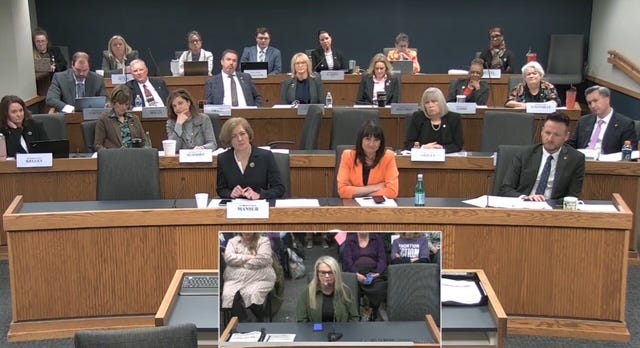
My testimony against SJR 54, Jefferson City, MO. 2/4/25.
Yesterday, I drove to the Missouri Capitol to testify against something that has already been resolved. Abortion.
I thought I would share my testimony to the committee. This was my one thing yesterday. This was my act of defiance and resistance.
Here is my testimony:
Hello. My name is Jess Piper and I am here to testify against HJR 54. This resolution is an attempt to overturn the will of Missouri voters.
The Republicans who are behind this fake resolution claim to represent rural people. They don’t and I am here to set that record straight.
I am a rural mom to five and grandmother to four. I live in Northwest Missouri and I am angry about the overreach of the Missouri GOP. I am here to testify on the disrespect – the absolute disdain – shown to every Missouri voter by some of the folks in this room.
Amendment 3 passed in Missouri. There is no reason why I had to drive eight hours round trip to testify against an abortion restriction. Why can’t you just accept the will of your constituents?
I collected signatures for Amendment 3 in some of the most rural areas of this state. Brookfield is a town of 4,000 and when I pulled up to set up my table and gather signatures, there were folks in the parking lot waiting. A woman signed her name and then texted her Bible group to remind them to come sign the amendment.
Ever heard of Marceline? The town has a population of 2,000. A woman I met in Marceline chored her animals and farm – and then came to sign the amendment in overalls and mucks.
She knew what she was signing, and I am here to give her voice. It’s hard to get your chores done and make it all the way to Jeff City to testify against legislation and your own lawmakers who won’t honor your vote or your voice.
I bet many of you know where Maryville is. We were able to get a few hundred signatures in that town. Maryville is a “huge urban space” in the middle of cornfields, population 11k. They even have a Starbucks. I sat at that coffee shop for hours one afternoon to get signatures. When I was about to pack up, a man named Gordon came in to add his name to the petition.
Gordon is 86 years old. He uses a walker and drove all the way to town and proudly signed his name to a petition to make sure his great-granddaughters would not suffer under the tyranny of an abortion ban.
I am here to remind you that lawmakers who would overturn the will of Missourians should remember they serve the folks who sent them here, and many of those folks voted to approve abortion rights in this state.
Those people include the Bible group from Brookfield and the farmer from Marceline and the great-grandfather from Maryville.
I am also here to express my disgust with the Missouri GOP. You claim to be the party of “small government” but that is a lie. You want to control books, curriculum, teachers, children’s private parts, and every uterus in the state. You overreach into the lives of Missouri citizens each day.
You can’t be the party of “small government” when your members act like tyrants. Do better.
It’s as easy as that.
Well, it wasn’t that easy — I had to drive all day to speak for 3 minutes, but it was worth every mile. They were forced to listen to someone they have tried to disenfranchise. They were forced to see my face and listen to my scathing review of their tenure. They couldn’t escape me or the dozens who testified against the resolution to ban abortion…again.
I know how hard every day is, but do one thing today.
Share an article with friends and then call your Congressional Rep to demand they hold the line with Musk. Call your Senators and demand they do the same. Call you AG and demand they stand with the American people on the biggest data breach in American history — sue Elon for stealing the data of the people of their state.
And then go outside if you can.
Don’t be paralyzed in front of the television or your phone. Doomscrolling without action will make you crazy and exhaust you. That’s the point of shock and awe.
Do one thing. And then rest.
Rinse. Repeat.
~Jess
P.S. I am so thankful for the Abortion Action group and the Missouri ACLU who planned the resistance event at the Capitol. There were so many Missourians there to oppose SJR 54, that we filled the hearing room and an overflow room. The hearing went on for several hours with testimony opposing the resolution.
This is what democracy looks like. (snip)
 Scottie's Playtime