February 5, 1830 America’s first daily labor newspaper began publication in New York City. George Henry Evans, a 29-year-old journeyman printer, was the publisher of “New York Daily Sentinel.” George Henry Evans More about George Henry Evans
February 5, 1991 49 German troops conscientiously objected to serving in Turkey during the Gulf War. The German peace movement actively supported U.S. soldiers stationed there by helping them file for conscientious objector (CO) status. By the end of the month, there were nearly 30,000 civilian COs refusing to serve in the military.
February 5, 2007 Lieutenant Ehren Watada Lieutenant Ehren Watada faced a court martial for refusing to deploy to Iraq and for publicly criticizing the war, the first officer since Vietnam to be so tried. A volunteer from Hawaii who joined the U.S. Army prior to the invasion in 2003, he had refused to serve because: “It would be a violation of my oath because this war to me is illegal in the sense that it was waged in deception, and it was also in violation of international law.” Initially having served in South Korea, he learned more about the Iraqi conflict and the bogus claims of Saddam Hussein’s possession of weapons of mass destruction. He offered to resign or serve in Afghanistan but was refused: “Mistakes can happen but to think that it was deliberate and that a careful deception was done on the American people – you just had to question who you are as a serviceman, as an American.”
February 4, 1882 American Colonization Society ship leaving New York City bound for Liberia. The American Colonization Society established the first settlement in what would become the west African state of Liberia. The new arrivals to the island called Perseverance were freeborn blacks from the U.S. who had emigrated with the encouragement of influential white Americans and funding from Congress. The colony was governed by whites for twenty years. Read more
February 4, 1987 The U.S. House of Representatives overrode President Ronald Reagan’s (second) veto (401-26) of the Clean Water Act. The law provided funds for communities to build waste treatment facilities and to clean up waterways. Reagan described it as ”loaded with waste and larded with pork.”
February 4, 1990 The Colombian government recognized native rights to half of its 69,000 square miles of forest in the Amazon River basin, home to 55,000 indigenous people. In addition to the official Spanish, as many as 200 languages or dialects are spoken among Colombia’s peoples. U’wa people Boys on the Amazon More on indigenous peoples
February 4, 1996 Start of a week of marches for peace by thousands in Grozny, the embattled capital of Chechnya.
February 4, 2004 The Massachusetts Supreme Court declared that gays were entitled to nothing less than marriage under the equal protection clause of the 14th Amendment to the Constitution. They ruled that Vermont-style civil unions would not suffice, declaring they created an “unconstitutional, inferior, and discriminatory status for same-sex couples.” The actual text of the decision in Goodridge vs. Department of Public Health
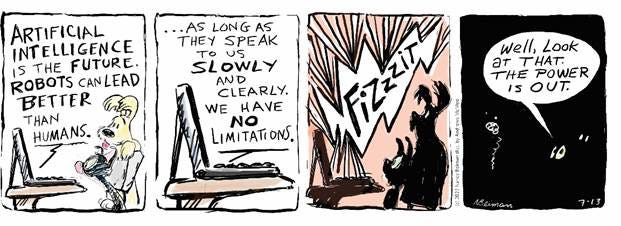
In addition to mocking people, challenging authority, and making people laugh while making others soil themselves in anger, political cartoons can be a public service. Today’s cartoon is a good example of that because every American needs to know about this shit. when I sent this cartoon to proofer Laura, she told me she was hoping I’d cover this today because it hasn’t been covered enough. Some of you, dear readers, have also posted in the comments about this issue. So, let me begin.
Elon Musk has been granted access to the Treasury Department’s payment system. What does this mean? It means Elon and his people have access to the financial information for everyone who receives payments from the federal government, including Elon’s competitors for government contracts…and even those who receive tax refunds.
This means Elon has your social security number, your date of birth, your address, your income, and if you do direct deposit with the government, he has your banking information. Elon might have your bank account and routing numbers. If you’re not pissed off yet, Elon even has access to your Social Security and Medicare accounts.
This is like the Nigerian Prince on crack.
Perhaps the only person safe from this is that survivalist living “off the grid” with a YouTube channel my little sister cites for anti-vaccine information.
David Lebryk, a top Treasury official and a non-political civil servant was put on leave and then suddenly retired on Friday after a standoff with Musk and his lieutenants. Treasury Secretary, Scott Bessent, gave Elon and his goons the keys to the car.
Elon is pretending he needs this access to monitor and stop government spending he deems unnecessary or corrupt. But again, Elon can’t approve or cancel government spending because he does NOT have that authority. Even Trump doesn’t have that authority.
Elmo attacked the Treasury Department Saturday, criticizing the department for not rejecting more payments as fraudulent or improper. Except, how does he know the payments are fraudulent or improper? Before last Saturday, Elmo didn’t even know what payments the government was making. Has he read every single contract the government has or just the billion-dollar contracts he has with the government?
Do you remember when the goons were outraged with the idea President Barack Obama was born in Kenya? Do you remember when the goons were upset over unelected bureaucrats?
The Department of Government Efficiency (DOGE) is NOT a government department, but a team within the Trump administration (sic). Some members of DOGE have been made employees of the Treasury Department which is very odd since Trump demanded a hiring freeze. Somehow, these new Treasury employees have all passed speedy background checks which I’m sure aren’t suspicious at all.
Other DOGE teams have begun demanding access to data and systems at other federal agencies.
One of the people affiliated with DOGE who now has access to the payment system is Tom Krause, the chief executive of a Silicon Valley company, Cloud Software Group, and is worth over $83 billion. He’s only “affiliated,” and not officially a part of DOGE. Trump is allowing billionaires to rifle through the Treasury. Has Tom Krause passed a background check?
Guess what! Surprise, surprise, Cloud Software Group, much like Elon’s companies, has contracts with the federal government. I didn’t read that in any stories about this issue, I traced it. Krause was the individual who pushed for access and was first resisted by Lebryk until his hasty retirement.
This is like the bank robbers demanding the code to the safe and the manager giving it to them while making them a cake.
Elon having anything to do with the government is a conflict of interest. Even the name, DOGE, is a conflict of interest and a violation of the Emoluments Clause. This shouldn’t be allowed.
The best information I can find for accountability for DOGE is that there are about 20 employees and its office is next to the White House in the Eisenhower Executive Office Building. What I can’t find but I’m sure will turn up throughout the Executive Grift, is how much DOGE is costing us.
Elon has talked about cutting $2 trillion from government spending, but it’s always always always always Republicans who do the most spending. I get to mention Dwight Eisenhower twice in this blog because he’s the last Republican president to leave a surplus. Now, here’s Elon to help Trump trim $2 trillion when it was Trump who increased our debt by over $7 trillion.
Ike sent that budget to Congress on January 25, 1960. A Republican president hasn’t sent a balanced budget to Congress since Running Bear by Johnny Preston was the number one song. See the shit I research for you? Also, Running Bear was the kind of shit we were forced to listen to before The Beatles (Elvis was in the Army and then he started a decade of those movies).
Bessent was confirmed just last week, but did he mention handing the government’s payment system over to Elon during his confirmation hearing? Since Trump didn’t mention it on the campaign trail, probably not.
Senator Ron Wyden, the top Democrat on the Finance Committee said, “I can think of no good reason why political operators who have demonstrated a blatant disregard for the law would need access to these sensitive, mission-critical systems.”
I get texts and emails from scammers all the time, but I’m pretty good at spotting them, just like I’m good at spotting fake news. Some of those scams claim a package from USPS can’t be delivered, so click this link. Another will claim my Netflix payment didn’t go through, so click this link. There’s a new one claiming you have unpaid tolls, so guess what they want you to do…click this link. Then there are those gorgeous women on Facebook leaving comments on your posts telling you that you seem like an interesting person, but their friend requests won’t go through, so please send one to them. Last year, someone sent me a check for over $6,000 for me to draw them something (that one had flies on it). But all of them can only wish to be as good of a phishing scammer as Elon.
If you’re not pissed off yet, then there’s something wrong with you.
Now, someone tell Donald Trump that Elon also has access to all his financial information too.
Creative note: This blog was written at Wegmans. I found a nice quiet spot in the corner of the dining area upstairs. The location is almost hidden. I got about two paragraphs of this blog written when a lady sat one table over from me with her pink computer and started blasting videos. It was like being the only person in a movie theater and a creeper comes in and sits next to you. Actually, I think that’s how my parents met. Dad was a creeper.
This interview appeared in a small zine, and it’s appearing here as well. Check out Charles Brubaker’s LAUREN IPSUM on this site! He does everything on paper!Read on Substack
INTERVIEW WITH NANCY BEIMAN SEPTEMBER 1, 2023
By Charles Brubaker
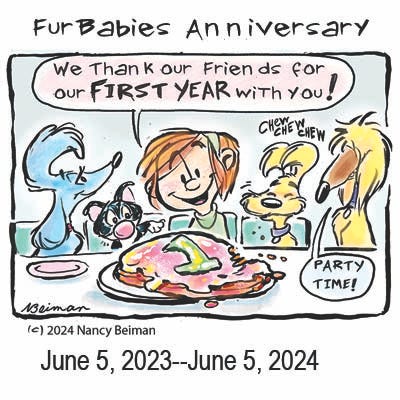
Nancy Beiman is best known for her decades-long work in animation, having animated for Warner Bros., Disney, Bill Melendez Productions, among others. However, on December 2022, at the age of 65, she ventured into a world of cartooning she hasn’t tried yet: a comic strip. The result was FurBabies, which made its debut on GoComics.com on June 5, 2023. The strip features Kate Buffet (pronounced boo-fay), an imaginative 9-year-old girl who can talk to her pets, dogs Stella and Shawm and their puppy Sirius, and Floof the kitten.
I interviewed Nancy about the comic via email. The following interview took place between August 12 to 16, 2023, and has been lightly edited for clarity.
What were your earliest cartooning influences?
My influences in animation were Chuck Jones, Charles M. Schulz, Robert Osborn, and Walt Kelly. I loved Zoltan Grgic’s work for the Zagreb animation studio. I was very fond of the UPA style but at the time did not know any of the artists’ names.
I met two of my influences and worked for one of them.
Speaking of Schulz, I remember you discussing your work on It’s the Girl in the Red Truck, Charlie Brown (1988) and how you animated Spike for it. What was your most memorable experience on that special?
Just working on a pantomime character was a liberating experience. I asked Bill Melendez who was the lead animator on Spike, and he said “You are. He’s never been animated before!” I loved using my knowledge of silent film comedy to block action on Spike. He walked like Chaplin (with those big feet) and did deadpan comedy like Keaton. He was a lot of fun to animate. That film is the most obscure of the Peanuts specials and should not be. It combined live action and animation (with the animated characters considered a ‘normal’ part of the live action world) two years before Who Framed Roger Rabbit. But CBS didn’t see any opportunity to sell toys, and it was not associated with any holiday, so they did not broadcast it until after Roger Rabbit was a hit. The Girl in the Red Truck was there first.
While you were getting started in animation did you think of doing comics? Were you published anywhere during your early days in the field?
I never considered doing comics at any time before December, 2022.
So FurBabies really is your first in the world of comics? What was the development process like? Which characters were created first?
I first got the idea for a comic strip about a kid who can talk to her pets as family members (rather than pets) in mid-December 2022. I drew up some sketches on December 24 and got Stella, Sirius, and Shawm immediately. They have changed very little since then. Kate has changed a lot. Here are the first sketches of her.
“Catt” drawn on December 24, 2022.
Floof is adapted from a cat design that I made for an unfinished film, Old Tricks. I used only the head and redesigned a kitten body. Floof has changed a bit since then. The head was that of an adult cat; she became more kittenish and cute after I drew about 10 strips. I had to go back and redraw some early Floofs when the strip was picked up by Andrews McMeel/GoComics. Kate was the hardest to create, and she was originally named Catt. She is inspired by Pippi Longstocking and a few students I have known (and they don’t know.) I had the character lineup, with Kate as Catt, on December 23, and changed her name to Katt, then Kate, on December 29. That’s when the characters were copyrighted.
Lynn Johnston saw the lineup on the 29th and instructed me to write 24 short story outlines, one sentence or so each, with dialogue. I got them done on New Year’s Eve. “You’ve got something. Can you keep this up?” Lynn asked me. I answered “Yes”. “Then draw 24 comics and let me know when they are done.” The first FurBabies comic strip, which is actually the first one on the GoComics site, was drawn on January 4, 2023. I used a 1926 Esterbrook “Radio” 914 pen nib once owned by Charles M. Schulz, on hot pressed Bristol board. It’s a gorgeous nib, but it is difficult to use a dip pen when you have inquisitive cats in a small apartment/studio. All subsequent strips were inked with a Pentel brush pen. All character art and backgrounds are drawn on paper, then scanned.
While we’re on art tools used in the comic, how big do you draw the strips? How do you color the comics?
I don’t draw ‘the strips’. I do rough scribbly thumbnail layouts for them, the most detailed are done for the Sundays. Each Sunday strip has a different layout. The characters and backgrounds are inked on paper, all of them separately. I use old animation paper or Italian hot press paper and draw a light rough, then ink with a Pentel brush pen. Characters can fill the entire page or be smaller, depending on the complexity of the drawing. I’ll do a drawing over if I don’t like the first one, and sometimes modify the scan in Photoshop. The backgrounds are often reused. I save each image as a 300dpi .bmp file and composite them on digital templates for 2, 3, or 4 panel strips. The digital dailies are 17 inches wide. Sundays are 24 inches wide. The finals are saved as TIFF files at GoComics’ recommended size…which means they are half to 2/3 of the size of the PDF files I work on. Only the first strip (June 5) was drawn with characters and backgrounds all on paper, like a traditional comic…I work much faster using animation methods. I use whatever works, the technology is not important.
Coloring is done in Photoshop using brushes that mimic pastel and watercolor wash. I work on top of the black line to continue the illusion that it was ‘painted’ on paper. Even the borders of the strip are ‘fuzzy’ and characters sometimes break through the panels. Sunday strips are designed to be graphically pleasing and planned on paper but still done piecemeal, animation style.
Sunday strip, December 10, 2023.
The writing method Lynn Johnson suggested, with 24 one-sentence outlines, is an interesting technique for plotting out comic strips. What’s your overall writing method like once you got your strip off the ground?
I continue to follow Lynn’s method. It’s not a one sentence log line: dialogue and location, sometimes action, is always included. I often change things when I actually draw the characters since I still think in visual story, like an animator. Lynn’s method is the best way to keep a comic on track. It shows you where you are going and what characters can do. You can change the script order before you draw the strips.
Like animation dialogue, scripts and action for the comic are often changed when I get down to the drawing. Short scripts are the best way to get a series going, to plan when new characters are introduced, and develop characters. Lynn also suggested that I use a monthly planner (a book with the entire month on one page) to plan and time the storylines. That was a lifesaver. Several storylines have been moved since I started drawing the strip in January and wintry themes were out of place in June.
You recently introduced Pratt-L, an AI chatbot Kate uses to cheat on her homework. Do you have concerns about the use of AI in creative fields? What was on your mind when you wrote the arc?
I tried out AI’s writing and art programs when they were available for free trial and found them completely incompetent. Pratt-L combines the worst features of both. It is the perfect villain for this strip since the main conflict is between organic lifeforms and technology. This conflict developed as I got to know Kate better. She was the hardest one to write for.
Some modern comics have child characters that never stream videos, play video games, or use cell phones. Tauhid Bondia deliberately set Crabgrass in 1985 before these things became common and life changed for children. Kate Buffet is nine years old, lives in the 21st century, grew up in the age of smartphones, influencers, and streaming videos. Kate is not lazy or stupid but has a quirky way of thinking that does not match what is expected of her, especially in school. She has a lot of curiosity and it’s only natural that she would try the new AI technology. She has the latest digital technology. I made the rest of the apartment furnishings very dated, to show the contrast between Kate and her parents. There are some subliminal messages (family friendly ones) in the backgrounds. For example, the refrigerator is a Calder, named after the artist. Pratt-L wants to be a friend, is completely incompetent, sometimes snarky, in need of constant approval and self-pitying (depending on what it is scraping), but not a dangerous threat the way it is in real life.
There will also be an ‘influencer’ in FurBabies. It will not be human.
AI is not a matter of concern; it is literally going to be a matter of life and death. There is a bill in Parliament recommending that it be allowed to write medical prescriptions in Canada. What could possibly go wrong? People are not taking it seriously as a threat because artists and writers are the first ones affected by it, and most people do not consider art to be a ‘real job’ (My Labor Day strip addresses that issue.) I am most surprised by artists who keep insisting that it is ‘a tool’ like Photoshop. There is a difference. Photoshop allows you to personally modify artwork and photos. I use my own photos for backgrounds, and I sometimes use pictures from the Web for dogs and cats, but always redraw and redesign what I see. Photoshop does not use a bot to ‘scrape’ material from a million other artists and then ‘create’ art which you claim as your own.
My biggest surprise is that some artists think that it is fun to play with it. I think that they are like rabbits admiring the scales on the snake that is about to kill them.
Pratt-L’s quotes are from an actual ‘robot press conference’ held in Zurich a few days before this strip was published.
There’s a strong “family” theme in your comic, with how Kate views her pets to Sirius and Floof referring to Stella and Shawn as their mom and dad. Will this dynamic be explored more further as the strip continues?
The animals are definitely a family. The Dog Family has accepted Floof as one of their members. Kate is a link between the Dog Family and the Human family; she can speak to both, but only one of them understands her. She knows that she really is not a Dog or a Cat. It’s an interesting dynamic, and since the characters generally ‘tell’ me what they will and will not do, I am not sure if Kate’s situation will change. I also don’t think the human parents will appear, except as offscreen character voices. It’s not that they don’t interact with Kate…I just don’t find them interesting enough to include in the strip. It’s told very much from the animals’ point of view unless Kate is in school without them.
June 5, 2024. The Dog Family.
Early in the run most of the strip focuses on Kate and her pets, although newer strips start to include more characters, like in the recent Scavenger Hunt story arc. In addition to Kate’s classmates you also had her interact with Little Fingers the raccoon. Will we see more of Kate interacting with other kids in her class, and more of Little Fingers and other animals Kate can talk to?
Optima “Poppy” Populare and Iris, the two girls on the scavenger hunt, are not interesting enough to do much more than snark. “Poppy” returns in school and in some Halloween strips. There will probably be a few more kids appearing later on, with their own pets, probably in the dog park or maybe in the apartment building. Little Fingers the raccoon returns in November, but he’s a wild raccoon. He won’t ever interact with the other animals.
You indicated in your newsletter that you have a backlog for your comic. How far ahead are you currently?
I am currently working on strips that will air in October. I am proud to say that not one of them involves a pumpkin! (Charles M. Schulz covered that territory very well.) I like to stay about two weeks ahead of deadlines, and originally was two months ahead due to the late start in 2023! That gave me the option of shifting the cartoons, or changing them, as I got to know the characters better. I can also take a week off without worrying about comics not appearing.
Since FurBabies is still a very new comic and I am still redefining myself as a comic strip creator, I moved story lines or reworked some existing strips after I had enough comics that showed the characters’ developing personalities. Some people who have seen months of the strips in continuity tell me that they read better ‘as a whole’ but that is not the way comics work; it’s taken one day at a time. FurBabies is not a ‘gag’ strip, it’s character driven, so there were a lot of changes. Some of the cartoons that ran in June were originally drawn for September.
Things are settling down now. Some readers are adjusting to the fact that Kate is not a ‘perfect’ little girl, she sometimes tries to cheat on homework with AI (and gives up), or that she can be a distraction in class. I finally figured out who she was when she took her burned cookies and sold them as dog biscuits. Kate makes plenty of mistakes, but she has a creative way of dealing with them.
Historic lesbian activist Sally Gearhart is featured in Deborah Craig’s new award-winning documentary Sally!
Most people have heard of Harvey Milk. Sally Gearhart—not as much. But in fact, Gearhart sat right beside Milk as his debate partner in 1978 when they disputed—and ultimately defeated—Proposition 6, the Briggs Initiative that would have banned lesbian and gay teachers and topics in California’s public schools. When their opponents quoted the Bible, Milk was at a loss. Gearhart, on the other hand, could quote it right back at them. Born in 1931 into a Christian household in Virginia, Gearhart charted her own unconventional path from a career as a teacher at Christian colleges in Texas until she determined …
February 3, 1816 Paul Cuffee, a shipowner and a free negro (born to slave parents in Massachusetts), arrived in Sierra Leone with 38 African Americans intent on setting up a colony for free blacks from the United States. He had earlier set up the Friendly Society of Sierra Leone, a trading organization, to encourage commerce between England, the U.S. and the British colony on the Atlantic coast of Africa.
February 3, 1893 Abigail Ashbrook of Willingboro, New Jersey, refused to pay taxes because she was denied the right to vote because she was a woman.
February 3, 1964 In New York City, more than 450,000 students, mostly black and Puerto Rican, comprising nearly half the citywide enrollment, boycotted the New York City schools to protest the system’s de facto segregation. The Parents’ Workshop for Equality, led by Reverend Milton Galamison, had proposed a plan to integrate the city’s schools but it was rejected by the school board. Freedom Schools were set up for the kids during the one-day direct action.
February 3, 1973 Three decades of armed conflict in Vietnam officially ended when a cease-fire agreement signed in Paris the previous month went into effect. Vietnam had endured almost uninterrupted hostility since 1945, when a war for independence from France was launched. A civil war between the northern and southern regions of the country began after the country was divided by the Geneva Convention in 1954 following France’s military defeat and troop withdrawal. American military “advisors” began arriving in 1955. Between 1954 and 1975, 107,504 South Vietnamese government troops, approximately 1,000,000 North Vietnamese and National Liberation Front soldiers, and 58,209 American troops died in combat. The number of Vietnamese civilian deaths is unknown, estimated between one and four million killed, and millions more wounded or affected by defoliants such as Agent Orange.
February 3, 1973 President Richard Nixon signed the Endangered Species Act, intended to avoid species extinction, especially through loss of habitat.
February 3, 1988 The U.S. House of Representatives rejected President Ronald Reagan’s request for at least $36.25 million in aid to the Nicaraguan Contras, an insurgent group trying violently to overthrow the Sandinista government.
February 3, 1994 President Bill Clinton lifted the trade embargo against Vietnam, which had been in place since the end of the Vietnam war.
In the mid-1800s, Ida Lewis’s daring sea rescues became a media sensation, leading to hundreds of telegrams, gifts, and marriage proposals. All Ida wanted to do was tend to her lighthouse.
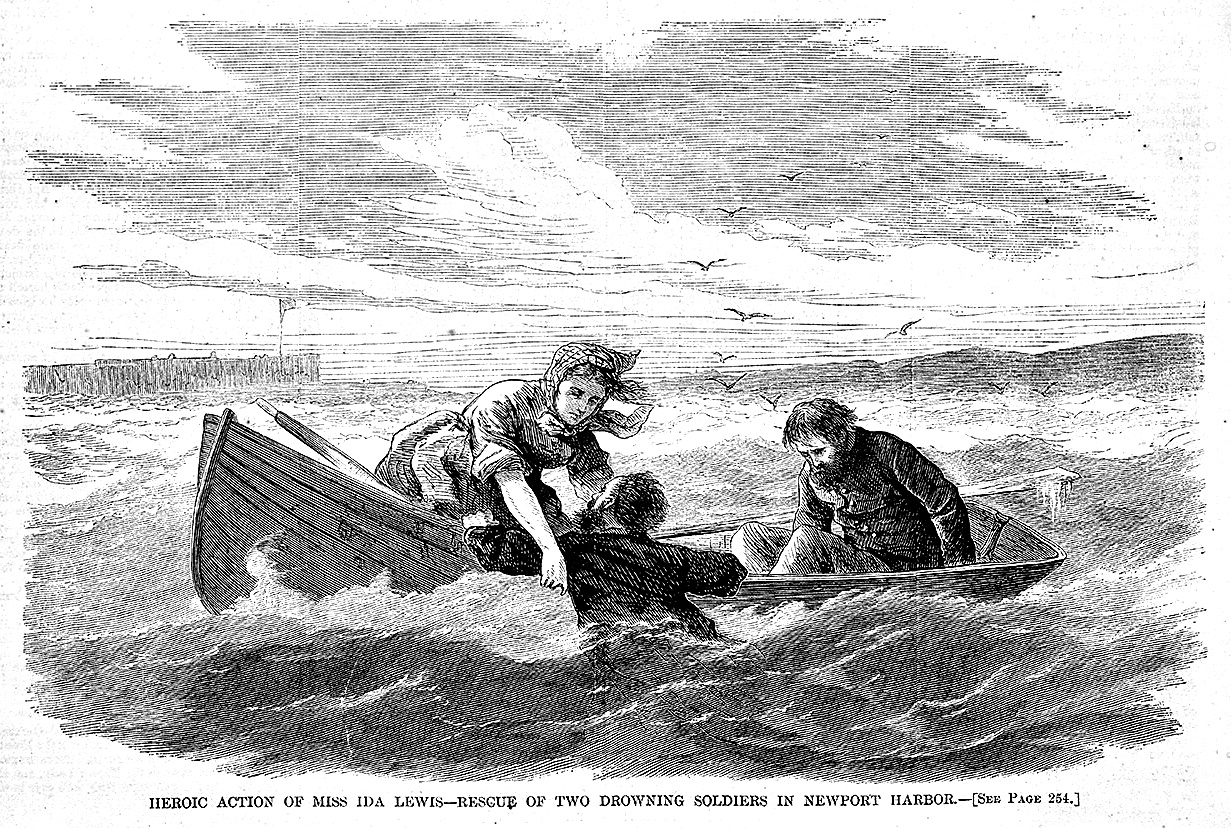
The events that led to Ida Lewis being called “The Bravest Woman in America” began on the blustery night of March 29, 1869, on Lime Rock Island, after her mother Zoradia spotted two men clinging to an overturned boat in the churning waves and screaming for help. “Ida, O my god! Ida, run quick! A boat has capsized, and men are drowning. Run quick, Ida!” she yelled to her daughter.
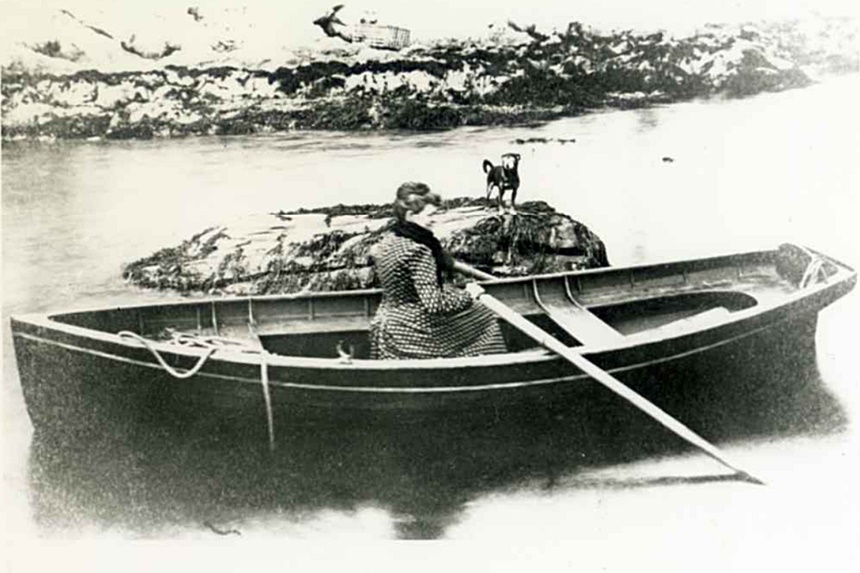
Ida and her younger brother Hosea immediately ran out of the house and jumped into a small skiff. Taking the icy oars, she rowed against a high wind to rescue the drowning men. Despite the freezing, wintery weather, she and Hosea lifted the choking men into the skiff, rowed them back to shore, and brought them into their home. The men were soldiers from nearby Fort Adams. As told in Lighthouse Keeper’s Daughter, Sergeant James Adams was barely able to “totter up to the house” and Private John McLoughlin was unconscious, but once revived and fed both recovered. Later, Sergent Adams told Ida’s other brother, Rudolph, “When I saw the boat approaching and a woman rowing, I thought She’s only a woman and she will never reach us. But I soon changed my mind.”
Illustration of Ida Lewis rescuing Sergeant James Adams and Private John McLoughlin, from the April 17, 1869, issue of Harper’s Weekly (Mariner’s Museum)
That was not the first time Ida had saved lives. By then she had already rescued three schoolboys and two other groups of men from drowning; during one rescue, Ida had saved four men whose boat had capsized in Newport Harbor. She was only twelve.
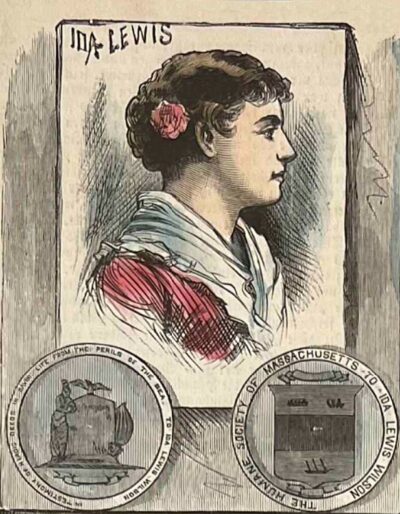
The New York Tribune’s story on Ida Lewis from their April 12, 1869 issue (Library of Congress)Illustration of Ida Lewis from Frank Leslie’s Illustrated, November 1881 (Newport Historical Society)
But her rescue of 1869 was so improbable that reporters flocked to Newport to interview her. On April 12, the New York Tribunecarried Ida’s story, followed by articles in Harper’s Weekly and Frank Leslie’s Illustrated Newspaper, which printed an etching of Ida’s pleasant face, strong features and wide-set hazel eyes. Adding to the story’s sensationalism was her weight of 103 pounds. Readers were riveted and soon besieged Ida with hundreds of telegrams, phone calls, gifts, and marriage proposals.
Shy and modest, Ida recoiled from the attention. When asked what motivated the rescue, she explained it as a moral obligation. “If there were some people out there who needed help, I would get into my boat and go to them even if I knew I couldn’t get back. Wouldn’t you?”
Readers were so overwhelmed by her courage that they collected funds to honor her. On July 4, 1869, in a public ceremony in Boston, they paraded a magnificent rescue boat through the streets, which was then presented to Ida. Among the audience were politicians and military leaders like Ulysses S. Grant, General Tecumseh Sherman, and Admiral George Dewey along with many wealthy Gilded Age summer residents of Newport who were then building estates along the shore. To the audience’s disappointment, she refused to address the crowd, leading prominent abolitionist Colonel Thomas Wentworth Higginson to explain, “Miss Lewis desires me to say that she has never made a speech in her life and…doesn’t expect to begin now.”
Later that summer, women’s rights leaders Susan B. Anthony and Elizabeth Cady Stanton visited Newport and met Ida, whom they cited as a “young heroine” and an example of women’s unsung abilities.
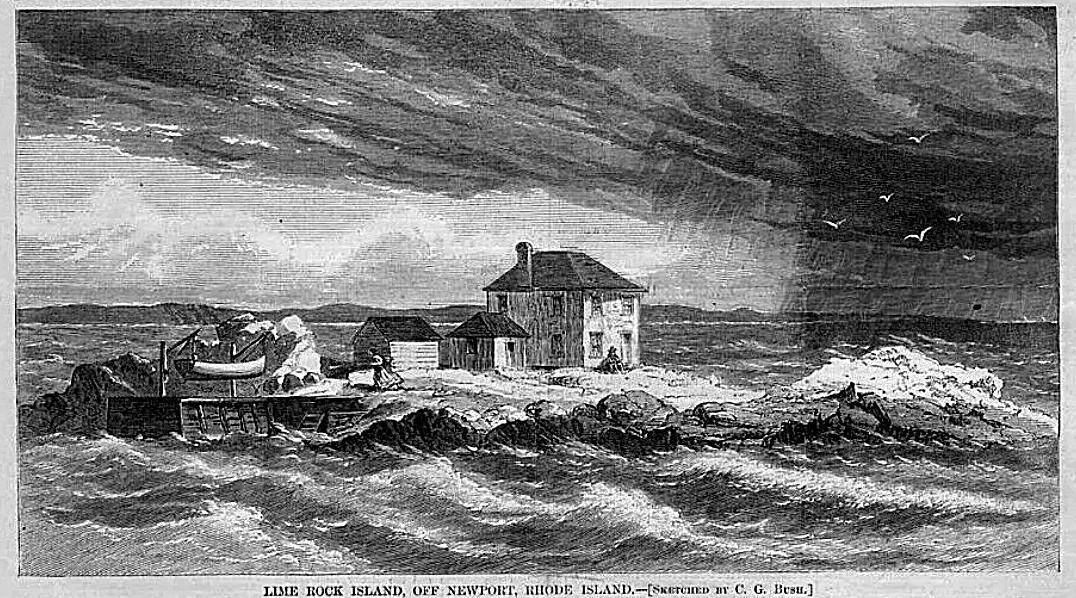
Born on February 25, 1842, Idawalley Zoradia Lewis was the oldest of the four children of Zoradia and Captain Hosea Lewis of the Revenue Cutter Service, the forerunner of the U.S. Coast Guard. In 1854 after the Lighthouse Service appointed Ida’s father as keeper, young Ida routinely sailed with him from Newport to Lime Rock Island to help maintain the light. Three years later when a house was built on the island and the light relocated there in a special second floor “lanthern” room, the Lewises moved to Lime Rock. Tragedy struck four months later when Ida’s father suffered a paralytic stroke, forcing her mother Zoradia to assume his keeper duties.
Illustration of Lime Rock Island from Harper’s Weekly, July 31, 1869 (Wikimedia Commons)
By then everyone in the family knew Ida was dependable, had unusual strength, and was a skilled sailor. Her brother Rudolf bragged, “Ida… can hold one to wind’ard in a gale better than any man I ever saw, wet an oar, and yes do it too when the sea is breaking over her.” Consequently, after her father’s stroke, she rowed her siblings to school and returned to the island with supplies from Newport.
Over the next 14 years, Ida helped her mother tend the light until her father died in 1877. A year later, Zoradia, who was ill with cancer, also died, leaving Ida to serve as keeper, maintain the family home, and care for a frail sister.
Being a lighthouse keeper was demanding. It was a job traditionally done by men. The beacon came from an oil-burning lantern housed in a wooden or iron frame surrounded by thick panes of glass. A solid wick suspended from the top of the frame enabled the oil (which needed to be refilled two or three times a night) to burn through the darkness. A Fresnel lens 17 inches tall and 11 ¾ inches in diameter reflected the burning oil, its light beaming far out beyond Newport Harbor. Every evening before dusk Ida trimmed the wick and adjusted the glass vents of the lens to create a proper draft. During the day, she cleaned the delicate panes of the lens, inspected and cleaned parts of the lantern, and removed carbon and other impurities. Those duties had to be performed carefully. If not, and the beacon failed, the lives of sailors at sea could be endangered.
Since Ida never kept records, no one knows how many rescues she achieved. Besides the famous 1869 rescue, several others were well known. The first occurred on a February 1866 night when she pulled three drunken soldiers from the waters after they “borrowed” her brother’s skiff and capsized it. The second happened the next January when three farmhands herded one of tycoon August Belmont’s prize sheep down Newport’s Main Street. Unexpectedly, the animal bolted and plunged into the harbor. Panicked, the trio jumped into Ida’s brother’s skiff to capture it but then overturned the boat. Again, Ida leapt into her own skiff and saved the drowning men whose hands were so numb from the frigid water that they barely grasped the sides of the capsized hull.
In 1870 Ida was officially appointed the Lighthouse Keeper of Lime Rock and awarded a salary of $750 per year (about $17,000 today). That same year she married Captain William Heard Wilson but became so unhappy that she soon left him and returned to her duties at Lime Rock Lighthouse.
Later, she rescued two more soldiers from Fort Adams who had fallen through the ice, prompting the United States government to award her the Gold Lifesaving Medal in 1881. Decades later, in 1907, Congress bestowed the first American Cross of Honor upon the aging Ida.
But awards, even national ones, meant little to her. “The light is my child and I know when it needs me, even if I sleep,” she once said. It was only when Ida died at age 69 on October 24, 1911, that her light finally went out.
February 2, 1779 Anthony Benezet and John Woolman, both prominent Quakers (Society of Friends), urged refusal to pay taxes used for arming against Indians in Pennsylvania. Since William Penn established the state two generations earlier, the Friends had dealt with the Indian tribes nonviolently, and had been treated likewise by the native Americans. Benezet and the Quakers were also early and consistent opponents of slavery. More about Anthony Benezet
February 2, 1848 The Treaty of Guadalupe Hidalgo was signed in the Mexican city of the same name, ending the Mexican War. In 1845 Congress had voted to annex Texas, and President James K. Polk sent General Zachary Taylor and troops to patrol the border, newly defined by Congress as the Rio Grande, though it previously had been the Nueces River. Following an encounter between Mexican and U.S. troops, Polk called for Congress to declare war on Mexico. General Winfield Scott and troops eventually seized Mexico City.The treaty’s provisions called for Mexico to cede 55% of its territory (present-day California, Nevada and Utah, New Mexico, most of Arizona, and portions of New Mexico, Wyoming and Colorado), and to recognize the Rio Grande as the southern border of Texas, in exchange for fifteen million dollars in compensation for war-related damage to Mexican property. According to the treaty, U.S. citizenship was offered to any Mexicans living in the 500,000 sq miles (1.3 million sq km) of new U.S. territory. Land ceded to the U.S. after the Mexican War. The Treaty of Guadalupe Hidalgo
February 2, 1931 The first of well over 400,000 Mexican-Americans from across the country, some of them citizens and many of them U.S. residents for as long as 40 years, were “repatriated” as Los Angeles Chicanos were forcibly deported to Mexico. More on those deported, Los Repatriados
February 2, 1932 The Conference on the Reduction and Limitation of Arms, the world’s first disarmament meeting, opened in Geneva, Switzerland. Sponsored by the League of Nations, and attended by delegates from 60 nations, no agreement was reached. The U.S. delegation called for the abolition of all offensive weapons as the basis for negotiations but found little support.
February 2, 1966 The first burning of Australian military conscription papers as a protest against the Vietnam War occurred in Sydney, Australia.
February 2, 1970 Bertrand Russell later in life Bertrand Russell, mathematician, Nobel laureate in literature and philosopher of peace, died in Penryndeudreaeth, Merioneth, in Wales at age 97. Bertrand Russell at age 10 “Patriots always talk of dying for their country but never of killing for their country.” — Bertrand Russell More of Russell’s wisdom
February 2, 1980 Reports surfaced that the FBI had conducted a sting operation targeting members of Congress. In what became known as ”Abscam,” members suspected of taking bribes were invited to meetings with FBI agents posing as Arab businessmen, offering $50,000 and $100,000 payments for special legislation. Audio and video recordings of the meetings were made surreptitiously. Six members of the house were convicted of accepting bribes. Another member of the House and one senator were targeted but took no money. FBI agents in Abscam sting operation Actual FBI videotape of one attempted scam
February 2, 1989 Soviet participation in the war in Afghanistan ended as Red Army troops withdrew from the capital city of Kabul. They left behind many of their arms for use by Afghan government forces. They were driven out principally by the insurgent mujahadin, armed through covert U.S. funding. Read more “Charlie Wilson’s War” movie trailer
February 2, 1990 South African President F.W. De Klerk unbanned (lifted the legal prohibition on) opposition parties: the African National Congress (ANC), the Pan-Africanist Congress and the South African Communist party were officially considered legal. He also announced the lifting of restrictions on the UDF, COSATU and thirty-three other anti-apartheid organizations, as well as the release of all political prisoners and the suspension of the death penalty. This was the result of his negotiations with the imprisoned Nelson Mandela, a leader of the ANC. The ecstatic reaction to De Klerk’s beginning the end of apartheid on BBC video
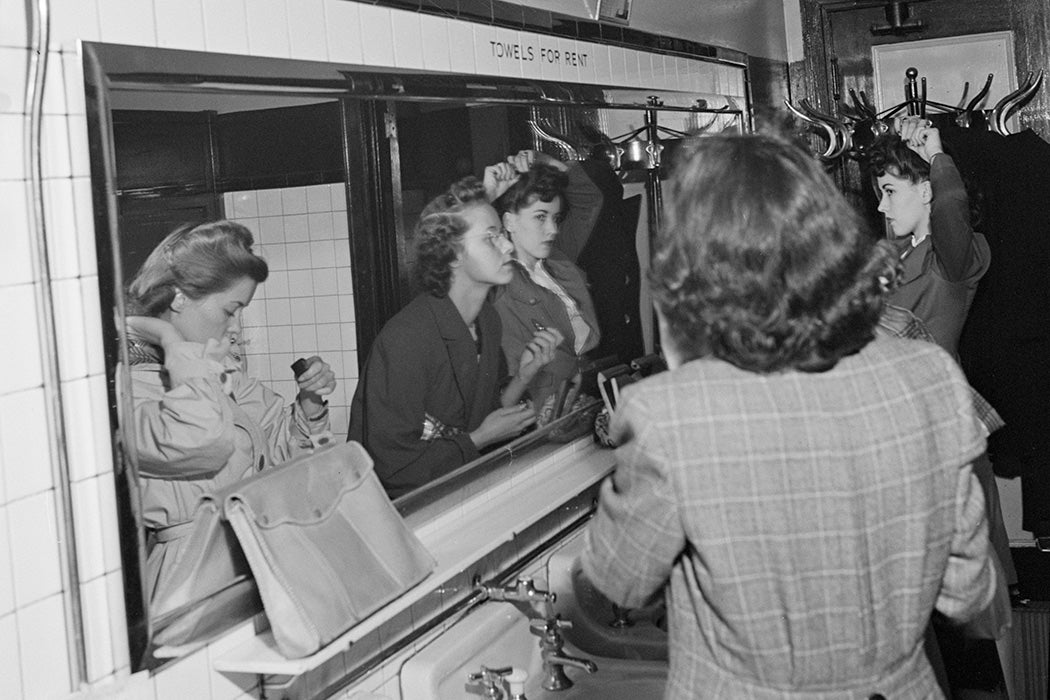
Women’s entry into public life around the turn of the twentieth century was a major catalyst for the creation of sex-segregated public restrooms. As scholar Daphne Spain writes, female civic reformers lobbied municipal governments to make cities more inclusive places for women, pushing for amenities such as health clinics and kindergartens. And in both small towns and big cities, notes historian Peter C. Baldwin, women worked to ensure the availability of public toilets. The first gender-segregated public bathrooms afforded women privacy, safety, and autonomy—if, that is, the women were white and of means; otherwise, access to bathrooms served as a tool of segregation. The history of the women’s bathrooms in the United States is a story of who does—and who doesn’t—get to belong in public life.
The first public bathrooms in the United States appeared in the late 1800s. Pub owners offered them to paying customers to drum up business and keep drinkers drinking. But, as Baldwin notes, pubs and saloons were improper, unwelcoming, and sometimes dangerous environments for women, and were effectively male-only establishments whose facilities only catered to men.
Just a few decades later, according to Spain, women had begun to challenge their “proper place” in society. While middle- and upper-class women increasingly ventured out of the home into the burgeoning urban environment to shop and to socialize, their lower-class counterparts increasingly found work in factories and other non-domestic environments where they could earn their own money. And some, many of whom belonged to the upper classes, forced their way into political and civic life, lobbying for, and winning, suffrage. Changing social stations pushed women and men together in public. They shared sidewalks, transportation, parks, stores, and restaurants. Women entered public life, and standards of decorum shifted to accommodate them, though certainly not to include them—gender segregation became a paramount concern, according to Baldwin, for preserving the modesty and propriety of women. Still, a dramatic shift had occurred: Men no longer wielded a monopoly on public life.
In the absence of an available pub bathroom, men were accustomed to relieving themselves in the street. Not only did that suddenly seem crass in mixed company, but the new science of germ theory made it clear that using the city as a toilet posed a health hazard, Baldwin says. Urban designers, physicians, and civic groups lobbied municipal governments in Chicago, Boston, New York, and elsewhere to provide a sanitary solution to the problem of human waste.
The first public toilets, euphemistically called “comfort stations,” appeared in American cities in the 1890s, according to Baldwin. By 1919, roughly one hundred cities, including Denver, Cleveland, Detroit, Philadelphia, and Seattle made toilet facilities available to the public for free or a small fee. Some were funded by health-minded philanthropists and reformers concerned not only with physical cleanliness, but “moral cleanliness,” writes sociologist Alexander K. Davis. They believed the two were intrinsically linked.
Comfort stations were gender segregated but not gender equal. While men were afforded the opportunity to take care of their most basic needs—the need to relieve themselves—women were not given the same. Women’s facilities were often smaller and had fewer toilets than the men’s, writes Baldwin, and were consistently inferior to the semi-private “customers only” bathrooms available in the “Adamless Eden” of a department store, as one such store owner Spain quotes called them; these were available only to patrons.
For those women denied the privilege of department store entry owing to race or lack of means, the comfort station was the only option for getting some privacy in public. Businesses, manufacturing plants, offices, and government buildings almost entirely lacked gender-segregated bathrooms, and because it was scandalous for a woman to enter a bathroom that men used, the lack of women’s toilets sent a clear signal about who was and wasn’t welcome in a particular space. Without equitable access, women were not able to fully participate in life outside the home. If you can’t empty your bladder or your bowels with dignity, it’s hard to be away from home for long.
Public stations were expensive to maintain and quickly became dirty and malodorous. Many were underground or in secluded areas and were dangerous for female users. Baldwin points out that by the early 1920s, cities cut budgets and patrons abandoned the cause, so stations fell into disrepair almost as soon as they appeared, and some of the same women’s groups that had petitioned for their creation eventually pressed for their closure. The provision of bathrooms became largely the remit of private business owners who could provide or restrict access as they pleased.
Women’s restroom at the Arizona Biltmore in Phoenix, AZ, 1930s via Wikimedia Commons
Though the truly public bathroom—where access is free to all—is increasingly rare today, the semi-public toilet is taken for granted. The ladies’ room in restaurants, bars, airports, train and bus stations, hotel lobbies, schools, and event venues remains one of the few spaces where men are strictly prohibited. Though many are accessible only to those who can patronize a business or afford a ticket for travel.
It’s such an important part of female culture that the women’s bathroom is a convenient prop in movies, TV, and books. Writers set a scene in the ladies’ room, where women gather to complain, cry, confide, confess, gossip, preen, or bully. And though such scenes sometimes lean on tired tropes of female behavior, the gender-segregated bathroom is a place to exist beyond the gaze and reach of men. Here, women speak candidly about feelings, bodies, periods, sex, romantic partners, friends, jobs, and family.
“They offer a space for bonding, the exchange of information, and personal recovery,” writes scholar Christine Overall. “Sex-segregated toilets provide ‘the element of sociability important to many women, who also use the women’s room as a refuge, ‘a place to feel safe, both physically safe but also psychologically safe.’” On the wall and in stalls, it’s not uncommon to see phone numbers for domestic violence helplines or, in bar bathrooms, instructions for ordering an “angel shot”: a coded way to ask a bartender for help in the face of harassment.
Of course, the ladies’ room by design isn’t a safe space for all women.
“At various points in US history, the absence of toilet facilities has signaled to [B]lacks, to women, to workers, to people with disabilities, to transgender people, and to homeless people that they are outsiders to the body politic and that there is no room for them in public space,” writes the feminist scholar Judith Plaskow. If these bathrooms are supposedly for the public, then by virtue of excluding certain people, the message is that their needs are not for consideration.
Access to public space in the US has even been explicitly exclusionary. When the Boston-based advocacy organization Women’s Educational and Industrial Union pressed for the creation of health clinics and lunch rooms in the early twentieth century, it made it clear that their goal was to segregate classes and create spaces, Spain explains, where only “middle-class and elite women could appear without being declassed and working women could appear in public without having their virtue questioned by being ‘on the streets.’”
In the Jim Crow south, writes Baldwin, Black women had to use separate bathrooms, typically older and poorly maintained, and were not afforded the privacy of gender-segregated facilities. In some cases, Black people in the segregated South had no access to public bathrooms at all.
Now, the current campaigns of exclusion seek to bar transgender women from accessing the ladies’ room. In 2016, the North Carolina state legislature passed “the bathroom bill,” which forced people to use the bathroom that corresponds to the gender they were assigned at birth. The next year, eight more states moved to impose similar restrictions. North Carolina’s bill was met with such anger on behalf of the LGBTQ community that some elements were quickly scrapped, and the remainder was left to lapse in 2020. While campaigns for equity have made such laws and restrictions exceedingly unpopular, they have not yet made them extinct.